
Swollen penis is a symptom, not a diagnosis, and the cause ranges from a harmless reaction to soap to a surgical emergency. Most cases come from inflammation of the head of the penis (balanitis), an allergic or irritant reaction, or a minor injury after sex, and they settle with simple care within days. A few causes, such as a foreskin trapped behind the glans (paraphimosis), a “snapped” erection (penile fracture), an erection that will not go down (priapism) or a rapidly spreading infection, need emergency treatment the same day. This guide walks through the 12 most common causes, the red flags that separate them, and what a urologist does about each.
Sources: Primary Care Dermatology Society — Genital oedema: an overview; NHS — Balanitis
- The most common reasons for a swollen penis are balanitis (inflammation of the glans, usually from yeast, poor hygiene or irritants), contact allergy to condoms, lubricants or soap, and minor friction injury after vigorous sex.
- Four causes are emergencies: paraphimosis (foreskin stuck behind the head), penile fracture (a pop and instant loss of erection during sex), priapism (an erection lasting more than 4 hours) and Fournier’s gangrene (painful, spreading swelling with fever). Go to an emergency department rather than waiting.
- A painless, firm cord just behind the head that appears after sex is usually sclerosing lymphangitis or Mondor’s disease; both are self-limiting and resolve over weeks with rest.
- A swollen penis that started after a new blood-pressure tablet may be ACE-inhibitor angioedema, which does not itch and needs the drug stopped; long-standing, painless, thickened swelling is usually lymphedema and needs a specialist, not antibiotics.
- What a swollen penis means and what it looks like
- Swollen penis causes: the 12 most common
- Swollen penis emergencies: paraphimosis, fracture, priapism and Fournier’s gangrene
- Infection and inflammation: balanitis, cellulitis and STIs
- Allergic reactions and angioedema
- Swelling after sex, masturbation or surgery
- Chronic swelling: penile lymphedema and fluid retention
- When to see a doctor about a swollen penis
- How a swollen penis is diagnosed and treated
- FAQs about a swollen penis
What a swollen penis means and what it looks like
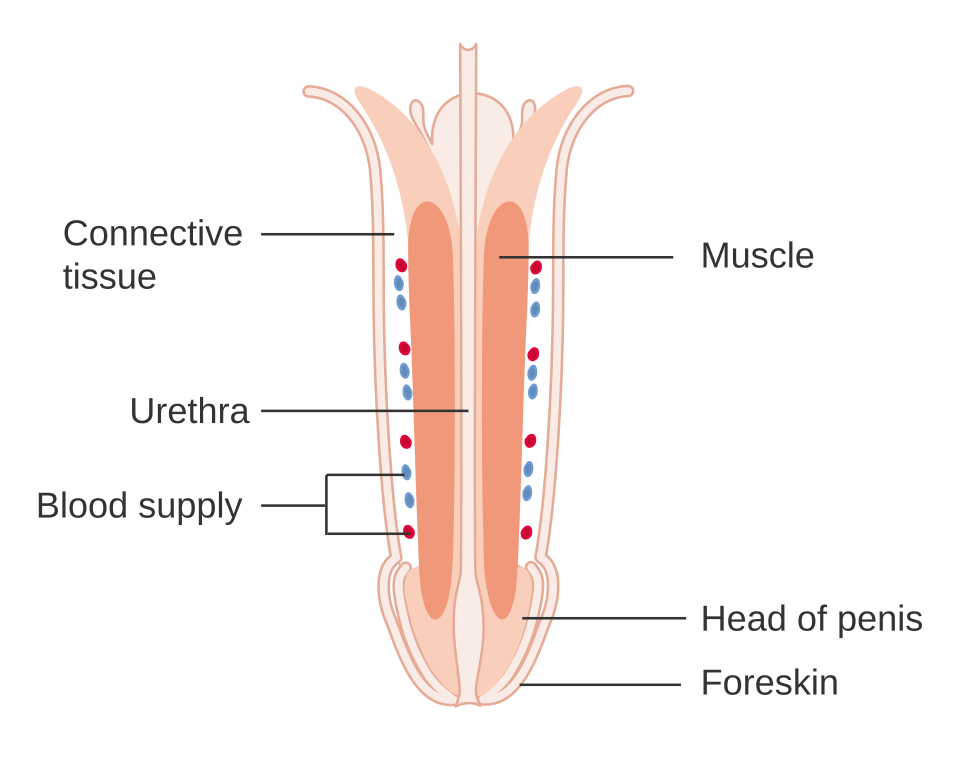
Swelling (edema) is fluid collecting in the tissues. In a swollen penis that fluid can sit in the loose skin of the shaft, in the foreskin, in the glans, or deeper inside the erectile chambers, and where it sits is the first clue to the cause. The penile skin is thin and elastic with very little fat beneath it, so even a small amount of fluid, blood or inflammation produces visible puffiness quickly, and the foreskin can balloon dramatically because it is a double fold of that same loose skin.
Doctors sort a swollen penis by three questions. Is it acute (hours to days) or chronic (weeks to months)? Is it painful, red and warm (inflammation or infection) or soft, pale and painless (fluid or lymph)? And is it diffuse across the shaft or localised to the head, the foreskin or a single cord-like line? Generalised fluid retention from heart, kidney or liver disease usually shows first in the feet and legs but can involve the whole body, so a swollen penis in a man who is also swollen elsewhere points to a systemic cause rather than a local one.
Sources: MedlinePlus (NIH) — Edema; Primary Care Dermatology Society — Genital oedema: an overview
Swollen penis causes: the 12 most common
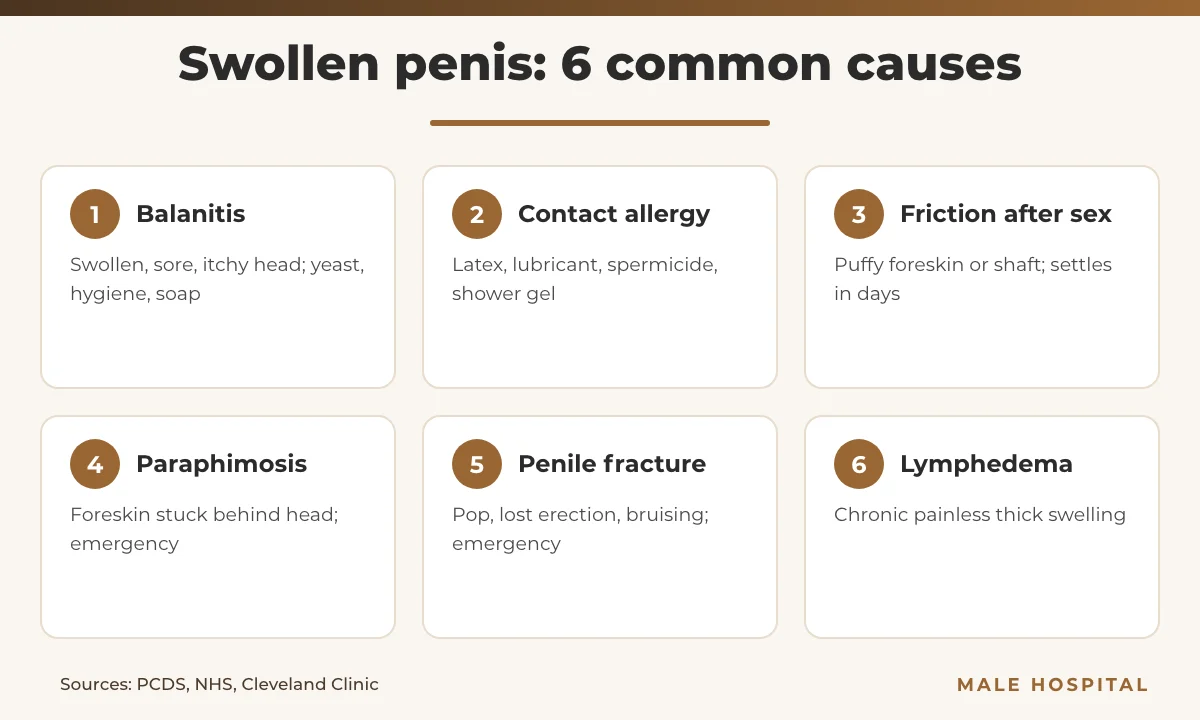
The Primary Care Dermatology Society groups the causes of a swollen penis and other genital swelling into inflammatory and allergic causes, angioedema, infection, drug reactions, lymphoedema, vascular causes and urological emergencies. In practice the list looks like this:
- Balanitis and balanoposthitis: inflammation of the glans, with or without the foreskin, usually from yeast, retained smegma, soap or an STI. The head is swollen, sore and often itchy.
- Irritant or allergic contact dermatitis: latex condoms, lubricants, spermicides, shower gels and topical creams can all produce an eczematous, oedematous or even blistering reaction.
- Friction injury after sex or masturbation: temporary puffiness of the foreskin or shaft skin from prolonged or vigorous activity, including overuse of a vacuum pump.
- Paraphimosis: the foreskin is pulled back and cannot return, so it forms a tight ring that traps fluid in the glans. An emergency.
- Penile fracture: a tear of the tunica albuginea during an erection; blood pools under the skin and the shaft swells and bruises within minutes. An emergency.
- Priapism: an erection lasting more than 4 hours; the shaft is rigid and increasingly painful. An emergency.
- Cellulitis and Fournier’s gangrene: bacterial infection of the skin or deeper tissue, with hot, tender swelling and often fever.
- Sclerosing lymphangitis: a painless, firm cord around the groove behind the head, typically after vigorous sex.
- Penile Mondor’s disease: a painful cord along the top of the shaft from a clot in the superficial dorsal vein.
- Angioedema: transient deep swelling from an allergic trigger, a hereditary disorder or ACE-inhibitor blood-pressure tablets.
- Penile lymphedema: chronic, thick, painless swelling when lymph drainage is blocked by infection, surgery, radiotherapy, Crohn’s disease or hidradenitis suppurativa.
- Swelling after circumcision or penile surgery: expected for 1 to 2 weeks, abnormal if it worsens, becomes hot or is accompanied by fever.
Less common causes of a swollen penis include fixed drug eruptions (a round swollen patch that returns in the same place every time a particular medicine is taken), venous outflow obstruction, Henoch-Schönlein purpura in boys and, rarely, a tumour. A rash on the swollen skin narrows the list further; our guide to penis rash covers those patterns.
Sources: Primary Care Dermatology Society — Genital oedema: an overview; Cleveland Clinic — Balanitis; NHS — Circumcision in men
Swollen penis emergencies: paraphimosis, fracture, priapism and Fournier’s gangrene
Four causes of a swollen penis can cost tissue, erectile function or, in one case, life if treatment is delayed by hours. Each has a recognisable pattern.
Paraphimosis: foreskin trapped behind the head
Paraphimosis happens when the foreskin of an uncircumcised or partly circumcised man is pulled back and cannot be brought forward again. The retracted foreskin acts as a constricting band, so the glans and the foreskin just behind it swell into a painful “doughnut”, and the head may turn blue, purple, black or brown as circulation is cut off. It affects roughly 1% of uncircumcised males aged 16 and over, most often boys and older men, typically after the foreskin is left retracted following washing, urination, sex or a urinary catheter.
The NHS classes this type of swollen penis as a medical emergency because blood flow to the tip is restricted, and it does not resolve on its own. A doctor compresses the glans to squeeze out the fluid and slides the foreskin forward; if that fails, a small release cut (dorsal slit) or a circumcision is done. Ice is not recommended because it worsens blood flow. Treated promptly, the outcome is excellent; our dedicated paraphimosis article explains the reduction technique and aftercare.
Sources: Cleveland Clinic — Paraphimosis; MedlinePlus (NIH) — Paraphimosis; NHS — Tight foreskin (phimosis and paraphimosis)
Penile fracture: a pop, then rapid swelling and bruising
A penile fracture is a tear in the tunica albuginea, the tough sheath around the erectile chambers, caused by bending an erect penis too far; about 60% of cases occur during intercourse when the penis slips out and strikes the partner’s pubic bone or perineum. The man hears a cracking or popping sound, has sudden intense pain and loses the erection immediately; swelling of the shaft develops quickly as the haematoma enlarges, and bruising can spread to the scrotum and lower abdomen, the “eggplant” appearance. Blood at the tip or in the urine signals a urethral injury, which complicates roughly 15% of fractures (range 1 to 38%).
The European Association of Urology strongly recommends surgical repair of the tunica, ideally within 24 hours, and BAUS advises not delaying surgery for imaging when the diagnosis is clear. Conservative management has been followed by fibrosis or angulation in 35% of men and erectile dysfunction in up to 62%, versus 2.8% curvature and 1.9% erectile dysfunction after repair. Our penile fracture guide covers the surgery and recovery.
Sources: EAU Guidelines — Urological Trauma: Urogenital trauma; BAUS — Penile fracture; Cleveland Clinic — Penile Fracture
Priapism: a rigid, painful erection that will not go down
Priapism is an erection lasting more than 4 hours that continues beyond, or is unrelated to, sexual stimulation. In the common ischemic (low-flow) type the shaft is rigid and increasingly painful while the glans stays soft, because trapped blood starves the erectile tissue of oxygen. The American Urological Association calls it a medical emergency: smooth-muscle damage may begin as early as 6 hours, more than half of men with episodes lasting 24 to 48 hours were left with permanent erectile dysfunction, and no recovery was seen after 36 hours. First-line treatment is aspiration of blood plus an injection of phenylephrine, with a surgical shunt if that fails. The NHS advises an emergency department after 3 to 4 hours, or 1 hour in sickle cell disease, the most common associated condition; erectile dysfunction drugs, some antidepressants, warfarin, cannabis and cocaine are other triggers. Read more in our priapism article.
Sources: AUA — Acute Ischemic Priapism Guideline; NHS — Priapism (painful erections); Cleveland Clinic — Priapism
Fournier’s gangrene: spreading infection with fever
Fournier’s gangrene is an aggressive, polymicrobial necrotising infection of the perineum and genitals. It usually starts as painful swelling of the scrotum or perineum with small dark patches of skin surrounded by redness and oedema; crackling under the skin (crepitus) and a foul discharge appear as it advances, but in up to 40% of cases the onset is insidious. Diabetes and malnutrition are the main risk factors, with recent urethral or perineal surgery and obesity adding risk, and large US registries report mortality of 5 to 10%. The EAU recommends broad-spectrum antibiotics on presentation and surgical debridement within 24 hours, so a hot, rapidly spreading swollen penis or scrotum with fever is an emergency.
Source: EAU Guidelines — Urological Infections (Fournier’s gangrene)
Infection and inflammation: balanitis, cellulitis and STIs
Balanitis
Balanitis is the single most common reason a man notices a swollen penis. The head is swollen, itchy and sore, usually red (less obvious on brown or black skin), sometimes with a thick discharge under the foreskin, an unpleasant smell, bleeding around the foreskin or burning when urinating. It mostly affects uncircumcised men, and the usual drivers are poor hygiene under the foreskin, yeast (thrush), a tight foreskin, irritation from soap or condoms, diabetes (sugar in the urine feeds yeast) and sexually transmitted infections such as gonorrhoea or chlamydia.
Treatment matches the cause: gentle washing and drying under the foreskin, an antifungal cream such as clotrimazole for yeast, a mild steroid cream for irritation, or antibiotics for a bacterial STI. Ice for up to 10 minutes several times a day and a simple painkiller ease the swollen penis, and most men feel better within a few days to a week. If it lasts longer, keeps coming back or does not respond, see a doctor, since untreated balanitis can leave hardened skin and a foreskin that no longer retracts; recurrent cases may be offered circumcision. Our balanitis guide goes deeper into causes and prevention.
Sources: NHS — Balanitis; Cleveland Clinic — Balanitis
Penile cellulitis
Cellulitis is a bacterial infection of the skin and the tissue beneath it. On the penis it is uncommon and mostly seen in sexually active young men, presenting with a swollen penis and pain, sometimes discharge, enlarged groin nodes and fever. Streptococci, especially group B, are the most common culprits, followed by staphylococci, chlamydia, E. coli and anaerobes. Broad-spectrum antibiotics are the mainstay and most cases respond rapidly; recurrent episodes should prompt a look for an underlying lymphatic malformation (lymphangioma).
Source: BMJ Case Reports (PMC) — Cellulitis of the penis: a case report
Sexually transmitted infections
Gonorrhoea and chlamydia can inflame the glans and foreskin directly, producing balanitis with discharge, and infections that attack the lymphatic channels (streptococci, chlamydia, lymphogranuloma venereum, filariasis in endemic regions) can leave secondary lymphoedema behind. A newly swollen penis after unprotected sex therefore justifies a full STI screen.
Sources: Primary Care Dermatology Society — Genital oedema: an overview; NHS — Balanitis
Allergic reactions and angioedema
Allergic contact dermatitis is a frequent and under-recognised cause of a swollen penis. Latex condoms, lubricants, spermicides and medicated creams can sensitise the skin, and the reaction may be eczematous, oedematous or blistering, usually with itching and a sharp border where the product touched. The fix is to stop the product, wash with water only, and use non-latex condoms if latex is the trigger; a short course of a mild steroid cream from a doctor speeds recovery.
Angioedema is different: a transient swelling of the deeper tissues, often without a rash, that in men frequently involves the genitals. It may be allergic or hereditary, and an important drug cause is the ACE-inhibitor family of blood-pressure tablets (names ending in “-pril”). ACE-inhibitor angioedema is the most common drug-induced angioedema, with an estimated incidence of 0.68% of users; it is driven by bradykinin rather than histamine, so it does not itch, produces no hives and responds poorly to antihistamines. A swollen penis from ACE-inhibitor angioedema is rare but documented, and in one reported case the swelling later spread to the lip and mouth, which is why angioedema that reaches the face, tongue or throat is an emergency. Treatment is stopping the drug permanently; the swelling settled within four days in that case. Men with angioedema of the foreskin are advised not to retract it, to avoid converting the swelling into paraphimosis.
Sources: Primary Care Dermatology Society — Genital oedema: an overview; Western Journal of Emergency Medicine (PMC) — ACE-inhibitor-related penile angioedema
Swelling after sex, masturbation or surgery
A swollen penis after sex is common and usually benign: prolonged or vigorous intercourse, masturbation or a long session with a vacuum pump stretches the loose skin and bruises small vessels, leaving the foreskin or shaft puffy for a day or two. Two specific conditions deserve a name because they frighten men and are often mistaken for an STI or a tumour.
Sclerosing lymphangitis
Non-venereal sclerosing lymphangitis is a firm, cord-like, usually painless swelling that runs around the coronal sulcus (the groove behind the head), typically in men in their twenties to forties, and becomes more prominent with erection. Repeated minor trauma from vigorous sexual activity is thought to be the main trigger. It is self-limiting, tends to regress on its own over about two months, and is treated conservatively with a period of sexual rest; a short course of oral steroids has been used to speed resolution. Because this kind of swollen penis can look like other conditions, a full STI panel is recommended when it is diagnosed.
Penile Mondor’s disease
Mondor’s disease of the penis is a superficial thrombophlebitis, a clot with inflammation, in the dorsal vein that runs along the top of the shaft. Unlike sclerosing lymphangitis it is painful, the cord is firm and non-compressible, and it is usually attached to the overlying skin. The most accepted cause is vessel-wall damage from prolonged vigorous sex; trauma, heavy exercise and immobility are other triggers. Diagnosis is clinical, with Doppler ultrasound when there is doubt, and it is self-limiting: reported duration ranges from 1 to 24 weeks, and many men improve within a couple of weeks. Management is anti-inflammatory painkillers and abstinence until the cord resolves; there is no evidence that anticoagulants, including heparin gel, shorten it, and surgical removal of the vein is reserved for persistent pain.
Sources: Cureus (PMC) — Non-venereal sclerosing lymphangitis of the penis: a case report; International Medical Case Reports Journal (PMC) — Penile Mondor’s disease: case report and literature review
After circumcision or other penile surgery
A swollen penis, bruising and minor bleeding are normal for 1 to 2 weeks after adult circumcision, and complete healing takes 4 to 6 weeks or longer. Swelling that increases instead of easing, a wound that becomes red or warm, pus, a high temperature, bleeding that will not stop or severe pain needs urgent review, and inability to pass urine is an emergency. The same principles apply after surgery for a tight foreskin, described on our phimosis treatment page.
Source: NHS — Circumcision in men
Chronic swelling: penile lymphedema and fluid retention
When a swollen penis has been present for weeks or months, is soft or doughy rather than hot, and does not hurt, the usual explanation is lymphedema: lymph fluid accumulating because its drainage channels are blocked or underdeveloped. Genital lymphedema is uncommon but disabling. Primary lymphedema comes from malformed or absent lymphatic vessels; around 14% of cases are hereditary and about 80% first appear at puberty. Secondary lymphedema follows damage to the lymph system by surgery, lymph-node removal, radiotherapy, chronic infections, Crohn’s disease or hidradenitis suppurativa; worldwide the leading cause is filariasis, while in the United States it most often follows cancer treatment.
Treatment starts conservatively with compression, skin care and specialised physiotherapy, but the benefit is temporary unless maintenance continues. For established thickened skin, surgery (removal of the affected tissue with grafting, or microsurgical lymphatic bypass) is an option; a 2020 systematic review found that every included study reported improved quality of life after surgery, though recurrence after excision ranged from about 5% to 25%. A swollen penis together with swollen ankles or a known heart, kidney or liver problem points instead to generalised fluid retention, treated by addressing the underlying condition.
Sources: Primary Care Dermatology Society — Genital oedema: an overview; Archives of Plastic Surgery (PMC) — Surgical management of male genital lymphedema: a systematic review; MedlinePlus (NIH) — Edema
When to see a doctor about a swollen penis
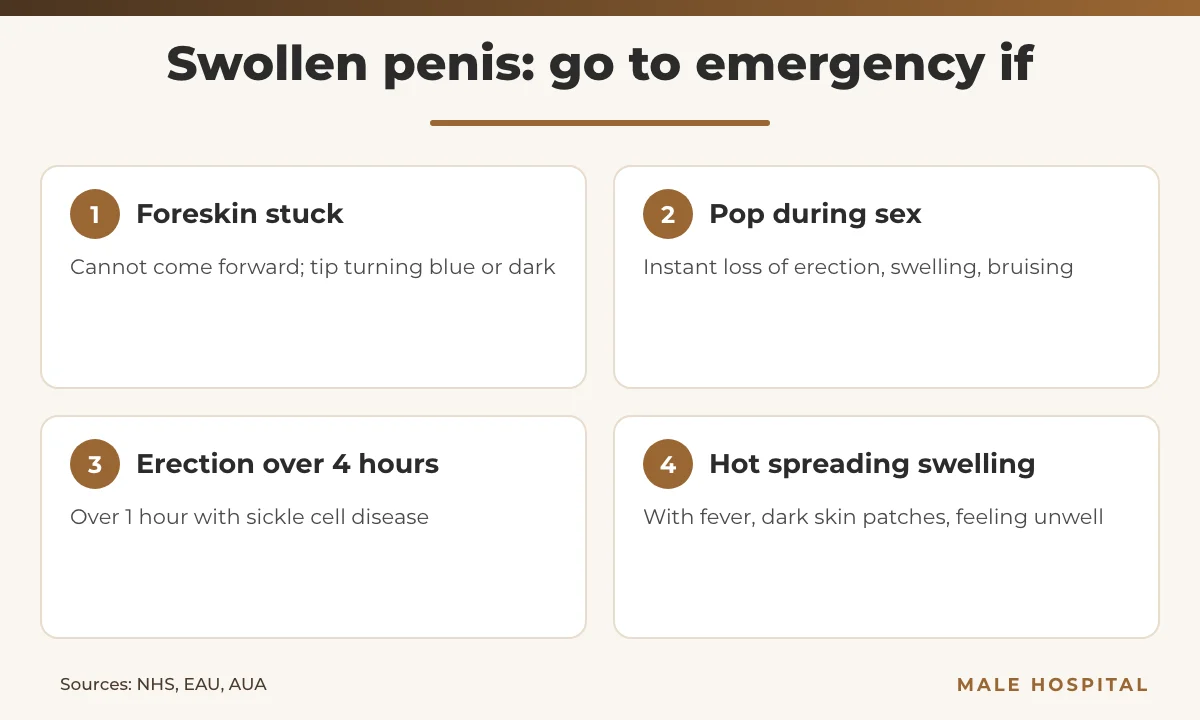
A mildly swollen penis after sex or a sore, itchy head that improves within two or three days of gentle washing rarely needs a visit. Go to an emergency department immediately, and do not drive yourself, if you have:
- a foreskin that is stuck behind the head and will not come forward, especially if the tip is turning blue, purple or dark;
- a popping sound, sudden pain and loss of erection during sex, followed by swelling and bruising;
- an erection that has lasted more than 4 hours (more than 1 hour with sickle cell disease);
- hot, rapidly spreading swelling of the penis, scrotum or perineum with fever, severe pain, dark patches of skin or feeling very unwell;
- swelling that also involves the lips, tongue or throat, or difficulty breathing;
- inability to pass urine.
Book a prompt appointment with a urologist or sexual-health clinic for a swollen penis that lasts more than a few days, keeps recurring, comes with discharge, blisters, ulcers or a rash, started after unprotected sex, follows a new medication, or is painless but slowly getting thicker. A painless cord after sex can wait a few days, but it should still be examined so the diagnosis is confirmed rather than guessed.
Sources: NHS — Tight foreskin (phimosis and paraphimosis); NHS — Priapism (painful erections); EAU Guidelines — Urological Infections (Fournier’s gangrene)
How a swollen penis is diagnosed and treated
In most cases the diagnosis of a swollen penis is made by history and examination alone: when the swelling started, what preceded it (sex, a new product, a new drug, an injury, surgery), whether it hurts, and what the skin looks like. A urologist checks whether the foreskin retracts and returns, feels for a cord or a haematoma, looks for discharge, ulcers or a rash, and examines the scrotum and groin lymph nodes. Tests answer specific questions: a swab for infection, glucose for diabetes, an STI screen after new sexual contact, Doppler ultrasound to tell Mondor’s disease from lymphangitis, and ultrasound or MRI when a penile fracture is suspected but unclear (MRI is the more accurate).
| Cause | Typical clue | Urgency | Usual treatment |
|---|---|---|---|
| Balanitis | Swollen, sore, itchy head; discharge, smell | See a doctor if no better in a few days | Hygiene, antifungal or steroid cream, antibiotics for STI |
| Contact allergy | Itchy swelling where a condom, lubricant or soap touched | Routine | Stop the product, mild steroid cream |
| Paraphimosis | Foreskin stuck behind head, doughnut swelling, colour change | Emergency | Manual reduction; dorsal slit or circumcision |
| Penile fracture | Pop during sex, instant loss of erection, bruising | Emergency | Surgical repair of the tunica within 24 hours |
| Priapism | Rigid painful erection over 4 hours, soft glans | Emergency | Aspiration plus phenylephrine; shunt if needed |
| Cellulitis / Fournier’s | Hot, tender, spreading swelling; fever | Urgent to emergency | Antibiotics; surgical debridement for Fournier’s |
| Sclerosing lymphangitis | Painless firm cord behind the head after sex | Routine | Sexual rest; resolves in about 2 months |
| Mondor’s disease | Painful cord on top of shaft after vigorous sex | Routine | NSAIDs, abstinence; 1–24 weeks to resolve |
| Angioedema | Rapid deep swelling, no itch; new ACE inhibitor | Urgent; emergency if face or throat involved | Stop the drug; antihistamines if allergic type |
| Lymphedema | Chronic painless thickened swelling | Routine specialist referral | Compression and physiotherapy; surgery for severe cases |
Two general rules apply to every swollen penis: do not apply ice to a suspected paraphimosis or priapism, because cold worsens the trapped circulation, and do not force a swollen foreskin back and forth, because that can turn a simple balanitis into paraphimosis. Men with diabetes should have their glucose control reviewed, since high sugar drives both yeast balanitis and serious skin infections such as Fournier’s gangrene.
If you are worried about a swollen penis that is not settling, you can describe it in a confidential consultation with Assoc. Prof. Dr. Zülfü Sertkaya, a urologist-andrologist in Istanbul, via WhatsApp; foreskin problems that keep recurring can be assessed for phimosis treatment or circumcision.
Sources: Cleveland Clinic — Paraphimosis; NHS — Priapism (painful erections); EAU Guidelines — Urological Trauma: Urogenital trauma
FAQs about a swollen penis
Why is my penis swollen but not painful?
A painless swollen penis is usually fluid rather than infection. Common explanations are mild friction oedema of the foreskin after sex, a painless cord of sclerosing lymphangitis behind the head, angioedema (which typically does not itch or hurt), or chronic lymphedema if it has been present for weeks. Painless swelling that keeps growing or thickening should be examined, because lymphatic blockage needs a specialist assessment.
Sources: Cureus (PMC) — Non-venereal sclerosing lymphangitis of the penis; Primary Care Dermatology Society — Genital oedema: an overview
Can a swollen penis go away on its own?
Often, yes. A swollen penis from friction after sex, mild irritant reactions and the cord-like swellings of sclerosing lymphangitis or Mondor’s disease are self-limiting; the first two settle in days and the cords in weeks to a couple of months with sexual rest. Balanitis improves within about a week once the cause is treated. Paraphimosis, priapism, penile fracture and spreading infection do not resolve on their own and need same-day care.
Sources: International Medical Case Reports Journal (PMC) — Penile Mondor’s disease; Cleveland Clinic — Paraphimosis
Is a swollen penis a sign of an STI?
Sometimes. Gonorrhoea and chlamydia can cause balanitis with a swollen, sore head and discharge, and some infections damage lymph channels and leave lasting swelling. Most cases of a swollen penis, however, are not sexually transmitted. If the swelling appeared after new or unprotected sex, or comes with discharge, ulcers or blisters, a sexual-health clinic can run a full screen; many offer walk-in services.
Sources: NHS — Balanitis; Primary Care Dermatology Society — Genital oedema: an overview
What should I do if my foreskin is stuck behind the head?
Treat it as an emergency. Do not apply ice, do not keep pulling, and do not wait to see whether it improves; go to an emergency department or call an ambulance, and do not drive yourself. A doctor will compress the glans to reduce the swelling and bring the foreskin forward, or make a small release cut if that fails. Prompt treatment gives an excellent outcome; delay risks tissue damage.
Sources: NHS — Tight foreskin (phimosis and paraphimosis); MedlinePlus (NIH) — Paraphimosis
Can a swollen penis be caused by medication?
Yes. ACE-inhibitor blood-pressure tablets can cause bradykinin-driven angioedema that occasionally involves the penis and does not respond to antihistamines; stopping the drug is the treatment. Fixed drug eruptions produce a round swollen patch in the same spot each time a medicine is taken. Erectile dysfunction injections and tablets, trazodone and some antipsychotics can trigger priapism, which is a different kind of “swelling” and an emergency.
Sources: Western Journal of Emergency Medicine (PMC) — ACE-inhibitor-related penile angioedema; Cleveland Clinic — Priapism
Should I put ice on a swollen penis?
It depends on the cause. Short applications of ice (up to 10 minutes, several times a day) help a swollen penis from balanitis, a bruise or post-operative puffiness. Ice should not be used for paraphimosis or priapism, because cold constricts vessels and worsens the trapped circulation; the NHS specifically warns against ice packs in priapism, particularly in men with sickle cell disease.
Sources: Cleveland Clinic — Balanitis; NHS — Priapism (painful erections)
Medically reviewed by Assoc. Prof. Dr. Zülfü Sertkaya, urologist and andrologist (FEBU), Istanbul. Last reviewed: November 2026.
This article is for general information and does not replace an individual consultation with a qualified doctor.
- Primary Care Dermatology Society — Genital oedema: an overview
- NHS — Balanitis
- Cleveland Clinic — Balanitis
- MedlinePlus (NIH) — Edema
- Cleveland Clinic — Paraphimosis
- MedlinePlus (NIH) — Paraphimosis
- NHS — Tight foreskin (phimosis and paraphimosis)
- EAU Guidelines — Urological Trauma — Urogenital trauma guidelines
- BAUS — Penile fracture
- Cleveland Clinic — Penile Fracture
- AUA — Acute Ischemic Priapism Guideline (2022)
- NHS — Priapism (painful erections)
- Cleveland Clinic — Priapism
- EAU Guidelines — Urological Infections — Fournier's gangrene
- BMJ Case Reports (PMC) — Cellulitis of the penis: a case report (2009)
- Western Journal of Emergency Medicine (PMC) — An Unusual Case of ACE-Inhibitor-Related Penile Angioedema (2015)
- Cureus (PMC) — Non-Venereal Sclerosing Lymphangitis of the Penis: A Case Report (2022)
- International Medical Case Reports Journal (PMC) — Penile Mondor's disease: a case report and literature review (2014)
- NHS — Circumcision in men
- Archives of Plastic Surgery (PMC) — Surgical management of male genital lymphedema: a systematic review (2020)