Antidepressants and erectile dysfunction are a common and fixable combination. Serotonin-boosting drugs such as sertraline, paroxetine, citalopram, venlafaxine and fluoxetine raise the rate of sexual problems, including weaker erections, lower desire and delayed orgasm, while bupropion, mirtazapine and agomelatine performed no worse than placebo in a large meta-analysis. For men, adding sildenafil or tadalafil has the best evidence, and switching drugs is an option to plan with your prescriber, never by stopping suddenly.
Sources: PubMed — J Clin Psychopharmacol 2009 — Serretti & Chiesa. Treatment-emergent sexual dysfunction related to antidepressants: a meta-analysis; PMC — Cochrane Database Syst Rev 2013 — Taylor et al. Strategies for managing sexual dysfunction induced by antidepressant medication
- In a meta-analysis of studies that asked directly, sexual dysfunction affected between 25.8% and 80.3% of patients on the antidepressants with significant effects.
- Bupropion, mirtazapine, agomelatine and moclobemide did not differ from placebo for sexual side effects in that analysis.
- Depression itself raises the odds of ED (pooled odds ratio 1.39), and ED raises the odds of depression almost threefold, so the drug is not always the only cause.
- A Cochrane review found that adding sildenafil or tadalafil improved erections in men with antidepressant-related ED.
- Do not stop an antidepressant suddenly. The NHS warns this can cause withdrawal symptoms; any change should be planned with your doctor.
- Antidepressants and erectile dysfunction: how common is it?
- Why SSRIs and SNRIs affect erections and orgasm
- Which antidepressants cause the most sexual side effects?
- Is it the antidepressant or the depression?
- Treatment options for antidepressants and erectile dysfunction
- Why you should never stop an antidepressant suddenly
- Post-SSRI sexual dysfunction (PSSD)
- When to see a doctor
- FAQs about antidepressants and erectile dysfunction
Antidepressants and erectile dysfunction: how common is it?
Sexual side effects are among the most under-reported effects of antidepressants because many patients do not mention them unless asked. To get a realistic figure, Italian researchers Serretti and Chiesa pooled only studies that asked patients directly with dedicated sexual-function questionnaires and that excluded people with sexual problems before treatment. For the antidepressants with a significant effect, treatment-emergent sexual dysfunction ranged from 25.8% to 80.3% of patients.
The NHS lists problems with sex, including a low sex drive, difficulty reaching orgasm and difficulty getting or keeping an erection, among the common side effects of antidepressants. The European Association of Urology (EAU) names antidepressants, specifically SSRIs and tricyclics, among drug-induced causes of ED, and MedlinePlus includes many antidepressants in its list of medicines that may cause erection problems.
Sources: NHS — Side effects of antidepressants; EAU — Sexual and Reproductive Health Guidelines — Management of erectile dysfunction; MedlinePlus — Drugs that may cause erection problems
This article is a supporting guide to our main erectile dysfunction treatment page. It focuses on what is specific to antidepressants: which drugs, why, and what to do.
Why SSRIs and SNRIs affect erections and orgasm
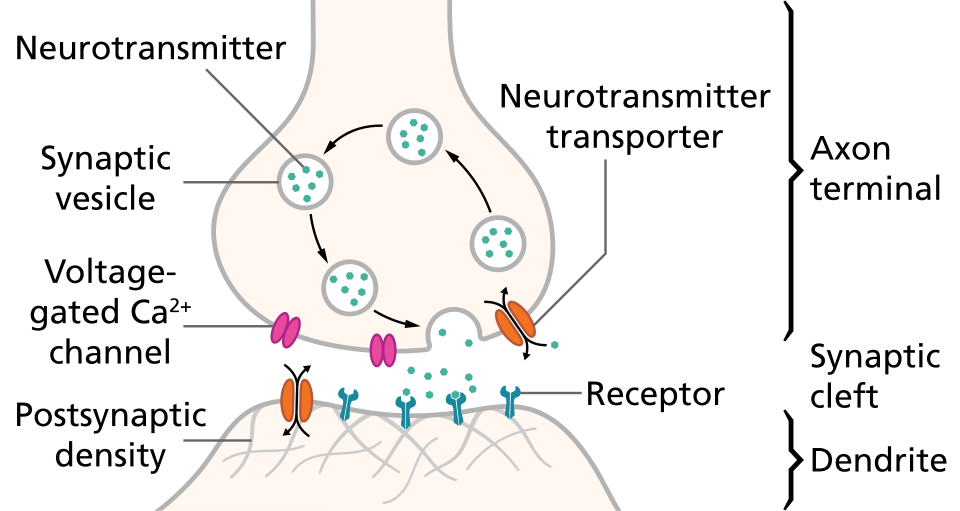
SSRIs (selective serotonin reuptake inhibitors) work by blocking the reuptake of serotonin at nerve junctions (synapses, shown in the diagram above), leaving more serotonin active. That helps mood and anxiety, but serotonin also acts as a brake on several stages of the sexual response. SNRIs such as venlafaxine and duloxetine add a noradrenaline effect but share the serotonin brake.
The result is usually a mix of problems rather than ED alone. Serretti and Chiesa measured three phases separately (desire, arousal and orgasm) and found raised rates of dysfunction in each phase with the drugs that had a significant effect. In men, arousal problems show up as weaker or shorter-lasting erections, and orgasm problems as delayed or absent ejaculation. If delayed orgasm is the main issue, our guide to delayed ejaculation covers it in detail.
Which antidepressants cause the most sexual side effects?
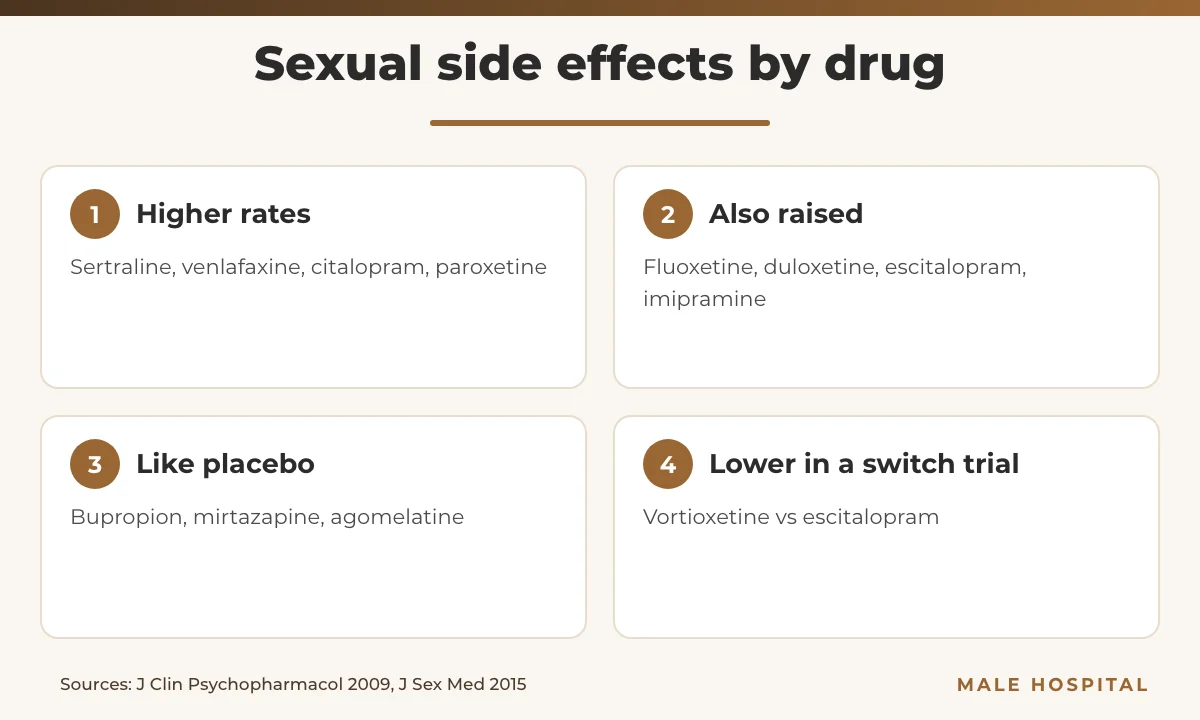
The 2009 meta-analysis ranked drugs by their excess sexual dysfunction compared with placebo, in decreasing order of impact. No significant difference from placebo was found for the group in the last row of the table.
| Group | Medicines (as named in the meta-analysis) | What it means for men |
|---|---|---|
| Significantly more sexual dysfunction than placebo (in decreasing order) | Sertraline, venlafaxine, citalopram, paroxetine, fluoxetine, imipramine, phenelzine, duloxetine, escitalopram, fluvoxamine | Erection, desire and orgasm problems are common; ask about them at every review |
| No significant difference from placebo | Agomelatine, amineptine, bupropion, moclobemide, mirtazapine, nefazodone | Often considered when sexual side effects are a priority; not all are available in every country |
Two caveats matter. First, the authors noted that including open-label studies and differences in questionnaires could weaken the precision of the ranking. Second, some drugs in the “no difference” group are no longer used or not licensed everywhere (the Cochrane review notes that nefazodone is no longer available for clinical use), so the realistic alternatives in most countries are bupropion and mirtazapine, plus newer options such as vortioxetine.
Sources: PubMed — J Clin Psychopharmacol 2009 — Serretti & Chiesa. Treatment-emergent sexual dysfunction related to antidepressants: a meta-analysis; PMC — Cochrane Database Syst Rev 2013 — Taylor et al. Strategies for managing sexual dysfunction induced by antidepressant medication
Vortioxetine was tested in a randomized trial of 447 adults whose depression was well treated with citalopram, paroxetine or sertraline but who had sexual side effects. Switching to vortioxetine improved sexual functioning scores more than switching to escitalopram (8.8 versus 6.6 points), with similar control of depression. The trial was run by the manufacturer, so independent confirmation would be welcome.
Is it the antidepressant or the depression?
Depression on its own can cause erection problems. A 2018 meta-analysis of 49 publications found that depression raised the odds of ED (pooled odds ratio 1.39), and that men with ED had almost three times the odds of developing depression (odds ratio 2.92). The authors recommended that men with ED be assessed for depression and vice versa.
This two-way link has practical consequences. Some men notice that erections actually improve as depression lifts on treatment, even on an SSRI, while others first notice sexual problems after starting medicine. Clues that point toward the drug include ED that started within weeks of starting or raising the dose, a parallel change in orgasm (delayed or numb), and good mood but persistent sexual side effects. Clues that point toward mood or anxiety include loss of interest across life, not just in sex, and performance worries. Our article on psychological erectile dysfunction explains the second pattern, and our guide to low libido in men covers desire problems.
Sources: PubMed — J Sex Med 2018 — Liu et al. Erectile dysfunction and depression: a systematic review and meta-analysis; Cleveland Clinic — Erectile Dysfunction
Treatment options for antidepressants and erectile dysfunction
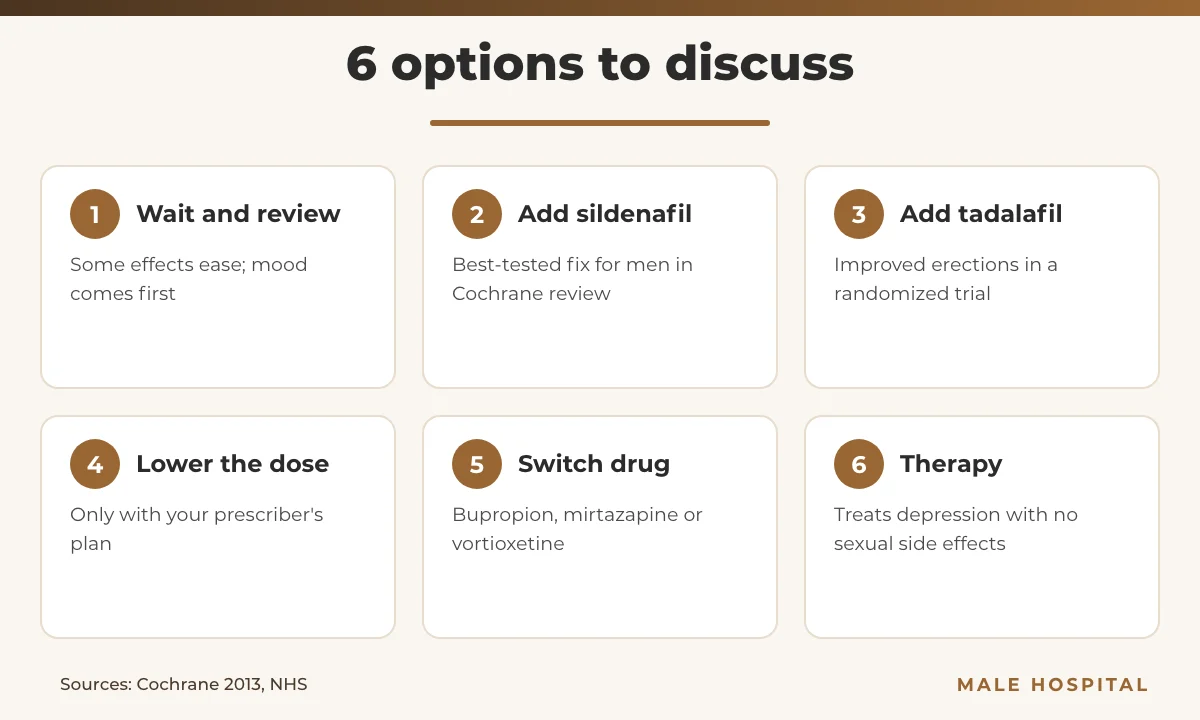
The Cochrane Collaboration reviewed 23 randomized trials (1,886 people) of strategies for antidepressant-induced sexual dysfunction. The evidence is limited, but it gives a clear first choice for men.
1. Add a PDE5 inhibitor
In men, sildenafil (three studies, 255 participants) and tadalafil (one study, 54 participants) improved erectile function more than placebo. Pooled sildenafil data showed better ability to get an erection (mean difference 1.04 points) and keep one (1.18 points) on International Index of Erectile Function items; one point equals moving from “sometimes” to “most times”. Men taking tadalafil were far more likely to report improvement. This is often the simplest option because it leaves a working antidepressant untouched. See sildenafil side effects before starting.
2. Switch to a drug with fewer sexual effects
Switching to bupropion, mirtazapine or vortioxetine is a common clinical approach, based on the lower rates seen in the studies above. The Cochrane authors note, however, that there were no randomized trials of switching to currently available antidepressants, so this decision depends on your history and on how well your current drug controls your mood.
Sources: PMC — Cochrane Database Syst Rev 2013 — Taylor et al. Strategies for managing sexual dysfunction induced by antidepressant medication; PubMed — J Clin Psychopharmacol 2009 — Serretti & Chiesa. Treatment-emergent sexual dysfunction related to antidepressants: a meta-analysis
3. Add bupropion
Bupropion at 150 mg twice daily improved sexual function rating scores over placebo in three studies of men and women, but 150 mg once daily showed no significant difference in response rates. The strongest support for this strategy came from women.
4. Adjust the dose or timing
A lower dose may reduce side effects while keeping the benefit, but only your prescriber can judge this. The Cochrane review found no randomized trials of “drug holidays” (skipping doses before sex), and with short-acting drugs that approach can trigger withdrawal symptoms.
Sources: PMC — Cochrane Database Syst Rev 2013 — Taylor et al. Strategies for managing sexual dysfunction induced by antidepressant medication; NHS — Antidepressants
5. Give it time, with a review
The NHS notes that antidepressants usually take 1 to 2 weeks to start working and up to 8 weeks to work fully, and that you will usually continue for at least 6 months after feeling better. Some side effects ease over the first weeks, but sexual effects often persist, so raise them at your review rather than waiting silently.
Source: NHS — Side effects of antidepressants
6. Talking therapy
Psychological treatment helps depression and anxiety without sexual side effects, and it can also address performance anxiety that builds up after a few disappointing experiences. Many men combine it with medication.
Why you should never stop an antidepressant suddenly
When sexual side effects are frustrating, stopping the tablet can feel like the obvious fix. The NHS is clear: do not stop taking an antidepressant suddenly or without talking to your doctor first. Coming off can cause withdrawal symptoms such as headaches, aching muscles, nausea, sweating, palpitations, dizziness and sleep problems, and stopping too early risks a relapse of depression. A doctor will usually agree a plan to reduce the dose gradually over several weeks or months.
Source: NHS — Antidepressants
Post-SSRI sexual dysfunction (PSSD)
For most men, sexual side effects improve after an antidepressant is stopped. The NHS acknowledges, however, that for some people these problems may carry on after stopping. This persistent condition is called post-SSRI sexual dysfunction (PSSD). A 2024 commentary describes its most common features as genital numbness, weak or pleasureless orgasm, loss of libido and erectile dysfunction.
How often PSSD occurs is unknown. The authors explain that it is hard to design a study to measure it, patients are often embarrassed to report it, and some cannot stop their antidepressant because of withdrawal. A definition with diagnostic criteria has been published, but the condition is not yet widely recognised by regulators. If sexual function has not returned months after stopping, a specialist assessment is worthwhile to look for other treatable causes as well.
Sources: NHS — Side effects of antidepressants; PMC — Epidemiol Psychiatr Sci 2024 — Healy & Mangin. Post-SSRI sexual dysfunction: barriers to quantifying incidence and prevalence
When to see a doctor
Talk to your prescriber if erection, desire or orgasm problems start or worsen after beginning or increasing an antidepressant; the NHS advises talking to your doctor if side effects are hard to manage. See a doctor promptly if:
- You are thinking of stopping your antidepressant because of sexual side effects.
- Sexual problems persist months after stopping the medicine.
- You also have heart disease or take nitrates and want an ED pill.
- An erection lasts more than four hours (a medical emergency).
- You have thoughts of self-harm or suicide: the NHS advises seeking help straight away, and calling emergency services if you are in danger.
Sources: NHS — Side effects of antidepressants; EAU — Sexual and Reproductive Health Guidelines — Management of erectile dysfunction
Our urologist-andrologist can work alongside your psychiatrist or GP to treat antidepressants and erectile dysfunction without putting your mental health at risk. Message us on WhatsApp for a confidential, free initial consultation.
FAQs about antidepressants and erectile dysfunction
Which antidepressant does not cause erectile dysfunction?
No antidepressant is completely free of sexual side effects, but bupropion, mirtazapine, agomelatine and moclobemide did not differ from placebo in a meta-analysis that asked patients directly. Vortioxetine also caused fewer sexual problems than escitalopram in a switch trial. Which is right for you depends on your symptoms, history and other medicines.
Sources: PubMed — J Clin Psychopharmacol 2009 — Serretti & Chiesa. Treatment-emergent sexual dysfunction related to antidepressants: a meta-analysis; PubMed — J Sex Med 2015 — Jacobsen et al. Effect of vortioxetine vs escitalopram on sexual functioning in adults with SSRI-induced sexual dysfunction
Does sertraline cause erectile dysfunction?
It can. Sertraline ranked first for treatment-emergent sexual dysfunction in the 2009 meta-analysis, covering desire, arousal and orgasm. Many men on sertraline still have normal erections, and those who do not have options: adding a PDE5 inhibitor, adjusting the dose with their doctor or switching to a drug with fewer sexual effects.
Sources: PubMed — J Clin Psychopharmacol 2009 — Serretti & Chiesa. Treatment-emergent sexual dysfunction related to antidepressants: a meta-analysis; PMC — Cochrane Database Syst Rev 2013 — Taylor et al. Strategies for managing sexual dysfunction induced by antidepressant medication
Can I take Viagra with antidepressants?
Generally, yes. Sildenafil and tadalafil were studied specifically in men with antidepressant-related ED in trials included in a Cochrane review, and both improved erections compared with placebo. The usual PDE5 inhibitor rules still apply: never combine them with nitrates or poppers, and check other heart medicines with your doctor first.
Sources: PMC — Cochrane Database Syst Rev 2013 — Taylor et al. Strategies for managing sexual dysfunction induced by antidepressant medication; EAU — Sexual and Reproductive Health Guidelines — Management of erectile dysfunction
Does antidepressant-related ED go away?
In most men, sexual function improves when the dose is reduced, the drug is changed or treatment ends. The NHS notes that in some people problems may continue after stopping, a condition known as post-SSRI sexual dysfunction, whose frequency is not yet known. Persistent problems deserve a full medical assessment.
Sources: NHS — Side effects of antidepressants; PMC — Epidemiol Psychiatr Sci 2024 — Healy & Mangin. Post-SSRI sexual dysfunction: barriers to quantifying incidence and prevalence
Can depression cause ED without medication?
Yes. A meta-analysis of 49 publications found that depression increased the odds of ED by about 39%, and ED nearly tripled the odds of depression. Low mood reduces desire and arousal, and anxiety about performance can follow. Treating the depression, with or without medicine, often improves sexual function as well.
Is bupropion better for sexual side effects?
Bupropion did not differ from placebo for sexual dysfunction in a meta-analysis, which makes it a common choice when sexual side effects matter. Adding bupropion 150 mg twice daily improved sexual function scores in a Cochrane review, though the evidence was strongest in women. Your prescriber will check whether it suits you.
Sources: PubMed — J Clin Psychopharmacol 2009 — Serretti & Chiesa. Treatment-emergent sexual dysfunction related to antidepressants: a meta-analysis; PMC — Cochrane Database Syst Rev 2013 — Taylor et al. Strategies for managing sexual dysfunction induced by antidepressant medication
Should I skip my antidepressant before sex?
Not without medical advice. The Cochrane review found no randomized trials supporting drug holidays, and missing doses of some antidepressants can trigger withdrawal symptoms. The NHS advises against stopping suddenly. Safer options include adding an ED pill or discussing a planned dose change or switch with your prescriber.
Sources: PMC — Cochrane Database Syst Rev 2013 — Taylor et al. Strategies for managing sexual dysfunction induced by antidepressant medication; NHS — Antidepressants
Medically reviewed by Assoc. Prof. Dr. Zülfü Sertkaya, urologist and andrologist (FEBU), Istanbul. Last reviewed: November 2026.
This article is for general information and does not replace an individual consultation with a qualified doctor.
- PubMed — J Clin Psychopharmacol 2009 — Serretti & Chiesa. Treatment-emergent sexual dysfunction related to antidepressants: a meta-analysis
- PMC — Cochrane Database Syst Rev 2013 — Taylor et al. Strategies for managing sexual dysfunction induced by antidepressant medication
- PubMed — J Sex Med 2018 — Liu et al. Erectile dysfunction and depression: a systematic review and meta-analysis
- NHS — Side effects of antidepressants
- NHS — Antidepressants
- MedlinePlus — Drugs that may cause erection problems
- EAU — Sexual and Reproductive Health Guidelines — Management of erectile dysfunction
- PubMed — J Sex Med 2015 — Jacobsen et al. Effect of vortioxetine vs escitalopram on sexual functioning in adults with SSRI-induced sexual dysfunction
- PMC — Epidemiol Psychiatr Sci 2024 — Healy & Mangin. Post-SSRI sexual dysfunction: barriers to quantifying incidence and prevalence
- Cleveland Clinic — Erectile Dysfunction