Erectile dysfunction and sleep apnea are closely connected: men with obstructive sleep apnea (OSA) have a significantly higher risk of ED, and a 2018 meta-analysis of 28 studies confirmed the association. Repeated drops in oxygen during the night appear to damage blood vessels and nerves and may lower testosterone. Treating the apnea with CPAP helps some men, but ED pills such as sildenafil work better for erections, and many men do best with both.
Sources: PubMed — Int J Impot Res 2018 — Kellesarian et al. Association between obstructive sleep apnea and erectile dysfunction: a systematic review and meta-analysis; PMC — Cochrane Database Syst Rev 2021 — Barbosa et al. Non-invasive positive airway pressure therapy for improving erectile dysfunction in men with obstructive sleep apnoea
- A meta-analysis of 28 observational studies found that OSA is associated with a higher risk of erectile dysfunction.
- Proposed mechanisms include low night-time oxygen, damage to the vessel lining, nerve dysfunction and lower testosterone.
- CPAP improved erectile scores in a 26-study review, but a Cochrane review rated the certainty of that benefit as very low.
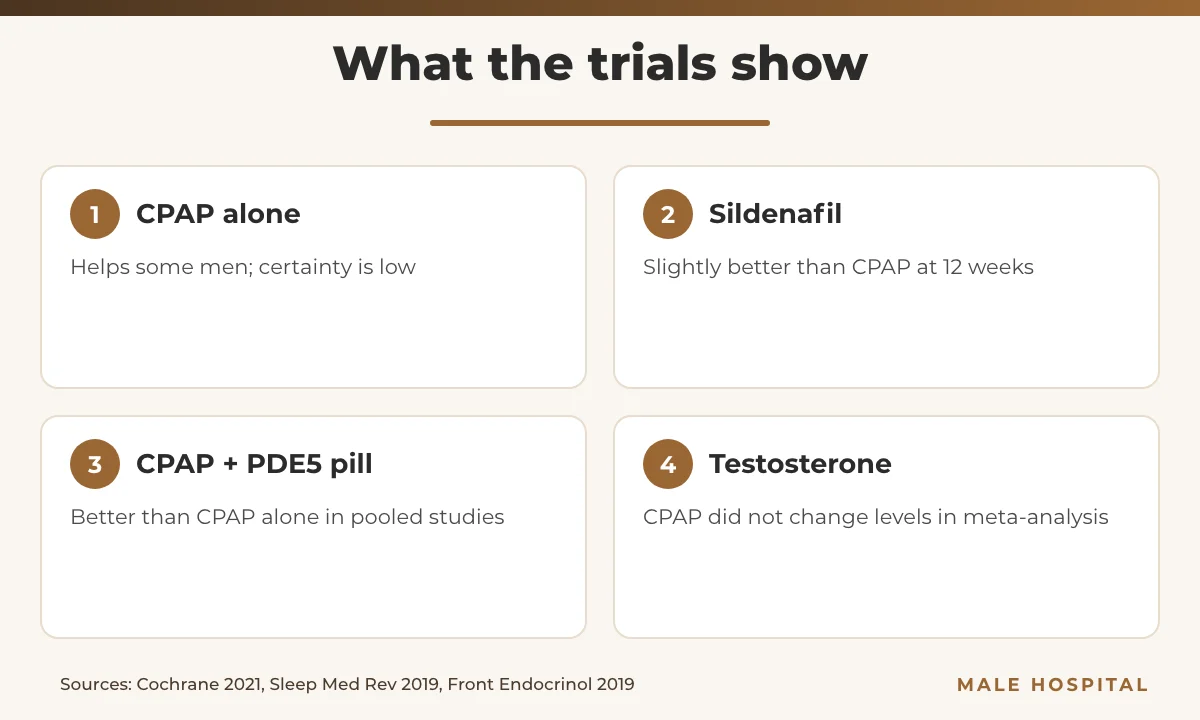
- Sildenafil slightly outperformed CPAP for erections at 12 weeks, and CPAP plus a PDE5 inhibitor beat CPAP alone.
- Loud snoring, gasping at night and daytime sleepiness in a man with ED are good reasons to ask for a sleep assessment.
- What is obstructive sleep apnea?
- Erectile dysfunction and sleep apnea: what the evidence shows
- How sleep apnea may affect erections
- Sleep apnea, night-time erections and morning wood
- Does CPAP improve erectile dysfunction?
- ED pills, CPAP or both?
- Testosterone, CPAP and sleep apnea
- Practical steps for men with both conditions
- When to see a doctor
- FAQs about erectile dysfunction and sleep apnea
What is obstructive sleep apnea?

OSA is a disorder in which the upper airway partly or completely collapses during sleep, so breathing repeatedly stops and starts. A 2019 review in the World Journal of Men’s Health describes it as a common sleep disorder marked by loud snoring and reduced or absent airflow; an apnea is a fall in airflow of more than 90% for at least 10 seconds, while a hypopnea is a 30% to 90% reduction.
Source: PMC — World J Mens Health 2019 — Cho & Duffy. Sleep, sleep disorders, and sexual dysfunction
It is far from rare. Epidemiological studies cited in the same review put its prevalence at 4.0% to 32.8% in middle-aged men. The Cleveland Clinic cites an estimate that about 1 billion people aged 30 to 69 worldwide have OSA, and notes that men are more likely to be diagnosed before age 50. According to the NHS, it has been linked to obesity, having a large neck, getting older, alcohol, smoking, large tonsils, sleeping on your back and a family history of sleep apnea.
Sources: PMC — World J Mens Health 2019 — Cho & Duffy. Sleep, sleep disorders, and sexual dysfunction; Cleveland Clinic — Sleep Apnea; NHS — Sleep apnoea
Typical night-time symptoms are breathing that stops and starts, gasping, snorting or choking noises, waking up often and loud snoring. During the day, many people feel very tired and find it hard to concentrate. The Cleveland Clinic also lists sexual dysfunction among the symptoms.
Sources: NHS — Sleep apnoea; Cleveland Clinic — Sleep Apnea
Erectile dysfunction and sleep apnea: what the evidence shows
The link has been studied many times. A 2018 systematic review in the International Journal of Impotence Research included 28 observational studies (19 cross-sectional, 7 case-control and 2 cohort studies). Pooling the 10 studies that reported odds ratios, the authors found that men without OSA had a significantly lower risk of ED than men with OSA, and concluded that OSA is associated with a higher risk of ED.
Because the studies were observational, they cannot prove that apnea causes ED. Both conditions share risk factors such as obesity, high blood pressure, diabetes and age, and the authors called for longitudinal studies. The European Association of Urology (EAU) nonetheless lists obstructive sleep apnoea and sleep disorders among the conditions associated with ED, which is why a good erectile dysfunction work-up asks about sleep.
Sources: PubMed — Int J Impot Res 2018 — Kellesarian et al. Association between obstructive sleep apnea and erectile dysfunction: a systematic review and meta-analysis; EAU — Sexual and Reproductive Health Guidelines — Management of erectile dysfunction
This article is a supporting guide; for an overview of all ED treatments, see our erectile dysfunction treatment page.
How sleep apnea may affect erections
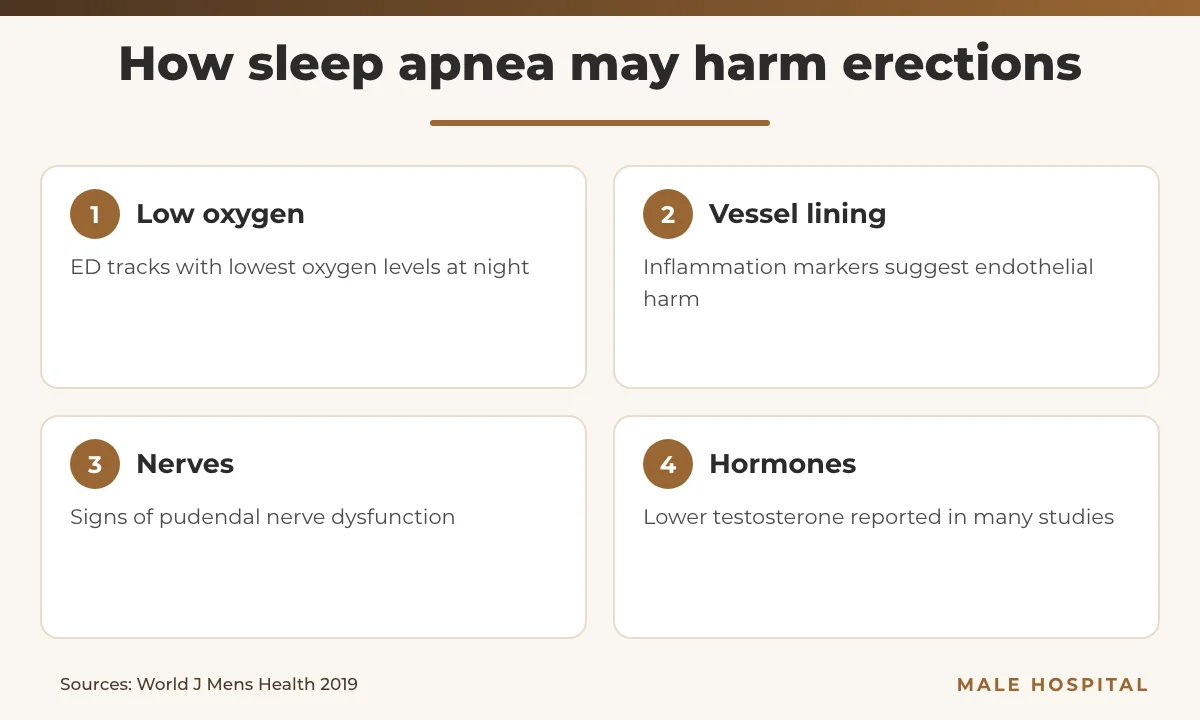
The exact mechanism is still unknown, but the 2019 review summarises four main theories, and in most men several probably act together.
Low oxygen at night
In some studies, ED severity tracked with the lowest oxygen saturation reached during the night rather than with the number of breathing pauses. Repeated oxygen dips may injure tissues that depend on good blood supply, including the erectile tissue.
Damage to blood vessels
Men with severe OSA and ED show raised inflammatory markers such as high-sensitivity C-reactive protein, tumour necrosis factor alpha and interleukins 6 and 8, which suggests that the vessel lining (endothelium) is involved. This is the same vascular pathway that links ED with high blood pressure, discussed in our guide to erectile dysfunction and high blood pressure.
Nerve dysfunction
An altered bulbocavernosus reflex, a test of the pudendal nerve that supplies the penis, has been found in men with OSA, supporting a role for peripheral nerve damage linked to low oxygen.
Lower testosterone
Many studies have found lower testosterone in men with OSA, with levels falling as apnea severity rises. The relationship is complicated, though: testosterone therapy may worsen OSA, and the review advises caution before giving testosterone to men with untreated apnea.
Source: PMC — World J Mens Health 2019 — Cho & Duffy. Sleep, sleep disorders, and sexual dysfunction
Sleep apnea, night-time erections and morning wood
Sleep-related erections are a natural, involuntary event that occurs typically during REM sleep, the dreaming phase, in healthy men. OSA fragments sleep through frequent brief arousals as oxygen falls, which can disturb the normal sleep cycle. That matters for diagnosis: doctors sometimes use night-time erection testing to help separate physical from psychological ED, and disturbed sleep can make the results harder to interpret. Our article on morning wood explains what changes in morning erections can and cannot tell you.
Source: PMC — World J Mens Health 2019 — Cho & Duffy. Sleep, sleep disorders, and sexual dysfunction
CPAP studies measured these night-time erections directly. In a 26-study meta-analysis, CPAP significantly improved total erectile events and nocturnal penile rigidity, although not penile circumference during sleep.
Does CPAP improve erectile dysfunction?
CPAP (continuous positive airway pressure) is the first-line treatment for moderate and severe OSA: a machine gently pumps air through a mask to keep the airway open. The NHS says it improves breathing and sleep quality, reduces tiredness and lowers the risk of complications such as high blood pressure, and that it works best when used every night.
Sources: NHS — Sleep apnoea; PMC — World J Mens Health 2019 — Cho & Duffy. Sleep, sleep disorders, and sexual dysfunction
The evidence on erections is mixed, and it is worth reading carefully:
- Pooled studies are encouraging. A 2019 meta-analysis of 26 studies found that CPAP significantly improved International Index of Erectile Function (IIEF) scores as well as night-time erection measures.
- Randomized trials are fewer and weaker. A 2021 Cochrane review found six randomized trials with 315 men. Compared with no CPAP, it was uncertain whether CPAP improves erectile scores, because the evidence was of very low certainty.
- Individual studies disagree. Some found better erectile scores after one to three months of CPAP; others found no meaningful change in sexual function, even though sleepiness improved.
Sources: PubMed — Sleep Med Rev 2019 — Li et al. The effect of CPAP and PDE5i on erectile function in men with obstructive sleep apnea and erectile dysfunction; PMC — Cochrane Database Syst Rev 2021 — Barbosa et al. Non-invasive positive airway pressure therapy for improving erectile dysfunction in men with obstructive sleep apnoea; PMC — World J Mens Health 2019 — Cho & Duffy. Sleep, sleep disorders, and sexual dysfunction
The practical message is that CPAP should be used for its proven benefits on sleep, alertness and cardiovascular risk, and that any improvement in erections is a welcome bonus rather than a guarantee.
ED pills, CPAP or both?
Head-to-head data favour PDE5 inhibitors for the erection itself. In the Cochrane review, sildenafil may slightly improve erectile function at 12 weeks compared with CPAP (three trials, 152 men, low-certainty evidence). In the 2019 meta-analysis, CPAP was inferior to PDE5 inhibitors on erectile function and successful intercourse, while CPAP combined with a PDE5 inhibitor was superior to CPAP alone.
Sources: PMC — Cochrane Database Syst Rev 2021 — Barbosa et al. Non-invasive positive airway pressure therapy for improving erectile dysfunction in men with obstructive sleep apnoea; PubMed — Sleep Med Rev 2019 — Li et al. The effect of CPAP and PDE5i on erectile function in men with obstructive sleep apnea and erectile dysfunction
| Approach | What it does for erections | Other benefits | Evidence quality |
|---|---|---|---|
| CPAP alone | Improves scores in some men; uncertain in randomized trials | Better sleep, less daytime sleepiness, lower blood pressure risk | Low to very low for ED |
| PDE5 inhibitor alone (sildenafil, tadalafil) | Slightly better than CPAP at 12 weeks | Does not treat the apnea | Low certainty |
| CPAP plus PDE5 inhibitor | Better than CPAP alone in pooled studies | Treats both conditions | Mostly observational data |
| Weight loss and lifestyle | Can help both apnea and erections | Lower blood pressure and diabetes risk | NHS-recommended for mild apnea |
Sources: PMC — Cochrane Database Syst Rev 2021 — Barbosa et al. Non-invasive positive airway pressure therapy for improving erectile dysfunction in men with obstructive sleep apnoea; PubMed — Sleep Med Rev 2019 — Li et al. The effect of CPAP and PDE5i on erectile function in men with obstructive sleep apnea and erectile dysfunction; NHS — Sleep apnoea
Side effects were minor in the trials: in one study, 4 of 20 men using CPAP reported nasal dryness, and 3 of 20 taking sildenafil had transient flushing and mild headache.
Testosterone, CPAP and sleep apnea
Because OSA is linked with lower testosterone, many men hope CPAP will raise their levels. A 2019 meta-analysis of 12 studies (388 patients) found that CPAP was not associated with a significant change in total testosterone or in other reproductive hormones, and the authors concluded that other strategies should be considered for managing low testosterone in men with OSA.
If testosterone is genuinely low, treatment needs care because testosterone therapy may worsen apnea. Weight loss, which improves both OSA and testosterone, is often the first step. We explain the role of hormones in testosterone and erectile dysfunction.
Source: PMC — World J Mens Health 2019 — Cho & Duffy. Sleep, sleep disorders, and sexual dysfunction
Practical steps for men with both conditions
- Get a proper diagnosis. If you snore loudly, stop breathing at night or feel exhausted during the day, ask for a sleep assessment.
- Use CPAP consistently if it is prescribed. The NHS stresses nightly use; tell your doctor if the mask is uncomfortable rather than giving up.
- Lose weight if you are overweight, exercise regularly, cut down on alcohol and stop smoking. The NHS notes these may be all that is needed for mild sleep apnea.
- Treat the ED directly. A PDE5 inhibitor is safe for most men and has the strongest erection data in OSA.
- Check the rest of your health. Blood pressure, blood sugar and cholesterol are common partners of both conditions.
Sources: NHS — Sleep apnoea; PMC — Cochrane Database Syst Rev 2021 — Barbosa et al. Non-invasive positive airway pressure therapy for improving erectile dysfunction in men with obstructive sleep apnoea
When to see a doctor
See a doctor if erection problems persist, especially alongside any of these warning signs of sleep apnea:
- Loud snoring with pauses in breathing noticed by a partner.
- Waking up gasping or choking.
- Severe daytime sleepiness, or falling asleep while driving. The NHS advises that people with confirmed sleep apnea and excessive sleepiness must not drive until symptoms are controlled.
- Morning headaches, night sweats or mood changes.
- High blood pressure that is hard to control.
Sources: NHS — Sleep apnoea; Cleveland Clinic — Sleep Apnea
Our urologist-andrologist can assess erectile dysfunction and sleep apnea together and coordinate with your sleep specialist. Message us on WhatsApp for a confidential, free initial consultation.
FAQs about erectile dysfunction and sleep apnea
Can sleep apnea cause erectile dysfunction?
Sleep apnea is strongly associated with ED: a meta-analysis of 28 studies found a significantly higher risk in men with OSA. Low night-time oxygen, damage to blood vessels and nerves, and lower testosterone are the leading explanations. Because the studies were observational and the conditions share risk factors such as obesity, direct cause has not been proven.
Sources: PubMed — Int J Impot Res 2018 — Kellesarian et al. Association between obstructive sleep apnea and erectile dysfunction: a systematic review and meta-analysis; PMC — World J Mens Health 2019 — Cho & Duffy. Sleep, sleep disorders, and sexual dysfunction
Will CPAP fix my erectile dysfunction?
It may help, but it is not reliable on its own. A 26-study meta-analysis found improved erectile scores with CPAP, while a Cochrane review of randomized trials judged the benefit uncertain. Use CPAP for its proven benefits on sleep and heart health, and add an ED treatment if erections remain a problem.
Sources: PubMed — Sleep Med Rev 2019 — Li et al. The effect of CPAP and PDE5i on erectile function in men with obstructive sleep apnea and erectile dysfunction; PMC — Cochrane Database Syst Rev 2021 — Barbosa et al. Non-invasive positive airway pressure therapy for improving erectile dysfunction in men with obstructive sleep apnoea
How long does CPAP take to improve erections?
Studies that reported improvement measured erectile scores after about one to three months of CPAP use. Results vary and depend on regular nightly use. If erections are unchanged after a few months of consistent CPAP, other contributors such as vascular disease, diabetes or low testosterone should be checked.
Source: PMC — World J Mens Health 2019 — Cho & Duffy. Sleep, sleep disorders, and sexual dysfunction
Is Viagra safe if I have sleep apnea?
For most men, yes. Sildenafil was tested in randomized trials of men with OSA and ED, where it slightly improved erections compared with CPAP and side effects were mild, such as flushing and headache. The usual PDE5 inhibitor precautions apply, including never combining it with nitrates.
Sources: PMC — Cochrane Database Syst Rev 2021 — Barbosa et al. Non-invasive positive airway pressure therapy for improving erectile dysfunction in men with obstructive sleep apnoea; EAU — Sexual and Reproductive Health Guidelines — Management of erectile dysfunction
Does sleep apnea lower testosterone?
Many studies report lower testosterone in men with OSA, with levels falling as severity rises. However, a meta-analysis found that CPAP did not significantly change testosterone levels, so low testosterone in OSA usually needs its own assessment. Testosterone therapy may worsen apnea and should be used cautiously.
Sources: PMC — World J Mens Health 2019 — Cho & Duffy. Sleep, sleep disorders, and sexual dysfunction; PubMed — Front Endocrinol 2019 — Effects of CPAP on testosterone levels in obstructive sleep apnea: a meta-analysis
Can losing weight help both sleep apnea and ED?
Yes, it is one of the few measures that targets both. The NHS lists obesity and a large neck as risk factors for sleep apnea and advises weight loss, regular exercise, less alcohol and stopping smoking, which may be enough for mild apnea. The same habits support blood vessel health and erections.
Source: NHS — Sleep apnoea
Medically reviewed by Assoc. Prof. Dr. Zülfü Sertkaya, urologist and andrologist (FEBU), Istanbul. Last reviewed: November 2026.
This article is for general information and does not replace an individual consultation with a qualified doctor.
- PubMed — Int J Impot Res 2018 — Kellesarian et al. Association between obstructive sleep apnea and erectile dysfunction: a systematic review and meta-analysis
- PMC — World J Mens Health 2019 — Cho & Duffy. Sleep, sleep disorders, and sexual dysfunction
- PMC — Cochrane Database Syst Rev 2021 — Barbosa et al. Non-invasive positive airway pressure therapy for improving erectile dysfunction in men with obstructive sleep apnoea
- PubMed — Sleep Med Rev 2019 — Li et al. The effect of CPAP and PDE5i on erectile function in men with obstructive sleep apnea and erectile dysfunction
- PubMed — Front Endocrinol 2019 — Effects of CPAP on testosterone levels in obstructive sleep apnea: a meta-analysis
- NHS — Sleep apnoea
- Cleveland Clinic — Sleep Apnea
- EAU — Sexual and Reproductive Health Guidelines — Management of erectile dysfunction