Morning wood is the everyday name for an erection you wake up with. Doctors call it nocturnal penile tumescence or sleep-related erection: an involuntary erection that happens several times a night, mostly during REM (dreaming) sleep, and is simply noticed on waking. Regular morning erections are a reassuring sign that the nerves, blood vessels and hormones behind erections are working, while a lasting loss of them can be an early clue to erectile dysfunction that may need treatment or a hormone problem.
Sources: Cleveland Clinic — Early Risers: Why Men Get Morning Erections; PMC — Cho & Duffy, Sleep, Sleep Disorders, and Sexual Dysfunction (World J Mens Health 2019)
- Morning wood is a normal, involuntary erection linked mainly to REM sleep; it is not caused by sexual thoughts.
- MedlinePlus states that most men have 3 to 5 erections at night, each lasting about 30 minutes.
- Missing morning wood now and then is usually not a concern; a consistent absence over weeks is worth discussing with a doctor.
- Normal night-time erections with problems during sex point toward a psychological or situational cause rather than a physical one.
- Poor morning erections are one of three sexual symptoms most closely tied to low testosterone in middle-aged and older men.
- What is morning wood?
- Why morning wood happens
- How often is morning wood normal?
- Morning wood and age
- No morning wood: what its absence can mean
- Morning wood as a clue: psychological or physical ED?
- How doctors test night-time erections
- Can you get morning erections back?
- When to see a doctor
- FAQs about morning wood
What is morning wood?
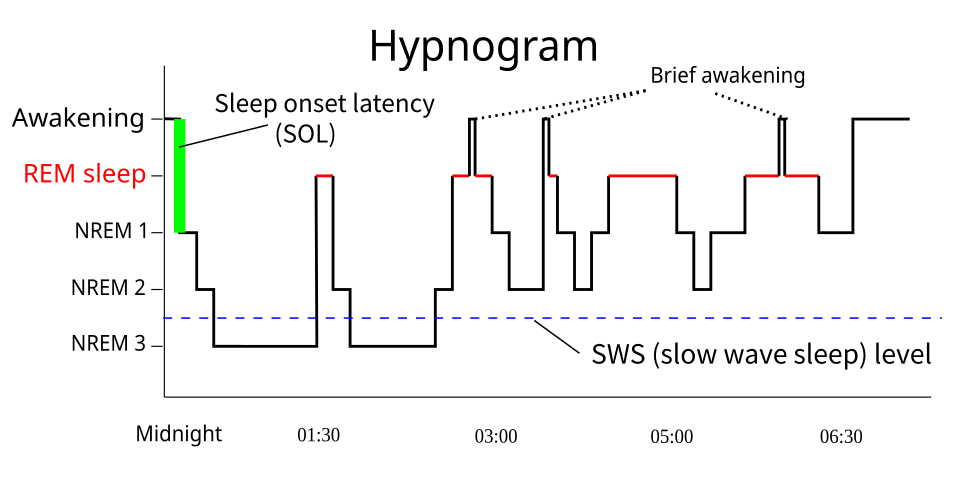
Morning wood is an erection that is present when you wake up. The name is a little misleading: the erection did not start because it is morning. It is usually the last of a series of erections that come and go throughout the night, and you notice it only because you happen to wake during or just after one.
The medical term used for decades was nocturnal penile tumescence (NPT), coined in early sleep research. Sleep specialists now prefer the term sleep-related erection (SRE). Both describe the same thing: a natural, involuntary erection that appears during sleep in healthy males, from infancy to old age.
Sources: PMC — Cho & Duffy, Sleep, Sleep Disorders, and Sexual Dysfunction (World J Mens Health 2019); Cleveland Clinic — Early Risers: Why Men Get Morning Erections
Sleep erections work through a different pathway from erections triggered by touch or fantasy. That is exactly why sleep erections, including morning wood, matter clinically: because they do not depend on desire, mood in the moment, or a partner, they give a rough picture of whether the “hardware” of erection is intact.
Why morning wood happens
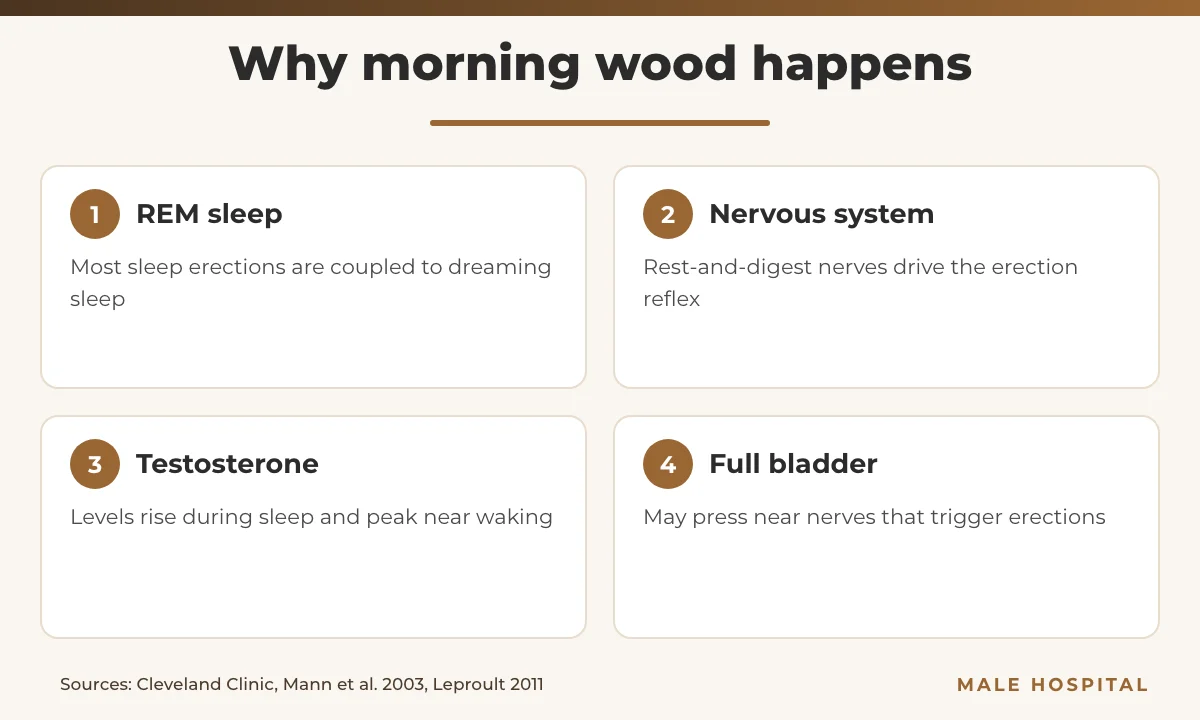
Scientists still do not have a complete explanation for sleep erections. Animal research points to control centers in the hypothalamus, the brain region that also governs sleep and hormones. What is well established is the strong link with REM sleep, the dreaming stage that recurs in cycles through the night.
Sources: PMC — Cho & Duffy, Sleep, Sleep Disorders, and Sexual Dysfunction (World J Mens Health 2019); PubMed — Schmidt & Schmidt, Sleep-related erections: neural mechanisms and clinical significance (Curr Neurol Neurosci Rep 2004)
REM sleep and the nervous system
In a sleep-laboratory study of healthy men, the vast majority of erections were coupled to REM episodes, although the timing between the start of an erection and the start of REM varied a lot and the two were not completely interdependent. Cleveland Clinic urologists explain that the parasympathetic (“rest and digest”) nervous system, which is active during sleep, also controls the erection reflex, and that this activity is especially strong during REM.
Sources: PubMed — Mann et al., Temporal relationship between nocturnal erections and REM episodes in healthy men (Neuropsychobiology 2003); Cleveland Clinic — Early Risers: Why Men Get Morning Erections
Other contributors
Several everyday factors may also contribute to morning wood. Testosterone tends to rise during sleep, so hormone levels are near their daily high on waking. A full bladder presses near the sacral nerves that help trigger erections. Touch from bedding or turning over in bed can also stimulate the penis. An erotic dream can cause an erection too, but most sleep erections have nothing to do with sexual dreams.
Source: Cleveland Clinic — Early Risers: Why Men Get Morning Erections
Sleep and testosterone are closely connected. Most of the daily testosterone release in men happens during sleep, and in a small University of Chicago study of 10 healthy young men, one week of sleep restricted to 5 hours a night lowered daytime testosterone by 10% to 15%.
How often is morning wood normal?
There is no rule that a healthy man must wake with morning wood every day. According to the U.S. National Library of Medicine, most men have 3 to 5 erections at night that last about 30 minutes. Whether you notice an erection on waking depends largely on when you wake up: if your alarm goes off during or right after a REM period, you are more likely to notice one.
Sources: MedlinePlus — Erection problems; Cleveland Clinic — Early Risers: Why Men Get Morning Erections
This means a few mornings without an erection are normal and say little on their own. Waking from deep (non-REM) sleep, a short or broken night, alcohol the evening before, or simply getting up to urinate earlier can all change what you notice. What matters is the pattern of morning wood over weeks, not a single morning.
The quick guide below summarizes what different patterns usually suggest. It is a starting point for a conversation with a doctor, not a diagnosis.
| What you notice | What it often suggests | Suggested step |
|---|---|---|
| Morning erections most weeks, normal erections with sex | Normal erectile function | No action needed |
| Occasional mornings without an erection | Usually normal variation in sleep timing | Watch the pattern; review sleep and alcohol |
| Firm morning erections but erection problems with a partner | Erection mechanism likely intact; stress or performance anxiety more likely | Talk to a doctor; counseling can help |
| Morning erections rare or absent for weeks, plus weak erections | Possible physical ED, low testosterone, a sleep disorder or medication effect | Medical check-up with blood tests |
| Loss of morning erections plus low sex drive and tiredness | Possible low testosterone | Morning testosterone test |
Sources: Cleveland Clinic — Early Risers: Why Men Get Morning Erections; MedlinePlus — Erection problems; PubMed — Wu et al., Identification of late-onset hypogonadism in middle-aged and elderly men (NEJM 2010)
Morning wood and age
Sleep erections occur at every age, even in male babies before birth. Their regularity and firmness, however, tend to fall as men get older. This decline in morning wood is a normal part of aging and does not by itself mean something is wrong.
Source: Cleveland Clinic — Early Risers: Why Men Get Morning Erections
A classic Mount Sinai sleep-laboratory study of 40 healthy men aged 23 to 73 found that the frequency and duration of night-time erections decreased steadily with age, independent of changes in sleep. Strikingly, most men over 60 did not have full sleep erections, even though they and their partners reported regular intercourse. In other words, an older man can have less morning wood and still have satisfying sex.
A follow-up study of 67 men aged 45 to 74 found that bioavailable testosterone correlated with several night-erection measures, but most of these links disappeared once age was taken into account. Age itself appears to be the main driver of the decline in healthy men.
No morning wood: what its absence can mean
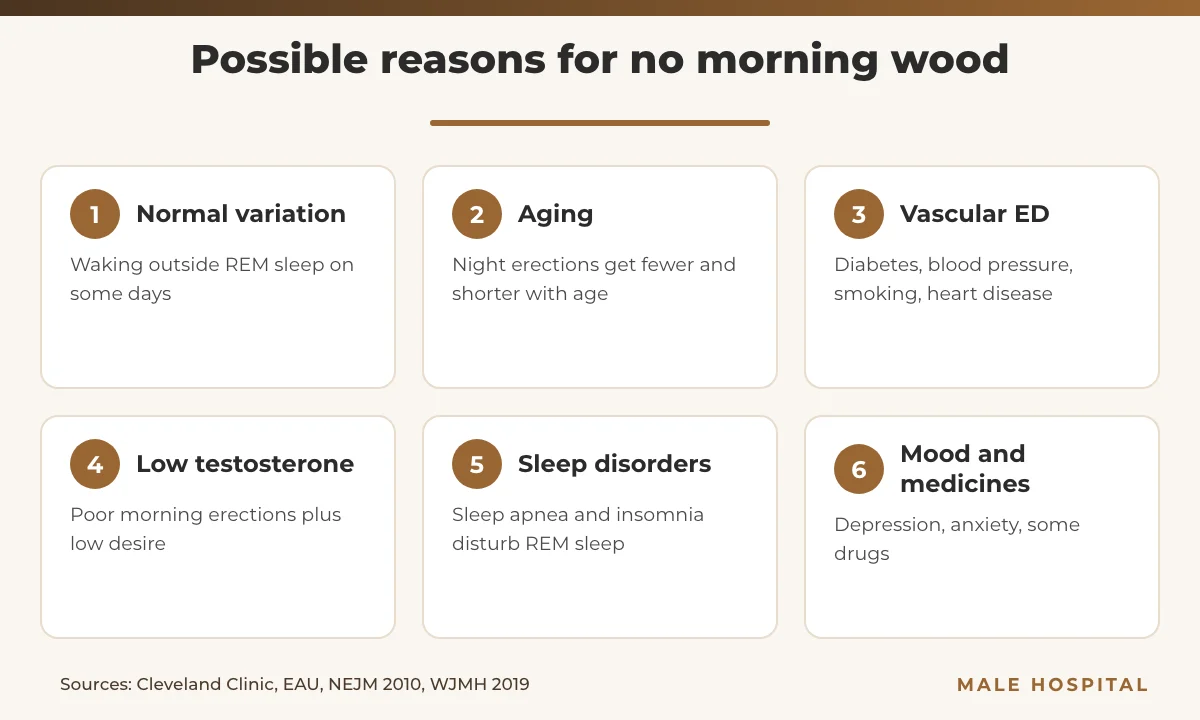
Waking without morning wood occasionally is not usually a concern. Never or almost never having it, especially if this is a change from your normal, can be an early indicator of erectile dysfunction or a hormone imbalance. Sleep disorders and stress can play a part as well.
Source: Cleveland Clinic — Early Risers: Why Men Get Morning Erections
Physical (vascular) erectile dysfunction
The most common cause of ED is reduced blood flow to the penis, often linked to diabetes, high blood pressure, high cholesterol, smoking or heart disease. Because sleep erections rely on the same blood vessels, they tend to weaken too. European guidelines describe ED as a precursor of cardiovascular disease, with higher risk when ED is more severe or long-standing, so a gradual loss of morning erections in a man with these risk factors deserves a heart-health check as well. Our guide on erectile dysfunction and heart disease explains this link.
Sources: NHS — Erectile dysfunction (impotence); EAU Guidelines — Management of erectile dysfunction
Low testosterone
In the European Male Ageing Study of 3,369 men aged 40 to 79, poor morning erections, low sexual desire and erectile dysfunction were the three symptoms most closely tied to low testosterone. Late-onset hypogonadism was defined as at least these three sexual symptoms together with a total testosterone level below 11 nmol/L (3.2 ng/mL). A 2024 study using night-erection monitoring also found fewer and less rigid sleep erections in men with ED and testosterone deficiency. For the full picture, see our guide to low testosterone.
Sources: PubMed — Wu et al., Identification of late-onset hypogonadism in middle-aged and elderly men (NEJM 2010); PubMed — Yuli et al., Association between testosterone levels and RigiScan parameters of patients with ED (Sex Med 2024)
Sleep problems
Because sleep erections ride on REM sleep, anything that fragments sleep can reduce them and, with them, morning wood. Studies report ED in 47% to 80% of men with obstructive sleep apnea, and insomnia has been found to be an independent risk factor for sexual dysfunction. Overall sleep quality appears to matter a great deal for sleep erections.
Source: PMC — Cho & Duffy, Sleep, Sleep Disorders, and Sexual Dysfunction (World J Mens Health 2019)
Mood, stress and medicines
Depression, anxiety and fatigue can reduce sleep erections. Several medicines can also affect erections, including some antidepressants, blood pressure medicines (especially beta-blockers), heart medicines such as digoxin, and sleeping pills. Never stop a prescribed medicine on your own; ask your doctor whether an alternative is possible.
Sources: PMC — Cho & Duffy, Sleep, Sleep Disorders, and Sexual Dysfunction (World J Mens Health 2019); MedlinePlus — Erection problems
Morning wood as a clue: psychological or physical ED?
Doctors ask about morning erections because it helps separate two broad types of erection problems. MedlinePlus puts it simply: if you have erections in the morning or at night while you sleep, the cause of your erection problems is likely not physical. The NHS similarly notes that, depending on the cause, a man with ED may still get erections at other times, such as when he wakes up.
Sources: MedlinePlus — Erection problems; NHS — Erectile dysfunction (impotence)
So a man who wakes with firm morning wood but loses his erection with a partner most likely has an intact erection mechanism, and stress, relationship issues or performance anxiety are more likely to be involved. This pattern is especially common in younger men. Our article on psychological erectile dysfunction covers how it is treated.
The clue is useful but not perfect. Morning wood shows that erections can happen; it does not prove they are firm or long-lasting enough for sex. Physical and emotional factors can also exist side by side, so one does not rule out the other. If your erections are less firm in general, our page on weak erection explains the common causes.
Sources: MedlinePlus — Erection problems; EAU Guidelines — Management of erectile dysfunction
How doctors test night-time erections
The first step in any erection assessment is a detailed medical and sexual history. European Association of Urology (EAU) guidelines specifically ask doctors to record the rigidity and duration of both sexually stimulated erections and morning erections, alongside validated questionnaires such as the IIEF or SHIM.
When an objective answer is needed, doctors can use nocturnal penile tumescence and rigidity (NPTR) testing, typically with a small device worn at home overnight. The EAU recommends recording at least two separate nights. An erection of at least 60% rigidity at the tip of the penis lasting 10 minutes or longer indicates a functional erection mechanism, and men with psychogenic ED usually have normal results.
The test has limits. It is not clear how closely sleep erections mirror erections during sex, and age, depression and sleep quality can all affect the result, so NPTR is used in selected cases rather than routinely. Our guide to the erectile dysfunction test explains where it fits alongside blood tests and penile Doppler ultrasound.
Sources: EAU Guidelines — Management of erectile dysfunction; PMC — Cho & Duffy, Sleep, Sleep Disorders, and Sexual Dysfunction (World J Mens Health 2019)
Can you get morning erections back?
There is no pill that specifically “brings back” morning erections, and chasing it is not the goal. The aim is to find and treat whatever is behind the change. When the cause is addressed, sleep erections and morning wood often improve as a side effect.
- Sleep enough and regularly. Short sleep lowers testosterone, and fragmented sleep cuts REM time, when most sleep erections occur.
- Get snoring and daytime sleepiness checked. Obstructive sleep apnea is common in men with ED. Some studies found better erectile function scores after one to three months of CPAP treatment, although results are inconsistent.
- Look after your blood vessels. Controlling diabetes, blood pressure and cholesterol, and stopping smoking, protect the arteries that supply erections.
- Limit alcohol. The NHS lists drinking too much alcohol among the common causes of occasional erection problems.
- Treat stress, anxiety and depression. Counseling and therapy can help when erection problems are linked to emotional or mental health issues.
Sources: PMC — Leproult & Van Cauter, Effect of 1 week of sleep restriction on testosterone levels in young healthy men (JAMA 2011); PMC — Cho & Duffy, Sleep, Sleep Disorders, and Sexual Dysfunction (World J Mens Health 2019); NHS — Erectile dysfunction (impotence)
Testosterone therapy is only appropriate when blood tests confirm a genuine deficiency together with symptoms. It should not be used just to boost morning erections in a man with normal levels.
When to see a doctor
A change in morning wood is rarely urgent, but it is a good reason for a check-up. See a doctor if you notice:
- Morning erections that have become rare or stopped over several weeks, especially if this is new for you.
- Trouble getting or keeping an erection more than 25% of the time.
- Loss of morning erections together with low sex drive, tiredness or low mood, which can point to low testosterone.
- Loud snoring, pauses in breathing at night or heavy daytime sleepiness, which suggest sleep apnea.
- Erection changes if you have diabetes, high blood pressure, high cholesterol, smoke or have heart disease.
Get emergency care for an erection that lasts more than 4 hours, for example after taking an ED medicine. This is called priapism and needs prompt treatment.
Sources: MedlinePlus — Erection problems; Cleveland Clinic — Early Risers: Why Men Get Morning Erections; EAU Guidelines — Management of erectile dysfunction
If you have noticed a change in your morning erections, you can arrange a confidential consultation with our urologist-andrologist, Assoc. Prof. Dr. Zülfü Sertkaya, through WhatsApp. He can assess the cause and, if needed, explain your options for erectile dysfunction treatment.
FAQs about morning wood
Is it normal to not have morning wood every day?
Yes. Missing a morning erection on some days is normal and usually reflects when you woke up rather than a problem. You mostly notice morning wood if you wake during or just after REM sleep. A consistent absence over several weeks, especially alongside weaker erections during sex, is the pattern worth discussing with a doctor.
Source: Cleveland Clinic — Early Risers: Why Men Get Morning Erections
Does morning wood mean I don’t have erectile dysfunction?
It means the basic erection mechanism is probably working, so a physical cause is less likely. MedlinePlus notes that erections at night or in the morning suggest your erection problem is likely not physical. However, a morning erection does not prove erections are firm or long enough for sex, so persistent difficulties still deserve an assessment.
Source: MedlinePlus — Erection problems
Is no morning wood a sign of low testosterone?
It can be. In the European Male Ageing Study, poor morning erections were one of three sexual symptoms, with low desire and erectile dysfunction, most strongly linked to low testosterone in men aged 40 to 79. Diagnosis still requires a blood test showing low testosterone alongside symptoms, so absent morning erections alone are not enough.
Does morning wood stop with age?
It does not stop completely, but it usually becomes less frequent and less firm. A sleep-laboratory study of healthy men aged 23 to 73 found that night-time erections became less frequent and shorter with age, and most men over 60 lacked full sleep erections while still reporting regular intercourse.
Is morning wood caused by needing to pee?
A full bladder may contribute but is not the main cause. Cleveland Clinic explains that a full bladder can press on nearby sacral nerves that help trigger erections. The main driver is the cycle of erections tied to REM sleep through the night, which happens whether or not your bladder is full.
Source: Cleveland Clinic — Early Risers: Why Men Get Morning Erections
Can stress or poor sleep stop morning erections?
Yes, both can. Depression, anxiety and fatigue can reduce sleep erections, and conditions that disturb sleep, such as obstructive sleep apnea and insomnia, are linked to sexual dysfunction. Overall sleep quality seems to matter a lot. Improving sleep and managing stress often help sleep erections return.
Source: PMC — Cho & Duffy, Sleep, Sleep Disorders, and Sexual Dysfunction (World J Mens Health 2019)
How many erections does a man have during sleep?
MedlinePlus states that most men have 3 to 5 erections at night, each lasting about 30 minutes. These episodes mostly coincide with REM sleep, which repeats in cycles through the night. The number and length of these erections tend to decline as men get older.
Sources: MedlinePlus — Erection problems; PubMed — Mann et al., Temporal relationship between nocturnal erections and REM episodes in healthy men (Neuropsychobiology 2003)
Can a doctor check my night-time erections?
Yes. A urologist can arrange nocturnal penile tumescence and rigidity testing, usually with a device worn at home on at least two nights. An erection with at least 60% tip rigidity lasting 10 minutes or more suggests a working erection mechanism. It is used in selected cases, not for everyone with ED.
Source: EAU Guidelines — Management of erectile dysfunction
Medically reviewed by Assoc. Prof. Dr. Zülfü Sertkaya, urologist and andrologist (FEBU), Istanbul. Last reviewed: November 2026.
This article is for general information and does not replace an individual consultation with a qualified doctor.
- Cleveland Clinic — Early Risers: Why Men Get Morning Erections
- MedlinePlus (U.S. National Library of Medicine) — Erection problems
- EAU Guidelines — Sexual and Reproductive Health — Management of erectile dysfunction
- NHS — Erectile dysfunction (impotence)
- PMC (World Journal of Men's Health) — Cho & Duffy. Sleep, Sleep Disorders, and Sexual Dysfunction (2019)
- PubMed (Curr Neurol Neurosci Rep) — Schmidt & Schmidt. Sleep-related erections: neural mechanisms and clinical significance (2004)
- PubMed (Neuropsychobiology) — Mann et al. Temporal relationship between nocturnal erections and REM episodes in healthy men (2003)
- PMC (JAMA) — Leproult & Van Cauter. Effect of 1 week of sleep restriction on testosterone levels in young healthy men (2011)
- PubMed (J Gerontol) — Schiavi & Schreiner-Engel. Nocturnal penile tumescence in healthy aging men (1988)
- PubMed (Arch Sex Behav) — Schiavi et al. Hormones and nocturnal penile tumescence in healthy aging men (1993)
- PubMed (N Engl J Med) — Wu et al. Identification of late-onset hypogonadism in middle-aged and elderly men (EMAS, 2010)
- PubMed (Sexual Medicine) — Yuli et al. Association between testosterone levels and RigiScan parameters of patients with erectile dysfunction (2024)