The best supplements for erectile dysfunction, judged by the research, are L-arginine and ginseng, yet even these give only small improvements, and only in mild to moderate ED. Most others rest on small or conflicting trials, yohimbe carries heart risks, and many “male enhancement” products hide prescription drugs. For lifestyle steps such as exercise and diet, see our guide to natural remedies for erectile dysfunction.
Source: EAU Guidelines — Management of erectile dysfunction; NCCIH — 4 Things To Know About Dietary Supplements Marketed for Sexual Enhancement
- Among supplements for erectile dysfunction, the European Association of Urology (EAU) gives only a weak recommendation for daily L-arginine or ginseng, and only for men with mild ED who refuse prescription treatment.
- In pooled trials, L-arginine raised the erectile function score by about 2.7 points versus placebo, an improvement many men may not notice.
- A Cochrane review rated the effect of ginseng on erectile function as trivial, based on mostly low-certainty evidence.
- As supplements for erectile dysfunction, tribulus, saffron and maca have mixed or very limited evidence; a 3-year trial of 8,920 men found vitamin D did not reduce ED.
- The FDA keeps finding hidden sildenafil and tadalafil in “natural” sexual enhancement products, which can be dangerous with nitrate heart medicines.
- Best supplements for erectile dysfunction: what the evidence says
- How ED supplements are supposed to work
- L-arginine, L-citrulline and pine bark extract
- Ginseng, saffron, tribulus and maca
- Yohimbe, DHEA and vitamin D: weak or risky choices
- Best supplements for erectile dysfunction compared
- FDA warnings: hidden drugs in ED supplements
- How to approach supplements more safely
- When to see a doctor
- FAQs about the best supplements for erectile dysfunction
Best supplements for erectile dysfunction: what the evidence says
Online claims about the best supplements for erectile dysfunction are bold; the medical literature is much quieter. The EAU guidelines state that, despite rapid growth in the market for herbs and supplements, there is very little robust scientific data on their efficacy and safety.
The EAU concludes that supplements for erectile dysfunction may have a small positive effect on erectile function, of unclear clinical significance. Its only supplement recommendation is a weak one: men with mild ED who refuse drug treatment may use daily L-arginine or ginseng, after being told that any improvement may be mild.
Source: EAU Guidelines — Management of erectile dysfunction
The US National Center for Complementary and Integrative Health (NCCIH) is even more cautious. It says there is no definite evidence that any herbal product is safe or effective for erectile dysfunction, that research on individual herbal supplements for erectile dysfunction is limited, and that much of it has been done in animals rather than people.
Source: NCCIH — 4 Things To Know About Dietary Supplements Marketed for Sexual Enhancement
This guide therefore names no brands; it rates the ingredients of supplements for erectile dysfunction actually tested in men.
How ED supplements are supposed to work
Most supplements for erectile dysfunction target blood flow. Erections depend on nitric oxide, which widens penile blood vessels, and the body makes nitric oxide from the amino acid L-arginine.
L-arginine taken by mouth, however, is heavily broken down before it reaches the circulation. L-citrulline largely escapes this first-pass breakdown and is then converted into L-arginine, which is the rationale for using citrulline as an alternative “donor” for the nitric oxide pathway.
Herbal supplements for erectile dysfunction such as tribulus are often sold as “testosterone boosters.” In tribulus trials, testosterone did not differ from placebo. If you suspect a hormone problem, a blood test is more useful than a booster; our guide on how to increase testosterone naturally explains what actually moves the numbers.
Source: Int J Impot Res 2026 — Suharyani et al. Tribulus terrestris for erectile dysfunction: meta-analysis
L-arginine, L-citrulline and pine bark extract
L-arginine
A 2019 meta-analysis in the Journal of Sexual Medicine pooled 10 randomized trials with 540 men who had mild to moderate ED. Doses of 1,500 to 5,000 mg improved ED compared with placebo or no treatment. Side effects occurred in 8.3% of men taking arginine versus 2.3% on placebo, and none were severe.
The EAU puts this in perspective. A larger meta-analysis of 18 trials it cites found a small but significant effect: the erectile function score of the International Index of Erectile Function (IIEF) rose by an average of 2.74 points versus placebo, with no difference in sexual satisfaction. The guideline notes that an improvement of this size may not be perceived as significant by patients.
Source: EAU Guidelines — Management of erectile dysfunction
Honest verdict: low to moderate certainty of a small benefit in mild to moderate ED. It is one of only two supplements for erectile dysfunction the EAU mentions, and only as a fallback for men who decline proven treatment.
L-citrulline
Among supplements for erectile dysfunction, the evidence for L-citrulline is much thinner. In a small single-blind Italian study, 24 men with mild ED took a placebo for one month and then 1.5 g of L-citrulline daily for another month. Erection hardness improved from “mild ED” to “normal” in 12 of 24 men (50%) on citrulline compared with 2 of 24 (8.3%) on placebo, and no side effects were reported.
The authors themselves stated that citrulline was less effective than prescription PDE5 inhibitor tablets, at least in the short term, and that its role deserves further research.
Source: Urology 2011 — Cormio et al. Oral L-citrulline supplementation improves erection hardness
Honest verdict: very low certainty; plausible but not proven.
Pine bark extract combined with L-arginine
French maritime pine bark extract (from Pinus pinaster) is often combined with L-arginine in supplements for erectile dysfunction. A 2023 meta-analysis found only 3 studies with 184 men. The combination improved the IIEF erectile function domain and other sexual function scores compared with control groups, without changing testosterone levels. The authors called for more randomized trials. On its own, pine bark extract had been tested in a single trial of just 21 men, which a 2018 review described as very preliminary.
Source: Front Endocrinol 2023 — Tian et al. L-arginine and Pycnogenol for male ED: meta-analysis; Drugs 2018 — Borrelli et al. Herbal Dietary Supplements for Erectile Dysfunction: Meta-Analysis
Honest verdict: low certainty; promising small studies only.
Ginseng, saffron, tribulus and maca
Ginseng
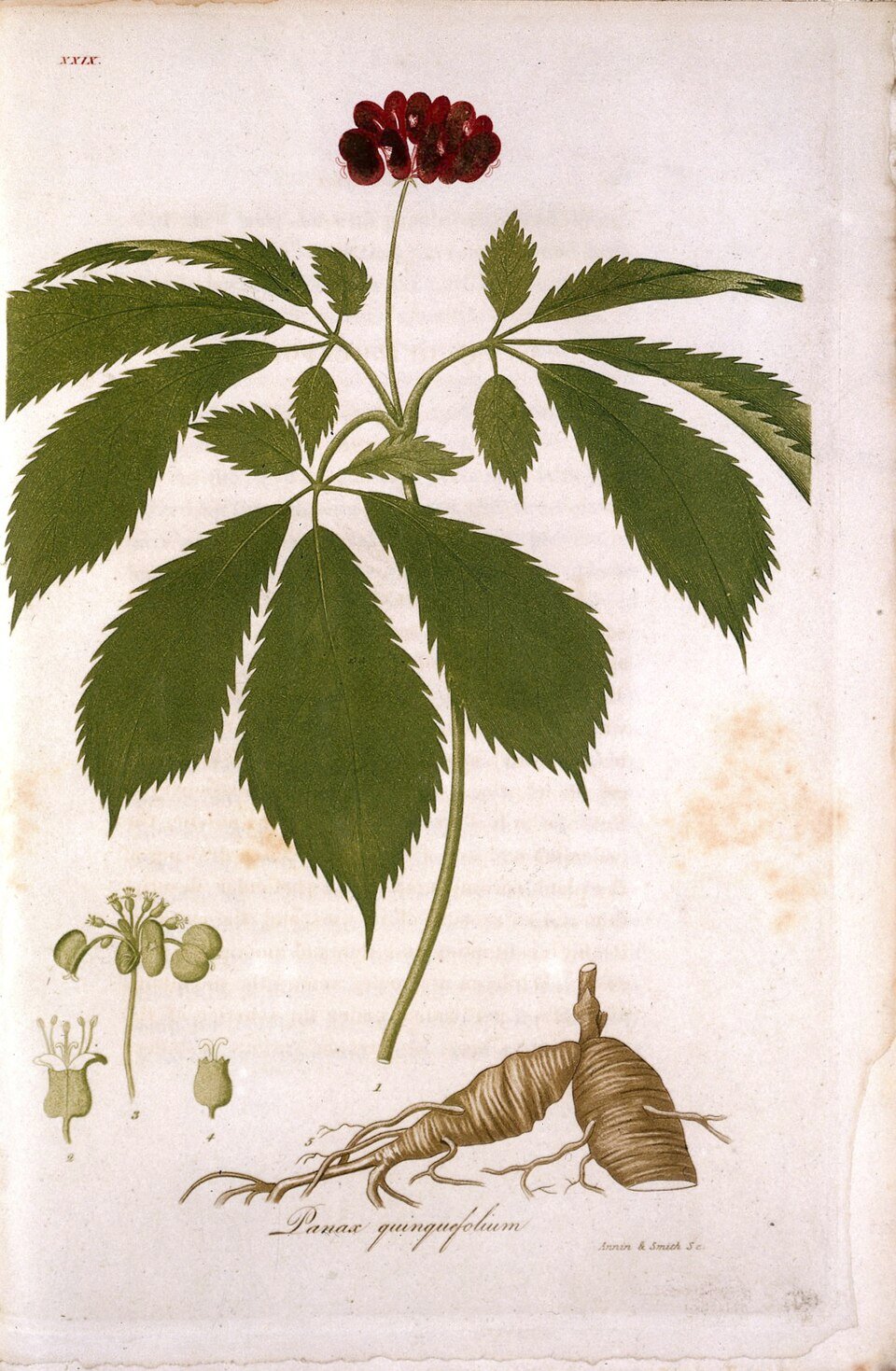
Ginseng (mainly Panax ginseng) is the best-studied herb among supplements for erectile dysfunction. In a 2018 meta-analysis, 5 ginseng trials with 399 men showed a significant improvement in erectile function, but the authors asked for larger, higher-quality trials.
The 2021 Cochrane review, the most rigorous assessment, included 9 placebo-controlled trials with 587 men with mild to moderate ED, followed for no more than 12 weeks. Measured with validated questionnaires, ginseng appeared to have only a trivial effect on erectile function, smaller than the change considered clinically meaningful, based on mostly low-certainty evidence. It may improve men’s self-reported ability to have intercourse, and side effects were similar to placebo. No trial compared ginseng with standard ED medicines.
Source: Cochrane Database Syst Rev 2021 — Lee et al. Ginseng for erectile dysfunction; Drugs 2018 — Borrelli et al. Herbal Dietary Supplements for ED
Safety matters too with supplements for erectile dysfunction. NCCIH reports that short-term use of Asian ginseng (up to 6 months) appears safe for most people, but its long-term safety is uncertain. Insomnia is the most common side effect. Ginseng may lower blood sugar, may interfere with blood clotting and might interact with certain medicines, so men with diabetes or on regular medication should check with a doctor first.
Source: NCCIH — Asian Ginseng
Honest verdict: low to moderate certainty of a small effect; the EAU’s weak recommendation applies to mild ED only.
Saffron
In the 2018 review of supplements for erectile dysfunction, 3 saffron trials with 397 men produced mixed results. A newer 2025 meta-analysis of 14 randomized trials with 1,227 men reported that saffron improved erectile function, orgasmic function and intercourse satisfaction, while also stressing the need for larger, higher-quality trials with longer follow-up.
Source: Drugs 2018 — Borrelli et al. Herbal Dietary Supplements for ED; J Tradit Complement Med 2025 — Herbal dietary supplements for ED: meta-analysis of RCTs
Honest verdict: low certainty; conflicting trials.
Tribulus terrestris
A 2025 meta-analysis of 8 studies reported that it improved the 5-item IIEF score by about 3.2 points more than placebo, with side effects similar to placebo, but total testosterone did not differ between the groups. Other reviews are less positive: the 2018 review found mixed results, and the 2025 meta-analysis of herbal supplements for erectile dysfunction concluded that evidence for tribulus remains insufficient.
Source: Int J Impot Res 2026 — Suharyani et al. Tribulus terrestris for ED: meta-analysis; J Tradit Complement Med 2025 — Herbal dietary supplements for ED: meta-analysis
Honest verdict: low certainty; mixed findings, and no proof that it raises testosterone.
Maca
For maca (Lepidium meyenii), a systematic review found just 4 randomized trials of maca for sexual function, only one of them in men with ED. The reviewers concluded that the evidence is limited and that the number, size and quality of trials were too low to draw firm conclusions. Later reviews of supplements for erectile dysfunction still describe the maca data as very preliminary or insufficient.
Source: BMC Complement Altern Med 2010 — Shin et al. Maca for improving sexual function: a systematic review; J Tradit Complement Med 2025 — Herbal dietary supplements for ED: meta-analysis
Honest verdict: very low certainty.
Other popular herbs, such as horny goat weed, were not among the single-herb ED trials in the 2018 review, and multi-herb formulas showed only preliminary results. The reviewers concluded that more research is needed before herbal supplements for erectile dysfunction can be recommended.
Source: Drugs 2018 — Borrelli et al. Herbal Dietary Supplements for ED
Yohimbe, DHEA and vitamin D: weak or risky choices
Yohimbe
Yohimbe bark contains yohimbine, a compound that an older 1998 meta-analysis of 7 trials found to be better than placebo for ED. However, NCCIH now states that there is not enough research to say whether yohimbe supplements help any condition, and that yohimbine has been linked to irregular heartbeat, blood pressure problems, heart attacks and seizures.
Most yohimbe products do not state their yohimbine content, which varies widely between brands. Yohimbe should not be combined with MAO inhibitor or tricyclic antidepressants.
Source: NCCIH — Yohimbe: Usefulness and Safety; J Urol 1998 — Ernst & Pittler. Yohimbine for erectile dysfunction: meta-analysis
Honest verdict: not recommended among supplements for erectile dysfunction; the safety risks outweigh uncertain benefits, especially for men with heart disease or high blood pressure.
DHEA
DHEA is a hormone precursor sold as a supplement in some countries. The main trial behind its use randomized 40 carefully selected men with low DHEA levels and normal testosterone to 50 mg DHEA or placebo for 6 months. IIEF scores were higher with DHEA, but the authors acknowledged their patient numbers were too small for relevant statistical analysis. No large trial has confirmed this.
Honest verdict: very low certainty; a hormone product that should not be taken without medical advice.
Vitamin D
In the Australian D-Health Trial, 8,920 men aged 60 to 84 received 60,000 IU of vitamin D or placebo each month. After 3 years, ED was just as common in both groups (58.8% vs 59.0%), and no subgroup benefited. The researchers concluded that vitamin D supplementation in older men is unlikely to prevent or improve ED.
Source: Clin Nutr ESPEN 2024 — Duarte Romero et al. Vitamin D supplementation and ED: D-Health Trial
Honest verdict: moderate to high certainty of no benefit for ED in older men (treat a proven deficiency for its own sake).
Best supplements for erectile dysfunction compared: evidence ratings
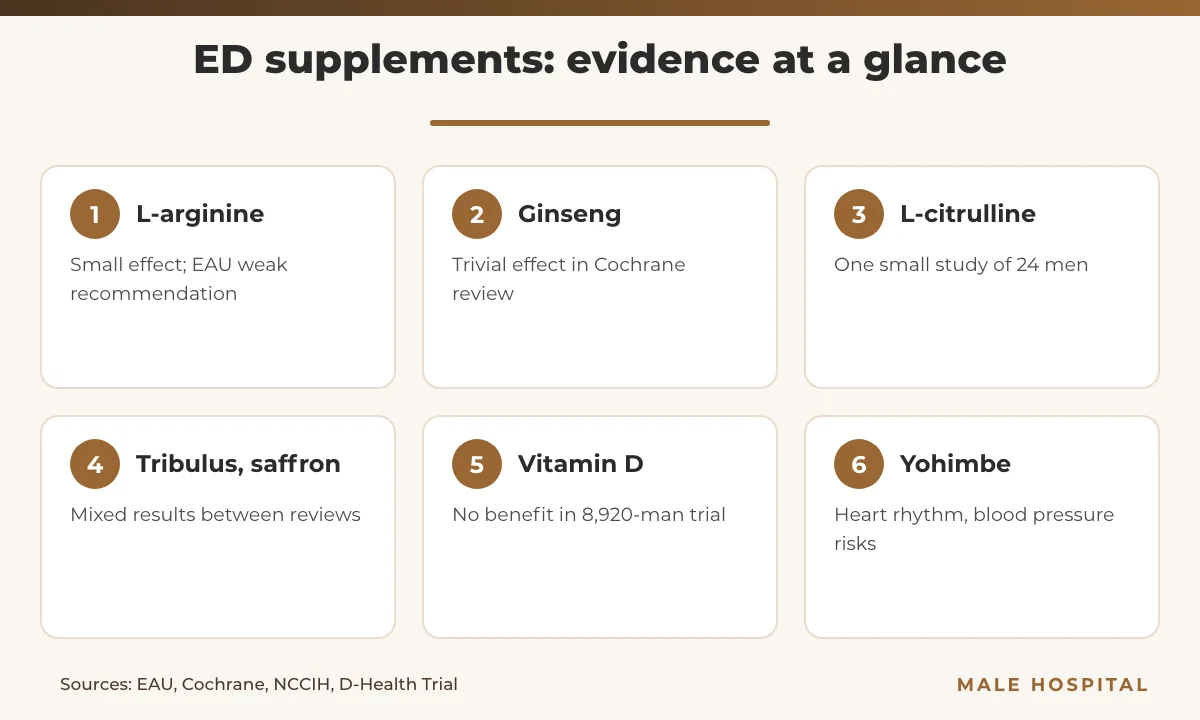
“Certainty” below reflects the number, size and quality of human trials of supplements for erectile dysfunction, not marketing claims.
| Supplement | Best human evidence | Certainty | Main caution |
|---|---|---|---|
| L-arginine | Meta-analyses; IIEF-EF +2.74 points vs placebo | Low to moderate; EAU weak recommendation | Small effect; more mild side effects than placebo |
| Ginseng | Cochrane: 9 trials, 587 men | Low to moderate; trivial effect | Insomnia; blood sugar and clotting effects |
| L-citrulline | One single-blind study, 24 men | Very low | Less effective than PDE5 tablets |
| Pine bark + L-arginine | 3 studies, 184 men | Low | Few, small trials |
| Saffron | Several small trials | Low; conflicting | Results vary between reviews |
| Tribulus terrestris | 8 studies in one meta-analysis | Low; mixed | Does not raise testosterone vs placebo |
| Maca | 1 small ED trial | Very low | Too little data |
| DHEA | 1 trial, 40 selected men | Very low | Hormone product |
| Vitamin D | Large 3-year randomized trial | No benefit shown | Does not prevent or improve ED |
| Yohimbe | Older trials; not enough modern research | Not recommended | Heart rhythm, blood pressure, seizures |
Sources: EAU Guidelines; Cochrane 2021 — Ginseng for ED; D-Health Trial 2024; NCCIH — Yohimbe
For comparison with supplements for erectile dysfunction, prescription PDE5 inhibitors such as sildenafil and tadalafil are recommended by the EAU as first-line therapy for ED. Our comparison of Viagra vs Cialis explains how they differ, and our erectile dysfunction treatment page covers the full range of options, from tablets to implants.
Source: EAU Guidelines — Management of erectile dysfunction
FDA warnings: hidden drugs in ED supplements
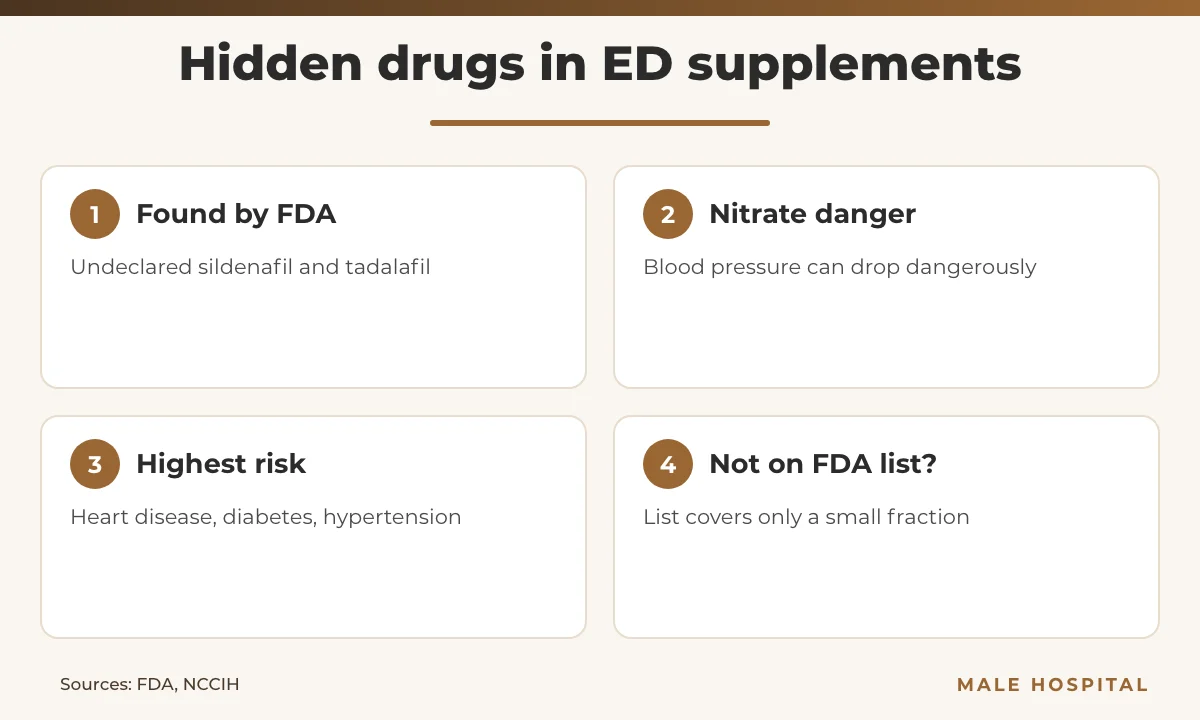
The biggest danger is what some supplements for erectile dysfunction secretly contain. The FDA warns that sexual enhancement and energy products are likely to be contaminated with dangerous hidden ingredients, are often marketed as supplements, foods or natural remedies, and can lead to severe health problems and hospitalization. Its public warning list covers only a small fraction of contaminated products, so a product that is not on the list is not necessarily safe.
Source: FDA — Sexual Enhancement and Energy Product Notifications
What FDA testing finds
FDA laboratory analyses repeatedly find sildenafil and tadalafil, the active ingredients of Viagra and Cialis, in products sold as “natural enhancement” supplements, not listed on the label. In a May 2026 notice, for example, the FDA warned consumers not to buy or use a product marketed as a natural enhancement supplement after finding both drugs in it.
The FDA explains why this is dangerous: these hidden ingredients may interact with nitrates found in some prescription drugs, such as nitroglycerin, and may lower blood pressure to dangerous levels. Men with diabetes, high blood pressure, high cholesterol or heart disease often take nitrates, so they face the greatest risk. Our article on erectile dysfunction and heart disease explains the link.
Source: FDA — Public notification: hidden sildenafil and tadalafil in a natural enhancement supplement
NCCIH adds that you cannot tell whether such drugs are present, because they are not on the label. The NHS similarly warns that many websites sell fake medicines and advises seeing a doctor before buying medicines online. If cost is the reason for choosing supplements for erectile dysfunction, our guide to generic Viagra explains the regulated, lower-cost option.
Source: NCCIH — 4 Things To Know About Dietary Supplements Marketed for Sexual Enhancement; NHS — Erectile dysfunction (impotence)
Warning signs of a tainted product
- It is sold for sexual enhancement or energy and presented as a supplement, food or “all natural” remedy.
- It claims to treat or cure ED; a product that claims to treat a disease is legally a drug, not a supplement.
- It promises drug-like results while listing only herbs on the label.
- It is not on the FDA warning list; that list covers only a small fraction of contaminated products.
Source: FDA — Sexual Enhancement and Energy Product Notifications; FDA — Questions and Answers on Dietary Supplements
How to approach supplements more safely
If you still want to try supplements for erectile dysfunction, a few steps reduce the risk. The US National Institute of Diabetes and Digestive and Kidney Diseases (NIDDK) advises talking with a health care professional before using dietary supplements for ED, because medicines and supplements can affect how other medicines work and may cause serious side effects.
- Get checked first, before taking supplements for erectile dysfunction. Frequent ED may be caused by conditions such as diabetes, high blood pressure or high cholesterol, which need treatment in their own right.
- Tell your doctor everything you take, including over-the-counter products, herbs and supplements.
- Never combine a sexual enhancement product with nitrate medicines.
- Avoid yohimbe and products that do not state exact doses.
- Set a time limit. Most trials of supplements for erectile dysfunction lasted 1 to 6 months; if nothing changes, stop and seek proper assessment.
- Report problems. The FDA asks consumers to report serious reactions to its MedWatch program.
Source: NIDDK — Treatment for Erectile Dysfunction; FDA — Public notification on hidden drug ingredients; J Tradit Complement Med 2025 — Herbal dietary supplements for ED: meta-analysis
Supplements for erectile dysfunction are, at best, an add-on to measures with stronger evidence: exercise, weight loss, a healthy diet and stopping smoking. The EAU strongly recommends lifestyle change before or alongside any ED treatment.
Source: EAU Guidelines — Management of erectile dysfunction
When to see a doctor
The NHS advises seeing a doctor if erection problems keep happening. Do not rely on supplements for erectile dysfunction, and get medical advice promptly, if any of the following apply:
- ED has lasted several weeks or keeps coming back.
- You have chest pain, shortness of breath on exertion, high blood pressure, diabetes or high cholesterol, or you take nitrate medicines.
- You develop an irregular heartbeat, chest symptoms or any severe reaction after taking an “enhancement” product, especially one containing yohimbe.
- Low mood, anxiety or relationship stress are affecting your sex life.
Source: NHS — Erectile dysfunction (impotence); NCCIH — Yohimbe: Usefulness and Safety
If you want an honest opinion on whether supplements for erectile dysfunction make sense for you, or what would work better, you can arrange a confidential consultation with our urologist-andrologist via WhatsApp. Treatment is planned after an individual assessment, and you can read about the options on our erectile dysfunction treatment page.
FAQs about the best supplements for erectile dysfunction
What is the best supplement for erectile dysfunction?
None of the supplements for erectile dysfunction is proven to work as well as prescription treatment. L-arginine and ginseng have the most trials, and the EAU allows them only as a weak option for mild ED in men who refuse medicines, with small expected benefits.
Source: EAU Guidelines — Management of erectile dysfunction
How much L-arginine is used in ED studies?
Trials pooled in a 2019 meta-analysis used 1,500 to 5,000 mg a day in men with mild to moderate ED, and treatment lengths varied widely. Side effects were more common than with placebo (8.3% vs 2.3%) but none were severe. Because doses of these supplements for erectile dysfunction were not standardized, ask a doctor before starting, especially if you take blood pressure medicines.
Source: J Sex Med 2019 — Rhim et al. Arginine supplements for ED: meta-analysis
Does ginseng really help erections?
Only slightly, if at all. A 2021 Cochrane review of 9 trials with 587 men found that ginseng may have a trivial effect on erectile function compared with placebo, based mostly on low-certainty evidence, though it may improve men’s self-reported ability to have intercourse. All trials were short, at 12 weeks or less, and none compared ginseng with ED medicines.
Source: Cochrane Database Syst Rev 2021 — Ginseng for erectile dysfunction
Are “male enhancement” pills safe?
Many are not. The FDA says sexual enhancement products are likely to be contaminated with dangerous hidden ingredients, and its testing has found undeclared sildenafil and tadalafil. These can cause a dangerous drop in blood pressure in men taking nitrates. The FDA’s warning list covers only a small fraction of such products, so absence from the list does not mean safety.
Source: FDA — Sexual Enhancement and Energy Product Notifications
Can testosterone boosters fix erectile dysfunction?
Herbal “testosterone boosters” have not been shown to raise testosterone meaningfully. In a 2025 meta-analysis, tribulus did not change total testosterone compared with placebo, and the pine bark plus arginine combination did not alter testosterone either. If low testosterone is suspected, a blood test and medical assessment are the right first step.
Source: Int J Impot Res 2026 — Tribulus terrestris for ED: meta-analysis; Front Endocrinol 2023 — L-arginine and Pycnogenol for ED
Are supplements approved by the FDA?
No. Under US law, the FDA cannot approve dietary supplements, including supplements for erectile dysfunction, before they are sold; manufacturers are responsible for safety and labeling. A product marketed to treat a disease such as ED meets the legal definition of a drug, so any supplement claiming to “cure” ED is making a claim it is not allowed to make.
Source: FDA — Questions and Answers on Dietary Supplements
Medically reviewed by Assoc. Prof. Dr. Zülfü Sertkaya, urologist and andrologist (FEBU), Istanbul. Last reviewed: November 2026.
This article is for general information and does not replace an individual consultation with a qualified doctor.
- EAU — Sexual and Reproductive Health Guidelines — Management of erectile dysfunction
- NCCIH — 4 Things To Know About Dietary Supplements Marketed for Sexual Enhancement
- NCCIH — Asian Ginseng
- NCCIH — Yohimbe: Usefulness and Safety
- FDA — Sexual Enhancement and Energy Product Notifications
- FDA — X10 Natural Enhancement Supplement may be harmful due to hidden drug ingredients
- FDA — Questions and Answers on Dietary Supplements
- NIDDK — Treatment for Erectile Dysfunction
- NHS — Erectile dysfunction (impotence)
- J Sex Med 2019 — Rhim et al. The Potential Role of Arginine Supplements on Erectile Dysfunction: A Systemic Review and Meta-Analysis
- Cochrane 2021 — Lee et al. Ginseng for erectile dysfunction
- Drugs 2018 — Borrelli et al. Herbal Dietary Supplements for Erectile Dysfunction: A Systematic Review and Meta-Analysis
- J Tradit Complement Med 2025 — Herbal dietary supplements for erectile dysfunction: A systematic review and meta-analysis of randomized-controlled trials
- Urology 2011 — Cormio et al. Oral L-citrulline supplementation improves erection hardness in men with mild erectile dysfunction
- Front Endocrinol 2023 — Tian et al. Efficacy of L-arginine and Pycnogenol in the treatment of male erectile dysfunction: meta-analysis
- Int J Impot Res 2026 — Suharyani et al. Tribulus terrestris for management of patients with erectile dysfunction: meta-analysis
- BMC Complement Altern Med 2010 — Shin et al. Maca (L. meyenii) for improving sexual function: a systematic review
- J Urol 1998 — Ernst & Pittler. Yohimbine for erectile dysfunction: a systematic review and meta-analysis
- Urology 1999 — Reiter et al. Dehydroepiandrosterone in the treatment of erectile dysfunction: randomized placebo-controlled study
- Clin Nutr ESPEN 2024 — Duarte Romero et al. The effect of three years of vitamin D supplementation on erectile dysfunction: D-Health Trial