Erectile dysfunction test is not one single test: doctors diagnose ED with a step-by-step work-up that starts with your medical and sexual history, a short questionnaire such as the IIEF-5 (SHIM), a physical exam and blood tests for blood sugar, cholesterol and morning testosterone. Most men need nothing more. Specialized tests, such as nocturnal erection monitoring or a penile Doppler ultrasound after an erection-inducing injection, are reserved for specific situations defined in the European (EAU) and American (AUA) urology guidelines.
Source: EAU Guidelines — Management of erectile dysfunction; PubMed — Burnett et al., Erectile Dysfunction: AUA Guideline (J Urol 2018)
- The basic erectile dysfunction test work-up is a detailed history, a validated questionnaire, a focused physical exam and blood tests. The EAU rates all of these as strong recommendations.
- The IIEF-5 (SHIM) scores erections from 5 to 25. A score of 21 or lower suggests ED, and the score also grades how severe it is.
- The standard erectile dysfunction test bloods are fasting glucose or HbA1c, a lipid profile and an early-morning, fasting total testosterone.
- Because ED can come before heart disease, the erectile dysfunction test also looks at blood pressure, weight and cardiovascular risk.
- Nocturnal erection testing and penile Doppler ultrasound are only needed in selected cases, such as young men after pelvic trauma, penile curvature, complex hormonal or psychological problems, or before surgery.
- What is an erectile dysfunction test?
- Step 1: Your history and the IIEF-5 (SHIM) questionnaire
- Step 2: The physical exam
- Step 3: Blood tests for erectile dysfunction
- Step 4: Checking your heart and vascular risk
- When a specialized erectile dysfunction test is needed
- Nocturnal penile tumescence (night-time erection) testing
- Penile Doppler ultrasound and the injection test
- When to see a doctor
- FAQs about the erectile dysfunction test
What is an erectile dysfunction test?
Erectile dysfunction (ED) means you cannot get or keep an erection firm enough for satisfying sex. When people search for an erectile dysfunction test, they usually picture a single scan or blood test. In reality, the diagnosis is clinical: it is made mainly from what you tell your doctor, and the tests are used to find the cause and any hidden health problems behind it.
The EAU guideline states that most patients can be managed on the basis of their medical and sexual history alone, the first erectile dysfunction test. The rest of the work-up, including the physical exam and blood tests, aims to identify reversible and modifiable risk factors such as diabetes, high cholesterol or low testosterone. If you are new to the condition, our guide to erectile dysfunction explains how erections work and why they fail.
Source: EAU Guidelines — Management of erectile dysfunction
The AUA guideline, published in 2018, takes the same approach. It describes ED care as shared decision-making between the doctor, the man and, where possible, his partner, and it states that every treatment option that is not contraindicated may be offered as a first-line choice. In other words, each erectile dysfunction test is there to guide the conversation, not to delay treatment.
Source: PubMed — Burnett et al., Erectile Dysfunction: AUA Guideline (J Urol 2018)
Step 1: Your history and the IIEF-5 (SHIM) questionnaire
The medical and sexual history
The most important erectile dysfunction test is a careful conversation. The EAU recommends a detailed medical and sexual history from the patient and, when available, the partner. Your doctor will ask how firm your erections are and how long they last, both with sexual stimulation and on waking in the morning, and whether you have problems with desire, arousal, ejaculation or orgasm.
Expect questions about:
- Medicines, including over-the-counter drugs, vitamins, herbal products and supplements.
- Smoking, alcohol and recreational drug use.
- Diabetes, high blood pressure, heart or blood vessel disease, and past pelvic surgery or trauma.
- Symptoms of low testosterone, such as low sex drive, low energy and fatigue.
- Stress, mood, anxiety and how the problem is affecting your relationship.
Source: EAU Guidelines — Management of erectile dysfunction; NIDDK — Diagnosis of Erectile Dysfunction
As an erectile dysfunction test, the history also helps separate physical from psychological causes. A psychological cause is more likely in young, healthy men whose problem started suddenly, often after an emotional event, or that happens only in certain situations. Men with psychogenic ED usually still have normal erections at night and on waking. Depression is common and easy to miss, so screening for it is considered an important part of the visit. Our article on psychological erectile dysfunction covers these clues in detail.
Source: MSD Manual Professional — Erectile Dysfunction
The IIEF-5 (SHIM) questionnaire
The EAU strongly recommends using a validated questionnaire, such as the International Index of Erectile Function (IIEF), to measure sexual function and later the effect of treatment. In daily practice many clinics use, as a quick erectile dysfunction test, its short form, the IIEF-5, also called the Sexual Health Inventory for Men (SHIM). It was developed and validated in 1999 in a study of 1,152 men, 1,036 with ED and 116 without.
The IIEF-5 erectile dysfunction test asks five questions about the past six months: your confidence that you can get and keep an erection, how often erections were hard enough for penetration, how often you could keep the erection after penetration, how difficult it was to keep it until the end of intercourse, and how often intercourse was satisfying. Each answer scores 1 to 5, so the total ranges from 5 to 25.
In the original study of this erectile dysfunction test, a cut-off score of 21 separated men with and without ED with a sensitivity of 0.98 and a specificity of 0.88. That means a score of 21 or less suggests ED, and the score is then used to grade severity.
Source: PubMed — Rosen et al., Development and evaluation of the IIEF-5 (Int J Impot Res 1999); PMC — Dostálová et al., ED in young myocardial infarction survivors (Am J Mens Health 2017)
| IIEF-5 (SHIM) score | Interpretation |
|---|---|
| 22–25 | No erectile dysfunction |
| 17–21 | Mild ED |
| 12–16 | Mild to moderate ED |
| 8–11 | Moderate ED |
| 5–7 | Severe ED |
Source: PMC — Dostálová et al., ED in young myocardial infarction survivors (Am J Mens Health 2017)
A questionnaire-based erectile dysfunction test supports the diagnosis but does not explain the cause, and it is not a substitute for a medical assessment. The EAU also mentions the Erectile Hardness Score as a simple way to rate how rigid erections are.
Source: EAU Guidelines — Management of erectile dysfunction
Step 2: The physical exam
A focused physical exam is a strong EAU recommendation for every man with ED. It covers the genital, hormonal (endocrine), blood vessel and nervous systems. The doctor looks for problems you may not have noticed, such as a hard plaque in the penis from Peyronie’s disease, genital skin lesions, an enlarged or irregular prostate, or signs of low testosterone such as small, soft testicles.
The exam usually includes:
- Blood pressure and heart rate, if they were not measured in the previous 3–6 months.
- Body mass index (BMI) or waist circumference, to screen for metabolic syndrome.
- Examination of the penis and testicles.
- Checks of pulses in the legs and simple nerve tests, such as sensation around the genitals and pelvic reflexes.
- A rectal exam of the prostate in selected men, for example if you have urinary symptoms.
Source: EAU Guidelines — Management of erectile dysfunction; MSD Manual Professional — Erectile Dysfunction; NHS — Erection problems (erectile dysfunction)
Many men worry about this part of the erectile dysfunction test, but it is usually brief and painless. It matters because some findings, such as penile curvature or a prostate nodule, change which further tests and treatments are appropriate.
Step 3: Blood tests for erectile dysfunction
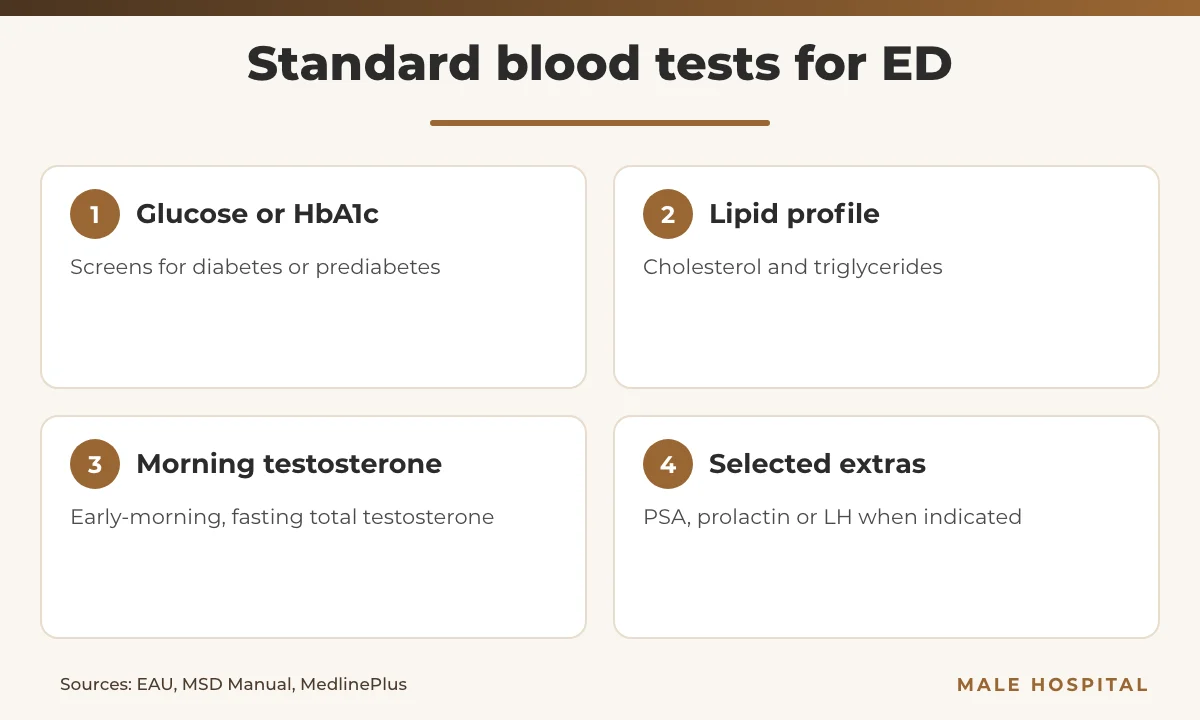
Blood tests are the part of an erectile dysfunction test that most often uncovers a treatable cause. The EAU recommends checking glucose, a lipid profile and total testosterone in every man with ED, rated as a strong recommendation, to identify reversible and modifiable risk factors.
- Fasting blood glucose or HbA1c to look for diabetes or prediabetes, if not tested in the previous 12 months.
- Lipid profile (cholesterol and triglycerides), also if not tested in the previous 12 months.
- Early-morning total testosterone, taken while fasting. Free or bioavailable testosterone may be needed to confirm a borderline result.
- Selected extra tests: PSA, prolactin or luteinizing hormone (LH), depending on your age, symptoms and first results.
Source: EAU Guidelines — Management of erectile dysfunction
For the erectile dysfunction test, testosterone is measured in the morning, typically between 7 and 10 a.m., because levels are usually highest then. If testosterone comes back low or low-normal, doctors typically add prolactin and LH to look for a pituitary cause, and they may check for thyroid disease or other hormone disorders when symptoms suggest them. Cleveland Clinic notes that some men also have a complete blood count, liver and kidney function tests, thyroid tests and a urine test, depending on what the doctor suspects. If you have fatigue, low libido or loss of body hair, read our guide to low testosterone symptoms.
Source: MSD Manual Professional — Erectile Dysfunction; Cleveland Clinic — Erectile Dysfunction; MedlinePlus — Testosterone Levels Test
A new diagnosis of diabetes is one of the most important things an erectile dysfunction test can find. Diabetes damages both blood vessels and nerves, and it changes how ED is managed. Our article on erectile dysfunction and diabetes explains this link.
Step 4: Checking your heart and vascular risk
The EAU describes ED as a potential early warning sign of cardiovascular disease, with more severe and longer-lasting ED carrying greater risk. The same narrowed, stiff arteries that limit blood flow to the penis can affect the heart. For this reason, a full erectile dysfunction test always looks beyond the penis.
For men whose ED appears mainly vascular, the EAU summarizes the Princeton IV recommendations, which use the ACC/AHA 10-year ASCVD risk score. This estimates your chance of a major heart or stroke event over ten years from your age, blood pressure, cholesterol, smoking and diabetes status. The risk is graded as low (under 5%), borderline (5% to under 7.5%), intermediate (7.5% to under 20%) or high (20% or more). Because the score may underestimate risk in men aged 40–60, the panel suggests a coronary artery calcium CT scan for men in the borderline and intermediate groups.
Men who already have heart symptoms or known heart disease are assessed during the erectile dysfunction test for how safe sexual activity is. Those at intermediate or uncertain risk usually need an exercise stress test before resuming sex.
Source: EAU Guidelines — Management of erectile dysfunction
The MSD Manual advises that men with new-onset vascular ED should be referred to a cardiologist, because ED can be the first sign of undiagnosed heart disease. Learn more in our guide to erectile dysfunction and heart disease.
Source: MSD Manual Professional — Erectile Dysfunction
When a specialized erectile dysfunction test is needed
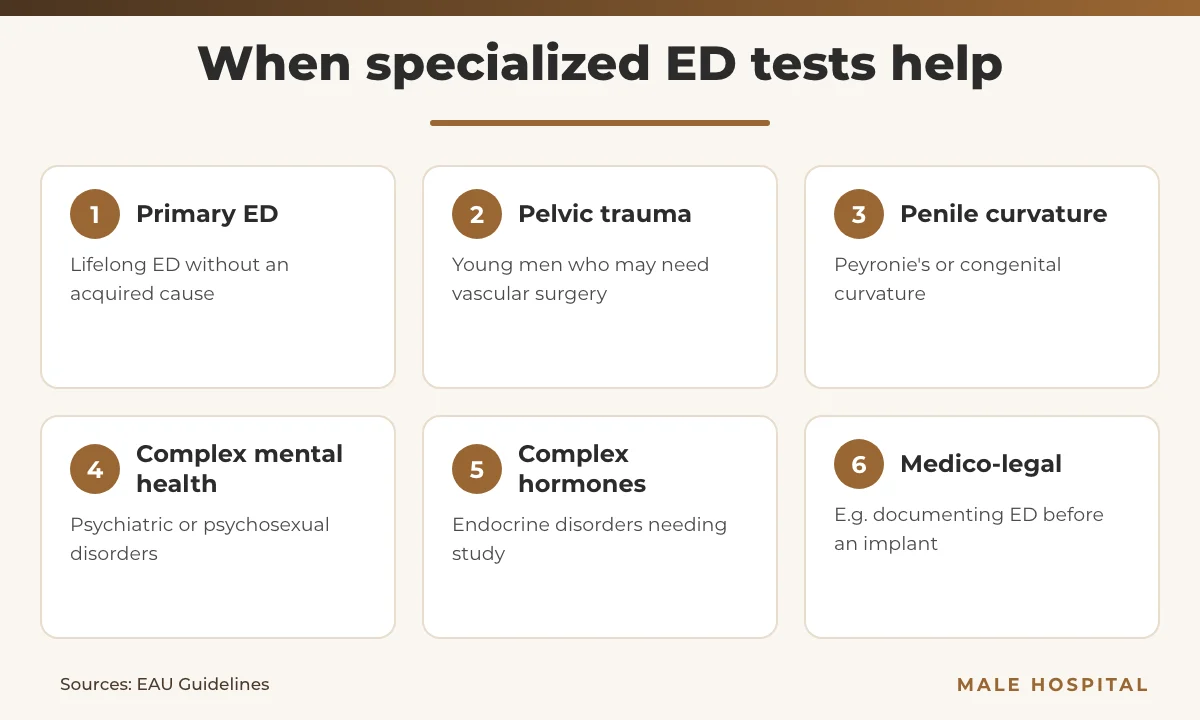
Most men never need more than the basic erectile dysfunction test work-up. The EAU lists specific situations in which specialized testing is recommended, mainly when the result will change treatment. According to the EAU, specialized tests are indicated in:
- Primary ED, meaning lifelong ED not caused by an acquired disease or psychological problem.
- Young men with pelvic or perineal trauma who might benefit from vascular surgery or angioplasty.
- Penile deformities that may need surgery, such as Peyronie’s disease or congenital curvature.
- Complex psychiatric or psychosexual disorders.
- Complex hormonal (endocrine) disorders.
- When the patient or partner requests it.
- Medico-legal reasons, for example documenting severe ED before penile prosthesis surgery.
Source: EAU Guidelines — Management of erectile dysfunction
The specialized erectile dysfunction test options include nocturnal penile tumescence and rigidity testing, the intracavernous injection test, dynamic penile duplex (Doppler) ultrasound, specialized hormone studies and specialized psychological evaluation. Two rarer tests are reserved for very specific cases. Internal pudendal arteriography, an X-ray of the penile arteries with contrast dye, should only be done in men being considered for penile revascularization surgery. Cavernosometry and cavernosography, which measure and image venous outflow, are now used infrequently.
Source: EAU Guidelines — Management of erectile dysfunction; MSD Manual Professional — Erectile Dysfunction
Nocturnal penile tumescence (night-time erection) testing
Healthy men have several erections during sleep. The nocturnal penile tumescence (NPT) erectile dysfunction test records these sleep-related erections to help tell a physical cause from a psychological one. If your erections during sleep are normal, the “hardware” of the penis is probably working, and psychological factors become more likely. According to NIDDK, the test can be done at home or in a sleep laboratory.
Source: MSD Manual Professional — Erectile Dysfunction; NIDDK — Diagnosis of Erectile Dysfunction
The best-known device for this erectile dysfunction test is the RigiScan, a portable monitor worn overnight that records both swelling (tumescence) and rigidity of the penis. The EAU recommends monitoring on at least two separate nights. An erection of at least 60% rigidity at the tip of the penis lasting at least 10 minutes indicates a functioning erectile mechanism.
Source: EAU Guidelines — Management of erectile dysfunction
Limits of night-time testing
NPT is not a perfect erectile dysfunction test. The EAU notes that sleep erections do not always reflect erections during sex, and that depression, poor sleep and other factors can affect results, which limits routine use. A review of NPT methods, from sleep-lab recording to strain gauges and the RigiScan, concluded that none is a true gold standard. A small 1992 study also found that men with diabetes who had normal sexual function often had abnormal NPT results, so an abnormal recording in a diabetic man does not by itself prove permanent ED.
Source: PMC — Gao et al., Nocturnal penile tumescence monitoring (Transl Androl Urol 2015); PubMed — Nofzinger et al., NPT in sexually functional diabetic men (Arch Intern Med 1992)
Penile Doppler ultrasound and the injection test
The intracavernosal injection test
In this office erectile dysfunction test, a small dose of a medicine that relaxes the erectile tissue is injected into the side of the penis. NIDDK explains that the doctor then checks how full the penis gets and how long the erection lasts. The EAU defines a positive result as a rigid erection, one that cannot be bent, appearing within 10 minutes and lasting 30 minutes. On its own the test gives only limited information about blood flow, so a Doppler study is added when it is clinically needed.
Source: NIDDK — Diagnosis of Erectile Dysfunction; EAU Guidelines — Management of erectile dysfunction
Dynamic penile duplex (Doppler) ultrasound
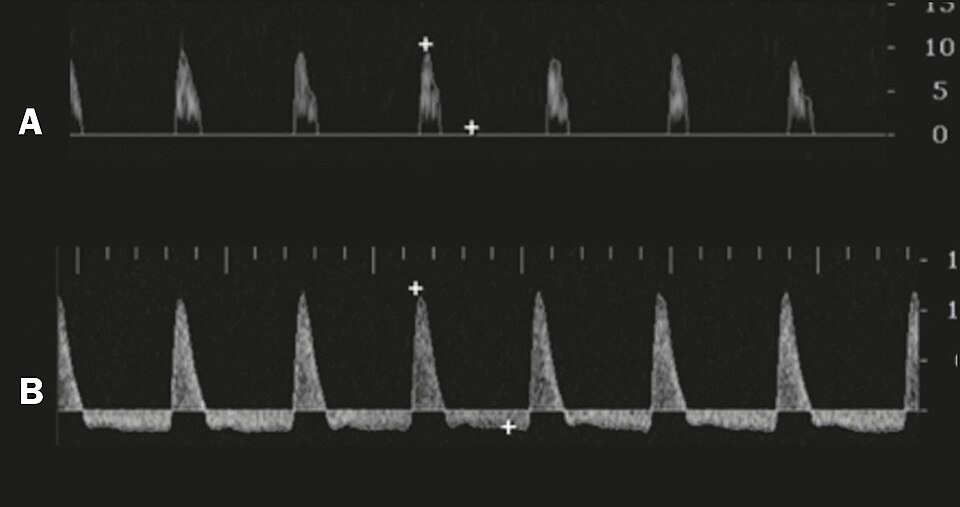
Penile duplex Doppler ultrasound is the most commonly used erectile dysfunction test to study the blood vessels of the penis. After the injection, an ultrasound probe measures blood flow in the cavernosal arteries. The EAU suggests it when blood-vessel ED is suspected, for example in men with diabetes, several cardiovascular risk factors, peripheral vascular disease, a kidney transplant, or a poor response to ED tablets.
Three numbers are reported from this erectile dysfunction test. Peak systolic velocity (PSV) reflects arterial inflow, end-diastolic velocity (EDV) reflects venous outflow, and the resistive index (RI) is an indirect measure of how well the penis traps blood. The EAU usually considers PSV above 30 cm/s, EDV below 3 cm/s and RI above 0.8 to be normal. If the scan is normal, no further vascular investigation is needed.
Source: EAU Guidelines — Management of erectile dysfunction; MSD Manual Professional — Erectile Dysfunction
Cut-offs for this erectile dysfunction test are not fully standardized. An ISSM-summarized analysis of 86 studies recommended PSV below 30 cm/s to diagnose poor arterial inflow and EDV of 5 cm/s or more for venous leak, while noting cited ranges of 25–35 cm/s and 3–7 cm/s. Anxiety keeps the erectile muscle tight and is the most common cause of a falsely abnormal scan, which is why experts recommend re-dosing the medicine until the erection is as full as possible. The review also cited a 47% false diagnosis rate for venous leak in men diagnosed at an outside center, and it stresses that only trained clinicians who can reverse a prolonged erection should perform the test.
Source: ISSM — Duplex Doppler ultrasound in the evaluation of patients with ED; PMC — Nascimento et al., Methodology pitfalls in duplex Doppler ultrasound (J Sex Med 2020)
All ED tests at a glance
| Test | What it shows | Who needs it |
|---|---|---|
| History + IIEF-5 (SHIM) | Whether ED is present, its severity and likely causes | Every man |
| Physical exam | Penile, prostate, hormonal, vascular and nerve findings | Every man |
| Glucose/HbA1c, lipids, morning testosterone | Diabetes, high cholesterol, low testosterone | Every man |
| Cardiovascular risk assessment | 10-year heart risk and safety of sexual activity | Especially men with vascular ED or heart symptoms |
| Nocturnal tumescence (RigiScan) | Whether sleep erections are normal | Selected men, e.g. suspected psychogenic or medico-legal cases |
| Injection test + penile Doppler | Arterial inflow and venous outflow | Suspected vascular ED, poor tablet response, before surgery |
| Arteriography, cavernosometry | Detailed vessel anatomy and venous leak | Rare; candidates for vascular surgery |
Source: EAU Guidelines — Management of erectile dysfunction
When to see a doctor
Occasional erection problems are common and are often linked to stress, tiredness or alcohol. The NHS advises seeing a doctor or sexual health clinic if erection problems keep happening, because they can be a sign of a treatable health condition. Book an assessment and erectile dysfunction test promptly if:
- ED keeps happening or is getting steadily worse.
- You also have chest pain, shortness of breath on exertion, high blood pressure, diabetes or a family history of early heart disease.
- You notice low sex drive, tiredness or loss of body hair, which can point to low testosterone.
- You see a new bend, lump or painful area in the penis.
- ED started after a pelvic injury, surgery or a new medicine.
Get emergency care for chest pain, and for an erection that lasts more than 3 to 4 hours. The NHS lists some ED treatments among the causes of this condition, called priapism.
Source: NHS — Erection problems (erectile dysfunction); NHS — Priapism (painful erections)
If you would like a confidential, step-by-step erectile dysfunction test, our urologist-andrologist can review your history and results and explain your erectile dysfunction treatment options. You can start with a free, private consultation on WhatsApp.
FAQs about the erectile dysfunction test
Is there a single test for erectile dysfunction?
No. There is no single erectile dysfunction test; ED is diagnosed mainly from your medical and sexual history, often supported by a questionnaire such as the IIEF-5. The physical exam and blood tests look for the cause and for related conditions such as diabetes, high cholesterol or low testosterone. Scans and night-time erection tests are used only in selected men, as listed in the EAU guideline.
Source: EAU Guidelines — Management of erectile dysfunction
Can I take an erectile dysfunction test at home?
You can fill in the five-question IIEF-5 (SHIM) yourself, and a total of 21 or less suggests ED. Some night-time erection monitoring can also be done at home. However, a home erectile dysfunction test cannot tell you why ED is happening or whether you have diabetes or heart risk, so it should lead to a medical check rather than replace one.
Source: PubMed — Rosen et al., IIEF-5 (Int J Impot Res 1999); NIDDK — Diagnosis of Erectile Dysfunction
What blood tests are done for erectile dysfunction?
The EAU recommends fasting glucose or HbA1c and a lipid profile if they have not been checked in the last 12 months, plus an early-morning fasting total testosterone. Depending on symptoms and results, doctors may extend the erectile dysfunction test with free testosterone, prolactin, LH, PSA, thyroid tests, kidney and liver tests or a blood count.
Source: EAU Guidelines — Management of erectile dysfunction; Cleveland Clinic — Erectile Dysfunction
Why does testosterone have to be tested in the morning?
Testosterone levels change through the day and are typically highest between 7 and 10 a.m., so guidelines ask for an early-morning sample for the erectile dysfunction test, taken fasting according to the EAU, to avoid falsely low readings. If the result is low or borderline, doctors may add free testosterone, LH or prolactin before low testosterone is diagnosed.
Source: EAU Guidelines — Management of erectile dysfunction; MedlinePlus — Testosterone Levels Test
Is a penile Doppler ultrasound painful?
The probe used in this erectile dysfunction test is painless; the only discomfort is usually the small injection into the penis, and most of the time is spent waiting for the erection and scanning. The main risk is an erection that lasts too long, so the test should be done by trained clinicians who can reverse it. Seek urgent help for any erection lasting more than 3 to 4 hours.
Source: ISSM — Duplex Doppler ultrasound in the evaluation of patients with ED; NHS — Priapism (painful erections)
Do morning erections mean my ED is psychological?
Normal erections on waking or during sleep suggest that the nerves and blood vessels are working, which points toward a psychological cause. They do not rule out a physical problem, though, because most ED is mixed. Doctors still complete the erectile dysfunction test, checking blood pressure, blood sugar, cholesterol and testosterone, before deciding.
Source: MSD Manual Professional — Erectile Dysfunction
Do I need tests before taking Viagra or Cialis?
Many men can start tablets after a basic erectile dysfunction test (history, exam and blood tests), without scans. This check matters because ED can be an early sign of heart disease or diabetes, and because doctors need to know whether sexual activity and these medicines are safe for you. Specialized tests are only added when guideline criteria apply.
Source: EAU Guidelines — Management of erectile dysfunction; PubMed — Burnett et al., Erectile Dysfunction: AUA Guideline (J Urol 2018)
How long does a full ED evaluation take?
The history, questionnaire and physical exam parts of the erectile dysfunction test can usually be completed in one visit, with blood results following later. Night-time erection monitoring needs at least two nights according to the EAU. During a Doppler scan, measurements are often taken over several minutes after the injection, commonly at 5, 10 and 20 minutes in timed protocols.
Source: EAU Guidelines — Management of erectile dysfunction; PMC — Nascimento et al., Methodology pitfalls in duplex Doppler ultrasound (J Sex Med 2020)
Medically reviewed by Assoc. Prof. Dr. Zülfü Sertkaya, urologist and andrologist (FEBU), Istanbul. Last reviewed: October 2026.
This article is for general information and does not replace an individual consultation with a qualified doctor.
- EAU — Sexual and Reproductive Health Guidelines — Management of erectile dysfunction
- PubMed — J Urol 2018 — Burnett et al. Erectile Dysfunction: AUA Guideline
- NIDDK — Diagnosis of Erectile Dysfunction
- MSD Manual Professional — Erectile Dysfunction
- Cleveland Clinic — Erectile Dysfunction
- NHS — Erection problems (erectile dysfunction)
- NHS — Priapism (painful erections)
- MedlinePlus — Testosterone Levels Test
- PubMed — Int J Impot Res 1999 — Rosen et al. Development and evaluation of an abridged, 5-item version of the IIEF (IIEF-5)
- PMC — Am J Mens Health 2017 — Dostálová et al. Erectile dysfunction in young myocardial infarction survivors
- ISSM — Duplex Doppler Ultrasound in the Evaluation of Patients With Erectile Dysfunction
- PMC — J Sex Med 2020 — Nascimento et al. Methodology pitfalls in duplex Doppler ultrasound in ED
- PMC — Transl Androl Urol 2015 — Gao et al. Nocturnal penile tumescence monitoring: what have we done and what should we do?
- PubMed — Arch Intern Med 1992 — Nofzinger et al. NPT studies are abnormal in sexually functional diabetic men