Low testosterone symptoms in men most often start in the bedroom: a lower sex drive, fewer morning erections and weaker erections are the most specific signs. Fatigue, loss of muscle, more body fat, low mood and poor concentration can follow, but these are common in many other conditions too. That is why a diagnosis needs both symptoms and at least two low early-morning blood tests, not symptoms alone.
Source: EAU — Sexual and Reproductive Health Guidelines: Male Hypogonadism; AUA — Evaluation and Management of Testosterone Deficiency
- Sexual symptoms (low libido, fewer spontaneous or morning erections, erectile dysfunction) are the most specific signs of low testosterone.
- Diagnosis requires symptoms plus low total testosterone on at least two separate early-morning tests; the AUA uses below 300 ng/dL and the EAU 12 nmol/L (3.5 ng/mL).
- Obesity, type 2 diabetes, opioid use, pituitary problems and testicular damage are common causes; normal ageing alone causes only a slow decline.
- Testosterone therapy suppresses sperm production, so it is not suitable for men who want to father a child soon.
- Guidelines advise against testosterone therapy in men with normal levels, for weight loss, or simply to boost energy in older age.
- What are low testosterone symptoms and why do they happen?
- Sexual low testosterone symptoms
- Physical signs: energy, muscle, fat, blood and bone
- Mood, sleep and concentration
- Low testosterone symptoms at a glance
- What causes low testosterone?
- How low testosterone is diagnosed
- When testosterone therapy is and isn’t appropriate
- When to see a doctor
- FAQs about low testosterone symptoms
What are low testosterone symptoms and why do they happen?
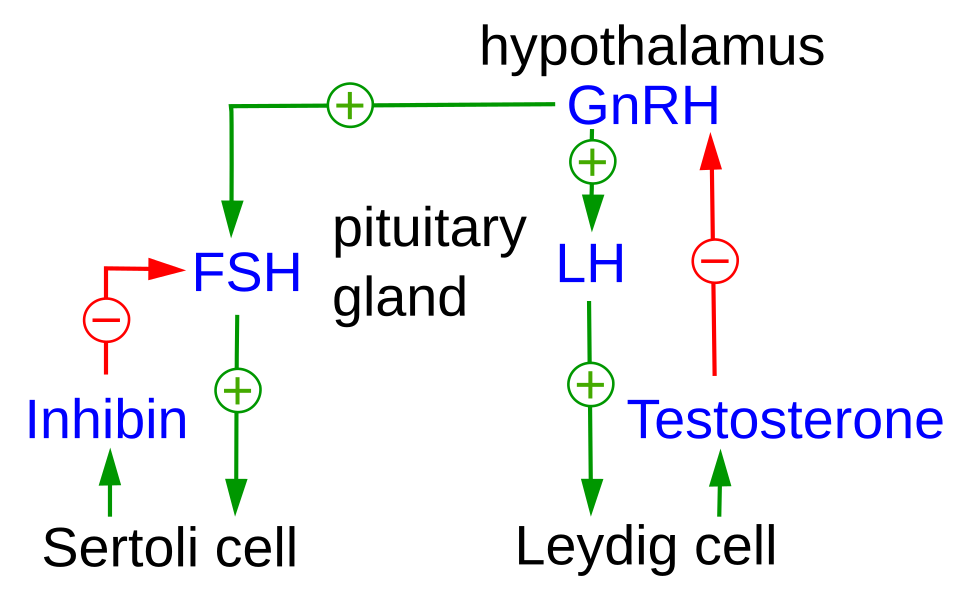
Testosterone is the main male sex hormone. It is made mostly by the testicles, under instructions from two areas in the brain: the hypothalamus and the pituitary gland. The pituitary releases luteinizing hormone (LH), which tells the testicles to make testosterone, and follicle-stimulating hormone (FSH), which supports sperm production. A problem anywhere along this chain can lower testosterone.
Doctors call a lasting shortage of testosterone male hypogonadism or testosterone deficiency. When it appears in middle or later life it is often called late-onset hypogonadism (LOH). The European Association of Urology (EAU) reports that symptomatic hypogonadism affects roughly 2.1–5.7% of men aged 40–79, with much higher rates in men with obesity, type 2 diabetes or cardiovascular disease.
Source: EAU — Sexual and Reproductive Health Guidelines: Male Hypogonadism; MedlinePlus — Hypogonadism
An important point: a low number on a lab report is not the same as a medical condition. Both the American Urological Association (AUA) and the Endocrine Society state that testosterone deficiency is diagnosed only when a man has low testosterone and symptoms or signs that fit. Many low testosterone symptoms, such as tiredness or low mood, overlap with stress, poor sleep, depression and other illnesses, so they are not proof of a hormone problem on their own.
Source: AUA — Evaluation and Management of Testosterone Deficiency; Endocrine Society — Testosterone Therapy for Hypogonadism Guideline
Sexual low testosterone symptoms
The EAU guideline is clear that sexual symptoms are the most specific symptoms associated with late-onset hypogonadism. In other words, if testosterone really is low, these are the changes most likely to be caused by it.
Low libido (reduced sex drive)
A noticeable drop in sexual interest, thoughts and desire is the classic sign. Men often describe it as simply “not thinking about sex” the way they used to, rather than wanting sex but being unable to perform. Less frequent intercourse and masturbation are listed by the EAU as related but less specific changes.
Fewer morning and spontaneous erections
Many men first notice that they rarely wake with an erection any more. A clear reduction in morning or spontaneous erections is one of the more specific symptoms in the EAU symptom list, and Cleveland Clinic also lists loss of morning erections among the typical signs.
Erectile dysfunction
Low testosterone can contribute to difficulty getting or keeping an erection. However, most erectile problems are driven by blood-vessel health, diabetes, medications or psychological factors, and low testosterone is only one possible piece of the puzzle. Our guide to erectile dysfunction causes, diagnosis and treatment explains the full picture. If testosterone is normal, restoring it will not fix the erection, and men with confirmed deficiency may still need tablets such as those compared in our Viagra vs Cialis guide.
Source: EAU — Sexual and Reproductive Health Guidelines: Male Hypogonadism; Cleveland Clinic — Low Testosterone (Low T)
Physical signs: energy, muscle, fat, blood and bone
Testosterone affects muscles, fat, blood and bones, so a long-lasting deficiency can change the body in several ways. These signs build up slowly and are less specific than the sexual symptoms.
- Fatigue and low energy: persistent tiredness, reduced stamina and less vigorous physical activity are among the commonly reported complaints.
- Loss of muscle and strength: a decrease in muscle mass and strength, and reduced ability to exercise.
- More body fat: increased body fat, sometimes with fat redistribution and breast tissue enlargement (gynecomastia).
- Hot flushes: sudden feelings of heat, similar to those in menopause, can occur when levels are very low.
- Smaller, softer testicles: shrinking testicles can point to low testicular function and is checked during examination.
Source: Cleveland Clinic — Low Testosterone (Low T); NHS — The “male menopause”
Anemia
Low testosterone and blood counts are linked. The Endocrine Society lists unexplained anemia as a condition that can suggest testosterone deficiency, particularly in men aged 65 and older. Anemia itself can add to tiredness and breathlessness, so a blood count is often part of the work-up.
Bone loss
Over time, hypogonadism can thin the bones. MedlinePlus lists osteoporosis as a complication of hypogonadism in men, which raises the risk of fractures from minor falls. A man with an unexpected fracture or low bone density may be checked for low testosterone.
Source: Endocrine Society — Testosterone Therapy for Hypogonadism Guideline; MedlinePlus — Hypogonadism
Mood, sleep and concentration
Low testosterone can also affect how a man feels and thinks. The EAU lists low or deflated mood, reduced motivation and fatigue as the more specific psychological symptoms, and difficulty concentrating, memory problems and sleep disturbance as less specific ones. The NHS adds irritability, mood swings and insomnia.
These symptoms deserve care in interpretation. The NHS points out that stress, depression, anxiety, relationship or money worries, heavy drinking and poor sleep commonly cause the same picture in midlife men, and are often the real cause. A good assessment looks at mental health and lifestyle alongside hormones, because treating the wrong problem leaves the man no better off.
Source: EAU — Sexual and Reproductive Health Guidelines: Male Hypogonadism; NHS — The “male menopause”
Low testosterone symptoms at a glance
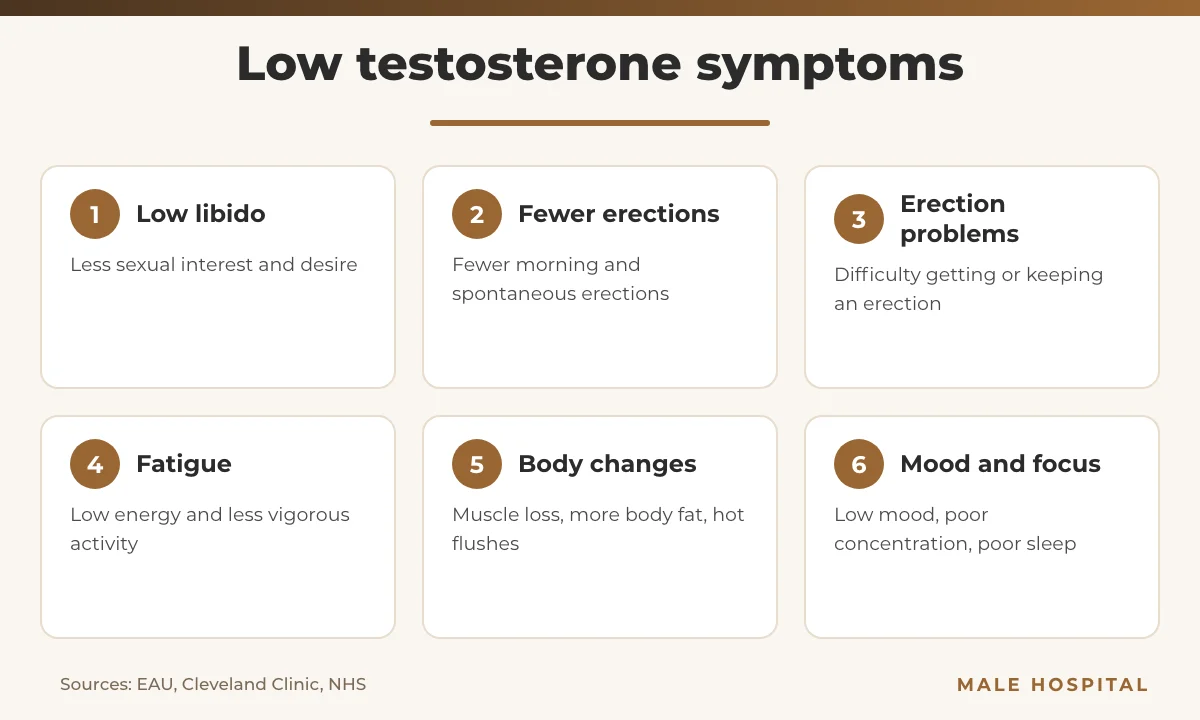
The table below groups the main low testosterone symptoms by type and shows how strongly each one points to a hormone problem rather than another cause.
| Type | Symptom or sign | How specific to low T? |
|---|---|---|
| Sexual | Low libido | More specific |
| Sexual | Fewer morning or spontaneous erections | More specific |
| Sexual | Erectile dysfunction | More specific, but many other causes |
| Physical | Reduced vigorous activity, low energy, fatigue | Moderate to low |
| Physical | Loss of muscle mass and strength | Low (also ageing, inactivity) |
| Physical | Increased body fat, breast enlargement | Low (obesity can also lower T) |
| Physical | Hot flushes | Less specific; suggests very low levels |
| Blood and bone | Unexplained anemia, osteoporosis | Found on tests; prompts checking T |
| Mental | Low mood, reduced motivation | Moderate; rule out depression |
| Mental | Poor concentration, memory, sleep problems | Less specific |
Source: EAU — Sexual and Reproductive Health Guidelines: Male Hypogonadism; Endocrine Society — Testosterone Therapy for Hypogonadism Guideline
What causes low testosterone?
Doctors divide the causes into two groups, depending on where the problem lies. Telling them apart matters, because it changes both further testing and treatment.
Primary hypogonadism (a testicular problem)
In primary hypogonadism the testicles themselves cannot make enough testosterone, even though the brain is sending strong signals. Blood tests typically show low testosterone with high LH and FSH. Causes include testicular injury, infection, surgery, chemotherapy or radiation, alcohol use disorder, iron overload and genetic conditions. Klinefelter syndrome (an extra X chromosome) is a common genetic cause, affecting about 1 in 500–1,000 male births according to the EAU.
Secondary hypogonadism (a brain signal problem)
In secondary hypogonadism the testicles are capable, but the hypothalamus or pituitary does not send enough LH and FSH. Testosterone is low while LH and FSH are low or inappropriately normal. Causes include pituitary tumors or bleeding, raised prolactin, head injury, some medicines, stopping anabolic steroids, and genetic conditions such as Kallmann syndrome.
Source: EAU — Sexual and Reproductive Health Guidelines: Male Hypogonadism; MedlinePlus — Hypogonadism; Cleveland Clinic — Low Testosterone (Low T)
Obesity and type 2 diabetes
The EAU describes obesity as a major cause of so-called functional hypogonadism, where the hormone system is suppressed but not permanently damaged. Cleveland Clinic notes that most men with symptoms have low testosterone related to obesity or diabetes. This is good news in one sense: weight loss and lifestyle change can improve levels, and the EAU recommends them as the first step for overweight men.
Opioids and other medicines
Opioid painkillers, and medicines used to treat opioid dependence, can suppress the brain signals that drive testosterone production. The EAU lists opiates among drugs that cause secondary hypogonadism and advises considering them in every evaluation. Anabolic steroid use and withdrawal are another common, often unspoken, cause.
Ageing
Testosterone falls gradually with age, by about 1% a year from around the age of 30–40, according to the NHS. The NHS stresses that this slow decline is unlikely to cause problems by itself and that true late-onset hypogonadism is uncommon and not a normal part of ageing. The term “male menopause” is misleading, because men do not experience a sudden hormone crash.
Source: EAU — Sexual and Reproductive Health Guidelines: Male Hypogonadism; NHS — The “male menopause”; Cleveland Clinic — Low Testosterone (Low T)
How low testosterone is diagnosed
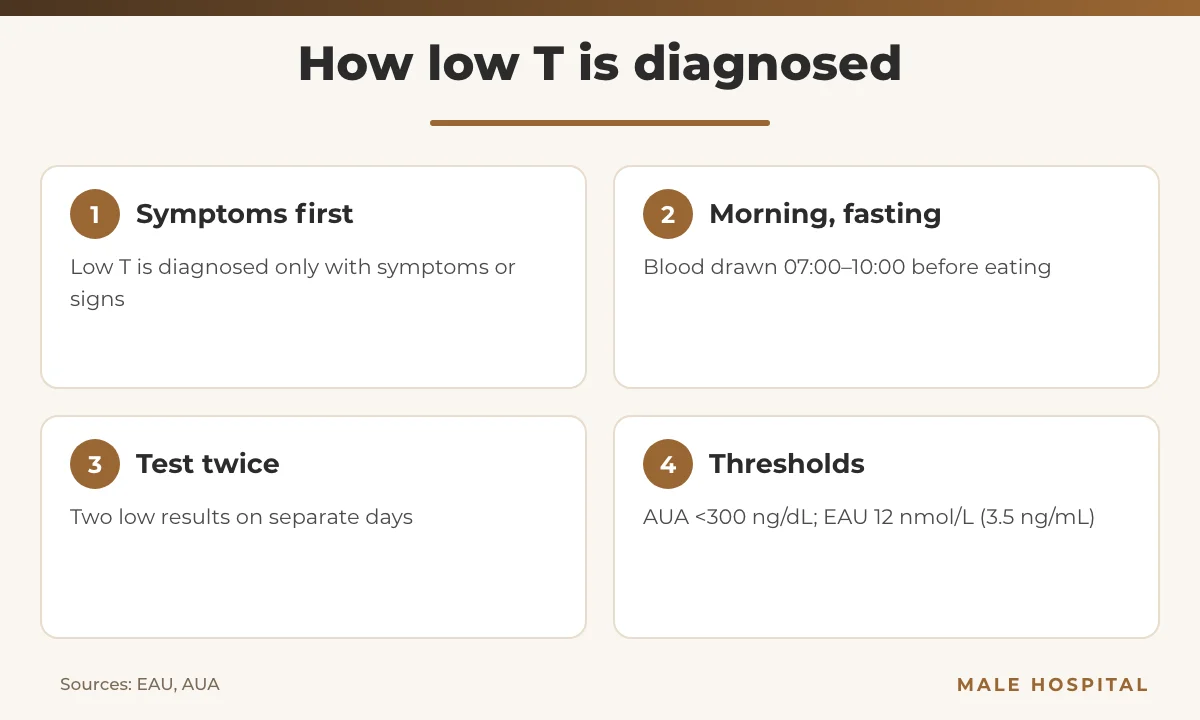
Because testosterone levels swing through the day and are affected by food, illness and sleep, a single random blood test can be misleading. Guidelines therefore set out a careful process.
Two early-morning, fasting blood tests
The EAU recommends measuring total testosterone in the morning, between 07:00 and 10:00, while fasting, and repeating it on at least two separate occasions before any treatment. Non-fasting samples can underestimate total testosterone by more than 30%. The AUA likewise requires two total testosterone measurements taken on separate occasions, both early in the morning, and states that neither symptoms alone nor a single low result is enough.
What counts as “low”?
The thresholds differ slightly between guidelines:
- AUA (2018, validity confirmed 2024): total testosterone below 300 ng/dL (about 10.4 nmol/L) is a reasonable cut-off supporting the diagnosis.
- EAU: total testosterone of 12 nmol/L (3.5 ng/mL, about 350 ng/dL) is used as the threshold for late-onset hypogonadism. A free testosterone below 220 pmol/L can also be considered when total testosterone is borderline. The benefit of treatment is greatest when levels are below 8 nmol/L.
Source: EAU — Sexual and Reproductive Health Guidelines: Male Hypogonadism; Urology Times — Testosterone deficiency FAQs from the AUA guideline
Further tests
Once low testosterone is confirmed, LH (and often FSH) shows whether the problem is primary or secondary, and prolactin helps detect pituitary causes. Before any treatment, doctors usually check hemoglobin and hematocrit (to know the baseline red cell level), PSA in men over 40, and discuss fertility plans. With very low levels in secondary hypogonadism, the EAU suggests pituitary imaging. Routine screening of all men is not recommended; testing should be guided by symptoms.
Source: Cleveland Clinic — Low Testosterone (Low T); Urology Times — Testosterone deficiency FAQs from the AUA guideline; Endocrine Society — Testosterone Therapy for Hypogonadism Guideline
When testosterone therapy is and isn’t appropriate
Testosterone replacement therapy (TRT) can relieve symptoms in men with a confirmed deficiency. It is available as gels, injections, pellets and a nasal gel, with oral forms for specific situations. But it is a long-term treatment with real trade-offs, and it is not right for everyone.
Lifestyle first where it fits
For men whose low testosterone is linked to excess weight or poor health habits, Cleveland Clinic names nutritious food and physical activity as the first treatments, with medication considered if symptoms persist after 6–12 months or are severe. The EAU also recommends weight loss and lifestyle change as the first step in overweight and obese men.
When TRT may be appropriate
TRT is considered for men who have consistent symptoms and repeatedly low morning testosterone, after other causes have been checked and the risks have been discussed. Treatment should then be monitored with follow-up blood tests.
When TRT is not appropriate
- Normal testosterone: the EAU strongly advises against testosterone therapy in men with normal levels.
- Weight loss or “vitality”: the EAU advises against using it to reduce weight or to improve cognition, vitality or physical strength in ageing men.
- Absolute contraindications (EAU): locally advanced or metastatic prostate cancer, male breast cancer, hematocrit of 54% or higher, uncontrolled heart failure, and a wish to have children.
- Other cautions: the Endocrine Society also lists elevated hematocrit and untreated severe sleep apnea among reasons to avoid therapy.
Source: EAU — Sexual and Reproductive Health Guidelines: Male Hypogonadism; Cleveland Clinic — Low Testosterone (Low T); Endocrine Society — Testosterone Therapy for Hypogonadism Guideline
Important fertility warning
Testosterone taken from outside the body (gel, injection or pellet) tells the brain that there is plenty of hormone, so the pituitary stops releasing LH and FSH. The EAU states that testosterone therapy suppresses gonadotropins, the body’s own testosterone production and sperm production. The result can be a very low or even zero sperm count. For this reason, the Endocrine Society recommends against testosterone therapy in men planning to father a child in the near term.
Men with secondary hypogonadism who want children can be treated with gonadotropin therapy instead, which the EAU describes as the standard approach. Other options, such as clomiphene citrate, may be used in some men to raise their own testosterone while preserving fertility, although this use is off-label.
Source: EAU — Sexual and Reproductive Health Guidelines: Male Hypogonadism; Endocrine Society — Testosterone Therapy for Hypogonadism Guideline; Cleveland Clinic — Low Testosterone (Low T)
What regulators say
In February 2025 the US Food and Drug Administration (FDA) removed the boxed warning about cardiovascular risk from testosterone products after a large trial (TRAVERSE), but added a warning about increased blood pressure. The FDA kept its “limitation of use” for age-related hypogonadism: testosterone products are not approved to treat low levels caused by ageing alone.
Source: FDA — Class-wide labeling changes for testosterone products
When to see a doctor
Book an assessment if you have had a drop in sex drive, fewer morning erections or erectile problems for several weeks, especially together with fatigue, muscle loss or low mood. Seek medical advice sooner if you notice:
- Breast enlargement or tenderness, or testicles that have become smaller or softer.
- A fracture after a minor fall, or a diagnosis of anemia with no clear cause.
- Low testosterone symptoms while taking opioid painkillers, or after stopping anabolic steroids.
- Difficulty conceiving with your partner.
- Feeling hopeless or having thoughts of self-harm: contact a doctor or emergency service right away, as depression needs prompt treatment whatever your hormone levels.
Never start testosterone bought online or at a gym without testing and medical supervision; it can switch off your own production and sperm output.
Source: NHS — The “male menopause”; MedlinePlus — Hypogonadism; EAU — Sexual and Reproductive Health Guidelines: Male Hypogonadism
If you are worried about your symptoms, you can arrange a confidential consultation with our urologist-andrologist, Assoc. Prof. Dr. Zülfü Sertkaya, via WhatsApp. When erections are the main concern, he can also explain the options in our erectile dysfunction treatment program.
FAQs about low testosterone symptoms
What are the first signs of low testosterone?
The earliest and most specific signs are usually sexual: less interest in sex, fewer erections on waking and weaker erections. Tiredness, reduced motivation and lower exercise capacity often come alongside. Because these can have many causes, a doctor will confirm low testosterone with repeated early-morning blood tests before calling it a hormone problem.
Source: EAU — Sexual and Reproductive Health Guidelines: Male Hypogonadism
What testosterone level is considered low?
The AUA treats a total testosterone below 300 ng/dL as a reasonable cut-off, while the EAU uses 12 nmol/L (3.5 ng/mL). Either way, the result must be low on two separate early-morning tests and must come with symptoms. A single low reading, particularly one taken in the afternoon or after a meal, is not enough for a diagnosis.
Source: Urology Times — Testosterone deficiency FAQs from the AUA guideline; EAU — Sexual and Reproductive Health Guidelines: Male Hypogonadism
Can low testosterone cause erectile dysfunction?
Yes, it can contribute, and erectile difficulty is one of the more specific symptoms of deficiency. But many men with erectile dysfunction have normal testosterone, and the cause lies in blood vessels, nerves, medications or stress. Testosterone treatment only helps erections when levels are genuinely low, and some men still need erection tablets as well.
Source: Cleveland Clinic — Low Testosterone (Low T)
Does testosterone therapy affect fertility?
Yes. Testosterone from gels, injections or pellets shuts down the brain hormones that drive sperm production, which can drop sperm counts to very low levels. Guidelines advise against testosterone therapy for men who want to father a child soon. Gonadotropin treatment, or in some cases off-label clomiphene, can raise testosterone while protecting sperm production.
Source: Endocrine Society — Testosterone Therapy for Hypogonadism Guideline
Is low testosterone just a normal part of ageing?
Not usually. Testosterone does fall slowly, at about 1% a year from the 30s or 40s, but the NHS says this gradual decline is unlikely to cause problems by itself. Clinically significant late-onset hypogonadism is uncommon and is more often linked to obesity, type 2 diabetes or other illness than to age alone.
Source: NHS — The “male menopause”
Can losing weight raise testosterone?
In many overweight men, yes. Obesity is a major cause of functional hypogonadism, where the hormone system is suppressed but still capable of recovering. The EAU recommends weight loss and lifestyle change as the first step in these men, and Cleveland Clinic lists healthy eating and physical activity as first-line treatment before considering medication.
Source: EAU — Sexual and Reproductive Health Guidelines: Male Hypogonadism; Cleveland Clinic — Low Testosterone (Low T)
Why should testosterone be tested in the morning?
Testosterone is normally highest in the early morning and falls during the day, and eating can lower the reading. The EAU recommends fasting samples taken between 07:00 and 10:00, because non-fasting samples can underestimate total testosterone by more than 30%. Testing at the wrong time can falsely label a healthy man as deficient.
Source: EAU — Sexual and Reproductive Health Guidelines: Male Hypogonadism
Is testosterone therapy approved for age-related low testosterone?
No. The FDA keeps a “limitation of use” stating that testosterone products are not approved for low levels caused by ageing alone. In 2025 it removed the boxed cardiovascular warning following the TRAVERSE trial but added a warning about raised blood pressure. Treatment is intended for men with confirmed hypogonadism and a clear medical reason.
Source: FDA — Class-wide labeling changes for testosterone products
Medically reviewed by Assoc. Prof. Dr. Zülfü Sertkaya, urologist and andrologist (FEBU), Istanbul. Last reviewed: October 2026.
This article is for general information and does not replace an individual consultation with a qualified doctor.
- EAU — Sexual and Reproductive Health Guidelines: Male Hypogonadism
- AUA — Evaluation and Management of Testosterone Deficiency
- Urology Times — Testosterone deficiency FAQs from the AUA guideline
- Endocrine Society — Testosterone Therapy for Hypogonadism Guideline
- NHS — The "male menopause"
- Cleveland Clinic — Low Testosterone (Low T)
- MedlinePlus — Hypogonadism
- FDA — FDA issues class-wide labeling changes for testosterone products