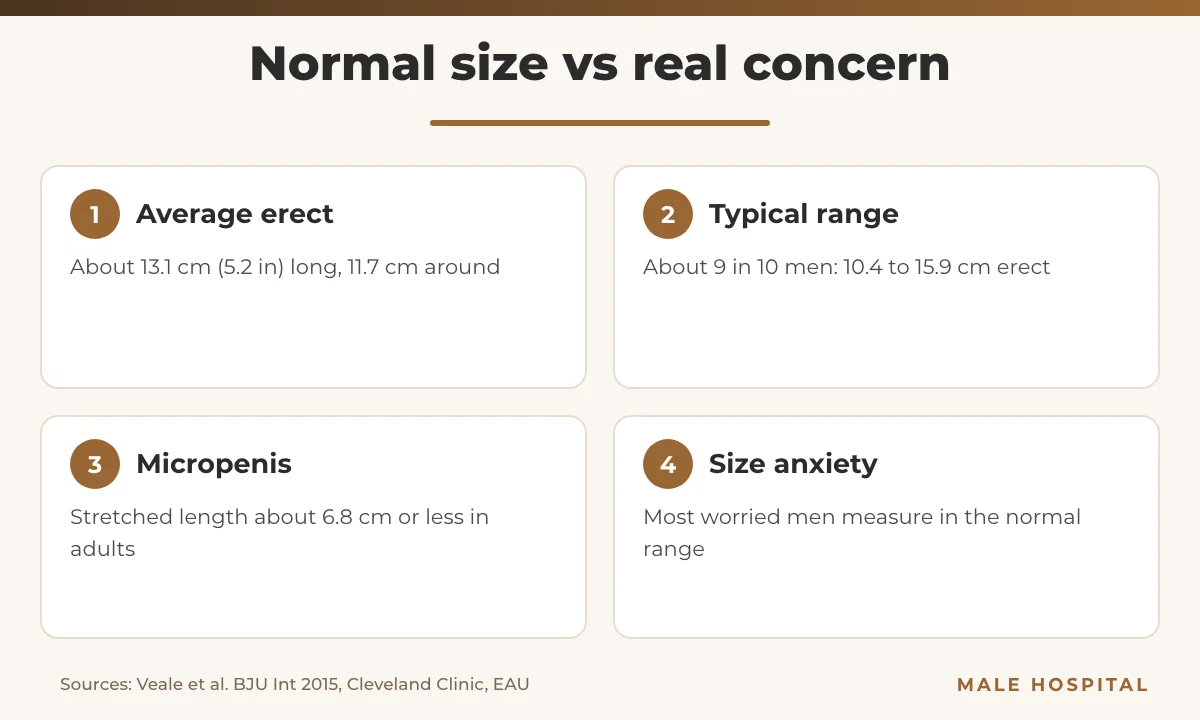
Average penis size is smaller than most men think. The largest systematic review of clinician-measured men (Veale et al., BJU International 2015) found an average erect length of 13.12 cm (5.17 in) and an average erect girth of 11.66 cm (4.59 in), with a flaccid length of 9.16 cm (3.61 in). Most men who worry that they are “too small” measure in the normal range.
- Measured by health professionals, the average erect penis is about 13 cm (5.2 in) long and 11.7 cm (4.6 in) around.
- Later meta-analyses with tens of thousands of men report very similar averages (erect length around 13.8–13.9 cm).
- In adults, micropenis means a stretched length at least 2.5 standard deviations below average (about 6.8 cm or less), which is rare.
- Height and foot length show only weak links with penis size; shoe size cannot predict it.
- Most men with small penis anxiety have a normal penis, and European guidelines advise counseling and screening for body dysmorphia before any enlargement procedure.
- What is the average penis size?
- Average penis size table: means and percentiles
- Has average penis size changed over time or by region?
- How to measure your penis correctly
- What counts as a micropenis?
- What does and does not affect penis size
- Does size matter to partners?
- Small penis anxiety and penile dysmorphic disorder
- When is penis enlargement considered?
- When to see a doctor
- FAQs about average penis size
What is the average penis size?
The best answer comes from studies where a doctor or nurse took the measurements, not from self-reported surveys. Men who measure themselves tend to round up, and volunteers for size studies may not represent everyone. That is why Veale and colleagues only included samples of at least 50 men measured by a health professional with a standard method.
They also excluded men with penile abnormalities, previous penile surgery, erectile dysfunction, or a complaint of small size. After pooling the data, they built nomograms (reference charts, similar to children’s growth charts) that show where any measurement sits compared with other men.
Their pooled averages were 9.16 cm (3.61 in) for flaccid length, 13.24 cm (5.21 in) for stretched flaccid length, and 13.12 cm (5.17 in) for erect length. Flaccid girth averaged 9.31 cm (3.67 in) and erect girth 11.66 cm (4.59 in). Erect measurements were based on fewer men (692 for length, 381 for girth) than flaccid ones (over 10,000), so the erect figures are less precise.
A 2024 meta-analysis of 33 studies and 36,883 men by Mostafaei and colleagues found almost the same numbers: flaccid length 9.22 cm, stretched length 12.84 cm, erect length 13.84 cm, flaccid girth 9.10 cm, and erect girth 11.91 cm. The authors state that their results were similar to Veale’s for all five measurements.
Average penis size table: means and percentiles
The table below lists the pooled means from the two largest systematic reviews of measured men. Centimeters are the original units; inches are converted and rounded.
| Measurement | Veale 2015, mean (SD) | Men measured (Veale) | Mostafaei 2024, mean |
|---|---|---|---|
| Flaccid length | 9.16 cm (1.57) / 3.61 in | 10,704 | 9.22 cm / 3.63 in |
| Stretched flaccid length | 13.24 cm (1.89) / 5.21 in | 14,160 | 12.84 cm / 5.06 in |
| Erect length | 13.12 cm (1.66) / 5.17 in | 692 | 13.84 cm / 5.45 in |
| Flaccid girth (circumference) | 9.31 cm (0.90) / 3.67 in | 9,407 | 9.10 cm / 3.58 in |
| Erect girth (circumference) | 11.66 cm (1.10) / 4.59 in | 381 | 11.91 cm / 4.69 in |
Sources: PubMed — Veale et al., Am I normal? (BJU Int 2015); PMC — Mostafaei et al., Penis length and circumference according to WHO regions
Where do you sit? Approximate percentiles
Veale’s nomograms were generated from a normal distribution using the pooled mean and standard deviation. Using those same numbers, we calculated the approximate percentiles below. They are estimates for orientation, not a diagnosis.
| Measurement | 5th percentile | 25th | 50th (average) | 75th | 95th percentile |
|---|---|---|---|---|---|
| Erect length | 10.4 cm | 12.0 cm | 13.1 cm | 14.2 cm | 15.9 cm |
| Stretched length | 10.1 cm | 12.0 cm | 13.2 cm | 14.5 cm | 16.3 cm |
| Flaccid length | 6.6 cm | 8.1 cm | 9.2 cm | 10.2 cm | 11.7 cm |
| Erect girth | 9.9 cm | 10.9 cm | 11.7 cm | 12.4 cm | 13.5 cm |
In plain terms, about 9 in 10 men have an erect length between roughly 10.4 and 15.9 cm (4.1 to 6.2 in). An erect penis longer than about 16 cm (6.3 in) puts a man in the top 5%, which shows how far pornography and marketing are from typical anatomy.
Source: PubMed — Veale et al., Am I normal? (BJU Int 2015), percentiles calculated from reported mean and SD
Has average penis size changed over time or by region?
A 2023 meta-analysis in the World Journal of Men’s Health by Belladelli and colleagues pooled 75 studies published between 1942 and 2021, covering 55,761 men. Its overall averages were 8.70 cm flaccid, 12.93 cm stretched, and 13.93 cm erect, again close to Veale’s results.
The headline finding was that erect length appeared to rise by 24% over 29 years (from 12.27 cm to 15.23 cm after adjustment), while flaccid and stretched lengths showed no significant trend. The authors were cautious: erect data came from only about a third of the men, studies varied hugely (I² = 98.9%), measurement methods differed, and some samples were volunteers. They listed earlier puberty, larger body size, and exposure to hormone-disrupting chemicals as possible explanations but stated that the cause remains unknown.
Regional differences
Both Belladelli and Mostafaei found differences between world regions, with lower average values in studies from Asia. In Mostafaei’s analysis, stretched length ranged from 10.88 cm (South-East Asia) to 14.47 cm (Americas), but there were no statistically significant regional differences in erect length or girth. The authors warn that measurement methods were not standardized, that differences within a region may exceed differences between regions, and that the results describe the studied samples rather than inherent differences between peoples.
Sources: PMC — Mostafaei et al., Penis length and circumference according to WHO regions; PMC — Belladelli et al., Worldwide temporal trends in penile length
How to measure your penis correctly
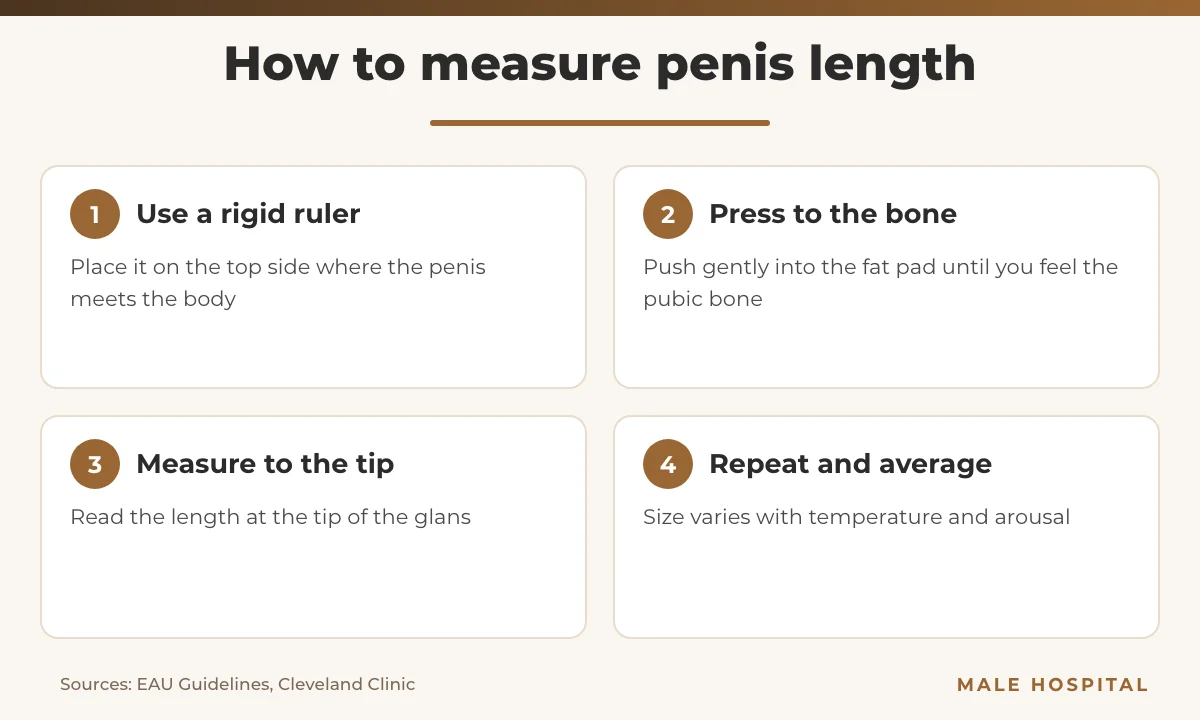
Most “I am below average” worries come from measuring the wrong way, or from looking down at the penis, which makes it look shorter. The European Association of Urology (EAU) recommends using stretched penile length to define penile length, measured from the pubic bone (or the skin junction) to the tip of the glans. It also advises recording flaccid and erect length and girth.
Source: EAU Guidelines — Penile size abnormalities and dysmorphophobia
Bone-pressed length, step by step
- Use a rigid ruler, not a tape, for length.
- Place the ruler on the top side of the penis, where it meets the body.
- Press the ruler gently into the fat pad until it touches the pubic bone. This “bone-pressed” method removes the effect of body fat.
- Measure to the tip of the glans, with the foreskin pulled back if you are uncircumcised.
- For stretched length, hold the flaccid penis by the glans and pull it gently straight out until you feel resistance, then measure the same way.
- For girth, wrap a flexible tape around the middle of the shaft or at the base.
Researchers in a study of 800 Argentinian men measured from the pubic bone to the glans tip while “exerting pressure on the prepubic fat”, and stretched the penis to its maximum for stretched length. Flaccid and stretched length correlated strongly (r = 0.7). Cleveland Clinic describes the same clinical technique: gently stretching the flaccid penis and measuring from tip to base with the ruler held close to the body.
Sources: PMC — Solé et al., Reference penile size measurement and correlation with other anthropometric dimensions in 800 men (Asian J Androl 2022); Cleveland Clinic — Micropenis
Flaccid size changes with temperature and arousal, so a single flaccid measurement says little. Veale’s review also noted that stretched length showed the greatest variability between studies, because the amount of pull is subjective. If you measure at home, take a few readings on different days and use the average.
Sources: PubMed — Veale et al., Am I normal? (BJU Int 2015); PMC — Belladelli et al., Worldwide temporal trends in penile length
What counts as a micropenis?
Micropenis is a medical diagnosis, not a description of a penis that is “on the small side”. The EAU defines it as a stretched penile length more than 2.5 standard deviations below the mean for age, measured from the pubic bone to the tip of the glans. Cleveland Clinic translates this for adults as a stretched length of 6.8 cm (2.67 in) or less.
Micropenis is usually noticed in infancy. The most common cause is low testosterone during fetal development, and it can be linked to conditions such as hypogonadism, Kallmann syndrome or androgen insensitivity. The penis is normally formed, and men with micropenis can still urinate and have erections. Hormone treatment works best when started early in childhood.
Sources: EAU Guidelines — Penile size abnormalities and dysmorphophobia; Cleveland Clinic — Micropenis
Buried penis is different
Some men see only a small part of the penis because it is hidden under skin and fat. Cleveland Clinic describes a buried penis as one of typical size and shape that is concealed by surrounding tissue, often linked to severe obesity (BMI above 40) or lymphedema. Weight loss alone may resolve it, and surgery, when needed, frees the penis but does not make it larger.
Source: Cleveland Clinic — Buried or hidden penis
What does and does not affect penis size
Penis size is mostly set by genetics and by hormones before birth and during puberty. Hormone problems in early life can lead to micropenis, but in adult men with normal development there is no proven pill, food or exercise that changes length.
Source: Cleveland Clinic — Micropenis
Height, shoe size and other body measurements
In Veale’s review, the most consistent link was between height and stretched or erect length, but it was only weak to moderate (r = 0.2 to 0.6). In the Argentinian study of 800 men, correlations with height (r = 0.2), foot length (r = 0.2), weight, BMI and age (r = −0.1 to 0.1) were all low. In other words, a tall man with big feet is not reliably larger, and a short man is not reliably smaller.
Sources: PubMed — Veale et al., Am I normal? (BJU Int 2015); PMC — Solé et al., Reference penile size measurement in 800 men
Body fat and erections
Belly and pubic fat can hide part of the shaft, which is why the bone-pressed method gives a truer number. Firmness also matters: an erect penis that is not fully rigid measures shorter. If erections are weaker than they used to be, our guide to erectile dysfunction causes and treatments explains what can help.
Source: Cleveland Clinic — Buried or hidden penis
Does size matter to partners?
Research suggests partners care less about size than men fear. In a 2015 PLoS One study, 75 women chose from 3D-printed models instead of guessing numbers. On average, they preferred an erect length of 16.0 cm (6.3 in) and girth of 12.2 cm (4.8 in) for a long-term partner, and 16.3 cm (6.4 in) and 12.7 cm (5.0 in) for a one-time partner. The authors concluded that women prefer penises only slightly larger than average.
A 2025 review of penile enhancement in Current Urology summarized survey work in which 32% of 375 sexually active women rated length as less important than girth. The same review noted that no study has directly measured whether partners are more satisfied after enlargement procedures. Communication, foreplay and treating any erection or ejaculation problem usually do more for sexual satisfaction than a few millimeters.
Source: PMC — Penile enhancement: a comprehensive and current perspective (Curr Urol 2025)
Small penis anxiety and penile dysmorphic disorder
Small penis anxiety means excessive worry about a penis that is actually normal in size. Penile dysmorphic disorder (PDD) is a more severe form: a type of body dysmorphic disorder (BDD) in which a man fixates on a perceived flaw in a normal penis and is significantly impaired by it, for example avoiding relationships, changing rooms or sex.
Source: EAU Guidelines — Penile size abnormalities and dysmorphophobia
Clinic studies show the gap between fear and reality. In a 2025 Urology Research and Practice study, none of the men with small penis anxiety had a short penis; their average erect length was in the normal range. After their erect penis was measured and they received counseling, anxiety scores fell significantly (from 10.18 to 7.38 on a standard scale). The Current Urology review similarly reports that most men seeking help for small size have normal measurements.
Sources: PMC — Role of penile girth and length in the erect state in reassuring patients with small penis anxiety (Urol Res Pract); PMC — Penile enhancement: a comprehensive and current perspective
Signs that worry has become BDD
- Checking, measuring or comparing yourself many times a day.
- Avoiding intimacy, gyms or public toilets because of how you look.
- Seeking repeated reassurance or procedures that never feel enough.
- Low mood, or thoughts of self-harm, linked to appearance.
The NHS explains that BDD is treated with cognitive behavioral therapy (CBT), an SSRI antidepressant, or both, and that symptoms rarely go away without treatment. The EAU strongly recommends referring men with suspected BDD for mental health counseling.
Sources: NHS — Body dysmorphic disorder (BDD); EAU Guidelines — Penile size abnormalities and dysmorphophobia
When is penis enlargement considered?
If your measurements are within the average penis size range, the first step is an honest assessment and counseling, not surgery. EAU guidance is specific:
- Traction therapy may be considered as a conservative option to gain length (weak recommendation).
- Penile prosthesis, penile disassembly or “sliding” techniques should not be offered to men who only want more length (strong recommendation).
- Hyaluronic acid, other soft tissue fillers or fat injection may be used for girth (weak recommendation), but not in men with penile dysmorphic disorder (strong recommendation).
- Silicone, paraffin or petroleum jelly injections should never be used (strong recommendation).
Source: EAU Guidelines — Penile size abnormalities and dysmorphophobia
The evidence behind enlargement surgery is limited. A 2024 systematic review in Medicina found that most techniques rest on case series with weak internal validity. Suspensory ligament release added a mean of 1.3 cm of stretched length in one series of 42 men, and filler results varied: polymethylmethacrylate caused palpable irregularities in 52% of 729 cases. The authors concluded that results are uncertain and better studies are needed.
Enlargement may be reasonable for selected men with true micropenis, a buried penis, length loss after Peyronie’s disease or prostate surgery, or persistent, informed concern about girth after psychological screening. You can read how we approach these cases on our penis enlargement treatment and penile filler for girth pages. For men with severe erectile dysfunction, an implant restores rigidity rather than adding size, as explained in what penile implant surgery does to size and performance.
Sources: PMC — Falagario et al., Techniques for penile augmentation surgery (Medicina 2024); PMC — Penile enhancement: a comprehensive and current perspective (Curr Urol 2025)
When to see a doctor
A normal-sized penis does not need treatment, but some situations deserve a medical check:
- Your stretched length, measured bone-pressed, is below about 7 cm (2.75 in).
- Your penis seems to have shortened, or has developed a bend, lump or painful erections (possible Peyronie’s disease).
- Your penis is hidden by skin or fat, making urination or hygiene difficult.
- Puberty seemed delayed, or you have been told you have a hormone problem such as hypogonadism.
- Worry about size is affecting your mood, relationships or daily life, or you have thoughts of self-harm. Seek urgent help if you feel unsafe.
Sources: Cleveland Clinic — Micropenis; Cleveland Clinic — Buried or hidden penis; NHS — Body dysmorphic disorder
If you would like an accurate measurement and an honest opinion, you can book a confidential consultation with our urologist-andrologist, Assoc. Prof. Dr. Zülfü Sertkaya, by sending a message on WhatsApp. Any treatment plan, and its cost, depends on that assessment.
FAQs about average penis size
What is the average erect penis size?
In Veale’s 2015 review of men measured by health professionals, the average erect length was 13.12 cm (5.17 in) and the average erect girth 11.66 cm (4.59 in). A 2024 meta-analysis of 36,883 men found 13.84 cm and 11.91 cm. Both show that a typical erect penis is a little over 5 inches long, not the 6 to 7 inches often assumed.
Sources: PubMed — Veale et al. (BJU Int 2015); PMC — Mostafaei et al.
What is the average flaccid penis size?
Average flaccid length is about 9.2 cm (3.6 in) and flaccid girth about 9.3 cm (3.7 in), according to Veale’s pooled data from more than 9,000 men. Flaccid size changes a lot with temperature and arousal, so it is a poor guide to erect size. Doctors prefer stretched length, which averages about 13.2 cm (5.2 in).
Source: PubMed — Veale et al. (BJU Int 2015)
Is 5 inches a normal penis size?
Yes. An erect length of 5 inches (12.7 cm) is very close to the 50th percentile in Veale’s data, meaning about half of men are shorter and half are longer. Based on the reported mean and standard deviation, roughly 90% of men have an erect length between about 4.1 and 6.2 inches (10.4 to 15.9 cm).
Source: PubMed — Veale et al. (BJU Int 2015)
Can shoe size or height predict penis size?
Not reliably. In a study of 800 men, the correlation between penis length and foot length was only 0.2, and the same weak value was found for height. Veale’s review reported height correlations of 0.2 to 0.6. These links are far too weak to guess an individual man’s size from his shoes or height.
Sources: PMC — Solé et al. (Asian J Androl 2022); PubMed — Veale et al.
Is average penis size getting bigger?
A 2023 meta-analysis reported a 24% rise in average erect length over 29 years, with no change in flaccid or stretched length. Because studies used different methods, many relied on volunteers, and results varied widely, the authors called the cause unknown. The finding is a signal for more research, not proof that men are growing.
Source: PMC — Belladelli et al. (World J Mens Health 2023)
What size is considered too small?
Doctors diagnose micropenis when stretched length is more than 2.5 standard deviations below the average for age. For adults, Cleveland Clinic puts this at about 6.8 cm (2.67 in) or less. A penis that is shorter than average but above this line is a normal variation, not a medical problem.
Source: Cleveland Clinic — Micropenis
Do pills, pumps or exercises increase penis size?
No pill or exercise has been shown to permanently lengthen a normal adult penis. EAU guidelines list only traction therapy as a conservative option for length, and that is a weak recommendation. Avoid any injection of silicone, paraffin or petroleum jelly, which guidelines strongly advise against.
Source: EAU Guidelines — Penile size abnormalities and dysmorphophobia
Why does my penis look smaller than average to me?
Looking down from above shortens the view, and comparisons with pornography or locker rooms are misleading. Body fat over the pubic bone can also hide part of the shaft. In a 2025 study, none of the men with small penis anxiety actually had a short penis, and measuring and counseling clearly reduced their anxiety.
Sources: PMC — Reassuring patients with small penis anxiety (Urol Res Pract); Cleveland Clinic — Buried penis
Medically reviewed by Assoc. Prof. Dr. Zülfü Sertkaya, urologist and andrologist (FEBU), Istanbul. Last reviewed: October 2026.
This article is for general information and does not replace an individual consultation with a qualified doctor.
- PubMed (BJU International) — Veale et al. Am I normal? Nomograms for flaccid and erect penis length and circumference in up to 15,521 men (2015)
- PMC (World Journal of Men's Health) — Belladelli et al. Worldwide temporal trends in penile length: a systematic review and meta-analysis (2023)
- PMC (Urology Research and Practice) — Mostafaei et al. Penis length and circumference according to WHO regions: a systematic review and meta-analysis
- EAU Guidelines — Sexual and Reproductive Health — Penile size abnormalities and dysmorphophobia
- Cleveland Clinic — Micropenis: causes, symptoms, diagnosis and treatment
- Cleveland Clinic — Buried or hidden penis
- NHS — Body dysmorphic disorder (BDD)
- PMC (Asian Journal of Andrology) — Solé et al. Reference penile size measurement and correlation with other anthropometric dimensions in 800 men (2022)
- PMC (PLoS One) — Prause et al. Women's preferences for penis size: a new research method using selection among 3D models (2015)
- PMC (Urology Research and Practice) — Role of penile girth and length in the erect state in reassuring patients with small penis anxiety
- PMC (Current Urology) — Penile enhancement: a comprehensive and current perspective (2025)
- PMC (Medicina) — Falagario et al. Techniques for penile augmentation surgery: a systematic review (2024)