
Penis Enlargement: 8 Options Honestly Rated by Evidence
Penis enlargement is possible only in limited, modest ways, and most men who ask for it already have a normal-sized penis. Measured averages from more than 15,000 men put erect length at about 13.1 cm (5.2 in), so honest care starts with accurate measurement and counselling. For selected men, traction therapy, temporary hyaluronic-acid girth fillers, or surgery for a buried penis can help, while pills, creams and “exercises” do not.
Source: King’s College London — Am I normal? An analysis of penis lengths (Veale et al., BJU Int 2015); EAU Guidelines — Penile size abnormalities and dysmorphophobia
Worried about your size? Get an honest, confidential assessment from a urologist-andrologist before you spend money on anything.
- Average erect length is about 13.1 cm and average erect girth about 11.7 cm; most men seeking enlargement fall inside the normal range.
- European guidelines ask doctors to screen for penile dysmorphic disorder first and say fillers should not be used in men who have it.
- Traction devices give small length gains (roughly 1–2 cm) after months of daily wear; hyaluronic-acid fillers add temporary girth.
- Ligament release, grafts and the Penuma silicone implant carry real complication risks; the EAU classes grafts and Penuma as experimental.
- Pills, creams, jelqing and hormones do not enlarge an adult penis, and many “enhancement” supplements contain hidden prescription drugs.
- What is penis enlargement?
- Who is a good candidate for penis enlargement?
- Penis enlargement options compared
- What does not work: pills, jelqing and hormones
- The procedure step by step
- Recovery timeline
- Risks and side effects of penis enlargement
- Results and realistic expectations
- Treatment with Dr. Zülfü Sertkaya in Istanbul
- How to start
- When to see a doctor
- FAQs about penis enlargement
What is penis enlargement?
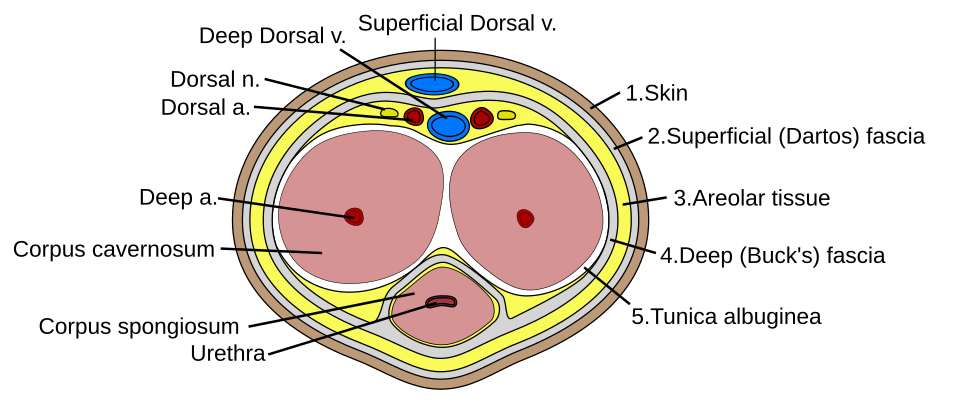
Penis enlargement (penile augmentation) means any attempt to increase penile length or girth. No method changes the erectile tissue itself, which is why gains are measured in millimetres to a few centimetres, not inches of “new” penis.
The starting point matters more than the method. The largest analysis of measured (not self-reported) penis size, by Veale and colleagues in BJU International (2015), pooled 17 studies of up to 15,521 men. Average flaccid length was 9.16 cm, stretched flaccid length 13.24 cm and erect length 13.12 cm; average erect circumference was 11.66 cm. Its nomograms (percentile charts) let doctors show most worried men that they are normal.
Source: King’s College London — Am I normal? An analysis of penis lengths
Small penis anxiety, dysmorphic concerns and true micropenis
The European Association of Urology (EAU) separates three groups. Small penis anxiety is excessive worry about a normal-sized penis. Penile dysmorphic disorder (PDD) is body dysmorphic disorder focused on a normal penis, a preoccupation that causes real distress. A true micropenis is a congenital condition with a genetic or hormonal cause, defined as a stretched length more than 2.5 standard deviations below the mean for age. A buried penis is a normal penis hidden by surrounding fat or skin.
The EAU notes that 84% of women report being satisfied with their partner’s penis size, while many men are not satisfied with their own. That gap is why the guideline gives a strong recommendation to ask about body dysmorphic disorder before any enlargement procedure.
Source: EAU Guidelines — Penile size abnormalities and dysmorphophobia
Who is a good candidate for penis enlargement?
A good candidate has a measurable problem, realistic expectations and no untreated body dysmorphic disorder, usually one of these:
- Buried penis from weight gain or a large fat pad above the pubic bone, where removing what hides the penis reveals existing length.
- Length lost to disease or surgery, for example after Peyronie’s disease.
- True micropenis, which the International Society for Sexual Medicine (ISSM) describes as a stretched length under 7.5 cm (about 3 in) and which needs specialist reconstructive care.
- A man with normal size who wants a modest cosmetic girth change, has been counselled, understands the evidence and has no signs of PDD.
Men with PDD are not good candidates. The EAU strongly advises against hyaluronic-acid fillers, other soft-tissue fillers and fat injection in men with penile dysmorphic disorder, and recommends psychotherapy when psychological factors or relationship issues drive the request. ISSM adds that cognitive behavioral therapy and, in some cases, antidepressants help men who feel inadequate despite normal size.
Source: ISSM — What are some penile augmentation procedures? Do they work?; EAU Guidelines — Penile size abnormalities and dysmorphophobia
Penis enlargement options compared
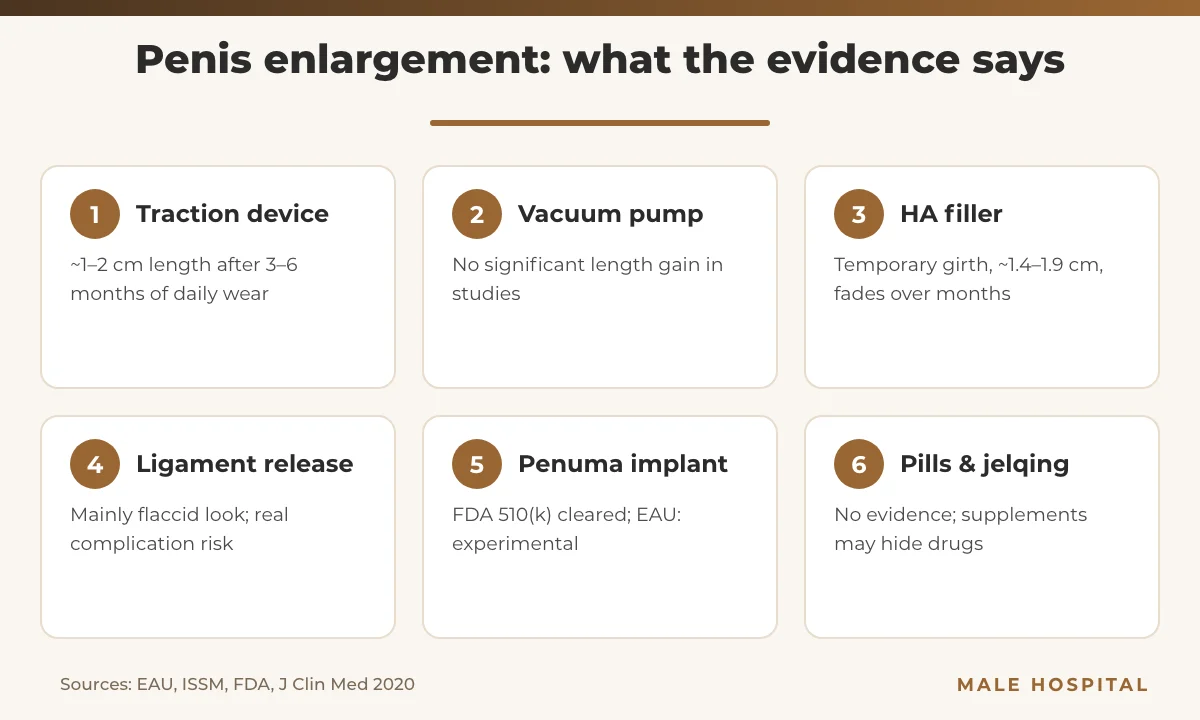
Reported gains below are averages from small, mostly uncontrolled studies; your own result may be smaller.
| Option | What it targets | Reported change | Guideline position |
|---|---|---|---|
| Penile traction device | Length | About +1.2 to +2.3 cm after 3–6 months of wear (several hours a day); no girth gain | EAU: weak recommendation to consider; ISSM: no proof it enlarges |
| Vacuum device | Length | No significant length gain in a 6-month study of 27 men | EAU evidence: ineffective for lengthening |
| Hyaluronic-acid (HA) filler | Girth (temporary) | About +1.9 cm at 6 months and +1.4 cm at 18 months in a randomized trial | EAU: weak for girth; strong against in PDD |
| Autologous fat injection | Girth | +2 to +3.5 cm reported; little long-term data | EAU: weak; AUA: not shown safe or effective |
| Suspensory ligament release | Flaccid length | Flaccid length 8.8 → 11.4 cm, stretched 12.4 → 13.5 cm in one series | EAU: weak, discuss complications; AUA: not shown safe or effective |
| Dermal / other grafts | Girth | Variable; high complication rates | EAU: strong against (experimental) |
| Penuma silicone implant | Flaccid length and girth | +2.5 cm flaccid length, +3.1 cm girth in one 92-man series | FDA 510(k) cleared; EAU: strong against (experimental) |
| Weight loss / suprapubic lipectomy | Visible length in buried penis | Reveals hidden shaft; satisfaction 73% at 18 months in one monsplasty series | EAU: strong for weight loss, weak for surgery |
Source: EAU Guidelines — Penile size abnormalities and dysmorphophobia; J Clin Med (PMC) — Hyaluronic vs polylactic acid fillers for penile augmentation, 18-month RCT; Ther Adv Urol (PMC) — Outcomes after Penuma silicone implant surgery
Traction devices: the best non-surgical evidence, but modest
A traction device is a frame that holds the penis under gentle, constant stretch. In the studies cited by the EAU, men wore it at least four hours a day for six months and gained about 1.7–2.3 cm in flaccid length and 1.3–1.7 cm in stretched length. Girth did not change. The EAU gives a weak recommendation to consider traction and rates the evidence as poor quality, while ISSM states there is no scientific evidence that non-surgical methods, traction included, increase size.
Vacuum devices
Vacuum pumps are useful for erectile dysfunction, but not for enlargement. In a study of 27 men with a stretched length under 10 cm, 20 minutes three times a week for six months produced no significant gain in length. The EAU summarizes the evidence as ineffective for lengthening.
Source: EAU Guidelines — Penile size abnormalities and dysmorphophobia; ISSM — Can a man make his penis larger?
Hyaluronic-acid fillers for girth and the glans
Hyaluronic acid is an absorbable gel injected under the shaft skin, off-label, to add girth (not length). In a blinded randomized trial of 67 men, girth rose by about 1.9 cm at six months and was still about 1.4 cm above baseline at 18 months; side effects were mild and settled with simple painkillers. You can read how the treatment is done on our penile filler (girth enhancement) page, and the separate glans penis filler page covers injections that add volume to the head of the penis.
The Sexual Medicine Society of North America (SMSNA) says limited data suggest potential cosmetic benefits of temporary hyaluronic-acid fillers, and it strongly recommends against permanent materials such as silicone and paraffin, which can cause disfiguring granulomas that often need surgical excision.
Source: J Clin Med (PMC) — Hyaluronic vs polylactic acid fillers for penile augmentation, 18-month RCT; J Sex Med — Cosmetic penile enhancement procedures: an SMSNA position statement
Suspensory ligament release
This operation divides the ligament that tethers the penis to the pubic bone so that more of the shaft hangs forward. It mainly changes flaccid appearance. The EAU gives a weak recommendation for the procedure but a strong recommendation to discuss its complications extensively, noting a significant incidence of complications. The American Urological Association (AUA) states that dividing the suspensory ligament has not been shown to be safe or efficacious. SMSNA limits it to selected men treated by experienced surgeons after a full risk discussion.
Fat injection and grafts
Fat taken from the abdomen can be injected along the shaft for girth. The EAU lists it as a weak option with not enough long-term data, and the AUA says fat injection has not been shown to be safe or efficacious. Dermal fat grafts and other grafts are a different matter: the EAU strongly advises against them as experimental, citing penile swelling and painful erections in up to 27% of men and curvature from graft scarring in up to 9%.
Source: AUA — Penile augmentation surgery policy statement; EAU Guidelines — Penile size abnormalities and dysmorphophobia; J Sex Med — SMSNA position statement
Penuma subcutaneous silicone implant: what the FDA actually cleared
Penuma is a soft silicone sleeve placed under the skin of the shaft, over the erectile bodies. It is cosmetic only, and its regulatory status is often overstated. The FDA did not “approve” it after a premarket approval (PMA) review. Instead, its maker received 510(k) clearance, meaning the FDA found it substantially equivalent to an existing device. The May 2022 clearance (K220760, “Pre-Formed Penile Silicone Block”) covers use in augmentation, reconstructive and cosmetic surgery, and states that in augmentation procedures it provides cosmetic augmentation of the penis for aesthetic purposes. An earlier 2017 clearance (K162624) described only the cosmetic correction of soft tissue deformities.
In a 92-man series from experienced users of the device, flaccid length rose by about 2.5 cm and girth by 3.1 cm, but 12% needed seroma drainage and 12% had the implant removed. The EAU strongly advises against using Penuma as experimental, and SMSNA recommends it be performed only under ethics (IRB) oversight.
Source: FDA — 510(k) K220760 Pre-Formed Penile Silicone Block, decision letter and indications; FDA — 510(k) K162624 Pre-Formed Penile Silicone Block; Ther Adv Urol (PMC) — Outcomes after Penuma silicone implant surgery
Weight loss and suprapubic fat removal for a buried penis
For many men with obesity, the penis is normal but partly hidden by the fat pad above it. Cleveland Clinic lists weight loss as the first step; it may resolve the problem or lower surgical risk. Surgery can remove the fat pad (escutcheonectomy), perform liposuction or abdominoplasty, and anchor the skin. These operations reveal the penis but do not make it larger. The EAU strongly recommends weight loss and lifestyle change, and gives a weak recommendation to consider surgery.
Source: Cleveland Clinic — Buried or hidden penis; EAU Guidelines — Penile size abnormalities and dysmorphophobia
What does not work: pills, jelqing and hormones
ISSM states that there is no scientific evidence that pumps, weights, jelqing (hand-stretching “exercises”), supplements or creams increase length or girth. Hormones do not help either: the EAU gives a strong recommendation against testosterone or other hormonal therapy to increase penile size in men after puberty.
“Male enhancement” pills are also a safety problem: the FDA repeatedly finds products sold as natural supplements that contain hidden prescription drugs. Magnum XXL products, for example, contained undeclared sildenafil and tadalafil (the drugs in Viagra and Cialis). The FDA warns that these hidden ingredients can interact with nitrates such as nitroglycerin and lower blood pressure to dangerous levels, a particular risk for men with diabetes, high blood pressure, high cholesterol or heart disease.
Source: ISSM — Can a man make his penis larger?; FDA — MAGNUM brand products may be harmful due to hidden drug ingredients; FDA — Sexual enhancement and energy product notifications
The procedure step by step
Whatever the final option, a responsible penis enlargement pathway follows the same order.
- History and goals. Why you want treatment, how it affects sex and relationships, and what change would count as success.
- Examination and measurement. Flaccid and stretched length and girth are measured in a standard way and compared with the Veale nomograms. The doctor also checks for a buried penis, curvature or erectile problems.
- Screening for dysmorphic concerns. The EAU strongly recommends asking about body dysmorphic disorder and PDD; a referral for psychological support is offered when it is relevant.
- Counselling on options. Expected gain, duration, complications and guideline status are explained before any decision, as the EAU strongly recommends.
- Treatment. A traction device is fitted and taught at home; fillers are injected under local anaesthetic in clinic; surgery is done in an operating theatre.
- Follow-up. Measurements are repeated and any complication is managed early.
Source: EAU Guidelines — Penile size abnormalities and dysmorphophobia; King’s College London — Am I normal?
Recovery timeline
Recovery depends on the method; your surgeon gives exact instructions about sex, exercise and wound care.
- Traction: no recovery period, but results need daily wear of several hours for 3–6 months.
- Hyaluronic-acid filler: mild injection-site pain or swelling may occur in the first days; girth peaks around one month and gradually declines over 6–18 months.
- Penuma implant: early problems such as seroma, scarring and infection appear in the first weeks; one series of 400 men reported seroma in 4.8% and infection in 3.3%.
- Suspensory ligament release: final length is usually assessed months later; the EAU-cited series reported results at 12 months.
- Buried penis surgery: long-term success depends on keeping weight stable after treatment.
Source: J Clin Med (PMC) — HA vs PLA filler RCT; Transl Androl Urol (PMC) — Complications and management of penile enhancement procedures; Cleveland Clinic — Buried or hidden penis
Risks and side effects of penis enlargement
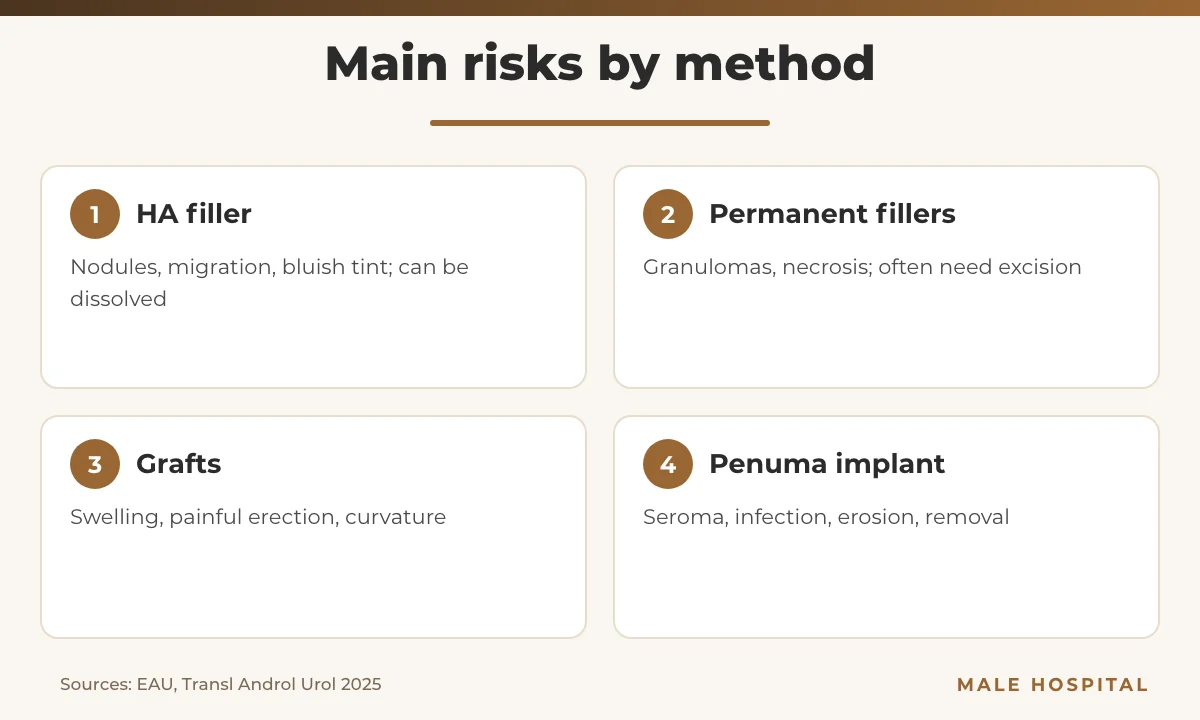
ISSM warns that penis enlargement procedures carry a risk of complications that can seriously damage the penis. The risks differ by method:
- Hyaluronic-acid fillers: lumps (nodules), migration of the gel, a bluish tint under thin skin, and rarely problems with blood supply. Hyaluronidase can dissolve the gel if needed.
- Permanent fillers (silicone, paraffin): granulomas, tissue death, chronic inflammation and infection; they cannot be dissolved and often need wide excision.
- Fat injection: swelling, bruising, uneven contour, infection and, rarely, fat embolism, which has been fatal.
- Grafts: swelling and painful erection in up to 27% of men and curvature in up to 9% (dermal fat grafts); length loss from graft scarring has also been reported.
- Penuma: seroma, infection, flaring of the device edge that can progress to erosion, and removal; one small series reported curvature and shortening after the implant.
- Ligament release: a significant complication rate according to the EAU, which is why the procedure needs extensive discussion first.
If you might need a penile prosthesis for erectile dysfunction in the future, discuss it before any enlargement procedure, and always tell a future surgeon exactly what was done.
Source: Transl Androl Urol (PMC) — Complications and management of penile enhancement procedures; ISSM — Can a man make his penis larger?; EAU Guidelines — Penile size abnormalities and dysmorphophobia
Results and realistic expectations
The honest summary is that penis enlargement offers small changes, and the most reliable “result” for many men is learning that they were normal all along.
| If you hope for… | Realistic expectation |
|---|---|
| Several inches of extra erect length | Not achievable with any proven method; erect length gains in traction studies were around 1 cm |
| A thicker shaft | HA filler can add around 1.5–2 cm of circumference for months, then fades |
| A longer-looking flaccid penis | Ligament release or removing suprapubic fat can improve how much shaft is visible |
| Better erections | Enlargement does not treat erectile dysfunction; that needs separate assessment |
| Ending the worry | If PDD is present, psychological treatment helps more than surgery |
If weak erections are part of the concern, our erectile dysfunction treatment page explains the options, and men having an implant can read what actually happens to size in our article on penile implant surgery and size.
Source: EAU Guidelines — Penile size abnormalities and dysmorphophobia; J Clin Med (PMC) — HA vs PLA filler RCT; ISSM — What are some penile augmentation procedures? Do they work?
Treatment with Dr. Zülfü Sertkaya in Istanbul
Assoc. Prof. Dr. Zülfü Sertkaya is a urologist and andrologist in Istanbul. He has been a urology specialist since 2014, became a Fellow of the European Board of Urology (FEBU) in 2017 and an Associate Professor of Urology in 2020. His published research includes penile enlargement techniques and the complications of penile implants, and his clinical focus covers penile prosthesis, Peyronie’s disease, premature ejaculation and male infertility. He holds a Coloplast Titan® inflatable penile prosthesis Center of Excellence certificate (2024) and is a member of the EAU, ESSM and ISSM.
The approach is to measure first, screen for dysmorphic concerns, explain the evidence plainly and advise against procedures unlikely to help. For international patients we arrange reception and transport, translation, trip planning, hotel accommodation, the medical consultation and aftercare. Prices are given only after a free assessment, because they depend on the technique or device that suits you.
How to start
Send a confidential WhatsApp message with your age, main concern, previous treatments, medical conditions, medications and any test results. Dr. Sertkaya’s team reviews your history and replies with a personalised plan: reassurance, a non-surgical option or a surgical assessment in Istanbul.
When to see a doctor
See a urologist promptly if you notice any of the following:
- Lumps, hardening, redness, discharge or worsening pain after a filler, injection or implant.
- Skin colour changes, blistering or dark patches on the penis after any procedure.
- A new bend, shortening or painful erections.
- Feeling faint or unwell after taking an “enhancement” supplement, especially if you also take nitrate heart medicines.
- Size worries that take up hours of your day, make you avoid sex, or come with low mood.
- A penis that is becoming hidden by weight gain, with urinary or hygiene problems.
Source: Transl Androl Urol (PMC) — Complications and management of penile enhancement procedures; Cleveland Clinic — Buried or hidden penis; FDA — MAGNUM brand products notification
Share your concern privately with Dr. Sertkaya’s team and get an honest, personalised plan.
FAQs about penis enlargement
Does penis enlargement really work?
Some methods produce small, measurable changes, but none adds large amounts of erect length. Traction gives about 1–2 cm of length after months of daily use, and hyaluronic-acid filler adds temporary girth. Ligament release mainly changes flaccid appearance. Pills, creams and jelqing have no scientific evidence behind them, according to ISSM.
Source: ISSM — Can a man make his penis larger?
What is a normal penis size?
In the Veale analysis of up to 15,521 men measured by health professionals, average erect length was 13.12 cm (about 5.2 in) and average erect girth 11.66 cm (about 4.6 in). Average flaccid length was 9.16 cm. Erect length showed only a weak link with height, so body size does not predict penis size well.
Source: King’s College London — Am I normal?
Is Penuma FDA approved?
Not in the sense of a full premarket approval. The device received FDA 510(k) clearance, which means it was judged substantially equivalent to an earlier device. The 2022 clearance covers cosmetic augmentation of the penis for aesthetic purposes. European guidelines still class Penuma as experimental and strongly advise against its use.
Source: FDA — 510(k) K220760; EAU Guidelines
How long do penile fillers last?
Hyaluronic acid is gradually absorbed. In a randomized trial, girth peaked about one month after injection and declined afterwards, but a gain of roughly 1.4 cm remained at 18 months. The authors report that hyaluronic-acid effects last up to about 18 months, so maintenance injections are usually needed to keep the result.
Source: J Clin Med (PMC) — HA vs PLA filler RCT
Do penis enlargement pills work?
No. There is no scientific evidence that supplements enlarge the penis. Worse, the FDA has found many sexual-enhancement products that secretly contain prescription drugs such as sildenafil and tadalafil. These can drop blood pressure dangerously when taken with nitrate heart medicines, so avoid them, especially if you have heart disease or diabetes.
Source: FDA — MAGNUM brand products notification
Will losing weight make my penis look bigger?
It can, if fat above the pubic bone is hiding part of the shaft. Weight loss does not grow the penis, but it can reveal length that is buried. Cleveland Clinic lists weight loss as the first step for an adult buried penis, and the EAU strongly recommends weight loss and lifestyle change before considering surgery.
Source: Cleveland Clinic — Buried or hidden penis
What is penile dysmorphic disorder?
It is a form of body dysmorphic disorder in which a man with a normal penis is preoccupied with its size to the point of distress. The EAU strongly recommends screening for it before enlargement and advises against fillers in men who have it. Psychotherapy, cognitive behavioral therapy and sometimes antidepressants are the recommended treatments.
Source: EAU Guidelines; ISSM — Penile augmentation procedures
How much does penis enlargement cost in Istanbul?
We do not publish a fixed price, because the cost depends on whether you need reassurance only, a traction device, fillers or surgery, and which product or technique is used. After a free, confidential assessment over WhatsApp, Dr. Sertkaya’s team gives you a personalised plan and a clear quotation.
Medically reviewed by Assoc. Prof. Dr. Zülfü Sertkaya, urologist and andrologist (FEBU), Istanbul. Last reviewed: October 2026.
This article is for general information and does not replace an individual consultation with a qualified doctor.
- EAU — Sexual and Reproductive Health Guidelines — Penile size abnormalities and dysmorphophobia
- King's College London — Am I normal? An analysis of penis lengths (Veale et al., BJU Int 2015)
- AUA — Penile Augmentation Surgery — policy statement
- ISSM — What are some penile augmentation procedures? Do they work?
- ISSM — Can a man make his penis larger?
- Journal of Sexual Medicine — Cosmetic penile enhancement procedures: an SMSNA position statement (2024)
- J Clin Med (PMC) — Hyaluronic vs polylactic acid filler injections for penile augmentation: 18-month randomized trial (2020)
- Ther Adv Urol (PMC) — Outcomes and patient satisfaction after Penuma silicone implant surgery (2024)
- Transl Androl Urol (PMC) — Complications and management of penile enhancement procedures (2025)
- FDA — 510(k) K220760 — Pre-Formed Penile Silicone Block (2022)
- FDA — 510(k) K162624 — Pre-Formed Penile Silicone Block (2017)
- FDA — MAGNUM brand products may be harmful due to hidden drug ingredients
- FDA — Sexual enhancement and energy product notifications
- Cleveland Clinic — Buried or hidden penis