
Penile Implant (Penile Prosthesis) Surgery in Istanbul
A penile implant (penile prosthesis) is a medical device placed entirely inside the body during surgery so that a man with erectile dysfunction (ED) can get an erection firm enough for sex whenever he chooses. It is usually offered when tablets, injections or a vacuum device have not worked or are not suitable, and guidelines report some of the highest satisfaction rates of any ED treatment. It does not make the penis longer, and it permanently changes the erectile tissue, so careful counselling comes first.
Source: EAU — Sexual and Reproductive Health Guidelines — Management of Erectile Dysfunction; Cleveland Clinic — Penile Implant: Purpose, Procedure, Risks & Recovery
- There are three main designs: three-piece inflatable, two-piece inflatable and malleable (semi-rigid) rods.
- European guidelines report satisfaction of 92–100 percent in patients and 91–95% in partners when men are properly counselled.
- With modern coated devices and careful technique, infection after a first implant is about 1–3% in low-risk men.
- Most men can use the implant for sex about 4–6 weeks after surgery, once the surgeon clears them.
- An implant restores rigidity, not size: it does not add length, and some men notice slight shortening.
Considering a penile implant? Send your history and get a confidential, personalised opinion from our urologist-andrologist.
- What is a penile implant (penile prosthesis)?
- Who is a good candidate?
- Implant types and devices compared
- Penile implant surgery step by step
- Recovery and activation timeline
- Risks: infection, erosion and mechanical failure
- Penile implant results: satisfaction, longevity and length
- Treatment with Dr. Zülfü Sertkaya in Istanbul
- How to start
- When to see a doctor
- FAQs about penile implant surgery
What is a penile implant (penile prosthesis)?
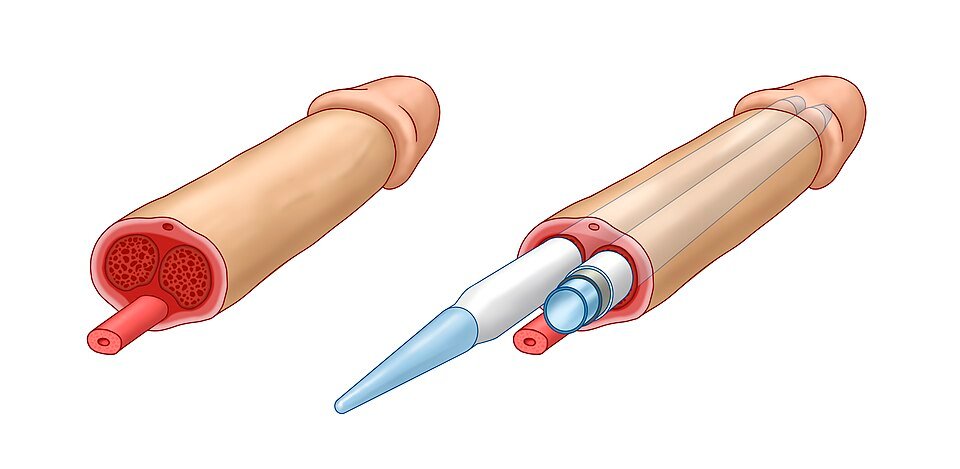
The penis contains two spongy chambers called the corpora cavernosa. In a natural erection they fill with blood. A penile prosthesis replaces that mechanism: the surgeon places a cylinder in each chamber, and the cylinders become rigid either by being filled with fluid (inflatable implants) or by being bent upward (malleable implants).
With an inflatable device, a small pump hidden in the scrotum moves fluid from a reservoir into the cylinders; a release valve lets the fluid flow back so the penis becomes soft again. Once healed, the device is not obvious to others, it does not change skin sensation, and it does not affect the ability to ejaculate and reach orgasm.
Source: Cleveland Clinic — Penile Implant: Purpose, Procedure, Risks & Recovery; ISSM — Does a penile prosthesis (implant) affect the size of the penis?
One point matters before anything else: placing a prosthesis damages the erectile tissue, so any remaining natural erections are usually lost and other ED treatments will no longer work. This is why an implant is treated as a definitive, last-line option rather than a first step.
Source: Boston Scientific — Tactra Malleable Penile Prosthesis — Risks
Who is a good candidate?
The European Association of Urology (EAU) recommends offering a penile prosthesis when other treatments fail or when a well-informed man prefers a definitive solution. Typical candidates include:
- Refractory ED: men whose erections do not respond to PDE5 tablets (such as sildenafil or tadalafil), penile injections or vacuum devices, or who cannot tolerate them. Learn about earlier steps on our erectile dysfunction treatment page.
- ED after radical prostatectomy or pelvic surgery: the EAU lists penile implants among the options after prostate cancer surgery when medicines and injections are not enough.
- Diabetes, vascular disease or spinal cord injury: these are common causes of severe, medication-resistant ED and are listed among the labelled indications for implants.
- Peyronie’s disease with ED: the American Urological Association (AUA) says surgeons may offer a prosthesis to men with Peyronie’s disease and ED, or with a bend that prevents intercourse despite medicines or a vacuum device.
Source: EAU — Sexual and Reproductive Health Guidelines — Management of Erectile Dysfunction; Coloplast — Genesis Malleable Penile Prosthesis
For Peyronie’s disease, the AUA advises using an inflatable rather than a malleable device, and allows extra steps during the same operation, such as manual modeling, plication or incision and grafting, if a significant bend remains after the cylinders are in place. Men with a curve but good erections usually need a different operation; see Peyronie’s disease treatment.
Source: AUA — Peyronie’s Disease Guideline
Implants are generally postponed when there is an active infection anywhere in the body, especially a urinary or genital infection, or an unresolved urinary problem. Poorly controlled diabetes, a body mass index above 30 and smoking raise the risk of infection, so improving them before surgery is part of the plan.
Source: Coloplast — Genesis Malleable Penile Prosthesis; Translational Andrology and Urology (PMC) — Recent technological development of penile prosthesis: a literature review (2024)
Implant types and devices compared
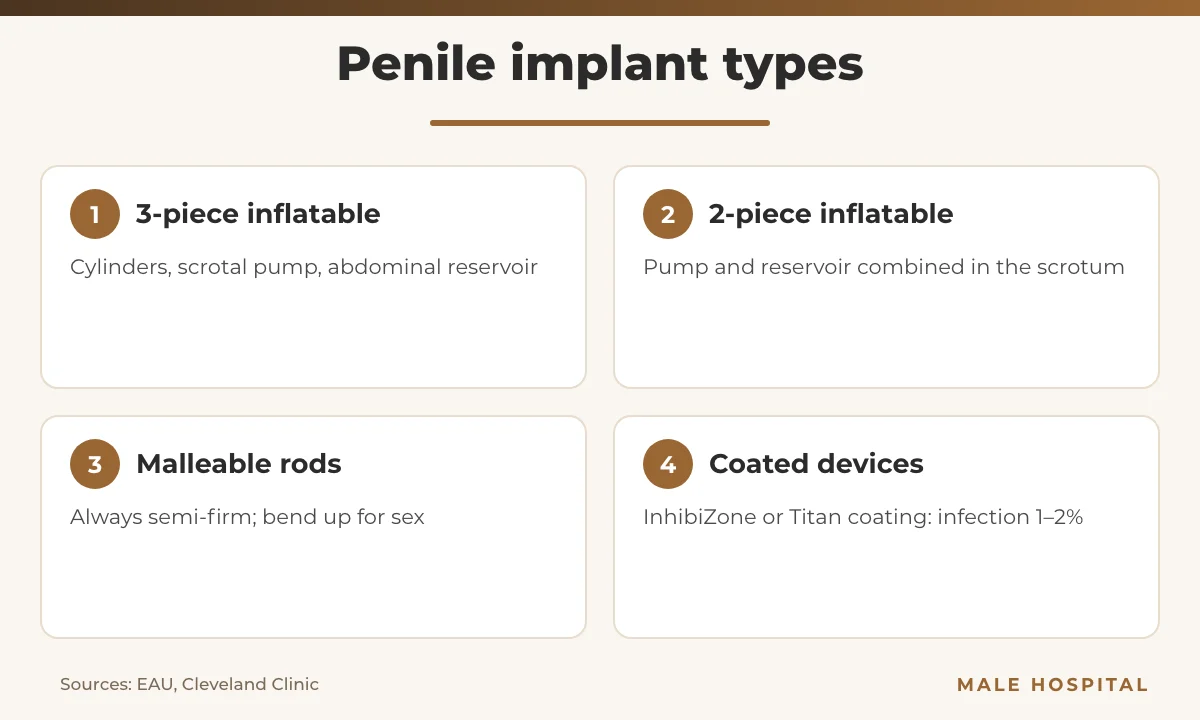
Three-piece inflatable implant
This is the design most men choose. It has two cylinders in the penis, a pump in the scrotum and a fluid reservoir in the lower abdomen. Because the reservoir holds the fluid away from the penis, the deflated penis looks and feels most natural, and the EAU notes that patients may prefer three-piece devices for this reason.
Two-piece inflatable implant
Here the reservoir is built into the pump in the scrotum, so no abdominal reservoir is needed. The EAU describes it as a viable option for men at high risk of reservoir complications, for example after previous abdominal surgery.
Malleable (semi-rigid) implant
Two bendable rods are placed in the penis; there is no pump or fluid. The penis is always firm and is bent up for sex and down for concealment. The rods suit men with limited hand function, but the EAU notes that a permanently semi-rigid penis is harder to conceal and feels less natural.
Source: EAU — Sexual and Reproductive Health Guidelines — Management of Erectile Dysfunction; Cleveland Clinic — Penile Implant: Purpose, Procedure, Risks & Recovery
Main devices on the market
Two manufacturers supply most implants worldwide. Boston Scientific makes the AMS 700 three-piece family, with CX, LGX and CXR cylinders and the MS Pump, available with the InhibiZone antibiotic surface treatment. Coloplast makes the Titan family with Bioflex cylinders, a hydrophilic coating that absorbs an antibiotic solution chosen by the surgeon, and the Titan Touch pump. Both companies also make malleable rods: Boston Scientific’s Tactra and Coloplast’s Genesis, which comes in 9.5, 11 and 13 mm diameters.
Source: Boston Scientific — AMS 700 Inflatable Penile Prosthesis; Coloplast — Titan Penile Implant; Coloplast — Genesis Malleable Penile Prosthesis
A systematic review comparing AMS 700 and Titan devices found durability and survival to be similar between the two brands. The EAU also states that there are no head-to-head studies proving one manufacturer’s implant better than another, so the right choice depends on your anatomy, your priorities and the surgeon’s experience.
Source: Cureus (PMC) — A Comparison Between AMS 700 and Coloplast Titan: A Systematic Literature Review (2020); EAU — Sexual and Reproductive Health Guidelines — Management of Erectile Dysfunction
| Feature | Three-piece inflatable | Two-piece inflatable | Malleable rods |
|---|---|---|---|
| Components | 2 cylinders, scrotal pump, abdominal reservoir | 2 cylinders, scrotal pump-reservoir | 2 bendable rods |
| Flaccid appearance | Most natural | Natural, slightly fuller | Always semi-firm |
| Hand dexterity needed | Yes (pump) | Yes (pump) | Minimal |
| Reported infection | 1–2% with coated devices | 0.7–7.5% across studies | 1.4–8.3% across studies |
| Reported dissatisfaction (one series) | 3.3% | 3.8% | 11.2% |
| Examples | AMS 700 CX/LGX/CXR, Titan | Two-piece inflatable models | Tactra, Genesis |
Source: Translational Andrology and Urology (PMC) — Recent technological development of penile prosthesis: a literature review (2024); EAU — Sexual and Reproductive Health Guidelines — Management of Erectile Dysfunction
Penile implant surgery step by step
Penile implant surgery is usually performed under general anaesthesia and typically takes one to two hours. Spinal anaesthesia is also used by some surgeons; in one small study, men who had spinal anaesthesia needed less intravenous pain medication and less treatment for nausea than those who had general anaesthesia.
Source: Cleveland Clinic — Penile Implant: Purpose, Procedure, Risks & Recovery; Advances in Urology (PMC) — Subarachnoid versus General Anesthesia in Penile Prosthetic Implantation (2012)
- Preparation: antibiotics are given, the skin is prepared, and a catheter may be placed in the bladder.
- Incision: the surgeon makes an incision either where the penis meets the scrotum (penoscrotal approach) or just above the penis (infrapubic approach).
- Dilation and sizing: each corpus cavernosum is gently opened and measured so cylinders of the correct length can be chosen.
- Placement: the cylinders go into the corpora; for a three-piece device the pump is placed in the scrotum and the reservoir in the lower abdomen, sometimes through a small extra incision.
- Testing and closure: the device is tested, and the wound is closed with dissolvable stitches; a small drain may be left for a short time.
Source: Cleveland Clinic — Penile Implant: Purpose, Procedure, Risks & Recovery
The EAU found no specific advantage of the penoscrotal over the infrapubic approach and recommends that implant surgeons are familiar with both.
Source: EAU — Sexual and Reproductive Health Guidelines — Management of Erectile Dysfunction
Recovery and activation timeline
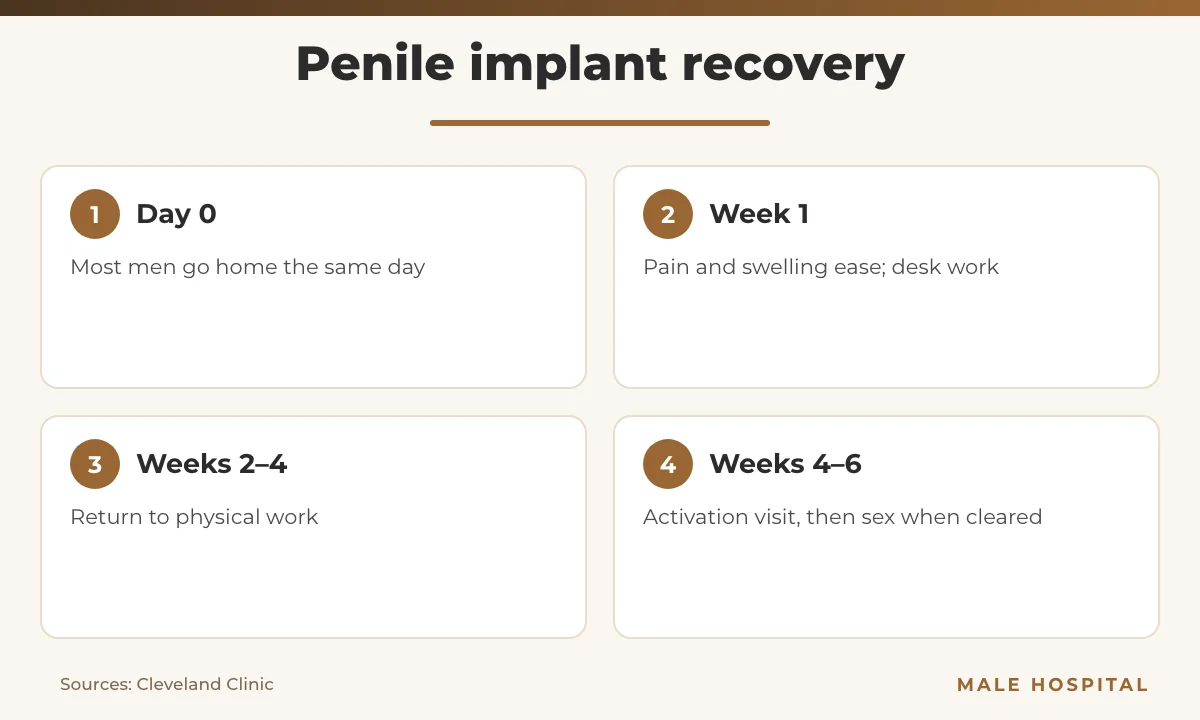
In most cases men go home a few hours after surgery, and they need someone to drive them and help for the first day or two. Pain, swelling and discomfort usually ease after about a week, although tenderness can last up to six weeks.
| Time after surgery | What to expect |
|---|---|
| Day of surgery | Home a few hours after surgery in most cases; a catheter is usually removed after surgery |
| Days 1–7 | A drain, if used, is removed after 1–3 days; pain and swelling settle; desk work is usually possible after at least one week |
| 2–4 weeks | Return to physically demanding work; avoid heavy lifting until the surgeon agrees |
| 4–6 weeks | Follow-up visit; the surgeon teaches you how to inflate and deflate the device (activation) |
| From about 4–6 weeks | Sexual activity can resume once the surgeon confirms healing |
Source: Cleveland Clinic — Penile Implant: Purpose, Procedure, Risks & Recovery
Learning to use an inflatable device takes a little practice: it can take a couple of minutes of pumping to reach full firmness. Some newer cylinders may expand slightly in length and girth over time with use. Adjusting to sex with the implant can take a few weeks or a couple of months, and most men describe sex as the same or better.
Source: Cleveland Clinic — Penile Implant: Purpose, Procedure, Risks & Recovery
Risks: infection, erosion and mechanical failure
The operation is safe in experienced hands, but like any implant it carries specific risks that you should understand before deciding.
Infection
Infection is the most serious complication, because it usually means the device has to be removed. The EAU reports that careful technique and antibiotic prophylaxis have reduced infection to 2–3% for first implants in low-risk men and high-volume centres, and to about 1–2% with antibiotic-impregnated (InhibiZone) or hydrophilic-coated (Titan) devices. When infection does happen, removing the device and replacing it immediately using a wash-out protocol succeeds in more than 80% of cases.
Source: EAU — Sexual and Reproductive Health Guidelines — Management of Erectile Dysfunction
A systematic review found that diabetes increases the odds of implant infection by about 1.5 times (odds ratio 1.53), and reported infection rates of roughly 0.3–2.7% with coated materials.
Erosion and glans problems
Erosion means a part of the device works its way through the tissue. The EAU states that impending erosion involving the distal corpora, urethra or glans can occur in 1–6% of cases; reduced blood flow to the glans (ischaemia) is rarer, around 1.5%, and is more likely in men with vascular disease or diabetes. Malleable rods have higher reported erosion rates (1.4–5.1%) than inflatable devices.
Source: EAU — Sexual and Reproductive Health Guidelines — Management of Erectile Dysfunction; Translational Andrology and Urology (PMC) — Recent technological development of penile prosthesis: a literature review (2024)
Mechanical failure
Modern three-piece devices have mechanical failure rates below 5% after five years. Malleable rods have no pump, yet published failure rates still range from 0.5% to 12%. A failed device can usually be replaced in a revision operation.
Source: EAU — Sexual and Reproductive Health Guidelines — Management of Erectile Dysfunction; Translational Andrology and Urology (PMC) — Recent technological development of penile prosthesis: a literature review (2024)
Other risks
Other possible problems include bleeding or a haematoma, urethral injury, excess scar tissue, movement of the pump or reservoir, persistent pain, and slight curvature or shortening.
Source: Cleveland Clinic — Penile Implant: Purpose, Procedure, Risks & Recovery; Boston Scientific — Tactra Malleable Penile Prosthesis — Risks
Penile implant results: satisfaction, longevity and length
Satisfaction
Satisfaction with implants is among the highest of any ED treatment: 92–100 percent of patients and 91–95% of partners in the studies summarised by the EAU, provided men receive proper counselling. In a 2024 review, dissatisfaction was reported in 3.3% of men with three-piece devices, 3.8% with two-piece and 11.2% with malleable implants.
Source: EAU — Sexual and Reproductive Health Guidelines — Management of Erectile Dysfunction; Translational Andrology and Urology (PMC) — Recent technological development of penile prosthesis: a literature review (2024)
Not every study is that high. In a European multicentre study of 361 men assessed 12 weeks after a first implant, 64.5% were satisfied, which is a reminder that results keep improving as men get used to the device and that expectations should be realistic.
Source: ISSM — Penile Length After Implant Surgery Depends on Pre-Surgery Stretched Length
How long does the device last?
Long-term follow-up of inflatable devices cited by the EAU shows device survival (no need for replacement) of 87.2% at five years, 76.8% at ten years, 63.7% at 15 years and 52.9% at 20 years.
Source: EAU — Sexual and Reproductive Health Guidelines — Management of Erectile Dysfunction
Length: an honest expectation
An implant restores rigidity; it is not designed to lengthen the penis. In one study of men with inflatable implants, about 70% measured 0.5–1.5 cm shorter, but only 43% of them noticed. Part of the perceived loss is that the glans does not swell the way it does in a natural erection, and men with long-standing ED may remember their past size inaccurately.
Source: ISSM — Does a penile prosthesis (implant) affect the size of the penis?; Cleveland Clinic — Penile Implant: Purpose, Procedure, Risks & Recovery
The best predictor of your future erect length is your stretched penile length before surgery, so a good surgeon measures it and discusses it with you. Boston Scientific states that its LGX cylinders allow up to 20% lengthwise expansion depending on anatomy, but this is cylinder expansion within the existing penis, not growth beyond your natural size.
Source: ISSM — Penile Length After Implant Surgery Depends on Pre-Surgery Stretched Length; Boston Scientific — AMS 700 Inflatable Penile Prosthesis; Asian Journal of Andrology (PMC) — Prospective and long-term evaluation of erect penile length obtained with inflatable penile prosthesis (2009)
Penuma is sometimes confused with an implant for ED. It is a subcutaneous silicone device cleared for cosmetic correction of soft-tissue penile deformities; it is not an erectile prosthesis. If size is your main concern, read our penis enlargement page, and for a plain-language summary of size and performance after surgery see our guide to what actually happens after penile implant surgery.
Treatment with Dr. Zülfü Sertkaya in Istanbul
Penile prosthesis surgery at Male Hospital is planned and performed by Assoc. Prof. Dr. Zülfü Sertkaya, a urologist and andrologist in Istanbul. He has been a urology specialist since 2014, is a Fellow of the European Board of Urology (FEBU, 2017) and became Associate Professor of Urology in 2020. Penile prosthesis surgery is one of his main areas of focus, and in 2024 he received the Titan Inflatable Penile Prosthesis Center of Excellence certificate from Coloplast.
His research includes penile prosthesis infection risk and implant complications, and he is a member of the EAU, the European Society for Sexual Medicine (ESSM), the International Society for Sexual Medicine (ISSM), the Turkish Urological Association and the Turkish Society of Andrology.
For patients travelling to Istanbul, our team provides reception and transport, translation, trip planning, hotel accommodation, medical consultation and aftercare. Prices are given only after a free assessment, because they depend on the device type and the surgical plan.
How to start
- Message us on WhatsApp for a free, confidential consultation.
- Share your history: ED duration, treatments tried, conditions such as diabetes or Peyronie’s disease, previous surgery and recent tests.
- Receive a personalised plan: Dr. Sertkaya reviews your information and explains whether an implant suits you, which device type fits your situation, and the steps of your trip.
When to see a doctor
See a urologist if ED persists despite tablets, if your erections have stopped responding after prostate surgery, or if a bend in your penis makes intercourse difficult. After implant surgery, contact your surgeon urgently if you notice:
- a fever of 38 °C (100 °F) or higher, or chills;
- heavy bleeding, or increasing redness, warmth, swelling or pus around the incision or scrotum;
- pain that gets worse instead of better after the first days;
- a part of the device pressing against or showing through the skin, or a dark or cold glans;
- difficulty passing urine or blood in the urine;
- a device that suddenly will not inflate or deflate.
Source: Cleveland Clinic — Penile Implant: Purpose, Procedure, Risks & Recovery; EAU — Sexual and Reproductive Health Guidelines — Management of Erectile Dysfunction
If you would like to know whether a penile implant is right for you, you can get a confidential opinion from our urologist-andrologist on WhatsApp.
FAQs about penile implant surgery
Is a penile implant painful?
Pain and swelling are expected after surgery and usually ease after about a week, although some tenderness can last up to six weeks. Pain medicine and rest help in the early days. Once healed, a correctly working device should not hurt during use, and persistent or worsening pain should be checked by the surgeon.
Source: Cleveland Clinic — Penile Implant: Purpose, Procedure, Risks & Recovery
Will I still feel pleasure and be able to ejaculate?
Yes. The implant does not change the sensation on the skin of the penis and does not affect the ability to ejaculate and reach orgasm. The device simply provides the rigidity that the erectile tissue can no longer achieve. Most men report that sex feels the same or better once they have adjusted to it.
Source: Cleveland Clinic — Penile Implant: Purpose, Procedure, Risks & Recovery
How soon can I have sex after penile implant surgery?
Most men can resume sex about four to six weeks after surgery. At a follow-up visit around that time, the surgeon checks healing and teaches you how to inflate and deflate the device. Do not try to use the implant before you are cleared, because early use can harm healing tissue.
Source: Cleveland Clinic — Penile Implant: Purpose, Procedure, Risks & Recovery
Will an implant make my penis bigger?
No. An implant restores rigidity but is not designed to add length, and some men measure slightly shorter afterwards. Your stretched length before surgery is the best guide to your inflated length after it. Men whose main concern is size should discuss other options separately rather than expecting enlargement from a prosthesis.
Source: ISSM — Does a penile prosthesis (implant) affect the size of the penis?; ISSM — Penile Length After Implant Surgery Depends on Pre-Surgery Stretched Length
Which is better, the AMS 700 or the Coloplast Titan?
There is no clear winner. A systematic review found similar durability and survival for the two brands, and the EAU notes there are no head-to-head trials comparing manufacturers. Both offer infection-reducing surfaces. The best device depends on your anatomy, any scarring or curvature, and your surgeon’s experience with each system.
Source: Cureus (PMC) — A Comparison Between AMS 700 and Coloplast Titan: A Systematic Literature Review (2020); EAU — Sexual and Reproductive Health Guidelines — Management of Erectile Dysfunction
How long does a penile implant last?
Many devices work for well over a decade. Data summarised by the EAU show that 76.8% of inflatable implants were still functioning without replacement at ten years and 52.9% at 20 years. When a device wears out or fails, it can usually be replaced in a revision operation.
Source: EAU — Sexual and Reproductive Health Guidelines — Management of Erectile Dysfunction
Can I get a penile implant after prostate cancer surgery?
Yes. ED after radical prostatectomy is one of the most common reasons for implant surgery. The EAU lists implants among the options when tablets and injections are not effective, and manufacturers list prostatectomy as an indication. Your surgeon will check that your cancer follow-up and urinary function are stable first.
Source: EAU — Sexual and Reproductive Health Guidelines — Management of Erectile Dysfunction; Coloplast — Genesis Malleable Penile Prosthesis
Can implant surgery be reversed?
The device itself can be removed, but the surgery is not truly reversible. Placing the cylinders damages the erectile tissue, so remaining natural erections are usually lost and other ED treatments are unlikely to work afterward. This is why the decision is made only after other options have been considered and the trade-offs are clearly understood.
Source: Boston Scientific — Tactra Malleable Penile Prosthesis — Risks
What happens if the implant gets infected?
An infected device usually has to be removed. In many cases the surgeon removes it, washes out the space with antiseptic solutions and places a new device in the same operation, which the EAU reports is successful in more than 80% of cases. Early signs such as fever, redness or worsening pain need urgent review.
Source: EAU — Sexual and Reproductive Health Guidelines — Management of Erectile Dysfunction
Ready to discuss a penile implant? Share your history on WhatsApp and receive a personalised plan from Dr. Sertkaya.
Medically reviewed by Assoc. Prof. Dr. Zülfü Sertkaya, urologist and andrologist (FEBU), Istanbul. Last reviewed: October 2026.
This article is for general information and does not replace an individual consultation with a qualified doctor.
- EAU — Sexual and Reproductive Health Guidelines — Management of Erectile Dysfunction
- Cleveland Clinic — Penile Implant: Purpose, Procedure, Risks & Recovery
- ISSM — Does a penile prosthesis (implant) affect the size of the penis?
- Boston Scientific — Tactra Malleable Penile Prosthesis — Risks
- Coloplast — Genesis Malleable Penile Prosthesis
- AUA — Peyronie's Disease Guideline
- Translational Andrology and Urology (PMC) — Recent technological development of penile prosthesis: a literature review (2024)
- Boston Scientific — AMS 700 Inflatable Penile Prosthesis
- Coloplast — Titan Penile Implant
- Cureus (PMC) — A Comparison Between AMS 700 and Coloplast Titan: A Systematic Literature Review (2020)
- Advances in Urology (PMC) — Subarachnoid versus General Anesthesia in Penile Prosthetic Implantation (2012)
- BMC Urology (PMC) — A systematic review of penile prosthesis infection and meta-analysis of diabetes mellitus role (2021)
- ISSM — Penile Length After Implant Surgery Depends on Pre-Surgery Stretched Length
- Asian Journal of Andrology (PMC) — Prospective and long-term evaluation of erect penile length obtained with inflatable penile prosthesis (2009)
- Urology Case Reports (PMC) — Infection of the Penuma penile implant and associated post-operative complications (2021)