
Peyronie's Disease Treatment: 6 Options Compared
Peyronie’s disease treatment depends on two things: whether the condition is still active (pain, a changing bend) or stable, and whether you can still get erections firm enough for sex. Active disease is usually managed with pain relief and selected non-surgical options, while a stable bend that stops intercourse can be corrected with injections, traction or surgery, and men with both Peyronie’s disease and erectile dysfunction are usually best served by a penile prosthesis.
Source: EAU Guidelines — Sexual and Reproductive Health: Penile Curvature; AUA — Peyronie’s Disease Guideline
- The disease is considered stable once pain has gone and the bend has not changed for at least three months; surgery is planned only after that point.
- Guidelines advise against oral vitamin E, tamoxifen, procarbazine, omega-3 fatty acids and radiotherapy for curvature, and against shockwave therapy for straightening.
- Collagenase injections (Xiaflex) remain FDA-approved in the US for curves of 30 degrees or more, but Xiapex was withdrawn from the EU market in 2020 for commercial reasons.
- Plication suits men with good erections, enough length and a moderate bend; grafting suits severe or complex bends; a prosthesis suits men who also have erectile dysfunction.
- No option restores the penis exactly to how it was before, so realistic goals are a functional, straighter erection and comfortable sex.
Send us your history and a photo of the curve for a confidential, personalised treatment plan from our urologist-andrologist.
- What is Peyronie’s disease treatment?
- Active vs stable phase: when to treat
- Who is a good candidate for each approach
- What guidelines say not to use
- Non-surgical Peyronie’s disease treatment options
- Surgery: plication, grafting and penile prosthesis
- Choosing a Peyronie’s disease treatment: options compared
- The procedure step by step
- Recovery timeline
- Risks and side effects
- Results and realistic expectations
- Peyronie’s disease treatment with Dr. Zülfü Sertkaya in Istanbul
- How to start
- When to see a doctor
- FAQs about Peyronie’s disease treatment
What is Peyronie’s disease treatment?
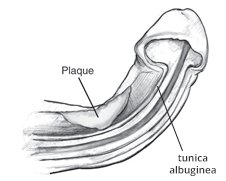
Peyronie’s disease is a scar (plaque) that forms in the tunica albuginea, the tough sheath around the erectile tissue. Because the scar does not stretch, the erect penis bends toward it: upward if the plaque is on top, downward if it is underneath. Some men also notice narrowing, an hourglass shape, shortening, painful erections or erection problems.
The cause is often unknown. It sometimes follows an injury to the penis, and it is more common in men with diabetes, high blood pressure, high cholesterol or heart disease. It may run in families, and some men also have Dupuytren’s contracture of the hand.
Source: NHS — Peyronie’s disease
The condition is more common than many men think. Cleveland Clinic estimates that about 6% to 10% of men aged 40 to 70 have it, and the European Association of Urology (EAU) notes that 1.5% to 16.9% of cases occur in men under 40.
Source: Cleveland Clinic — Peyronie’s Disease; EAU Guidelines — Sexual and Reproductive Health: Penile Curvature
Treatment aims to control pain, stop the bend interfering with sex and protect erections. Mild cases that do not affect intercourse may need no treatment at all. A bend present since birth without a plaque is a different condition (congenital curvature), covered on our penile curvature correction page.
Source: MedlinePlus — Curvature of the penis
Active vs stable phase: when to treat
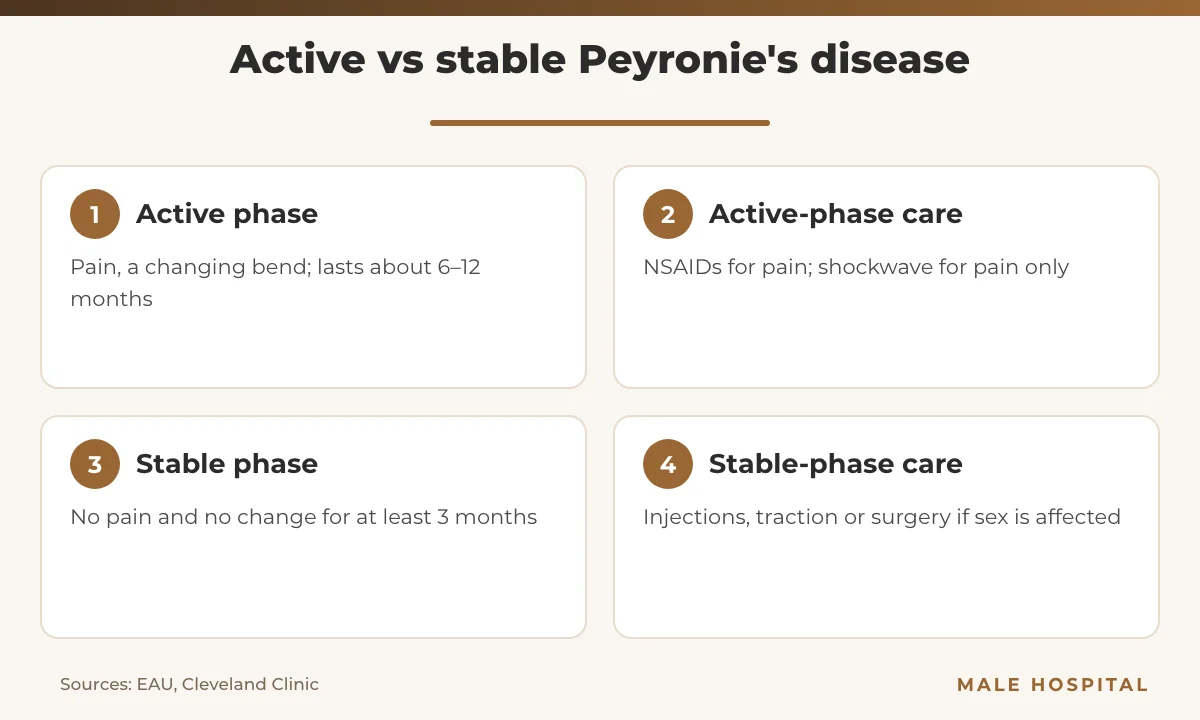
The disease usually starts with an active (acute) phase lasting about 6 to 12 months: the scar is forming, the bend may change and erections are often painful.
In the stable (chronic) phase the scar stops growing. The EAU defines stability as resolved pain and a curvature unchanged for at least three months.
The EAU says surgery should be performed only when the disease is stable and the deformity compromises intercourse, generally after 3 to 6 months of stability or more than 9 to 12 months after onset.
Source: EAU Guidelines — Sexual and Reproductive Health: Penile Curvature; Cleveland Clinic — Peyronie’s Disease
What is reasonable in each phase
- Active phase: anti-inflammatory painkillers (NSAIDs) for pain, low-intensity shockwave therapy for pain only, traction or vacuum devices as part of a combined plan, and PDE5 inhibitors if you also have erection problems.
- Stable phase: collagenase injections where available, intralesional verapamil, traction, or surgery when the bend still prevents intercourse.
Source: EAU Guidelines — Sexual and Reproductive Health: Penile Curvature
Who is a good candidate for each approach
Before any decision, the EAU recommends documenting plaque size and location, penile length, the degree of curvature, any complex deformity (such as an hourglass or hinge) and erectile function.
Objective measurement of the bend is mandatory: home photographs are a practical first step, while an injection-induced erection in clinic is the most accurate. Ultrasound shows calcification, and Doppler can assess blood flow before surgery.
Source: EAU Guidelines — Sexual and Reproductive Health: Penile Curvature
- Non-surgical care suits men in the active phase, men with a bend that still allows sex, and men who are unfit for or prefer to avoid surgery.
- Collagenase suits stable disease with a curve between 30 and 90 degrees and intact erections (with or without medication), according to the American Urological Association (AUA).
- Straightening surgery suits stable disease when the deformity prevents intercourse but erections are still firm enough, with or without tablets.
- A penile prosthesis suits men with Peyronie’s disease plus erectile dysfunction that does not respond to medication.
Source: AUA — Peyronie’s Disease Guideline; EAU Guidelines — Sexual and Reproductive Health: Penile Curvature
What guidelines say not to use
The AUA states that clinicians should not offer oral therapy with vitamin E, tamoxifen, procarbazine, omega-3 fatty acids, or a combination of vitamin E with L-carnitine. It also advises against electromotive verapamil (applied through the skin with an electric current) and against radiotherapy.
The AUA says shockwave therapy should not be used to reduce curvature or plaque size, and the EAU strongly recommends against using it to improve curvature. Both allow it only as an option for penile pain.
Source: AUA — Peyronie’s Disease Guideline; EAU Guidelines — Sexual and Reproductive Health: Penile Curvature
Other tablets, such as pentoxifylline, colchicine, L-arginine and potassium aminobenzoate (Potaba), have not been shown in reliable studies to reduce curvature, although some may ease symptoms. The EAU advises against the “sliding” surgical technique because of the risk of glans necrosis (loss of tissue at the head of the penis).
Source: Cleveland Clinic — Peyronie’s Disease; MedlinePlus — Curvature of the penis
Non-surgical Peyronie’s disease treatment options
Penile traction therapy
A traction device gently stretches the penis for several hours a day. The EAU reports devices worn for 2 to 8 hours daily, with benefit seen at more than 3 hours a day: length gains of 0.4 to 1.8 cm and, in a meta-analysis, about 15 degrees of curvature improvement. The EAU gives traction and vacuum devices a weak recommendation, alone or as part of a combined plan, because outcome data are limited.
The AUA found only observational studies and asked for randomized trials. The NHS notes devices must be used daily for several months.
Source: EAU Guidelines — Sexual and Reproductive Health: Penile Curvature; NHS — Peyronie’s disease
Collagenase injections (Xiaflex / Xiapex)
Collagenase clostridium histolyticum is an enzyme injected directly into the plaque to break down collagen. In the US, Xiaflex remains FDA-approved for adult men with a palpable plaque and a curve of at least 30 degrees; its prescribing information was most recently revised in September 2026. Because of the risk of serious penile injury, it can only be given through a restricted safety program (REMS) by certified prescribers.
In the two pivotal trials, average curvature improved by 35.0% and 33.2% with Xiaflex at one year, compared with 17.8% and 21.8% with placebo.
Source: DailyMed (NLM) — XIAFLEX prescribing information
In Europe the situation is different. The European marketing authorisation for Xiapex was withdrawn with effect from 1 March 2020, at the request of the company, which decided to permanently stop marketing it for commercial reasons, not because of a safety finding. The EAU keeps its recommendation for collagenase in men with dorsal or lateral curves above 30 degrees who want non-surgical treatment, but notes it is no longer on the European market.
Source: European Medicines Agency — Xiapex: withdrawal of marketing authorisation; EAU Guidelines — Sexual and Reproductive Health: Penile Curvature
Intralesional verapamil and interferon
Verapamil, a blood-pressure medicine, can be injected into the plaque. The AUA says it may be offered (a conditional recommendation), with counselling about bruising, dizziness, nausea and injection-site pain. The EAU finds the evidence contradictory and makes no recommendation for clinical use.
Interferon alpha-2b injections may be offered under the AUA guideline, with possible flu-like symptoms, sinusitis and minor swelling. The EAU does not recommend interferon because of limited evidence and its 2021 withdrawal from the EU and US markets.
Source: AUA — Peyronie’s Disease Guideline; EAU Guidelines — Sexual and Reproductive Health: Penile Curvature
Shockwave, PDE5 inhibitors and newer options
Low-intensity shockwave therapy may ease painful erections in the active phase, but it does not straighten the penis. PDE5 inhibitors such as tadalafil are used to treat erectile dysfunction that accompanies Peyronie’s disease (see our erectile dysfunction treatment page). Hyaluronic acid injections and platelet-rich plasma (PRP) are being studied, but the EAU stresses that data on both are limited.
Source: EAU Guidelines — Sexual and Reproductive Health: Penile Curvature
Surgery: plication, grafting and penile prosthesis
Surgery can straighten the penis, but it usually cannot return it fully to its previous shape.
Source: NHS — Peyronie’s disease
Plication (tunical shortening)
Plication places permanent stitches on the side opposite the plaque (the longer side), so the penis straightens by shortening that side. Techniques include simple plication, the 16-dot technique and the Nesbit operation. The EAU suggests plication as the first option for men with adequate length and rigidity, a less severe curve and no hourglass or hinge deformity, and notes that no single technique has proven superior.
Straightening is achieved in more than 85% of patients. The trade-off is length: some shortening was reported in 33% to 45% of men in EAU-reviewed series, although the AUA notes that men often perceive more loss than is actually measured.
Source: EAU Guidelines — Sexual and Reproductive Health: Penile Curvature; AUA — Peyronie’s Disease Guideline
Plaque incision or partial excision with grafting (tunical lengthening)
Here the surgeon cuts into or partly removes the plaque on the short side and covers the defect with a graft, which lengthens that side. The EAU suggests grafting for men with normal erections but inadequate length, a severe curve (often described as over 60 degrees, although this cut-off is not validated) or a complex deformity such as an hourglass. Straightening success ranges from about 84% to 94% depending on the graft material.
The main concern is erections: new erectile dysfunction after grafting ranges from about 5% to 22% depending on the graft. The AUA therefore recommends these operations mainly for men whose erections are intact or respond well to tablets or a vacuum device.
Source: EAU Guidelines — Sexual and Reproductive Health: Penile Curvature; AUA — Peyronie’s Disease Guideline
Penile prosthesis with modelling (Peyronie’s disease plus ED)
When curvature and erectile dysfunction occur together and tablets no longer work, a penile prosthesis treats both problems in one operation. The EAU strongly recommends this approach, and the AUA advises using an inflatable device in men with Peyronie’s disease.
If a significant bend remains after the implant is placed, the surgeon performs manual modelling: the inflated device is bent against the curve for about 90 seconds to stretch the scar. If the residual curve is under 30 degrees, no further step is needed; otherwise plication or incision with grafting can be added during the same operation. The AUA notes that modelling is difficult with semi-rigid devices.
Source: EAU Guidelines — Sexual and Reproductive Health: Penile Curvature; AUA — Peyronie’s Disease Guideline
For a detailed, patient-level look at what an implant changes, read our guide to penile implant surgery and what happens to size and performance.
Choosing a Peyronie’s disease treatment: options compared
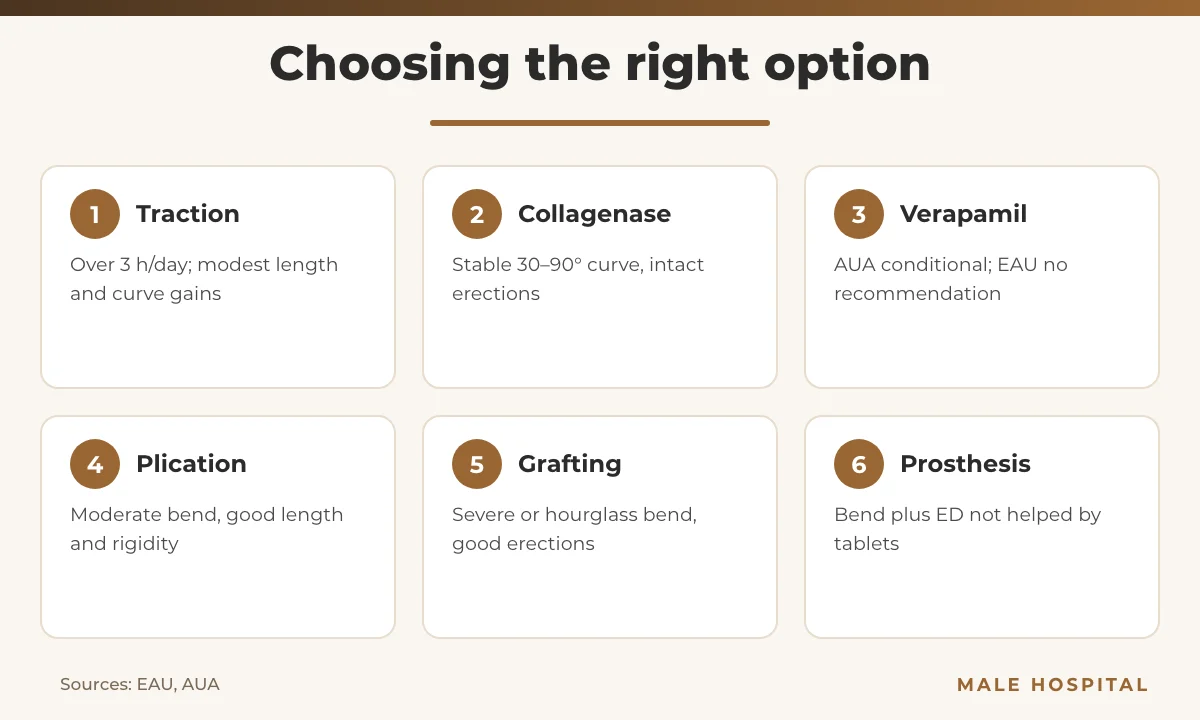
The right Peyronie’s disease treatment comes down to three questions: how big and complex is the bend, how good are your erections, and how much length do you have (and fear losing)?
| Option | Curvature | Erections | Length | Guideline view |
|---|---|---|---|---|
| Traction device | Mild to moderate; active or stable | Any | May gain 0.4–1.8 cm | EAU weak; AUA: needs better trials |
| Collagenase (Xiaflex) | 30–90°, stable, no urethral plaque | Intact (with or without tablets) | Not designed to add length | AUA option; EAU strong, but withdrawn in EU |
| Intralesional verapamil | Stable plaque | Any | Neutral | AUA conditional; EAU no recommendation |
| Plication | Less severe, no hourglass or hinge | Good rigidity | Adequate length needed; some shortening | EAU first surgical option |
| Incision/excision + graft | Severe (often >60°) or complex | Normal or responsive to tablets | Better preserves length | EAU and AUA option |
| Inflatable prosthesis ± modelling | Any degree | ED not responding to tablets | Depends on technique | EAU strong; AUA inflatable preferred |
Source: EAU Guidelines — Sexual and Reproductive Health: Penile Curvature; AUA — Peyronie’s Disease Guideline; DailyMed (NLM) — XIAFLEX prescribing information
The procedure step by step
- History and examination: onset, pain, whether the shape is changing, erection quality.
- Measuring the curve: home photographs, then if needed an in-clinic erection test and ultrasound.
- Choosing the plan using the factors in the table above.
- Treatment. For collagenase, each cycle is two injections into the plaque 1 to 3 days apart, followed by a modelling session 1 to 3 days after the second injection.
- Follow-up after each cycle or after surgical healing.
Source: EAU Guidelines — Sexual and Reproductive Health: Penile Curvature; DailyMed (NLM) — XIAFLEX prescribing information
Recovery timeline
| Treatment | What recovery looks like |
|---|---|
| Collagenase cycle | No sexual activity between the two injections; wait at least 4 weeks after the second injection and until pain and swelling settle. Home stretching 3 times daily and gentle straightening once daily for 6 weeks. |
| Further cycles | About every 6 weeks, up to 4 cycles; stopped early if the curve falls below 15 degrees. |
| Traction | More than 3 hours a day is linked to benefit; most men need several months of daily use. |
| Surgery or prosthesis | Planned only after the disease has been stable; your surgeon gives an individual timeline for wound healing, device activation and return to sex. |
Source: DailyMed (NLM) — XIAFLEX prescribing information; EAU Guidelines — Sexual and Reproductive Health: Penile Curvature; Cleveland Clinic — Peyronie’s Disease
During a collagenase course, the label also advises against using a vacuum erection device and avoiding straining, for example during bowel movements. Bruising and swelling are expected, and mild pain can usually be managed with over-the-counter painkillers.
Source: DailyMed (NLM) — XIAFLEX prescribing information
Risks and side effects
- Collagenase: penile bruising, swelling and pain are the most common effects. Corporal rupture (penile fracture) occurred in 0.5% of treated men in trials, and severe penile hematoma in 3.7%. It must not be used if the plaque involves the urethra.
- Verapamil and interferon: bruising, dizziness, nausea and injection pain (verapamil); flu-like symptoms, sinusitis and swelling (interferon).
- Plication: some shortening, reduced sensation (around 8% to 9%), recurrence of the bend, palpable stitch knots and new erectile dysfunction in a minority.
- Grafting: new erectile dysfunction (about 5% to 22% depending on the graft) and temporary numbness from handling the nerves.
- Prosthesis with modelling: the general risks of implant surgery plus a risk of urethral injury during modelling of about 3%.
Source: DailyMed (NLM) — XIAFLEX prescribing information; AUA — Peyronie’s Disease Guideline; EAU Guidelines — Sexual and Reproductive Health: Penile Curvature
Results and realistic expectations
Injections and traction reduce the bend partly rather than completely, and often take months. Surgery straightens most men reliably, but some length is commonly lost with plication and erections can be affected after grafting.
The emotional side matters too. Peyronie’s disease is linked with depression, anxiety and body-image concerns, and the EAU reports that depression scores fell after surgical correction.
Source: Cleveland Clinic — Peyronie’s Disease; EAU Guidelines — Sexual and Reproductive Health: Penile Curvature
Peyronie’s disease treatment with Dr. Zülfü Sertkaya in Istanbul
Assoc. Prof. Dr. Zülfü Sertkaya is a urologist and andrologist in Istanbul and a Fellow of the European Board of Urology (FEBU, 2017). He has been a urology specialist since 2014, became Associate Professor of Urology in 2020, and Peyronie’s disease and penile prosthesis surgery are among his main areas of focus. He holds a Titan® Inflatable Penile Prosthesis Center of Excellence certificate from Coloplast (2024) and is a member of the EAU, ESSM, ISSM, the Turkish Urological Association and the Turkish Society of Andrology.
For patients travelling to Istanbul, our team supports you with reception and transport, translation, trip planning, hotel accommodation, medical consultation and aftercare. Pricing is given after a free assessment, because it depends on the technique or device that suits you.
How to start
Start with a free, confidential WhatsApp consultation. Share your history (when the bend began, whether it still hurts, how firm erections are, your medicines) plus any scans and, if you are comfortable, side and top photos of a natural erection. Dr. Sertkaya’s team will reply with a personalised plan and tell you whether you are a candidate for non-surgical care, straightening surgery or an implant.
When to see a doctor
See a doctor if you notice a hard lump on the shaft, a new bend when erect, or painful erections or erection problems that affect sex. Seek urgent care if you feel a sharp pain or hear a pop during sex followed by swelling and bruising, which can signal a penile fracture. During collagenase treatment, report straight away a popping sensation, sudden loss of erection, severe pain, severe bruising or swelling, difficulty urinating or blood in the urine.
Source: NHS — Peyronie’s disease; MedlinePlus — Curvature of the penis; DailyMed (NLM) — XIAFLEX prescribing information
Ready to discuss your curve privately? Message us and receive a personalised plan from Dr. Sertkaya’s team.
FAQs about Peyronie’s disease treatment
Can Peyronie’s disease go away on its own?
Sometimes symptoms improve or stay stable without treatment, and pain usually fades as the active phase ends. However, the bend does not reliably disappear, and in some men it worsens until intercourse becomes impossible.
Source: MedlinePlus — Curvature of the penis
What is the most effective Peyronie’s disease treatment?
For a stable, significant bend, surgery gives the most predictable straightening: plication straightens more than 85% of men, and grafting about 84% to 94%. Injections and traction are less invasive but usually only reduce the curve partly. If you also have erectile dysfunction that tablets do not fix, an inflatable prosthesis with modelling is the strongly recommended choice.
Source: EAU Guidelines — Sexual and Reproductive Health: Penile Curvature
Does vitamin E help Peyronie’s disease?
The AUA guideline says clinicians should not offer oral vitamin E for Peyronie’s disease, either alone or combined with L-carnitine. The same statement covers tamoxifen, procarbazine and omega-3 fatty acids.
Source: AUA — Peyronie’s Disease Guideline
Is Xiaflex still available?
In the United States, yes: Xiaflex is FDA-approved for men with a palpable plaque and a curve of at least 30 degrees, given through a restricted safety program, and its label was updated in September 2026. In the European Union, Xiapex has not been marketed since its authorisation was withdrawn in March 2020 for commercial reasons.
Source: DailyMed (NLM) — XIAFLEX prescribing information; European Medicines Agency — Xiapex: withdrawal of marketing authorisation
Does shockwave therapy straighten the penis?
No. Both major guidelines say shockwave therapy should not be used to correct curvature or shrink the plaque. The AUA and EAU accept it only as an option to relieve painful erections during the active phase.
Source: AUA — Peyronie’s Disease Guideline
Will surgery make my penis shorter?
It can, depending on the operation. Plication shortens the longer side, and some shortening was reported in roughly a third or more of men, often 1 to 1.5 cm, although many men perceive more loss than is measured. Grafting lengthens the short side and better preserves length but carries a higher risk of erection problems.
Source: EAU Guidelines — Sexual and Reproductive Health: Penile Curvature
How long should I wait before surgery?
Surgery should wait until the disease is stable, meaning pain has gone and the bend has not changed for at least three months. In practice, urologists generally operate after 3 to 6 months of stability or more than 9 to 12 months after the problem began, and only if the bend actually interferes with sex.
Source: EAU Guidelines — Sexual and Reproductive Health: Penile Curvature
Is a penile implant a good option for Peyronie’s disease?
It is the preferred option when Peyronie’s disease comes with erectile dysfunction that does not respond to medication. An inflatable implant gives a rigid erection on demand, and residual bending can be corrected by modelling or added straightening during the same operation. Cleveland Clinic describes it as the best option in this situation.
Source: Cleveland Clinic — Peyronie’s Disease
Medically reviewed by Assoc. Prof. Dr. Zülfü Sertkaya, urologist and andrologist (FEBU), Istanbul. Last reviewed: October 2026.
This article is for general information and does not replace an individual consultation with a qualified doctor.
- EAU — Sexual and Reproductive Health Guidelines — Penile Curvature
- AUA — Peyronie's Disease Guideline
- DailyMed (U.S. National Library of Medicine) — XIAFLEX (collagenase clostridium histolyticum) prescribing information
- European Medicines Agency — Xiapex: withdrawal of marketing authorisation
- NHS — Peyronie's disease
- Cleveland Clinic — Peyronie's Disease
- MedlinePlus — Curvature of the penis