
Penile Filler: Honest Guide to HA Girth Injections
Penile filler is an in-office injection, most often of hyaluronic acid (HA), placed under the skin of the penile shaft to increase girth (thickness), not length. Small randomized trials report average girth gains of roughly 1.5–2.5 cm that largely persist for 12–18 months, but the treatment is off-label, the evidence is limited, and European urology guidelines give it only a weak recommendation after thorough counseling.
Sources: EAU Guidelines — Penile Size Abnormalities and Dysmorphophobia; World Journal of Men’s Health (PMC) — Efficacy and Safety of Penile Girth Enhancement Using Hyaluronic Acid Filler
- A penile filler adds girth only; it does not lengthen the penis or treat erectile dysfunction.
- No dermal filler is FDA-approved for the penis, so any use is off-label, and the AUA states that injection and fat-transfer methods have not been shown to be safe or effective.
- In trials, HA increased girth by about 2 cm at 24 weeks, with mostly mild, temporary side effects.
- Silicone, paraffin and petroleum jelly must never be injected; they cause paraffinomas that often need reconstructive surgery.
- Men with a normal-sized penis and severe size anxiety should be screened for body dysmorphic disorder before any filler.
Wondering whether a filler suits you? Get an honest, confidential opinion from our urologist-andrologist.
- What is a penile filler?
- Who is a good candidate for penile girth enhancement?
- What the evidence shows for penile filler injections
- Penile filler options compared
- The penile filler procedure step by step
- Recovery and aftercare
- Risks and side effects of penis filler
- Results and realistic expectations
- Penile filler with Dr. Zülfü Sertkaya in Istanbul
- How to start
- When to see a doctor
- FAQs about penile filler
What is a penile filler?
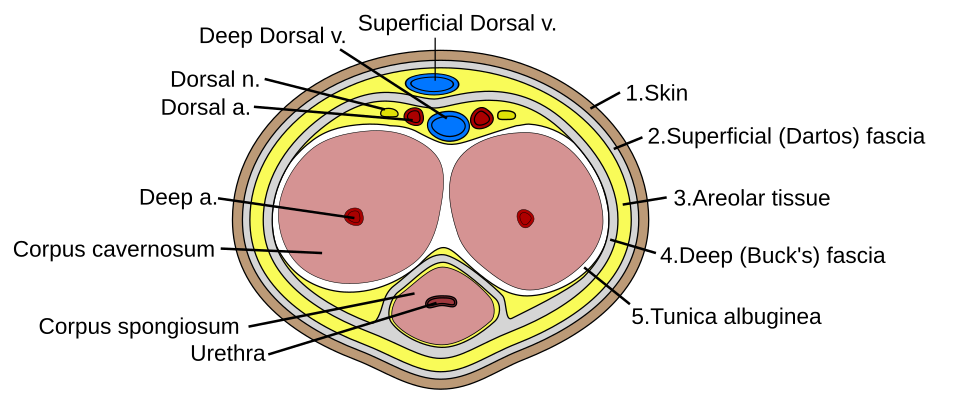
A penile filler is a soft-tissue filler injected into the loose layer between the skin (dartos fascia) and the deeper Buck’s fascia that surrounds the erectile bodies. The filler adds volume around the shaft, so the penis looks and feels thicker in both the flaccid and erect state. It does not enter the erectile tissue itself.
Hyaluronic acid is the most studied material. It is a gel-like sugar molecule that occurs naturally in the body; filler products are chemically cross-linked so they last longer. Other options studied for penile girth enhancement include poly-L-lactic acid (PLLA/PLA), polymethyl methacrylate (PMMA) microspheres and the patient’s own fat.
Sources: World Journal of Men’s Health (PMC) — Efficacy and Safety of Penile Girth Enhancement Using Hyaluronic Acid Filler; EAU Guidelines — Penile Size Abnormalities and Dysmorphophobia
It is important to be clear about regulation. The US Food and Drug Administration (FDA) has approved dermal fillers only for specific uses such as facial wrinkles and folds and the lips, cheeks, chin and back of the hand, and it recommends against fillers for body contouring or enhancement. Authors in Sexual Medicine note that dermal fillers have not been approved by the FDA for penile girth. In other words, every penis filler treatment is off-label use of a product approved for other areas.
Sources: FDA — Dermal Fillers (Soft Tissue Fillers); Sexual Medicine (PMC) — Penile Girth Injection Complications: A Case Report
Who is a good candidate for penile girth enhancement?
Most men who ask about size have a normal penis. The EAU guideline gives average circumference figures of about 9.3 cm flaccid and 11.7 cm erect, while noting there is no consensus on a single “normal” size. Body dysmorphic disorder is more common among people seeking cosmetic procedures, and the EAU strongly recommends asking about it in men with a normal-sized penis who feel they are too small.
Source: EAU Guidelines — Penile Size Abnormalities and Dysmorphophobia
A reasonable candidate for a penile filler is usually an adult man who:
- has a realistic goal of modest extra thickness rather than a dramatic change;
- has no active genital infection or skin disease;
- has been told clearly that the treatment is off-label and that long-term data are lacking;
- does not have penile dysmorphic disorder; the EAU strongly advises against fillers or fat injection in these men and recommends referral for mental health counseling instead.
Sources: EAU Guidelines — Penile Size Abnormalities and Dysmorphophobia; ISSM — What Are Some Penile Augmentation Procedures? Do They Work?
A filler is not a treatment for weak erections, curvature or a very short penis. If erections are the real concern, our erectile dysfunction treatment page explains the evidence-based options. If the main wish is more length, read about all methods, including their limits, on our penis enlargement page.
What the evidence shows for penile filler injections
The best data come from a small number of randomized trials, mostly from South Korea. In a multicenter, patient- and evaluator-blinded trial in World Journal of Men’s Health, 64 men completed treatment with either a cross-linked HA filler or a PLA filler. Mean girth increased by 22.7 mm with HA and 20.2 mm with PLA at 24 weeks, with no significant difference between the groups and no serious adverse events.
A 2023 meta-analysis pooled four Korean randomized trials with 283 participants. HA produced a slightly greater increase in penile diameter than PLA and better sexual satisfaction at 12 weeks, while complication rates were similar. The authors stress the limits: few trials, different HA formulations, follow-up of only 24–72 weeks, and three of the four trials led by the same first author.
The EAU guideline summarizes reported girth gains of 1.4–3.78 cm for HA and 1.2–2.4 cm for PLA, with high satisfaction in most HA studies. However, it rates the overall evidence as low and gives fillers only a weak recommendation. The American Urological Association states that subcutaneous fat injection for girth has not been shown to be safe or efficacious, and ISSM notes that the AUA does not consider injection therapies safe.
Sources: EAU Guidelines — Penile Size Abnormalities and Dysmorphophobia; American Urological Association — Penile Augmentation Surgery policy statement
How long does a penile filler last?
Durability is the most common question, and honest answers require caution. In a series of 50 men, maximal circumference rose from 7.48 cm to 11.41 cm at one month and was 11.26 cm at 18 months. Another study found that girth at 12 months was smaller than at one month but still significantly above baseline. How long HA lasts depends on its cross-linking, purity and concentration, so results vary by product.
Source: Gels (PMC) — The Application of Hyaluronic Acid Injections in Functional and Aesthetic Andrology
In practice, published follow-up mostly covers one to one and a half years. A systematic review describes an HA series with significant girth gains still present at 18 months. Beyond that, long-term physical and psychological effects remain unknown, and top-up injections may be discussed if volume decreases.
Sources: Medicina (PMC) — Techniques for Penile Augmentation Surgery: A Systematic Review; Annals of Medicine and Surgery (PMC) — Efficacy and complications of hyaluronic acid and polylactic acid for penile augmentation
Penile filler options compared
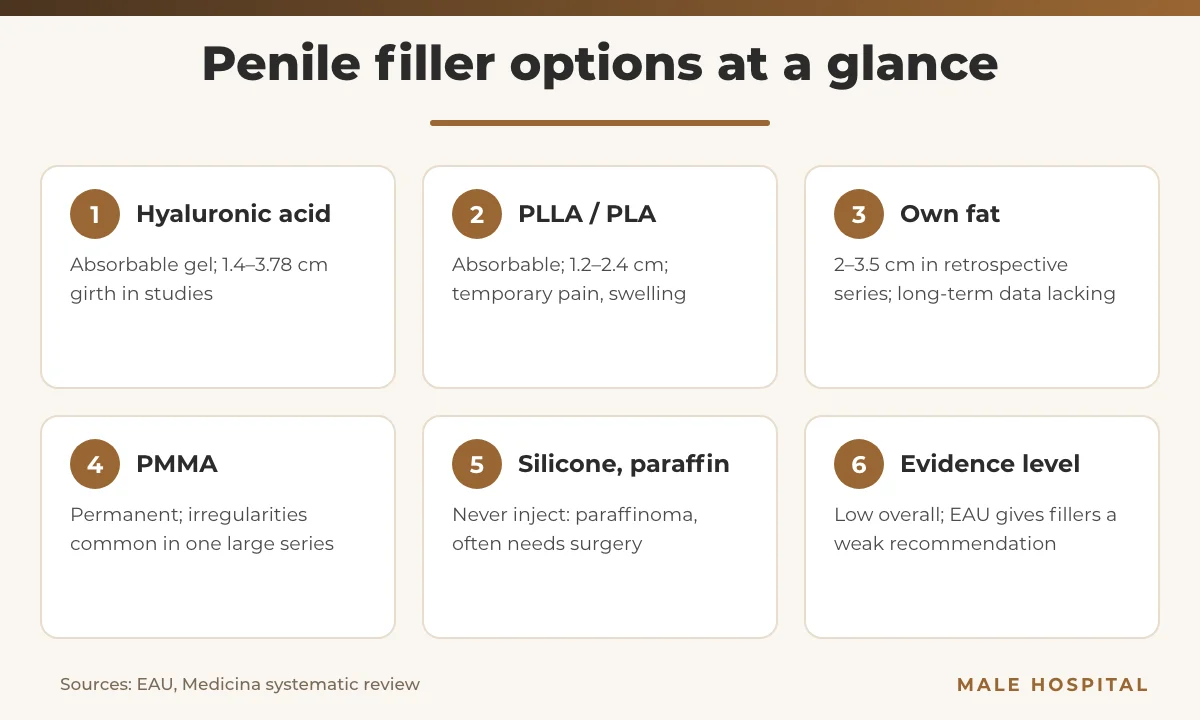
Not all fillers behave the same. The key differences are whether the material is absorbed by the body and how serious its complications can be.
| Option | Type | Reported girth gain | Main concerns |
|---|---|---|---|
| Hyaluronic acid (HA) | Absorbable gel | 1.4–3.78 cm | Nodules, swelling, uneven contour, rare infection |
| PLLA / PLA | Biostimulatory, absorbable | 1.2–2.4 cm | Temporary pain and swelling |
| Autologous fat grafting | Patient’s own tissue | 2–3.5 cm (retrospective) | Unpredictable survival, nodular fat; AUA: not shown safe or effective |
| PMMA microspheres | Permanent | About 2.4–3.5 cm | Irregularities in about half of men in one large series; hard to remove |
| Silicone, paraffin, petroleum jelly | Foreign body, permanent | Not a treatment | Granulomas, infection, gangrene, reconstructive surgery |
Sources: EAU Guidelines — Penile Size Abnormalities and Dysmorphophobia; Medicina (PMC) — Techniques for Penile Augmentation Surgery: A Systematic Review
Fat grafting and PLLA
Fat transfer uses liposuctioned fat from the abdomen or thighs. Retrospective studies report useful gains, but the EAU notes that long-term data are lacking, and the AUA policy specifically says subcutaneous fat injection for girth has not been shown to be safe or efficacious. PLLA (or PLA) stimulates collagen formation and performed similarly to HA in a head-to-head trial.
Sources: EAU Guidelines — Penile Size Abnormalities and Dysmorphophobia; American Urological Association — Penile Augmentation Surgery policy statement
Why permanent fillers carry more risk
PMMA microspheres stay in the tissue indefinitely. In a review of 729 men treated with PMMA, mean flaccid mid-shaft girth rose by 2.4 cm, but irregularities occurred in 52%, and some men needed surgical removal of nodules. The FDA approves non-absorbable fillers only for nasolabial folds and certain acne scars, not for the body. A permanent material cannot simply wear off if the result is lumpy or uneven.
Sources: Medicina (PMC) — Techniques for Penile Augmentation Surgery: A Systematic Review; FDA — Dermal Fillers (Soft Tissue Fillers)
Silicone and paraffin self-injection: paraffinoma
Injecting silicone, paraffin, mineral oil or petroleum jelly, often by non-medical people, causes a chronic foreign-body reaction called a sclerosing lipogranuloma or paraffinoma. Men develop painful lumps, skin ulcers, infection and deformity, sometimes years after the injection. Creams and steroid injections do not work; reconstructive surgery, such as excision with scrotal flap repair, is the only effective treatment. The EAU strongly recommends never using these substances.
Sources: Malaysian Journal of Medical Sciences (PMC) — Surgical Techniques for Correction of Penile Paraffinoma; EAU Guidelines — Penile Size Abnormalities and Dysmorphophobia
The FDA states that injectable silicone is not approved for any body contouring and warns that it can migrate, block blood vessels and cause stroke, infection, disfigurement or death. In a Journal of Sexual Medicine series summarized by ISSM, men who had silicone or other materials injected needed corrective surgery, and none regained a completely normal-looking penis.
Sources: FDA — FDA warns about illegal use of injectable silicone for body contouring; ISSM — Penis Enlargement Surgery: Men Should Know About Complications
The penile filler procedure step by step
Techniques vary between specialists. The steps below follow the protocol used in the published randomized HA trial.
- Consultation and measurement: medical and sexual history, examination, and flaccid and stretched girth measurements to set a realistic target.
- Anesthesia: a numbing cream or a penile dorsal nerve block; the procedure is done under local anesthesia.
- Entry points: small punctures at the base and the far end of the shaft.
- Injection: using a blunt cannula, the filler is spread in fanning, back-and-forth passes in the plane between Buck’s fascia and the dartos fascia, avoiding the dorsal vessels and nerves.
- Volume: trial patients received about 15–22 mL, adjusted to penile size (mean about 20 mL).
- Molding and dressing: the filler is gently shaped for an even contour, and a compressive dressing is applied overnight.
Uncircumcised men deserve a specific discussion. In a study of 230 men, penile swelling occurred in 21, all of whom had a redundant foreskin, and the authors suggested circumcision beforehand in such cases.
Source: Sexual Medicine (PMC) — Penile Girth Injection Complications: A Case Report
Recovery and aftercare
In the randomized trial, men wore a compressive dressing overnight and avoided intercourse for four weeks. Bruising, redness, swelling and tenderness at the injection site are common with any filler and usually settle on their own.
| Time after treatment | What to expect |
|---|---|
| First night | Compressive dressing; mild soreness and swelling |
| Days 1–7 | Bruising, redness and swelling usually settle |
| Around week 2 | The usual time when subcutaneous nodules appear, if they occur; report any lumps |
| Week 4 | Intercourse usually resumed (trial protocol); follow-up check |
| Months 1–18 | Girth gain largely maintained in studies, with gradual reduction |
Sources: World Journal of Men’s Health (PMC) — Efficacy and Safety of Penile Girth Enhancement Using Hyaluronic Acid Filler; FDA — Dermal Fillers (Soft Tissue Fillers)
Risks and side effects of penis filler
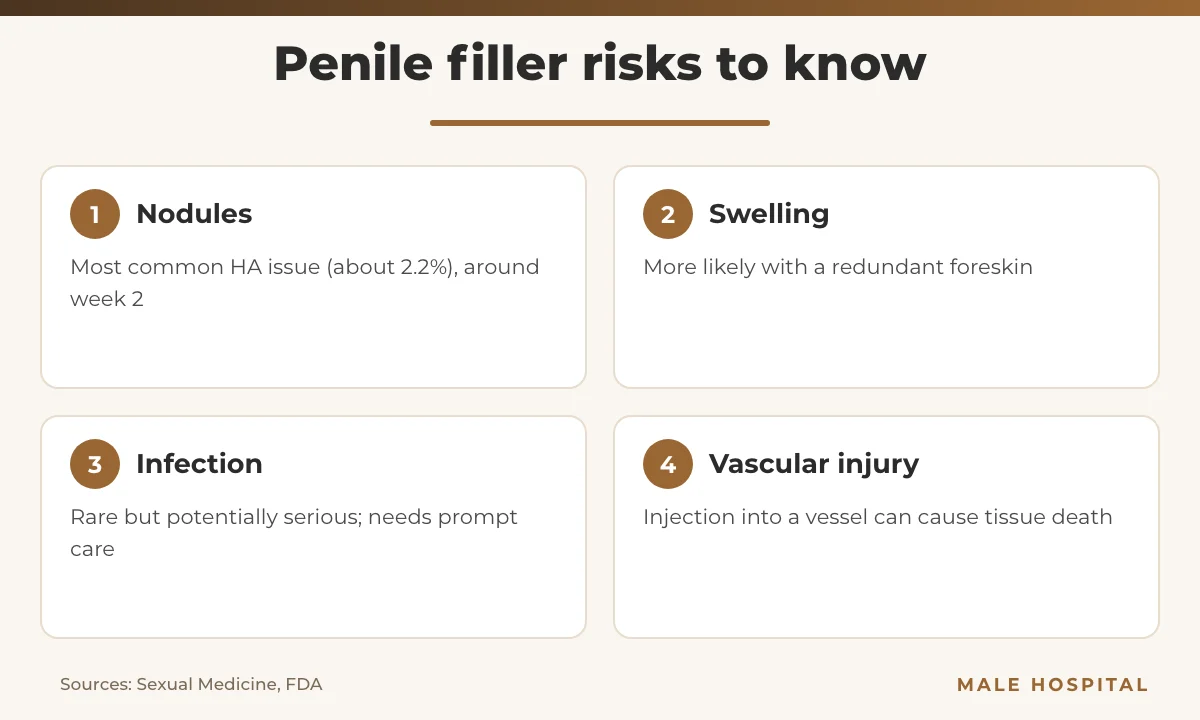
In the randomized HA trial, filler-related side effects occurred in 6.3% of men on HA and 9.4% on PLA, mostly mild injection-site inflammation that resolved with conservative care. Across HA studies, subcutaneous nodules are the most common problem (about 2.2%), typically appearing around two weeks, followed by subcutaneous bleeding and infection.
Sources: World Journal of Men’s Health (PMC) — Efficacy and Safety of Penile Girth Enhancement Using Hyaluronic Acid Filler; Sexual Medicine (PMC) — Penile Girth Injection Complications: A Case Report
- Nodules and asymmetry: lumps or an uneven shaft contour; reviews also list overcorrection and surface irregularities.
- Swelling and dermatitis: one reported man developed skin breakdown and edema two weeks after HA injection, which improved over a month with treatment.
- Infection: rare but potentially serious; one case report describes severe penile infection with septic shock within 24 hours.
- Vascular injury: the FDA calls accidental injection into a blood vessel the most concerning filler risk because it can cause tissue death.
- Granulomas and late effects: some complications may appear years later.
Sources: Sexual Medicine (PMC) — Penile Girth Injection Complications: A Case Report; Gels (PMC) — The Application of Hyaluronic Acid Injections in Functional and Aesthetic Andrology; FDA — Dermal Fillers (Soft Tissue Fillers)
Experienced injection technique, sterile conditions and a urologist who can manage complications all reduce, but never eliminate, these risks.
Results and realistic expectations
A realistic expectation from a penile filler is a visibly thicker shaft by around 1.5–2.5 cm in circumference, with satisfaction improving in most trial participants. Some men in the randomized trial also reported improved ejaculatory control, but the study was not designed to test that, so a filler should not be chosen as a premature ejaculation treatment.
Sources: World Journal of Men’s Health (PMC) — Efficacy and Safety of Penile Girth Enhancement Using Hyaluronic Acid Filler; Annals of Medicine and Surgery (PMC) — Efficacy and complications of hyaluronic acid and polylactic acid for penile augmentation
A filler will not add length, change erection strength or fix curvature. The gain may slowly decrease over 12–18 months, and long-term effects beyond that are unknown. If the glans looks small compared with a thicker shaft, a separate glans filler treatment can be discussed. Men with persistent ejaculatory problems will find proven options on our premature ejaculation treatment page.
Source: Gels (PMC) — The Application of Hyaluronic Acid Injections in Functional and Aesthetic Andrology
Penile filler with Dr. Zülfü Sertkaya in Istanbul
Because complications can involve the erectile anatomy, a penile filler should be performed or supervised by a urologist-andrologist rather than an aesthetic salon. Assoc. Prof. Dr. Zülfü Sertkaya is a urologist and andrologist in Istanbul, Fellow of the European Board of Urology (FEBU, 2017) and Associate Professor of Urology since 2020. He has been a urology specialist since 2014.
His focus includes penile prosthesis, Peyronie’s disease, premature ejaculation and male infertility, and his research has covered penile enlargement techniques and implant complications. He is a member of the EAU, ESSM, ISSM, the Turkish Urological Association and the Turkish Society of Andrology.
For international patients, our team helps with reception and transport, translation, trip planning, hotel accommodation, medical consultation and aftercare. Pricing is given only after a free assessment, because it depends on the technique and filler volume suited to you.
How to start
Start with a free, confidential WhatsApp consultation. Share your age, medical history, any previous injections and your goals; the doctor reviews them and, if a filler is appropriate, prepares a personalized plan. If it is not, you will be told honestly and offered alternatives.
When to see a doctor
After any penile injection, seek urgent medical care if you notice:
- severe or worsening pain, or pain that keeps increasing after the first days;
- skin that turns pale, gray, blue or black, which may signal blocked blood flow;
- spreading redness, heat, pus, fever or chills, which may signal infection;
- a hard lump, ulcer or new curvature;
- difficulty passing urine or loss of sensation.
Men who have had silicone, paraffin or oil injected should see a urologist even without symptoms, because problems can appear years later.
Sources: FDA — Dermal Fillers (Soft Tissue Fillers); Malaysian Journal of Medical Sciences (PMC) — Surgical Techniques for Correction of Penile Paraffinoma
Share your history privately and receive a personalized, evidence-based plan from Dr. Zülfü Sertkaya.
FAQs about penile filler
Is penile filler FDA-approved?
No. The FDA has approved dermal fillers for areas such as facial wrinkles, lips, cheeks, chin and the back of the hand, and recommends against fillers for body enhancement. Using HA or other fillers on the penis is off-label. Studies from countries such as South Korea support short-term effectiveness, but the evidence remains limited and guidelines recommend thorough counseling first.
Sources: FDA — Dermal Fillers (Soft Tissue Fillers); Sexual Medicine (PMC) — Penile Girth Injection Complications: A Case Report
How much girth can a penile filler add?
In the largest randomized HA trial, mean girth increased by about 2.3 cm at 24 weeks. The EAU guideline reports a range of 1.4–3.78 cm across HA studies. The amount depends on the volume injected, your anatomy and the product. A filler adds thickness only, so length stays the same.
Sources: World Journal of Men’s Health (PMC) — Efficacy and Safety of Penile Girth Enhancement Using Hyaluronic Acid Filler; EAU Guidelines — Penile Size Abnormalities and Dysmorphophobia
How long do penis fillers last?
Most studies follow men for 12–18 months. Girth gains are largely maintained over this period, though they slowly decrease. One series of 50 men showed almost the same circumference at 18 months as at one month. Durability depends on the filler’s cross-linking and concentration, and data beyond two years are scarce.
Source: Gels (PMC) — The Application of Hyaluronic Acid Injections in Functional and Aesthetic Andrology
Is penile filler painful?
The procedure is done under local anesthesia with a numbing cream or a nerve block, so most men feel pressure rather than sharp pain. Afterward, mild soreness, bruising and swelling are common for several days. In the randomized trial, only one man reported transient pain as a filler-related side effect.
Can a penile filler affect erections or sensation?
The filler is placed outside the erectile tissue, and the randomized trials reported no serious adverse events. Severe complications from foreign materials such as silicone, however, have caused erectile dysfunction and penile shortening. Rarely, vascular injury or infection after any filler can damage tissue, which is why expert technique matters.
Sources: ISSM — Penis Enlargement Surgery: Men Should Know About Complications; FDA — Dermal Fillers (Soft Tissue Fillers)
Is fat grafting better than HA filler?
Fat transfer uses your own tissue, and retrospective studies report gains of 2–3.5 cm. However, how much fat survives is unpredictable, long-term data are lacking, and the AUA states that fat injection for girth has not been shown to be safe or efficacious. HA, by contrast, has data from several randomized trials.
Sources: EAU Guidelines — Penile Size Abnormalities and Dysmorphophobia; American Urological Association — Penile Augmentation Surgery policy statement
What happens if silicone or paraffin is injected into the penis?
These substances trigger a chronic foreign-body reaction called a paraffinoma, with painful lumps, ulcers, infection and deformity that can appear months or decades later. Creams and steroid injections do not help; surgical removal and reconstruction is the only effective treatment. The EAU strongly advises never using them.
Sources: Malaysian Journal of Medical Sciences (PMC) — Surgical Techniques for Correction of Penile Paraffinoma; EAU Guidelines — Penile Size Abnormalities and Dysmorphophobia
Can I have sex after a penile filler?
In the published randomized trial, men were asked to avoid intercourse for four weeks to let the filler settle and the puncture sites heal. Your doctor may adjust this based on how you recover. Contact the clinic before resuming if you still have pain, swelling or lumps.
Who should not get penile filler?
Fillers are not advised during an active genital infection or skin disease, or in men with unrealistic expectations. The EAU strongly recommends against fillers in men with penile dysmorphic disorder, whose distress usually persists after cosmetic procedures. These men are better helped by mental health counseling.
Source: EAU Guidelines — Penile Size Abnormalities and Dysmorphophobia
Medically reviewed by Assoc. Prof. Dr. Zülfü Sertkaya, urologist and andrologist (FEBU), Istanbul. Last reviewed: October 2026.
This article is for general information and does not replace an individual consultation with a qualified doctor.
- World Journal of Men's Health (PMC) — Efficacy and Safety of Penile Girth Enhancement Using Hyaluronic Acid Filler
- Annals of Medicine and Surgery (PMC) — Efficacy and complications of hyaluronic acid and polylactic acid for penile augmentation
- Gels (PMC) — The Application of Hyaluronic Acid Injections in Functional and Aesthetic Andrology
- Sexual Medicine (PMC) — Penile Girth Injection Complications: A Case Report
- Malaysian Journal of Medical Sciences (PMC) — Surgical Techniques for Correction of Penile Paraffinoma
- Medicina (PMC) — Techniques for Penile Augmentation Surgery: A Systematic Review
- EAU Guidelines — Penile Size Abnormalities and Dysmorphophobia
- FDA — Dermal Fillers (Soft Tissue Fillers)
- FDA — FDA warns about illegal use of injectable silicone for body contouring
- American Urological Association — Penile Augmentation Surgery policy statement
- ISSM — What Are Some Penile Augmentation Procedures? Do They Work?
- ISSM — Penis Enlargement Surgery: Men Should Know About Complications