
Premature Ejaculation Treatment: 10 Proven Options
Premature ejaculation treatment works for most men, and it usually starts without surgery. European Association of Urology (EAU) guidelines recommend on-demand dapoxetine or a lidocaine-prilocaine spray as first-line options for lifelong premature ejaculation (PE), with daily SSRIs or clomipramine as second line, tramadol as a cautious third line, and psychosexual therapy added to medication, especially for acquired PE. Surgical nerve procedures are not recommended by the EAU, and newer techniques such as cryoneurolysis remain investigational.
Source: EAU — Sexual and Reproductive Health Guidelines: Disorders of Ejaculation
- The ISSM defines lifelong PE as ejaculation within about 1 minute of penetration, and acquired PE as a bothersome drop in latency, often to about 3 minutes or less, together with poor control and distress.
- Erectile dysfunction, prostatitis or other sexual problems should be treated first, because they can cause or worsen PE.
- First-line medical options are dapoxetine (not approved in the USA) and a lidocaine-prilocaine spray; daily SSRIs and clomipramine are off-label second-line choices.
- Behavioural techniques and psychosexual therapy work best combined with medication rather than alone.
- The EAU advises against dorsal neurectomy and recommends caution with glans hyaluronic acid injections; cryoneurolysis is still being studied.
Tell our urologist-andrologist what you are experiencing and get a confidential, personalised plan.
- What is premature ejaculation?
- Who is a good candidate for premature ejaculation treatment?
- How PE is diagnosed before treatment
- Premature ejaculation treatment options compared
- Surgical and ablative options: what the evidence says
- Premature ejaculation treatment step by step
- How quickly treatment works: timeline
- Risks and side effects
- Results and realistic expectations
- Treatment with Dr. Zülfü Sertkaya in Istanbul
- How to start
- When to see a doctor
- FAQs about premature ejaculation treatment
What is premature ejaculation?
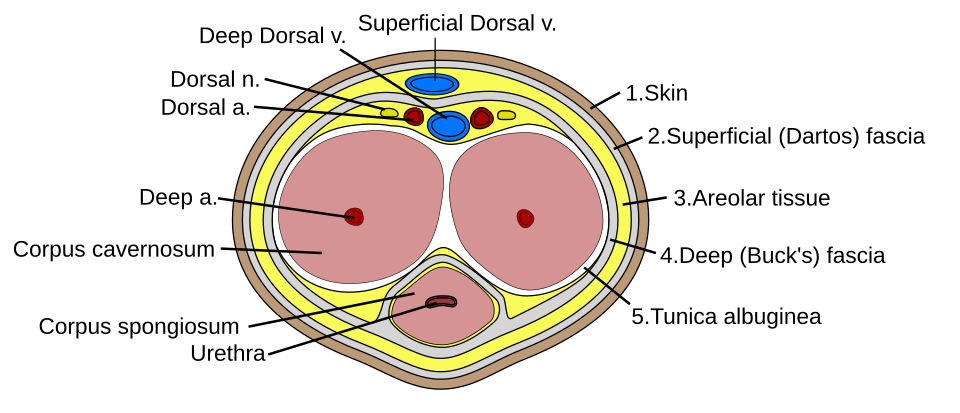
Premature ejaculation means ejaculating sooner than you or your partner want, regularly enough to cause distress. Occasional quick ejaculation is normal. Cleveland Clinic describes it as the most common sexual dysfunction in men, reported by about 1 in 5 men aged 18 to 59.
Source: NHS — Ejaculation problems; Cleveland Clinic — Premature Ejaculation
The ISSM definition: lifelong vs acquired PE
The International Society for Sexual Medicine (ISSM) uses a three-part definition. The first part is time, measured as intravaginal ejaculatory latency time (IELT), the time from penetration to ejaculation:
- Lifelong PE: ejaculation always or nearly always occurs before or within about 1 minute of vaginal penetration, present since the first sexual experiences. The committee noted the 1-minute cut-off can be applied flexibly, up to about 90 seconds.
- Acquired PE: a clinically significant and bothersome reduction in latency, often to about 3 minutes or less, that starts later in life after previously normal control.
The other two parts are an inability to delay ejaculation on all or nearly all penetrations, and negative personal consequences such as distress, frustration or avoiding intimacy. The EAU also describes “variable” PE (a normal fluctuation) and “subjective” PE, where a man feels he ejaculates too quickly but his measured latency is normal.
Sources: Sex Med (PMC) — ISSM unified definition of lifelong and acquired premature ejaculation; ISSM — What is premature ejaculation?
What causes it?
Causes are often mixed. Psychological factors such as performance anxiety, stress, depression and relationship problems are common. Physical contributors include erectile dysfunction, prostatitis, thyroid problems and recreational drugs. Habits learned early, such as rushing during masturbation, may also play a role in lifelong PE.
Source: NHS — Ejaculation problems
Who is a good candidate for premature ejaculation treatment?
Any adult man who ejaculates earlier than he wishes on most occasions and feels bothered by it can benefit from an assessment. Treatment choice depends on the type of PE and on your priorities:
- Lifelong PE: medication (dapoxetine, topical spray, or daily SSRIs) is the core of treatment, often supported by behavioural techniques.
- Acquired PE: the underlying cause comes first. If erectile dysfunction is present, it should be treated before or alongside PE; psychological or behavioural therapy combined with medication is recommended.
- Variable or subjective PE: education, reassurance and psychosexual counselling are usually more appropriate than drugs.
Source: EAU — Sexual and Reproductive Health Guidelines: Disorders of Ejaculation
How PE is diagnosed before treatment
Diagnosis is based mainly on a careful medical and sexual history. Your doctor will ask how long it has existed, whether it happens in every situation, how much control you feel, and whether erections are firm enough. In everyday practice, your own estimate of IELT is considered sufficient; stopwatch timing is used in research.
Validated questionnaires help. On the Premature Ejaculation Diagnostic Tool (PEDT), a score above 11 suggests PE. A physical examination is recommended, but routine laboratory tests are not; blood tests are ordered only if something like a thyroid or prostate problem is suspected. A key step is checking for erectile dysfunction, because men who struggle to keep an erection may rush to ejaculate, which is secondary PE.
Sources: EAU — Sexual and Reproductive Health Guidelines: Disorders of Ejaculation; Cleveland Clinic — Premature Ejaculation
Premature ejaculation treatment options compared
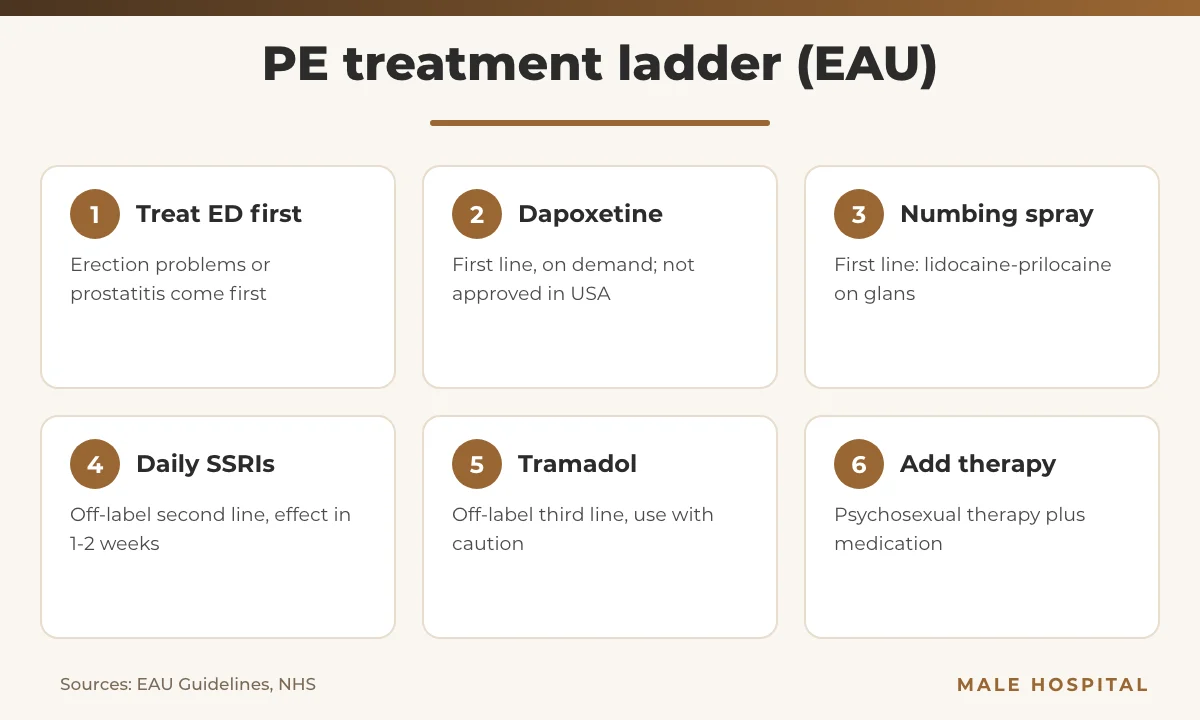
The table summarises where each option sits in current EAU guidance. “Off-label” means the drug is licensed for another condition but can legally be prescribed for PE by a doctor.
| Option | How it is used | EAU position | Main drawbacks |
|---|---|---|---|
| Dapoxetine | 30 or 60 mg tablet before sex, on demand | First line (strong); not approved in the USA | Nausea, headache, dizziness; rare fainting |
| Lidocaine-prilocaine spray | 3 sprays on the glans about 5 minutes before sex | First line (strong) | Numbness, partner burning, erection issues in some |
| Daily SSRIs / clomipramine | Daily tablet (clomipramine also on demand) | Off-label second line (strong) | Nausea, fatigue, lower libido; many stop |
| Tramadol | On demand | Off-label third line, with caution (strong) | Addiction potential, sedation, constipation |
| PDE5 inhibitors | Alone or combined with other therapy | Recommended (strong); essential if ED coexists | Headache, flushing |
| Behavioural / psychosexual therapy | Techniques, counselling, couple therapy | Combine with medication (weak) | Weak evidence alone; needs practice |
| Glans hyaluronic acid | Injection into the glans | Use with caution (weak) | Limited safety data |
| Dorsal neurectomy | Surgical cutting of dorsal nerve branches | Do not perform (weak) | Irreversible; limited safety data |
Source: EAU — Sexual and Reproductive Health Guidelines: Disorders of Ejaculation
Behavioural techniques: stop-start and squeeze
With the stop-start technique, you stop stimulation just before the point of no return, wait for the urge to fade, then continue. The squeeze technique adds firm pressure on the head of the penis for 10 to 20 seconds, followed by a pause of about 30 seconds, repeated several times.
These methods are low-risk and build awareness of arousal, but the EAU notes that behavioural therapy alone has weak and inconsistent evidence and unknown long-term results. Their real value is alongside medication.
Sources: NHS — Ejaculation problems; EAU — Sexual and Reproductive Health Guidelines: Disorders of Ejaculation
Pelvic floor muscle training
The pelvic floor muscles contract during ejaculation, so training them may improve control. In an Italian series of men with lifelong PE, 122 completed a 12-week program of physiokinesiotherapy, electrical stimulation and biofeedback (three sessions a week); about 91% reported satisfactory control at 12 weeks and roughly 57% still did at 36 months. The study had no control group, and the EAU guideline does not include a recommendation on pelvic floor training for PE, so it is best seen as a promising add-on rather than proven first-line care.
Topical anaesthetics: lidocaine-prilocaine spray
A metered spray containing lidocaine 7.5 mg and prilocaine 2.5 mg per spray (authorised in the EU as Fortacin for lifelong PE) reduces glans sensitivity. The dose is three sprays onto the glans before intercourse, no more than three doses in 24 hours and at least four hours apart. In long-term studies, IELT rose up to about 6.3-fold over three months. Wearing a condom or washing before contact helps prevent numbness in your partner.
Sources: European Medicines Agency — Fortacin (lidocaine/prilocaine); EAU — Sexual and Reproductive Health Guidelines: Disorders of Ejaculation
Dapoxetine (where approved)
Dapoxetine is a short-acting SSRI and the first oral drug approved specifically for PE, licensed in many countries but not in the USA. It is taken on demand, 1 to 3 hours before sex and no more than once a day. In trials, average IELT increased about 2.5-fold with 30 mg and 3-fold with 60 mg, with larger gains in men whose baseline latency was under 30 seconds. Because vasovagal fainting occurred in about 0.1% of trial participants, blood pressure and heart rate are checked before starting.
Sources: EAU — Sexual and Reproductive Health Guidelines: Disorders of Ejaculation; NHS — Ejaculation problems
Off-label daily SSRIs and clomipramine
Antidepressants such as paroxetine, sertraline, fluoxetine and citalopram delay ejaculation when taken daily; paroxetine has the strongest effect. The delay usually appears after one to two weeks. Clomipramine, a tricyclic, can be taken daily or a few hours before sex. These are effective second-line choices, but about half of men stop SSRIs on their own, often because of side effects, and tolerance may develop after 6 to 12 months.
Source: EAU — Sexual and Reproductive Health Guidelines: Disorders of Ejaculation
Tramadol (off-label, with caution)
Tramadol is an opioid-type painkiller that also affects serotonin. Taken on demand, it increased median IELT up to about 2.5-fold in studies. The EAU lists it only as a third-line option, to be used with caution, because long-term safety, including the risk of addiction, is poorly documented, and the US FDA has warned about addiction and breathing problems with tramadol.
Source: EAU — Sexual and Reproductive Health Guidelines: Disorders of Ejaculation
PDE5 inhibitors when erectile dysfunction coexists
If you also have erection problems, treating them with a PDE5 inhibitor such as sildenafil or tadalafil comes first, and PE often improves as erection anxiety fades. See our erectile dysfunction treatment page for those options. The current EAU guideline also recommends PDE5 inhibitors alone or in combination for men with PE without ED: sildenafil alone did not clearly lengthen IELT in studies, but it improved confidence, perceived control and satisfaction, and adding a PDE5 inhibitor to an SSRI worked better than an SSRI alone.
Sources: EAU — Sexual and Reproductive Health Guidelines: Disorders of Ejaculation; Cleveland Clinic — Premature Ejaculation
Psychosexual therapy and combination therapy
A psychosexual or sex therapist helps with performance anxiety, relationship tension and unhelpful beliefs about sex, and coaches techniques such as stop-start, often with your partner involved. Evidence shows that combining psychosexual approaches with medication gives better results than medication alone, which is why the EAU recommends combination therapy, particularly for acquired PE.
Sources: EAU — Sexual and Reproductive Health Guidelines: Disorders of Ejaculation; NHS — Ejaculation problems
Surgical and ablative options: what the evidence says
Procedures aim to reduce sensory signals from the glans carried by the dorsal nerves. Guideline support is weak or negative, and long-term safety data are limited.
Selective dorsal neurectomy
This operation cuts selected branches of the dorsal nerve. The EAU guideline states plainly: do not perform dorsal neurectomy, because the procedure is irreversible and more safety data are needed. We follow this guidance.
Glans hyaluronic acid injection
Injecting hyaluronic acid filler into the glans is thought to buffer sensation. Randomised trials showed a modest but significant increase in IELT without serious adverse events, yet serious complications are possible, so the EAU recommends using it with caution compared with more established treatments. Our glans filler page explains the procedure in detail.
Source: EAU — Sexual and Reproductive Health Guidelines: Disorders of Ejaculation
Selective dorsal cryoneurolysis
Cryoneurolysis uses targeted cold to temporarily disrupt nerve conduction rather than cutting the nerve, and its authors describe it as potentially reversible. A 2026 retrospective study in The Journal of Sexual Medicine, co-authored by Dr. Zülfü Sertkaya, followed 108 men with lifelong PE that had not responded to standard therapy. Geometric mean IELT rose from about 54 seconds to about 231 seconds at 12 months; mild procedure-related discomfort occurred in 7.4%, about 10% still had PE, and many men needed repeat sessions. No erectile dysfunction, persistent numbness or infection was reported. The authors stress that the technique remains investigational and needs randomised trials. The EAU guideline does not currently address cryoneurolysis.
Sources: J Sex Med — Selective dorsal cryoneurolysis in lifelong premature ejaculation: a cohort of 108 men (2026); EAU — Sexual and Reproductive Health Guidelines: Disorders of Ejaculation
Premature ejaculation treatment step by step
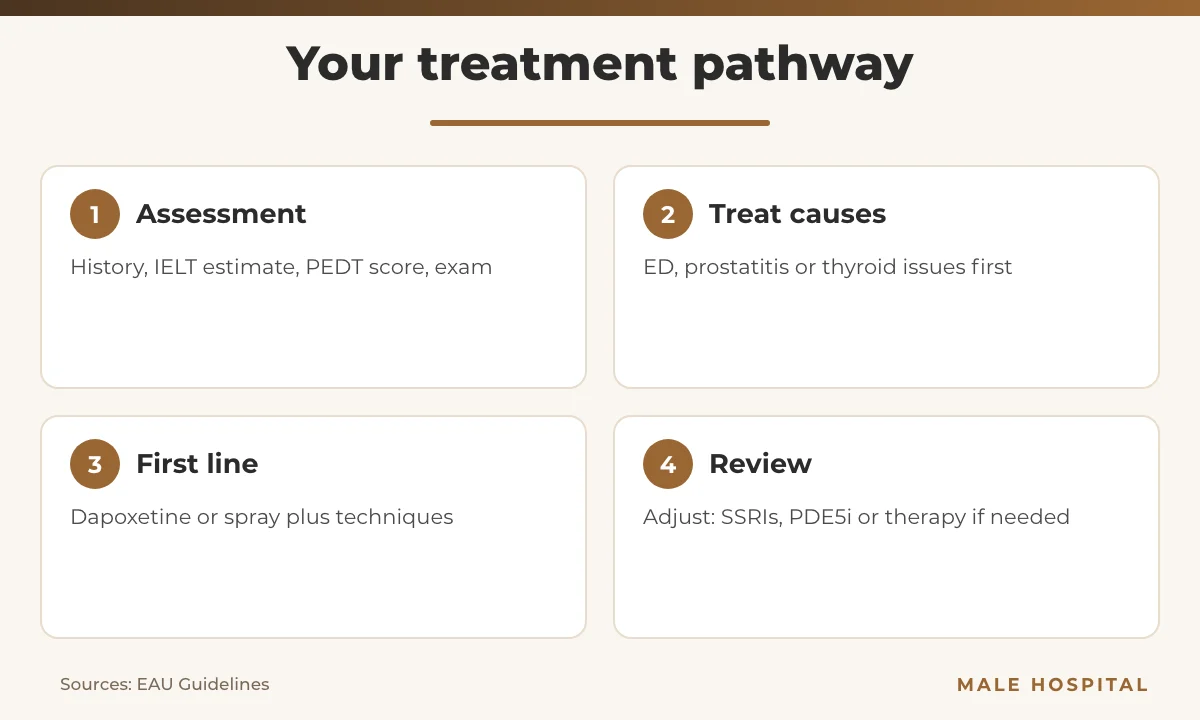
- History and questionnaires: type of PE (lifelong or acquired), estimated IELT, sense of control, distress, and a PEDT score.
- Examination and screening: a focused physical exam, and checks for erectile dysfunction, prostatitis or thyroid symptoms; tests only when indicated.
- Treat contributing conditions first: ED, other sexual dysfunction or genitourinary infection.
- First-line therapy: dapoxetine or the lidocaine-prilocaine spray, plus behavioural techniques and education for you and your partner.
- Review and adjust: if results or side effects are unsatisfactory, move to daily SSRIs or clomipramine, consider adding a PDE5 inhibitor or psychosexual therapy, and reserve tramadol for selected cases.
- Refractory cases: discuss the limited evidence for glans hyaluronic acid or investigational options before any decision.
Source: EAU — Sexual and Reproductive Health Guidelines: Disorders of Ejaculation
How quickly treatment works: timeline
| Treatment | When an effect is expected |
|---|---|
| Lidocaine-prilocaine spray | Same session (applied about 5 minutes before sex) |
| Dapoxetine | Same day (taken 1 to 3 hours before sex) |
| Daily SSRIs | Usually after 1 to 2 weeks; early side effects often ease within 2 to 3 weeks |
| Pelvic floor rehabilitation | Programs studied ran 12 weeks |
| Selective dorsal cryoneurolysis (investigational) | Improvement seen by month 3 in the 2026 cohort |
Sources: EAU — Sexual and Reproductive Health Guidelines: Disorders of Ejaculation; NHS — Ejaculation problems
Risks and side effects
- Dapoxetine: nausea, diarrhoea, headache and dizziness, which are dose-related; 4% (30 mg) and 10% (60 mg) of trial participants stopped because of side effects. Rarely, fainting.
- Daily SSRIs: fatigue, nausea, dry mouth and diarrhoea, plus possible sexual side effects such as reduced libido, difficulty reaching orgasm and erectile problems. Caution is needed in men aged 18 or younger and in men with depression, especially with suicidal thoughts.
- Lidocaine-prilocaine spray: genital numbness (about 4.5%), erectile difficulty (about 4.4%) and burning in partners (about 3.9%).
- Tramadol: constipation, sedation, dry mouth and a potential for dependence.
- Procedures: neurectomy is irreversible; glans fillers carry a risk of serious complications despite good trial safety; cryoneurolysis lacks long-term controlled data.
Sources: EAU — Sexual and Reproductive Health Guidelines: Disorders of Ejaculation; European Medicines Agency — Fortacin (lidocaine/prilocaine)
Results and realistic expectations
Effective premature ejaculation treatment typically turns seconds into minutes and, just as important, improves your sense of control and reduces distress. Expect measurable but not unlimited gains: the trial averages above (2.5- to 6-fold increases in IELT) describe groups, and individual responses vary. Medication controls PE while you use it; it does not usually cure lifelong PE, and symptoms can return after stopping. Acquired PE may resolve once its cause, such as ED or prostatitis, is treated.
Be wary of any provider who promises a permanent cure from a single procedure.
Source: EAU — Sexual and Reproductive Health Guidelines: Disorders of Ejaculation
Treatment with Dr. Zülfü Sertkaya in Istanbul
Premature ejaculation treatment at Male Hospital is led by Assoc. Prof. Dr. Zülfü Sertkaya, a urologist and andrologist in Istanbul. He is a Fellow of the European Board of Urology (FEBU, 2017), became Associate Professor of Urology in 2020, and has been a urology specialist since 2014. Premature ejaculation is one of his main clinical focuses, alongside penile prosthesis, Peyronie’s disease and male infertility; his PE research includes selective dorsal cryoneurolysis. He is a member of the EAU, ESSM, ISSM, the Turkish Urological Association and the Turkish Society of Andrology.
For international patients, our team provides reception and transport, translation, trip planning, hotel accommodation, medical consultation and aftercare. Pricing is shared only after a free assessment, because it depends on the treatment plan and technique that suit you.
How to start
Send us a confidential message on WhatsApp describing your symptoms, how long they have lasted, any medicines you have tried, and any test results you already have. Dr. Sertkaya’s team reviews your history and replies with a personalised plan, whether that is medication you can start at home or an in-person visit in Istanbul.
When to see a doctor
See a doctor if early ejaculation happens on most occasions and causes distress, if it started suddenly after years of normal control, or if it comes with erection problems. Seek prompt care for pain during ejaculation or urination, blood in the semen, fever or pelvic pain (possible prostatitis), or symptoms such as palpitations, weight change or heat intolerance that may point to a thyroid problem. Speak to your doctor urgently if you feel low or have thoughts of self-harm while taking an antidepressant.
Sources: NHS — Ejaculation problems; EAU — Sexual and Reproductive Health Guidelines: Disorders of Ejaculation
Ready for a discreet, evidence-based plan? Share your history with Dr. Sertkaya’s team today.
FAQs about premature ejaculation treatment
What is the most effective premature ejaculation treatment?
There is no single best option for everyone. EAU guidelines list on-demand dapoxetine and lidocaine-prilocaine spray as first-line treatments for lifelong PE, with daily SSRIs or clomipramine as second line. Combining medication with behavioural or psychosexual therapy tends to give better results than medication alone, particularly when PE was acquired later in life.
Source: EAU — Sexual and Reproductive Health Guidelines: Disorders of Ejaculation
Can premature ejaculation be cured permanently?
Acquired PE can disappear once the cause, such as erectile dysfunction, prostatitis or anxiety, is treated. Lifelong PE is usually controlled rather than cured: drugs work while you use them, and symptoms may return when they are stopped. Behavioural skills learned in therapy can help maintain control over time.
Source: EAU — Sexual and Reproductive Health Guidelines: Disorders of Ejaculation
How long does premature ejaculation last on average?
Under the ISSM definition, lifelong PE means ejaculating within about one minute of penetration almost every time, while acquired PE usually involves a bothersome drop to about three minutes or less. Time alone does not make the diagnosis; lack of control and distress must also be present.
Source: Sex Med (PMC) — ISSM unified definition of lifelong and acquired premature ejaculation
Do numbing sprays really work?
Yes, for many men. The lidocaine-prilocaine spray is an EAU first-line treatment, applied as three sprays to the glans shortly before sex, and long-term studies reported IELT increases of up to about six-fold. Using a condom or washing before contact reduces the chance of numbing your partner.
Source: European Medicines Agency — Fortacin (lidocaine/prilocaine)
Is dapoxetine available in the USA?
No. Dapoxetine is approved for premature ejaculation in many countries but not in the USA. Where it is licensed, it is taken 1 to 3 hours before sex, no more than once a day. A doctor should check your blood pressure and heart rate first because of a small risk of fainting.
Source: NHS — Ejaculation problems
Can Viagra help premature ejaculation?
Sildenafil (Viagra) and other PDE5 inhibitors are essential when PE coexists with erectile dysfunction. In men without ED, sildenafil alone did not clearly lengthen latency in studies, but it improved confidence and control, and the EAU now recommends PDE5 inhibitors alone or combined with other treatments for PE.
Source: Cleveland Clinic — Premature Ejaculation
Do pelvic floor exercises help with premature ejaculation?
They may. A 12-week supervised rehabilitation program in men with lifelong PE reported satisfactory control in about 91% of completers, with just over half maintaining it at three years. However, the study had no control group, and guidelines do not yet recommend pelvic floor training as a standard PE treatment.
Is surgery recommended for premature ejaculation?
Generally no. The EAU advises against dorsal neurectomy because it is irreversible and safety data are lacking, and recommends caution with glans hyaluronic acid injections. Selective dorsal cryoneurolysis showed encouraging results in a 2026 retrospective cohort, but its authors describe it as investigational until randomised trials are done.
Sources: EAU — Sexual and Reproductive Health Guidelines: Disorders of Ejaculation; J Sex Med — Selective dorsal cryoneurolysis in lifelong premature ejaculation: a cohort of 108 men (2026)
How much does premature ejaculation treatment cost in Istanbul?
Cost depends on what you need, from medication and follow-up to therapy or a procedure, so we do not publish fixed prices. After a free WhatsApp assessment of your history and any test results, Dr. Sertkaya’s team gives you a personalised plan and a clear quote before you decide.
Medically reviewed by Assoc. Prof. Dr. Zülfü Sertkaya, urologist and andrologist (FEBU), Istanbul. Last reviewed: October 2026.
This article is for general information and does not replace an individual consultation with a qualified doctor.
- EAU — Sexual and Reproductive Health Guidelines: Disorders of Ejaculation
- Sex Med (PMC) — An evidence-based unified definition of lifelong and acquired premature ejaculation (ISSM, 2014)
- ISSM — What is premature ejaculation?
- NHS — Ejaculation problems
- Cleveland Clinic — Premature Ejaculation
- European Medicines Agency — Fortacin (lidocaine/prilocaine) EPAR
- Asian J Androl (PMC) — Pelvic muscle floor rehabilitation as a therapeutic option in lifelong premature ejaculation: long-term outcomes (2018)
- J Sex Med — Clinical outcomes of selective dorsal cryoneurolysis in patients with lifelong premature ejaculation: a retrospective cohort of 108 men (2026)