Premature ejaculation (PE) means ejaculating sooner than you or your partner would like, with little or no ability to delay it and real distress as a result. Specialists define it by three things together: a short time to ejaculation, poor control and negative personal consequences. It is the most common sexual complaint in younger men, and it is treatable.
Source: ISSM — What Is Premature Ejaculation?; Cleveland Clinic — PE: Causes, Diagnosis & Treatment
- The ISSM definition: ejaculation within about 1 minute of penetration (lifelong PE) or a clear drop to about 3 minutes or less (acquired PE), plus poor control and distress.
- Doctors recognize four patterns: lifelong, acquired, variable and subjective. Only the first two are treated as a medical dysfunction.
- Older surveys reported that 20–30% of men are affected, but stopwatch studies suggest true lifelong PE affects only about 4% of men.
- Causes range from serotonin signaling and anxiety to erectile dysfunction, prostatitis and an overactive thyroid.
- Diagnosis is mostly a conversation; the five-question PEDT score helps, and most men need no lab tests.
- What is premature ejaculation?
- Lifelong, acquired, variable and subjective PE
- How common is PE?
- What causes premature ejaculation?
- How doctors diagnose premature ejaculation
- How PE affects men and couples
- Treatment options at a glance
- Self-help techniques that have evidence
- When to see a doctor
- FAQs about premature ejaculation
What is premature ejaculation?
Almost every man ejaculates faster than he wanted at some point, especially with a new partner, after a long break from sex or when very aroused. That alone is not a disorder. Doctors only diagnose PE when the problem is persistent and bothers the man or the couple.
For Arabic-speaking readers: a detailed, source-referenced overview of this condition in Arabic is available in the Alphateb medical encyclopedia — سرعة القذف.
The International Society for Sexual Medicine (ISSM) wrote the definition most specialists use today. It has three parts that must all be present:
- Short latency: ejaculation always or nearly always happens before or within about 1 minute of vaginal penetration from the first sexual experiences (lifelong PE), or there is a clinically significant drop in latency, often to about 3 minutes or less (acquired PE).
- Poor control: the man is unable to delay ejaculation on all or nearly all penetrations.
- Negative consequences: distress, frustration, bother or avoidance of sexual intimacy.
The ISSM definition was built from studies of vaginal intercourse, so it formally applies only to that situation. Men who have sex with men, or couples who mainly have other kinds of sex, can still have the same problem; there is simply less research on them. The latest WHO classification (ICD-11) uses the term “early ejaculation” for the same condition.
Sources: PMC — ISSM Guidelines Update on PE Diagnosis and Treatment (Althof et al., 2014); EAU — Guidelines on Sexual and Reproductive Health: Disorders of Ejaculation
Lifelong, acquired, variable and subjective PE
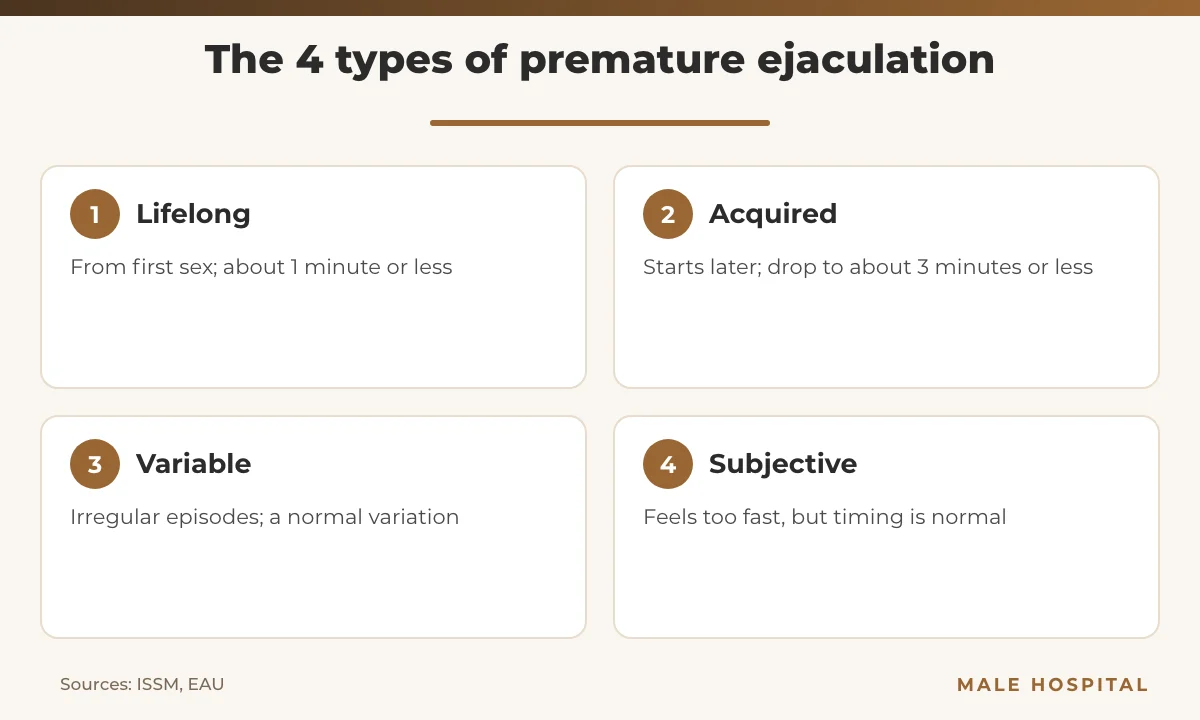
Not every man who “finishes too fast” has the same problem. European Association of Urology (EAU) and ISSM experts separate four patterns, and the type matters because it points to different causes and different treatment.
Lifelong PE
Lifelong PE has been present since a man’s first sexual experiences and happens with almost every partner and situation. Ejaculation typically occurs within about a minute of penetration. Researchers think it has a strong biological basis, involving serotonin, dopamine, oxytocin, hormonal and genetic factors working together.
Acquired PE
Acquired PE starts later in life in a man who previously had normal control. It is more often linked to a trigger such as erectile dysfunction, prostatitis, thyroid disease, stress or relationship problems. Compared with men with lifelong PE, men with acquired PE tend to be older and more often have erection problems and other health conditions.
Variable PE
Here early ejaculation happens irregularly: fast on some occasions, normal on others. Guidelines regard this as a normal variation in sexual performance rather than a disease. Reassurance and education are usually what helps.
Subjective PE
Some men feel they ejaculate too early even though their actual time is normal or even long. The EAU does not regard it as a true medical pathology, but the distress is real and counseling can help.
| Type | When it starts | Typical timing | Medical disorder? |
|---|---|---|---|
| Lifelong | From first sexual experiences | About 1 minute or less | Yes |
| Acquired | Later, after normal function | Clear drop, often to about 3 minutes or less | Yes |
| Variable | Any time, irregular | Sometimes short, sometimes normal | No, normal variation |
| Subjective | Any time | Normal or long | No, but distress may need support |
Sources: EAU — Guidelines on Sexual and Reproductive Health: Disorders of Ejaculation; PMC — ISSM Guidelines Update on PE Diagnosis and Treatment (Althof et al., 2014)
What is IELT?
IELT stands for intravaginal ejaculatory latency time: the time from vaginal penetration to ejaculation. In research it is measured with a stopwatch, and the results are reported as a geometric mean because a few very long times would otherwise distort the average.
In everyday practice, nobody needs to time sex with a stopwatch. The EAU accepts a man’s own estimate of his IELT, which agrees with stopwatch measurements with roughly 80% sensitivity and 80% specificity. Just as important, the EAU stresses that IELT alone cannot define PE, because the times of men with and without the condition overlap a lot. Control and distress count as much as the minutes.
Source: EAU — Guidelines on Sexual and Reproductive Health: Disorders of Ejaculation
How common is PE?
You will see very different numbers online, and the reason is the definition used. Cleveland Clinic estimates that 30% to 40% of men experience premature ejaculation at some point. About 1 in 5 men aged 18 to 59 report it, which makes it the most common sexual dysfunction in that age group.
Those figures come from surveys in which men simply said whether they ejaculate “too fast”. The ISSM guideline notes that such older surveys, which reported rates of 20–30%, used vague criteria. When researchers measured IELT with a stopwatch, the picture changed: lifelong PE is unlikely to affect more than about 4% of the general population, and about 5% of men have a latency under 2 minutes.
So both statements are true at once. Many men are bothered by their ejaculation time at some stage, while a much smaller group has the persistent, clearly short latency that defines the disorder. Unlike erectile dysfunction, PE does not become more common with age, and the EAU reports no link with marital status or income.
Sources: Cleveland Clinic — PE: Causes, Diagnosis & Treatment; PMC — ISSM Guidelines Update on PE Diagnosis and Treatment (Althof et al., 2014); EAU — Guidelines on Sexual and Reproductive Health: Disorders of Ejaculation
What causes premature ejaculation?
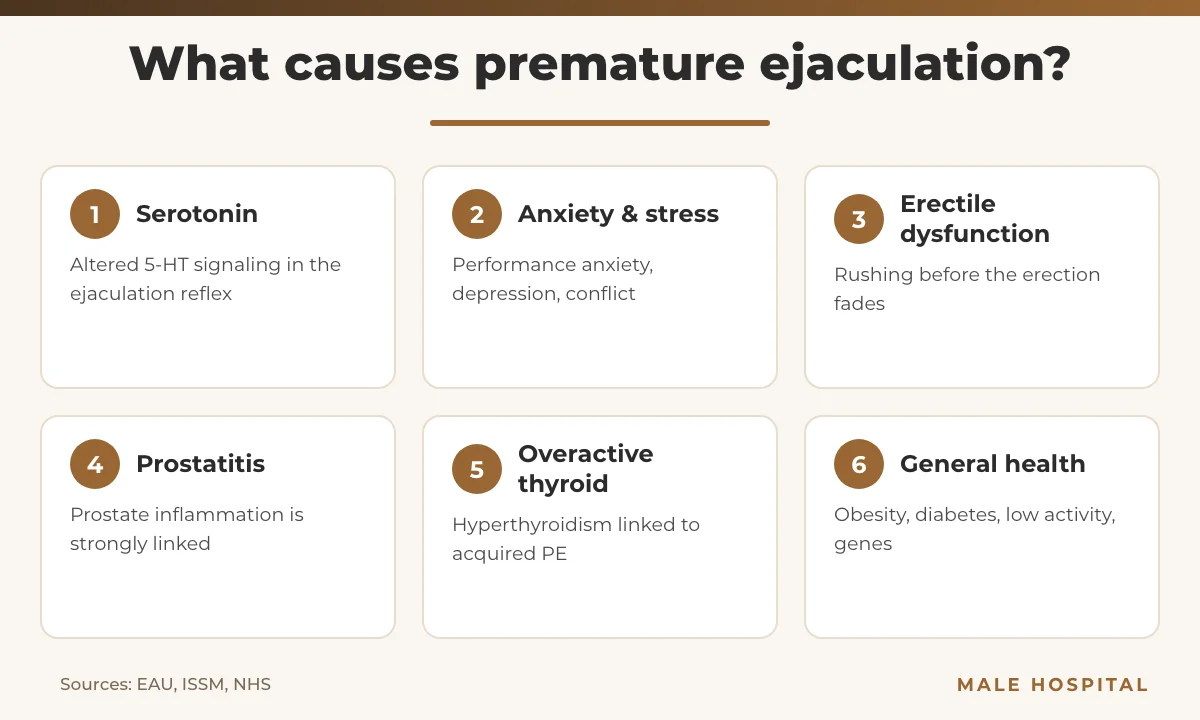
The EAU states plainly that the exact cause of PE is still largely unknown. In most men several factors overlap, and the mix differs between lifelong and acquired PE.
Neurobiology and serotonin
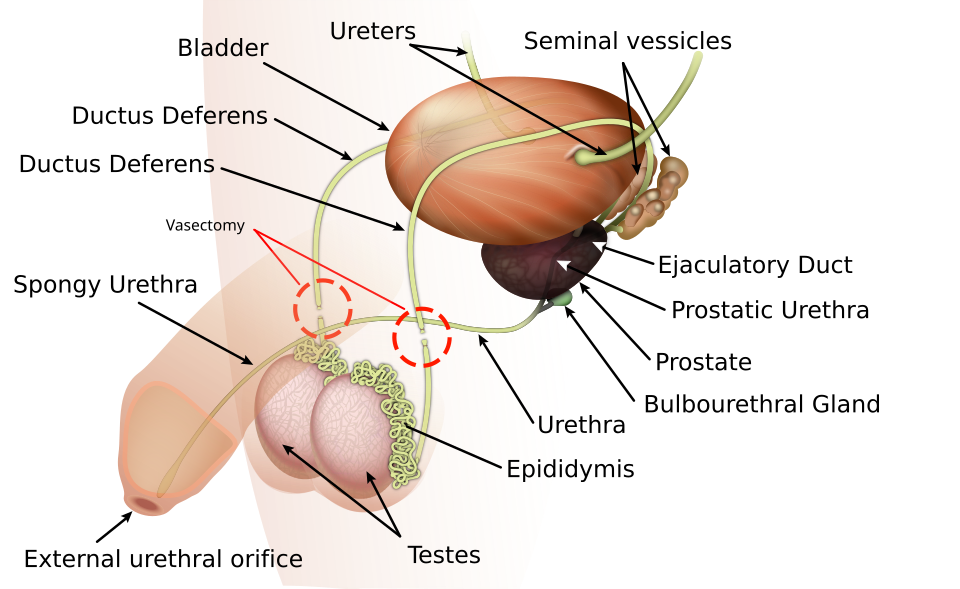
Ejaculation is a reflex controlled by the brain and spinal cord, and the chemical messenger serotonin (5-HT) helps slow it down. Problems with serotonin receptors are one of the leading theories for lifelong PE, which is why medicines that raise serotonin levels can lengthen latency. Dopamine, oxytocin, hormones and genes are also thought to play a part. The ISSM guideline adds a caveat: proven serotonin problems may explain only a small share of cases, and genetic influences appear modest.
Psychological and relationship factors
Performance anxiety, stress, depression, low self-esteem and relationship conflict are among the most common contributors. The NHS also lists early sexual experiences that taught a man to finish quickly, past traumatic sexual experiences and a strict upbringing around sex. Anxiety tends to feed itself: a fast episode creates worry, and the worry makes the next episode faster.
Erectile dysfunction
Erectile dysfunction (ED) is strongly linked to acquired PE. A man who fears losing his erection may rush to ejaculate before it fades, and over time this becomes a habit. The EAU therefore asks doctors to check for ED in every man with PE and to treat it first. If this sounds familiar, our guide to erectile dysfunction causes and treatment explains that side of the problem.
Prostatitis
Inflammation of the prostate is strongly associated with PE in the EAU guideline, and an inflamed prostate is listed as a physical cause by Cleveland Clinic. The ISSM notes that the mechanism is not yet clear. Pelvic pain, burning when urinating or discomfort after ejaculation alongside early ejaculation should prompt a prostate check.
Thyroid problems
An overactive thyroid (hyperthyroidism) is one of the conditions the EAU links most strongly with PE; the NHS mentions thyroid problems as a physical cause too. The ISSM guideline cites a study in which acquired PE in hyperthyroid men fell from 50% to 15% once thyroid function was normalized, although it stresses that thyroid disease explains very few cases and plays no role in lifelong PE. A blood test makes sense when there are other symptoms such as weight loss, palpitations or heat intolerance.
Other risk factors
The EAU also lists genetic predisposition, poor general health, obesity, diabetes, metabolic syndrome, low physical activity, stress and depressive symptoms. Recreational drug use and penile hypersensitivity have been proposed as well.
Sources: EAU — Guidelines on Sexual and Reproductive Health: Disorders of Ejaculation; NHS — Ejaculation problems; Cleveland Clinic — PE: Causes, Diagnosis & Treatment
How doctors diagnose premature ejaculation
Diagnosis is mainly a careful, private conversation. A urologist or andrologist will ask:
- Has it been present since your first sexual experiences, or did it start later?
- Does it happen with every partner and every time, or only in certain situations?
- Roughly how long after penetration do you ejaculate, and how much control do you feel?
- How much does it bother you and your partner, and do you avoid sex because of it?
- Do you have problems getting or keeping an erection?
- Which medicines, supplements, alcohol or drugs do you use?
A physical examination is recommended, mainly to look for ED, prostate problems or signs of thyroid disease. Routine blood tests or special nerve tests are not recommended unless your history or exam points to a specific cause.
The PEDT questionnaire
The Premature Ejaculation Diagnostic Tool (PEDT) is a validated five-question form covering control, frequency, how little stimulation triggers ejaculation, distress and relationship difficulty. The EAU interprets the total score as follows: 11 or more suggests PE, 9–10 suggests probable PE, and 8 or below means PE is unlikely. Other forms, such as the Arabic Index of Premature Ejaculation (AIPE), are also used. A questionnaire supports the doctor’s judgment; it does not replace the conversation.
Sources: EAU — Guidelines on Sexual and Reproductive Health: Disorders of Ejaculation; Cleveland Clinic — PE: Causes, Diagnosis & Treatment
How PE affects men and couples
PE is not dangerous to physical health, but its emotional effects can be heavy. The ISSM guideline reports that men with PE and their partners both describe lower quality of life and more relationship difficulties. Men often feel embarrassment, frustration and anxiety, and some start avoiding intimacy or new relationships altogether.
Partners are affected too, and sexual problems in the partner are also linked to PE. The ISSM guideline calls involving the partner in treatment an important, though not mandatory, ingredient of success, partly because a partner left out may resist changes in the couple’s sexual routine. A calm, shared approach usually works better than a man trying to fix it alone.
Cleveland Clinic advises seeing a doctor when PE causes anxiety or depression or strains the relationship. Treating the condition early can stop a cycle of worry and avoidance from setting in.
Sources: PMC — ISSM Guidelines Update on PE Diagnosis and Treatment (Althof et al., 2014); Cleveland Clinic — PE: Causes, Diagnosis & Treatment
Treatment options at a glance
Treatment depends on the type and cause. The EAU’s first step is always to treat anything underlying it, such as erectile dysfunction, prostatitis or another sexual problem. Beyond that, the main options are summarized below; our page on premature ejaculation treatment in Istanbul explains each one in detail.
| Option | Guideline position (EAU) |
|---|---|
| On-demand dapoxetine or lidocaine/prilocaine spray | First line for lifelong PE |
| Treating the underlying cause | First goal in acquired PE |
| Daily SSRIs or clomipramine | Second line, off-label |
| Tramadol | Third line, off-label, with caution |
| PDE5 inhibitors (e.g., sildenafil) | Recommended when PE comes with ED; the EAU also allows them alone or in combination |
| Psychological or behavioral therapy | Recommended alongside medication, especially in acquired PE |
| Hyaluronic acid glans injection | Use with caution |
| Dorsal neurectomy | Not recommended until more safety data exist |
Dapoxetine, a short-acting SSRI developed for PE and taken 1 to 3 hours before sex, increased latency about 2.5- to 3-fold in trials reviewed by the ISSM. Combining a medicine with behavioral or psychological therapy often works better than either alone. If you are comparing erection pills because ED is part of the picture, see our article on Viagra vs Cialis.
Sources: EAU — Guidelines on Sexual and Reproductive Health: Disorders of Ejaculation; PMC — ISSM Guidelines Update on PE Diagnosis and Treatment (Althof et al., 2014); NHS — Ejaculation problems
Self-help techniques that have evidence
Several home techniques are recommended by the NHS and used in sex therapy. The ISSM rates the evidence for behavioral therapy as modest (level 2b): it helps many men, but the studies are small and the effect can fade without practice. These methods work best with a cooperative partner and patience.
The stop-start method
During masturbation or sex, stop all stimulation when you feel close to ejaculating, wait until the urge eases, then start again. Repeating this several times teaches you to recognize the “point of no return” earlier and to stay below it.
The squeeze technique
When you are close to ejaculating, stop and squeeze the head of the penis for 10 to 20 seconds, then wait about 30 seconds before continuing. You or your partner can apply the squeeze.
Pelvic floor muscle training
The pelvic floor muscles help control ejaculation. In a small Italian study presented by the EAU, 40 men with lifelong PE did 12 weeks of pelvic floor training; 33 improved, and average time to ejaculation rose from about 32 seconds to about 146 seconds. The researchers stressed that this was a small study without standardized exercises and that larger trials are needed, so treat it as a promising add-on rather than a proven cure.
Simple practical changes
- Masturbating an hour or two before sex.
- Using a thick condom to reduce sensation.
- Positions with your partner on top, so they can slow down or pause when you are close.
- Reducing performance pressure: focusing on touch and closeness rather than the clock.
Over-the-counter numbing sprays and creams contain local anesthetics such as lidocaine or prilocaine. They can work, but they may also numb your partner unless you use a condom or wash before contact. Cleveland Clinic notes there is not enough evidence for herbal or alternative remedies, so be wary of supplements sold online with big promises.
Sources: NHS — Ejaculation problems; EAU — Lifelong premature ejaculation can be treated by pelvic floor exercises; PMC — ISSM Guidelines Update on PE Diagnosis and Treatment (Althof et al., 2014)
When to see a doctor
Occasional early ejaculation is normal and needs no treatment. Book an appointment with a urologist or andrologist if:
- Early ejaculation happens on most occasions and has lasted for months.
- It started suddenly after years of normal control (acquired PE often has a treatable cause).
- You also have trouble getting or keeping an erection.
- You notice pelvic or perineal pain, burning on urination, painful ejaculation or blood in your semen.
- You have symptoms of an overactive thyroid, such as unexplained weight loss, a racing heart, tremor or feeling hot all the time.
- The problem is causing anxiety, low mood or strain in your relationship, or you avoid sex because of it.
- Self-help techniques or over-the-counter products have not helped.
Sources: Cleveland Clinic — PE: Causes, Diagnosis & Treatment; NHS — Ejaculation problems
If you would like a discreet assessment, you can book a confidential consultation with our urologist-andrologist Assoc. Prof. Dr. Zülfü Sertkaya, whose clinical focus includes premature ejaculation, via WhatsApp. He will explain which type you have and which options fit you.
FAQs about premature ejaculation
How long should a man last before ejaculating?
There is no single “right” time. Specialists consider ejaculation within about 1 minute of penetration (lifelong) or a clear drop to about 3 minutes or less (acquired) as the time element of PE, but only when it comes with poor control and distress. A man who lasts a few minutes and feels in control does not have a disorder.
Source: PMC — ISSM Guidelines Update on PE Diagnosis and Treatment (Althof et al., 2014)
Can PE go away on its own?
Variable PE, which comes and goes, often settles with reassurance, less anxiety and more sexual experience with a regular partner. Acquired PE may improve once its trigger, such as ED, prostatitis, thyroid disease or stress, is treated. Lifelong PE usually persists without treatment, although medicines and behavioral methods can control it well.
Source: EAU — Guidelines on Sexual and Reproductive Health: Disorders of Ejaculation
Is premature ejaculation a physical or psychological problem?
Usually both. Lifelong PE is thought to have a mainly biological basis involving serotonin and other brain signals, while acquired PE is more often linked to anxiety, relationship issues or conditions such as ED, prostatitis and hyperthyroidism. Psychological factors can make any type worse, which is why combined treatment is often recommended.
Source: EAU — Guidelines on Sexual and Reproductive Health: Disorders of Ejaculation
Does masturbation cause premature ejaculation?
There is no good evidence that masturbation itself causes PE. The NHS does mention that early sexual habits, such as learning to finish quickly, may play a role for some men. In fact, masturbating an hour or two before sex is one of the self-help tips the NHS suggests for lasting longer.
Source: NHS — Ejaculation problems
Can erectile dysfunction cause PE?
Yes. ED is one of the conditions most strongly linked with acquired PE. Men who worry about losing their erection may hurry to ejaculate, and this pattern can become fixed. Guidelines advise checking for ED in every man with PE and treating it first, often with a PDE5 inhibitor such as sildenafil or tadalafil.
Source: PMC — ISSM Guidelines Update on PE Diagnosis and Treatment (Althof et al., 2014)
Do I need blood tests for PE?
Most men do not. European guidelines recommend a detailed history and a physical examination, and they advise against routine laboratory tests. Your doctor may order a thyroid test, a prostate assessment or hormone levels only if your symptoms or the examination point to a specific underlying condition.
Source: EAU — Guidelines on Sexual and Reproductive Health: Disorders of Ejaculation
Do numbing sprays for PE really work?
Lidocaine/prilocaine spray is a first-line option for lifelong PE in EAU guidelines, and the ISSM rates topical anesthetics as moderately effective. They reduce sensitivity of the glans. The main downside, as the NHS points out, is that they can also numb the partner, so they are often combined with a condom.
Sources: EAU — Guidelines on Sexual and Reproductive Health: Disorders of Ejaculation; NHS — Ejaculation problems
Is premature ejaculation common in young men?
Yes. About 1 in 5 men aged 18 to 59 report PE, making it the most common sexual dysfunction in that range. Unlike erectile dysfunction, it does not clearly increase with age. Young men who are anxious or new to sex often have variable episodes that improve with experience and a relaxed partner.
Source: Cleveland Clinic — PE: Causes, Diagnosis & Treatment
Medically reviewed by Assoc. Prof. Dr. Zülfü Sertkaya, urologist and andrologist (FEBU), Istanbul. Last reviewed: October 2026.
This article is for general information and does not replace an individual consultation with a qualified doctor.
- ISSM — What Is Premature Ejaculation?
- Sexual Medicine (PMC) — An Update of the ISSM Guidelines for the Diagnosis and Treatment of Premature Ejaculation (Althof et al., 2014)
- EAU — Guidelines on Sexual and Reproductive Health: Disorders of Ejaculation
- NHS — Ejaculation problems
- Cleveland Clinic — Premature Ejaculation: Causes, Diagnosis & Treatment
- EAU — Lifelong premature ejaculation can be treated by pelvic floor exercises