Micropenis is a rare medical diagnosis, not a casual label for a penis that seems small. It means a penis that is normally formed but has a stretched length more than 2.5 standard deviations below the average for age; in adult men that is about 6.8 cm (2.67 in) or less. Most cases start with low hormone activity before birth, and early hormone treatment in infancy or childhood gives the best results.
Sources: Cleveland Clinic — Micropenis: causes, symptoms, diagnosis and treatment; EAU Guidelines — Sexual and Reproductive Health — Penile size abnormalities and dysmorphophobia
- Micropenis is diagnosed by measuring stretched penile length (SPL) and comparing it with age-specific reference values; the cut-off is 2.5 standard deviations below the mean.
- It affects about 1.5 in 10,000 newborn boys in the United States. Many men who worry about being “too small” are in the normal range.
- The most common causes are hormone problems, such as hypogonadotropic hypogonadism, and in up to a quarter of cases no cause is found.
- A short course of testosterone in infancy or childhood often improves length; after puberty, European guidelines strongly advise against hormones to increase size.
- Most men with micropenis can urinate, have erections and orgasms; total phalloplasty is reserved for severe cases in specialised, high-volume centres.
- What is micropenis?
- How micropenis is measured
- What causes micropenis?
- Conditions that look like micropenis
- Diagnosing micropenis in infants and adults
- Micropenis treatment in infancy and childhood
- Options for adults: what works and what does not
- Sexual function and fertility
- Psychological support
- When to see a doctor
- FAQs about micropenis
What is micropenis?

Micropenis (also called microphallus) describes a penis that has a typical structure, with a normal urethral opening at the tip, but is unusually short for the person’s age. Doctors do not diagnose it by eye. They measure the stretched penile length and compare it with reference charts for the same age group.
The cut-off used by urology and pediatric endocrinology guidelines is a stretched length more than 2.5 standard deviations (SD) below the mean. Cleveland Clinic translates this into practical numbers: in newborns the average stretched length is about 3.5 cm (1.4 in), and about 1.9 cm (0.75 in) or less meets the definition; in adults the average is about 13.3 cm (5.25 in), and 6.8 cm (2.67 in) or less meets it.
Source: Cleveland Clinic — Micropenis: causes, symptoms, diagnosis and treatment
The European Association of Urology (EAU) uses the same 2.5 SD definition, adjusted for age, and notes that there is no single agreed “normal” penile size. It separates a true micropenis, which is congenital and linked to an underlying genetic or hormonal condition, from two other situations: a man with a normal penis who feels it is short, and a buried penis hidden by surrounding tissue.
The condition is uncommon. In the United States about 1.5 in 10,000 boys are born with it, and the EAU cites a range of 0.015% to 0.66% of male newborns across studies. If you want to see how you compare with the general population, our guide to average penis size covers the measured averages and percentiles.
Sources: EAU Guidelines — Sexual and Reproductive Health — Penile size abnormalities and dysmorphophobia; Cleveland Clinic — Micropenis: causes, symptoms, diagnosis and treatment
How micropenis is measured
Stretched penile length is used because a flaccid penis changes size with temperature, arousal and stress, while gentle stretching gives a value close to erect length. The standard technique is the same in babies and adults:
- The penis is held by the glans and gently stretched.
- A rigid ruler or measuring device is placed on the upper (dorsal) side.
- The ruler is pressed into the fat pad above the penis until it meets the pubic bone.
- Length is read from the pubic bone to the tip of the glans; the foreskin is not included.
Pressing down to the bone matters. The EAU explains that measuring only from the skin junction underestimates erect length by about 20%, and the bone-to-tip method correlates better with erect length, especially in men with overweight or obesity. In infants, pediatric endocrinologists sometimes use a modified syringe to push the fat pad back and reduce errors.
Sources: EAU Guidelines — Sexual and Reproductive Health — Penile size abnormalities and dysmorphophobia; PMC — Hatipoğlu & Kurtoğlu, pediatric endocrinology review (2013)
| Age group | Average stretched length | Suggests micropenis |
|---|---|---|
| Term newborn | About 3.5 cm (1.4 in) | About 1.9 cm (0.75 in) or less |
| Adult | About 13.3 cm (5.25 in) | About 6.8 cm (2.67 in) or less |
| Children and teenagers | Rises with age and puberty stage | Below −2.5 SD on an age-specific chart |
Sources: Cleveland Clinic — Micropenis: causes, symptoms, diagnosis and treatment; PMC — Hatipoğlu & Kurtoğlu, pediatric endocrinology review (2013)
Reference values differ between populations. For example, one Turkish study of 1,217 term newborns found a mean of 3.16 cm with a −2.5 SD cut-off of 2.19 cm, which is why clinicians use charts that suit the child’s age and background rather than one fixed number.
Source: PMC — Hatipoğlu & Kurtoğlu, pediatric endocrinology review (2013)
What causes micropenis?
The penis forms early in pregnancy, but most of its growth depends on testosterone and its stronger form, dihydrotestosterone (DHT). The fetal testes start producing testosterone at 8 to 12 weeks, and penile length increases by about 20 mm between weeks 16 and 38. A problem with hormone signals after about week 12 can leave a normally shaped but small penis.
Source: PMC — Hatipoğlu & Kurtoğlu, pediatric endocrinology review (2013)
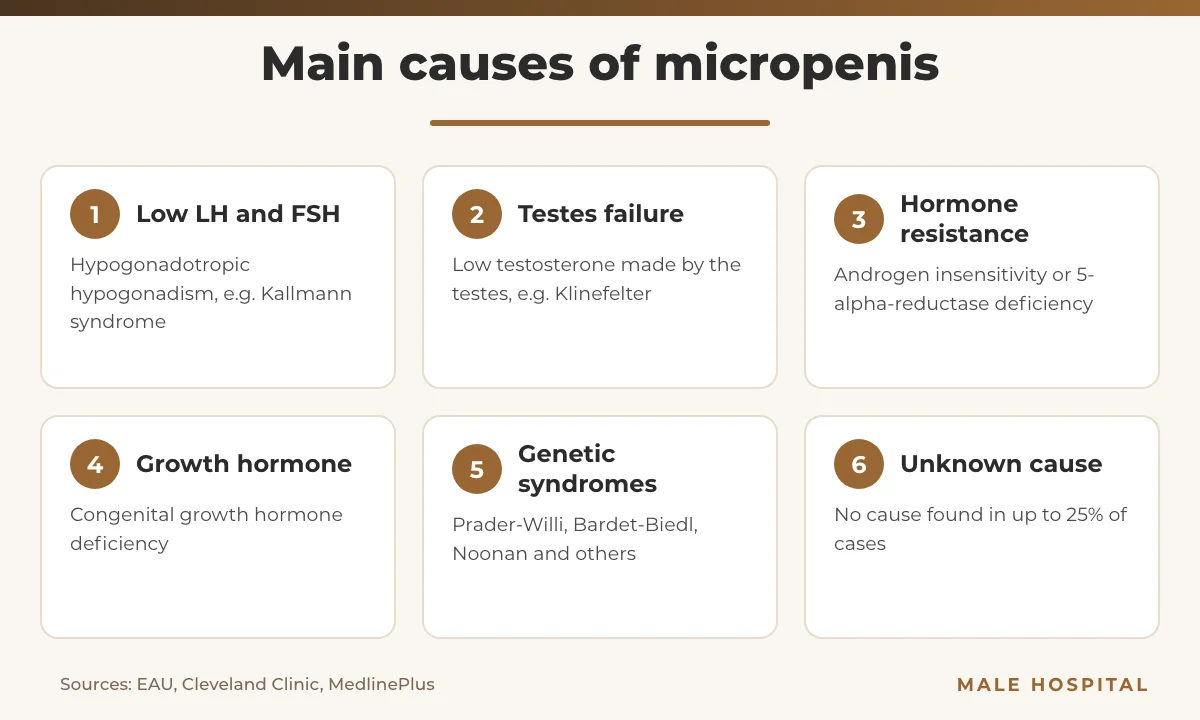
Hypogonadotropic hypogonadism
In hypogonadotropic hypogonadism, the hypothalamus or pituitary gland does not send enough LH and FSH to the testes, so testosterone stays low. Cleveland Clinic lists male hypogonadism as the most common cause. Kallmann syndrome is one form; affected males often have a very small penis and undescended testes, together with a reduced or absent sense of smell. A pituitary problem may also involve other hormones, so it is checked carefully. Low testosterone has very different effects in adult life, described in our article on low testosterone symptoms.
Sources: Cleveland Clinic — Micropenis: causes, symptoms, diagnosis and treatment; MedlinePlus Genetics — Kallmann syndrome
Problems in the testes or in hormone action
Primary (hypergonadotropic) hypogonadism means the testes themselves produce too little testosterone, as in Klinefelter syndrome or androgen synthesis defects. In androgen insensitivity syndrome, changes in the AR gene stop androgen receptors working properly, so the body cannot respond fully to normal hormone levels. In 5-alpha-reductase deficiency, variants in the SRD5A2 gene reduce conversion of testosterone to DHT, which the external genitals need to develop.
Sources: EAU Guidelines — Sexual and Reproductive Health — Penile size abnormalities and dysmorphophobia; MedlinePlus Genetics — Androgen insensitivity syndrome; Cleveland Clinic — Micropenis: causes, symptoms, diagnosis and treatment
Growth hormone deficiency and genetic syndromes
Growth hormone and IGF-1 also support penile growth, and published case reports describe a very small penis caused by isolated congenital growth hormone deficiency. Micropenis can also be part of genetic syndromes, including Prader-Willi, Bardet-Biedl and Noonan syndromes, and it can occur with other congenital urinary or genital differences.
Sources: PMC — Al-Beltagi et al., Microphallus early management in infancy: a comprehensive review (2024); PubMed — Lee et al., growth hormone deficiency case report (2018); Cleveland Clinic — Micropenis: causes, symptoms, diagnosis and treatment
Idiopathic micropenis
Sometimes no cause is found even after full testing (idiopathic cases). The EAU estimates that the cause remains unknown in up to 25% of cases. These boys may still respond to hormone treatment.
Source: EAU Guidelines — Sexual and Reproductive Health — Penile size abnormalities and dysmorphophobia
Conditions that look like micropenis
Many babies and men referred for a “small penis” actually have a normal-sized penis that is hidden or tethered. This is sometimes called apparent micropenis, and correct measurement usually makes the difference clear.
- Buried (hidden or concealed) penis: a penis of typical size and shape covered by skin and fat. In children it often reflects how the skin attaches at the base and tends to improve with growth; in adults it is most often linked to obesity, lymphedema or problems after circumcision.
- Webbed penis: a fold of scrotal skin extends up the underside of the shaft, so the penis looks shorter.
- Trapped penis: scarred skin after circumcision or injury holds the penis inside the fat pad.
Surgery for a buried penis can remove scar tissue, extra fat or skin and reposition the penis, but it does not make the penis itself larger. In adults, the EAU strongly recommends weight loss and risk-factor control before surgery, and surgery in high-volume centres.
Sources: Cleveland Clinic — Buried penis (hidden penis); PMC — Hatipoğlu & Kurtoğlu, pediatric endocrinology review (2013); EAU Guidelines — Sexual and Reproductive Health — Penile size abnormalities and dysmorphophobia
Diagnosing micropenis in infants and adults
In newborns and infants
The problem is often noticed at the newborn check. The doctor confirms the stretched length, examines the scrotum and testes, and looks for other features of a hormone or genetic condition. Testes that cannot be felt together with a very small penis need urgent specialist assessment, and electrolytes are checked when the genitals look atypical, because of the risk of congenital adrenal hyperplasia.
Source: PMC — Al-Beltagi et al., Microphallus early management in infancy: a comprehensive review (2024)
Timing helps. In the first months of life boys go through “mini-puberty,” a natural rise in LH, FSH and testosterone with a peak at about 1 to 3 months. Blood tests in this window show how well the hormone axis works. Typical tests include:
- LH, FSH, testosterone, DHT and testosterone precursors, plus other pituitary hormones when needed.
- An hCG stimulation test after mini-puberty; a testosterone response below about 300 ng/dL suggests a problem with the testes.
- Karyotype (chromosome test) and further genetic testing.
- Pelvic ultrasound, and brain MRI if a pituitary or midline problem is suspected.
Sources: PMC — Hatipoğlu & Kurtoğlu, pediatric endocrinology review (2013); PMC — Al-Beltagi et al., Microphallus early management in infancy: a comprehensive review (2024)
Endocrinologists today advise that a 46,XY baby with working testes that respond to androgens should be raised as a boy regardless of penis size, a change from older practice. Families should receive full, honest information from the start.
Source: PubMed — Lee et al., growth hormone deficiency case report (2018)
In teenagers and adults
In adults the main task is to separate a true micropenis from a normal penis that feels small. The EAU recommends flaccid and stretched measurements, erect measurements before any surgery, and questions about body dysmorphic disorder (BDD) in men with a normal-sized penis who report a short penis. Doctors also look for acquired shortening, for example after Peyronie’s disease, prostate cancer treatment or several penile operations. A hormone profile is useful when puberty was delayed or testes are small.
Source: EAU Guidelines — Sexual and Reproductive Health — Penile size abnormalities and dysmorphophobia
Micropenis treatment in infancy and childhood
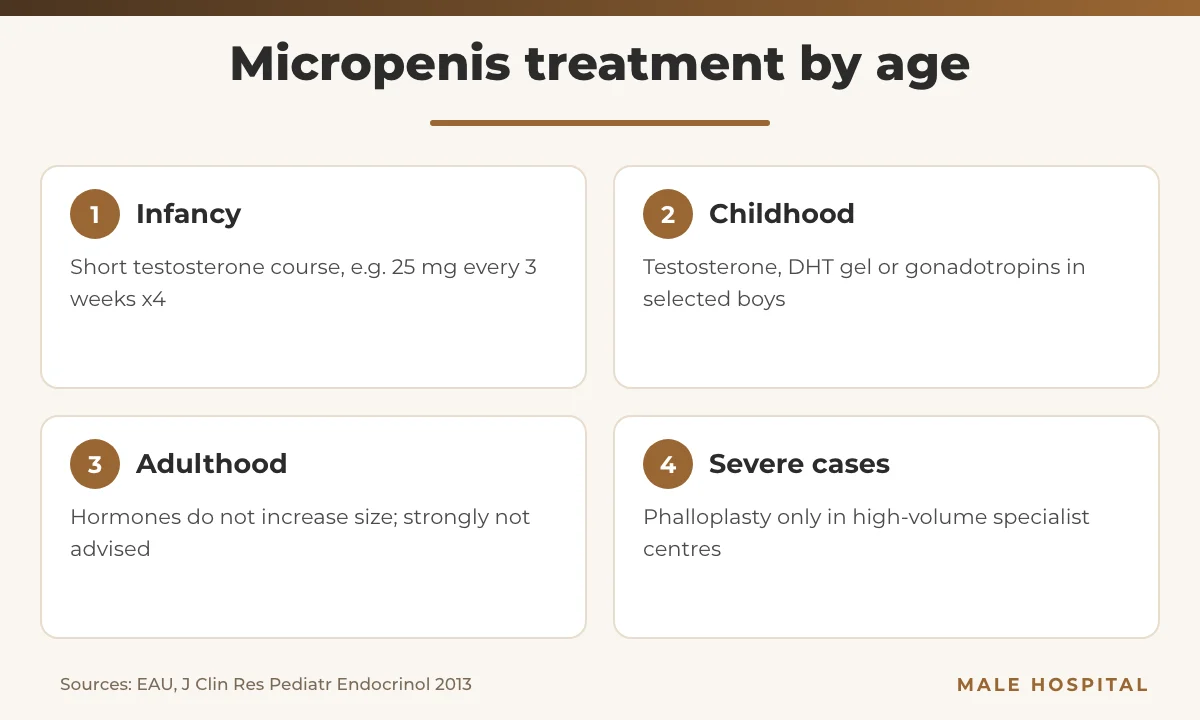
Hormone therapy is the first-line treatment in children, and results are better when it starts early. The EAU strongly recommends endocrine treatment (testosterone, topical DHT or gonadotropins) to restore penile size in boys with a small penis or differences of sex development.
Sources: EAU Guidelines — Sexual and Reproductive Health — Penile size abnormalities and dysmorphophobia; Cleveland Clinic — Micropenis: causes, symptoms, diagnosis and treatment
Testosterone
The most widely used regimen in pediatric endocrinology is four intramuscular injections of 25 mg testosterone (enanthate or cypionate) every three weeks over about three months. Testosterone gel or cream is an alternative. A good response is roughly a doubling of length. Side effects are usually minor but can include a temporary growth spurt and faster bone maturation, so the course is short and supervised by a specialist.
Sources: PMC — Hatipoğlu & Kurtoğlu, pediatric endocrinology review (2013); Cleveland Clinic — Micropenis: causes, symptoms, diagnosis and treatment
DHT gel and gonadotropins
Topical DHT gel has helped some boys with partial androgen insensitivity or 5-alpha-reductase deficiency. For hypogonadotropic hypogonadism, recombinant LH and FSH, given as injections or continuous infusion in small studies, increased penile length and testicular size. These options are used in specialist centres and the evidence comes from small series.
Sources: PMC — Al-Beltagi et al., Microphallus early management in infancy: a comprehensive review (2024); PMC — Hatipoğlu & Kurtoğlu, pediatric endocrinology review (2013)
Not every child responds. Boys with androgen insensitivity syndrome may have little response, because the problem lies in hormone action rather than hormone levels. The aim of treatment is a penis that allows standing urination, normal sexual function and a positive body image, not necessarily the population average.
Sources: Cleveland Clinic — Micropenis: causes, symptoms, diagnosis and treatment; PMC — Hatipoğlu & Kurtoğlu, pediatric endocrinology review (2013)
Options for adults: what works and what does not
After puberty, the penis does not respond to extra hormones the way a child’s does. The EAU gives a strong recommendation against testosterone or other hormones to increase penile size in men, because they do not increase adult size. Treating confirmed hypogonadism in an adult is a separate medical decision with different goals.
Source: EAU Guidelines — Sexual and Reproductive Health — Penile size abnormalities and dysmorphophobia
| Option in adults | What the evidence shows | EAU position |
|---|---|---|
| Testosterone or other hormones for size | No increase in adult penile size | Strongly not recommended |
| Penile traction device | Length gains of about 1.2–2.3 cm, no girth gain; low-quality evidence | May be considered (weak) |
| Vacuum device | Ineffective for lengthening | Weak recommendation only |
| Total phallic reconstruction (phalloplasty) | Can restore anatomy in severe congenital micropenis; urinary complications common | May be used (weak), in high-volume centres |
Source: EAU Guidelines — Sexual and Reproductive Health — Penile size abnormalities and dysmorphophobia
Phalloplasty in specialised centres
Total phalloplasty builds a new penis from a flap of tissue, most often from the forearm (radial forearm flap) or thigh, usually followed by a penile prosthesis for rigidity. In a Belgian study of 10 men with severe penile deficiency, all were sexually active after surgery and 90% were satisfied with the result, but six developed urinary complications such as urethral stricture or fistula, half disliked some aspects of appearance, and sensation was less than hoped. Other small series report similar urinary problems, and in one of them half of the implanted prostheses were later removed.
Sources: PubMed — Callens et al., Sexual quality of life after total phalloplasty in men with penile deficiency (2015); EAU Guidelines — Sexual and Reproductive Health — Penile size abnormalities and dysmorphophobia
Phalloplasty is major, multi-stage surgery with significant risks, so it is reserved for severe cases after thorough counselling. Cosmetic procedures such as ligament release or fillers are different operations; their limits are explained on our penis enlargement treatment page, and any procedure should follow an honest assessment of expected gain.
Sources: EAU Guidelines — Sexual and Reproductive Health — Penile size abnormalities and dysmorphophobia; PMC — Al-Beltagi et al., Microphallus early management in infancy: a comprehensive review (2024)
Sexual function and fertility
Most people with micropenis have typical sexual function. The condition does not stop urination, erections, masturbation or orgasm, and long-term studies show that most men raised male have a normal male gender identity and sexual function even when the penis stays small. Penetration can be harder, and sex therapy can help couples find positions and practices that work for them.
Sources: Cleveland Clinic — Micropenis: causes, symptoms, diagnosis and treatment; PMC — Hatipoğlu & Kurtoğlu, pediatric endocrinology review (2013)
Fertility depends mainly on the cause, not on penis length. Some affected men have a lower sperm count. In hypogonadotropic hypogonadism, testosterone alone does not start sperm production, but combined gonadotropin therapy (hCG plus FSH) can grow the testes and induce sperm production; in one London cohort the median sperm concentration after treatment was 8.9 million/mL. Men with androgen insensitivity are often infertile. Our male infertility guide explains the tests and treatment options.
Sources: Cleveland Clinic — Micropenis: causes, symptoms, diagnosis and treatment; PubMed — Castro et al., Combined gonadotropin therapy for testes development and spermatogenesis in males with gonadotropin deficiency (2025); MedlinePlus Genetics — Androgen insensitivity syndrome
Psychological support
Living with a very small penis can affect self-esteem, body image and relationships, and boys may face bullying. Reviews recommend psychological assessment and support for every patient and family, with attention to bullying and body image, and continued support after any surgery.
Sources: PMC — Al-Beltagi et al., Microphallus early management in infancy: a comprehensive review (2024); PubMed — Callens et al., Sexual quality of life after total phalloplasty in men with penile deficiency (2015)
Many men who seek help for a “small penis” actually have a normal size. The EAU strongly recommends asking about body dysmorphic disorder and referring men with suspected BDD to an accredited mental health professional, because they are at higher risk of poor surgical outcomes. BDD is treatable with cognitive behavioural therapy (CBT) and, in moderate or severe cases, an SSRI medicine. Worry about size can also feed performance anxiety, discussed in our article on psychological erectile dysfunction.
Sources: EAU Guidelines — Sexual and Reproductive Health — Penile size abnormalities and dysmorphophobia; NHS — Body dysmorphic disorder (BDD)
When to see a doctor
See a urologist, pediatric urologist or endocrinologist if:
- A newborn’s penis looks very small, or one or both testes cannot be felt; this needs prompt assessment.
- A boy’s genitals look atypical or puberty seems late or incomplete.
- An adult’s bone-pressed stretched length is about 6.8 cm (2.67 in) or less.
- The penis seems to have shortened, is hidden by fat or skin, or makes urination or hygiene difficult.
- Worry about size is affecting your mood, relationships or daily life. Seek urgent help if you have thoughts of self-harm.
Sources: Cleveland Clinic — Micropenis: causes, symptoms, diagnosis and treatment; PMC — Al-Beltagi et al., Microphallus early management in infancy: a comprehensive review (2024); NHS — Body dysmorphic disorder (BDD)
For a confidential assessment, accurate measurement and an honest discussion of realistic options, you can message our urologist-andrologist, Assoc. Prof. Dr. Zülfü Sertkaya, on WhatsApp. Any treatment plan, and its cost, depends on that assessment.
FAQs about micropenis
What size is considered a micropenis in adults?
An adult micropenis is a stretched length more than 2.5 standard deviations below the average, which Cleveland Clinic puts at about 6.8 cm (2.67 in) or less. The measurement must be taken bone-pressed, from the pubic bone to the tip of the glans, with the penis gently stretched. A penis shorter than average but above this cut-off is normal.
Source: Cleveland Clinic — Micropenis: causes, symptoms, diagnosis and treatment
Can micropenis be cured?
There is no single cure, but early hormone treatment in infancy or childhood often brings the penis into a range that allows standing urination and normal sex. Outlook is best when the cause is a hormone deficiency diagnosed early. In androgen insensitivity, hormones help less. In adults, options are limited to devices or reconstructive surgery in selected cases.
Sources: Cleveland Clinic — Micropenis: causes, symptoms, diagnosis and treatment; EAU Guidelines — Sexual and Reproductive Health — Penile size abnormalities and dysmorphophobia
Does testosterone help micropenis in adults?
No. European urology guidelines strongly recommend against testosterone or other hormones to increase penile size after puberty, because adult penile tissue does not grow in response. Testosterone for confirmed hypogonadism is a separate medical decision and should not be expected to change length.
Source: EAU Guidelines — Sexual and Reproductive Health — Penile size abnormalities and dysmorphophobia
Can a man with micropenis have children?
Often, yes. Fertility depends on the underlying cause. Some men have lower sperm counts, and men with hypogonadotropic hypogonadism may need gonadotropin injections to start sperm production. Men with androgen insensitivity are frequently infertile. A semen analysis and hormone tests show where a man stands.
Sources: Cleveland Clinic — Micropenis: causes, symptoms, diagnosis and treatment; PubMed — Castro et al., Combined gonadotropin therapy for testes development and spermatogenesis in males with gonadotropin deficiency (2025); MedlinePlus Genetics — Androgen insensitivity syndrome
Is micropenis the same as a small penis?
No. Micropenis is a defined medical diagnosis caused by a hormonal or genetic condition. Most men who feel they have a small penis measure within the normal range, a situation the EAU calls a “short penis” complaint. Some of these men have penile dysmorphic disorder, which responds better to psychological care than to surgery.
Source: EAU Guidelines — Sexual and Reproductive Health — Penile size abnormalities and dysmorphophobia
How common is micropenis?
It is rare. In the United States about 1.5 of every 10,000 boys are born with it. The EAU reports rates between 0.015% and 0.66% of male newborns in different studies, and notes concern that endocrine-disrupting chemicals may play a role, although this is not proven.
Sources: Cleveland Clinic — Micropenis: causes, symptoms, diagnosis and treatment; EAU Guidelines — Sexual and Reproductive Health — Penile size abnormalities and dysmorphophobia
Is phalloplasty safe for micropenis?
Phalloplasty can restore anatomy and allow intercourse, but it is complex, staged surgery. Urinary complications such as stricture and fistula are common, a penile implant is usually needed and may need revision, and sensation is often less than expected. Guidelines advise it only for severe cases in high-volume centres after detailed counselling.
Sources: PubMed — Callens et al., Sexual quality of life after total phalloplasty in men with penile deficiency (2015); EAU Guidelines — Sexual and Reproductive Health — Penile size abnormalities and dysmorphophobia
Can a buried penis be mistaken for micropenis?
Yes. A buried penis is normal in size but hidden by skin and fat, so it can look very small. Pressing the ruler down to the pubic bone usually shows a normal length. Treatment targets the cause, such as weight loss or surgery to free the penis, rather than enlarging it.
Sources: Cleveland Clinic — Buried penis (hidden penis); PMC — Hatipoğlu & Kurtoğlu, pediatric endocrinology review (2013)
Medically reviewed by Assoc. Prof. Dr. Zülfü Sertkaya, urologist and andrologist (FEBU), Istanbul. Last reviewed: October 2026.
This article is for general information and does not replace an individual consultation with a qualified doctor.
- Cleveland Clinic — Micropenis: causes, symptoms, diagnosis and treatment
- EAU Guidelines — Sexual and Reproductive Health — Penile size abnormalities and dysmorphophobia
- PMC (J Clin Res Pediatr Endocrinol) — Hatipoğlu & Kurtoğlu, Micropenis: etiology, diagnosis and treatment approaches (2013)
- PMC (World J Clin Pediatr) — Al-Beltagi et al., Microphallus early management in infancy: a comprehensive review (2024)
- PubMed (World J Urol) — Callens et al., Sexual quality of life after total phalloplasty in men with penile deficiency (2015)
- PubMed (Pediatrics) — Lee et al., Growth hormone deficiency causing micropenis: lessons learned from a well-adjusted adult (2018)
- PubMed (Hum Reprod Open) — Castro et al., Combined gonadotropin therapy for testes development and spermatogenesis in males with gonadotropin deficiency (2025)
- MedlinePlus Genetics — Kallmann syndrome
- MedlinePlus Genetics — Androgen insensitivity syndrome
- Cleveland Clinic — Buried penis (hidden penis)
- NHS — Body dysmorphic disorder (BDD)