
Semen analysis is the laboratory test that checks the volume of a man’s ejaculate and the number, movement, shape and vitality of his sperm. It is the first and most important test when a couple has trouble conceiving, and it is also used to confirm that a vasectomy has worked. Results are compared with the WHO 2021 lower reference limits, and an abnormal result should always be repeated before drawing conclusions.
Source: Cleveland Clinic — Semen Analysis; EAU — Sexual and Reproductive Health Guidelines (male infertility chapter)
- Abstain from ejaculation for 2 to 7 days, collect the whole sample by masturbation into a sterile cup, avoid lubricants and saliva, and get it to the lab within about one hour.
- WHO 2021 lower reference limits include 1.4 mL volume, 16 million sperm/mL, 39 million sperm per ejaculate, 42% total motility, 30% progressive motility and 4% normal forms.
- These limits come from fertile men; a value below them does not prove infertility, and a value above them does not guarantee fertility.
- Sperm counts vary from sample to sample, so an abnormal result should be confirmed with at least one more test.
- Home sperm tests mainly estimate concentration or motile sperm and cannot replace a full laboratory test.
- What is a semen analysis and what does it measure?
- How to prepare and collect the sample
- WHO 2021 semen analysis reference values
- Semen analysis terms explained
- Why repeat testing is needed
- Home sperm tests: what they can and cannot tell you
- Sperm DNA fragmentation testing
- What happens after an abnormal result
- How lifestyle affects sperm and test results
- When to see a doctor
- FAQs about semen analysis
What is a semen analysis and what does it measure?
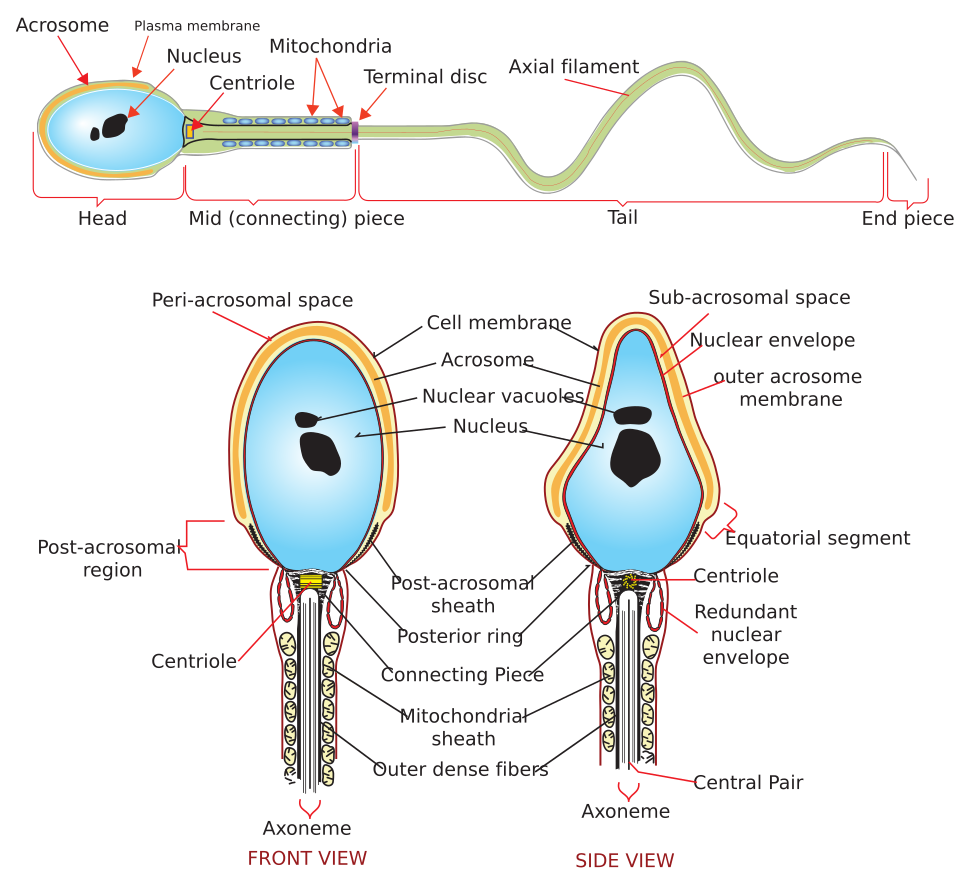
A semen analysis (sometimes called a sperm test or seminogram) examines a fresh sample of ejaculate under standardized laboratory conditions. Doctors order it for two main reasons: to look for a male factor when a couple has not conceived, and to check that no sperm remain after a vasectomy. After a vasectomy, the expected result is no sperm, or only very few non-moving sperm.
Source: Cleveland Clinic — Semen Analysis
The European Association of Urology (EAU) notes that a male factor is involved in about half of couples with infertility, which is why both partners should be tested from the start. You can read more about the wider picture in our guide to male infertility causes and treatment.
Source: EAU — Sexual and Reproductive Health Guidelines (male infertility chapter)
The main parameters
- Semen volume: how many milliliters of fluid are ejaculated.
- Sperm concentration: millions of sperm per milliliter.
- Total sperm number: concentration multiplied by volume, giving the number of sperm in the whole ejaculate.
- Motility: the percentage of sperm that move, split into progressive (swimming forward), non-progressive and immotile.
- Morphology: the percentage of sperm with a normal shape of head, midpiece and tail.
- Vitality: the percentage of live sperm, usually checked when many sperm are not moving.
- pH and liquefaction: the acidity of the semen and how quickly the gel-like ejaculate becomes liquid (normally within 15 to 30 minutes).
- White blood cells: a raised number can point to inflammation or infection.
Source: Cleveland Clinic — Semen Analysis
Since 2021, the WHO manual groups tests into basic, extended and advanced examinations. The basic examination covers the parameters above; extended tests include sperm DNA fragmentation, while advanced tests are mainly used in research.
Source: Arab Journal of Urology (PMC) — Chung et al. 2023, Sixth edition of the WHO laboratory manual: updates for busy clinicians; WHO — Laboratory manual for the examination and processing of human semen, 6th edition (2021)
How to prepare and collect the sample
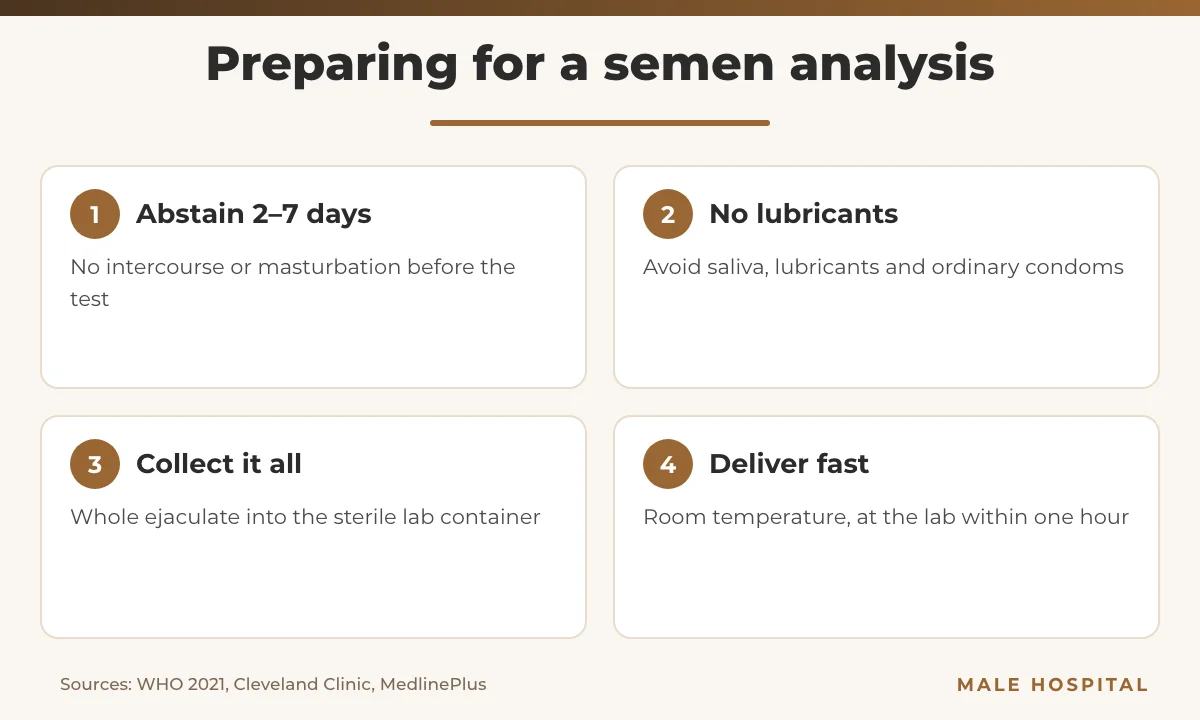
Good preparation matters, because a sample collected the wrong way can make a healthy man look subfertile. The WHO 2021 manual asks for a sample collected by masturbation after 2 to 7 days without ejaculation.
Before the test
- Avoid all sexual activity that leads to ejaculation, including intercourse and masturbation, for 2 to 7 days.
- Do not use saliva, vaginal fluid or commercial lubricants, as they can harm sperm.
- Tell the doctor about recent fever, medicines, supplements, testosterone or anabolic steroid use.
- Bring a photo ID if the lab asks for one, and follow its labeling instructions.
Source: Cleveland Clinic — Semen Analysis
Collecting the sample
Masturbation into the sterile, wide-mouthed container supplied by the lab is the preferred method. Urinate first, wash your hands and penis, and avoid touching the inside of the cup. The whole ejaculate should be collected; if part of it is lost, tell the lab, because a missing portion makes the result unreliable.
Source: MedlinePlus — Semen Analysis
Many clinics have a private collection room. If you collect at home, Cleveland Clinic advises keeping the sample at room temperature (about 20 °C) and getting it to the lab within one hour. When masturbation is not possible, for example for religious reasons, the clinic can provide a special non-lubricated collection condom; MedlinePlus advises keeping a condom sample at body temperature and delivering it within 30 to 60 minutes.
Source: Cleveland Clinic — Semen Analysis; MedlinePlus — Semen Analysis
WHO 2021 semen analysis reference values
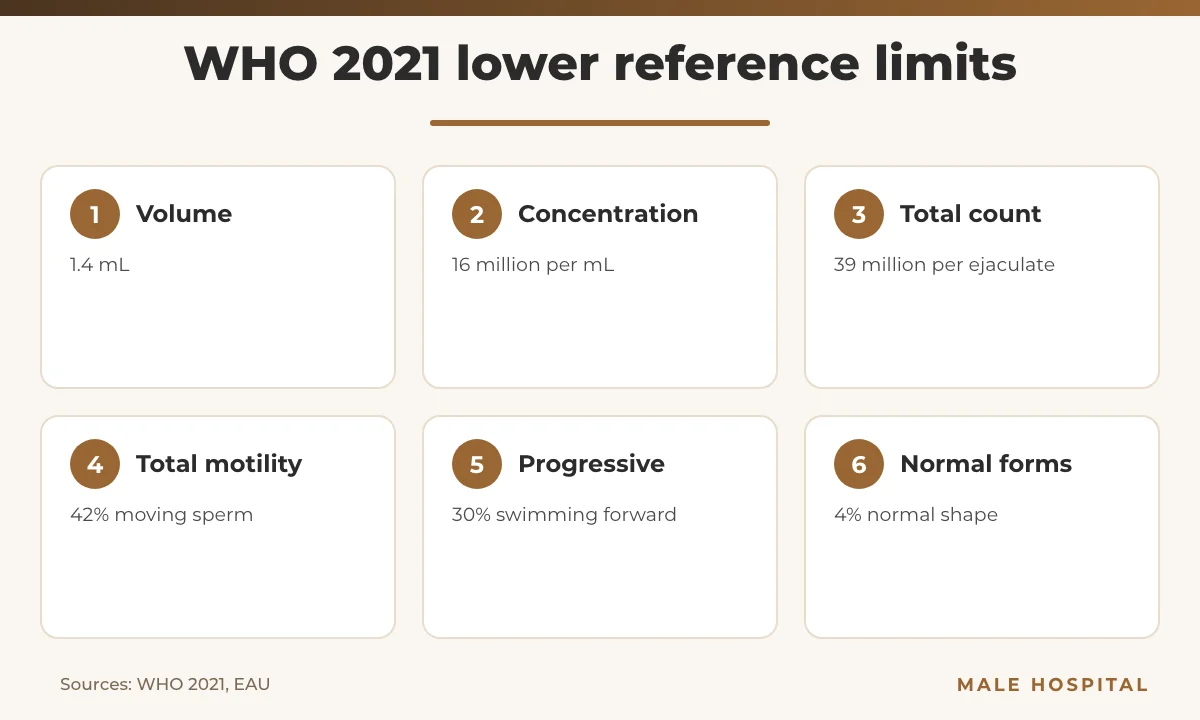
The sixth edition of the WHO laboratory manual, published in 2021, updated the reference values using data from more than 3,500 fertile men in twelve countries on five continents. The lower reference limit is the 5th centile: 95% of these fertile men had values at or above it.
Source: Andrology (PubMed) — Campbell et al. 2021, Distribution of semen examination results 2020; WHO — Laboratory manual for the examination and processing of human semen, 6th edition (2021)
| Parameter | WHO 2021 lower reference limit | 95% confidence interval |
|---|---|---|
| Semen volume | 1.4 mL | 1.3–1.5 |
| Sperm concentration | 16 million/mL | 15–18 |
| Total sperm number | 39 million per ejaculate | 35–40 |
| Total motility (progressive + non-progressive) | 42% | 40–43 |
| Progressive motility | 30% | 29–31 |
| Vitality (live sperm) | 54% | 50–56 |
| Normal morphology | 4% | 3.9–4.0 |
| pH | 7.2 or higher | — |
| Peroxidase-positive white cells | below 1 million/mL | — |
Source: EAU — Sexual and Reproductive Health Guidelines (male infertility chapter); Life (PMC) — Boitrelle et al. 2021, critical review of the sixth edition of the WHO laboratory manual
How to read these numbers
These figures are reference limits, not pass-or-fail cut-offs. The EAU states that the 5th centile does not represent a limit between fertile and infertile men, and the editors of the 2021 manual deliberately moved away from fixed thresholds. Some men below a limit father children naturally, while some men with “normal” results still face infertility.
Source: EAU — Sexual and Reproductive Health Guidelines (male infertility chapter); Life (PMC) — Boitrelle et al. 2021, critical review of the sixth edition of the WHO laboratory manual
Your lab report may show different “normal” ranges. Many patient resources still quote ranges such as 1.5 to 7.6 mL for volume and 15 to 259 million/mL for concentration, which come from the earlier 2010 manual, so always read your report against the reference values your lab uses.
Source: MedlinePlus — Semen Analysis
Semen analysis terms explained
Reports and doctors often use Greek-based terms to describe a result. The 2021 WHO manual stopped using several of them (such as asthenozoospermia and teratozoospermia) because a single threshold is not meaningful on its own, but they remain common in clinical practice and in EAU guidelines, which still apply the earlier cut-offs.
Source: Life (PMC) — Boitrelle et al. 2021, critical review of the sixth edition of the WHO laboratory manual; EAU — Sexual and Reproductive Health Guidelines (male infertility chapter)
| Term | Meaning | Usual cut-off |
|---|---|---|
| Oligozoospermia | Low sperm concentration | Below 16 million/mL |
| Asthenozoospermia | Poor sperm movement | Below 32% progressive motility (WHO 2010; 30% in 2021 data) |
| Teratozoospermia | Too few normally shaped sperm | Below 4% normal forms |
| Oligo-astheno-teratozoospermia (OAT) | All three problems together | — |
| Azoospermia | Complete absence of sperm in the semen | No sperm, even after centrifugation |
| Leukocytospermia (pyospermia) | Too many white blood cells in semen | More than 1 million/mL |
Source: EAU — Sexual and Reproductive Health Guidelines (male infertility chapter); Cleveland Clinic — Semen Analysis
Azoospermia has two broad types: obstructive, where sperm are made but a blockage stops them reaching the semen, and non-obstructive, where the testicles make very few or no sperm. Leukocytospermia is linked with oxidative stress, which may damage sperm, but the EAU notes that its clinical meaning is controversial and that it is not a reliable marker of infection on its own.
Source: EAU — Sexual and Reproductive Health Guidelines (male infertility chapter); Life (PMC) — Boitrelle et al. 2021, critical review of the sixth edition of the WHO laboratory manual
Why repeat testing is needed
Sperm counts vary from day to day, even in healthy men, and a sample can also be affected by an abstinence period outside the recommended window or by an incomplete collection. For this reason, a single abnormal result is never a diagnosis.
Source: MedlinePlus — Semen Analysis
The EAU makes a strong recommendation to perform at least two semen analyses if the first one is abnormal; if the first result is normal by WHO criteria, one test is enough. MedlinePlus notes that two or more samples may be needed within a week or two, while the NHS usually repeats the test about 3 months after an abnormal result. Your doctor will choose the interval based on the findings. Azoospermia in particular should be confirmed on at least two consecutive samples examined after centrifugation.
Source: EAU — Sexual and Reproductive Health Guidelines (male infertility chapter); MedlinePlus — Semen Analysis; NHS — Low sperm count
Home sperm tests: what they can and cannot tell you
Home kits have become popular because they are private and cheap. Most estimate sperm concentration, motile sperm concentration, or both; some use a test strip with a cut-off around 20 million/mL, while smartphone-based devices use the phone camera to look at sperm movement.
Their limits are important. A 2021 review in the World Journal of Men’s Health found that home kits generally do not assess morphology, and many omit semen volume and pH; the authors concluded that they cannot be regarded as a complete replacement of the laboratory test and should not be the sole test for male factor infertility. Cleveland Clinic adds that few studies show how well these kits work, and relying on them can delay diagnosis and treatment.
Source: World Journal of Men’s Health (PMC) — Gonzalez et al. 2021, Clinical Update on Home Testing for Male Fertility; Cleveland Clinic — Semen Analysis
A home test can be a reasonable first look, and it is useful for checking sperm after a vasectomy. If you are trying to conceive, however, a normal home result should not stop you from getting a full lab test when pregnancy does not happen.
Sperm DNA fragmentation testing
Sperm DNA fragmentation (SDF) testing measures how much of the genetic material inside sperm is broken. It is not part of a routine sperm test. The 2021 WHO manual lists it as an extended test and describes methods such as TUNEL, sperm chromatin dispersion, the Comet assay and acridine orange flow cytometry, but it gives no normal cut-off, so each lab must set its own reference range.
Source: Life (PMC) — Boitrelle et al. 2021, critical review of the sixth edition of the WHO laboratory manual; Arab Journal of Urology (PMC) — Chung et al. 2023, Sixth edition of the WHO laboratory manual: updates for busy clinicians
The evidence supports using SDF testing in selected situations rather than for everyone. The EAU makes a strong recommendation to test SDF in couples with recurrent pregnancy loss after natural conception, failure of assisted reproduction, or men with unexplained infertility. In contrast, the EAU advises against routine testing for reactive oxygen species.
Source: EAU — Sexual and Reproductive Health Guidelines (male infertility chapter)
Factors linked with higher SDF include smoking, varicocele, infection and long abstinence; the EAU notes that repeated ejaculation at short intervals has been reported to lower SDF. Antioxidants and lifestyle measures may help, but the EAU points out that randomized trials have not confirmed this benefit.
Source: EAU — Sexual and Reproductive Health Guidelines (male infertility chapter)
What happens after an abnormal result
If a repeat test confirms an abnormality, the next step is a full andrological assessment by a urologist or andrologist. This usually includes a medical and sexual history, a physical examination of the testicles and spermatic cord, blood tests and often imaging. The NHS describes referral to a specialist who may order blood tests, a testicular ultrasound or a urine test.
Source: EAU — Sexual and Reproductive Health Guidelines (male infertility chapter); NHS — Low sperm count
Typical further tests
- Hormones: the EAU recommends measuring total testosterone, FSH and LH in all men with oligozoospermia or azoospermia. Low testosterone has its own signs, described in our article on low testosterone symptoms.
- Genetic tests: a karyotype and genetic counselling for men with azoospermia or severe oligozoospermia (below 5 million/mL), and Y-chromosome microdeletion testing when the concentration is 1 million/mL or lower (to be considered below 5 million/mL).
- Scrotal ultrasound: the EAU suggests it for infertile men, partly because they have a higher risk of testicular cancer, and it can also confirm a varicocele.
Source: EAU — Sexual and Reproductive Health Guidelines (male infertility chapter)
The physical examination may find a varicocele, swollen veins in the scrotum that can cause infertility and can be repaired in selected men. Other findings, such as a hormonal problem or a blockage, lead to their own treatments, ranging from medication to surgical sperm retrieval combined with IVF/ICSI. Treatment is always chosen according to the cause, not the semen numbers alone.
Source: EAU — Sexual and Reproductive Health Guidelines (male infertility chapter); Cleveland Clinic — Infertility in men: causes, diagnosis and treatment
How lifestyle affects sperm and test results
Several everyday factors are linked with poorer sperm quality, and some of them are easy to change. Cleveland Clinic lists tobacco, marijuana and alcohol use, a body mass index above 25, frequent heat exposure such as saunas and hot tubs, and exposure to toxins like lead, pesticides or mercury as risk factors for male infertility.
Source: Cleveland Clinic — Infertility in men: causes, diagnosis and treatment
The EAU reports a negative association between smoking and sperm parameters, and notes that moderate drinking did not appear to harm semen while high alcohol intake can. The NHS recommends stopping smoking, keeping alcohol within 14 units a week, losing weight if overweight, wearing loose underwear, avoiding workplace chemicals such as pesticides, solvents and heavy metals, and avoiding recreational drugs including cocaine and anabolic steroids.
Source: EAU — Sexual and Reproductive Health Guidelines (male infertility chapter); NHS — Low sperm count
Testosterone itself deserves a special warning. Cleveland Clinic lists both testosterone treatment and anabolic steroid use as risk factors for male infertility. The EAU explains that anabolic steroid abuse can cause oligozoospermia or azoospermia, that stopping the drug is the first step, and that sperm numbers usually recover over six to twelve months. Men who want children should discuss fertility before starting testosterone replacement therapy.
Source: Cleveland Clinic — Infertility in men: causes, diagnosis and treatment; EAU — Sexual and Reproductive Health Guidelines (male infertility chapter)
Evidence on how much lifestyle change improves results is mixed. Uncontrolled studies suggest weight loss improves sperm parameters, but randomized data are more conflicting, and a meta-analysis found that bariatric surgery did not improve sperm quality in men with severe obesity. Healthy changes are still worthwhile for general and sexual health, and your doctor will judge their effect with a repeat test rather than expecting an immediate improvement.
Source: EAU — Sexual and Reproductive Health Guidelines (male infertility chapter)
When to see a doctor
The NHS advises seeing a doctor if you have not conceived after more than a year of regular unprotected sex, or after 6 months if your partner is 36 or older. You do not need to wait that long if there are warning signs.
Source: NHS — Low sperm count
- A lump or change in a testicle; the EAU notes that infertile men have a higher risk of testicular cancer.
- Swollen veins in the scrotum, which can be a varicocele.
- Runny or watery semen, which can be a sign of a low sperm count.
- A history of undescended testicles, chemotherapy or radiation, or infections such as epididymitis, orchitis or sexually transmitted infections.
- Current or past use of testosterone or anabolic steroids.
- Signs of low testosterone such as erectile problems, tiredness, low mood or weight gain.
- A test showing no sperm (azoospermia) or a very low count.
Source: Cleveland Clinic — Infertility in men: causes, diagnosis and treatment; EAU — Sexual and Reproductive Health Guidelines (male infertility chapter)
If your result is abnormal, you can arrange a confidential consultation with our urologist-andrologist Assoc. Prof. Dr. Zülfü Sertkaya, whose focus includes male infertility. Send your report on WhatsApp for a free first review.
FAQs about semen analysis
How many days should I abstain before a sperm test?
The WHO 2021 manual recommends 2 to 7 days without ejaculation before the test. Abstinence includes intercourse and masturbation. Staying inside this window gives the lab a representative sample; very short or very long intervals can change volume, count and motility, which makes the result harder to interpret. If you were outside the window, tell the lab when you hand in the sample.
What is a normal sperm count?
Under the WHO 2021 values, the lower reference limits are 16 million sperm per milliliter and 39 million sperm in the whole ejaculate. Values at or above these levels are typical of fertile men. However, the count is only one part of the picture: motility, morphology and the female partner’s fertility also matter, and borderline values should be repeated.
Source: EAU — Sexual and Reproductive Health Guidelines (male infertility chapter); Andrology (PubMed) — Campbell et al. 2021, Distribution of semen examination results 2020
Can I collect the sample at home?
Often yes, if your lab allows it. Use the sterile container supplied, collect the entire ejaculate by masturbation, keep it at room temperature and deliver it within about one hour. Ordinary condoms and lubricants should not be used because they can harm sperm; ask the clinic for a special collection condom if masturbation is not possible.
Source: Cleveland Clinic — Semen Analysis
How long do sperm test results take?
Results usually come back within a few days of the sample. The examination itself has to start soon after collection, because sperm begin to die outside the body. Your doctor should go through the report with you, since numbers near the reference limits need context rather than a simple normal or abnormal label.
Source: Cleveland Clinic — Semen Analysis; MedlinePlus — Semen Analysis
Is 4% normal morphology bad?
No. In the WHO 2021 data, 4% normal forms is the lower reference limit found in fertile men, because strict criteria classify most sperm, even in healthy men, as imperfect. A result at or slightly above 4% is within the reference range. Morphology alone rarely decides treatment; it is interpreted together with count and motility.
Source: Life (PMC) — Boitrelle et al. 2021, critical review of the sixth edition of the WHO laboratory manual; EAU — Sexual and Reproductive Health Guidelines (male infertility chapter)
Can one sperm test detect infertility on its own?
Not completely. The test shows whether semen quality is within the range seen in fertile men, but the reference limits do not separate fertile from infertile men. A full diagnosis also needs a medical history, examination, hormone tests and, in some men, genetic tests or ultrasound, as well as an assessment of the female partner.
Source: EAU — Sexual and Reproductive Health Guidelines (male infertility chapter)
Are home sperm tests accurate?
Some home kits estimate sperm concentration fairly well in validation studies, but they measure only one or two parameters and generally ignore morphology, volume and pH. Experts say they should not replace a laboratory test or be the only fertility test for a couple trying to conceive.
Can lifestyle changes improve sperm test results?
They can help in some men. Stopping smoking, reducing alcohol, losing excess weight, avoiding heat to the testicles and stopping anabolic steroids are all recommended. Changes are not seen immediately, so doctors usually repeat the test after a period of weeks to months to judge the effect.
Source: NHS — Low sperm count; Cleveland Clinic — Infertility in men: causes, diagnosis and treatment
Medically reviewed by Assoc. Prof. Dr. Zülfü Sertkaya, urologist and andrologist (FEBU), Istanbul. Last reviewed: October 2026.
This article is for general information and does not replace an individual consultation with a qualified doctor.
- EAU — Sexual and Reproductive Health Guidelines (male infertility chapter)
- Cleveland Clinic — Semen Analysis
- MedlinePlus — Semen Analysis
- Arab Journal of Urology (PMC) — Chung et al. 2023, Sixth edition of the WHO laboratory manual: updates for busy clinicians
- Life (PMC) — Boitrelle et al. 2021, critical review of the sixth edition of the WHO laboratory manual
- Andrology (PubMed) — Campbell et al. 2021, Distribution of semen examination results 2020
- World Journal of Men's Health (PMC) — Gonzalez et al. 2021, Clinical Update on Home Testing for Male Fertility
- NHS — Low sperm count
- Cleveland Clinic — Infertility in men: causes, diagnosis and treatment
- WHO — Laboratory manual for the examination and processing of human semen, 6th edition (2021)