
Peyronie’s disease (PD) is a benign condition in which scar tissue, called a plaque, forms inside the penis and causes it to bend, dent, narrow or shorten, usually during an erection. It can also cause painful erections and erectile dysfunction. It is not cancer and not contagious, it is far more common than most men think, and it can be diagnosed and treated by a urologist.
Source: NIDDK — Penile Curvature; Cleveland Clinic — Symptoms & Treatment
- The plaque forms in the tunica albuginea, the elastic sheath around the erectile chambers, and stops that part of the penis from stretching during an erection.
- About 1 in 100 US men has a formal diagnosis, but symptom surveys suggest more than 1 in 10 may be affected.
- Repeated small injuries (microtrauma), Dupuytren’s contracture, diabetes with erectile dysfunction, older age and family history all raise the risk.
- The disease has an active (painful, changing) phase and a stable phase. Pain usually settles on its own; the curve often does not.
- Diagnosis is mainly a history and examination, with an assessment of the erect penis; treatment is planned around the phase of the disease.
What is Peyronie’s disease?
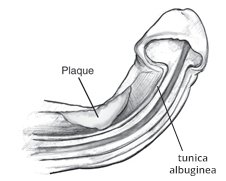
To understand the condition, it helps to know how an erection works. The penis contains two spongy erectile chambers (the corpora cavernosa) that fill with blood. Each is wrapped in a tough, elastic membrane called the tunica albuginea. When the chambers fill, this sheath stretches evenly and then becomes firm, which is what keeps the erection straight and rigid.
For Arabic-speaking readers: a detailed, source-referenced overview of this condition in Arabic is available in the Alphateb medical encyclopedia — انحناء القضيب.
In this condition, a patch of the tunica albuginea is replaced by fibrous scar tissue, the plaque. Scar tissue does not stretch the way healthy tissue does. During an erection, the healthy side lengthens normally while the scarred side stays short, so the penis bends toward the plaque. A plaque on the top of the shaft pulls the penis upward; one on the underside pulls it downward.
The plaque is benign. It is not a tumor and does not turn into cancer, and it cannot be passed to a partner. It sits beneath the skin, so many men can feel it as a hard lump or band on the shaft even when the penis is soft.
Source: NIDDK — Penile Curvature; NHS — Peyronie’s: overview, symptoms and treatment
Peyronie’s disease vs congenital curvature
Not every curved penis has Peyronie’s disease. Some men are born with a bend, known as congenital penile curvature. It is not caused by plaque, scarring or injury, it does not change over time, and it is often first noticed after puberty. A slight curve is common and normal. The clues that point to the disease instead are a curve that is new, a curve that is changing, a palpable lump, or pain with erections.
Source: Cleveland Clinic — Symptoms & Treatment
How common is Peyronie’s disease?
Peyronie’s disease is much more common than its low profile suggests. According to the US National Institute of Diabetes and Digestive and Kidney Diseases (NIDDK), about 1 in 100 American men over 18 has been diagnosed, but when researchers count men who report symptoms, the true figure is estimated at more than 1 in 10. Many men never mention it to a doctor because of embarrassment, so the condition is widely believed to be underdiagnosed.
Published studies give a very wide range because they use different definitions and populations. The American Urological Association (AUA) guideline cites estimates from 0.5% to 20.3%. In one US survey, 0.5% of men had a formal diagnosis while 13.1% reported at least one symptom. Rates are higher in men who already have erectile dysfunction (7.9% in one study) and highest in diabetic men with erectile dysfunction (20.3%).
The disease most often begins around the ages of 50 to 60, but younger men are not immune. The European Association of Urology (EAU) guideline reports prevalence figures of 1.5% to 16.9% in men under 40.
Source: NIDDK — Penile Curvature; AUA — PD Guideline; EAU — Sexual and Reproductive Health Guidelines: Penile Curvature
Causes and risk factors of Peyronie’s disease
The exact cause is still not fully understood. The leading explanation is abnormal wound healing. Experts believe that repeated small injuries to the tunica albuginea, for example from bending of the erect penis during sex, sports or accidents, trigger bleeding and inflammation inside the sheath. In most men this heals normally. In men who develop the condition, the repair process goes wrong and lays down excess, disorganized scar tissue.
What happens inside the tissue
Research reviews describe an imbalance between building scar tissue and breaking it down. A signaling protein called TGF-β (transforming growth factor beta) plays a central role: it activates cells called myofibroblasts, which produce large amounts of collagen and resist normal clean-up. Fibrin from small bleeds may further stimulate this process. In some men, the same signals encourage calcium deposits, so the plaque can become partly calcified, almost bone-like, over time.
Notably, many men cannot remember any injury at all. Cleveland Clinic notes that up to 80% of people with the condition do not recall a specific event before the changes began, which supports the idea that repeated, unnoticed microtrauma is involved.
Source: World Journal of Urology (PMC) — Inflammation and Fibrosis in PD; Cleveland Clinic — Symptoms & Treatment
Known risk factors
- Penile microtrauma: vigorous sexual or non-sexual activity that causes small injuries to the penis.
- Dupuytren’s contracture and related disorders: Dupuytren’s contracture thickens tissue in the palm and bends the fingers. It shares biological pathways with Peyronie’s disease: in one group of 415 men with PD, 22% also had Dupuytren’s, and in a group of 85 men with Dupuytren’s, 26% had Peyronie’s-like symptoms. Plantar fasciitis, scleroderma and other connective tissue or autoimmune conditions are also linked.
- Diabetes and erectile dysfunction: men with diabetes-related erectile dysfunction are roughly four to five times more likely to develop the condition.
- Older age: the risk rises with age.
- Family history: having a father or brother with the condition increases risk, and genetic studies have found familial clustering.
- Prostate cancer surgery: likely related to the erectile dysfunction that can follow surgery.
- Cardiovascular factors: the NHS also lists high blood pressure, high cholesterol, coronary heart disease and arteriosclerosis, and notes a possible link with some medicines such as beta blockers.
Source: NIDDK — Penile Curvature; World Journal of Urology (PMC) — Inflammation and Fibrosis in PD; NHS — Peyronie’s: overview, symptoms and treatment
Peyronie’s disease symptoms
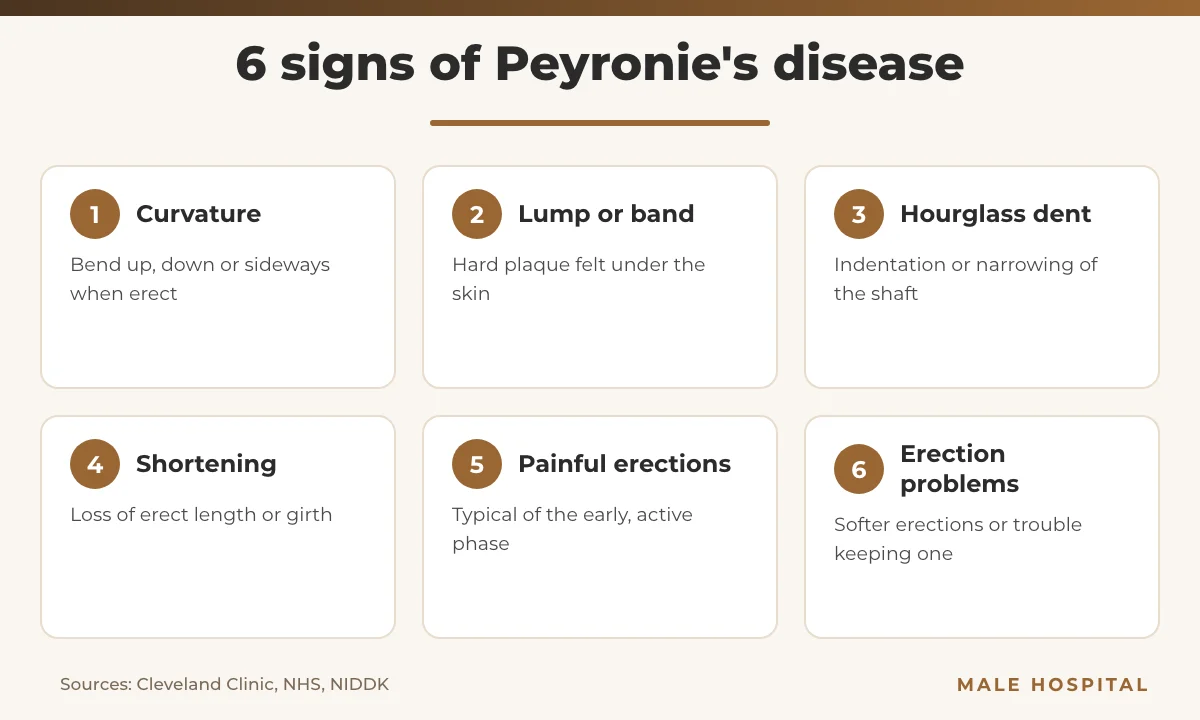
Symptoms can appear gradually over weeks or months, or seem to develop almost overnight. Most men notice one or more of the following:
- Curvature: the main sign. The penis bends upward, downward or to one side during an erection, depending on where the plaque sits. Some men also have a bend when the penis is soft.
- A lump or hard band: a firm area under the skin of the shaft, often on the top. Swelling may come first and harden later.
- Indentation or “hourglass” shape: instead of a bend, some men see a dent or a narrowed waist in the shaft. This happens when scar tissue is on both the top and bottom, or wraps around the shaft.
- Shortening: scar tissue can reduce the length or girth of the erect penis.
- Pain: pain with erections or during sex, which is typical of the early phase.
- Erectile dysfunction: softer erections or difficulty keeping an erection.
The amount of curvature matters for sex. Cleveland Clinic notes that a curve greater than 30 degrees can make intercourse painful or impossible.
Source: Cleveland Clinic — Symptoms & Treatment; NHS — Peyronie’s: overview, symptoms and treatment
The link with erectile dysfunction
Erectile dysfunction is common in men with PD: the EAU guideline reports rates between 30% and 70.6%. The two conditions feed into each other. Shared risk factors such as diabetes and vascular disease affect both, and pain, distress or anxiety about the bend can make erections harder to maintain. Our complete guide to erectile dysfunction explains these mechanisms in more detail.
Source: EAU — Sexual and Reproductive Health Guidelines: Penile Curvature
How the symptoms compare
| Symptom | What causes it | Typical course |
|---|---|---|
| Pain with erections | Active inflammation in the tunica albuginea | Usually fades with time, even without treatment |
| Curvature | Plaque stops one side of the penis from stretching | Often stays the same or worsens; improves in a minority |
| Indentation / hourglass | Scar on opposite sides or around the shaft | Tends to persist once the disease is stable |
| Shortening | Scar tissue limits length and girth | Tends to persist |
| Lump | The plaque itself, sometimes calcified | Remains; size does not predict the degree of bend |
| Erectile dysfunction | Vascular risk factors, plaque, anxiety | Can develop at any stage; treatable |
Source: AUA — PD Guideline; EAU — Penile Curvature; Cleveland Clinic — Symptoms & Treatment
Active vs stable phase: how the disease evolves
PD usually moves through two phases. Knowing which phase you are in is the single most important factor in planning care, because some treatments make sense only early on and surgery is reserved for stable disease.
The active (acute) phase
This is the period when the plaque is forming. Pain with erections is common, a lump may appear and the curve can change from month to month. Sources differ on its length: Cleveland Clinic describes it as lasting about 6 to 12 months, while the NIDDK says it can last up to 18 months.
The stable (chronic) phase
Eventually the scar stops growing. Pain usually fades, and the deformity settles at a fixed degree. According to the NIDDK, this chronic phase usually begins 12 to 18 months after symptoms start. The EAU guideline defines stable disease as no pain and an unchanged curvature for at least three months. Erectile dysfunction may still appear in this phase.
Source: NIDDK — Penile Curvature; Cleveland Clinic — Symptoms & Treatment; EAU — Penile Curvature
Natural history: what happens without treatment?
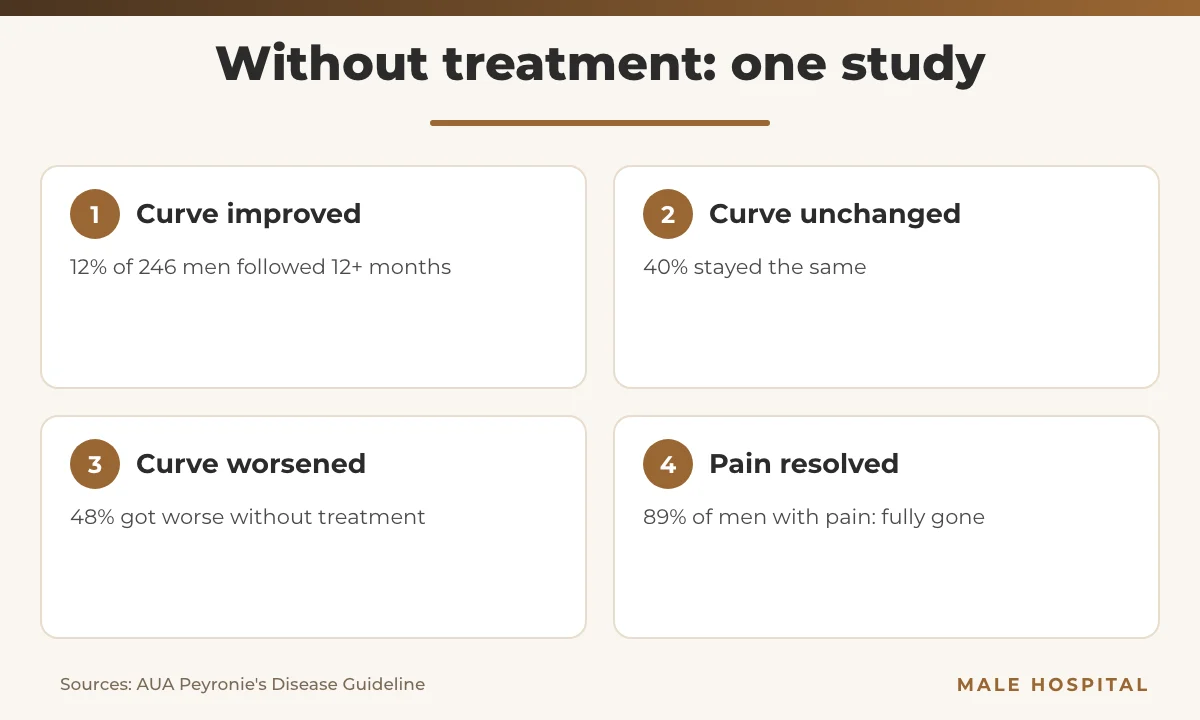
Many men hope the bend will simply go away. The evidence summarized by the AUA is more mixed. In a study that followed 246 untreated men for at least 12 months, the curve improved in 12%, stayed the same in 40% and worsened in 48%. Pain behaved very differently: it improved in every man who had it, and 89% reported that it resolved completely. A second study of 176 men found no change in 67%, improvement in 12% and worsening in 21%.
The practical message is that pain is very likely to settle on its own, but a meaningful curve is unlikely to straighten without help. Waiting a few months to see whether the disease stabilizes is reasonable for many men, while worsening curvature, shortening or loss of function is a reason for an earlier specialist review.
Source: AUA — PD Guideline
How doctors diagnose Peyronie’s disease
There is no blood test for this condition. The diagnosis is clinical, and a urologist experienced in sexual medicine can usually confirm it at the first visit.
1. History
The doctor asks when the symptoms started, whether erections are painful, how the shape, length and girth have changed, whether erections are still firm enough for sex and how much distress the problem causes. Many specialists use a validated questionnaire, the Peyronie’s Disease Questionnaire (PDQ), which scores psychological and physical symptoms, pain and bother.
2. Physical examination
The penis is examined when soft, and the plaque can usually be felt. The doctor may measure stretched penile length and check the hands and feet for Dupuytren’s contracture or similar changes. Plaque size on examination does not correlate with how much the penis bends.
3. Assessing the erect penis
Because the deformity appears during an erection, an objective assessment of the erect penis is essential. Options include photographs taken at home, a vacuum device, or an in-office injection of a medicine that produces an erection. The AUA recommends an in-office injection test, with or without duplex Doppler ultrasound, before any invasive treatment, and the EAU considers the injection method the most accurate. This lets the doctor measure the angle and see narrowing, hinging and erection quality.
4. Ultrasound
Penile ultrasound shows where the plaque is and whether it is calcified. Duplex Doppler ultrasound also measures blood flow, which matters when erectile dysfunction is present or surgery is being planned. CT and MRI are not recommended routinely.
Source: AUA — PD Guideline; EAU — Penile Curvature
Tip: if your doctor asks for home photos, take them from directly above and from the side at full erection, in good light. Accurate measurements of length also help track the disease; our article on average penis size and how to measure correctly explains the standard technique.
The emotional and relationship impact of Peyronie’s disease
The condition affects much more than the shape of the penis. The AUA guideline describes a profound effect on quality of life. Up to 81% of men report emotional distress, and in one study 48% had clinically meaningful depressive symptoms that stayed high over time. More than half (54%) report relationship difficulties because of the condition.
Men often describe worry about how the penis looks, a reduced sense of masculinity, anxiety before sex, loss of confidence and a feeling of isolation, because they find it hard to talk to partners or even doctors about it. These feelings are common and understandable, and they are a legitimate part of the medical problem. Specialists are advised to assess distress before and during treatment, and counseling or sex therapy, ideally involving the partner, can help alongside medical care.
Source: AUA — PD Guideline; NIDDK — Penile Curvature
Peyronie’s disease treatment options in brief
Not every man needs treatment. A mild curve without pain that does not interfere with sex can simply be monitored. When treatment is needed, the choice depends on the phase of the disease, the degree and type of deformity, the quality of erections and the man’s own goals.
- Active phase: the aim is to control pain and limit progression; options include medicines and penile traction devices.
- Stable phase with a significant curve: plaque injections or surgery to straighten the penis. Surgery is usually considered only once the disease has been stable for 3 to 6 months.
- Peyronie’s with severe erectile dysfunction: a penile implant can treat both the erection problem and the curve.
The NHS notes that surgery usually cannot restore the penis to exactly its shape before the disease, which is why realistic expectations matter. We cover every option, its evidence and its risks on our Peyronie’s disease treatment page, with surgical techniques explained under penile curvature correction and implants under penile prosthesis surgery.
Source: NHS — Peyronie’s: overview, symptoms and treatment; EAU — Penile Curvature; Cleveland Clinic — Symptoms & Treatment
When to see a doctor about Peyronie’s disease
See a urologist, without embarrassment, if you notice any of the following:
- A new curve in the erect penis, or a curve that is getting worse.
- A hard lump, band or swelling on the shaft.
- Pain during erections or sex.
- An indentation, narrowing or loss of length.
- Erections that have become softer or harder to keep.
- Low mood, anxiety or relationship strain related to the change.
Seeing a specialist early, during the active phase, gives you the widest choice of options and an accurate baseline to compare against later.
Seek urgent care if penile symptoms come with an inability to urinate, bleeding, or a sudden injury that causes severe penile pain. These are emergencies and are not typical of PD alone.
Source: NHS — Peyronie’s: overview, symptoms and treatment; Cleveland Clinic — Symptoms & Treatment
If you have noticed a bend, a lump or painful erections, you can arrange a confidential assessment with our urologist-andrologist Assoc. Prof. Dr. Zülfü Sertkaya, whose clinical focus includes Peyronie’s disease. Send your questions privately on WhatsApp for a free initial consultation.
FAQs about Peyronie’s disease
Can Peyronie’s disease go away on its own?
Pain usually does: in one study, 89% of untreated men with painful erections reported that the pain resolved completely. The curve is different. Only about 12% of men saw it improve without treatment, while roughly 40% stayed the same and 48% worsened in that study. Mild cases may never need treatment, but a significant bend rarely straightens by itself.
Source: AUA — PD Guideline
Is Peyronie’s disease cancer or contagious?
No to both. The plaque is benign scar tissue in the sheath around the erectile chambers. It is not a tumor, it does not become cancerous, and it cannot be passed to a sexual partner. It is a disorder of wound healing, related to conditions such as Dupuytren’s contracture, rather than an infection.
Source: NIDDK — Penile Curvature
Is a slightly curved penis normal?
Yes. Many men have a mild bend, and some are born with a curve (congenital curvature) that never changes and has no plaque or pain. PD is more likely when the curve is new or changing, when you can feel a lump, or when erections hurt. A urologist can tell the two apart with a simple examination.
Source: Cleveland Clinic — Symptoms & Treatment
Does Peyronie’s disease make the penis smaller?
It can. Scar tissue in the tunica albuginea does not stretch, so some men lose erect length, and plaques on both sides or around the shaft can cause narrowing or an hourglass shape. Not every man is affected this way, which is why doctors record length and shape at diagnosis to follow any change.
Source: Cleveland Clinic — Symptoms & Treatment; NHS — Peyronie’s: overview, symptoms and treatment
Can young men get Peyronie’s disease?
Yes, although it is most common from around age 50. The EAU guideline reports prevalence estimates of 1.5% to 16.9% in men under 40, and an older study found that curvature worsened more often in men under 50 than in older men. Younger men with a new bend or lump should be assessed rather than told to wait.
Source: EAU — Penile Curvature; AUA — PD Guideline
Is Peyronie’s disease hereditary?
Genes appear to play a part. Having a father or brother with the condition raises your risk, families with an inherited pattern have been described, and a genetic variant has been linked to susceptibility in research. Genes are only part of the picture; repeated microtrauma and other risk factors also matter.
Source: World Journal of Urology (PMC) — Inflammation and Fibrosis in PD; NIDDK — Penile Curvature
Can Peyronie’s disease affect fertility?
PD is a problem of penile shape and erections rather than of the testicles. However, if the curve, pain or erectile dysfunction makes intercourse difficult or impossible, it can make it harder to conceive naturally. The NIDDK lists difficulty fathering a child among its possible complications. Treating the deformity or the erection problem can help restore intercourse.
Source: NIDDK — Penile Curvature
Does a bigger plaque mean a worse curve?
Not necessarily. The EAU guideline notes that the size of the plaque on examination does not correlate with the degree of curvature, and ultrasound is not accurate for measuring plaque size. That is why the curve has to be assessed during an erection, by photographs or an in-office test, rather than judged from the lump alone.
Source: EAU — Penile Curvature
Medically reviewed by Assoc. Prof. Dr. Zülfü Sertkaya, urologist and andrologist (FEBU), Istanbul. Last reviewed: October 2026.
This article is for general information and does not replace an individual consultation with a qualified doctor.
- NIDDK — Penile Curvature (Peyronie's Disease)
- AUA — Peyronie's Disease Guideline
- EAU — Sexual and Reproductive Health Guidelines: Penile Curvature
- Cleveland Clinic — Peyronie's Disease: Symptoms & Treatment
- NHS — Peyronie's disease
- World Journal of Urology (PMC) — Inflammation and Fibrosis: Implications for the Pathogenesis of Peyronie's Disease (Patel et al.)