Penile implant revision surgery is a second operation to repair, reposition or replace a penile prosthesis that has stopped working, moved, become infected or does not meet the patient’s needs. Most revisions are done for mechanical failure, and in experienced hands most men end up with a working implant again, although the risk of infection is higher than with a first implant. If you are still deciding about a first device, start with our penile prosthesis surgery page, and for the full list of things that can go wrong, see our guide to penile implant complications.
Source: PubMed — Henry et al., An outcomes analysis of over 200 revision surgeries for penile prosthesis implantation (2012); BAUS — Penile prostheses (patient leaflet, 2024)
- About 30% of penile prostheses need some kind of reoperation within 15 years of the first implant, most often because of mechanical failure, which is also the top reason for penile implant revision.
- In a multicenter study of 214 non-infected penile implant revisions, 93% of men ended up with a working inflatable implant after a washout protocol.
- Infection risk after penile implant revision is higher than after a first implant: BAUS quotes about 6–10% for revision or complex cases, versus 1–2% for first-time implants.
- For an infected implant, removing the device and placing a new one in the same operation (immediate salvage) succeeds in more than 80% of selected cases.
- Removing an implant without replacing it leads to scarring and shortening, which makes any later implant harder.
- What is penile implant revision surgery?
- Why penile implant revision surgery is needed
- Signs your implant may need a revision
- Types of revision: partial exchange, full replacement or drain and retain
- Revision for an infected implant: salvage or removal
- Risks of penile implant revision surgery compared with a first implant
- Success rates and realistic results
- Preparing for revision and recovering afterward
- Choosing a surgeon for penile implant revision surgery
- When to see a doctor
- FAQs about penile implant revision surgery
What is penile implant revision surgery?
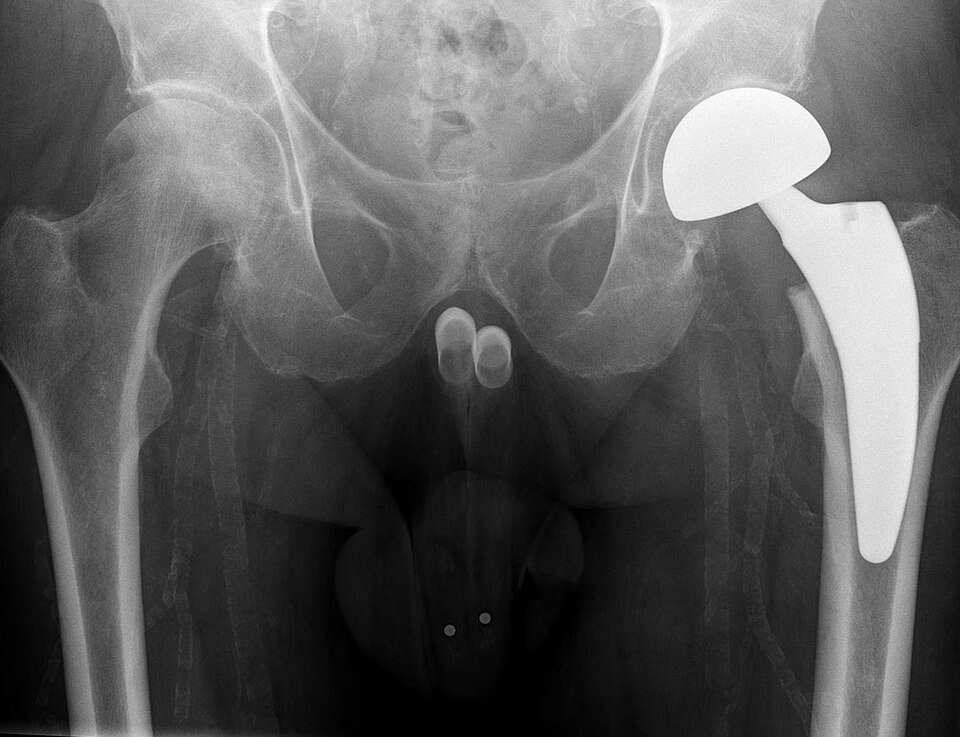
A penile prosthesis is a medical device placed inside the two erectile chambers of the penis (the corpora cavernosa). The most common type, the three-piece inflatable implant, has two cylinders in the penis, a pump in the scrotum and a fluid reservoir in the lower abdomen. Like any mechanical device, it can wear out, and the surrounding tissues can change over time, which is why penile implant revision is sometimes needed.
Any planned return to the operating room for an existing implant is called a reoperation. Surgeons usually separate three situations: removing the device only (explant), repairing or repositioning part of it (revision), and removing the old device and placing a new one in the same operation (explant and reimplant). In everyday language, all of these are often simply called penile implant revision surgery.
Reoperation, including penile implant revision, is not rare. A Canadian high-volume center that reviewed 1,161 implant procedures noted that about 30% of penile prostheses need a reoperation within 15 years of the original implant. Cleveland Clinic explains that when an implant wears out it stops working, and the surgeon can usually revise it by replacing it with a new device.
Source: PubMed — Chan et al., Indications for penile prosthesis revision (2019); Cleveland Clinic — Penile implants
Why penile implant revision surgery is needed
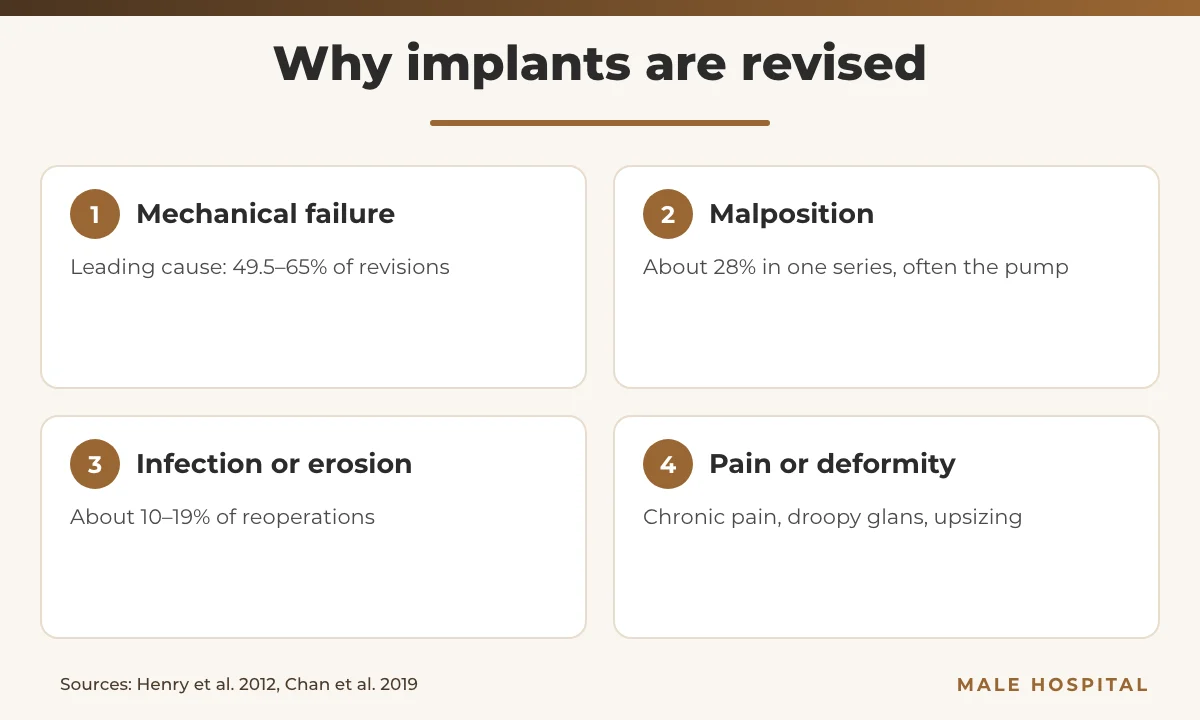
The reasons for penile implant revision fall into a few clear groups. Two large series give a good picture of how often each one occurs.
Mechanical failure
Mechanical failure is the leading cause. In a multicenter study of 214 non-infected penile implant revisions, 65% were done for mechanical failure. In the Canadian series of 99 first-time reoperations, mechanical failure accounted for 49.5%, with leaks or breaks most often found in the tubing and the cylinders. BAUS tells patients that about 1 in 20 inflatable implants (5%) malfunction within 10 years, which can cause uncontrolled self-inflation and require further surgery.
Malposition, herniation and technical problems
In the Canadian series, 28.3% of reoperations were for technical causes such as a misplaced component or a cylinder bulging through weakened tissue (herniation). The pump was the part most often repositioned. The authors concluded that more than a quarter of reoperations might have been prevented by changes in surgical technique, device positioning and aftercare.
Infection and erosion
Infection or erosion (a component wearing through the tissue or skin) made up 19% of penile implant revisions in the multicenter study and about 10% of reoperations in the Canadian series. Infection usually requires removal of the device, discussed in detail below.
Pain, deformity and dissatisfaction
Some penile implant revisions are done on implants that still work. In the Canadian series, 12.1% of reoperations treated chronic pain. In the multicenter study, 16% of revisions were on functioning, uninfected devices because of patient dissatisfaction, a drooping glans (called SST deformity), a scrotal blood collection, or to place larger cylinders (upsizing) in men with scarred erectile tissue.
Source: PubMed — Henry et al., An outcomes analysis of over 200 revision surgeries for penile prosthesis implantation (2012); PubMed — Chan et al., Indications for penile prosthesis revision (2019); BAUS — Penile prostheses (patient leaflet, 2024)
Signs your implant may need a revision
Not every problem means surgery. Many issues, such as difficulty finding the pump or a partial inflation, can first be checked in clinic by an implant surgeon. The following are common reasons men are assessed for a penile implant revision:
- The implant will not inflate, will not stay firm, or loses fluid over hours (a sign of a leak).
- The implant inflates on its own (autoinflation) or will not deflate.
- The pump has moved, is hard to reach, or the tubing can be felt in an uncomfortable place.
- One cylinder bulges, the erection bends, or the glans droops forward.
- Pain that continues months after surgery, or the penis feels clearly shorter than expected.
- New pain, warmth, redness, or the pump sticking to the scrotal skin, which can be signs of a low-grade infection.
Cleveland Clinic adds that once you have an implant, erection medicines will no longer work, and you are unlikely to have natural erections if the implant is removed and not replaced. That is why penile implant revision usually replaces a failed device rather than simply taking it out.
Source: PMC — Brimley et al., Management of inflatable penile prosthesis infection: a review (2021); Cleveland Clinic — Penile implants
Types of revision: partial exchange, full replacement or drain and retain
When an implant malfunctions without infection, the surgeon planning a penile implant revision must decide how much of the device to change. A partial exchange replaces only the broken part, for example one pump or one pair of cylinders. A complete exchange removes and replaces every component. A third option, “drain and retain,” replaces the cylinders and pump but leaves the old, emptied reservoir in place when removing it would mean risky dissection deep in the pelvis.
A 2024 systematic review in Sexual Medicine Reviews compared these approaches across 11 studies. The results suggest that changing the whole device is usually the safer choice:
| Approach | Infection | Any complication | Later mechanical failure |
|---|---|---|---|
| Partial-component exchange | 6.3% | 23.9% | 10% |
| Complete-component exchange | 2.7% | 11.3% | 2.8% |
| New device, old reservoir retained | 3.9% | 19.6% | 5.8% |
The authors concluded that in penile implant revision, partial exchange carries higher infection and complication rates, while mechanical failure rates are broadly comparable.
Removing an old reservoir can be difficult because scar tissue forms around it. A study summarized by ISSM notes that after a simple malfunction the reservoir may be left where it is, because further dissection could damage pelvic structures, and a new reservoir can be placed on the other side or in an alternative space. With infection, all components are usually removed.
Source: ISSM — Surgical removal of hard-to-reach IPP reservoir: new technique discussed
Revision for an infected implant: salvage or removal
An infected penile prosthesis cannot usually be cured with antibiotics alone, because bacteria form a protective film (biofilm) on the device. The EAU guidelines state that infection requires removal of the prosthesis and antibiotic treatment. There are two main strategies after that.
Immediate salvage
In a salvage procedure, the surgeon removes the infected device, washes the space with a series of antiseptic and antibiotic solutions, and places a new implant in the same operation. The EAU guidelines report successful salvage in more than 80% of cases when a washout protocol is used. A 2024 narrative review describes immediate salvage as safe and effective, and as the preferred strategy for most men with an implant infection, because it preserves penile length.
Some surgeons place a malleable (bendable) implant during salvage. In one multicenter series, 54 of 58 malleable salvage procedures (93%) were free of infection, and the review reports that up to 70% of these men keep the malleable device rather than converting back to an inflatable one. You can read more about this device type in our guide to the malleable penile implant.
Source: EAU Guidelines — Management of erectile dysfunction; PMC — Adams et al., Narrative review of immediate salvage for penile prosthesis infection (2024)
Removal with delayed replacement
When infection is severe, for example with fever, pus, tissue death or a device pushing through the skin, the surgeon usually removes everything and waits. Brimley and colleagues describe a typical wait of 3–6 months before a new implant. During that time the empty erectile chambers scar (corporal fibrosis), which makes the next operation harder and the penis shorter.
The 2024 review reports a 15–30% loss of penile length after removal with delayed replacement, and satisfaction of about 58% after delayed implantation, compared with 75–98% after a first implant. The EAU panel notes that the evidence does not allow a firm recommendation on how to proceed after an implant has been removed.
Source: PMC — Brimley et al., Management of inflatable penile prosthesis infection: a review (2021); PMC — Adams et al., Narrative review of immediate salvage for penile prosthesis infection (2024); EAU Guidelines — Management of erectile dysfunction
Risks of penile implant revision surgery compared with a first implant
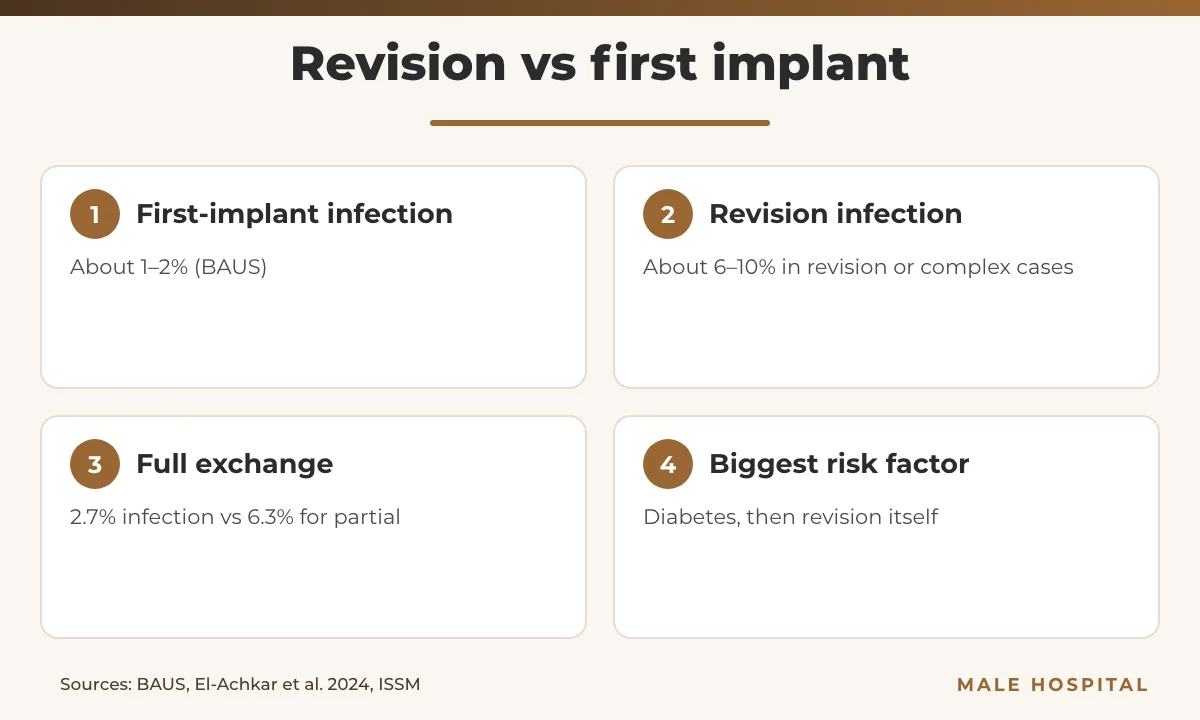
A penile implant revision is usually longer and more technically demanding than a first implant. The surgeon works through scar tissue, the old device must be removed carefully, and the space may hold bacteria even when there are no signs of infection. These factors explain why reported infection rates rise.
| Measure | First implant | Revision | Source |
|---|---|---|---|
| Infection (UK patient information) | 1–2% | 6–10% (revision, fibrosis or complex cases) | BAUS |
| Infection (series of 377 men, same antiseptic) | 2.2% | 9.7% | ISSM summary |
| Infection (review figure) | Up to 3% | Up to 18% | Brimley et al. |
| Infection or impending erosion after a revision washout protocol | — | 5.7% | Henry et al. |
The spread of figures reflects different patients, devices and techniques, so your own risk depends heavily on your health and the reason for penile implant revision. In the series summarized by ISSM, diabetes was the strongest risk factor for infection and revision surgery the second, and the odds of infection rose by about 1% for every extra minute of operating time.
Source: BAUS — Penile prostheses (patient leaflet, 2024); ISSM — Factors that may increase chances of infection with inflatable penile prostheses; PMC — Brimley et al., Management of inflatable penile prosthesis infection: a review (2021)
Other risks of penile implant revision are similar to a first operation: bruising and swelling, bleeding, erosion, injury to nearby structures, and a further mechanical failure years later. A 2026 review of revision costs adds that uncontrolled diabetes (HbA1c above 8), smoking, Peyronie’s disease and higher blood loss were each linked to a greater chance of reoperation in published series.
Source: PMC — Majzoub, Cost considerations in penile implantation revision surgery from a global perspective (2026); BAUS — Penile prostheses (patient leaflet, 2024)
Success rates and realistic results
The best data on non-infected penile implant revisions come from the multicenter study of 214 cases performed between 2000 and 2007. With component exchange followed by a revision washout, 93% of revisions produced a functioning inflatable implant, and only 12 men needed a further procedure or had a complication over a mean follow-up of about 4.6 years.
For infected implants, results depend on the strategy. Most published immediate salvage series report infection-free success in roughly 73–94% of men, with the classic Mulcahy series at 45 of 55 patients (about 81%). Removal with delayed replacement clears the infection but at the cost of length and a harder second operation.
It also helps to know how long the new device is likely to last. The EAU guidelines cite implant survival of 87.2% at five years. BAUS tells patients that an implant typically lasts 10–15 years before it may need to be exchanged, while Cleveland Clinic gives an average of about 20 years. The honest answer is that some devices last much longer than others, so a penile implant revision does not have to be the last operation.
Source: PubMed — Henry et al., An outcomes analysis of over 200 revision surgeries for penile prosthesis implantation (2012); PMC — Adams et al., Narrative review of immediate salvage for penile prosthesis infection (2024); EAU Guidelines — Management of erectile dysfunction; Cleveland Clinic — Penile implants
A penile implant revision can also correct problems from the first operation, such as a poorly placed pump, a cylinder that is too short, or a drooping glans. It cannot restore length that was lost from years of erectile dysfunction or from scarring after an implant was removed. Setting realistic expectations before surgery matters as much as the technique itself.
Preparing for revision and recovering afterward
Preparation for penile implant revision focuses on reducing infection risk. Cleveland Clinic warns that skin and urinary infections increase the risk of infecting an implant, so these should be treated before surgery. Because diabetes is the most important infection risk factor in recent data, good blood sugar control in the weeks before surgery is one of the most useful things you can do. Stopping smoking is also sensible, since smoking was linked to reoperation in the published series.
Recovery after a straightforward component exchange is broadly similar to recovery after a first implant, with swelling and discomfort for the first weeks and a pause before using the device for sex. After salvage for infection, the 2024 review suggests about two weeks of culture-directed antibiotics. Our guide to penile implant recovery explains the usual timeline in more detail.
Source: Cleveland Clinic — Penile implants; ISSM — Factors that may increase chances of infection with inflatable penile prostheses; PMC — Adams et al., Narrative review of immediate salvage for penile prosthesis infection (2024)
Choosing a surgeon for penile implant revision surgery
Penile implant revision is more complex than a first implant, and experience matters. The EAU guidelines link lower infection rates to high-volume centers, and the 2026 review on revision costs recommends referral of these cases to high-volume centers. The Canadian series showed that many technical reoperations may be avoidable with careful device positioning and aftercare, which also argues for an experienced implant surgeon the second time around.
Useful questions to ask include how many penile implant revisions the surgeon performs, whether they plan to replace all components or only the faulty part, how they will handle the old reservoir, whether a coated device and a washout protocol will be used, and what happens if infection is found during surgery.
At Male Hospital, implant surgery is performed by Assoc. Prof. Dr. Zülfü Sertkaya, a urologist and andrologist in Istanbul and a Fellow of the European Board of Urology. His clinical focus includes penile prosthesis surgery, he holds a Titan inflatable penile prosthesis Center of Excellence certificate from Coloplast (2024), and his research has addressed penile prosthesis infection risk and implant complications.
Source: EAU Guidelines — Management of erectile dysfunction; PMC — Majzoub, Cost considerations in penile implantation revision surgery from a global perspective (2026); PubMed — Chan et al., Indications for penile prosthesis revision (2019)
When to see a doctor
Seek same-day medical care if you have an implant and notice any of the following:
- Fever or chills, especially with pain in the penis or scrotum.
- Pain that is getting worse rather than better, or new pain long after surgery.
- Redness, warmth, swelling or discharge from the wound or the scrotum.
- The pump stuck to the scrotal skin, thinning skin over a component, or any part of the device visible.
- Color change of the head of the penis, which can signal poor blood flow.
Brimley and colleagues list new pain, warmth, redness and adhesion of the pump to the scrotal skin as signs of a milder infection, and fever, purulent discharge or device extrusion as signs of obvious infection. Cleveland Clinic lists reduced blood flow to the head of the penis as a complication that requires removal of the implant. Non-urgent problems, such as an implant that will not fully inflate, deserve a planned review with an implant surgeon.
Source: PMC — Brimley et al., Management of inflatable penile prosthesis infection: a review (2021); Cleveland Clinic — Penile implants
If your implant is not working as it should, you can get a confidential assessment with our urologist-andrologist on WhatsApp. You can also learn more about our penile prosthesis surgery service in Istanbul.
FAQs about penile implant revision surgery
How common is penile implant revision surgery?
Fairly common over the long term. A Canadian high-volume center notes that about 30% of penile prostheses need a reoperation within 15 years of the original surgery. In its own series, 99 of 1,161 implant procedures were first-time reoperations, with a median of 46 months before the second operation. Mechanical failure was the most frequent reason.
Source: PubMed — Chan et al., Indications for penile prosthesis revision (2019)
Is revision surgery riskier than the first implant?
Yes, mainly because of infection. UK patient information from BAUS quotes infection in about 6–10% of revision or complex cases, compared with 1–2% after a first implant. Penile implant revision operations also tend to take longer because of scar tissue. Careful technique, full device exchange and washout protocols help keep the risk down.
Source: BAUS — Penile prostheses (patient leaflet, 2024)
Can only the broken part of my implant be replaced?
It is possible, but usually not preferred. A 2024 systematic review found that replacing only one or two components carried a higher infection rate (6.3%) and complication rate (23.9%) than replacing the whole device (2.7% and 11.3%). Many surgeons doing a penile implant revision therefore exchange all parts, sometimes leaving an old reservoir in place if removal would be risky.
Will I lose length after revision surgery?
Length after a planned exchange depends on the condition of the erectile tissue; in some men with scarring, surgeons revise specifically to place larger cylinders (upsizing). The main length loss happens when an infected implant is removed and not replaced right away: a 2024 review reports a 15–30% reduction in length with delayed replacement.
Source: PMC — Adams et al., Narrative review of immediate salvage for penile prosthesis infection (2024); PubMed — Henry et al., An outcomes analysis of over 200 revision surgeries for penile prosthesis implantation (2012)
Can an infected penile implant be saved?
The original device cannot usually be kept, but a new one can often be placed in the same operation. The EAU guidelines report that removing the infected device and immediately replacing it after a washout succeeds in more than 80% of cases. Men with severe infection, such as fever with pus or tissue death, usually need full removal first.
Source: EAU Guidelines — Management of erectile dysfunction
How long does a penile implant last before it needs replacing?
Figures vary by source and device. The EAU guidelines cite survival of 87.2% at five years, BAUS tells patients that implants typically last 10–15 years, and Cleveland Clinic gives an average of about 20 years. There is no need to replace a device that is still working well.
Source: EAU Guidelines — Management of erectile dysfunction; BAUS — Penile prostheses (patient leaflet, 2024); Cleveland Clinic — Penile implants
How much does penile implant revision surgery cost?
A 2026 review notes that penile implant revisions are more complex than first implants and need more resources, so they generally cost more, but direct cost data are limited. At Male Hospital, the price depends on your assessment, the device and the type of revision needed. You can ask for a free consultation on WhatsApp, and our penile implant cost guide covers published price ranges.
Medically reviewed by Assoc. Prof. Dr. Zülfü Sertkaya, urologist and andrologist (FEBU), Istanbul. Last reviewed: November 2026.
This article is for general information and does not replace an individual consultation with a qualified doctor.
- EAU Guidelines — Sexual and Reproductive Health — Management of erectile dysfunction
- BAUS — Penile prostheses (patient information leaflet, 2024)
- Cleveland Clinic — Penile implants
- ISSM — Factors that may increase chances of infection with inflatable penile prostheses
- ISSM — Surgical removal of hard-to-reach IPP reservoir: new technique discussed
- PubMed (J Sex Med) — Henry et al. An outcomes analysis of over 200 revision surgeries for penile prosthesis implantation: a multicenter study (2012)
- PubMed (J Sex Med) — Chan et al. Indications for penile prosthesis revision: lessons learned to limit technical causes of reoperation (2019)
- PubMed (Sex Med Rev) — El-Achkar et al. A systematic review comparing different approaches for inflatable penile prosthesis revision (2024)
- PMC (Transl Androl Urol) — Adams et al. Narrative review of immediate salvage for penile prosthesis infection (2024)
- PMC (Arab Journal of Urology) — Brimley et al. Tips and tricks in the management of inflatable penile prosthesis infection: a review (2021)
- PMC (Curr Urol Rep) — Majzoub. Cost considerations in penile implantation revision surgery from a global perspective (2026)