Blood pressure medication and erectile dysfunction are linked less often than most men fear. Thiazide diuretics and older beta-blockers are the blood pressure medication classes most often blamed for erection problems, while angiotensin receptor blockers (ARBs), ACE inhibitors, calcium channel blockers and the beta-blocker nebivolol look neutral or even favourable. If ED starts after a new tablet, the answer is a conversation with your doctor about switching, not stopping the medicine on your own.
Sources: MedlinePlus — Drugs that may cause erection problems; PubMed — Cardiovasc Drugs Ther 2022 — Farmakis et al. Effects of major antihypertensive drug classes on erectile function: a network meta-analysis
- MedlinePlus names thiazide diuretics as the most common blood pressure cause of ED, followed by beta-blockers; alpha-blockers are less likely to cause it.
- A network meta-analysis of 25 trials (7,784 patients) found no significant difference in erectile function between the five main drug classes, or versus placebo.
- Nebivolol, a vasodilating beta-blocker, gave better erectile function scores than metoprolol in a 2025 meta-analysis of four randomized trials.
- In one trial, being told that atenolol could cause ED raised the ED rate from 3.1% to 31.2%. Expectation is a real factor.
- Most men can add a PDE5 inhibitor such as sildenafil or tadalafil to their blood pressure medication; nitrates and nicorandil are the exceptions.
- Why blood pressure medication and erectile dysfunction get confused
- Blood pressure medication and erectile dysfunction: class by class
- Thiazide diuretics
- Beta-blockers: atenolol versus nebivolol
- ARBs, ACE inhibitors and calcium channel blockers
- Alpha-blockers and ED pills
- Taking ED pills with blood pressure medication
- What to do if ED starts after a new tablet
- When to see a doctor
- FAQs about blood pressure medication and erectile dysfunction
Why blood pressure medication and erectile dysfunction get confused

High blood pressure itself damages the small arteries of the penis, so many men already have some loss of erectile function by the time they are diagnosed. When they then notice ED a few weeks after starting a tablet, it is natural to blame the tablet. We explain how hypertension harms erections in our main guide to erectile dysfunction and high blood pressure; this article focuses on the medicines.
The risk is real for some drugs. The European Association of Urology (EAU) lists thiazide diuretics and beta-blockers among drug-induced causes of ED, and the NIDDK and Cleveland Clinic both include blood pressure medication and diuretics in their lists of medications that can cause erection problems. At the same time, the EAU notes that newer cardiovascular drugs have shown a neutral or even beneficial effect on erectile function. The class you take matters more than simply being “on blood pressure pills”.
Sources: EAU — Sexual and Reproductive Health Guidelines — Management of erectile dysfunction; NIDDK — Symptoms & Causes of Erectile Dysfunction; Cleveland Clinic — Erectile Dysfunction
Blood pressure medication and erectile dysfunction: class by class
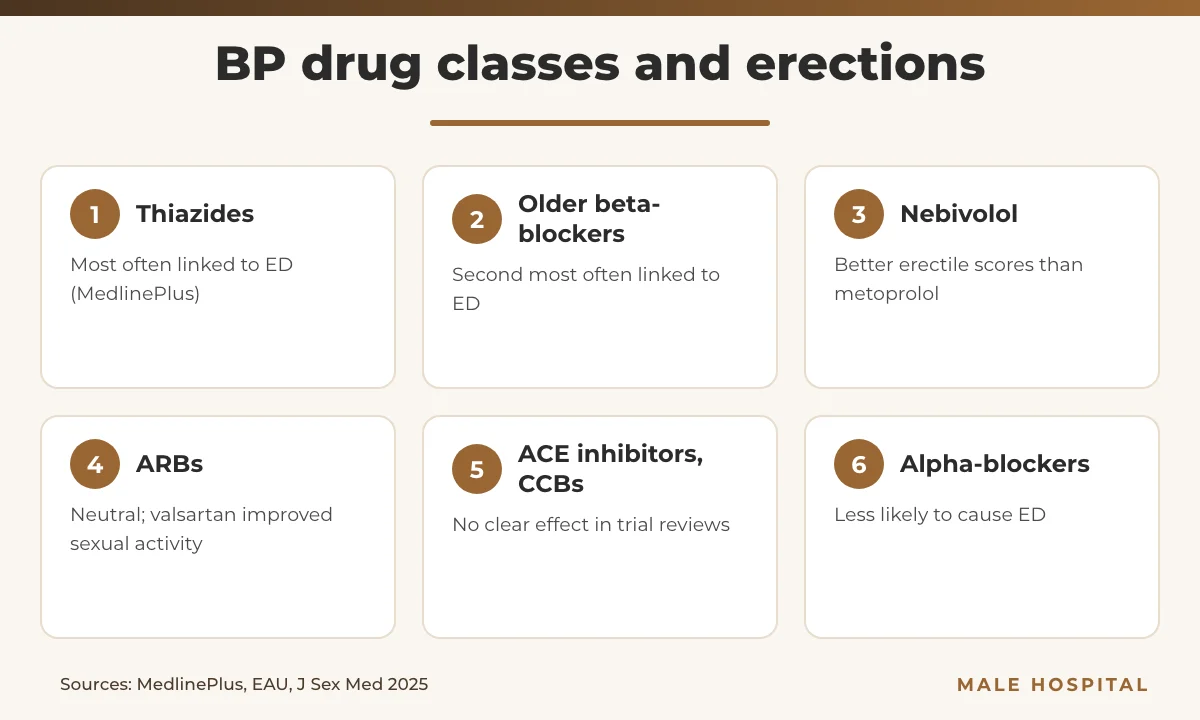
The table below summarises what the sources say about each main class. Individual responses vary, and a blood pressure medication that suits one man may not suit another.
| Drug class | Common examples | Link with ED | Evidence notes |
|---|---|---|---|
| Thiazide and thiazide-like diuretics | Bendroflumethiazide, chlorthalidone, hydrochlorothiazide | Most often linked | MedlinePlus: the most common cause of ED among blood pressure medication |
| Older beta-blockers | Atenolol, metoprolol, propranolol | Often linked | Second most common per MedlinePlus; strong nocebo effect shown with atenolol |
| Nebivolol | Nebivolol | Favourable | Higher erectile scores than metoprolol in four randomized trials |
| Angiotensin receptor blockers (ARBs) | Valsartan, losartan, telmisartan | Neutral to favourable | Valsartan improved sexual activity; no significant change in erectile function overall |
| ACE inhibitors | Ramipril, enalapril, lisinopril | No clear effect | No significant difference from placebo in network meta-analysis |
| Calcium channel blockers | Amlodipine | No clear effect | No significant difference from placebo in network meta-analysis |
| Alpha-blockers | Doxazosin | Less likely | Less likely to cause ED; combine carefully with ED pills |
Sources: MedlinePlus — Drugs that may cause erection problems; PubMed — Cardiovasc Drugs Ther 2022 — Farmakis et al. Effects of major antihypertensive drug classes on erectile function: a network meta-analysis; PubMed — J Sex Med 2025 — Lu et al. Effect of nebivolol on erectile function: a systematic review and meta-analysis of randomized controlled trials; PMC — Am J Mens Health 2019 — Ismail et al. Angiotensin receptor blockers for erectile dysfunction in hypertensive men: a brief meta-analysis
Thiazide diuretics
Thiazides are cheap, effective and widely used as a first or second blood pressure medication. They are also the class most consistently associated with erection problems in consumer and guideline sources: MedlinePlus states that thiazides are the most common cause of ED among high blood pressure medicines, and the EAU lists them by name as a drug-induced cause.
Why they might affect erections is not fully settled, and randomized data are less dramatic than the reputation. In the 2022 network meta-analysis, thiazides were one of five classes compared, and no class, thiazides included, significantly changed erectile function versus placebo. The authors rated the risk of bias as concerning or high in most included studies, so a real but modest effect in some men cannot be excluded.
Sources: MedlinePlus — Drugs that may cause erection problems; EAU — Sexual and Reproductive Health Guidelines — Management of erectile dysfunction; PubMed — Cardiovasc Drugs Ther 2022 — Farmakis et al. Effects of major antihypertensive drug classes on erectile function: a network meta-analysis
Other diuretics, such as furosemide, bumetanide and spironolactone, also appear on the MedlinePlus list of drugs that may cause erection problems.
Source: MedlinePlus — Drugs that may cause erection problems
Beta-blockers: atenolol versus nebivolol
Beta-blockers have the strongest reputation for causing ED, and the reputation itself is part of the story.
The atenolol nocebo trial
In a study published in the European Heart Journal, 96 men with new cardiovascular disease and normal erections started atenolol 50 mg. One group did not know which drug they were taking, a second knew the blood pressure medication name, and a third was told it could cause ED. After three months, ED was reported by 3.1%, 15.6% and 31.2% of the three groups respectively. When the affected men were then given sildenafil or a placebo, placebo reversed the problem as well as sildenafil in all but one man.
Nebivolol
Nebivolol is a newer beta-blocker that also widens blood vessels. A 2025 meta-analysis in the Journal of Sexual Medicine pooled four randomized trials (397 men) comparing nebivolol with metoprolol and found higher erectile function (IIEF-5) scores with nebivolol, with a mean difference of 1.81 points. One of the included trials, in 60 men undergoing coronary bypass surgery, found that erectile function fell with metoprolol, while nebivolol appeared protective.
Sources: PubMed — J Sex Med 2025 — Lu et al. Effect of nebivolol on erectile function: a systematic review and meta-analysis of randomized controlled trials; PubMed — Anatol J Cardiol 2016 — Nebivolol compared with metoprolol for erectile function in males undergoing coronary artery bypass graft
The 2022 network meta-analysis adds nuance: nebivolol beat non-vasodilating beta-blockers (odds ratio 2.92), but not placebo or other vasodilating beta-blockers. So nebivolol looks kinder to erections than older drugs, rather than actively treating ED.
ARBs, ACE inhibitors and calcium channel blockers
These three classes are the usual alternatives when a man on a thiazide or older beta-blocker develops ED.
ARBs (sartans). A meta-analysis of four trials with 2,809 men found that valsartan improved sexual activity, while losartan and telmisartan did not significantly improve erectile function compared with control or placebo. The authors concluded that ARBs should be considered when prescribing blood pressure medication to men, but stressed that few studies are available. The diagram above shows the renin-angiotensin system these drugs block.
ACE inhibitors and calcium channel blockers. In the network meta-analysis, neither class significantly changed erectile function compared with placebo or with other classes. Some ACE inhibitors (captopril, enalapril) and a calcium channel blocker (verapamil) do appear on the MedlinePlus list of drugs that may cause erection problems, which is a reminder that individual reactions vary.
Sources: PubMed — Cardiovasc Drugs Ther 2022 — Farmakis et al. Effects of major antihypertensive drug classes on erectile function: a network meta-analysis; MedlinePlus — Drugs that may cause erection problems
Alpha-blockers and ED pills
Alpha-blockers such as doxazosin lower blood pressure and also relax the prostate, so they are sometimes chosen for men with both hypertension and urinary symptoms. MedlinePlus notes that alpha-blockers are less likely to cause ED than thiazides or beta-blockers.
Because both alpha-blockers and PDE5 inhibitors widen blood vessels, the NHS lists ED medicines such as sildenafil among medicines that may not mix well with doxazosin, so the combination should be discussed with your doctor or pharmacist. The EAU reviewed the evidence and states that the combination may change blood pressure measurements but does not increase adverse events due to low blood pressure, so there is no current limitation on using them together. In practice, doctors often start with a lower ED pill dose. If you also have prostate symptoms, see our article on enlarged prostate and erectile dysfunction.
Sources: MedlinePlus — Drugs that may cause erection problems; NHS — Doxazosin: medicine for high blood pressure and enlarged prostate; EAU — Sexual and Reproductive Health Guidelines — Management of erectile dysfunction
Taking ED pills with blood pressure medication
For most men the solution is not choosing between blood pressure control and erections. The EAU guidelines state that combining a PDE5 inhibitor with blood pressure medication may cause small additional falls in blood pressure that are usually minor, and that the side-effect profile of the ED pill is not worsened even when a man takes several antihypertensives.
The absolute contraindication is any organic nitrate (angina sprays and tablets) or recreational nitrites (“poppers”), which can cause a dangerous drop in blood pressure. Nicorandil is also contraindicated. If you are unsure which ED pill fits your routine, our comparison of Viagra vs Cialis and our guide to the tadalafil daily dose explain the options.
Source: EAU — Sexual and Reproductive Health Guidelines — Management of erectile dysfunction
What to do if ED starts after a new tablet
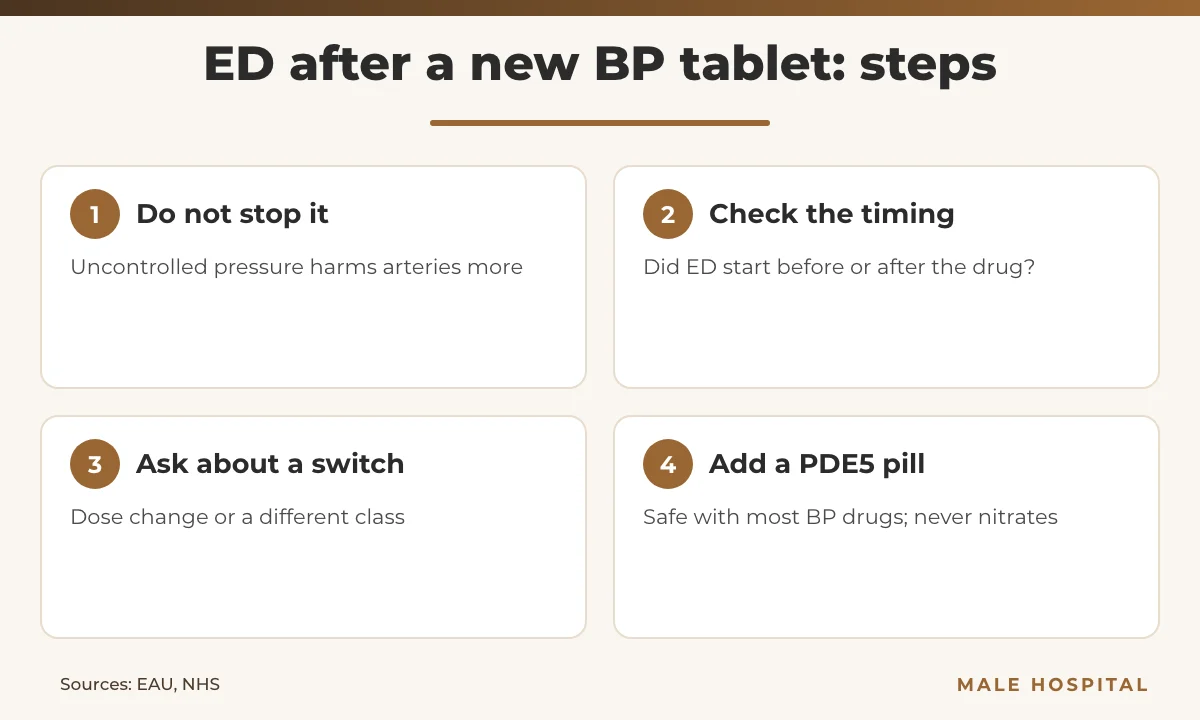
- Keep taking the blood pressure medication. High blood pressure can lead to heart attacks and strokes, and stopping treatment without advice puts you at risk while doing little for long-term erectile health.
- Note the timing. Were erections already weaker before the blood pressure medication was started? Do you still have morning erections? This helps your doctor separate the drug from the underlying vascular disease or anxiety.
- Ask about alternatives. Depending on your heart, kidney and diabetes status, your doctor may lower the dose or switch class, for example from a thiazide or atenolol to an ARB, ACE inhibitor, calcium channel blocker or nebivolol.
- Give the new plan time and remember that worry about side effects can itself affect erections.
- Consider an ED treatment. A PDE5 inhibitor works for many men on blood pressure medication; injections, devices and implants remain options if pills fail.
Sources: NHS — High blood pressure (hypertension); EAU — Sexual and Reproductive Health Guidelines — Management of erectile dysfunction; PubMed — Eur Heart J 2003 — Silvestri et al. Report of erectile dysfunction after therapy with beta-blockers is related to patient knowledge of side effects
When to see a doctor
See your doctor if erection problems persist for several weeks, if they began soon after a new heart or blood pressure medication, or if you want to add an ED pill to your current treatment. Seek urgent help for chest pain, fainting or severe dizziness, and for any erection lasting more than four hours. Bring a complete list of your medicines, including any nitrate spray, because that decides which ED treatments are safe.
Sources: NHS — High blood pressure (hypertension); EAU — Sexual and Reproductive Health Guidelines — Management of erectile dysfunction
If you would like a specialist to review your blood pressure medication and erectile dysfunction together, our urologist-andrologist offers confidential consultations through our erectile dysfunction treatment service. Send your blood pressure medication list on WhatsApp for a free initial assessment.
FAQs about blood pressure medication and erectile dysfunction
Which blood pressure medication causes the most ED?
According to MedlinePlus, thiazide diuretics are the most common cause of erectile dysfunction among high blood pressure medication, followed by beta-blockers. Alpha-blockers are less likely to cause it. Randomized trial reviews show smaller differences than this ranking suggests, so the best choice depends on your overall cardiovascular risk and how you respond.
Sources: MedlinePlus — Drugs that may cause erection problems; PubMed — Cardiovasc Drugs Ther 2022 — Farmakis et al. Effects of major antihypertensive drug classes on erectile function: a network meta-analysis
Which blood pressure medication is best for men with ED?
There is no single best drug, but ARBs, ACE inhibitors, calcium channel blockers and nebivolol are usually considered neutral or favourable for erections. Valsartan improved sexual activity in one meta-analysis, and nebivolol scored better than metoprolol in four randomized trials. Your doctor will balance these data against kidney function, diabetes and heart history.
Sources: PMC — Am J Mens Health 2019 — Ismail et al. Angiotensin receptor blockers for erectile dysfunction in hypertensive men: a brief meta-analysis; PubMed — J Sex Med 2025 — Lu et al. Effect of nebivolol on erectile function: a systematic review and meta-analysis of randomized controlled trials
Is ED from beta-blockers reversible?
Usually, yes. When ED is caused by the blood pressure medication, a dose change or switch typically helps. In the atenolol study, placebo reversed reported ED as effectively as sildenafil in all but one man, showing how often expectation contributes. If ED persists after a switch, underlying vascular disease is more likely and needs its own assessment.
Does amlodipine cause erectile dysfunction?
Calcium channel blockers such as amlodipine did not significantly change erectile function compared with placebo in a network meta-analysis of randomized trials. Amlodipine is not on the MedlinePlus list of drugs that may cause erection problems, although verapamil, another calcium channel blocker, is. Individual side effects are still possible, so report any change.
Sources: PubMed — Cardiovasc Drugs Ther 2022 — Farmakis et al. Effects of major antihypertensive drug classes on erectile function: a network meta-analysis; MedlinePlus — Drugs that may cause erection problems
Do ARBs like losartan improve erections?
Not clearly. In a meta-analysis of four trials with 2,809 men, valsartan improved sexual activity, but losartan and telmisartan did not significantly improve erectile function compared with control or placebo. ARBs are a reasonable switch for men troubled by ED on other drugs, but they are not a treatment for ED.
Can I take sildenafil with my blood pressure medication?
For most men, yes. The EAU states that the extra drop in blood pressure is usually minor and that ED pill side effects are not worsened, even with several blood pressure medication. Never combine sildenafil with nitrates, poppers or nicorandil, and ask your doctor about a lower starting dose if you take an alpha-blocker.
Source: EAU — Sexual and Reproductive Health Guidelines — Management of erectile dysfunction
Should I stop my tablet to see if my erections improve?
No. Stopping blood pressure medication without medical advice can let your pressure rise and increase the risk of heart attack and stroke. Ask your doctor whether a planned switch to another class is appropriate; that is the safe way to test whether the drug was contributing.
Source: NHS — High blood pressure (hypertension)
Medically reviewed by Assoc. Prof. Dr. Zülfü Sertkaya, urologist and andrologist (FEBU), Istanbul. Last reviewed: November 2026.
This article is for general information and does not replace an individual consultation with a qualified doctor.
- MedlinePlus — Drugs that may cause erection problems
- EAU — Sexual and Reproductive Health Guidelines — Management of erectile dysfunction
- PubMed — Cardiovasc Drugs Ther 2022 — Farmakis et al. Effects of major antihypertensive drug classes on erectile function: a network meta-analysis
- PubMed — J Sex Med 2025 — Lu et al. Effect of nebivolol on erectile function: a systematic review and meta-analysis of randomized controlled trials
- PubMed — Anatol J Cardiol 2016 — Nebivolol compared with metoprolol for erectile function in males undergoing coronary artery bypass graft
- PMC — Am J Mens Health 2019 — Ismail et al. Angiotensin receptor blockers for erectile dysfunction in hypertensive men: a brief meta-analysis
- PubMed — Eur Heart J 2003 — Silvestri et al. Report of erectile dysfunction after therapy with beta-blockers is related to patient knowledge of side effects
- NHS — Doxazosin: medicine for high blood pressure and enlarged prostate
- NHS — High blood pressure (hypertension)
- Cleveland Clinic — Erectile Dysfunction
- NIDDK — Symptoms & Causes of Erectile Dysfunction