Priapism is a persistent erection that lasts for hours without sexual stimulation and does not go away after orgasm. The most common form, the ischemic type, traps oxygen-poor blood in the penis and is a medical emergency: if an erection lasts more than 4 hours (or more than 1 hour if you have sickle cell disease), go to the nearest emergency department now. Treatment within the first few hours gives the best chance of keeping normal erections, which is why this condition matters for everyone using erectile dysfunction treatment.
Source: EAU — Sexual and Reproductive Health Guidelines, chapter 10; NHS — Long-lasting erection advice
- An erection lasting more than 4 hours is an emergency. Do not wait for it to settle on its own, and do not drive yourself to hospital.
- More than 95% of cases are ischemic (low-flow, rigid and painful). Non-ischemic (high-flow) priapism is rare, usually follows an injury and is not an emergency.
- Common triggers include sickle cell disease, penile injections for ED, some antipsychotics and antidepressants such as trazodone, alpha-blockers, cocaine and cannabis.
- Emergency treatment follows a stepwise plan: blood aspiration, phenylephrine injections into the penis, and surgery (a shunt) only if these fail.
- The longer ischemic priapism lasts, the higher the risk of permanent erectile dysfunction; after 36 hours recovery of natural erections is unlikely.
- What is priapism?
- Priapism is an emergency: what to do right now
- Types of priapism: ischemic, non-ischemic and stuttering
- What causes priapism?
- Why time matters: the 4-hour rule
- How priapism is diagnosed in the emergency room
- Emergency priapism treatment (EAU and AUA guidelines)
- Priapism and long-term erectile dysfunction
- When to see a doctor
- FAQs about priapism
What is priapism?
A normal erection happens when arteries fill the two spongy erectile chambers of the penis (the corpora cavernosa) and the outflow veins are squeezed shut. Once arousal ends, the arteries narrow, blood drains and the penis softens. In priapism this switch-off fails, and the erection persists or keeps coming back without any sexual desire behind it.
European Association of Urology (EAU) guidelines define priapism as a persistent or prolonged erection that occurs without sexual stimulation and fails to subside. They divide it into three forms: ischemic, non-ischemic (arterial) and stuttering. This matters because the treatment and urgency are completely different.
Source: EAU — Sexual and Reproductive Health Guidelines, chapter 10
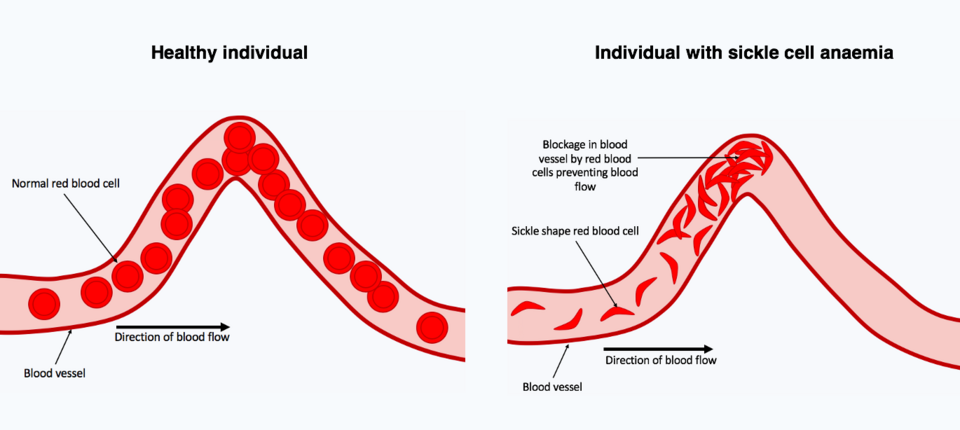
In the ischemic form, blood is trapped inside the erectile chambers. It quickly loses oxygen and becomes acidic, and the penis behaves like a compartment syndrome: the tissue is starved of fresh blood. In sickle cell disease, misshapen red cells that block small vessels are one well-known route to this trapped-blood state.
Source: EAU — Sexual and Reproductive Health Guidelines, chapter 10; Hematology ASH Educ Program 2022 (PMC) — Idris et al. sickle cell review
Priapism is an emergency: what to do right now
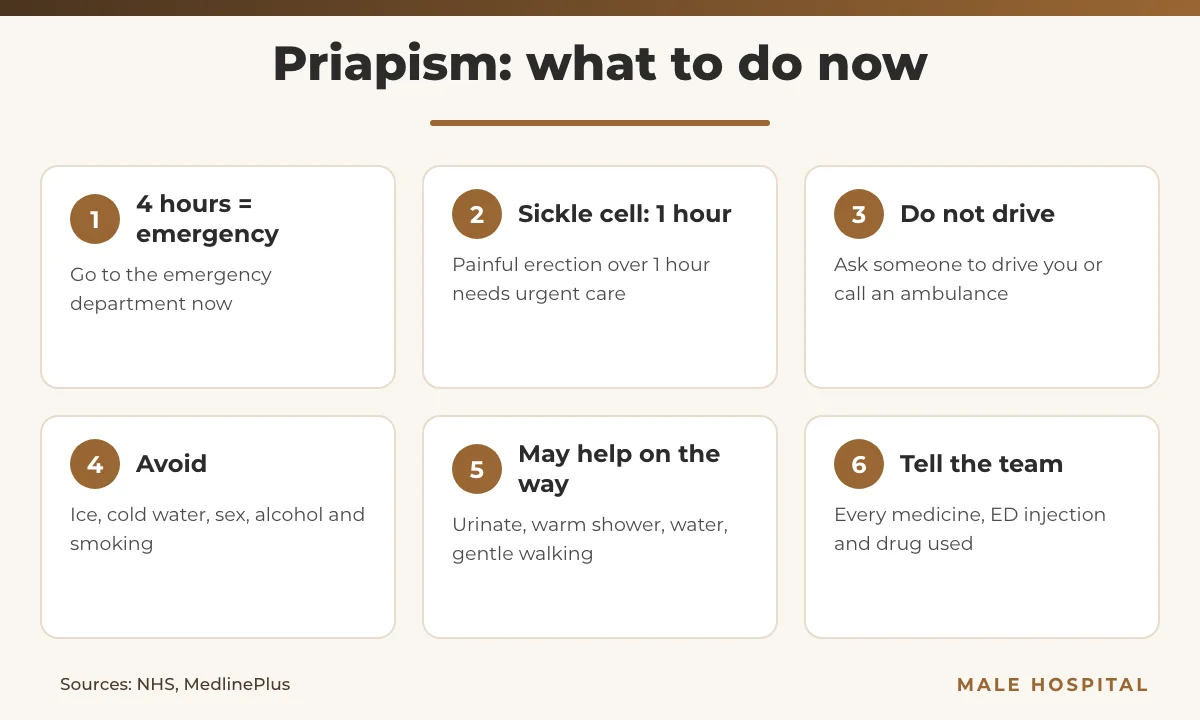
If you are reading this with an erection that will not go down, the most important advice is simple. The NHS says to call emergency services or go to the emergency department if an erection lasts more than 3 to 4 hours, or more than 1 hour if you have sickle cell disease. Ask someone to drive you or call an ambulance; do not drive yourself.
MedlinePlus is just as direct: an erection that does not go away is a medical emergency, and you should get to a hospital emergency room right away. Embarrassment is the main reason men arrive late, and late arrival is the main reason men lose erectile function. Emergency teams see this condition regularly and treat it confidentially.
Source: NHS — Long-lasting erection advice; MedlinePlus — Penis pain
What you can do on the way
The NHS lists a few things that may help while you arrange urgent care, but they never replace it: try to urinate, take a warm bath or shower, drink water, walk gently, and take paracetamol if you need pain relief. Avoid ice or cold water on the penis, sex or masturbation, alcohol and smoking.
- Bring a list of every medicine, supplement and recreational drug you used in the last 48 hours, including any ED pills or injections and their doses.
- Tell staff if you have sickle cell disease, thalassemia, leukemia or take blood thinners.
- Note when the erection started; the time is a key part of the treatment decision.
Source: NHS — Long-lasting erection advice; EAU — Sexual and Reproductive Health Guidelines, chapter 10
Types of priapism: ischemic, non-ischemic and stuttering
The ischemic (low-flow) form accounts for more than 95% of episodes. The shaft is fully rigid and tender, while the glans (head) usually stays soft. It is painful, gets worse over time and needs urgent treatment.
The non-ischemic (high-flow or arterial) form makes up about 5% of cases. It is usually caused by blunt trauma to the perineum or penis that creates a leak from an artery into the erectile tissue, and it can start up to two to three weeks after the injury. The erection is typically painless and not fully rigid. Because the tissue still receives oxygenated blood, the EAU does not classify it as an emergency.
Stuttering, or recurrent, episodes are repeated, painful erections that go down on their own between episodes. This is a recurrent ischemic pattern, and EAU guidelines report it in 42–64% of males with sickle cell disease.
Source: EAU — Sexual and Reproductive Health Guidelines, chapter 10; Cleveland Clinic — Penile Disorders Treatment
| Feature | Ischemic (low-flow) | Non-ischemic (high-flow) | Stuttering |
|---|---|---|---|
| Share of cases | More than 95% | About 5% | Recurrent ischemic form |
| Rigidity and pain | Fully rigid, painful | Partly rigid, usually painless | Painful episodes that subside |
| Typical cause | Drugs, ED injections, sickle cell, unknown | Blunt perineal or penile trauma | Sickle cell disease most often |
| Penile blood gas | Dark, low oxygen, acidic | Bright red, like arterial blood | Ischemic pattern during episodes |
| Urgency | Emergency | Not an emergency, but needs a urologist | Treat each long episode as an emergency |
| First-line treatment | Aspiration plus phenylephrine | Observation, compression, then embolization | Acute care plus prevention plan |
Source: EAU — Sexual and Reproductive Health Guidelines, chapter 10; AUA/SMSNA — Acute ischemic guideline (2021)
What causes priapism?
Many episodes have a clear trigger, but some are idiopathic, meaning no cause is found. The main groups of causes are blood disorders, medicines given for erections, other prescription drugs and recreational drugs.
Sickle cell disease and other blood disorders
Sickle cell disease is the leading cause in children, responsible for 63% of pediatric cases, and the primary cause in 23% of adult cases, according to the EAU. A 2022 review in the American Society of Hematology education program estimates that the ischemic type affects about 33% of adult men with sickle cell disease, and the EAU notes that 90% of affected men have their first episode before age 20. Thalassemia and leukemia can also be responsible, and in rare cases a cancer that spreads to the penis is responsible (3.5% of men in one series of 412 cases).
Source: EAU — Sexual and Reproductive Health Guidelines, chapter 10; Hematology ASH Educ Program 2022 (PMC) — Idris et al. sickle cell review
Penile injections and other ED treatments
Injecting erection drugs directly into the penis is a well-known trigger. The EAU reports ischemic episodes in 0.4–35% of men after intracavernosal injections, with the highest risk from papaverine-based mixtures such as trimix and less than 1% with prostaglandin E1 (alprostadil) alone. This is why the first doses of penile injections for erectile dysfunction are titrated in the clinic.
ED tablets are a much smaller concern. PDE5 inhibitors such as sildenafil and tadalafil accounted for only 2.9% of drug-induced cases in the data summarized by the EAU, and the guideline does not regard them as a risk factor on their own. Still, every label warns about erections lasting more than 4 hours, as discussed in our guide to sildenafil side effects.
Source: EAU — Sexual and Reproductive Health Guidelines, chapter 10
Prescription medicines
Among drug-induced cases reviewed by the EAU, second-generation antipsychotics were the largest group (33.8%), followed by alpha-blockers (8.8%), which are used for blood pressure and prostate symptoms. Antidepressants, especially trazodone, are also listed; MedlinePlus names a prolonged erection as a serious trazodone side effect that needs emergency treatment. The NHS adds blood thinners such as warfarin and some blood pressure medicines.
Source: EAU — Sexual and Reproductive Health Guidelines, chapter 10; MedlinePlus — Trazodone; NHS — Long-lasting erection advice
Recreational drugs and trauma
Cocaine (including crack), cannabis and alcohol are recognized triggers of the ischemic form. Trauma to the perineum, for example a fall astride a bar or a bicycle injury, is the classic cause of the high-flow type. Spinal cord injury and some urological procedures are rarer causes.
Source: F1000Research 2018 (PMC) — Muneer et al. management review; EAU — Sexual and Reproductive Health Guidelines, chapter 10
Why time matters: the 4-hour rule
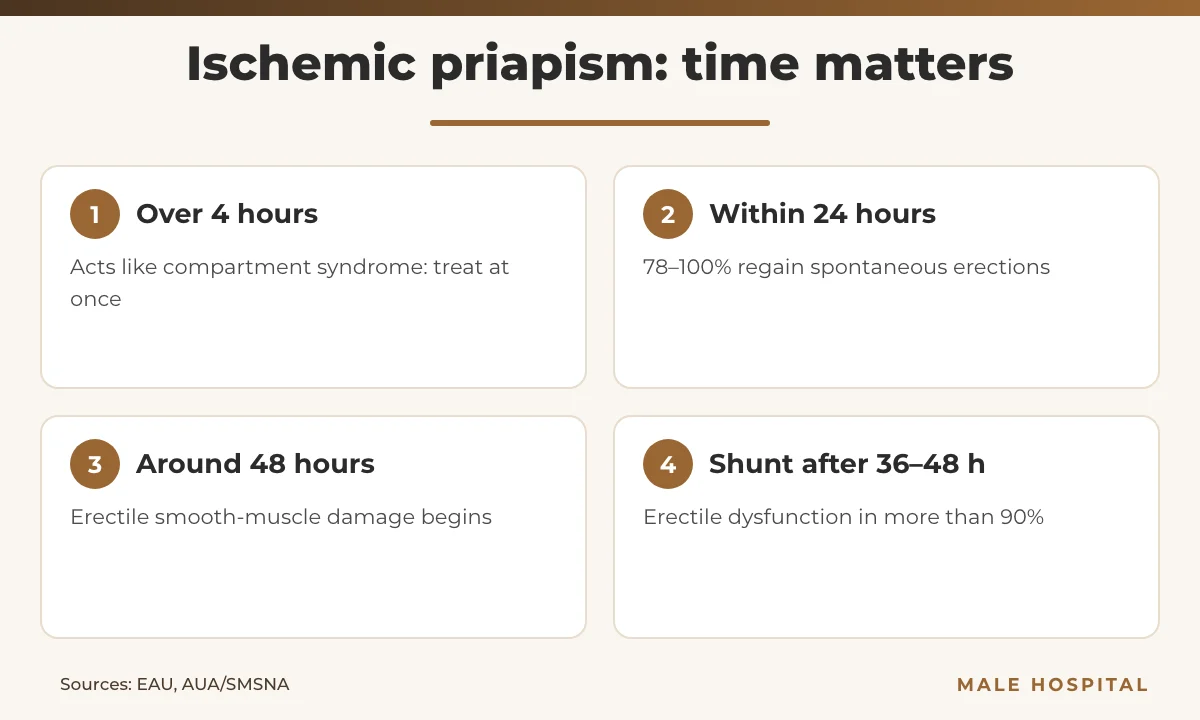
The ischemic form is a race against tissue damage. The EAU states that an episode lasting more than 4 hours behaves like a compartment syndrome and that management should start as early as possible, ideally within four to six hours. The AUA/SMSNA guideline likewise calls a prolonged ischemic episode a medical emergency that can lead to scarring (fibrosis) of the erectile tissue.
The numbers explain the urgency. When an ischemic episode resolves within 24 hours, at least 78% of men regain spontaneous erections in the studies reviewed. Smooth-muscle damage begins around 48 hours, and when shunt surgery is needed after 36–48 hours, more than 90% of men develop erectile dysfunction. One study found the risk of ED rose sharply once an episode passed 20 hours.
Source: EAU — Sexual and Reproductive Health Guidelines, chapter 10; PubMed — Bivalacqua et al. AUA/SMSNA guideline (J Urol 2021)
For men with sickle cell disease, the threshold is lower. The NHS advises urgent care if a painful erection lasts more than 1 hour, and hematology experts recommend involving a urologist early, once an episode passes 3 hours.
Source: NHS — Long-lasting erection advice; Hematology ASH Educ Program 2022 (PMC) — Idris et al.
How priapism is diagnosed in the emergency room
The first goal is to separate the ischemic from the non-ischemic form. The doctor asks how long the erection has lasted, whether it hurts, what medicines or drugs you took, and about any injury or blood disorder. A physical exam checks the rigidity of the shaft and glans, the perineum and the abdomen.
The key test is a penile blood gas. The AUA/SMSNA guideline recommends taking a sample of blood from the erectile tissue at the first presentation. In the ischemic type this blood is dark, with an oxygen level (pO2) below 30 mmHg, carbon dioxide (pCO2) above 60 mmHg and a pH below 7.25. In the high-flow type it is bright red and looks like normal arterial blood.
Blood tests (full blood count and clotting profile) look for blood disorders. A color duplex ultrasound of the penis and perineum shows blood flow and can locate an arterial leak in high-flow cases. MRI is reserved for prolonged or difficult cases to judge whether the erectile muscle is still viable.
Source: EAU — Sexual and Reproductive Health Guidelines, chapter 10; AUA/SMSNA — Acute ischemic guideline (2021)
Emergency priapism treatment (EAU and AUA guidelines)
Ischemic type: a stepwise plan
Treatment starts with a local anesthetic block, then aspiration: a needle (16 or 18 gauge) drains the trapped blood until bright red, oxygenated blood appears. Saline irrigation may be added. Aspiration followed by a vessel-tightening drug resolves 80% or more of episodes in published series, compared with 58% for the drug alone.
The drug of choice is phenylephrine injected into the erectile tissue. The EAU recommends 200 micrograms every 3–5 minutes, up to 1 mg within one hour, with blood pressure and pulse monitored because it can raise blood pressure. When the erection follows an ED injection and has lasted 4 hours or less, the AUA advises phenylephrine as the first treatment. For sickle cell–related episodes, the EAU recommends the same approach as for other ischemic cases and advises against exchange transfusion as the main treatment.
Source: EAU — Sexual and Reproductive Health Guidelines, chapter 10; AUA/SMSNA — Acute ischemic guideline (2021)
If aspiration and injections fail, surgery creates a shunt, a channel that lets trapped blood drain from the erectile chambers into the glans or another route. Both guidelines recommend a distal shunt first (such as the Winter, Ebbehoj, Al-Ghorab or T-shunt), with or without tunneling, because these are less invasive and linked to lower ED rates. Penoscrotal decompression is a newer option the EAU lists as a possible alternative.
Source: AUA/SMSNA — Acute ischemic guideline (2021); F1000Research 2018 (PMC) — Muneer et al.
Non-ischemic type
The high-flow type is managed differently. Aspiration does not help, and some leaks close on their own, so the EAU suggests starting with observation and perineal compression or cold applied by the medical team. If the erection persists, selective arterial embolization, which blocks the leaking branch through a catheter, is the recommended step; reported success after the first procedure is 61.7–83.3%. Cleveland Clinic describes this temporary artery blockage as the best treatment for the arterial form.
Source: EAU — Sexual and Reproductive Health Guidelines, chapter 10; Cleveland Clinic — Penile Disorders Treatment
Stuttering episodes: preventing the next one
Each long episode is treated like an acute ischemic one. For frequent relapses, the EAU lists preventive options including hormonal therapy (not before sexual maturity), low daily doses of PDE5 inhibitors started only when the penis is soft, oral terbutaline, etilefrine, gabapentin and, in selected men, home self-injection of a vessel-tightening drug. The evidence for these is limited, and the 2022 hematology review concludes there is no evidence-based prevention yet.
Source: EAU — Sexual and Reproductive Health Guidelines, chapter 10; Hematology ASH Educ Program 2022 (PMC) — Idris et al.
Priapism and long-term erectile dysfunction
The biggest long-term risk of the ischemic form is permanent erectile dysfunction, caused by fibrosis of the erectile tissue. The AUA/SMSNA guideline asks doctors to counsel every man with a persistent ischemic erection about this risk, and to tell men whose episode lasted more than 36 hours that recovery of natural erections is unlikely. Scarring can also shorten the penis.
The effect reaches beyond a single episode. In men with sickle cell disease, severe ED is about five times more common in those with a history of priapism. After the high-flow type, ED rates after treatment range from 0 to 50% and are highest after surgical ligation of the artery.
Source: AUA/SMSNA — Acute ischemic guideline (2021); Hematology ASH Educ Program 2022 (PMC) — Idris et al.; EAU — Sexual and Reproductive Health Guidelines, chapter 10
Early penile prosthesis after priapism
For men with untreated episodes beyond 36–48 hours or episodes that do not respond to shunts, guidelines allow an early penile prosthesis. Compared with a delayed implant, early placement in EAU data had lower infection (6–7% vs 19–30%) and penile shortening (3% vs 40%) rates and higher satisfaction. The EAU suggests the first three weeks as the best window and advises delaying the implant if a shunt has already been done. Our guide to the inflatable penile prosthesis explains how these devices work.
Source: EAU — Sexual and Reproductive Health Guidelines, chapter 10; PubMed — Bivalacqua et al. AUA/SMSNA guideline (J Urol 2021)
When to see a doctor
Go to the emergency department immediately, without waiting for an appointment, if:
- An erection has lasted 4 hours or more, with or without sexual stimulation.
- You have sickle cell disease and a painful erection has lasted more than 1 hour, or will not go away.
- The erection followed an ED injection, a new medicine or recreational drug use and is not settling.
- The penis is rigid and increasingly painful while the head stays soft.
Book a prompt urology appointment if you have repeated shorter erections that are painful (possible stuttering episodes), a partly rigid, painless erection days or weeks after a groin or perineal injury, or erection problems after a past episode. If a medicine you take may be the cause, do not stop it on your own; ask the prescriber about alternatives.
Source: NHS — Sickle cell disease: symptoms; NHS — Long-lasting erection advice; EAU — Sexual and Reproductive Health Guidelines, chapter 10
If you have erection problems after an episode, or want to review the safety of your current ED treatment, you can arrange a confidential consultation with our urologist-andrologist on WhatsApp. An acute episode, however, always belongs in your nearest emergency department, not in an online chat.
FAQs about priapism
How long is too long for an erection?
Any erection lasting 4 hours or more without ongoing sexual stimulation needs emergency care, and the NHS advises acting at 3 to 4 hours. Men with sickle cell disease should seek urgent help after 1 hour of a painful erection. Do not wait to see if it fades; early treatment protects future erections.
Source: NHS — Long-lasting erection advice
Can priapism go away on its own?
Short stuttering episodes and some high-flow cases can settle without treatment. An established ischemic erection usually does not, and every hour of delay increases the chance of scarring. Home measures such as a warm shower, urinating or gentle walking may help, but only while you are already on the way to emergency care.
Source: EAU — Sexual and Reproductive Health Guidelines, chapter 10; NHS — Long-lasting erection advice
Can Viagra or Cialis cause priapism?
It is possible but uncommon. In data summarized by the EAU, PDE5 inhibitors accounted for only 2.9% of drug-induced cases, and the guideline does not consider them a risk factor on their own. The risk rises when they are combined with injections, other drugs or a blood disorder, so follow the prescribed dose.
Source: EAU — Sexual and Reproductive Health Guidelines, chapter 10
What do doctors do to treat priapism?
For the ischemic type, a doctor numbs the penis, drains the trapped blood with a needle and injects phenylephrine to tighten the blood vessels, repeating doses if needed while monitoring blood pressure. If that fails, a urologist performs a small shunt operation so blood can drain. The high-flow type may instead need embolization of the leaking artery.
Source: AUA/SMSNA — Acute ischemic guideline (2021); Cleveland Clinic — Penile Disorders Treatment
Will I have erectile dysfunction after priapism?
It depends mainly on how long the episode lasted. When an ischemic episode resolves within 24 hours, at least 78% of men regain spontaneous erections in EAU data. After 36 hours, recovery of natural erections is unlikely, and a penile implant may be the most reliable way to restore sexual function.
Source: EAU — Sexual and Reproductive Health Guidelines, chapter 10; PubMed — Bivalacqua et al. (J Urol 2021)
Should I put ice on a long-lasting erection?
No, not at home. The NHS advises avoiding ice or cold water and suggests a warm bath or shower, drinking water and gentle walking while you arrange urgent care. In hospital, doctors may use targeted perineal compression or cold for the high-flow type, but that decision belongs to the treating team.
Source: NHS — Long-lasting erection advice; EAU — Sexual and Reproductive Health Guidelines, chapter 10
Why is sickle cell disease linked to priapism?
Sickled red blood cells can block small vessels and trap blood in the erectile tissue. About a third of adult men with sickle cell disease experience ischemic episodes, often starting in the teenage years, and recurrent stuttering episodes are common. Men with sickle cell disease should treat a painful erection lasting over an hour as urgent.
Source: Hematology ASH Educ Program 2022 (PMC) — Idris et al.; NHS — Sickle cell disease: symptoms
Is high-flow priapism dangerous?
The high-flow type is not considered an emergency because the erectile tissue still receives oxygen, so it does not cause the rapid damage of the ischemic type. It still needs a urologist’s assessment. Many cases are observed first, and embolization is used if the arterial leak does not close on its own.
Source: EAU — Sexual and Reproductive Health Guidelines, chapter 10; F1000Research 2018 (PMC) — Muneer et al.
Medically reviewed by Assoc. Prof. Dr. Zülfü Sertkaya, urologist and andrologist (FEBU), Istanbul. Last reviewed: November 2026.
This article is for general information and does not replace an individual consultation with a qualified doctor.
- EAU — Sexual and Reproductive Health Guidelines — Priapism
- AUA/SMSNA — Acute Ischemic Priapism: an AUA/SMSNA Guideline
- PubMed — J Urol 2021 — Bivalacqua et al. Acute Ischemic Priapism: An AUA/SMSNA Guideline
- NHS — Priapism
- NHS — Sickle cell disease — Symptoms
- MedlinePlus — Penis pain
- MedlinePlus — Trazodone
- Cleveland Clinic — Penile Disorders Treatment
- Hematology ASH Educ Program 2022 (PMC) — Idris, Burnett, DeBaun. Epidemiology and treatment of priapism in sickle cell disease
- F1000Research 2018 (PMC) — Muneer, Alnajjar, Ralph. Recent advances in the management of priapism