An inflatable penile prosthesis is a fluid-filled implant that lets a man with erectile dysfunction (ED) create a firm erection on demand by squeezing a small pump hidden in the scrotum, and then return the penis to a soft state afterwards. It comes in two designs: the 3-piece device, which adds a separate fluid reservoir in the lower abdomen and is the most widely used, and the simpler 2-piece device, which has no separate reservoir. For the operation itself, recovery and the alternative semi-rigid implant, see our main penile prosthesis (penile implant) surgery page; this guide focuses on how the two inflatable designs differ and who suits which.
Sources: Cleveland Clinic — Penile implants; EAU Guidelines — Management of erectile dysfunction
- A 3-piece inflatable penile prosthesis has two cylinders, a scrotal pump and a separate reservoir; a 2-piece device has only cylinders and a pump.
- The 3-piece design is the most common and is generally considered to give the most natural erection and the best rigidity.
- The 2-piece device needs fewer pumps (about 3–6 versus 10–14) and avoids placing a reservoir in the abdomen, which helps men with limited hand strength or extensive pelvic surgery or scarring.
- European guidelines report no head-to-head proof that one manufacturer or device type is better; the right choice depends on your anatomy, history and hands.
- Satisfaction with penile implants is among the highest of all ED treatments, at 92 to 100 percent of patients in published series.
What is an inflatable penile prosthesis?
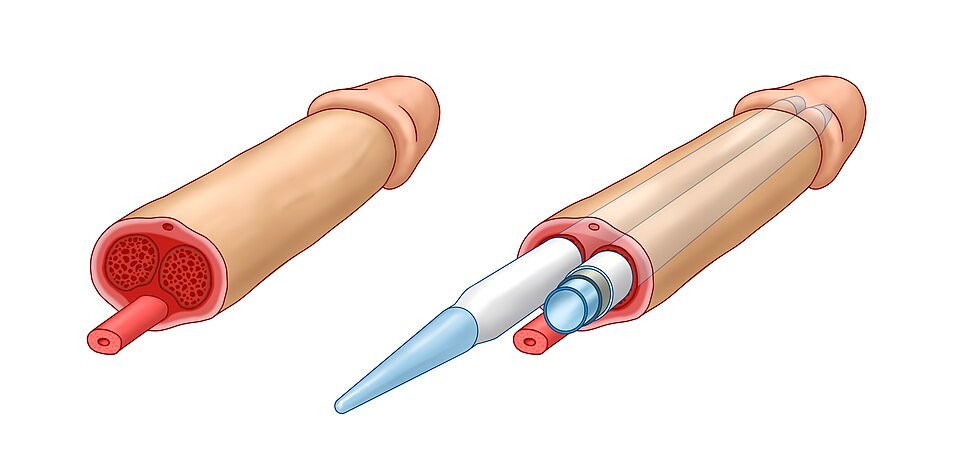
The penis contains two parallel spongy chambers, the corpora cavernosa, that normally fill with blood during an erection. In implant surgery, the surgeon places a soft, expandable cylinder inside each chamber. In an inflatable penile prosthesis, these cylinders fill with fluid when you pump and empty when you release, so the penis can look and feel relaxed most of the time and become rigid only when you want it to.
Penile implants are generally offered to men whose ED has not improved with tablets, injections or other conservative treatments, or who prefer a permanent solution. Men with Peyronie’s disease and ED are also common candidates. European Association of Urology (EAU) guidelines give a strong recommendation to implant a penile prosthesis if other treatments fail or based on patient preference, after full counselling about benefits and harms.
Sources: Cleveland Clinic — Penile implants; EAU Guidelines — Management of erectile dysfunction
Implants fall into two broad classes. An inflatable penile prosthesis comes in 2-piece and 3-piece versions. Semi-rigid (malleable) devices are bendable rods that stay firm all the time and are positioned by hand. Malleable implants have a simpler surgical technique and can suit men with limited manual dexterity, but they give a permanently firm penis that is harder to conceal.
Sources: EAU Guidelines — Management of erectile dysfunction; PMC (Asian J Androl) — Akula & Raheem, Fundamentals of prosthetic urology (2019)
How the pump of an inflatable penile prosthesis works
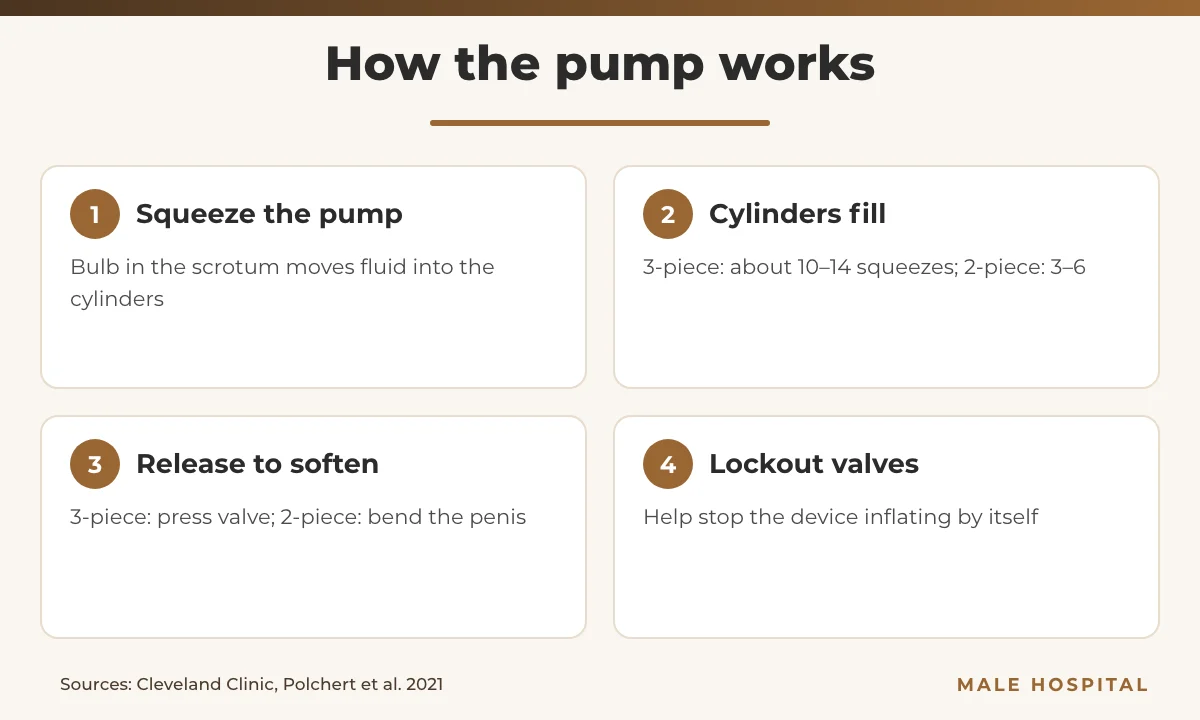
Every inflatable penile prosthesis is a closed hydraulic system: no part of it is outside the body, and nothing needs charging. The pump is a small bulb placed under the loose skin of the scrotum, between the testicles, where it can be felt and squeezed through the skin.
Inflation
To get an erection with an inflatable penile prosthesis, you squeeze the pump repeatedly with your fingers. Each squeeze moves fluid into the cylinders, which lengthen and widen inside the erection chambers until the penis is firm. A 3-piece device takes roughly 10–14 squeezes to harden; the 2-piece Ambicor needs only about 3–6.
Deflation
To go soft again, the fluid has to leave the cylinders. In a 3-piece device you press a release valve on the pump, and the fluid flows back into the reservoir. Newer pump designs have made this easier: one pump design was reported to allow full deflation in 2–4 seconds, and another has touch pads that can be felt and pressed with one hand. In the 2-piece Ambicor there is no button; you deflate it by bending the penis downward, which opens a time-pressure valve.
Sources: Cleveland Clinic — Penile implants; PMC (Transl Androl Urol) — Polchert et al., Narrative review of penile prosthetic implant technology (2021)
Preventing unwanted inflation
In early 3-piece designs, pressure on the abdomen could push fluid from the reservoir into the cylinders, causing a partial erection without pumping (auto-inflation). A modern inflatable penile prosthesis includes lockout valves to stop this. One study of a reservoir with a lockout valve reported auto-inflation falling from 11% with the older design to 1.3% with the newer one.
Sources: PMC (Transl Androl Urol) — Polchert et al., Narrative review of penile prosthetic implant technology (2021); PMC (Asian J Androl) — Akula & Raheem, Fundamentals of prosthetic urology (2019)
You do not use the pump straight after surgery. Your surgeon teaches you how to inflate and deflate at a follow-up visit once healing allows; our guide to penile implant recovery covers that timeline step by step.
The 3-piece inflatable penile prosthesis
The 3-piece inflatable penile prosthesis has three connected parts: two cylinders in the penis, a pump in the scrotum and a fluid reservoir placed under the lower abdominal muscles. Tubing joins all three. Because the reservoir holds the fluid away from the penis when the device is deflated, the cylinders can empty well, and many experts regard the 3-piece design as the closest match to a natural erection. It is the most commonly implanted type in the United States and is valued for its rigidity.
Sources: Cleveland Clinic — Penile implants; PMC (Asian J Androl) — Akula & Raheem, Fundamentals of prosthetic urology (2019); PMC (Transl Androl Urol) — Polchert et al., Narrative review of penile prosthetic implant technology (2021)
Where the reservoir goes
Traditionally, the reservoir is placed in the space of Retzius, a gap behind the pubic bone and in front of the bladder. This placement is done without direct vision, so there is a small risk of injury to the bowel, bladder or blood vessels, and it can be difficult or risky after previous pelvic surgery or radiation. Alternative (ectopic) sites are now more widely accepted, such as a high submuscular position in the abdominal wall, and the US Food and Drug Administration (FDA) has approved submuscular reservoir placement. Manufacturers have also designed flatter, low-profile reservoirs, because some men are bothered by being able to feel the reservoir.
Sources: PMC (Transl Androl Urol) — Polchert et al., Narrative review of penile prosthetic implant technology (2021); PMC (Asian J Androl) — Akula & Raheem, Fundamentals of prosthetic urology (2019); PubMed (Sex Med Rev) — Dinerman et al., New advancements in inflatable implants (2021)
The 2-piece inflatable penile prosthesis
A 2-piece inflatable penile prosthesis consists only of the two cylinders and the scrotal pump, with no separate reservoir in the abdomen. The best-known example, the AMS Ambicor, is described in the literature as the only 2-piece inflatable implant available in the United States. Two-piece devices make up fewer than 5% of implanted penile prostheses.
The main attractions are simplicity and avoiding the reservoir. Inflation takes fewer squeezes and deflation is done by bending the penis, which reviews describe as easier for older men or men with reduced sensation or hand strength. Its rigidity is considered less robust than that of a 3-piece device, although reported satisfaction is comparable. A 2018 review found overall complication rates of 2.1% to 9.5% and patient satisfaction of 75% to 96.4%, while noting that published data are limited and follow-up is short.
Sources: PubMed (J Sex Med) — Abdelsayed & Levine, Ambicor 2-piece device: who and how? (2018); PMC (Asian J Androl) — Akula & Raheem, Fundamentals of prosthetic urology (2019); PMC (Transl Androl Urol) — Polchert et al., Narrative review of penile prosthetic implant technology (2021)
The same review lists significant penile deformity, a long narrow penis or a short penis as relative contraindications, and another review advises against the 2-piece design in men with pre-existing Peyronie’s disease. If curvature is part of your problem, our Peyronie’s disease treatment page explains how this is assessed before choosing a device.
Sources: PubMed (J Sex Med) — Abdelsayed & Levine, Ambicor 2-piece device: who and how? (2018); PMC (Transl Androl Urol) — Polchert et al., Narrative review of penile prosthetic implant technology (2021)
3-piece vs 2-piece inflatable penile prosthesis: side-by-side comparison
The table below summarizes the practical differences. Note that EAU guidelines state that no prospective randomized trials have compared satisfaction between the two inflatable designs, so these points come from device design and observational studies.
| Feature | 3-piece inflatable | 2-piece inflatable |
|---|---|---|
| Components | 2 cylinders + scrotal pump + abdominal reservoir | 2 cylinders + scrotal pump |
| Squeezes to inflate | About 10–14 | About 3–6 |
| How to deflate | Press the release valve on the pump | Bend the penis downward |
| Rigidity | Considered optimal | Less robust |
| Reservoir surgery | Needed (Retzius or ectopic site) | Not needed |
| Share of implants | Most common type | Fewer than 5% |
| Reported satisfaction | High; implants overall 92 to 100 percent | 75%–96.4% in a 2018 review |
Sources: EAU Guidelines — Management of erectile dysfunction; PMC (Asian J Androl) — Akula & Raheem, Fundamentals of prosthetic urology (2019); PMC (Transl Androl Urol) — Polchert et al., Narrative review of penile prosthetic implant technology (2021); PubMed (J Sex Med) — Abdelsayed & Levine, Ambicor 2-piece device: who and how? (2018)
Pros and cons at a glance
| Device | Pros | Cons |
|---|---|---|
| 3-piece inflatable | Most natural-looking erection; best rigidity; widest choice of cylinders and reservoirs; lockout valves limit auto-inflation | Needs reservoir placement; more squeezes and some finger dexterity; reservoir can sometimes be felt |
| 2-piece inflatable | No abdominal reservoir; fewer squeezes; simple bend-to-deflate; useful after major pelvic surgery | Less rigid; fewer size options; not advised with significant deformity or Peyronie’s; limited long-term data |
| Semi-rigid (for comparison) | Simplest surgery and use; no pump; suits limited dexterity | Permanently firm; harder to conceal; less natural |
Sources: EAU Guidelines — Management of erectile dysfunction; PMC (Transl Androl Urol) — Polchert et al., Narrative review of penile prosthetic implant technology (2021); PubMed (J Sex Med) — Abdelsayed & Levine, Ambicor 2-piece device: who and how? (2018)
Which inflatable penile prosthesis suits you?
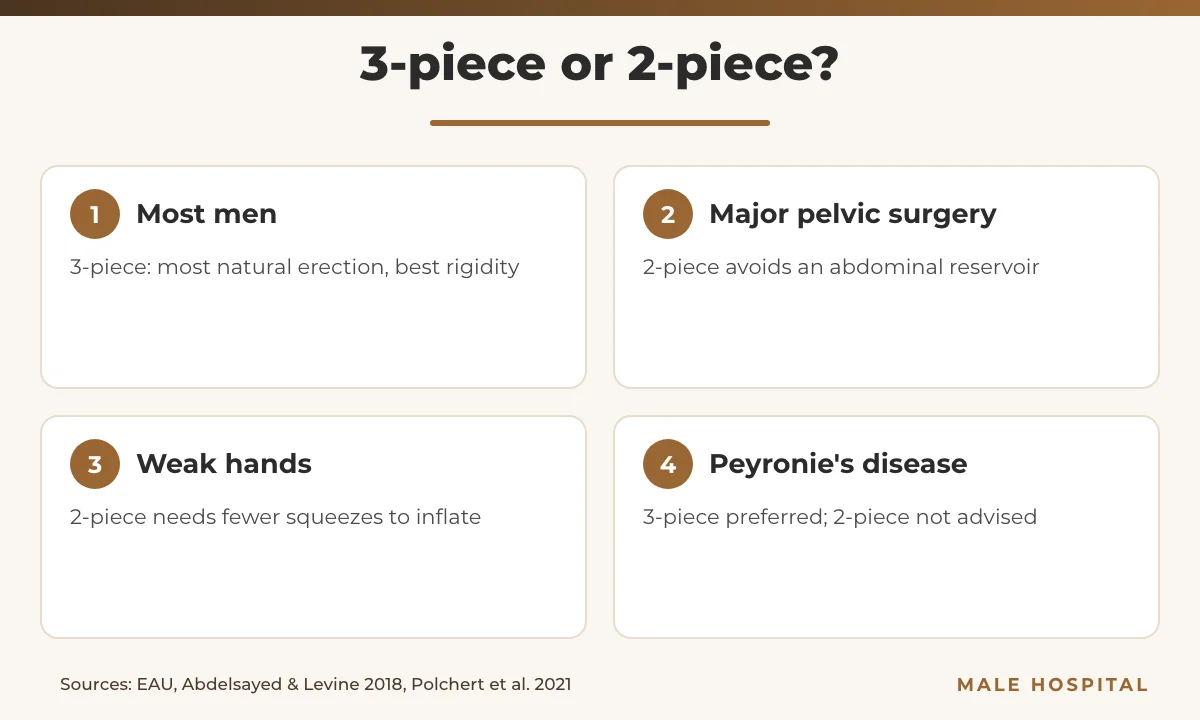
For most men without special risk factors, surgeons recommend a 3-piece inflatable penile prosthesis because it offers the most natural erection and best rigidity. EAU guidelines note that the 3-piece design may be preferred for this reason, while a 2-piece device may be suggested for men at high risk of complications from reservoir placement, such as those with previous abdominal surgery.
Sources: EAU Guidelines — Management of erectile dysfunction; PMC (Asian J Androl) — Akula & Raheem, Fundamentals of prosthetic urology (2019)
Situations where a 2-piece device is often considered
- Extensive previous abdominal or pelvic surgery, or scarring behind the pubic bone, which makes reservoir placement difficult.
- A current or planned pelvic organ transplant.
- Reduced manual dexterity, hand strength or motor control, for example in some men with diabetes, where 10–14 firm squeezes are hard.
- Older men with poor sensation who benefit from simpler inflation and deflation.
Sources: PubMed (J Sex Med) — Abdelsayed & Levine, Ambicor 2-piece device: who and how? (2018); PMC (Transl Androl Urol) — Polchert et al., Narrative review of penile prosthetic implant technology (2021); PMC (Asian J Androl) — Akula & Raheem, Fundamentals of prosthetic urology (2019)
Situations that favor a 3-piece device
- Peyronie’s disease or other significant curvature, where the 2-piece design is not advised.
- A very long or narrow penis, or a short penis, where 2-piece sizing is a relative contraindication.
- Men who want the firmest, most natural-feeling erection and can work the pump comfortably.
Sources: PubMed (J Sex Med) — Abdelsayed & Levine, Ambicor 2-piece device: who and how? (2018); PMC (Transl Androl Urol) — Polchert et al., Narrative review of penile prosthetic implant technology (2021)
When neither type of inflatable penile prosthesis suits, for example with very poor hand function, a malleable implant remains an option. Concerns about length are common to all designs; our article on penile implant size explains what studies show about length and girth after surgery.
Source: EAU Guidelines — Management of erectile dysfunction
Inflatable penile prosthesis models: device examples
The examples below are the inflatable penile prosthesis models most widely described in the medical literature. They are taken from manufacturer pages and peer-reviewed reviews; availability differs by country, and your surgeon chooses the model and size during planning and surgery. EAU guidelines state that no head-to-head studies show any manufacturer’s device to be superior.
Source: EAU Guidelines — Management of erectile dysfunction
Boston Scientific AMS 700 (3-piece)
The AMS 700 is Boston Scientific’s 3-piece inflatable penile prosthesis line. Its cylinder options include the LGX, designed for length and girth expansion with up to 20% elongation depending on anatomy; the CX, with controlled expansion that mainly optimizes girth and comes in additional lengths; and the CXR for men who need smaller cylinders. It uses the MS pump and offers spherical reservoirs (65 ml and 100 ml) or a flat Conceal reservoir (100 ml). InhibiZone versions carry an antibiotic surface treatment of minocycline and rifampin.
Sources: Boston Scientific — AMS 700 product page; PMC (Transl Androl Urol) — Polchert et al., Narrative review of penile prosthetic implant technology (2021)
Boston Scientific AMS Ambicor (2-piece)
The Ambicor is the 2-piece inflatable penile prosthesis described above: cylinders and a scrotal pump, inflated with a few squeezes and deflated by bending the penis. Most published data on it are limited and have short follow-up, so long-term comparisons with 3-piece devices are scarce.
Sources: PubMed (J Sex Med) — Abdelsayed & Levine, Ambicor 2-piece device: who and how? (2018); PMC (Transl Androl Urol) — Polchert et al., Narrative review of penile prosthetic implant technology (2021)
Coloplast Titan (3-piece)
The Titan family is Coloplast’s 3-piece inflatable penile prosthesis line. Its reservoir includes a Lock-out Valve to prevent auto-inflation, the One Touch Release (OTR) pump has touch pads designed for one-handed deflation, and its hydrophilic coating reduces bacterial adherence and absorbs a water-based antibiotic solution chosen by the surgeon. In June 2026 Coloplast announced FDA approval of a next-generation model, Titan Prime, made from a polymer called Bioflex; the company says it keeps the rigidity and girth of the current Titan while improving flaccid flexibility, with a phased US launch from late 2026 and approvals still pending in other countries.
Sources: PMC (Transl Androl Urol) — Polchert et al., Narrative review of penile prosthetic implant technology (2021); Coloplast — Titan Prime FDA approval (2026)
Other recent design changes
A 2021 review of new technology lists flatter reservoirs, adjusted tubing length, one-touch deflation, narrower-base cylinders and softer cylinder tips among the main improvements of the past decade. For comparison, Boston Scientific’s current malleable option is the Tactra.
Sources: PubMed (Sex Med Rev) — Dinerman et al., New advancements in inflatable implants (2021); Boston Scientific — Penile prosthesis products
Satisfaction, infection and durability
Penile implants have some of the highest satisfaction rates of any ED treatment: 92 to 100 percent for patients and 91–95% for partners when men are properly counselled. Cleveland Clinic similarly reports that over 90% of people with a penile implant are happy with the results.
Sources: EAU Guidelines — Management of erectile dysfunction; Cleveland Clinic — Penile implants
Infection is the most serious risk. With careful technique and preventive antibiotics, infection after a first implant in low-risk men at high-volume centers is about 2–3%, and antibiotic-impregnated or hydrophilic-coated devices may lower this to 1–2%. Diabetes, low testosterone and spinal cord injury raise the risk. Other uncommon problems include bleeding, scar tissue, erosion, pump or reservoir displacement and mechanical failure; see our article on penile implant complications for detail.
Sources: EAU Guidelines — Management of erectile dysfunction; Cleveland Clinic — Penile implants
An inflatable penile prosthesis is mechanical and can eventually wear out. Modified 3-piece devices have shown mechanical failure rates below 5% at five years. A meta-analysis cited by the EAU reported overall implant survival of 87.2% at 5 years, 76.8% at 10 years and 52.9% at 20 years. A failed device can usually be replaced in a revision operation.
Sources: EAU Guidelines — Management of erectile dysfunction; Cleveland Clinic — Penile implants
When to see a doctor
If you are considering an implant, see a urologist when ED persists despite tablets, injections or a vacuum erection device, or when Peyronie’s disease and ED occur together. If you already have an inflatable penile prosthesis, contact your surgeon promptly if you notice:
- Fever, increasing pain, redness, warmth, swelling or discharge around the penis, scrotum or wound, which can signal infection.
- Any part of the device showing through or pressing against the skin (erosion).
- A pump that has moved, cannot be found, or will not inflate or deflate.
- An erection that will not go down after using the release mechanism, or the device inflating by itself.
- Difficulty passing urine, blood in the urine, or a cold, dark or numb glans.
Sources: Cleveland Clinic — Penile implants; EAU Guidelines — Management of erectile dysfunction
If you would like to discuss whether a 3-piece or 2-piece device fits your situation, you can arrange a confidential consultation with Assoc. Prof. Dr. Zülfü Sertkaya, a urologist-andrologist who focuses on penile prosthesis surgery, by WhatsApp. Pricing depends on the assessment and the device chosen, and is explained during the free consultation.
FAQs about the inflatable penile prosthesis
Is a 3-piece or 2-piece penile implant better?
Neither is better for everyone. The 3-piece inflatable penile prosthesis is more common and usually gives a firmer, more natural erection, so most men without special risk factors receive it. The 2-piece device avoids an abdominal reservoir and is easier to pump, which can suit men with extensive pelvic surgery or weak hands. No randomized trial has compared their satisfaction directly.
Sources: EAU Guidelines — Management of erectile dysfunction; PubMed (J Sex Med) — Abdelsayed & Levine, Ambicor 2-piece device: who and how? (2018)
How many times do you pump an inflatable penile prosthesis?
A 3-piece inflatable penile prosthesis typically needs about 10 to 14 squeezes of the scrotal pump to become fully rigid, while the 2-piece Ambicor needs only about 3 to 6. The exact number varies with the device and cylinder size. Your surgeon or nurse will show you the technique at the activation visit and check that you can inflate and deflate comfortably.
Can other people see or feel the pump?
The pump sits under the skin of the scrotum, between the testicles, so it is not visible when you are dressed, and a partner may only notice it on close touch. The reservoir of a 3-piece inflatable penile prosthesis lies under the abdominal muscles; some men can feel it, which is why manufacturers developed flatter, low-profile reservoirs and alternative placement sites.
Sources: Cleveland Clinic — Penile implants; PMC (Transl Androl Urol) — Polchert et al., Narrative review of penile prosthetic implant technology (2021)
Does an inflatable penile prosthesis inflate by itself?
Unwanted inflation was a known problem with older 3-piece designs, when pressure on the reservoir pushed fluid into the cylinders. Modern reservoirs and pumps include lockout valves, and one study reported auto-inflation dropping from 11% to 1.3% with the newer design. If it happens, deflate the inflatable penile prosthesis and tell your surgeon.
How long does an inflatable penile prosthesis last?
Many devices last for years, but they are mechanical and can fail. A meta-analysis cited in the EAU guidelines found that about 87% of implants were still working at 5 years, 77% at 10 years and 53% at 20 years. When an inflatable penile prosthesis fails, it can usually be replaced through a revision operation.
Sources: EAU Guidelines — Management of erectile dysfunction; Cleveland Clinic — Penile implants
Will an inflatable penile prosthesis change sensation or orgasm?
According to Cleveland Clinic, an implant does not change the sensation on the skin of the penis or your ability to orgasm and ejaculate, and most men report that sex feels the same or better. It can take a few weeks or months to get used to the feeling of the implant. What changes is how you get the erection: you pump rather than rely on blood flow.
Source: Cleveland Clinic — Penile implants
Is the Ambicor still available?
Published reviews describe the AMS Ambicor as the only 2-piece inflatable penile prosthesis available in the United States, and it remains in clinical use. Availability of specific models can differ between countries and change over time, so ask your surgeon which devices they can offer and why they recommend one for you.
Source: PubMed (J Sex Med) — Abdelsayed & Levine, Ambicor 2-piece device: who and how? (2018)
Who should not get an inflatable penile prosthesis?
Surgery should not go ahead while you have any active infection, including a skin or urinary infection, and your doctor will check that you can empty your bladder without severe urinary problems. Men with diabetes, low testosterone or spinal cord injury carry a higher infection risk, so blood sugar and other conditions should be optimized first. Men who cannot operate any pump may be better suited to a malleable implant.
Sources: EAU Guidelines — Management of erectile dysfunction; Cleveland Clinic — Penile implants
Medically reviewed by Assoc. Prof. Dr. Zülfü Sertkaya, urologist and andrologist (FEBU), Istanbul. Last reviewed: November 2026.
This article is for general information and does not replace an individual consultation with a qualified doctor.
- EAU Guidelines — Management of erectile dysfunction
- Cleveland Clinic — Penile implants
- PMC (Asian J Androl) — Akula & Raheem, Fundamentals of prosthetic urology (2019)
- PMC (Transl Androl Urol) — Polchert et al., Narrative review of penile prosthetic implant technology (2021)
- PubMed (J Sex Med) — Abdelsayed & Levine, Ambicor 2-piece inflatable penile prosthesis: who and how? (2018)
- PubMed (Sex Med Rev) — Dinerman et al., New advancements in inflatable penile prosthesis (2021)
- Boston Scientific — AMS 700 inflatable penile prosthesis
- Boston Scientific — Penile prosthesis products
- Coloplast — Titan Prime inflatable penile prosthesis approved by the FDA (2026)