A penis extender (penile traction device) is a frame that holds the penis under gentle, steady stretch for hours a day. Small studies show average gains of about 1 to 2 cm in flaccid and stretched length after 3 to 6 months of daily wear, with no gain in girth. It is the only non-surgical enlargement method that European guidelines say may be considered, and it can also reduce curvature in some men with Peyronie’s disease. If you are weighing all your options, our penis enlargement page compares traction with fillers and surgery.
Source: EAU Guidelines — Penile size abnormalities and dysmorphophobia; EAU Guidelines — Penile curvature
- In the main studies, men wore a penis extender 4 to 9 hours a day for 3 to 6 months and gained roughly 1.2 to 2.3 cm in length; erect length rose by about 1.2 cm in the one study that measured it.
- Traction does not make the penis thicker, and the evidence comes from small studies without a control group.
- The EAU gives a weak recommendation to consider traction for length; the ISSM says no non-surgical method has proven scientific support for enlargement.
- In Peyronie’s disease, traction can reduce curvature in some men, but the AUA (2015) found the evidence insufficient for a recommendation and a 2023 Cochrane review rated it very low certainty.
- Side effects are usually mild and short-lived: discomfort, redness, bruising, itching and changes in glans sensation.
- What is a penis extender and how does it work?
- Does a penis extender work for length? The evidence
- Penis extender for Peyronie’s disease and curvature
- Traction after Peyronie’s treatment or prostate surgery
- How long do you need to wear a penis extender?
- Penis extender side effects and risks
- Realistic expectations from a penis extender
- Who should and should not consider traction
- When to see a doctor
- FAQs about penis extenders
What is a penis extender and how does it work?
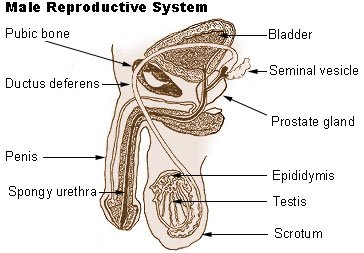
The classic penis extender has a plastic support ring that sits at the base of the penis, a distal ring or strap that holds the shaft just below the head (glans), and two parallel rods between them. The rods are lengthened step by step with a spring mechanism, so the penis is held in a constant, gentle stretch. Newer designs differ: one uses a vacuum cup over the whole glans to spread the pulling force, and some can be worn with a belt under clothing.
Doctors call this penile traction therapy (PTT). A penis extender is used on the soft (flaccid) penis, not during an erection, and the pulling force is increased gradually over weeks.
Source: Ther Adv Urol (PMC) — Valenzuela et al., Penile traction therapy in Peyronie’s disease: current evidence and future prospects (2019); Curr Urol (PMC) — Chen et al., Penile enhancement: a comprehensive and current perspective (2025)
Why stretching might change tissue
The idea comes from other areas of medicine where slow, sustained tension remodels tissue. In laboratory studies, cells from Peyronie’s plaques responded to mechanical force by changing their connective tissue structure and remodeling collagen, and in Dupuytren’s tissue (a similar scarring condition of the hand) collagen fibers lined up in the direction of the strain. For Peyronie’s disease, the EAU notes that traction may remodel collagen by reducing myofibroblast activity. These are plausible mechanisms, but they do not prove that a healthy penis grows in a lasting way.
Source: Ther Adv Urol (PMC) — Valenzuela et al. (2019); EAU Guidelines — Penile curvature
Does a penis extender work for length? The evidence
Three small prospective studies form most of the evidence that guidelines rely on. None of them had a control group of men who did not use a penis extender, so part of the change could reflect measurement differences or expectations. Still, all three reported measurable length gains.
In an Italian phase II study, men with a “short penis” were asked to wear a penis extender for at least 4 hours a day for 6 months. Average gains were 2.3 cm in flaccid length and 1.7 cm in stretched length; girth did not change significantly.
Source: PubMed — Gontero et al., Penile-extender device in the treatment of “short penis” (BJU Int 2009)
In an Iranian study of 23 men, the penis extender was worn 4 to 6 hours a day for the first two weeks, then 9 hours a day until the end of month three. Mean flaccid length rose from 8.8 cm to 10.5 cm and stretched length from 11.5 cm to 13.2 cm. The circumference of the shaft did not increase.
The third study offered counseling to 163 men worried about their size; 54 then chose to use a penis extender for 4 to 6 hours a day for 6 months. They gained an average of 1.7 cm flaccid, 1.3 cm stretched and 1.2 cm erect length, and the gains held during a 3-month period off the device. Girth did not change, and satisfaction was described as modest.
| Study | Daily wear and duration | Average length gain | Girth |
|---|---|---|---|
| Gontero et al., 2009 | At least 4 h/day for 6 months | +2.3 cm flaccid, +1.7 cm stretched | No significant change |
| Nikoobakht et al., 2011 (23 men) | 4–6 h/day, then 9 h/day, for 3 months | +1.7 cm flaccid, +1.7 cm stretched | No increase in shaft girth |
| Nowroozi et al., 2015 (54 men) | 4–6 h/day for 6 months | +1.7 cm flaccid, +1.3 cm stretched, +1.2 cm erect | No effect |
Source: EAU Guidelines — Penile size abnormalities and dysmorphophobia
What the guidelines conclude
The European Association of Urology (EAU) says traction seems to lengthen the penis in the flaccid and stretched state, is not effective for girth, and that the quality of evidence is poor because there are no randomized trials. Its recommendation is weak: consider traction as a conservative treatment to increase length. The International Society for Sexual Medicine (ISSM) lists traction devices among products marketed for enlargement and states that no non-surgical method has scientific evidence behind it.
A review from Turin, the group behind one of the studies above, called extenders the only evidence-based way to lengthen the penis without surgery. Both views fit the same data: the gains are real enough to measure but small, and they come from limited studies.
Source: EAU Guidelines — Penile size abnormalities and dysmorphophobia; ISSM — Can a man make his penis larger?; PubMed — Oderda and Gontero, Non-invasive methods of penile lengthening: fact or fiction? (BJU Int 2011)
Penis extender for Peyronie’s disease and curvature
Peyronie’s disease is scar tissue (plaque) in the tunica albuginea, the tough sheath around the erection chambers, which can bend, shorten or narrow the erect penis. This is where traction has been studied most, and where the goals are different: less curvature and recovery of lost length rather than enlargement of a normal penis.
Acute (active) phase
In a Spanish study, 55 men in the early, painful phase used a penis extender for 6 months and were compared with 41 men who had no treatment. In the traction group, curvature fell from an average of 33° to 15° at 6 months, pain scores dropped from 5.5 to 2.5 out of 10, and erections improved. In the untreated group, curvature got worse and stretched length decreased. The authors also reported that 40% of men who would otherwise have been surgical candidates no longer needed surgery.
Stable (chronic) phase
Results in stable disease are mixed. An early Italian study of men with stable curves of up to 50° found only a small, non-significant change (31° to 27°), although stretched length rose by 1.3 cm. A later multicenter study of 93 men with curves of at least 45° reported a mean reduction of 31.2° after 12 weeks with 3 to 8 hours of daily wear, and a mean stretched length gain of 1.8 cm. Men who wore the penis extender more than 6 hours a day improved more than those who wore it under 4 hours.
Source: PubMed — Gontero et al., Penile extender in penile curvature from Peyronie’s disease (J Sex Med 2009); PubMed — Moncada et al., Penimaster PRO in stable Peyronie’s disease (BJU Int 2019)
The only randomized trial with a newer penis extender (RestoreX, developed in cooperation with Mayo Clinic, where the trial was run) assigned 110 men to 30 to 90 minutes of traction a day or no treatment for 3 months. Traction users gained 1.5 cm of length versus 0 cm in controls and improved curvature by 11.7° versus a 1.3° worsening.
How the guidelines rate traction for Peyronie’s
The EAU gives a weak recommendation to offer traction devices to reduce penile deformity, alone or with other treatments, and cites a meta-analysis showing about 15° of improvement. The AUA guideline (2015) judged three observational studies of traction insufficient for a recommendation. A 2023 meta-analysis of five studies (419 men) found a significant effect on curvature but not on length, and a Cochrane review rated the traction evidence as very low certainty. The UK NHS says devices may help but must be used every day for several months.
Source: EAU Guidelines — Penile curvature; AUA — Peyronie’s Disease Guideline (2015); PubMed — Almsaoud et al., Penile traction device in Peyronie’s disease: systematic review and meta-analysis (Transl Androl Urol 2023); PubMed — Rosenberg et al., Non-surgical therapies for Peyronie’s disease (Cochrane 2023); NHS — Peyronie’s disease
Traction is one piece of a wider plan that depends on the disease phase and severity; our Peyronie’s disease treatment page explains how injections and surgery fit in, and our guide to penile curvature covers curves that are present from birth.
Traction after Peyronie’s treatment or prostate surgery
A penis extender is also used to protect length after other treatments. A meta-analysis of 4 studies (348 men) found that men who used traction for more than 2 hours a day after Peyronie’s surgery or injections had a stretched length about 1 cm greater than men who did not. The EAU likewise notes that traction or vacuum devices after surgery may help prevent length loss of up to 1.5 cm.
Source: PubMed — Haney et al., Adjunct mechanical traction and penile length in Peyronie’s disease: meta-analysis (Urology 2018); EAU Guidelines — Penile curvature
Radical prostatectomy (removal of the prostate for cancer) often shortens the penis. In a randomized trial of 82 men after the operation, those using a penis extender for 6 months had a length change of +1.6 cm versus +0.3 cm in controls, along with better erectile function scores. This was a single-center trial by the device’s developers, and the authors call for external validation.
How long do you need to wear a penis extender?
Wear time is the main reason people stop. In the classic length studies, men wore the penis extender 4 to 6 hours a day, and in one study up to 9 hours, for 3 to 6 months. A review of traction for Peyronie’s disease concluded that devices should be used for more than 3 to 6 hours a day to get the best results, and the 2019 multicenter study found a clear dose effect: more hours, more curvature correction.
Source: Ther Adv Urol (PMC) — Valenzuela et al. (2019); PubMed — Moncada et al. (BJU Int 2019)
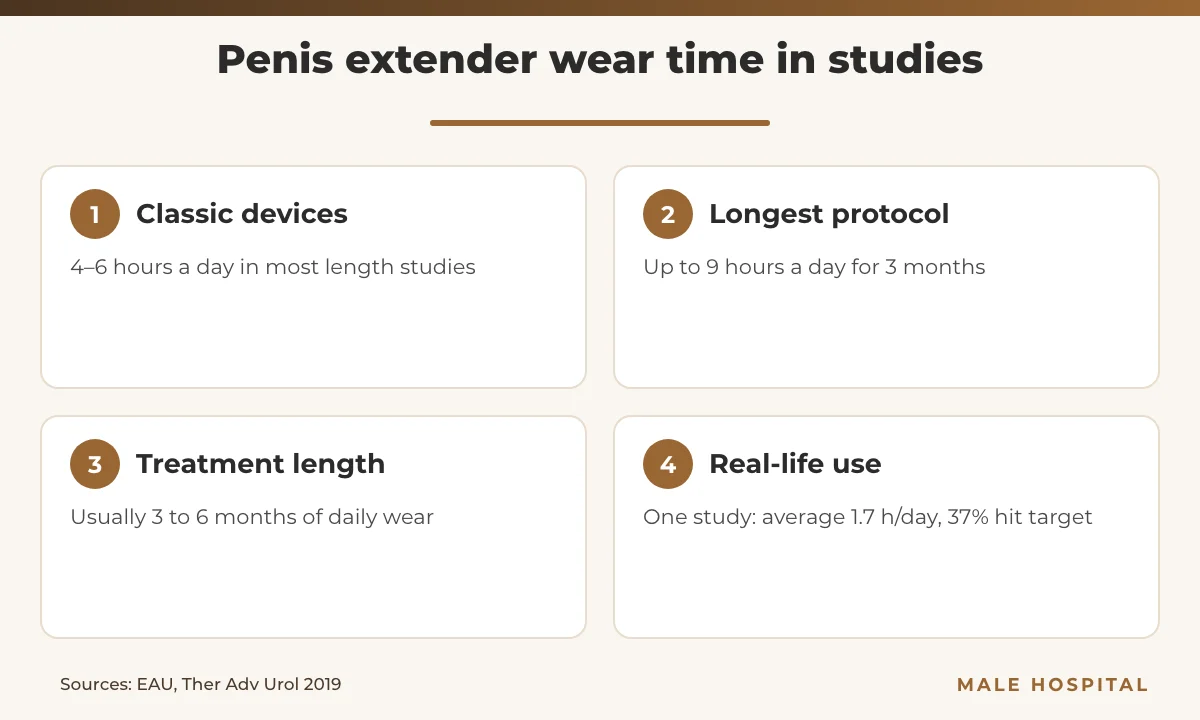
Real life is harder than study protocols. In one study, men were asked to use a penis extender for 3 hours or more daily, yet they averaged only 1.7 hours a day, and just 37% reached the target. The newer RestoreX device was tested at 30 to 90 minutes a day; in its follow-up phase men averaged about 31 minutes daily, and those who used it at least 15 minutes a day gained 2.0 to 2.3 cm. These shorter-wear results come from one research group and still need independent confirmation.
Source: Ther Adv Urol (PMC) — Valenzuela et al. (2019); PubMed — Joseph et al., RestoreX traction in Peyronie’s disease: open-label and follow-up phases (J Sex Med 2020)
Practical tips if you try one
- Start with low tension and increase it gradually, as the study protocols did.
- Spread wear time into sessions with breaks, rather than forcing long stretches through pain.
- Measure stretched length the same way each time (bone-pressed, from the pubic bone to the tip) so you can judge progress honestly.
- Stop and seek advice if you notice persistent numbness, color change, broken skin or pain.
Source: PubMed — Nikoobakht et al. (J Sex Med 2011); PubMed — Moncada et al. (BJU Int 2019)
Penis extender side effects and risks
Across studies, a penis extender has had a good safety record, with no serious complications reported in the main length trials. That does not mean it is free of side effects. The most common problems reported with traction are:
- Pain or discomfort — transient pain in up to about a quarter of users.
- Skin changes — redness (erythema), bruising (ecchymoses) and itching where the device grips.
- Glans sensation changes — in the 2019 multicenter study, mild side effects such as local discomfort and glans numbness affected 43% of men.
- Rare overuse injury — one case report described swelling of the pubic bone after vigorous use.
Source: Ther Adv Urol (PMC) — Valenzuela et al. (2019); PubMed — Moncada et al. (BJU Int 2019)
The EAU found no reported serious adverse effects such as skin ulcers, loss of sensation or weaker erections in Peyronie’s studies, and Cleveland Clinic states there are generally no long-term side effects when a penis extender is used properly. In the 2015 length study, only 4 men stopped because of mild, reversible problems.
Source: EAU Guidelines — Penile curvature; Cleveland Clinic — Peyronie’s disease; Curr Urol (PMC) — Chen et al. (2025)
Hidden risks: product quality and false hope
Devices are widely sold online, and a 2025 review notes that many enlargement products lack the necessary regulatory oversight. The bigger risk for many men is psychological: buying device after device in pursuit of a size change that no method can deliver. Pills, creams and stretching exercises such as jelqing have no scientific support at all.
Source: Curr Urol (PMC) — Chen et al. (2025); ISSM — Can a man make his penis larger?
Realistic expectations from a penis extender
Before thinking about any device, it helps to know where you stand. Measured by health professionals, the average penis size is about 13 cm (5.2 in) erect, and most men who worry about being small are in the normal range. The EAU recommends checking for penile dysmorphic disorder (a distressing preoccupation with penis size despite normal measurements) before any enlargement treatment.
Source: EAU Guidelines — Penile size abnormalities and dysmorphophobia
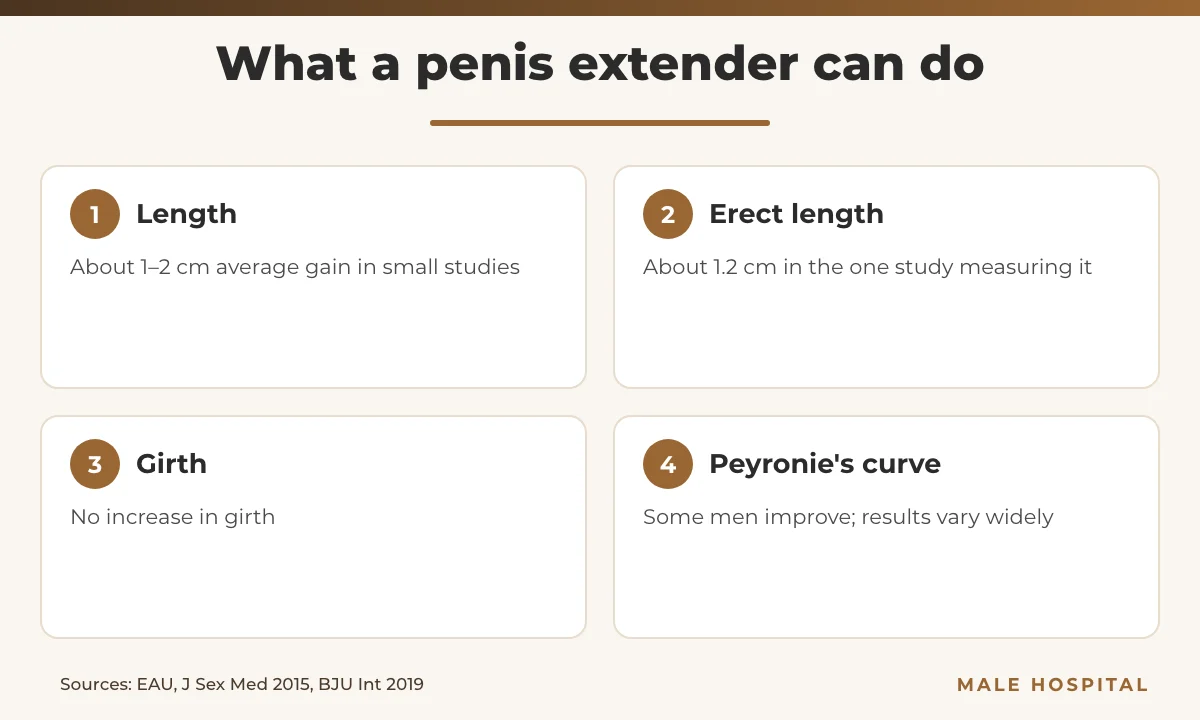
| If you hope for… | What the evidence suggests |
|---|---|
| Several inches more length | Not shown in any study; average gains were about 1–2 cm |
| Longer erect length | About 1.2 cm in the only length study that measured erections |
| A thicker penis | Traction does not increase girth |
| Quick results | Studies ran 3–6 months of daily wear |
| A straighter penis with Peyronie’s | Some men improve, by roughly 10–30° in trials; results vary widely |
Source: PubMed — Nowroozi et al. (J Sex Med 2015); PubMed — Ziegelmann et al. (J Urol 2019); PubMed — Moncada et al. (BJU Int 2019)
Gains in flaccid length tend to be larger than gains in erect length, which is the measurement most men care about. In Peyronie’s disease, even small changes can matter a lot: a reduction in curvature or a recovered centimeter may be the difference between comfortable and difficult intercourse.
Who should and should not consider traction
A penis extender may be reasonable for:
- Men with a normal-sized penis who still want a modest, non-surgical length change, after measurement and counseling.
- Men with Peyronie’s disease, in the active or stable phase, who want to try to reduce curvature or recover length before considering surgery.
- Men after Peyronie’s surgery, injection therapy or prostate removal, to limit length loss, when their urologist advises it.
It is less suitable for men who mainly want more girth, men who cannot commit to months of daily use, and men whose distress about size points to penile dysmorphic disorder, where psychological support comes first. In Peyronie’s disease, calcified plaques and hourglass or hinge deformities have not been studied systematically, so results there are uncertain.
Source: EAU Guidelines — Penile curvature; EAU Guidelines — Penile size abnormalities and dysmorphophobia
Vacuum pumps are often sold alongside extenders, but they work differently. A vacuum device creates an erection and is useful for erectile dysfunction, yet in a 6-month study it did not increase length; see our guide to the vacuum erection device for its proper uses.
Source: EAU Guidelines — Penile size abnormalities and dysmorphophobia
When to see a doctor
See a urologist before starting traction if you have a new curve, a lump in the shaft or pain with erections, since these can be signs of Peyronie’s disease that need assessment of the disease phase. Stop using the penis extender and get medical advice promptly if you notice:
- Numbness or tingling of the glans that does not settle soon after removing the device.
- Dark, blue or pale skin, blisters, broken skin or sores.
- Pain that persists after a session, or swelling and pain over the pubic bone.
- Weaker erections or a new or worsening bend.
- Constant worry about penis size that affects your mood, relationships or daily life.
Source: NHS — Peyronie’s disease; Ther Adv Urol (PMC) — Valenzuela et al. (2019)
If you are unsure whether traction makes sense for you, you can book a free, confidential consultation with our urologist-andrologist on WhatsApp. We will review your measurements, curvature and goals, and explain where traction fits among the penis enlargement options.
FAQs about penis extenders
Do penis extenders actually work?
They can produce small length gains. In the main studies, men gained about 1.2 to 2.3 cm in flaccid or stretched length after 3 to 6 months of wearing a penis extender several hours a day. However, the studies were small and had no control groups, so the EAU rates the evidence as poor and makes only a weak recommendation.
Source: EAU Guidelines — Penile size abnormalities and dysmorphophobia
Are penis extender results permanent?
Long-term data are limited. In one study, length gains stayed stable during 3 months off the penis extender, and in another, results at 6 months were maintained at 12 months. There are no studies following men for many years, so nobody can promise that gains last indefinitely.
Source: PubMed — Nowroozi et al. (J Sex Med 2015); PubMed — Gontero et al. (J Sex Med 2009)
How many hours a day should I wear a penis extender?
Most studies used 4 to 6 hours a day, with one using up to 9 hours, for 3 to 6 months. Reviews suggest more than 3 to 6 hours daily for the best effect with traditional devices. One newer device was tested at 30 to 90 minutes a day, but those results come from a single research group.
Source: Ther Adv Urol (PMC) — Valenzuela et al. (2019); PubMed — Ziegelmann et al. (J Urol 2019)
Can a penis extender increase girth?
No. None of the main studies found a meaningful increase in girth, and the EAU states that traction is not effective for girth enhancement. Men mainly concerned about thickness should discuss other options, such as hyaluronic-acid fillers, with a specialist, keeping in mind that those effects are temporary.
Source: EAU Guidelines — Penile size abnormalities and dysmorphophobia
Can a penis extender straighten a curved penis?
In Peyronie’s disease it can reduce curvature in some men, with studies reporting improvements from a few degrees up to about 30° on average. The EAU gives a weak recommendation to offer traction to reduce deformity. For curvature present from birth, surgery based on plication is the established treatment.
Source: EAU Guidelines — Penile curvature; PubMed — Moncada et al. (BJU Int 2019)
Does traction help after prostate removal?
It may. In a randomized trial of men after radical prostatectomy, 6 months of traction led to a length change of +1.6 cm compared with +0.3 cm without it, plus better erectile function and sexual satisfaction scores. The trial was small, run at one center by the device’s developers, and needs confirmation by other teams.
Source: PubMed — Toussi et al. (J Urol 2021)
Is a penis extender better than a penis pump for size?
For length, yes. Traction has small studies showing measurable gains, while a 6-month study of a vacuum pump used three times a week found no significant increase in length, and the EAU summarizes vacuum devices as ineffective for lengthening. Pumps remain a valid treatment for erectile dysfunction.
Source: EAU Guidelines — Penile size abnormalities and dysmorphophobia
Can a penis extender cause erectile dysfunction?
The studies have not shown this. The EAU reports no cases of diminished rigidity in Peyronie’s traction studies, and several trials found erectile function scores improved during traction. If your erections weaken while using a penis extender, stop and see a urologist to look for another cause.
Source: EAU Guidelines — Penile curvature; PubMed — Gontero et al. (BJU Int 2009)
Medically reviewed by Assoc. Prof. Dr. Zülfü Sertkaya, urologist and andrologist (FEBU), Istanbul. Last reviewed: November 2026.
This article is for general information and does not replace an individual consultation with a qualified doctor.
- EAU Guidelines — Sexual and Reproductive Health — Penile size abnormalities and dysmorphophobia
- EAU Guidelines — Sexual and Reproductive Health — Penile curvature
- AUA — Peyronie's Disease Guideline (2015)
- ISSM — Can a man make his penis larger?
- NHS — Peyronie's disease
- Cleveland Clinic — Peyronie's disease
- PMC (Therapeutic Advances in Urology) — Valenzuela et al. The use of penile traction therapy in the management of Peyronie's disease: current evidence and future prospects (2019)
- PMC (Current Urology) — Chen et al. Penile enhancement: a comprehensive and current perspective (2025)
- PubMed (BJU International) — Gontero et al. A pilot phase-II prospective study of a penile-extender device in the treatment of 'short penis' (2009)
- PubMed (Journal of Sexual Medicine) — Nikoobakht et al. Effect of penile-extender device in increasing penile size in men with shortened penis (2011)
- PubMed (Journal of Sexual Medicine) — Nowroozi et al. Applying extender devices in patients with penile dysmorphophobia (2015)
- PubMed (BJU International) — Oderda and Gontero. Non-invasive methods of penile lengthening: fact or fiction? (2011)
- PubMed (Journal of Sexual Medicine) — Martínez-Salamanca et al. Acute phase Peyronie's disease management with traction device (2014)
- PubMed (Journal of Sexual Medicine) — Gontero et al. Use of penile extender device in the treatment of penile curvature as a result of Peyronie's disease (2009)
- PubMed (BJU International) — Moncada et al. Penile traction therapy with Penimaster PRO in the stable phase of Peyronie's disease (2019)
- PubMed (Journal of Urology) — Ziegelmann et al. Outcomes of a novel penile traction device in men with Peyronie's disease: a randomized controlled trial (2019)
- PubMed (Journal of Sexual Medicine) — Joseph et al. Outcomes of RestoreX penile traction therapy: open label and follow-up phases (2020)
- PubMed (Urology) — Haney et al. Adjunct mechanical traction and penile length in Peyronie's disease: systematic review and meta-analysis (2018)
- PubMed (Journal of Urology) — Toussi et al. Novel penile traction device post prostatectomy: randomized controlled trial (2021)
- PubMed (Translational Andrology and Urology) — Almsaoud et al. Penile traction device in Peyronie's disease: systematic review and meta-analysis (2023)
- PubMed (Cochrane Database of Systematic Reviews) — Rosenberg et al. Non-surgical therapies for Peyronie's disease (2023)