Penile curvature is a bend in the erect penis, upward, downward or to one side, and a mild curve of roughly 5 to 30 degrees is common and normal. A curve becomes a medical issue when it is new or changing, painful, or bent enough to make sex difficult. The two main causes are congenital curvature, present from birth, and acquired curvature, most often from Peyronie’s disease.
Source: Cleveland Clinic — Curved penis: what it means and what’s normal; EAU Guidelines — Sexual and Reproductive Health (curvature chapter)
- A slight bend in an erection is normal. Cleveland Clinic describes curves of about 5 to 30 degrees as typical.
- Congenital curvature is present from birth, is usually a downward (ventral) bend, causes no lump and does not get worse over time.
- Acquired curvature appears later in life. Peyronie’s disease, where scar tissue (a plaque) forms in the penis, is the most common cause.
- A curve only needs treatment when it causes pain, distress or problems with intercourse. A larger curve without symptoms may need nothing at all.
- Doctors assess the erect penis, using home photos or an in-office injection test, before recommending any treatment.
- What is penile curvature?
- How much penile curvature is normal?
- Congenital vs acquired penile curvature
- Congenital penile curvature (chordee)
- Acquired curvature: Peyronie’s disease and injury
- When does penile curvature matter?
- How doctors assess penile curvature
- Treatment options in brief
- When to see a doctor
- FAQs about penile curvature
What is penile curvature?
Penile curvature simply means that the penis does not point straight when it is erect. The bend can go up (dorsal), down (ventral) or to the left or right (lateral), and some men also notice a twist or a dent. Most men only see the curve during an erection, because that is when the internal chambers fill and the shape of the shaft becomes fixed.
The penis contains two spongy erectile chambers, the corpora cavernosa, each wrapped in a tough, elastic sheath called the tunica albuginea. When both sides of this sheath stretch equally, the erection is straight. If one side is shorter or less elastic than the other, the penis bends toward the shorter side. This is the basic mechanism behind almost every type of penile curvature, whether a man was born with it or developed it later.
Penile curvature is not a sexually transmitted infection, and it does not in itself affect fertility. What matters is whether it causes pain, gets in the way of sex, or is a sign of an underlying condition that is still changing.
Source: Cleveland Clinic — Curved penis: what it means and what’s normal; EAU Guidelines — Sexual and Reproductive Health (curvature chapter)
How much penile curvature is normal?
No penis is perfectly straight, and a gentle bend is part of normal anatomy. According to Cleveland Clinic, a curve of about 5 to 30 degrees is typical, and many erect penises lean slightly to the left or right. The NHS likewise notes that there may naturally be a slight curve when the penis is erect.
The number of degrees is not the whole story. Cleveland Clinic points out that even curves above 30 degrees may not need treatment if they cause no symptoms and do not stop comfortable sex. Neither the European Association of Urology (EAU) nor the American Urological Association (AUA) sets a single angle that turns a normal curve into a disease. Instead, doctors focus on function: pain, difficulty with penetration, distress, and whether the shape is stable or changing.
Source: Cleveland Clinic — Curved penis: what it means and what’s normal; NHS — Peyronie’s disease
Congenital vs acquired penile curvature
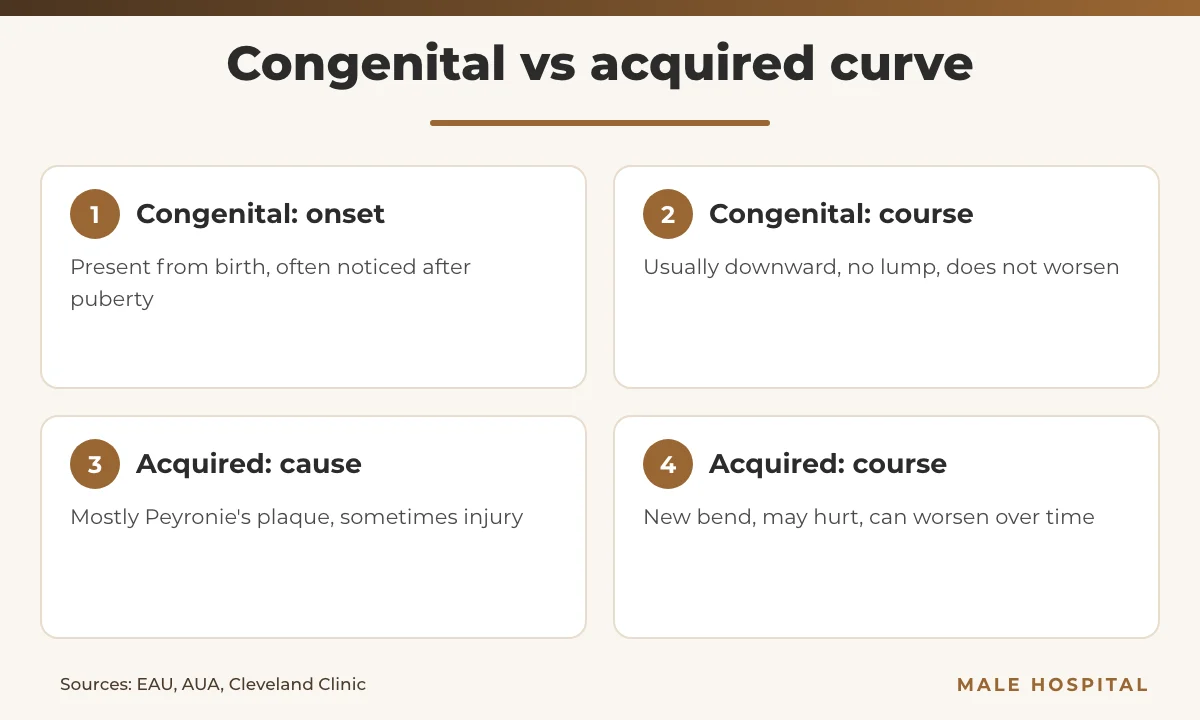
Urologists divide curves into two broad groups. Congenital penile curvature is present from birth and is caused by uneven development of the erectile tissue. Acquired curvature develops later in life, most often from Peyronie’s disease, where scar tissue forms inside the tunica albuginea, and less often after an injury. The difference matters because the two behave very differently over time and are treated differently.
| Feature | Congenital curvature | Acquired curvature (Peyronie’s disease) |
|---|---|---|
| When it starts | Present from birth; usually noticed at or after puberty | Later in life; typical onset between ages 50 and 60 |
| Cause | Uneven development of the tunica albuginea | Fibrous scar tissue (plaque) in the tunica albuginea |
| Usual direction | Mostly downward (ventral); sideways possible; upward rare | Toward the plaque: upward, downward or sideways |
| Lump you can feel | No | Often a hard lump or band on the shaft |
| Pain | Not typical | Painful erections are common in the early, active phase |
| Change over time | Stable; does not worsen or correct itself | Can worsen, stay the same or, less often, improve |
| Main treatment if needed | Surgery only, after puberty | Depends on phase: pain relief, selected non-surgical options, or surgery once stable |
Source: EAU Guidelines — Sexual and Reproductive Health (curvature chapter); Cleveland Clinic — Chordee: causes, symptoms, diagnosis and treatment; NHS — Peyronie’s disease
The AUA guideline gives doctors a simple rule of thumb: a lifelong downward curve, with no pain and no palpable plaque, points to congenital curvature and should not be mistaken for Peyronie’s disease. A curve that is new, changing, painful or associated with a lump points the other way.
Source: AUA — Peyronie’s Disease Guideline
Congenital penile curvature (chordee)
Congenital penile curvature, also called chordee, is a bend that a boy is born with. The EAU explains that it results from disproportionate development of the tunica albuginea of the two erectile bodies, and that it is not linked to a malformation of the urethra. Cleveland Clinic adds that the exact cause is unknown and is thought to relate to how the elastic tissue forms before birth. It cannot be prevented.
How common is it?
Figures vary with how penile curvature is defined. Cleveland Clinic and a review by Montag and Palmer report some degree of curvature in 4% to 10% of males without hypospadias. The EAU guideline calls clinically significant congenital curvature rare, with a reported incidence below 1%, while acknowledging the 4% to 10% figure from other studies. In practice, a mild congenital bend is common, but one severe enough to need surgery is unusual.
Direction and timing
Most congenital curves point downward (ventral). Sideways (lateral) curves also occur, while upward (dorsal) congenital curvature is rare. Parents sometimes notice a bend in infancy, but many men only become aware of it after puberty, when erections and sexual activity make the curve obvious. Unlike Peyronie’s disease, congenital penile curvature does not get worse over time, and it does not straighten on its own with age.
Curvature with hypospadias
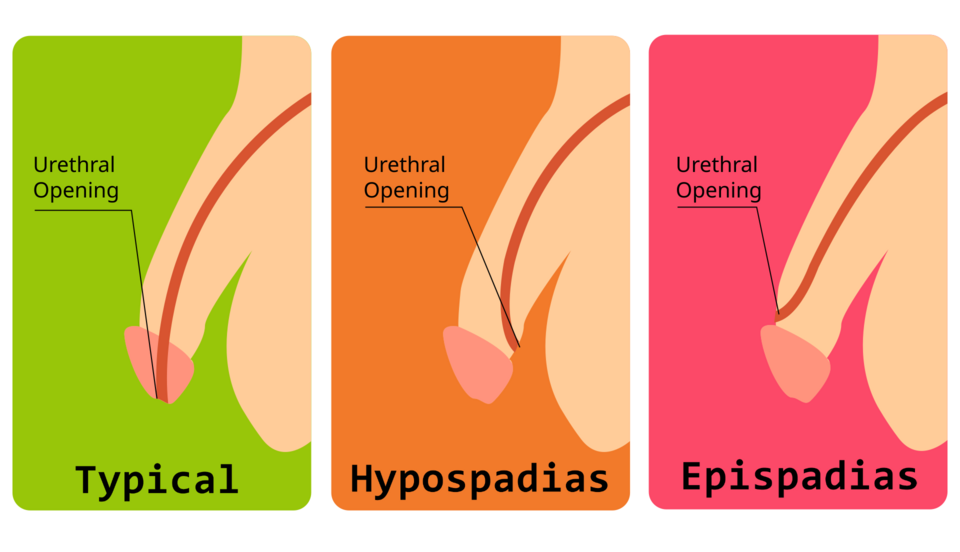
Chordee can occur on its own or together with hypospadias, a birth difference in which the urethral opening sits on the underside of the penis instead of at the tip. Hypospadias affects about 1 in 200 newborn boys in the United States and can cause a downward curve during erection. It is usually repaired in early childhood, and MedlinePlus notes that most urologists recommend repair between 6 and 12 months of age. Penile curvature that is found in adolescence or adulthood without hypospadias is a separate situation and is managed by an adult urologist.
Source: EAU Guidelines — Sexual and Reproductive Health (curvature chapter); Cleveland Clinic — Chordee: causes, symptoms, diagnosis and treatment; The Scientific World Journal (PMC) — Abnormalities of Penile Curvature: Chordee and Penile Torsion; MedlinePlus — Hypospadias
Acquired curvature: Peyronie’s disease and injury
When a man who previously had a straight erection develops a new bend, the most likely cause is Peyronie’s disease. The AUA defines it as an acquired penile abnormality caused by fibrosis (scarring) of the tunica albuginea, which may come with pain, deformity, erectile dysfunction or distress. The scar tissue does not stretch, so the penis bends toward it during an erection. This article only summarizes the condition; our full guide to Peyronie’s disease symptoms, causes and phases covers it in depth.
Key facts about Peyronie’s disease
- It is common: about 1 in 100 US men over 18 has been diagnosed, but based on reported symptoms the true figure may be more than 1 in 10.
- It is usually a disease of mid-life: onset is typically between 50 and 60, though the EAU reports prevalence figures of 1.5% to 16.9% in men under 40.
- It has more signs than a bend: a hard lump, painful erections, an hourglass dent, narrowing or shortening, and erection problems.
- It has two phases: an active phase, with pain or a curve that is still changing, and a stable phase. The EAU defines stability as resolution of pain and no change in the curve for at least three months.
- Pain usually settles, the bend often does not: in one study cited by the AUA, 89% of men with pain had complete resolution without treatment, while the curve worsened in 48%, stayed the same in 40% and improved in only 12%.
Source: AUA — Peyronie’s Disease Guideline; NIDDK — Peyronie’s disease; EAU Guidelines — Sexual and Reproductive Health (curvature chapter); NHS — Peyronie’s disease
Injury to the erect penis
Trauma is the other route to acquired penile curvature. Cleveland Clinic lists the penis slipping out during intercourse and bending, forceful masturbation, and falling onto an erect penis as possible causes. Many men with Peyronie’s disease cannot remember any specific injury, and small, unnoticed injuries during sex are thought to contribute. Cleveland Clinic also notes that softer erections, which become more common with age, bend more easily.
A sudden, severe injury is different. A cracking or popping sound during an erection followed by sharp pain, rapid loss of the erection, and bruising or swelling may mean a penile fracture, which is an emergency. Do not try to straighten a curved penis yourself, as this can make things worse.
Source: Cleveland Clinic — Curved penis: what it means and what’s normal
When does penile curvature matter?
Because some bend is normal, the useful question is not “Is my penis curved?” but “Is the curve causing a problem?” Guidelines and patient resources point to a short list of situations where penile curvature deserves a medical opinion:
- Sex is difficult or painful: severe congenital curvature can make intercourse difficult or impossible, and a marked curve can also hurt a partner.
- The curve is new or changing: a bend that appears in adulthood or is getting worse suggests Peyronie’s disease in its active phase.
- There is pain: painful erections, especially with a new bend, are typical of active Peyronie’s disease.
- You can feel a lump: a firm band or nodule under the skin of the shaft points to a plaque.
- There are other shape changes: an hourglass dent, narrowing or shortening.
- Erections are weaker: erectile dysfunction is common in Peyronie’s disease, with rates of 30% to 70.6% reported by the EAU.
- It affects your well-being: Cleveland Clinic notes that curvature can cause anxiety, depression and stress, and congenital curvature can make men self-conscious.
If none of these apply and the curve has always been the same, the bend is very likely a normal variation. A clear explanation from a specialist is often reassurance enough.
Source: EAU Guidelines — Sexual and Reproductive Health (curvature chapter); Cleveland Clinic — Curved penis: what it means and what’s normal; Cleveland Clinic — Chordee: causes, symptoms, diagnosis and treatment
How doctors assess penile curvature
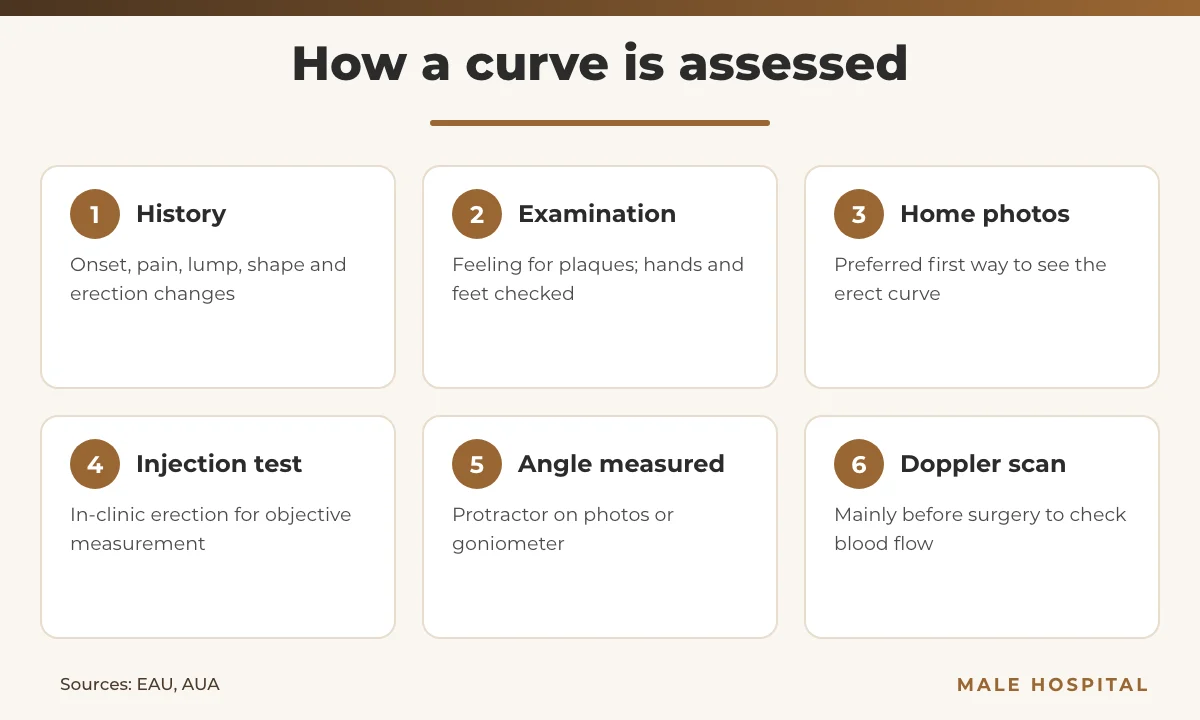
Assessment aims to answer three questions: is the curve congenital or acquired, how severe is it in a real erection, and, if it is Peyronie’s disease, is it still active?
History and examination
For congenital penile curvature, the EAU says a medical and sexual history is usually enough, together with a physical examination. For suspected Peyronie’s disease, the doctor asks how long the symptoms have been present, whether erections are painful, whether you have felt a lump, how the shape, length and girth have changed, and how good your erections are. The examination includes feeling the soft penis for plaques. The EAU also advises checking the hands and feet, because Dupuytren’s contracture and Ledderhose disease are linked to Peyronie’s disease.
Seeing the curve in an erection
A curve cannot be judged properly on a soft penis, so the EAU calls an assessment of the erect penis mandatory. There are three ways to do it:
- Home photographs: the EAU’s preferred first option. Your doctor may also ask you to repeat them to track changes over time.
- Vacuum-assisted erection test: a vacuum device is used in the clinic to produce an erection.
- Intracavernosal injection (ICI) test: a small dose of erection-inducing medicine is injected into the penis in the clinic. The EAU considers it superior for objective assessment, and for congenital curvature it prefers photos taken after an injection.
The AUA recommends an in-office injection test, with or without a duplex Doppler ultrasound, before any invasive Peyronie’s treatment. The angle can be measured with a protractor on photos or with a goniometer in the clinic.
Ultrasound and other imaging
Imaging is usually not needed to make the diagnosis. Ultrasound can locate plaques and show calcification, but the EAU notes that measuring plaque size this way is inaccurate and operator-dependent, and that plaque size does not correlate with the degree of curvature. Penile Doppler ultrasound is mainly used before surgery to check blood flow and rule out arterial causes of erectile dysfunction. CT and MRI are not recommended routinely. Our guide to the erectile dysfunction test explains the Doppler and injection test step by step.
Source: EAU Guidelines — Sexual and Reproductive Health (curvature chapter); AUA — Peyronie’s Disease Guideline; NIDDK — Peyronie’s disease
Treatment options in brief
A mild, painless curve that does not interfere with sex needs no treatment. When treatment is needed, the right approach depends on the cause.
Congenital curvature
Surgery is the only effective treatment for congenital curvature. The EAU advises waiting until after puberty, because the penis is still growing, but surgery can be done at any age in adult life when the curve impairs intercourse. The usual operations are plication techniques, such as the Nesbit, Yachia or 16-dot procedures, which shorten the longer side of the tunica albuginea to straighten the shaft. Pills, injections and devices do not straighten a congenital curve. Details of the operation, recovery and expected results are on our penile curvature correction page.
Peyronie’s disease
Treatment follows the phase of the disease. In the active phase, the focus is on pain relief and monitoring; the EAU recommends anti-inflammatory painkillers (NSAIDs) for pain. Several popular remedies are not supported: the AUA advises against vitamin E, tamoxifen and omega-3 supplements, and the EAU says not to use shockwave therapy to improve curvature. Traction devices have a weak recommendation with limited data. Collagenase injections carry a strong EAU recommendation for selected curves over 30 degrees, but the same guideline notes they have been withdrawn from the European market.
Surgery is reserved for stable disease that compromises sex. Options include plication, plaque incision or excision with a graft for severe or complex curves, and a penile implant for men who also have erectile dysfunction that does not respond to medication. Our Peyronie’s disease treatment page explains how these options are chosen.
Source: EAU Guidelines — Sexual and Reproductive Health (curvature chapter); AUA — Peyronie’s Disease Guideline; Cleveland Clinic — Chordee: causes, symptoms, diagnosis and treatment
When to see a doctor
Book a routine appointment with a urologist if you notice any of the following:
- A new bend, or a curve that is getting worse
- Pain during erections, sex or masturbation
- A hard lump, band or swelling on the shaft
- An hourglass dent, narrowing or loss of length
- A curve that makes penetration difficult or hurts your partner
- Weaker erections or trouble keeping an erection
- Worry or distress about the shape of your penis
Go to an emergency department immediately if you hear a crack during an erection followed by severe pain, sudden loss of the erection and bruising or swelling, if you cannot urinate, or if there is bleeding from the penis.
As the NHS puts it, there is no need to feel embarrassed about getting help. A short examination is usually all it takes to tell a normal bend from one that needs attention.
Source: Cleveland Clinic — Curved penis: what it means and what’s normal; NHS — Peyronie’s disease
If you are unsure whether your curve is normal, you can send a confidential message to our urologist-andrologist on WhatsApp for a free first consultation. If treatment is needed, we will explain whether curvature correction surgery or another approach suits you.
FAQs about penile curvature
Is it normal for a penis to curve to the left or right?
Yes. Many erect penises lean slightly to one side, and Cleveland Clinic describes a curve of about 5 to 30 degrees as typical. A sideways bend is only a concern if it is new, changing or painful, if you can feel a lump, or if it makes sex difficult or uncomfortable for you or your partner.
Source: Cleveland Clinic — Curved penis: what it means and what’s normal
How many degrees of penile curvature need treatment?
There is no single cut-off. Guidelines base treatment on symptoms and function, not on an angle alone. A curve over 30 degrees that causes no pain and allows comfortable sex may need nothing. In Peyronie’s disease, some treatments have angle limits; for example, collagenase injections were studied in curves between 30 and 90 degrees.
Source: AUA — Peyronie’s Disease Guideline; Cleveland Clinic — Curved penis: what it means and what’s normal
Can a congenital curve get worse with age?
No. Congenital penile curvature is stable: it typically does not worsen over time, and it also does not straighten on its own. If a curve you have always had suddenly changes, becomes painful or develops a lump, something new, most often Peyronie’s disease, may be happening and should be checked by a urologist.
Source: Cleveland Clinic — Chordee: causes, symptoms, diagnosis and treatment
Can a curved penis straighten on its own?
Congenital penile curvature does not resolve with age. In Peyronie’s disease, pain usually settles, but the bend often persists: in one study cited by the AUA, the curve improved without treatment in only 12% of men, stayed the same in 40% and worsened in 48%. Mild cases sometimes improve, but this is the exception.
Source: AUA — Peyronie’s Disease Guideline
Can exercises or stretching straighten a curved penis?
Manual stretching or trying to bend the penis straight is not a treatment, and Cleveland Clinic warns it can make the problem worse. Medical traction devices worn for several months are a different thing; they are used for Peyronie’s disease, but the EAU gives them only a weak recommendation because outcome data are limited.
Source: Cleveland Clinic — Curved penis: what it means and what’s normal; EAU Guidelines — Sexual and Reproductive Health (curvature chapter)
Should I take photos of my erection for the doctor?
Yes, it helps. The EAU lists home photographs of the erect penis as the preferred first way to assess curvature, and the NIDDK notes that urologists may ask for photos to track the bend over follow-up visits. If the photos are unclear or surgery is being considered, an in-office injection test gives a more objective measurement.
Source: EAU Guidelines — Sexual and Reproductive Health (curvature chapter); NIDDK — Peyronie’s disease
Medically reviewed by Assoc. Prof. Dr. Zülfü Sertkaya, urologist and andrologist (FEBU), Istanbul. Last reviewed: October 2026.
This article is for general information and does not replace an individual consultation with a qualified doctor.
- EAU — Sexual and Reproductive Health Guidelines: Penile Curvature
- AUA — Peyronie's Disease Guideline
- Cleveland Clinic — Curved Penis: What It Means & What's Normal
- Cleveland Clinic — Chordee: Causes, Symptoms, Diagnosis & Treatment
- NIDDK — Penile Curvature (Peyronie's Disease)
- NHS — Peyronie's disease
- The Scientific World Journal (PMC) — Abnormalities of Penile Curvature: Chordee and Penile Torsion (Montag & Palmer, 2011)
- MedlinePlus — Hypospadias