Azoospermia means there are no sperm at all in the ejaculate, even when the semen is spun down and examined under a microscope. It affects about 1% of all men and roughly 15% of infertile men, and it falls into two groups: obstructive, where sperm are made but blocked, and non-obstructive, where the testicles make few or no sperm. Many men with either type can still have a biological child through surgical sperm retrieval and ICSI. For the wider picture of fertility problems in men, see our guide to male infertility.
Source: Cleveland Clinic — Azoospermia (Zero Sperm Count): Causes & Treatment; NICHD (NIH) — What causes male infertility?
- Azoospermia must be confirmed on at least two semen analyses, with the sample centrifuged so that very rare sperm are not missed.
- Obstructive azoospermia (OA, 20–40% of cases) usually has normal hormones and normal-sized testicles; sperm production is working but the tubes are blocked.
- Non-obstructive azoospermia (NOA) is a sperm production problem; hormones (FSH, LH, testosterone) and genetic tests (karyotype, Y-chromosome microdeletions) are essential to find the cause.
- In NOA, testicular sperm extraction finds sperm in about half of men; micro-TESE is the EAU treatment of choice.
- Retrieved sperm is used with ICSI; a large meta-analysis reported a live birth rate of about 24% per ICSI cycle in NOA.
- What is azoospermia?
- Obstructive vs non-obstructive azoospermia
- Azoospermia causes
- Symptoms: how azoospermia is usually discovered
- Azoospermia diagnosis: hormones, genetics and imaging
- Azoospermia treatment by cause
- Sperm retrieval: TESA, PESA, MESA and micro-TESE success rates
- ICSI and pregnancy chances with retrieved sperm
- When to see a doctor
- FAQs about azoospermia
What is azoospermia?
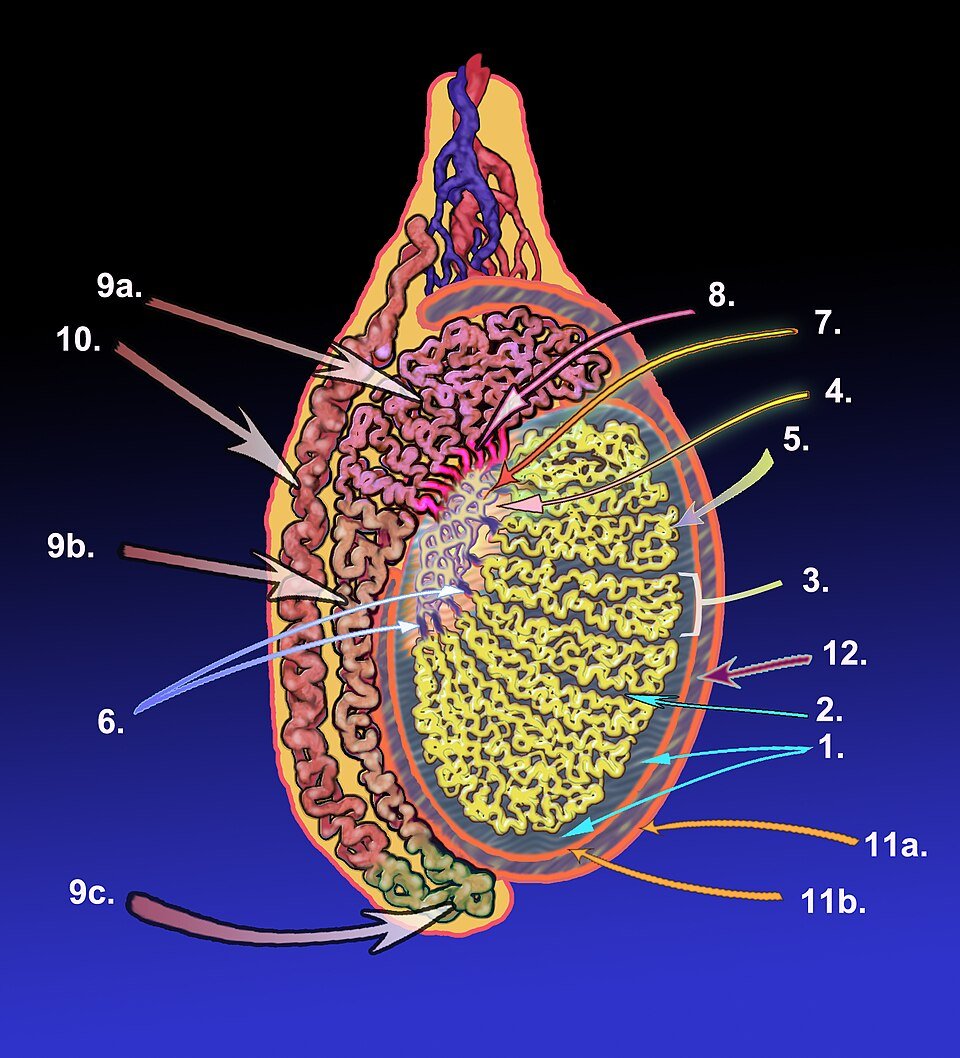
Sperm are made inside the testicles in tiny coiled tubes called seminiferous tubules. They then mature in the epididymis, travel up the vas deferens and mix with fluid from the prostate and seminal vesicles at ejaculation. Azoospermia is the complete absence of sperm in that final sample, meaning something has gone wrong with production, with transport, or with both.
The diagnosis needs care. The EAU recommends centrifuging the semen at 3,000g for 15 minutes and examining the pellet under a phase-contrast microscope. This separates a true zero count from cryptozoospermia, where a few sperm are present and can sometimes be used for ICSI without surgery.
Source: EAU — Sexual and Reproductive Health Guidelines (male infertility chapter)
If your first test showed zero sperm, our guide to semen analysis explains how the sample should be collected and why a repeat test is always needed.
Source: Cleveland Clinic — Azoospermia (Zero Sperm Count): Causes & Treatment; NICHD (NIH) — What causes male infertility?
Obstructive vs non-obstructive azoospermia
The key step after diagnosis is deciding which type you have, because treatment and the odds of finding sperm differ. In obstructive azoospermia (OA), the testicles produce sperm normally but a blockage in the epididymis, vas deferens or ejaculatory ducts stops them reaching the semen. In non-obstructive azoospermia (NOA), the problem is in sperm production itself, either inside the testicle or in the hormone signals from the brain.
The EAU reports that OA accounts for 20–40% of men with azoospermia. Men with OA typically have normal FSH, normal-sized testicles (at least one usually larger than 15 mL) and sometimes an enlarged epididymis. In NOA, the testicles are usually, but not always, small, and about 30% of men have low testosterone (hypogonadism).
Source: EAU — Sexual and Reproductive Health Guidelines (male infertility chapter)
| Feature | Obstructive azoospermia | Non-obstructive azoospermia |
|---|---|---|
| Main problem | Blocked transport of sperm | Little or no sperm production |
| Share of azoospermic men | 20–40% | The majority (60–80%) |
| FSH | Usually normal | Often high; low in hormone (pituitary) causes |
| Testicle size | Usually normal (one testis >15 mL) | Usually small |
| Typical causes | Vasectomy, CBAVD, infection, surgery scars | Klinefelter, Y microdeletions, undescended testes, chemotherapy |
| Main options | Microsurgical repair, or MESA/PESA/TESA plus ICSI | Micro-TESE plus ICSI; hormone therapy if pituitary cause |
Source: EAU — Sexual and Reproductive Health Guidelines (male infertility chapter); Cleveland Clinic — Azoospermia (Zero Sperm Count): Causes & Treatment
Azoospermia causes
Causes of obstruction
Among the blockages, the EAU lists epididymal obstruction as the most frequent (30–67% of obstructive cases), followed by intratesticular blockage (about 15%) and ejaculatory duct obstruction (1–5%). A previous vasectomy is the most familiar reason. Infections such as epididymitis, scrotal or groin surgery (for example hernia repair), trauma and cysts can also scar the ducts.
Congenital bilateral absence of the vas deferens (CBAVD) is a special case. It is linked to mutations in the CFTR gene, the same gene involved in cystic fibrosis, so the man may be a carrier without having lung disease. The EAU advises examining every azoospermic man for CBAVD, especially when semen volume is below 1.0 mL and the pH is acidic (below 7.0).
Source: EAU — Sexual and Reproductive Health Guidelines (male infertility chapter); Cleveland Clinic — Azoospermia (Zero Sperm Count): Causes & Treatment
Causes of non-obstructive azoospermia
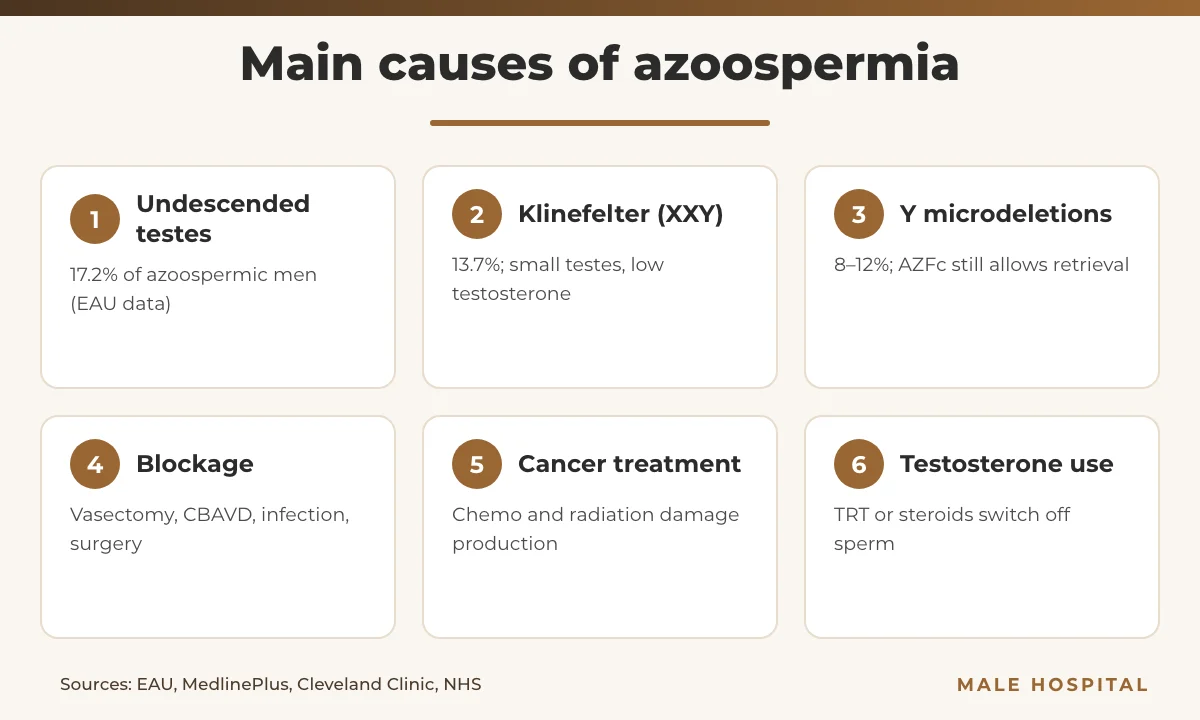
In a large EAU dataset of azoospermic men, the most common identified findings were previously undescended testicles (17.2%), Klinefelter syndrome (13.7%), cancer-related sperm banking (12.5%), varicocele (10.9%) and obstruction (10.3%), while 13.3% had no identifiable cause. Klinefelter syndrome, an extra X chromosome (47,XXY), affects about 1 in 650 newborn boys and usually leaves the testicles small and low in testosterone.
Y-chromosome microdeletions are small missing pieces of the AZF (“azoospermia factor”) regions that carry genes for sperm production; the EAU finds them in 8–12% of azoospermic men. Other causes include orchitis (testicle inflammation), chemotherapy and radiotherapy, pituitary disorders such as Kallmann syndrome or high prolactin, certain medications, toxins and heavy metals.
Source: EAU — Sexual and Reproductive Health Guidelines (male infertility chapter); MedlinePlus Genetics — Klinefelter syndrome; Cleveland Clinic — Azoospermia (Zero Sperm Count): Causes & Treatment
Testosterone and anabolic steroids
One avoidable cause deserves its own warning. Testosterone taken from outside, whether prescribed or used for bodybuilding, tells the pituitary gland to stop releasing the hormones that drive sperm production. The EAU states that testosterone therapy is contraindicated in men who want to father a child, and the NHS lists reduced sperm count, infertility and shrunken testicles among the harms of anabolic steroid misuse. If you are considering testosterone replacement therapy, discuss fertility first.
Source: EAU — Sexual and Reproductive Health Guidelines (male hypogonadism chapter); NHS — Anabolic steroid misuse
Symptoms: how azoospermia is usually discovered
Most men have no symptoms. Cleveland Clinic notes that the condition is usually discovered only when a couple cannot conceive and the man has a semen test; ejaculation usually looks normal because sperm make up only a small part of semen. When signs do appear, they point to the underlying cause:
- Low sex drive, tiredness, reduced body hair or breast enlargement, which suggest a hormone problem or Klinefelter syndrome.
- Small or soft testicles, or a testicle that was undescended in childhood.
- A very small semen volume, which can suggest ejaculatory duct obstruction or absent vas deferens.
Source: Cleveland Clinic — Azoospermia (Zero Sperm Count): Causes & Treatment; EAU — Sexual and Reproductive Health Guidelines (male infertility chapter)
Azoospermia diagnosis: hormones, genetics and imaging
The EAU makes a strong recommendation to confirm NOA with two consecutive semen analyses and then to complete a full work-up: medical history, physical examination, hormone tests, genetic tests and scrotal ultrasound. Each step narrows down the cause.
History and physical examination
Your doctor will ask about childhood undescended testicles, infections, past surgery, chemotherapy, medications, steroid use, heat exposure and family history. The examination checks testicle size and consistency, the epididymis, whether both vas deferens can be felt, and signs of varicocele or low testosterone.
Hormone tests
The EAU recommends measuring total testosterone, FSH and LH in every azoospermic man. A high FSH with small testicles points toward testicular failure, while low FSH, LH and testosterone point to a pituitary or hypothalamus problem that may be treatable with medication. Prolactin and an MRI of the brain may be added when a pituitary cause is suspected. Importantly, FSH alone does not reliably predict whether sperm will be found at surgery.
Source: EAU — Sexual and Reproductive Health Guidelines (male infertility chapter); Cleveland Clinic — Azoospermia (Zero Sperm Count): Causes & Treatment
Genetic tests
Genetic testing changes both treatment and family planning:
- Karyotype: the EAU recommends offering a chromosome test with genetic counselling to all azoospermic men, mainly to detect Klinefelter syndrome and chromosome rearrangements.
- Y-chromosome microdeletions: AZFc deletions make up 65–70% of cases, and testicular sperm is still found in 50–75% of these men. Complete AZFa or AZFb deletions mean there is effectively no chance of finding sperm, so the EAU advises against surgery.
- CFTR testing: needed in men with CBAVD, and the female partner should also be tested because a child could inherit cystic fibrosis.
Sons conceived with sperm from a man with a Y microdeletion will inherit the same deletion, which is why counselling before ICSI matters.
Source: EAU — Sexual and Reproductive Health Guidelines (male infertility chapter); HFEA — Intracytoplasmic sperm injection (ICSI)
Imaging and other tests
Scrotal ultrasound checks testicle volume and structure, the epididymis and varicocele; infertile men also have a higher risk of testicular cancer. Transrectal ultrasound is recommended when the semen volume is low and the pH acidic, to look for ejaculatory duct obstruction. A post-ejaculation urine test can show retrograde ejaculation, in which sperm travel backward into the bladder.
Source: EAU — Sexual and Reproductive Health Guidelines (male infertility chapter); Cleveland Clinic — Azoospermia (Zero Sperm Count): Causes & Treatment
Azoospermia treatment by cause
Repairing a blockage
When the female partner has good ovarian reserve, the EAU strongly recommends microsurgical reconstruction for OA. After vasectomy reversal (vasovasostomy), sperm return to the ejaculate in 90–97% of men and pregnancy rates are 52–73%. When the blockage is in the epididymis, a vasoepididymostomy achieves patency in 63–85% and natural pregnancy in 21–45%. Sperm can also be retrieved and frozen during the same operation as a backup.
Source: EAU — Sexual and Reproductive Health Guidelines (male infertility chapter)
Hormone treatment for pituitary causes
Men with hypogonadotropic hypogonadism, where the brain does not send enough LH and FSH, are the one group in whom medication can restart sperm production. The EAU calls gonadotropin therapy (hCG combined with FSH) the standard for these men when they want children. A review in Faculty Reviews notes that natural conception has been reported within 6–9 months of starting treatment, although it can take up to 24 months. In men whose testicles themselves have failed (high FSH), the EAU does not recommend routine hormone stimulation before surgery.
Source: EAU — Sexual and Reproductive Health Guidelines (male hypogonadism chapter); Faculty Reviews (PMC) — Tharakan et al. 2021, Non-obstructive azoospermia: current and future perspectives
Varicocele repair
A palpable varicocele in a man with NOA may be worth repairing. In a meta-analysis quoted by the EAU, sperm appeared in the ejaculate after surgery in 43.9% of men and retrieval rates were higher, but the evidence quality is low and the decision should be individual.
Source: EAU — Sexual and Reproductive Health Guidelines (male infertility chapter)
Preserving fertility before cancer treatment
Chemotherapy and radiotherapy can stop sperm production for good. The EAU states that all males with cancer must be offered sperm freezing before gonadotoxic treatment, and notes that zero sperm counts are already present in 24% of men with testicular germ cell tumors at diagnosis.
Source: EAU — Sexual and Reproductive Health Guidelines (male infertility chapter)
Sperm retrieval: TESA, PESA, MESA and micro-TESE success rates
Surgical sperm retrieval collects sperm directly from the epididymis or testicle so it can be used for ICSI or frozen. The NHS notes that extraction is usually done under local anesthetic as an outpatient procedure, and any sperm found is frozen for later use.
Source: NHS — Infertility: treatment
In obstructive cases
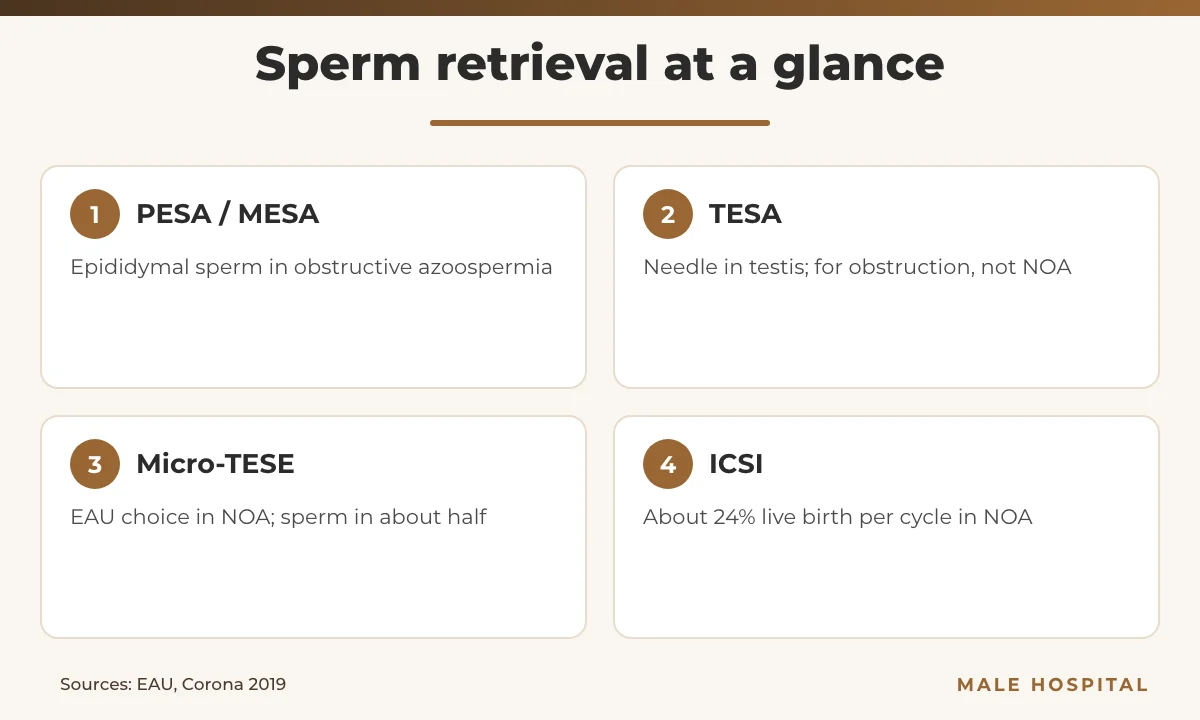
Because production is normal, sperm are usually easy to find. PESA (percutaneous epididymal sperm aspiration) uses a fine needle passed blindly into the epididymis; TESA (testicular sperm aspiration) uses a needle into the testicle; MESA (microsurgical epididymal sperm aspiration) opens the epididymis under a microscope and usually yields enough sperm for several ICSI cycles. A meta-analysis of five studies with 1,541 men found no significant difference in pregnancy rates between TESA and PESA.
Source: Transl Androl Urol (PMC) — Shih et al. 2019, TESA versus PESA for obstructive azoospermia; EAU — Sexual and Reproductive Health Guidelines (male infertility chapter)
In non-obstructive cases (NOA)
Sperm production in NOA is often patchy: a few tubules may still make sperm while most do not. Micro-TESE (microdissection testicular sperm extraction) opens the testicle and uses an operating microscope to pick out the wider, healthier-looking tubules. The EAU names micro-TESE the treatment of choice and advises against needle aspiration (TESA or fine-needle aspiration) in NOA.
| Situation | Reported sperm retrieval rate |
|---|---|
| NOA, any TESE (117 studies, 21,404 men) | 47% per procedure |
| Micro-TESE vs conventional TESE (case-control pooling) | 52% vs 35% |
| Micro-TESE vs multiple-pass TESA (one RCT, 100 men) | 43% vs 22% |
| TESA in NOA | 11–60% (no longer recommended) |
| Salvage micro-TESE after a failed attempt | About 39% (pooled) |
| Klinefelter syndrome | Up to 50% |
| AZFc microdeletion | 50–75% |
| Complete AZFa or AZFb deletion | Effectively zero; surgery not advised |
Sources: EAU — Sexual and Reproductive Health Guidelines (male infertility chapter); Hum Reprod Update (PubMed) — Corona et al. 2019, Sperm recovery and ICSI outcomes in NOA
The evidence on micro-TESE versus conventional TESE is not settled. The largest meta-analysis (Corona et al., 2019) found the same 46% rate for both, while case-control studies favor micro-TESE. Micro-TESE does cause less bleeding and scarring: after conventional TESE, the EAU reports intratesticular hematomas in 51.7% of men at three months and fibrosis in up to 30%. Testosterone can dip after surgery but tends to recover over 18–26 months.
What predicts success? In the Corona analysis, retrieval rates did not depend on age or hormone levels, but rose with testicle size; a mean testis volume above 12.5 mL predicted retrieval rates above 60%. Testicular histology matters too: a Faculty Reviews summary reports the highest rates (73% or more) in hypospermatogenesis and the lowest (22–41%) in Sertoli-cell-only syndrome, where tubules contain no sperm-producing cells.
Source: Hum Reprod Update (PubMed) — Corona et al. 2019, Sperm recovery and ICSI outcomes in NOA; Faculty Reviews (PMC) — Tharakan et al. 2021, Non-obstructive azoospermia: current and future perspectives; EAU — Sexual and Reproductive Health Guidelines (male infertility chapter)
ICSI and pregnancy chances with retrieved sperm
Surgically retrieved sperm are too few to use with natural conception or ordinary IVF, so they are used with ICSI (intracytoplasmic sperm injection), in which an embryologist injects a single sperm directly into each egg. The UK fertility regulator HFEA describes ICSI as the most common and successful treatment for male infertility and lists surgical sperm collection after vasectomy, blockage or extremely low counts as a main reason to use it.
Source: HFEA — Intracytoplasmic sperm injection (ICSI)
Outcomes depend heavily on the female partner’s age and egg quality, but published data give a realistic range:
- Obstructive (OA): in a meta-analysis of 20 studies, 44.1% of ICSI cycles with fresh epididymal sperm gave a clinical pregnancy, compared with 36.6% with frozen epididymal sperm; for testicular sperm, freezing did not significantly change results.
- Non-obstructive (NOA): the Corona meta-analysis reported a cumulative pregnancy rate of 29% and a live birth rate of 24% per ICSI cycle. Fresh sperm gave higher pregnancy rates than frozen (35% vs 20%), but the difference in live births was not confirmed.
Source: J Assist Reprod Genet (PMC) — Liu et al. 2020, Cryopreserved testicular or epididymal sperm and ICSI outcome in obstructive azoospermia; Hum Reprod Update (PubMed) — Corona et al. 2019, Sperm recovery and ICSI outcomes in NOA
The HFEA also points out that a son conceived through ICSI may inherit his father’s infertility, which is highly likely when there is a defined genetic cause, especially one on the Y chromosome. If no sperm is found, a salvage micro-TESE or donor sperm may be discussed.
Source: HFEA — Intracytoplasmic sperm injection (ICSI); EAU — Sexual and Reproductive Health Guidelines (male infertility chapter)
When to see a doctor
See a urologist or andrologist (a urologist specializing in male reproductive health) if:
- A semen analysis shows no sperm, even once; it should be repeated and centrifuged.
- You have been trying to conceive for 12 months without success, or sooner if your partner is 36 or older or you already suspect a fertility problem.
- You had undescended testicles, orchitis, testicular injury or groin surgery.
- You have small testicles, low libido, breast enlargement or other signs of low testosterone.
- You use, or have used, testosterone or anabolic steroids and want children.
- You notice a lump, swelling or persistent pain in a testicle, which needs prompt assessment because testicular cancer is more common in infertile men.
- You face chemotherapy or radiotherapy and want to bank sperm first.
Source: EAU — Sexual and Reproductive Health Guidelines (male infertility chapter); Cleveland Clinic — Azoospermia (Zero Sperm Count): Causes & Treatment; NHS — Infertility
If your semen test showed no sperm, you can arrange a confidential consultation and a full azoospermia work-up with our urologist-andrologist Assoc. Prof. Dr. Zülfü Sertkaya, whose research includes micro-TESE and male hormones. Send your semen and hormone results by WhatsApp for a free first review.
FAQs about azoospermia
Can a man with azoospermia have a biological child?
Often, yes. In obstructive cases, sperm are produced normally and can usually be retrieved or the blockage repaired. In non-obstructive cases, testicular sperm extraction finds sperm in about half of men, and retrieved sperm can fertilize eggs through ICSI. A meta-analysis reported live birth rates of about 24% per ICSI cycle in NOA.
Source: Hum Reprod Update (PubMed) — Corona et al. 2019, Sperm recovery and ICSI outcomes in NOA
Can azoospermia be cured naturally?
There is no proven natural cure. Some causes are reversible: stopping anabolic steroids or testosterone, treating a pituitary hormone deficiency with hCG and FSH, or repairing a blockage. Avoiding drugs, heavy alcohol, saunas and hot tubs supports overall sperm health, but lifestyle changes cannot restore sperm when the testicles or genes are the cause.
Source: EAU — Sexual and Reproductive Health Guidelines (male hypogonadism chapter); Cleveland Clinic — Azoospermia (Zero Sperm Count): Causes & Treatment
Can azoospermia be temporary?
Yes, in some cases. Sperm production can be switched off by testosterone or anabolic steroid use and by some medications, and may recover after the trigger is removed. That is one reason the EAU requires at least two semen analyses before confirming the diagnosis. Damage from chemotherapy, radiation or genetic causes is more often long-lasting.
Source: EAU — Sexual and Reproductive Health Guidelines (male infertility chapter); NHS — Anabolic steroid misuse
Is micro-TESE better than TESA?
For NOA, yes. A randomized trial of 100 men found sperm in 43% with micro-TESE versus 22% with multiple-pass TESA, and the EAU advises against needle aspiration in NOA. For obstructive cases, needle methods such as TESA or PESA work well because sperm production is normal, so micro-TESE is rarely needed.
Source: EAU — Sexual and Reproductive Health Guidelines (male infertility chapter)
Does high FSH mean no sperm will be found?
No. A high FSH suggests the testicles are struggling, but the EAU notes that FSH does not accurately predict whether sperm will be found, and men with high FSH may still have small areas of sperm production. In the largest meta-analysis, retrieval rates were independent of hormone levels, while larger testicle volume was a better predictor.
Source: EAU — Sexual and Reproductive Health Guidelines (male infertility chapter); Hum Reprod Update (PubMed) — Corona et al. 2019, Sperm recovery and ICSI outcomes in NOA
Is azoospermia genetic, and can it be passed to children?
Some causes are. Klinefelter syndrome and Y-chromosome microdeletions are found in a meaningful share of these men, and CFTR mutations cause absent vas deferens. Sons conceived through ICSI from a father with a Y microdeletion inherit it, and CFTR carriers can pass on cystic fibrosis risk, so genetic counselling is recommended before treatment.
Source: HFEA — Intracytoplasmic sperm injection (ICSI); EAU — Sexual and Reproductive Health Guidelines (male infertility chapter)
How much does azoospermia treatment cost?
The cost depends on the cause and the plan: hormone therapy, blockage repair, PESA or TESA, micro-TESE, and the partner’s ICSI cycle are priced very differently. A reliable estimate is only possible after the hormone, genetic and ultrasound results are reviewed. You can send your test results for a free WhatsApp consultation to get a personalized plan.
Medically reviewed by Assoc. Prof. Dr. Zülfü Sertkaya, urologist and andrologist (FEBU), Istanbul. Last reviewed: October 2026.
This article is for general information and does not replace an individual consultation with a qualified doctor.
- EAU — Sexual and Reproductive Health Guidelines (male infertility chapter)
- EAU — Sexual and Reproductive Health Guidelines (male hypogonadism chapter)
- Cleveland Clinic — Azoospermia (Zero Sperm Count): Causes & Treatment
- NICHD (NIH) — What causes male infertility?
- MedlinePlus Genetics — Klinefelter syndrome
- HFEA — Intracytoplasmic sperm injection (ICSI)
- NHS — Infertility
- NHS — Infertility: treatment
- NHS — Anabolic steroid misuse
- Hum Reprod Update (PubMed) — Corona et al. 2019 — Sperm recovery and ICSI outcomes in men with non-obstructive azoospermia
- Faculty Reviews (PMC) — Tharakan et al. 2021 — Non-obstructive azoospermia: current and future perspectives
- Transl Androl Urol (PMC) — Shih et al. 2019 — TESA versus PESA for obstructive azoospermia
- J Assist Reprod Genet (PMC) — Liu et al. 2020 — Cryopreserved testicular or epididymal sperm and ICSI outcome in obstructive azoospermia