Low sperm count (oligozoospermia) means a man’s semen contains fewer sperm than the lower reference limit set by the World Health Organization: about 16 million sperm per milliliter, or 39 million sperm in the whole ejaculate, in the WHO 2021 manual. It usually causes no symptoms and is found during fertility testing. Many men with this result still father children, either naturally or with treatment, so the result is a starting point for investigation rather than a verdict. For the wider picture of fertility problems in men, see our guide to male infertility.
Source: EAU — Sexual and Reproductive Health Guidelines (male infertility chapter)
- WHO 2021 lower reference limits are 16 million sperm/mL and 39 million sperm per ejaculate; values below these are usually labelled oligozoospermia.
- A low sperm count under 5 million/mL is generally described as severe and triggers genetic testing.
- Common causes include varicocele, hormone problems, genetic conditions, heat, smoking, obesity, anabolic steroids and some medicines, but in many men no single cause is found.
- Treatment depends on the cause: lifestyle change, stopping harmful drugs, hormone therapy, varicocele repair, or assisted reproduction such as IVF with ICSI.
- Testosterone therapy lowers sperm production and should not be used to treat male infertility.
- What is a low sperm count? The WHO 2021 definition
- Mild, moderate and severe oligozoospermia
- Symptoms: why most men do not notice anything
- Causes of a low sperm count
- Tests and diagnosis
- Low sperm count treatment options
- Chances of conception
- What you can do yourself
- When to see a doctor
- FAQs about low sperm count
What is a low sperm count? The WHO 2021 definition
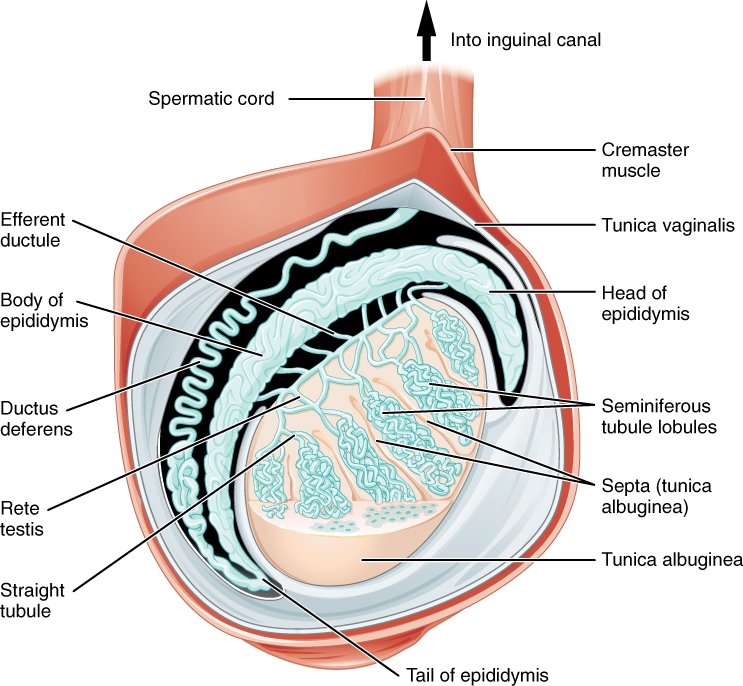
Sperm are made in the seminiferous tubules of the testicles, mature in the epididymis and leave the body in semen. A sperm count is measured in a semen analysis, which reports two related numbers: the concentration (millions of sperm per milliliter) and the total sperm number (concentration multiplied by semen volume).
The sixth edition of the WHO laboratory manual, published in 2021, sets the lower reference limits (the 5th centile of men whose partners conceived within a year) at 16 million sperm per milliliter and 39 million sperm per ejaculate. A result below these values is what most doctors call oligozoospermia.
Source: EAU — Sexual and Reproductive Health Guidelines (male infertility chapter); WHO — Laboratory manual for the examination and processing of human semen, 6th edition (2021)
Why you may see 15 million or 16 million
Many websites and older papers, including Cleveland Clinic and a 2020 endocrinology review, still quote fewer than 15 million sperm/mL, the threshold from the previous WHO manual. The difference is small and does not change how doctors manage the result.
Two other points about the 2021 manual matter. First, it dropped descriptive labels such as oligozoospermia, although urologists, including the European Association of Urology (EAU) panel, still use them because they are clinically useful. Second, it states that the 5th-centile values alone are not enough to diagnose male infertility; they are reference points, not a fertile/infertile cut-off.
Source: Cleveland Clinic — Oligospermia: Causes & Treatment; Arab Journal of Urology (PMC) — Chung et al. 2023, Sixth edition of the WHO laboratory manual: updates for busy clinicians; Life (PMC) — Boitrelle et al. 2021, critical review of the sixth edition of the WHO laboratory manual
A low sperm count is also different from having no sperm at all. When no sperm are found in the ejaculate, even after the sample is spun down, the diagnosis is azoospermia, which is investigated and treated differently.
Mild, moderate and severe oligozoospermia
Doctors often grade a low sperm count by concentration. The grading below comes from a 2020 review that used the older 15 million/mL limit; the EAU panel also keeps “severe oligozoospermia” (under 5 million/mL) as a clinically useful category, because it changes which tests are ordered.
| Grade | Sperm concentration | What it usually means in practice |
|---|---|---|
| Within reference range | 16 million/mL or more (WHO 2021) | Count is not the limiting factor, but motility and shape still matter |
| Mild | About 10–15 million/mL | Repeat test, look for reversible causes; natural conception remains possible |
| Moderate | 5–10 million/mL | Hormone tests and full urological assessment |
| Severe | Under 5 million/mL | Karyotype and genetic counseling; Y-chromosome testing considered |
| Azoospermia | No sperm in the ejaculate | Separate diagnostic pathway, sometimes surgical sperm retrieval |
Source: Journal of Clinical Endocrinology & Metabolism (PMC) — Choy & Amory 2020, Nonsurgical Management of Oligozoospermia; EAU — Sexual and Reproductive Health Guidelines (male infertility chapter)
A low sperm count often comes with other abnormal findings, such as reduced motility or fewer normally shaped sperm. The combination, not the count alone, gives the best picture of fertility potential.
Symptoms: why most men do not notice anything
The main sign of a low sperm count is difficulty conceiving. Semen usually looks and feels normal, and erections, orgasm and ejaculation are unaffected. Most men only find out when a couple has tried for a year without success and both partners are tested.
Some men have symptoms of the underlying cause rather than of the low sperm count itself:
- Reduced facial or body hair, low sex drive or erectile problems, which can point to a hormone problem.
- Swelling, pain or a lump in the testicle or scrotum.
- A dull ache or a “bag of worms” feeling above the testicle, typical of a varicocele.
Source: Cleveland Clinic — Oligospermia: Causes & Treatment
Causes of a low sperm count
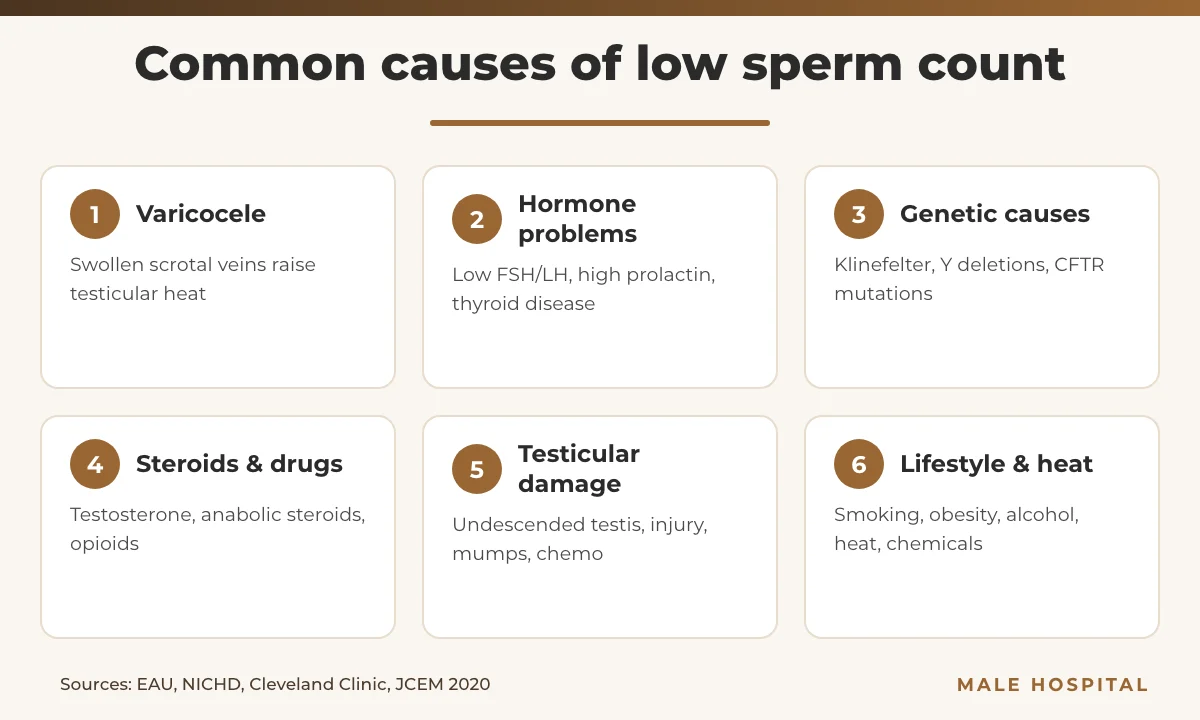
Sperm production depends on healthy testicles, the right hormone signals from the brain (FSH and LH) and open ducts to carry sperm out. A problem at any of these levels can cause a low sperm count. Even after a full work-up, however, 60% to 75% of men with oligozoospermia do not receive a clear diagnosis; this is called idiopathic oligozoospermia.
Varicocele
A varicocele is a swelling of the veins in the scrotum that raises testicular temperature. The US National Institute of Child Health and Human Development (NICHD) calls it the most common cause of oligospermia, and the EAU reports it in about 25% of men with an abnormal semen analysis. Our dedicated article on varicocele covers grades, diagnosis and repair in detail.
Source: NICHD — What causes male infertility?; EAU — Sexual and Reproductive Health Guidelines (male infertility chapter)
Hormone problems
Low output of FSH and LH from the pituitary (hypogonadotropic hypogonadism, including Kallmann syndrome), a prolactin-secreting pituitary tumor, thyroid disease and some adrenal disorders can all reduce sperm production. These causes matter because they are among the few that respond well to medicine.
Genetic conditions
Klinefelter syndrome (an extra X chromosome), small deletions on the Y chromosome (AZF microdeletions) and mutations in the cystic fibrosis gene (CFTR) are recognized causes, especially when the count is very low.
Testicular damage and blockage
Undescended testicles, testicular injury or torsion, mumps orchitis, sexually transmitted infections, chemotherapy and radiotherapy can damage sperm-producing tissue. A partial blockage of the ejaculatory ducts is a less common, treatable cause.
Source: Journal of Clinical Endocrinology & Metabolism (PMC) — Choy & Amory 2020, Nonsurgical Management of Oligozoospermia; NICHD — What causes male infertility?
Medicines, steroids and drugs
Testosterone and anabolic steroids switch off the brain signals that drive sperm production and are a frequent, reversible cause in younger men. Other medicines linked to a low sperm count include opioids, glucocorticoids such as prednisone, 5-alpha reductase inhibitors such as finasteride, some antipsychotics, methotrexate and chemotherapy. Never stop a prescribed medicine without talking to your doctor first.
Lifestyle and environment
Smoking, obesity, heavy drinking, recreational drugs such as cannabis and cocaine, prolonged heat exposure and workplace chemicals such as pesticides, solvents and heavy metals are all associated with poorer semen quality.
Source: Cleveland Clinic — Oligospermia: Causes & Treatment
Tests and diagnosis
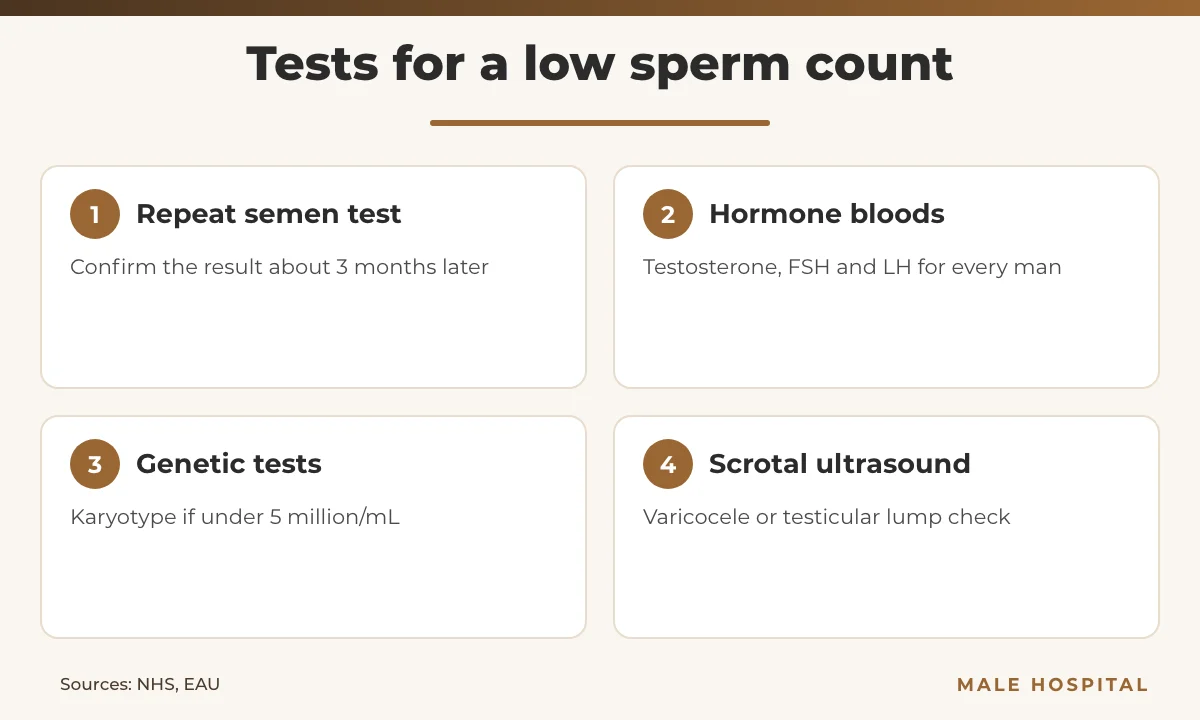
Sperm counts vary a lot from one sample to the next, so a single abnormal result is not a diagnosis of low sperm count. The NHS advises a second semen analysis about three months after the first. If the repeat test is also abnormal, a specialist assessment follows.
Source: NHS — Low sperm count
History and examination
The urologist asks about childhood conditions (such as undescended testicles), past infections, surgery, medicines, supplements, steroid use, work exposures and lifestyle. A physical examination checks testicular size and consistency, the epididymis and vas deferens, and looks for a varicocele.
Hormone blood tests
The EAU strongly recommends a hormonal evaluation, including total testosterone, FSH and LH, for every man with oligozoospermia. A high FSH suggests that the testicles themselves are struggling, while low FSH and LH point to a problem in the pituitary or hypothalamus. Prolactin and thyroid tests are added when the history suggests them, and testosterone is best measured in the morning.
Genetic tests
For men with fewer than 5 million sperm/mL, the EAU recommends a karyotype (chromosome test) with genetic counseling. Y-chromosome microdeletion testing is strongly recommended at 1 million sperm/mL or below and should be considered below 5 million/mL; such deletions are very rare above that level.
Source: EAU — Sexual and Reproductive Health Guidelines (male infertility chapter); Journal of Clinical Endocrinology & Metabolism (PMC) — Choy & Amory 2020, Nonsurgical Management of Oligozoospermia
Imaging and urine tests
A scrotal ultrasound can confirm a varicocele or check a testicular lump. A transrectal ultrasound is used when an ejaculatory duct blockage is suspected, for example when semen volume is very low. A urine test after ejaculation can detect retrograde ejaculation, where sperm flow backward into the bladder.
Source: Cleveland Clinic — Oligospermia: Causes & Treatment; Journal of Clinical Endocrinology & Metabolism (PMC) — Choy & Amory 2020, Nonsurgical Management of Oligozoospermia
Low sperm count treatment options
Treatment for a low sperm count aims either to raise the count by fixing the cause or to help a couple conceive despite it. The female partner’s age and fertility always shape the plan: when she is 35 or older, referral for assisted reproduction should not be delayed while waiting for the male side to improve.
Removing the cause
Stopping anabolic steroids, testosterone or other harmful drugs often allows sperm production to recover, but slowly. The EAU advises withdrawing anabolic steroids for six to 12 months before considering hormone treatment, and one study cited in a 2020 review found that sperm production took 10 to 14 months to recover.
Source: EAU — Sexual and Reproductive Health Guidelines (male infertility chapter); Journal of Clinical Endocrinology & Metabolism (PMC) — Choy & Amory 2020, Nonsurgical Management of Oligozoospermia
Hormone treatment
In men with hypogonadotropic hypogonadism, the EAU strongly recommends inducing sperm production with hCG injections, with FSH added if needed. Sperm output usually improves after three to six months, and most couples conceive within one to two years of therapy. Men with a raised prolactin level can be treated with a dopamine agonist such as cabergoline.
For idiopathic oligozoospermia with a normal FSH level, the EAU gives a weak recommendation for FSH treatment, based on evidence of better sperm quality and pregnancy rates; high-dose FSH is not recommended. Clomiphene and aromatase inhibitors are used off-label: the EAU advises against using them routinely because the evidence is low quality, and the 2020 review cautions against long-term use because of possible bone loss.
Source: EAU — Sexual and Reproductive Health Guidelines (male infertility chapter); Journal of Clinical Endocrinology & Metabolism (PMC) — Choy & Amory 2020, Nonsurgical Management of Oligozoospermia
Why testosterone is not a fertility treatment
It sounds logical to give testosterone to a man with a low sperm count, but it does the opposite: extra testosterone tells the brain to stop making FSH and LH, so the testicles make even fewer sperm. The EAU strongly recommends against testosterone therapy for male infertility. Men with low testosterone who still want children should discuss alternatives first; our article on testosterone replacement therapy explains the trade-offs.
Varicocele repair
The EAU strongly recommends treating a clinical (palpable) varicocele in infertile men with abnormal semen parameters and otherwise unexplained infertility, provided the female partner has good ovarian reserve. Repair may improve sperm concentration and pregnancy rates. It is not advised when the semen analysis is normal or the varicocele can only be seen on ultrasound.
Antioxidants and supplements
Supplements such as coenzyme Q10, L-carnitine and vitamin C are widely sold for sperm health, but the EAU does not recommend routine antioxidant treatment. In the large MOXI trial, antioxidants did not improve semen parameters or live birth rates. Talk to your doctor before starting any supplement.
Source: EAU — Sexual and Reproductive Health Guidelines (male infertility chapter); Cleveland Clinic — Oligospermia: Causes & Treatment
Assisted reproduction
Intrauterine insemination (IUI), where washed sperm are placed in the uterus, is often tried first, although evidence for it in oligozoospermia is weak. IVF with intracytoplasmic sperm injection (ICSI), where one sperm is injected directly into each egg, needs only a small number of sperm and is the main option for severe cases. Donor sperm is another option some couples choose.
Source: Journal of Clinical Endocrinology & Metabolism (PMC) — Choy & Amory 2020, Nonsurgical Management of Oligozoospermia; HFEA — Intracytoplasmic sperm injection (ICSI)
| Treatment | Best suited to | Evidence / guideline position |
|---|---|---|
| Lifestyle change, stopping harmful drugs | Everyone; men using steroids or testosterone | EAU: inform men about obesity, smoking, alcohol and inactivity (strong) |
| hCG ± FSH | Hypogonadotropic hypogonadism | EAU: strong recommendation |
| FSH | Idiopathic oligozoospermia with normal FSH | EAU: weak recommendation |
| Clomiphene, aromatase inhibitors, antioxidants | Selected cases only | Off-label; EAU: not for routine use |
| Varicocele repair | Palpable varicocele plus abnormal semen | EAU: strong recommendation |
| IVF with ICSI | Severe low sperm count, failed other options, older partner | Standard option for severe male factor |
| Testosterone therapy | Not a fertility treatment | EAU: do not use for male infertility (strong) |
Source: EAU — Sexual and Reproductive Health Guidelines (male infertility chapter)
Chances of conception with a low sperm count
A low sperm count lowers the chance of pregnancy each month, but it rarely makes natural conception impossible unless the count is extremely low. The NHS notes that many couples still conceive naturally and advises sex every two to three days without contraception, rather than timing it only around ovulation.
Source: NHS — Low sperm count
The relationship between count and fertility is gradual rather than a cliff edge. In a Danish study of 430 couples trying for their first pregnancy, 65% of couples conceived within six cycles when the sperm concentration was 40 million/mL or more, compared with 51% when it was lower. The chance of conception rose with concentration up to about 40 million/mL, with no extra benefit above that, and normal sperm shape predicted pregnancy independently of the count.
With IVF and ICSI, a 2020 review reports fertilization rates of 50% to 75% in men with a low sperm count (oligozoospermia), a clinical pregnancy rate of around 20% per cycle and a cumulative live birth rate of around 50% after three cycles. The HFEA notes that ICSI success rates are very similar to standard IVF and depend heavily on the woman’s age.
Before ICSI, couples should know that sons conceived this way may inherit their father’s infertility when there is a genetic cause, which is one reason genetic testing comes first in severe cases.
Source: Journal of Clinical Endocrinology & Metabolism (PMC) — Choy & Amory 2020, Nonsurgical Management of Oligozoospermia; HFEA — Intracytoplasmic sperm injection (ICSI)
What you can do yourself
The EAU strongly recommends informing infertile men about the harmful effects of obesity, low physical activity, smoking and high alcohol intake, and notes that lifestyle changes may improve sperm quality and the chance of conception. Give any change time to work: the NHS repeats an abnormal test after about three months.
- Stop smoking: smoking is linked to poorer sperm parameters and more sperm DNA damage.
- Reach a healthy weight: excess weight affects the hormones that drive sperm production.
- Keep alcohol moderate: the NHS advises no more than 14 units a week, spread over three days or more.
- Stay active: moderate recreational exercise is associated with better semen parameters.
- Keep the testicles cool: loose underwear and avoiding long exposure to heat may help.
- Avoid drugs and steroids: including cannabis, cocaine and anabolic steroids.
- Limit chemical exposure at work: use protective equipment around pesticides, solvents and heavy metals.
Source: EAU — Sexual and Reproductive Health Guidelines (male infertility chapter); NHS — Low sperm count
When to see a doctor
See a doctor if you and your partner have not conceived after more than one year of regular unprotected sex, or after six months if your partner is 36 or older. Both partners should be tested at the same time, because a male factor is found in about half of infertile couples.
Seek an earlier appointment if you have:
- A lump, swelling or persistent pain in a testicle (a new testicular lump should be checked promptly).
- A history of undescended testicles, testicular surgery, chemotherapy or radiotherapy.
- Signs of low testosterone, such as low sex drive, erectile problems or loss of body hair.
- Current or past use of anabolic steroids or testosterone.
- A semen analysis showing a very low sperm count or no sperm.
Source: NHS — Low sperm count; EAU — Sexual and Reproductive Health Guidelines (male infertility chapter); Cleveland Clinic — Oligospermia: Causes & Treatment
If your semen analysis shows a low sperm count, you can arrange a confidential review of your results with our urologist-andrologist, Assoc. Prof. Dr. Zülfü Sertkaya, whose practice includes male infertility. Send your report on WhatsApp for a free initial consultation.
FAQs about low sperm count
Can a man with a low sperm count get a woman pregnant naturally?
Yes, often. A low sperm count reduces the chance of pregnancy each cycle, but it does not usually make it impossible, especially when the count is only mildly reduced and the partner is younger. The NHS recommends sex every two to three days. If pregnancy has not happened after a year, or six months when the partner is 36 or older, both partners should be assessed.
Source: NHS — Low sperm count
What sperm count is considered low by the WHO?
The WHO 2021 manual gives lower reference limits of 16 million sperm per milliliter and 39 million sperm per ejaculate. Values below these are generally described as a low sperm count. These figures are the 5th centile of men who fathered a child within a year, so they are reference points rather than a strict line between fertile and infertile men.
Source: EAU — Sexual and Reproductive Health Guidelines (male infertility chapter)
Can oligospermia be cured?
It depends on the cause. Counts often recover after stopping anabolic steroids or testosterone, treating a hormone deficiency, or repairing a clinical varicocele. Genetic causes cannot be reversed, and in many men no cause is found. When the count cannot be raised enough, IVF with ICSI can still allow a couple to have a biological child.
Source: Cleveland Clinic — Oligospermia: Causes & Treatment
How long does it take to improve sperm count?
Improvement is not quick. The NHS repeats an abnormal semen analysis after about three months, and lifestyle changes should be given at least that long before judging them. Recovery after anabolic steroid use can be much slower; one study cited in a 2020 review found sperm production took 10 to 14 months to recover.
Source: NHS — Low sperm count; Journal of Clinical Endocrinology & Metabolism (PMC) — Choy & Amory 2020, Nonsurgical Management of Oligozoospermia
Can a varicocele lower sperm count?
Yes. A varicocele raises the temperature around the testicle and is described by the NICHD as the most common cause of oligospermia. The EAU recommends repair for men with a palpable varicocele, abnormal semen results and otherwise unexplained infertility, when the female partner has good ovarian reserve; repair may improve sperm concentration and pregnancy rates.
Source: NICHD — What causes male infertility?; EAU — Sexual and Reproductive Health Guidelines (male infertility chapter)
Is oligospermia genetic?
Sometimes. Klinefelter syndrome, Y-chromosome microdeletions and cystic fibrosis gene mutations are known genetic causes, particularly when the count is very low. For this reason, the EAU recommends chromosome testing and genetic counseling for men with fewer than 5 million sperm/mL, and Y-chromosome testing at very low counts.
Source: EAU — Sexual and Reproductive Health Guidelines (male infertility chapter); NICHD — What causes male infertility?
Is ICSI safe for men with very low sperm counts?
ICSI is widely used and effective at achieving fertilization with few sperm. The HFEA notes slightly higher risks than some other treatments, including possible egg damage, a very small number of children with certain defects that may relate to the underlying infertility, and the possibility that sons inherit their father’s infertility when the cause is genetic.
Source: HFEA — Intracytoplasmic sperm injection (ICSI)
Medically reviewed by Assoc. Prof. Dr. Zülfü Sertkaya, urologist and andrologist (FEBU), Istanbul. Last reviewed: November 2026.
This article is for general information and does not replace an individual consultation with a qualified doctor.
- EAU — Sexual and Reproductive Health Guidelines (male infertility chapter)
- NHS — Low sperm count
- Cleveland Clinic — Oligospermia (Low Sperm Count): Causes & Treatment
- WHO — Laboratory manual for the examination and processing of human semen, 6th edition (2021)
- Journal of Clinical Endocrinology & Metabolism (PMC) — Choy & Amory 2020, Nonsurgical Management of Oligozoospermia
- Arab Journal of Urology (PMC) — Chung et al. 2023, Sixth edition of the WHO laboratory manual: updates for busy clinicians
- Life (PMC) — Boitrelle et al. 2021, critical review of the sixth edition of the WHO laboratory manual
- NICHD — What causes male infertility?
- The Lancet (PubMed) — Bonde et al. 1998, Relation between semen quality and fertility: 430 first-pregnancy planners
- HFEA — Intracytoplasmic sperm injection (ICSI)