Penis rash is usually caused by something simple and treatable: irritation from soap or condoms, a yeast infection under the foreskin, or a skin condition such as psoriasis that flares on the genitals. Less often a penis rash is the first sign of a sexually transmitted infection or a chronic skin disease such as lichen sclerosus, which is why a rash that blisters, ulcerates, turns white or lasts more than two weeks deserves an examination rather than guesswork. This guide explains what each type of penis rash looks like, which ones are contagious, how doctors tell them apart and how they are treated.
Sources: DermNet — Balanitis; MedlinePlus — Genital sores, male
- Most cases of penis rash are not sexually transmitted: irritant dermatitis, Candida (yeast) balanitis, psoriasis and eczema are far more common than herpes or syphilis.
- Penis rash pattern matters: satellite spots suggest yeast, grouped blisters suggest herpes, a smooth shiny plaque suggests psoriasis or Zoon balanitis, and white patches with a tightening foreskin suggest lichen sclerosus.
- A single firm, painless ulcer that heals on its own within 3 to 6 weeks is the classic sign of primary syphilis; it still needs antibiotics.
- Washing with water or an emollient instead of soap and drying under the foreskin prevents many rashes; uncircumcised men have a roughly 68% higher lifetime incidence of balanitis.
- See a doctor for blisters, ulcers, white patches, a rash that has not improved after two weeks of gentle care, or any lump or sore that does not heal.
- What is a penis rash and what does it look like?
- Penis rash causes: the 10 most common
- Non-infectious causes: irritation, psoriasis, lichen and Zoon balanitis
- Infectious causes: yeast, fungus, scabies and STIs
- Penis rash symptom guide: what the pattern tells you
- When to see a doctor about a penis rash
- Diagnosis: what the doctor checks and tests
- Penis rash treatment by cause
- Prevention: skin care that works
- FAQs about penis rash
What is a penis rash and what does it look like?
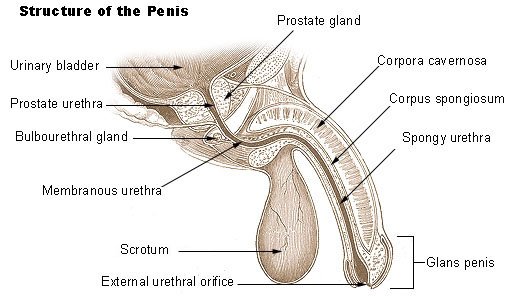
A penis rash is any change in the color, texture or surface of the skin of the glans (head), foreskin, shaft or the folds around the base. It can be red, pink, purple, gray, brown or white depending on the cause and your skin tone; on brown or black skin, redness is harder to see and the area may look darker or violet instead. It may be flat, raised, scaly, shiny, blistered or ulcerated, and may itch, burn or cause no discomfort at all.
Inflammation of the glans is called balanitis; when the foreskin is involved too it is balanoposthitis. Our balanitis guide covers that condition in depth, so this article answers the wider question most men ask: what is this penis rash, is it contagious, and what should I do about it? Balanitis itself affects roughly 3 to 11% of men and up to 6% of young men at some point.
Sources: DermNet — Balanitis; NHS — Balanitis
Penis rash causes: the 10 most common
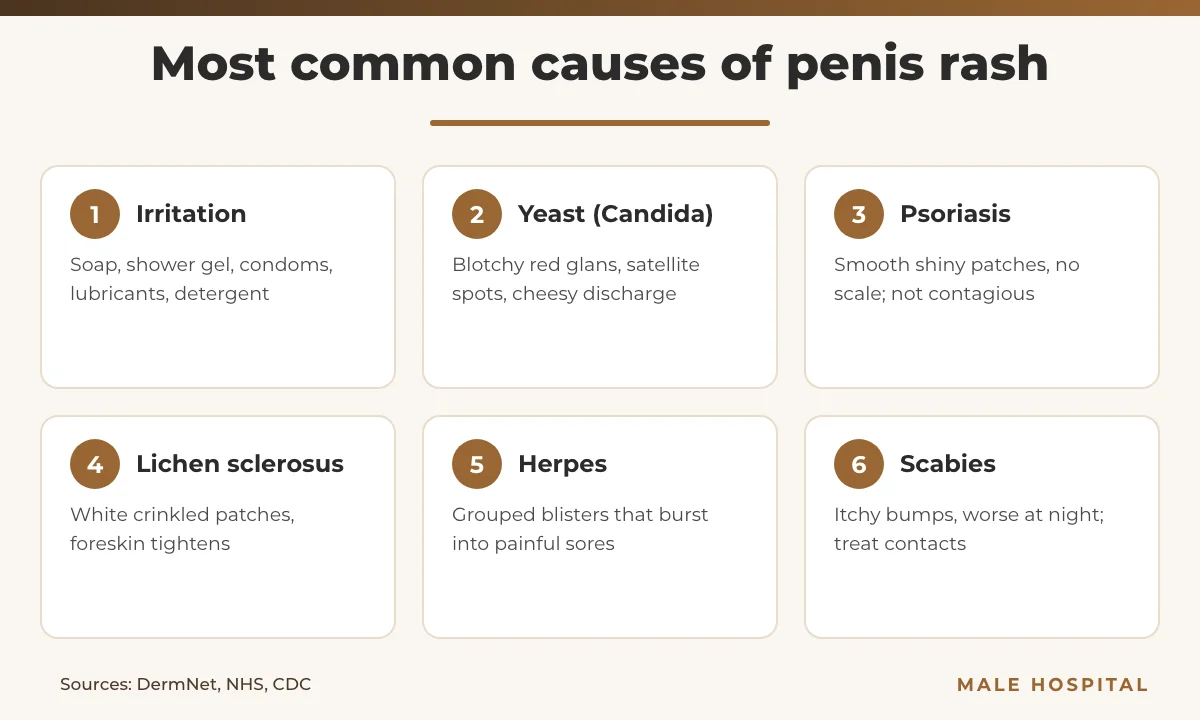
Genital skin is thin, warm and often moist, which makes it prone to both irritation and infection. The causes of a penis rash fall into two groups: non-infectious skin reactions and diseases, and infections (fungal, bacterial, viral or parasitic). In a hospital series of 108 biopsied, non-venereal penile skin conditions, Zoon balanitis (27.8%), lichen sclerosus (15.7%) and psoriasis (11.1%) led the list, although biopsied cases are skewed towards older men and chronic disease.
- Irritant or allergic contact dermatitis from soap, shower gel, detergent, lubricants, spermicides or latex condoms.
- Candida (yeast) balanitis, the most common infectious cause, especially in uncircumcised men and men with diabetes.
- Poor or over-zealous hygiene: retained smegma under the foreskin, or scrubbing with harsh products.
- Psoriasis and eczema flaring on the genitals, usually without the scale seen elsewhere.
- Lichen sclerosus, a chronic inflammatory disease that causes white, scar-like patches.
- Zoon balanitis, a benign chronic plaque on the glans of middle-aged and older uncircumcised men.
- Tinea cruris (jock itch), a ring-shaped fungal rash of the groin folds that rarely reaches the penis itself.
- Scabies, a mite infestation causing intensely itchy bumps, worse at night.
- Genital herpes, with grouped blisters that break into painful shallow sores.
- Syphilis, genital warts and molluscum contagiosum, which cause ulcers, warty growths or dome-shaped spots rather than a classic rash.
Sources: Indian Dermatology Online Journal (PMC) — Marcos-Pinto et al. 2018, Nonvenereal Penile Dermatoses: A Retrospective Study; DermNet — Balanitis; Cleveland Clinic — Balanitis
Non-infectious causes: irritation, psoriasis, lichen and Zoon balanitis
Contact dermatitis and irritation
The most frequent reason for a sore, red, itchy penis rash is irritation. Perfumed soaps, antibacterial washes, baby wipes, detergent residue, spermicides and some condoms or lubricants can all inflame genital skin. Allergic reactions tend to be sharply outlined, swollen and itchy; irritant reactions are more diffuse and often follow vigorous washing or prolonged moisture. The fix is usually simple: stop the product, wash with water or a bland emollient, dry gently, and switch to sensitive-skin or non-latex condoms if those are the trigger.
Sources: NHS — Balanitis; Cleveland Clinic — Balanitis
Genital psoriasis
Psoriasis affects more than 3% of the U.S. population, and more than half of people with psoriasis have genital symptoms at least once. As a penis rash it rarely looks like the thick silvery plaques of the elbows and knees; because the skin is thin and constantly rubbed, patches are smooth, shiny, pink, red, purple or dark brown, sometimes cracked, and may itch or burn. Genital psoriasis is not contagious and is not an STI, even though it is often mistaken for one. Friction from tight clothing or sex, skin injury and yeast overgrowth can trigger a flare.
Sources: Cleveland Clinic — Genital Psoriasis; American Academy of Dermatology — How can I treat psoriasis on my genitals?
Lichen sclerosus
Lichen sclerosus produces a penis rash of itchy white patches that look smooth or crinkled, most often on the foreskin and tip of the penis. The skin becomes fragile and may bleed or split, and over time the foreskin can tighten so that retraction and erections become painful. It cannot be cured, but a strong prescription steroid ointment used regularly for a few months usually controls it. The condition carries a low but real increase in penile cancer risk, and the European Association of Urology lists it among conditions commonly found in men with penile cancer, so regular self-checks for a lump, thickened skin or a non-healing ulcer are advised. Our article on lichen sclerosus in men covers it in detail.
Sources: NHS — Lichen sclerosus; EAU Guidelines — Penile Cancer: Epidemiology, Aetiology and Pathology
Zoon balanitis (plasma cell balanitis)
Zoon balanitis is a benign, chronic cause of penis rash seen mainly in uncircumcised men in middle and older age. It appears as a single, well-defined, shiny orange-red plaque on the glans, often mirrored on the inner foreskin, with tiny brighter red “cayenne pepper” spots. Because it can resemble a pre-cancerous lesion, a biopsy is often needed. Circumcision is the definitive treatment, with lesions typically resolving within weeks to a few months; moderately potent steroids, tacrolimus or pimecrolimus for 4 to 8 weeks, and laser are alternatives.
Normal bumps that are not a rash
Two harmless findings are often mistaken for a penis rash. Pearly penile papules are tiny flesh-colored bumps in neat rows around the rim of the glans, and Fordyce spots are small pale yellow dots on the shaft or scrotum. Neither is infectious and neither needs treatment.
Infectious causes: yeast, fungus, scabies and STIs
Candida (yeast) balanitis
Fungal infection, mostly Candida, is the most common infectious cause of a penis rash. It produces blotchy redness of the glans with small satellite spots at the edge, itching, a thick white or cheesy discharge under the foreskin and sometimes a sour smell. It thrives where the area stays warm and moist and is more likely in uncircumcised men and in men with diabetes, because sugar in the urine feeds yeast. A topical antifungal such as clotrimazole, miconazole or nystatin usually clears it; a swab confirms the diagnosis if unclear, and a blood sugar test is worthwhile when yeast keeps returning.
Sources: DermNet — Balanitis; NHS — Balanitis
Jock itch (tinea cruris)
Jock itch is a contagious dermatophyte infection of the groin folds, inner thighs and buttock crease that causes a scaly, itchy, often ring-shaped rash with a raised edge. The penis and scrotum are rarely affected, so a penis rash confined to the glans is unlikely to be tinea. It often spreads from athlete’s foot and is treated with antifungal cream or spray applied daily for up to 4 weeks; the rash usually resolves within one to eight weeks, but stopping early invites a relapse.
Sources: Cleveland Clinic — Jock Itch (Tinea Cruris); NHS — Ringworm
Scabies
Scabies mites cause a raised, spotty rash and intense itching that is worse at night, typically between the fingers, around the wrists and waist and in the groin; on the penis they form inflamed, itchy bumps easily mistaken for an STI. Treatment is a cream or lotion applied to the whole body and repeated 7 days later, for the patient, everyone in the household and any sexual partner from the past 8 weeks. Itching can linger for 2 to 4 weeks after the mites are dead.
Source: NHS — Scabies
Genital herpes
Herpes simplex virus causes a penis rash of clustered small blisters that burst and leave painful, shallow sores on the glans, shaft, scrotum, thighs or buttocks, often preceded by tingling or burning and, in a first episode, flu-like symptoms. Most people infected have no or very mild symptoms. Sores take a week or more to heal, and because the virus stays in a nearby nerve, outbreaks can recur, usually milder each time. Every first episode should be treated with an oral antiviral such as acyclovir 400 mg three times daily or valacyclovir 1 g twice daily for 7 to 10 days, started as early as possible. Daily suppressive therapy cuts recurrences by roughly 70 to 80% in men with frequent outbreaks and lowers the chance of passing the virus to a partner.
Sources: CDC — About Genital Herpes; CDC — STI Treatment Guidelines: Genital Herpes; NHS — Genital herpes
Syphilis
Primary syphilis begins as one or more firm, round, painless sores (chancres) where the bacterium entered, usually the genitals. The sore lasts about 3 to 6 weeks and heals even without treatment, which is exactly why it is missed. Weeks later, secondary syphilis can cause a rough red or reddish-brown rash, classically on the palms and soles, with fever, swollen glands, sore throat or patchy hair loss. Syphilis is curable with antibiotics, but treatment cannot undo damage already done, so any painless genital ulcer should be tested promptly and partners informed.
Source: CDC — About Syphilis
Warts and molluscum
Genital warts (HPV) form soft, flesh-colored or darker growths rather than a flat rash, while molluscum contagiosum produces smooth, dome-shaped spots about 2 to 5 mm wide with a shiny central dimple, acquired in adults through sexual skin contact; it usually clears within 18 months without treatment. MedlinePlus advises against self-treating any genital sore, because home remedies can make the cause harder to identify, and recommends avoiding sex until you have been examined.
Sources: NHS — Molluscum contagiosum; MedlinePlus — Genital sores, male
Penis rash symptom guide: what the pattern tells you
No table replaces an examination of a penis rash, but appearance, site, itch versus pain and timing narrow the possibilities considerably.
| What you see | Itch or pain | Most likely cause | Contagious? |
|---|---|---|---|
| Diffuse redness after a new soap, condom or lubricant | Itch, sting | Contact dermatitis | No |
| Blotchy red glans, satellite spots, cheesy discharge | Itch, burning | Candida balanitis | Not classed as an STI |
| Smooth, shiny red or dark patches without scale | Variable itch | Genital psoriasis | No |
| White crinkled patches; foreskin tightening | Itch, pain on erection | Lichen sclerosus | No |
| Scaly ring-shaped patch with raised edge | Itch, burning | Jock itch | Yes |
| Tiny inflamed bumps, itch worst at night | Intense itch | Scabies | Yes |
| Grouped blisters that burst into shallow sores | Pain, tingling first | Genital herpes | Yes |
| Firm, round, painless ulcer that heals in 3–6 weeks | None | Primary syphilis | Yes |
| Persistent velvety red patch, lump or non-healing sore | Often none | Pre-cancer or penile cancer (rare) | No |
Sources: DermNet — Balanitis; CDC — About Syphilis; Cleveland Clinic — Jock Itch (Tinea Cruris)
When to see a doctor about a penis rash
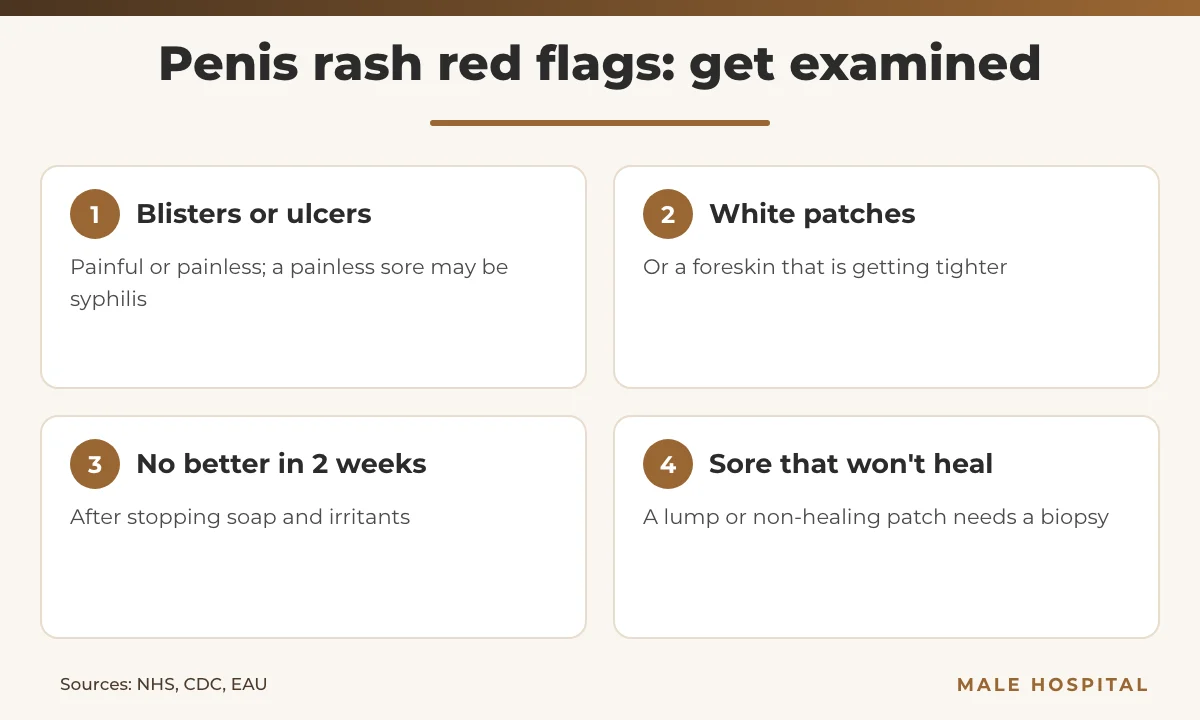
A mild, itchy redness that appeared after a new product and settles within a few days of gentle care rarely needs a visit. Every other penis rash is worth a professional look, and some findings should not wait:
- Blisters, open sores or any ulcer, painful or painless; a syphilis chancre is painless and heals on its own.
- White patches, thickened skin or a foreskin that is becoming tight, which may point to lichen sclerosus and scarring (phimosis).
- A rash that has not improved after about two weeks of stopping irritants and washing with water only, or that keeps coming back.
- A lump, a velvety red patch or a sore that will not heal.
- Fever, swollen groin glands, a rash on the palms and soles, or pain on urination alongside the genital rash.
- A foreskin stuck behind the glans that cannot be pulled forward: this is paraphimosis and is an emergency.
A urologist, dermatologist or sexual health clinic can all help; if you have had a new sexual partner, say so, because it changes which tests are run.
Sources: NHS — Balanitis; NHS — Lichen sclerosus; MedlinePlus — Genital sores, male
Diagnosis: what the doctor checks and tests
Diagnosis of a penis rash is mostly clinical. The doctor examines the penis, foreskin, scrotum and groin folds and often the rest of the skin, nails and mouth, because psoriasis, lichen planus and scabies leave clues elsewhere. Expect questions about when the rash started, products and medicines you use, itch versus pain, and sexual history.
Tests are chosen to fit the picture: a swab from the glans identifies yeast, bacteria or herpes virus; blood or urine tests screen for diabetes, syphilis and HIV; and a small skin biopsy under local anesthetic is used when a rash resists treatment or a pre-cancerous change must be excluded. DermNet recommends excluding sexually transmitted infections and considering an HIV test whenever balanitis fails to respond to standard therapy.
Sources: DermNet — Balanitis; MedlinePlus — Genital sores, male; Indian Journal of Sexually Transmitted Diseases and AIDS (PMC) — Dayal & Sahu 2016, Zoon balanitis: A comprehensive review
Penis rash treatment by cause
Penis rash treatment follows the diagnosis, which is why a trial of whatever cream is in the bathroom cabinet so often fails or makes things worse; a steroid cream applied to a fungal rash, for example, can spread the infection. The main options are:
- Irritation and eczema: stop the trigger, wash with water or an emollient, and use a mild to moderate topical steroid for a short course if inflammation persists.
- Candida balanitis: topical antifungal cream (clotrimazole, miconazole, nystatin) and control of diabetes if present.
- Bacterial balanitis or STIs such as gonorrhea and chlamydia: antibiotics prescribed after a swab, with partner notification where relevant.
- Genital psoriasis: a mild corticosteroid, a short course of a stronger one, calcipotriene, or tacrolimus or pimecrolimus; the American Academy of Dermatology advises against tazarotene and phototherapy on the genitals; severe cases may need methotrexate, cyclosporine or a biologic.
- Lichen sclerosus, lichen planus and Zoon balanitis: a potent steroid ointment such as clobetasol 0.05% and/or a calcineurin inhibitor; circumcision when scarring, phimosis or Zoon balanitis does not settle.
- Jock itch: antifungal cream or spray daily for up to 4 weeks, oral terbinafine, itraconazole or fluconazole for extensive cases, and treatment of athlete’s foot at the same time.
- Scabies: whole-body topical treatment repeated after 7 days for the patient, household and recent sexual contacts.
- Herpes: oral acyclovir, valacyclovir or famciclovir for 7 to 10 days in a first episode; episodic or daily suppressive therapy for recurrences.
- Syphilis: antibiotics with follow-up blood tests to confirm cure.
- Pre-cancerous lesions: topical 5-fluorouracil or imiquimod, or surgery, under specialist care.
Most straightforward cases of balanitis improve within a few days to a week of the right treatment. Avoid sex while the skin is raw or infectious, and keep follow-up appointments for Zoon balanitis and lichen sclerosus because of recurrence and the small risk of malignant change. Recurrent balanitis that does not respond to medicine, a scarred foreskin and Zoon balanitis are the usual reasons a urologist recommends circumcision; our phimosis treatment page explains how a tight foreskin is assessed and corrected.
Sources: DermNet — Balanitis; American Academy of Dermatology — How can I treat psoriasis on my genitals?; CDC — STI Treatment Guidelines: Genital Herpes; Cleveland Clinic — Balanitis
Prevention: skin care that works
Genital skin needs less, not more. The NHS advises adults to wash the penis once a day with warm water or an emollient rather than soap or shower gel, gently pull back the foreskin to wash underneath, and dry carefully before dressing. Avoid scented soaps, antibacterial washes, baby wipes and strongly fragranced laundry products; choose loose, breathable cotton underwear; and wash your hands before using the toilet or touching the penis.
If condoms or lubricants irritate, switch to non-latex, fragrance-free, spermicide-free products. Treat athlete’s foot promptly and put socks on before underwear so the fungus is not carried to the groin. Condoms lower the risk of herpes, syphilis and other STIs, although not completely, because sores and viral shedding can occur on skin a condom does not cover.
Sources: NHS — Balanitis; Cleveland Clinic — Jock Itch (Tinea Cruris); CDC — About Genital Herpes
If a penis rash is worrying you, keeps returning or has changed the look or movement of your foreskin, you can arrange a confidential assessment with our urologist-andrologist Assoc. Prof. Dr. Zülfü Sertkaya in Istanbul; message us on WhatsApp to ask a question or book a consultation.
FAQs about penis rash
Is a penis rash always an STI?
No. The most frequent causes are irritation from soaps or condoms, yeast (Candida) balanitis, psoriasis and eczema, none of which is sexually transmitted. Herpes, syphilis, warts and scabies are the main infectious causes to rule out, which is why a new penis rash after a new partner should be tested rather than assumed.
Sources: DermNet — Balanitis; MedlinePlus — Genital sores, male
How long does a penis rash take to go away?
It depends on the cause of the penis rash. Simple irritation settles within days once the trigger is removed; yeast balanitis usually improves within a few days to a week of antifungal cream; jock itch needs daily antifungal treatment for up to 4 weeks; herpes sores heal in a week or more. Psoriasis and lichen sclerosus are controlled rather than cured.
Sources: Cleveland Clinic — Balanitis; NHS — Ringworm
Can I use hydrocortisone or an antifungal cream on a penis rash myself?
Over-the-counter antifungal cream is reasonable for a classic itchy, blotchy yeast rash in a man who has had it diagnosed before. Steroid creams can worsen a fungal or herpes rash and mask lichen sclerosus or a pre-cancerous patch, so they should be used only after a diagnosis. Never self-treat a sore or ulcer.
Sources: MedlinePlus — Genital sores, male; DermNet — Balanitis
Can diabetes cause a rash on the penis?
Yes. High glucose in the urine feeds Candida under the foreskin, so recurrent or stubborn yeast balanitis is a recognized early sign of undiagnosed or poorly controlled diabetes. The NHS notes that a blood test for diabetes may be arranged when balanitis symptoms are severe, and controlling blood sugar is part of the treatment.
Sources: NHS — Balanitis; Cleveland Clinic — Balanitis
Is genital psoriasis contagious to my partner?
No. Psoriasis is an immune-driven skin disease, not an infection, and cannot be passed on through sex or skin contact. Friction during intercourse can trigger a flare, so the American Academy of Dermatology suggests a lubricated condom, gentle washing afterwards and avoiding sex while the skin is raw.
Sources: Cleveland Clinic — Genital Psoriasis; American Academy of Dermatology — How can I treat psoriasis on my genitals?
Can a penis rash be cancer?
Rarely, but a persistent velvety red patch, a lump, thickened skin or a sore that does not heal on the glans or foreskin can be penile intraepithelial neoplasia or penile cancer. HPV infection, phimosis, chronic inflammation and lichen sclerosus are the main risk factors identified by the EAU, and a biopsy settles the question quickly.
Sources: EAU Guidelines — Penile Cancer: Epidemiology, Aetiology and Pathology; NHS — Lichen sclerosus
Medically reviewed by Assoc. Prof. Dr. Zülfü Sertkaya, urologist and andrologist (FEBU), Istanbul. Last reviewed: November 2026.
This article is for general information and does not replace an individual consultation with a qualified doctor.
- DermNet — Balanitis
- NHS — Balanitis
- Cleveland Clinic — Balanitis
- MedlinePlus (NIH) — Genital sores – male
- Indian Dermatology Online Journal (PMC) — Marcos-Pinto et al. 2018 — Nonvenereal Penile Dermatoses: A Retrospective Study
- Indian Journal of Sexually Transmitted Diseases and AIDS (PMC) — Dayal & Sahu 2016 — Zoon balanitis: A comprehensive review
- Cleveland Clinic — Genital Psoriasis
- American Academy of Dermatology — How can I treat psoriasis on my genitals?
- NHS — Lichen sclerosus
- EAU Guidelines — Penile Cancer — Epidemiology, Aetiology and Pathology
- Cleveland Clinic — Jock Itch (Tinea Cruris)
- NHS — Ringworm
- NHS — Scabies
- CDC — About Genital Herpes
- CDC — STI Treatment Guidelines — Genital Herpes
- NHS — Genital herpes
- CDC — About Syphilis
- NHS — Molluscum contagiosum