
Phimosis Treatment: 5 Proven Options and the Best Choice
Phimosis treatment for adult men usually starts with a prescription steroid cream and gentle stretching, which loosens many tight foreskins within 4 to 8 weeks. If the foreskin stays tight, is scarred by lichen sclerosus, or causes pain during sex, a urologist can offer surgery: a foreskin-sparing preputioplasty, a frenuloplasty for a short frenulum, or adult circumcision, which remains the definitive option.
Source: Clinics and Practice (PMC) — Phimosis in Adults: Narrative Review of the New Available Devices and the Standard Treatments; NHS — Phimosis (tight foreskin)
- Topical corticosteroids, applied for 4 to 8 weeks with gentle stretching, are the usual first step in phimosis treatment for a tight foreskin in adults.
- Lichen sclerosus is a common cause of scarred, tightening foreskin in men; it needs a strong steroid ointment and sometimes circumcision.
- Preputioplasty keeps the foreskin and suits selected men; frenuloplasty treats a short frenulum that tears or hurts during sex.
- Adult circumcision is the gold-standard surgical option; most men return to work in about a week and wait at least 4 weeks before sex.
- A foreskin stuck behind the head of the penis (paraphimosis) is an emergency and needs same-day care.
Tell us about your symptoms privately and receive a personalised plan from our urologist-andrologist.
- What is phimosis treatment?
- Causes in adults, including lichen sclerosus
- Who is a good candidate for each approach
- Phimosis treatment options compared
- Steroid cream and stretching
- Surgery: preputioplasty, frenuloplasty and adult circumcision
- The procedure step by step
- Recovery timeline and sex after surgery
- Risks and side effects
- Results and realistic expectations
- Phimosis treatment with Dr. Zülfü Sertkaya in Istanbul
- How to start
- When to see a doctor
- FAQs about phimosis treatment
What is phimosis treatment?
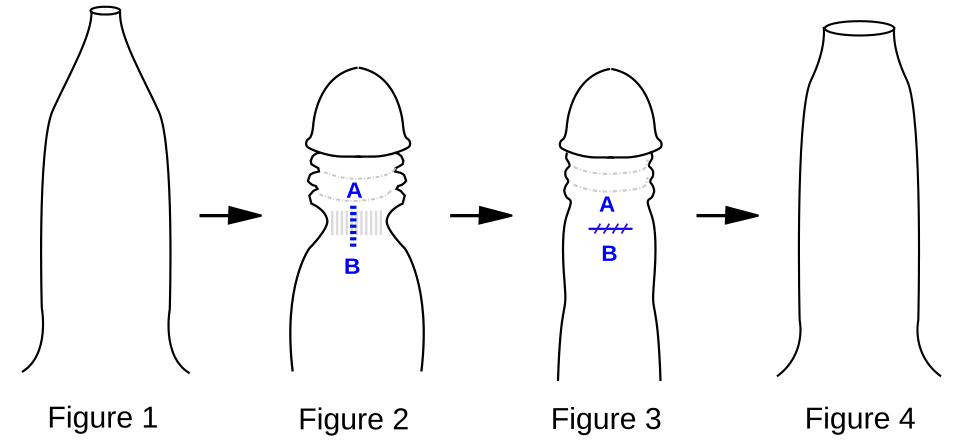
Phimosis means the foreskin is too tight to pull back fully over the head of the penis (the glans). In babies and young boys this is normal and usually resolves with age without any phimosis treatment. In adults it is called pathologic phimosis when it is caused by infection, inflammation or scarring, and it can make washing, urinating, erections and intercourse uncomfortable.
Common symptoms in men include swelling and tenderness, pain when peeing or a weak urine flow, repeated infections under the foreskin, bleeding or a thick discharge, and painful erections that make sex difficult. Some men also notice small tears in the foreskin after intercourse, a common reason to seek phimosis treatment.
Source: Cleveland Clinic — Phimosis; NHS — Phimosis (tight foreskin)
Phimosis treatment aims to give you a foreskin that retracts comfortably, or no tight foreskin at all, so that hygiene, urination and sex are pain-free. The right choice depends on the cause, how severe the narrowing is, whether there is scarring, and what you prefer: many men want to keep the foreskin, while others prefer a single definitive operation. For a broader overview of the condition itself, see our guide to phimosis in men.
Causes in adults, including lichen sclerosus
Adult phimosis is usually acquired, and the cause shapes phimosis treatment. Recurrent balanitis or balanoposthitis (inflammation of the glans and foreskin), infections including sexually transmitted infections, injuries, eczema, psoriasis and lichen planus can all leave the foreskin inflamed or scarred. Diabetes is another recognised cause, partly because sugar in the urine encourages repeated infections. Cases peak twice in life: in the first decade and again after the age of 60.
Source: Clinics and Practice (PMC) — Phimosis in Adults: Narrative Review; Cleveland Clinic — Phimosis
Lichen sclerosus (balanitis xerotica obliterans)
Lichen sclerosus is a common cause of tight, scarred foreskin in men and an important factor in phimosis treatment. It causes itchy white patches, smooth or crinkled, most often on the foreskin and the end of the penis. The skin is fragile and may bleed or hurt when rubbed, and the foreskin can tighten until erections become painful. It is not caused by infection, poor hygiene or sexual contact, and it is not contagious.
Lichen sclerosus slightly increases the risk of penile cancer, so men with it should check the area regularly and report a lump, thickened skin or an ulcer that does not heal. Long-standing phimosis is also linked with a higher risk of penile cancer, which is one reason a persistently tight, inflamed foreskin should receive phimosis treatment rather than be ignored. If repeated inflammation is your main problem, our article on balanitis explains the causes and care.
Source: NHS — Lichen sclerosus; Cleveland Clinic — Phimosis
Who is a good candidate for each approach
Almost every adult with a tight foreskin is a candidate for some form of phimosis treatment; the question is which one. A doctor usually makes the diagnosis from your history and an examination, and may test urine or a swab if infection is suspected.
- Steroid cream and stretching: men with mild to moderate narrowing (the review describes conservative care for grades 0 to 2) and no heavy scarring.
- Preputioplasty: men who want to keep the foreskin and can already pull it back partly; the tight ring is widened rather than removed.
- Frenuloplasty: men whose main problem is a short frenulum (frenulum breve) that tears, bleeds or hurts during erections or intercourse.
- Circumcision: men with lichen sclerosus, severe phimosis, failure of cream, painful intercourse, or repeated infections despite other treatment.
Source: Cleveland Clinic — Phimosis; Clinics and Practice (PMC) — Phimosis in Adults: Narrative Review; NHS — Circumcision in men
Phimosis treatment options compared
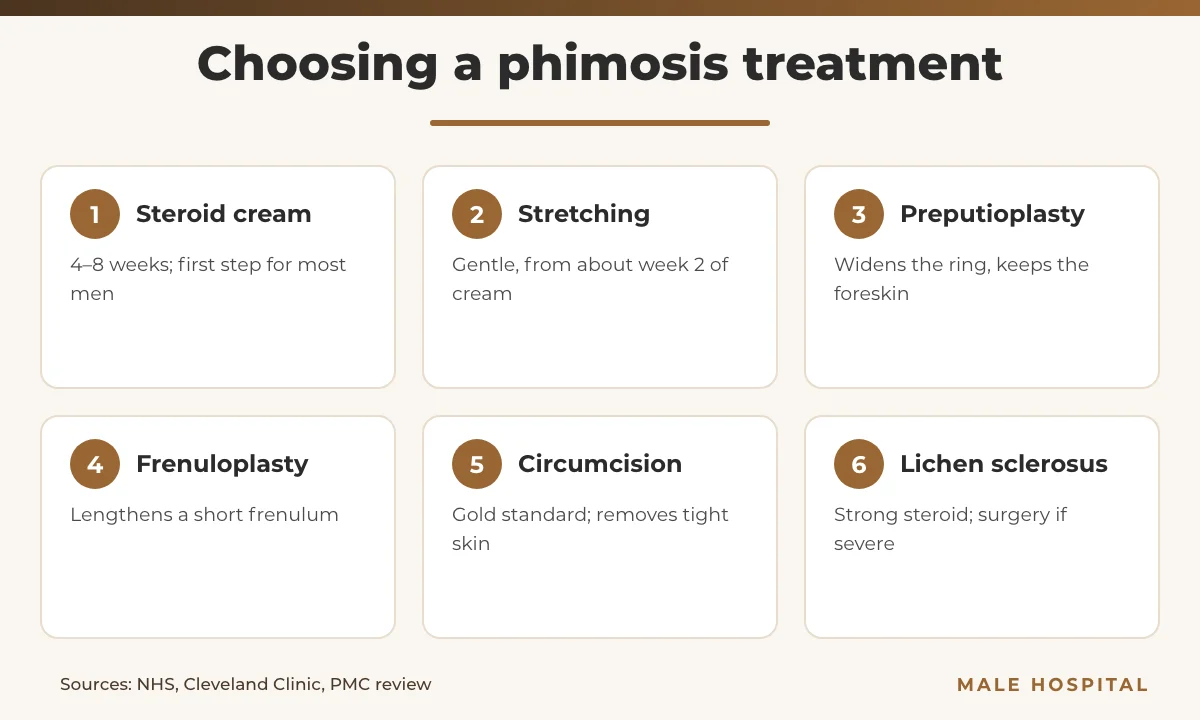
The table below summarises the main phimosis treatment options for adult men.
| Option | Best for | Keeps foreskin? | What the evidence shows |
|---|---|---|---|
| Topical steroid (4–8 weeks) | Mild to moderate narrowing; first step | Yes | More resolution than placebo or manual stretching alone; no long-term durability data |
| Stretching / silicone dilators | Grade 0–2 phimosis, alongside cream | Yes | One study: 52% of men no longer needed circumcision after a median 60 days |
| Preputioplasty | Partly retractable foreskin, wish to keep it | Yes | Small series; most men satisfied, a few later circumcised |
| Frenuloplasty | Short frenulum that tears or hurts | Yes | Median satisfaction 8/10; 11% later had circumcision |
| Adult circumcision | Lichen sclerosus, severe or recurrent phimosis | No | Gold standard; overall complication risk about 3.8% |
Source: Clinics and Practice (PMC) — Phimosis in Adults: Narrative Review; Annals of the Royal College of Surgeons of England (PMC) — Is Frenuloplasty Worthwhile? A 12-Year Experience
Steroid cream and stretching
Non-surgical phimosis treatment relies mainly on topical corticosteroids of different strengths, usually applied to the tight ring of the foreskin for 4 to 8 weeks. Compared with placebo or manual stretching alone, steroids clearly increase the chance of complete or partial improvement. When lichen sclerosus is the cause, a very potent steroid such as clobetasol propionate 0.05% is the usual choice.
Gentle stretching typically starts about two weeks after beginning the cream. Pull the foreskin back only as far as is comfortable, never force it, apply the cream to the newly exposed skin, and always return the foreskin over the glans afterwards. Wash daily with warm water or a mild unperfumed soap, and avoid perfumed products, talc and deodorants on the penis. If there is infection, antibiotics are added to phimosis treatment as well.
Source: Cleveland Clinic — Phimosis; NHS — Phimosis (tight foreskin)
There are no long-term data on how durable the improvement is, and long use of strong steroids can thin the skin (atrophy), cause small visible blood vessels (telangiectasia) and lower local immunity, so phimosis treatment courses with steroids should be supervised. A silicone dilator device studied in adults with grade 2 or less phimosis helped 37 of 71 men (52%) avoid circumcision, and 81% of them kept a good result at a median of 24 months.
For lichen sclerosus, the steroid ointment used in phimosis treatment is usually applied regularly for a few months to control symptoms, then a weaker steroid or a moisturiser may be used to keep it settled.
Source: Clinics and Practice (PMC) — Phimosis in Adults: Narrative Review; NHS — Lichen sclerosus
Surgery: preputioplasty, frenuloplasty and adult circumcision
When cream and stretching do not work, or the foreskin is scarred, surgical phimosis treatment is the next step. There are three main operations, and the choice depends on where the tightness is and whether you want to keep the foreskin.
Preputioplasty (foreskin-sparing surgery)
Preputioplasty widens the tight ring instead of removing the foreskin. The surgeon makes one or more incisions across the narrow band and closes them in a way that enlarges the opening, using techniques such as the Y-V plasty or the Heineke–Mikulicz plasty. The Y-V technique is limited to men who can already retract the foreskin partly. In one series of 89 cases, 73% were very satisfied or satisfied, 13% were indifferent and 13% dissatisfied, and two men later chose circumcision. Reviewers suggest offering preputioplasty selectively as a phimosis treatment.
Source: Clinics and Practice (PMC) — Phimosis in Adults: Narrative Review
Frenuloplasty for a short frenulum
The frenulum is the small band of skin on the underside of the penis that joins the foreskin to the glans. When it is short (frenulum breve), it can cause painful erections, painful intercourse and bleeding when it tears; it has also been described as a contributor to premature ejaculation. A simple frenuloplasty under local anaesthesia lengthens the band and gives relief and satisfaction comparable to circumcision in many men. If early climax is your main concern, our premature ejaculation treatment page covers the wider options.
In a 12-year review of 213 frenuloplasties, the main reasons were tearing or bleeding and pain during intercourse. Patients rated the result a median 8 out of 10, and 11% went on to circumcision, a median of 11 months later. The authors note the true failure rate may be somewhat higher.
Source: Indian Journal of Plastic Surgery (PMC) — Frenulum Breve: An Addendum to Accessory Penile Frenulum; Annals of the Royal College of Surgeons of England (PMC) — Is Frenuloplasty Worthwhile?
Adult circumcision techniques
Circumcision removes the foreskin and is considered the gold-standard surgical phimosis treatment, especially for lichen sclerosus. In the United States, phimosis is the reason for about half of adult circumcisions. Several techniques exist:
- Sleeve circumcision: two circular cuts and removal of the skin band between them; considered the best technique for men and older boys.
- Dorsal slit technique: a cut along the top of the foreskin before trimming; used in modified forms and as a comparison in studies.
- Ring devices (such as the Shang Ring): in 702 adults the operation took about 4 minutes, infection occurred in 1.14% and bleeding in 0.3%; the ring is removed after about 12 days, and mild swelling usually settled in about two weeks.
Source: Clinics and Practice (PMC) — Phimosis in Adults: Narrative Review
The procedure step by step
Whatever surgical phimosis treatment is chosen, the pathway follows similar steps:
- Assessment: history, examination of the foreskin and frenulum, and tests for infection or diabetes if needed. Any infection is treated first.
- Plan: the surgeon explains which operation suits you, the alternatives and the risks, so you can give informed consent.
- Anaesthesia: adult circumcision is usually done under general anaesthetic, though local anaesthetic or an epidural may be used; frenuloplasty is often done under local anaesthesia. An antibiotic injection may be given.
- Surgery: for circumcision, a circular cut is made below the head of the penis, the foreskin is removed and the skin is closed with dissolvable stitches. The operation takes about 30 minutes.
- Discharge: most men go home the same day with pain relief and wound-care instructions.
Source: NHS — Circumcision in men; Indian Journal of Plastic Surgery (PMC) — Frenulum Breve
Recovery timeline and sex after surgery
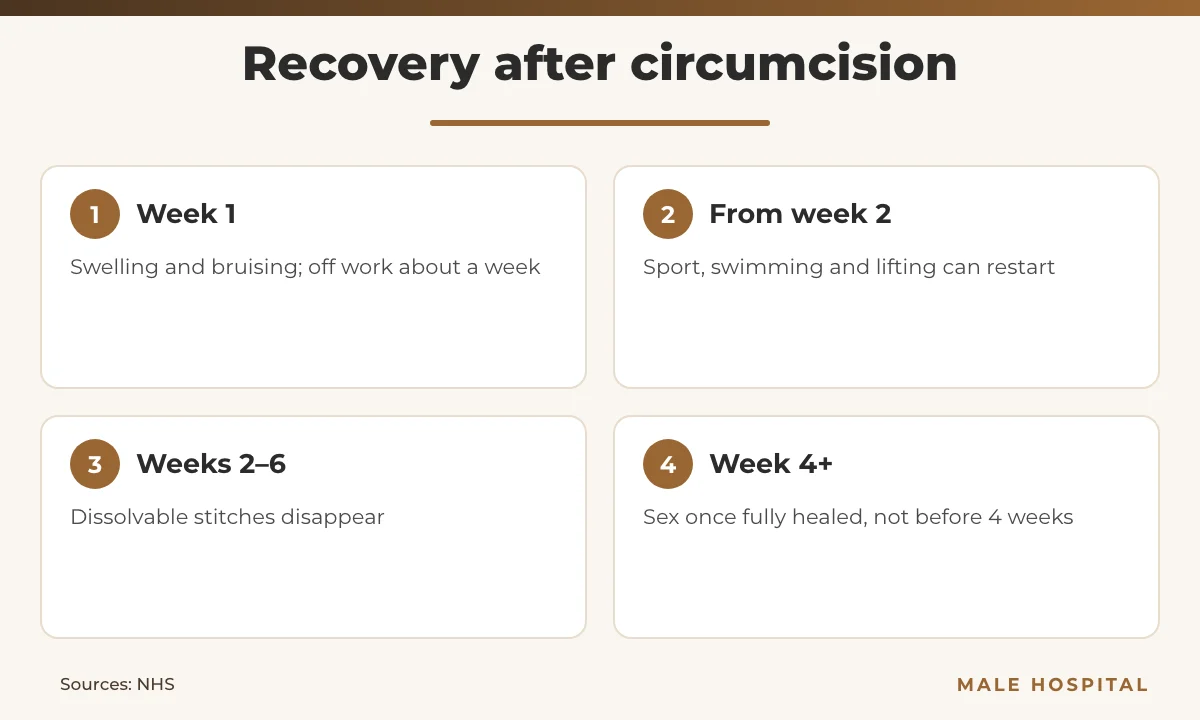
Recovery after surgical phimosis treatment such as adult circumcision is gradual. The timeline below follows NHS advice; your surgeon may adjust it, and preputioplasty or frenuloplasty wounds are smaller but follow similar care.
| Time after surgery | What to expect |
|---|---|
| First 24 hours | Rest at home; do not drive for at least 24 hours after a general anaesthetic |
| Weeks 1–2 | Swelling, bruising and minor bleeding are normal; most men stay off work for about a week |
| From week 2 | Swimming, cycling, sport and heavy lifting can usually restart |
| Weeks 2–6 | Dissolvable stitches disappear |
| Week 4 onward | Sex and masturbation once the wound is fully healed, and not before 4 weeks |
| 4–6 weeks to a few months | Healing completes; glans sensitivity and tightness during erections ease |
Source: NHS — Circumcision in men
After phimosis treatment with surgery, simple painkillers such as paracetamol or ibuprofen usually control discomfort. Keep the area clean with gentle washing using mild, unscented soap, and follow your surgeon’s dressing advice. The head of the penis often feels very sensitive for the first few weeks because it is no longer covered, and erections can feel tight for a few months as the scar stretches.
About sex after surgery: the skin moves differently and the glans usually becomes somewhat less sensitive, but the NHS states these changes should not have a major effect on your long-term sex life. In one study of 69 men, pre-operative symptoms had fully resolved in 86% by three months, and both erection scores and genital self-image improved. Evidence on sensation is limited, and no study has shown a change in time to orgasm or sexual satisfaction.
Source: NHS — Circumcision in men; MedlinePlus — Circumcision; Clinics and Practice (PMC) — Phimosis in Adults: Narrative Review
Risks and side effects
Every phimosis treatment carries some risk.
- Steroid creams: skin thinning, small visible blood vessels and reduced local immunity with prolonged or unsupervised use.
- Circumcision, common: bleeding, infection, pain, redness around the wound, and a foreskin left too long or too short.
- Circumcision, overall: complications in about 3.8% of cases in the review; serious complications such as urethral fistula are rare, at 0.2–0.6%.
- Further surgery: sometimes needed to stop bleeding, remove excess skin or improve the appearance.
- Urinary problems: rarely, narrowing of the urinary opening or damage to the urethra causing difficulty peeing.
- Sensation: the glans usually becomes less sensitive after circumcision.
- Foreskin-sparing surgery: the tightness or symptoms can return, and some men later need circumcision.
Source: NHS — Circumcision in men; Cleveland Clinic — Phimosis; MedlinePlus — Circumcision; Clinics and Practice (PMC) — Phimosis in Adults: Narrative Review
Results and realistic expectations
After phimosis treatment with cream and stretching, or with surgery, the outlook for adult men is good. Steroids and stretching avoid an operation for a meaningful share of men, but results may not last once treatment stops, and lichen sclerosus often needs ongoing skin care even after surgery. Preputioplasty and frenuloplasty keep the foreskin and satisfy most patients, yet a minority later need circumcision.
Circumcision removes the tight skin permanently, so phimosis cannot recur, although the scar line, sensation and look of the penis change. Realistic goals of phimosis treatment are comfortable hygiene, normal urination, and pain-free erections and intercourse. Lichen sclerosus can still affect the glans after circumcision, so regular self-checks and follow-up remain important.
Source: Cleveland Clinic — Phimosis; NHS — Lichen sclerosus
Phimosis treatment with Dr. Zülfü Sertkaya in Istanbul
Assoc. Prof. Dr. Zülfü Sertkaya is a urologist and andrologist in Istanbul and a Fellow of the European Board of Urology (FEBU, 2017). He has been a urology specialist since 2014 and became Associate Professor of Urology in 2020. He is a member of the EAU, ESSM, ISSM, the Turkish Urological Association and the Turkish Society of Andrology, and he founded the Andro Expertise Men’s Health and Aesthetic Clinic in Zeytinburnu, Istanbul.
For patients travelling to Istanbul, our team supports you with reception and transport, translation, trip planning, hotel accommodation, medical consultation and aftercare. Phimosis treatment pricing is given after a free assessment, because it depends on the technique that suits you and the type of anaesthesia.
How to start
Start with a free, confidential WhatsApp consultation. Share your history: how long the foreskin has been tight, whether it cracks, tears or bleeds, any white patches or itching, diabetes or other conditions, previous creams and how long you used them, and any problems during sex. Dr. Sertkaya’s team will reply with a personalised plan and tell you whether cream, foreskin-sparing surgery, frenuloplasty or circumcision is the most suitable phimosis treatment for you.
When to see a doctor
See a doctor about phimosis treatment if your foreskin is tight and swollen or painful, if there is bleeding, a thick discharge or an unpleasant smell, if peeing is painful or difficult, if erections hurt, or if you have an itchy white patch on the penis. Report any lump, thickened skin or ulcer that does not heal.
Go to an emergency department straight away if the foreskin has been pulled back and will not return over the tip of the penis (paraphimosis), because it can cut off blood flow. After circumcision, seek urgent help for bleeding that will not stop, a red or hot wound, fever, blood in the urine or worsening pain, and emergency care if you cannot pee at all.
Source: NHS — Phimosis (tight foreskin); NHS — Circumcision in men; NHS — Lichen sclerosus
Ready to fix a tight foreskin? Message us and receive a personalised plan from Dr. Sertkaya’s team.
Related men’s health guides
- Phimosis: Causes, 4 Treatments and When to Worry
- Adult Circumcision: 7 Facts on Surgery, Recovery and Sex
- Paraphimosis: Emergency Signs, 4 Treatments and Prevention
- Balanitis: 6 Common Causes, Treatment and Prevention
- Lichen Sclerosus in Men: 7 Key Signs, Causes and Treatment
- Pearly Penile Papules: 6 Ways to Tell Them From Warts
FAQs about phimosis treatment
Can adult phimosis be treated without surgery?
Often, yes. A prescription corticosteroid cream applied for 4 to 8 weeks, combined with gentle stretching that starts about two weeks into the course, loosens many tight foreskins. This non-surgical phimosis treatment works best when there is little scarring. If the foreskin is scarred by lichen sclerosus, or the cream fails, surgery is usually the next step.
Source: Cleveland Clinic — Phimosis
How long does steroid cream take to work for phimosis?
Courses usually last 4 to 8 weeks. Many men notice the foreskin softening within the first few weeks, which is when stretching is added. If there is no improvement by the end of the course, ask your doctor to reassess, because longer unsupervised steroid use can thin the skin and further cream is unlikely to help much.
Source: Clinics and Practice (PMC) — Phimosis in Adults: Narrative Review
Is circumcision the only permanent cure?
Circumcision is the only option that removes the tight skin completely, so phimosis cannot come back. Preputioplasty and frenuloplasty keep the foreskin and work well for selected men, but symptoms return in some, and a minority later choose circumcision. Your surgeon can explain which phimosis treatment fits the type and cause of your tightness.
Source: Clinics and Practice (PMC) — Phimosis in Adults: Narrative Review
When can I have sex after circumcision?
The NHS advises avoiding sex and masturbation for at least 4 weeks, or until the wound has fully healed, whichever is later. Healing usually takes 4 to 6 weeks. Erections may feel tight for a few months as the scar stretches, and the glans is often very sensitive at first before settling over several weeks.
Source: NHS — Circumcision in men
Does circumcision affect sexual pleasure or erections?
The glans usually becomes somewhat less sensitive and the skin moves differently, but the NHS says these changes should not have a major effect on long-term sex life. Studies suggest no major harm to erectile function or satisfaction, and in one study of men with phimosis, erection scores improved after surgery.
Source: NHS — Circumcision in men; Clinics and Practice (PMC) — Phimosis in Adults: Narrative Review
What is a short frenulum and how is it fixed?
The frenulum is the band of skin under the glans. When it is too short, it can pull painfully during erections, tear and bleed during sex, and has been linked with early ejaculation. A frenuloplasty under local anaesthesia lengthens it; in one long-term review, patients rated the result a median 8 out of 10.
Source: Indian Journal of Plastic Surgery (PMC) — Frenulum Breve; Annals of the Royal College of Surgeons of England (PMC) — Is Frenuloplasty Worthwhile?
Is lichen sclerosus on the penis dangerous?
Lichen sclerosus is not an infection and cannot be passed to a partner. It is controlled with a strong steroid ointment, and severe cases may need circumcision. It slightly raises the risk of penile cancer, so check the skin regularly and see a doctor about any lump, thickening or non-healing ulcer.
Source: NHS — Lichen sclerosus
How long does adult circumcision take, and will I stay in hospital?
The operation itself takes about 30 minutes, usually under general anaesthetic, although local anaesthetic is sometimes used. Most men go home the same day. Plan to stay off work for about a week and avoid sport, swimming, cycling and heavy lifting for at least two weeks.
Source: NHS — Circumcision in men
How much does phimosis treatment cost in Istanbul?
The cost of phimosis treatment depends on whether you need cream only, preputioplasty, frenuloplasty or circumcision, on the technique, and on the type of anaesthesia. We give pricing after a free, confidential WhatsApp assessment of your history, so that the quote matches the treatment you actually need.
Medically reviewed by Assoc. Prof. Dr. Zülfü Sertkaya, urologist and andrologist (FEBU), Istanbul. Last reviewed: October 2026.
This article is for general information and does not replace an individual consultation with a qualified doctor.
- NHS — Phimosis (tight foreskin)
- NHS — Circumcision in men
- NHS — Lichen sclerosus
- Cleveland Clinic — Phimosis
- Clinics and Practice (PMC) — Phimosis in Adults: Narrative Review of the New Available Devices and the Standard Treatments
- Annals of the Royal College of Surgeons of England (PMC) — Is Frenuloplasty Worthwhile? A 12-Year Experience
- Indian Journal of Plastic Surgery (PMC) — Frenulum Breve: An Addendum to Accessory Penile Frenulum
- MedlinePlus — Circumcision