Adult circumcision is a short operation, usually done as a day case, that removes the foreskin of the penis. In adult men it is mostly recommended for medical problems such as a tight foreskin (phimosis), repeated balanitis or scarring from lichen sclerosus, when creams and other treatments have not worked. Most men return to work in about a week and need to avoid sex for at least 4 to 6 weeks while the wound heals.
Source: NHS — Circumcision in men; Cleveland Clinic — Circumcision: Procedure, Benefits, Risks & Recovery
- The main medical reasons for circumcision in men are phimosis, paraphimosis, recurrent balanitis or posthitis, lichen sclerosus and some foreskin tumors.
- The operation takes about 30 minutes under general anesthesia, a local nerve block or, less often, an epidural.
- Plan about 1 week off work, no sport for 2 weeks and no sex or masturbation for at least 4 to 6 weeks.
- The highest-quality studies found no overall harm to erections, sensation, ejaculation timing or sexual satisfaction.
- Three randomized trials showed circumcision lowers heterosexual men’s risk of acquiring HIV by roughly 50–60%, but it is only partial protection.
- What is adult circumcision?
- Medical reasons for adult circumcision
- Before surgery: assessment and preparation
- Anesthesia options
- Circumcision techniques for adults
- Recovery after adult circumcision
- Risks and complications
- Adult circumcision, sensation and sexual function
- Circumcision and HIV prevention: what WHO says
- When to see a doctor
- FAQs about adult circumcision
What is adult circumcision?
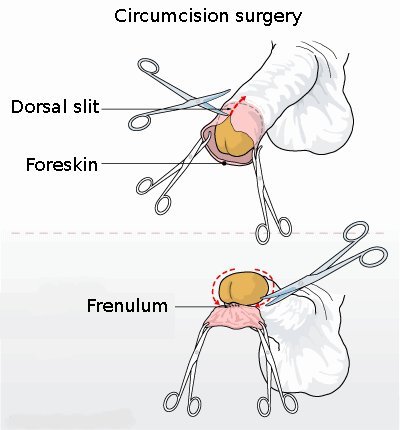
The foreskin (prepuce) is the double fold of skin that covers the head of the penis, the glans. Circumcision is the surgical removal of the foreskin so that the glans is permanently exposed. A thin band of tissue on the underside, the frenulum, is usually trimmed or repaired at the same time.
Circumcision is far more often done in babies and children, but adults can have it too. In men the operation takes slightly longer than in infants, and the skin edges are usually closed with dissolvable stitches.
Source: Cleveland Clinic — Circumcision; American Family Physician — Adult Circumcision
Men ask about adult circumcision for two broad reasons. The first is medical: a foreskin problem that keeps coming back or does not respond to creams. The second is non-medical: religious, cultural or personal preference. Both are legitimate, but a careful surgeon will explore the reasons, explain the risks and alternatives, and make sure the decision is informed before booking surgery.
Source: American Family Physician — Adult Circumcision
Medical reasons for adult circumcision
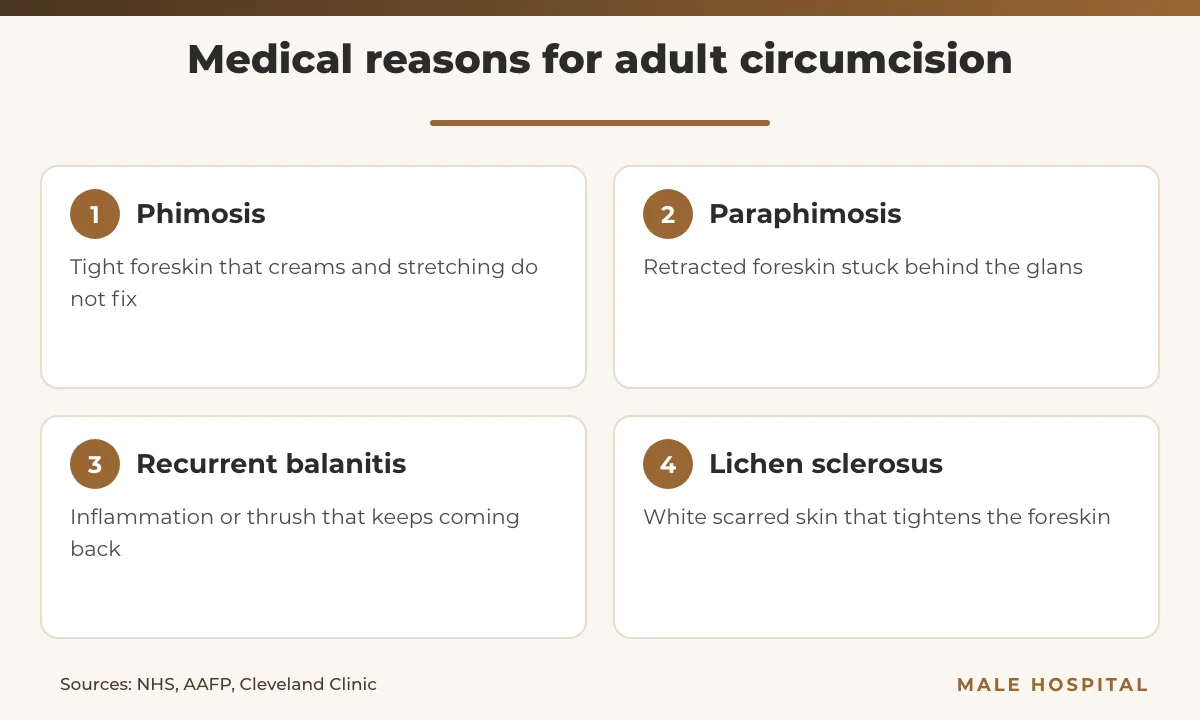
In public health systems such as the UK NHS, adult circumcision for men is offered only for medical reasons, usually after other treatments have failed. A review in American Family Physician lists phimosis as the most common indication and paraphimosis as the second most common.
Phimosis and paraphimosis
Phimosis is a foreskin that is too tight to retract, which can cause painful erections, splitting of the skin during sex or difficulty peeing. Steroid creams and gentle stretching often help, so surgery is usually considered when phimosis is severe, the cream does not work, intercourse is painful or the cause is lichen sclerosus. Our complete guide to phimosis explains these first-line options in detail. Paraphimosis, a retracted foreskin that gets stuck behind the glans and swells, is an emergency and the second most common reason for adult circumcision.
Source: NHS — Circumcision in men; Cleveland Clinic — Circumcision
Recurrent balanitis and posthitis
Balanitis means inflammation of the glans; posthitis is inflammation of the foreskin. A single episode is usually treated with hygiene measures and creams, as described in our balanitis guide. When the swelling, itching or soreness keeps returning, including recurrent yeast infections that do not settle with antifungal treatment, removing the foreskin takes away the warm, moist space where the problem starts.
Lichen sclerosus, tumors and other reasons
Lichen sclerosus (also called balanitis xerotica obliterans) causes white, scarred, tight skin and is a common reason adult phimosis does not respond to creams. Adult circumcision may also form part of the treatment of tumors of the foreskin and of rare penile cancer. Less common indications include excess foreskin and repeated tears of the frenulum during sex.
Source: NHS — Circumcision in men; American Family Physician — Adult Circumcision
Before surgery: assessment and preparation
Before surgery, the urologist takes a medical history and examines the penis. This checks the reason for surgery, looks for active infection or anything suspicious that needs a different approach first, and confirms which technique suits your anatomy. Men with an active infection, a possible penile cancer or unusual anatomy of the genitals should be managed by a urologist rather than in a general clinic.
Tell your surgeon about every medicine and supplement you take. Anti-inflammatory painkillers (NSAIDs) and blood thinners increase the risk of bleeding during and after adult circumcision, and you may be asked to pause some of them under medical advice. If you will have a general anesthetic, you will be given fasting instructions, and an antibiotic injection may be given at the time of surgery to lower the infection risk.
Source: Cleveland Clinic — Circumcision; NHS — Circumcision in men; American Family Physician — Adult Circumcision
Anesthesia options
According to the NHS, the operation is usually done under general anesthesia, so you are asleep throughout. The alternatives are a local anesthetic, which numbs only the penis while you stay awake, or an epidural, which numbs you from the waist down. Most men go home the same day.
The local technique most often used is a dorsal penile nerve block: anesthetic is injected near the base of the penis, at roughly the 10 and 2 o’clock positions, to numb the two main nerves on the upper side. Many surgeons add a ring block, a band of anesthetic injected around the base of the shaft, to numb the underside and frenulum too. A numbing cream applied beforehand can reduce the sting of the needle.
Source: NHS — Circumcision in men; American Family Physician — Adult Circumcision
The choice depends on your general health, your preference and the surgeon’s advice, and it is worth discussing at your consultation. Either way, you should not feel sharp pain during the procedure itself.
Circumcision techniques for adults
In the standard adult circumcision, the surgeon makes a circular cut just below the glans, removes the foreskin and closes the skin with dissolvable stitches. The procedure takes about 30 minutes and follows the same principles in adults and children. Bleeding vessels are sealed with fine ties or electrocautery.
Source: NHS — Circumcision in men; Cleveland Clinic — Circumcision
Dorsal slit technique
The foreskin is first cut lengthwise along the top, from the tip toward the corona (the rim of the glans), which opens a tight ring and exposes the glans. The skin is then trimmed around the base and the edges are stitched. This method is preferred when the foreskin cannot be pulled back, as in phimosis or after paraphimosis.
Sleeve technique
Circular incisions are marked around the shaft near the corona and frenulum, and the “sleeve” of skin between them is removed before the edges are joined with stitches. It can give better control of bleeding when large veins lie under the skin.
Device-assisted circumcision
Disposable devices that clamp the foreskin are used for adult circumcision in some settings, particularly in mass HIV-prevention programs. The World Health Organization has published separate guidance on evaluating and using devices for adult male circumcision.
Source: American Family Physician — Adult Circumcision; WHO — Voluntary medical male circumcision for HIV prevention
| Technique | How it works | Often chosen when |
|---|---|---|
| Dorsal slit | Lengthwise cut on top, then trimming around the base | The foreskin is tight or cannot be retracted (phimosis, after paraphimosis) |
| Sleeve | Two circular cuts; the band of skin between them is removed | The foreskin retracts and precise bleeding control is wanted |
| Device-assisted | A disposable clamp or ring holds and seals the foreskin | Mainly large public HIV-prevention programs |
Source: American Family Physician — Adult Circumcision; WHO — Voluntary medical male circumcision
Recovery after adult circumcision
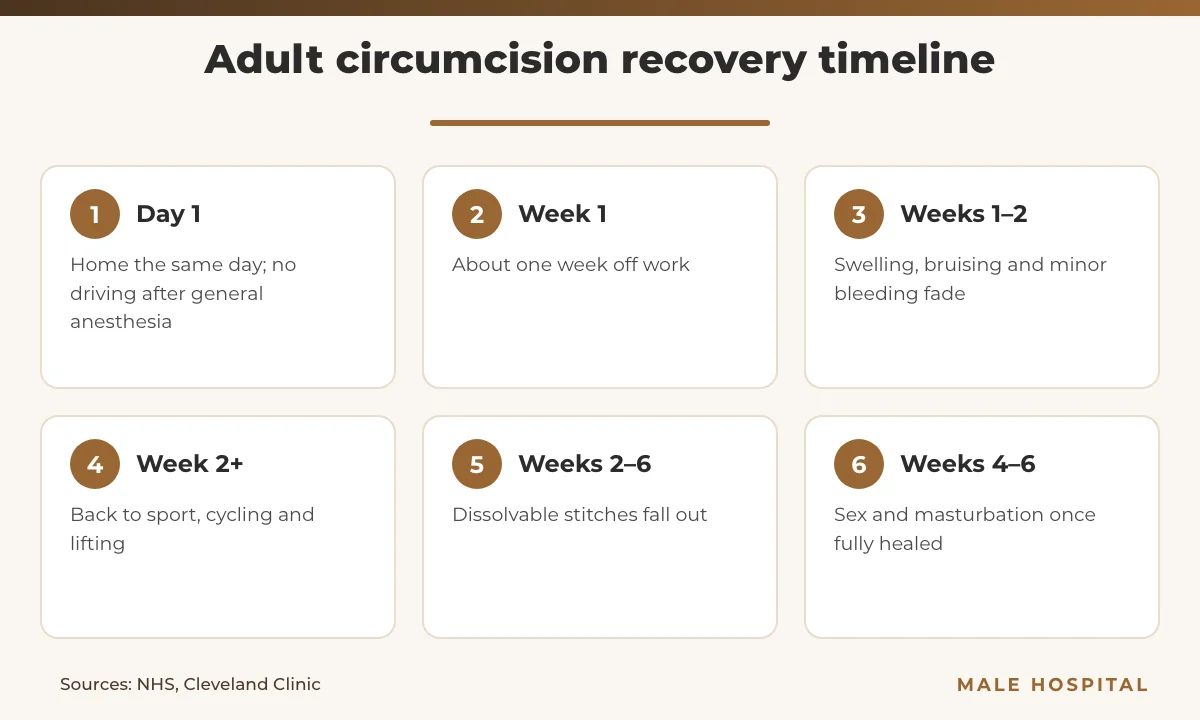
Most men recover in two to three weeks, but full healing can take four to six weeks or a little longer. Swelling, bruising and some minor bleeding are normal for the first one to two weeks. The newly exposed glans is very sensitive at first, and this settles over a few weeks.
Source: Cleveland Clinic — Circumcision; NHS — Circumcision in men
Practical aftercare
- If a dressing is used, it is usually removed 24 to 48 hours after surgery once there is no oozing.
- Wear loose clothing or supportive briefs, wash the area gently and pat or air dry.
- Simple painkillers such as paracetamol or ibuprofen usually control the discomfort; follow your surgeon’s advice on which to use.
- Do not drive for at least 24 hours after a general anesthetic, and only drive once you can do an emergency stop without pain.
- Erections, including at night, can pull on the stitches and cause brief discomfort in the first weeks.
Source: NHS — Circumcision in men; American Family Physician — Adult Circumcision
The abstinence period: when can you have sex again?
Avoid sex and masturbation for at least four weeks, and until the wound has completely healed; Cleveland Clinic and American Family Physician both advise four to six weeks. Starting too early can split the healing scar, cause bleeding or let infection in. Even after that, the scar may feel tight or uncomfortable during erections for a few months while it stretches, and it can occasionally bleed, so go gently and use plenty of lubricant at first.
Source: NHS — Circumcision in men; Cleveland Clinic — Circumcision; American Family Physician — Adult Circumcision
| Time after surgery | What to expect or avoid |
|---|---|
| First 24 hours | Rest at home; no driving after a general anesthetic; someone should stay with you overnight |
| 24–48 hours | Dressing (if used) removed once there is no oozing |
| 1–2 weeks | Swelling and bruising fade; about 1 week off work |
| At least 2 weeks | No swimming, cycling, sport or heavy lifting |
| 2–6 weeks | Dissolvable stitches fall out |
| 4–6 weeks | Sex and masturbation once the wound has fully healed |
| Up to a few months | Tightness during erections eases as the scar softens |
Source: NHS — Circumcision in men; Cleveland Clinic — Circumcision
Risks and complications
Adult circumcision is a common and generally safe operation. Cleveland Clinic reports complications in less than 3% of circumcisions, and in a large Kenyan trial of young adult men, adverse events related to surgery occurred in 1.5% of those circumcised and resolved quickly. Most problems are minor.
Source: Cleveland Clinic — Circumcision; The Lancet (PubMed) — Male circumcision for HIV prevention in young men in Kisumu, Kenya
- Bleeding and hematoma: the most frequent problems; usually controlled with pressure, occasionally needing a return to theater.
- Infection: redness, warmth, pus or fever; treated with local or oral antibiotics.
- Swelling and pain: expected early on, but should improve day by day.
- Cosmetic issues: too much or too little skin removed, uneven scar or adhesions, which may need revision surgery.
- Meatal problems: irritation of the urinary opening (meatitis) or, rarely, narrowing (meatal stenosis) or damage to the urethra, causing a weak stream or difficulty peeing.
- Anesthesia-related effects: as with any procedure under anesthesia.
Source: NHS — Circumcision in men; American Family Physician — Adult Circumcision; Cleveland Clinic — Circumcision
Adult circumcision does not affect fertility. Choosing an experienced urologist, stopping blood thinners only as advised, and following the aftercare instructions are the most effective ways to keep these risks low.
Source: Cleveland Clinic — Circumcision
Adult circumcision, sensation and sexual function
Whether adult circumcision changes sex is one of the most common worries, and online opinions are strongly divided. The research is the best guide, and it points mostly in a reassuring direction.
What the best studies show
A 2013 systematic review in The Journal of Sexual Medicine examined 36 studies covering more than 40,000 men. The randomized trials and the high- and good-quality observational studies uniformly found no overall adverse effect of circumcision on penile sensitivity, arousal, sexual sensation, erectile function, premature ejaculation, time to ejaculation, orgasm, satisfaction or pain during penetration. Most studies that did report harm were rated low quality because of design or analysis flaws.
In the Kenyan randomized trial, 2,684 men aged 18–24 were followed for two years. Rates of any sexual dysfunction fell over time in both the circumcised and the control group, and the change was not linked to circumcision. At 24 months, 64% of circumcised men said their penis was “much more sensitive” than before surgery, and 54.5% rated reaching orgasm as much easier.
What individual men may notice
Evidence across groups does not mean nothing changes for an individual. The NHS notes that some loss of sensitivity in the glans is common and may be noticeable during sex, and that the skin moves differently over the shaft, but these changes should not significantly affect a man’s long-term sex life. Early on, the opposite is typical: the newly exposed glans feels oversensitive for a few weeks. Cleveland Clinic states there is no proof that circumcision reduces sensitivity.
Source: NHS — Circumcision in men; Cleveland Clinic — Circumcision
Adult circumcision is not a treatment for premature ejaculation or erectile dysfunction, and good-quality studies do not show it causes either. If you notice a change in erections or ejaculation after surgery, it deserves its own assessment rather than being blamed automatically on the operation.
Circumcision and HIV prevention: what WHO says
Between 2002 and 2006, three large randomized trials in South Africa, Uganda and Kenya enrolled more than 11,000 HIV-negative heterosexual men. All three were stopped early because the benefit was clear. A Cochrane meta-analysis found that circumcision reduced the risk of acquiring HIV by 50% at 12 months and 54% at 21–24 months, and concluded the reduction lies between 38% and 66% over 24 months, with a very low rate of adverse events.
Source: Cochrane Review (PubMed) — Male circumcision for prevention of heterosexual acquisition of HIV in men; The Lancet (PubMed) — Male circumcision for HIV prevention in Kisumu, Kenya
Based on this evidence, WHO and UNAIDS have recommended voluntary medical male circumcision (VMMC) since 2007 as an additional HIV-prevention method, describing a risk reduction of approximately 60% for heterosexual exposure. Programs focus on priority countries in Eastern and Southern Africa. The WHO HIV fact sheet lists circumcision alongside condom use as ways to reduce the risk of infection.
Source: WHO — Voluntary medical male circumcision for HIV prevention; WHO — HIV and AIDS fact sheet
Important limits of the evidence
- The protection is partial: circumcised men can still get HIV, so condoms remain essential.
- The trial evidence applies to men having vaginal sex with women. The CDC says there is insufficient evidence that circumcision reduces HIV risk for men who have sex with men.
- Evidence of a direct benefit for female partners is inconclusive.
- The trials also found protection against high-risk genital HPV and genital herpes.
Source: CDC — HIV Risk and Prevention Estimates; CDC — STI Treatment Guidelines: Primary Prevention Methods
For a man living in a low-prevalence country, HIV prevention alone is rarely the main reason for the operation. It is best seen as a modest extra benefit on top of a medical indication, never a replacement for condoms, testing or pre-exposure prophylaxis.
When to see a doctor
See a urologist about adult circumcision if your foreskin is tight, splits, keeps getting inflamed or makes sex painful despite treatment. After surgery, contact your surgeon or a doctor if:
- stitches have not dissolved after 6 weeks, or the wound reopens;
- there is pus, discharge or a bad smell, or the wound becomes red and warm;
- you have a high temperature or feel hot and shivery;
- new bruising appears, or the urine stream becomes thin or slow;
- pain is severe or getting worse, or you see blood in your urine.
Seek emergency care if bleeding will not stop with firm pressure, or if you cannot pee at all.
Source: NHS — Circumcision in men
If you are considering adult circumcision, you can arrange a confidential assessment with our urologist-andrologist, Assoc. Prof. Dr. Zülfü Sertkaya, in Istanbul. Send us a message on WhatsApp for a free initial consultation; the right approach and its cost depend on the examination.
FAQs about adult circumcision
Is adult circumcision painful?
You should not feel pain during the operation because it is done under general anesthesia, a local nerve block or an epidural. Afterward, soreness, swelling and bruising are normal for one to two weeks and are usually controlled with simple painkillers such as paracetamol or ibuprofen. The exposed glans may feel oversensitive for a few weeks before settling.
Source: NHS — Circumcision in men
How long does adult circumcision take to heal?
Most men feel largely recovered in two to three weeks, but full healing takes about four to six weeks and occasionally longer. Dissolvable stitches disappear within two to six weeks. Tightness of the scar during erections can persist for a few months before it softens, which is normal and does not mean something has gone wrong.
Source: Cleveland Clinic — Circumcision
How long after circumcision can I have sex?
Wait at least four weeks and until the wound is fully healed; many surgeons advise four to six weeks. That rule covers masturbation as well as intercourse. Resuming too early can tear the healing scar, cause bleeding or introduce infection. When you restart, go gently and use lubricant, as the scar may still feel tight.
Source: NHS — Circumcision in men; American Family Physician — Adult Circumcision
Does circumcision reduce sensitivity or sexual pleasure?
The highest-quality studies, including randomized trials, found no overall negative effect on sensitivity, sensation, erections, ejaculation or satisfaction. In one trial most men even reported greater sensitivity two years later. Individual experiences vary: the NHS notes some men notice reduced glans sensitivity, though it should not significantly affect their long-term sex life.
Source: The Journal of Sexual Medicine (PubMed) — Systematic review; The Journal of Sexual Medicine (PubMed) — Kisumu trial
How much time off work do I need?
After adult circumcision, plan on about one week off work for a desk job. Avoid swimming, cycling, contact sport and heavy lifting for at least two weeks, and longer if your job is physically demanding. If you have a general anesthetic, do not drive for at least 24 hours, and only drive once you can make an emergency stop without pain.
Source: NHS — Circumcision in men
Does circumcision protect against HIV and STIs?
For heterosexual men, three randomized trials showed circumcision lowers the risk of acquiring HIV by roughly 50–60%, and it also reduced high-risk HPV and genital herpes. The protection is partial, so condoms are still needed. The CDC says evidence is insufficient to show the same benefit for men who have sex with men.
Source: CDC — STI Treatment Guidelines: Primary Prevention Methods; WHO — VMMC for HIV prevention
Can phimosis be treated without circumcision?
Often, yes. A steroid cream and gentle stretching resolve many cases, as explained in our phimosis guide. Adult circumcision is usually advised when phimosis is severe, creams fail, sex is painful or lichen sclerosus is the cause, because scarred skin rarely loosens again on its own.
Source: Cleveland Clinic — Circumcision; NHS — Circumcision in men
Will circumcision affect my fertility or erections?
No. Adult circumcision removes only the foreskin and does not touch the testicles, sperm production or the erectile tissue, and Cleveland Clinic states it does not affect fertility. Reviews of high-quality studies found no adverse effect on erectile function. Discomfort during erections in the first weeks comes from the healing scar and settles with time.
Source: Cleveland Clinic — Circumcision; The Journal of Sexual Medicine (PubMed) — Systematic review
Medically reviewed by Assoc. Prof. Dr. Zülfü Sertkaya, urologist and andrologist (FEBU), Istanbul. Last reviewed: November 2026.
This article is for general information and does not replace an individual consultation with a qualified doctor.
- NHS — Circumcision in men
- Cleveland Clinic — Circumcision: Procedure, Benefits, Risks & Recovery
- American Family Physician (AAFP) — Adult Circumcision
- WHO — Voluntary medical male circumcision for HIV prevention
- WHO — HIV and AIDS fact sheet
- Cochrane Review (PubMed) — Male circumcision for prevention of heterosexual acquisition of HIV in men
- The Lancet (PubMed) — Male circumcision for HIV prevention in young men in Kisumu, Kenya: a randomised controlled trial
- The Journal of Sexual Medicine (PubMed) — Does male circumcision affect sexual function, sensitivity, or satisfaction? A systematic review
- The Journal of Sexual Medicine (PubMed) — Adult male circumcision: effects on sexual function and sexual satisfaction in Kisumu, Kenya
- CDC — HIV Risk and Prevention Estimates
- CDC — STI Treatment Guidelines: Primary Prevention Methods