Penis enlargement surgery covers a handful of operations, mainly suspensory ligament release, skin plasties such as V-Y plasty, girth grafts, the Penuma silicone implant and, for true micropenis, total phalloplasty. Typical gains are modest (about 1–2 cm in length and around 2.5 cm in girth across older studies), complication rates are high, and European guidelines class grafts and Penuma as experimental. This page focuses only on the surgical techniques; for the full picture, including non-surgical options, see our main penis enlargement treatment page.
Sources: Eur Urol (PubMed) — A critical analysis of penile enhancement procedures (Vardi et al., 2008); EAU Guidelines — Penile size abnormalities and dysmorphophobia
- Most types of penis enlargement surgery change how long the penis looks when soft, not the size of the erectile tissue itself.
- In the best-known series of suspensory ligament release, stretched length rose by an average of 1.3 cm and only 35% of men were satisfied.
- The European Association of Urology (EAU) strongly advises against grafts, biodegradable scaffolds and the Penuma implant for girth, calling them experimental.
- The American Urological Association (AUA) states that ligament division and fat injection have not been shown to be safe or effective.
- Total phalloplasty is a major reconstructive operation reserved for true micropenis or penile loss, with urethral complications in up to half of patients in some series.
- What penis enlargement surgery can and cannot do
- Suspensory ligament release
- V-Y plasty, Z-plasty and ventral phalloplasty
- Girth surgery with grafts and scaffolds
- The Penuma silicone implant
- Sliding techniques and penile disassembly
- Total phalloplasty for micropenis
- Penis enlargement surgery options compared
- When to see a doctor
- FAQs about penis enlargement surgery
What penis enlargement surgery can and cannot do
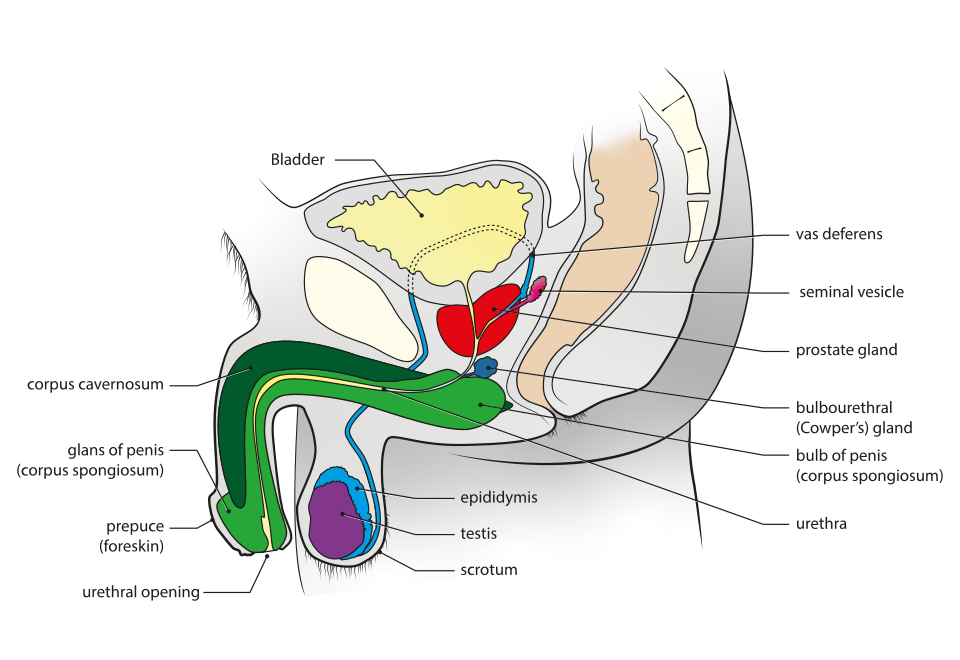
Part of the erectile tissue (the corpora cavernosa) lies inside the body, anchored to the pubic bone. No penis enlargement surgery creates new erectile tissue in a man with a normal penis. Instead, surgeons either bring part of the hidden shaft forward, rearrange the skin so more of the shaft shows, add bulk under the skin for girth, or, in rare reconstructive cases, build a new phallus from a tissue flap.
The evidence base is weak. A 2008 systematic review in European Urology found only a few well-designed studies; overall, penis enlargement surgery gave about 1–2 cm of length and 2.5 cm of girth, while penile deformity, paradoxical shortening, unattractive scarring, granulomas and sexual dysfunction were reported frequently. The authors concluded that these procedures should be regarded as investigational. A 2024 systematic review of 46 more recent studies reached a similar message: surgery can help selected men, but its risks and complexity must be weighed carefully.
Sources: Eur Urol (PubMed) — A critical analysis of penile enhancement procedures (Vardi et al., 2008); Medicina (PMC) — Techniques for penile augmentation surgery: a systematic review (Falagario et al., 2024)
Who usually asks for it
Most men who request penis enlargement surgery have a normal-sized penis; our guide to average penis size explains the measured ranges. The EAU strongly recommends screening for penile dysmorphic disorder (PDD), a form of body dysmorphic disorder focused on the penis, before any procedure, because penis enlargement surgery rarely relieves that distress. Non-surgical options such as a penis extender or temporary fillers are covered elsewhere and are not repeated here.
Source: EAU Guidelines — Penile size abnormalities and dysmorphophobia
Suspensory ligament release
The suspensory ligament holds the base of the penis against the pubic bone. In ligament release (ligamentolysis), the surgeon divides it through a small incision above the penis, letting part of the internal shaft move forward. This penis enlargement surgery changes how long the flaccid penis looks; it does not lengthen the erectile bodies. Some surgeons place a spacer between the pubis and penis to reduce reattachment.
Results
The most-cited penis enlargement surgery series is from a London andrology unit (Li et al., European Urology 2006). In 42 men, stretched flaccid length rose by a mean of 1.3 cm, with a range from 1 cm shorter to 3 cm longer; adding a silicone spacer gave better results. Only 35% of men were satisfied overall, and just 27% of those with penile dysmorphic disorder. The authors concluded that ligament division may add length, but usually not enough to satisfy the patient.
A larger combined-technique penis enlargement surgery series cited by the EAU (ligament release plus V-Y skin plasty and fat grafting) reported resting length rising from 8.8 to 11.4 cm at 12 months, but stretched length rose only from 12.4 to 13.5 cm, which shows that much of the change is in the flaccid appearance.
Sources: Eur Urol (PubMed) — Penile suspensory ligament division for penile augmentation (Li et al., 2006); EAU Guidelines — Penile size abnormalities and dysmorphophobia
Complications and guideline positions
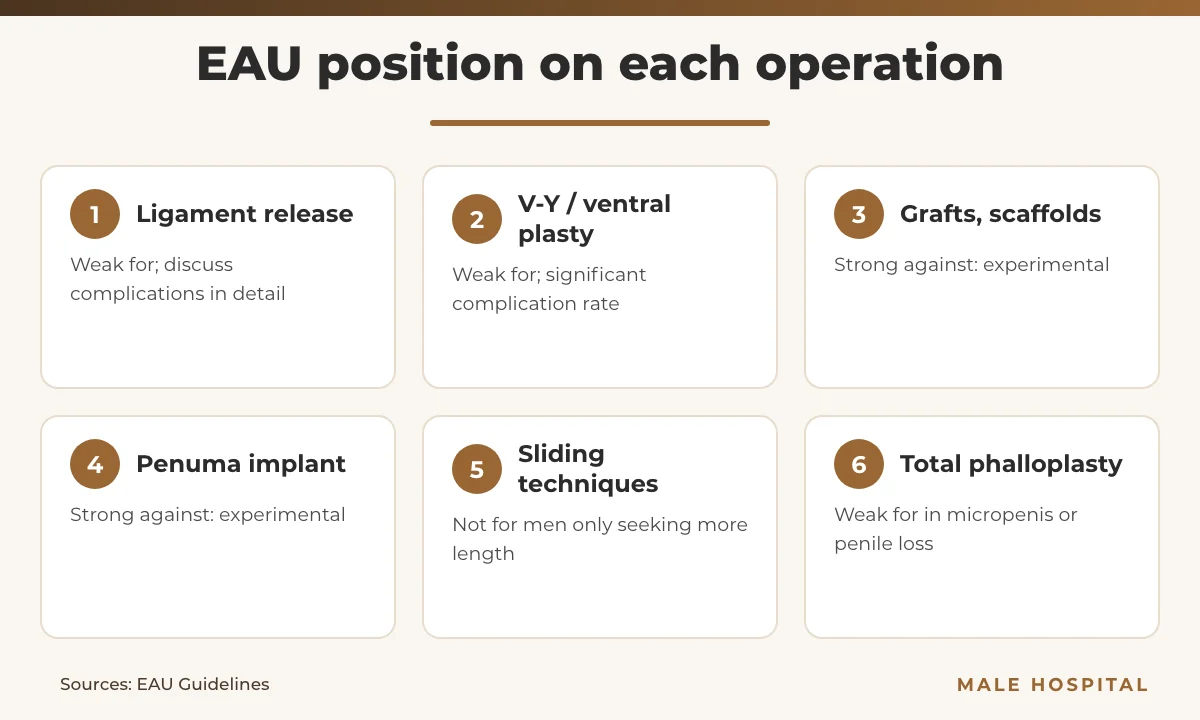
Reported problems after this penis enlargement surgery include scarring, loss of sensation, a less stable erection and, paradoxically, a shorter penis. The Sexual Medicine Society of North America (SMSNA) says the procedure may be reasonably offered by experienced surgeons to carefully counseled men, citing limited data and risks such as sensory change and instability. The EAU gives a weak recommendation for it but a strong recommendation to discuss its complications thoroughly. The AUA’s long-standing policy states that division of the suspensory ligament to increase length in adults has not been shown to be safe or efficacious.
Sources: J Sex Med — Cosmetic penile enhancement procedures: an SMSNA position statement (2024); AUA — Penile augmentation surgery policy statement; ISSM — What are some penile augmentation procedures? Do they work?
V-Y plasty, Z-plasty and ventral phalloplasty
As a form of penis enlargement surgery, skin plasties move skin rather than erectile tissue. In a V-Y plasty, a V-shaped cut in the skin above the penis is closed as a Y, which advances pubic skin onto the shaft; it is usually combined with ligament release so the newly exposed shaft is covered. A Z-plasty rotates two triangular skin flaps; with 60-degree triangles the geometric gain along the scar line is about 1.75 times its original length. These figures describe skin geometry, not actual shaft gain.
Ventral phalloplasty (also called scrotoplasty or release of a penoscrotal web) frees skin where the underside of the penis joins the scrotum, so the shaft looks longer from the side. In a series of 41 men cited by the EAU, ventral skin plasty gave a median flaccid length gain of 2.1 cm. The technique is also used during penile implant surgery: in one study, 83.7% of men who had web release reported a longer penis afterwards, compared with 2.7% of those who did not.
The EAU notes a significant complication rate for three types of penis enlargement surgery: ligament release, ventral phalloplasty and suprapubic lipoplasty. It makes a weak recommendation that they may be used for lengthening and a strong recommendation to discuss their complications in detail. Suprapubic fat removal for a buried penis is explained on our main enlargement page.
Sources: Medicina (PMC) — Techniques for penile augmentation surgery: a systematic review (Falagario et al., 2024); EAU Guidelines — Penile size abnormalities and dysmorphophobia
Girth surgery with grafts and scaffolds
Girth operations, a form of penis enlargement surgery, place tissue or a manufactured material between the skin and the erectile bodies. Unlike hyaluronic-acid injections, which are described on our penile filler page, grafts are placed through an incision and are meant to be long-lasting. When they scar, shrink or become infected, removal is a significant operation.
Dermal fat grafts
In this penis enlargement surgery, strips of skin and fat, usually from the groin or buttock, are wrapped around the shaft. The EAU summarizes girth gains of 1.67–2.3 cm, but also swelling in up to 27% of men, painful erections in up to 27% and curvature in up to 9%. In one small series combining a dermofat graft with a local flap, complications such as skin loss and fat necrosis affected up to half of patients.
Xenografts and acellular dermal matrix
Processed animal tissue, such as porcine dermis (InteXen), avoids a donor-site scar in penis enlargement surgery. In a series of 69 men cited by the EAU, flaccid girth rose by 3.2 cm and erect girth by 2.4 cm at one year, but fibrosis occurred in up to 13%, with an average length loss of 0.5 cm in those men. Another acellular dermal matrix series in the 2024 review reported a mean gain of only 1.1 cm and an overall complication rate of 71.8%, mostly uncomfortable erections, delayed healing and bruising; seven grafts had to be removed.
Vein grafts and biodegradable scaffolds
In another penis enlargement surgery, some surgeons graft saphenous vein onto the erectile bodies to increase erect girth; one series of 39 men reported a 1.1–2.1 cm gain without major complications. Biodegradable scaffolds seeded with the man’s own cells have reported gains of 2–3 cm, alongside infection, skin necrosis and seroma (fluid collection). The EAU calls the early vein-graft data encouraging but asks for better trials.
The guideline positions on graft-based penis enlargement surgery are clear. The EAU strongly recommends against grafts and biodegradable scaffolds for girth enhancement because they are experimental, and the SMSNA recommends against graft-and-flap girth surgery outside research protocols.
Sources: EAU Guidelines — Penile size abnormalities and dysmorphophobia; Medicina (PMC) — Techniques for penile augmentation surgery: a systematic review (Falagario et al., 2024); J Sex Med — SMSNA position statement (2024)
The Penuma silicone implant
Penuma is a soft silicone sleeve placed during penis enlargement surgery under the shaft skin, over the erectile bodies, through an incision above the penis or in the upper scrotum. It is a cosmetic device: it adds girth and flaccid length but does not treat erectile dysfunction, and it is a different device from the penile prosthesis used for erectile dysfunction, described in our penile implant surgery guide.
Regulatory status
The FDA’s 510(k) database lists the “Pre-Formed Penile Silicone Block” (K220760), cleared on May 13, 2022, as substantially equivalent to an existing device. A 510(k) clearance is not the same as a full premarket approval based on clinical trials, so marketing claims of “FDA approval” should be read with care.
Source: FDA — 510(k) premarket notification K220760, Pre-Formed Penile Silicone Block
Outcomes and complications
Penuma penis enlargement surgery results differ by who reports them. The inventor’s series of 400 men (Elist, 2018) reported midshaft girth rising from 8.5 to 13.4 cm and flaccid length from 9.1 to 11.3 cm, with seroma in 4.8%, infection in 3.2% and device removal in 3%. An independent single-surgeon series of 92 implants (Therapeutic Advances in Urology, 2024) found a mean gain of 2.5 cm in flaccid length and 3.1 cm in girth, but 12% needed seroma drainage, 7% needed revision and 12% had the implant removed. Removal was more common with the incision above the penis (21%) than with the scrotal approach (6%). Another 100-patient series reported 10% removal.
The EAU strongly recommends against Penuma because it is experimental. The SMSNA considers subcutaneous silicone implants investigational and recommends they be placed only under ethics-board (IRB) oversight, with long-term safety tracking and at no cost to the patient.
Sources: Ther Adv Urol (PMC) — Outcomes after Penuma silicone implant surgery (Salkowski & Levine, 2024); Medicina (PMC) — Techniques for penile augmentation surgery: a systematic review (Falagario et al., 2024); J Sex Med — SMSNA position statement (2024)
Sliding techniques and penile disassembly
Unlike cosmetic penis enlargement surgery, these operations lengthen the erectile bodies themselves, but they were designed for men whose penis has shortened from Peyronie’s disease, previous surgery or a penile prosthesis, not for men of normal size. In the sliding technique, the tough outer layer of the erectile bodies (the tunica albuginea) is cut in a pattern that lets it slide and extend, the gaps are covered with grafts, and a penile prosthesis is usually inserted to keep the gain.
Reported mean gains are about 3.1–3.6 cm in series of 105 to 416 men, with high satisfaction. The price is a demanding operation: hematoma (a collection of blood) occurred in about 19–25% of men in most series and 56% in one, temporary numbness of the glans in roughly 3–5%, temporary loss of orgasm in 5–7%, and rare glans necrosis. Penile disassembly, which separates the glans and urethra from the erectile bodies and inserts cartilage, gave about 3 cm in one series of 19 men, but glans necrosis is a significant risk.
For this reason, the EAU strongly recommends that penile prosthesis implantation, penile disassembly and sliding techniques should not be offered as penis enlargement surgery to men who are simply seeking a longer penis.
Sources: Medicina (PMC) — Techniques for penile augmentation surgery: a systematic review (Falagario et al., 2024); EAU Guidelines — Penile size abnormalities and dysmorphophobia
Total phalloplasty for micropenis
A true micropenis is a rare congenital diagnosis, usually hormonal in origin, and it is the main setting where major penis enlargement surgery is considered in adults. Total phalloplasty builds a new phallus from a flap of the man’s own tissue, most often the radial forearm, the anterolateral thigh or the latissimus dorsi (back) muscle, and a penile prosthesis can be added later for rigidity.
Results can be good in specialist hands. In a latissimus dorsi series of 12 men, the new phallus measured about 16 cm long, with no flap loss. In a large series of 108 men, the flap survived in 96.3% and 80% were satisfied, but urethral complications affected 49.1% and infection 15.7%. Across the 2024 review, urethral strictures ranged from 6.5% to 38%, fistulas from 12.5% to 50%, and prosthesis removal for infection from 6.5% to 20%.
The EAU gives a weak recommendation for total phallic reconstruction to restore anatomy in congenital micropenis and after traumatic penile loss. It is major reconstructive surgery for specialist centres, not cosmetic penis enlargement surgery.
Sources: EAU Guidelines — Penile size abnormalities and dysmorphophobia; Medicina (PMC) — Techniques for penile augmentation surgery: a systematic review (Falagario et al., 2024)
Penis enlargement surgery options compared
These penis enlargement surgery figures come from small, mostly retrospective series; treat them as possibilities, not promises.
| Technique | Main goal | Reported change | Key risks | EAU position |
|---|---|---|---|---|
| Suspensory ligament release | Flaccid length | Mean +1.3 cm stretched (range −1 to +3) | Scarring, instability, sensory change, shortening | Weak for; strong to discuss complications |
| V-Y / Z-plasty, ventral phalloplasty | Visible length | Median +2.1 cm flaccid (ventral plasty) | Scar, wound problems, recurrence | Weak for; strong to discuss complications |
| Dermal fat / xenografts | Girth | About +1.1 to +3.2 cm | Swelling, painful erection, curvature, fibrosis | Strong against (experimental) |
| Penuma silicone implant | Girth and flaccid length | +2.5 cm length, +3.1 cm girth (92-man series) | Seroma, infection, erosion, removal 3–12% | Strong against (experimental) |
| Sliding techniques | Corporal length after shortening | About +3.1 to +3.6 cm | Hematoma, glans numbness, glans necrosis | Strong against for men seeking lengthening |
| Total phalloplasty | New phallus (micropenis, penile loss) | About 16 cm phallus in one series | Urethral stricture and fistula, flap loss, implant infection | Weak for, in selected cases |
Sources: EAU Guidelines — Penile size abnormalities and dysmorphophobia; Eur Urol (PubMed) — Li et al., 2006; Ther Adv Urol (PMC) — Penuma outcomes, 2024
Before you agree to surgery
Before any penis enlargement surgery, ask the surgeon which technique they propose, how many they have performed, their own complication and removal rates, how length and girth will be measured before and after, and what happens if the result needs to be reversed. ISSM notes that possible side effects of augmentation procedures include infection, severe scarring, deformity, reduced sensation, painful erections, erectile dysfunction and even a shorter penis.
Source: ISSM — What are some penile augmentation procedures? Do they work?
When to see a doctor

After any penis enlargement surgery, contact your surgeon or go to an emergency department promptly if you notice:
- Fever, spreading redness, warmth or pus from the wound, which can signal infection.
- Rapidly increasing swelling or a tense, dark, painful shaft, which can mean a hematoma.
- Skin that turns black, grey or very pale, or a glans that loses color, which can mean the tissue is losing its blood supply.
- An implant edge or graft visible through the skin (erosion).
- Difficulty passing urine, a weak stream, or urine leaking from a new opening, especially after phalloplasty.
- New curvature, persistent numbness, or painful erections that do not settle.
Sources: ISSM — What are some penile augmentation procedures? Do they work?; Medicina (PMC) — Techniques for penile augmentation surgery: a systematic review (Falagario et al., 2024)
If you are considering surgery, you can get a confidential, evidence-based assessment from our urologist-andrologist in Istanbul through WhatsApp; any plan, and its cost, depends on that assessment. You can also read about every option, surgical and non-surgical, on our penis enlargement page.
FAQs about penis enlargement surgery
How many centimeters can penis enlargement surgery add?
Expect modest numbers from penis enlargement surgery. A systematic review found about 1–2 cm of length and 2.5 cm of girth on average. Ligament release added a mean of 1.3 cm of stretched length in one 42-man series, and some men gained nothing. Larger gains come mainly from sliding techniques or phalloplasty, which are reconstructive operations for shortening or micropenis.
Sources: Eur Urol (PubMed) — Vardi et al., 2008; Eur Urol (PubMed) — Li et al., 2006
Does suspensory ligament release make the erect penis longer?
Mostly no. Releasing the ligament lets more of the shaft hang forward, so the change is clearest when the penis is soft. In a combined-technique series cited by European guidelines, resting length rose by 2.6 cm but stretched length by only 1.1 cm. Experts also warn of possible sensory change and a less stable erection.
Sources: EAU Guidelines — Penile size abnormalities and dysmorphophobia; J Sex Med — SMSNA position statement (2024)
Is Penuma FDA approved?
Penuma’s maker received 510(k) clearance for the “Pre-Formed Penile Silicone Block” (K220760, May 2022), meaning the FDA judged it substantially equivalent to an existing device. That is different from a premarket approval based on clinical trials. European guidelines still class Penuma as experimental and strongly advise against it.
Sources: FDA — 510(k) K220760; EAU Guidelines — Penile size abnormalities and dysmorphophobia
Can penis enlargement surgery cause erectile dysfunction?
It can. ISSM lists erectile dysfunction, painful erections, reduced sensation and deformity among the possible side effects of augmentation procedures. Grafts can scar and bend the penis, and sliding techniques carry risks of glans numbness and, rarely, glans necrosis. Men who already have erectile problems should have these assessed and treated before any penis enlargement surgery.
Source: ISSM — What are some penile augmentation procedures? Do they work?
Are the results of girth grafts permanent?
Not reliably. Grafts used in penis enlargement surgery can shrink, harden or scar; one porcine graft series reported fibrosis in up to 13% of men, with some length loss, and another dermal matrix series removed seven grafts. Because of these problems, both the EAU and SMSNA advise against graft-based girth surgery outside research studies.
Sources: EAU Guidelines — Penile size abnormalities and dysmorphophobia; J Sex Med — SMSNA position statement (2024)
Do urologists recommend penis enlargement surgery for normal-sized men?
Generally not. The AUA says ligament division and fat injection have not been shown to be safe or effective, and ISSM notes that, according to the AUA, augmentation should only be considered for micropenis (stretched length under 7.5 cm). The EAU allows a few penis enlargement surgery procedures with weak recommendations but asks doctors to screen for penile dysmorphic disorder first.
Sources: AUA — Penile augmentation surgery policy statement; ISSM — What are some penile augmentation procedures?
Can a penile implant for erectile dysfunction make the penis bigger?
No. A penile prosthesis restores rigidity but does not add length; in one study 72% of men felt shorter after implantation even though measured length did not change significantly. European guidelines strongly recommend against offering a prosthesis, penile disassembly or sliding techniques to men who are only seeking a longer penis.
Source: EAU Guidelines — Penile size abnormalities and dysmorphophobia
Medically reviewed by Assoc. Prof. Dr. Zülfü Sertkaya, urologist and andrologist (FEBU), Istanbul. Last reviewed: November 2026.
This article is for general information and does not replace an individual consultation with a qualified doctor.
- EAU Guidelines — Sexual and Reproductive Health — Penile size abnormalities and dysmorphophobia
- AUA — Penile augmentation surgery (policy statement)
- J Sex Med (SMSNA) — Trost et al., Cosmetic penile enhancement procedures: an SMSNA position statement (2024)
- ISSM — What are some penile augmentation procedures? Do they work?
- PMC (Medicina) — Falagario et al., Techniques for penile augmentation surgery: a systematic review of surgical outcomes, complications and quality of life (2024)
- PMC (Ther Adv Urol) — Salkowski & Levine, Outcomes and patient satisfaction after Penuma silicone implant surgery via two surgical approaches (2024)
- PubMed (Eur Urol) — Li et al., Penile suspensory ligament division for penile augmentation: indications and results (2006)
- PubMed (Eur Urol) — Vardi et al., A critical analysis of penile enhancement procedures for patients with normal penile size (2008)
- FDA — 510(k) premarket notification K220760 — Pre-Formed Penile Silicone Block