Balanitis is inflammation of the head of the penis (the glans), usually causing redness, soreness, itching and sometimes a smelly discharge under the foreskin. It is common in uncircumcised men and is most often caused by a yeast (Candida) infection, bacteria, irritation from soap, or a skin condition. Treatment depends on the cause, and most cases settle quickly with gentle hygiene and the right cream.
Source: NHS — Balanitis; BASHH — Guideline on the Management of Balanoposthitis 2025
- Balanitis affects up to 20% of uncircumcised men at some point but is uncommon after circumcision.
- Thrush (Candida) is a frequent cause, and repeated thrush of the penis can be the first sign of diabetes, so a urine or blood sugar test is often advised.
- Both poor hygiene and over-washing with soap can trigger it: rinse with warm water and use an emollient instead of soap.
- Treatment matches the cause: antifungal cream for yeast, antibiotics for bacteria, steroid creams for skin conditions such as lichen sclerosus.
- A patch that does not heal despite treatment should be examined and, if needed, biopsied to rule out precancerous change.
What is balanitis?

Balanitis means inflammation of the glans penis. Posthitis means inflammation of the foreskin (prepuce). Because the two surfaces touch each other, they are usually inflamed together, and doctors then use the term balanoposthitis. In everyday language, the two terms are used interchangeably.
It is a description, not a single disease. The British Association for Sexual Health and HIV (BASHH) calls it a collection of different conditions that look similar but have very different causes: infections, skin diseases, irritation, and, rarely, precancerous change of the penile skin. Finding the actual cause is what makes treatment work.
The condition is not usually serious. Cleveland Clinic notes that the inflammation itself is not an infection you can pass on, although an underlying infection such as a sexually transmitted infection (STI) can be.
Sources: BASHH — Guideline on the Management of Balanoposthitis 2025; Cleveland Clinic — Balanitis
Who gets balanitis?
According to BASHH, balanoposthitis affects up to 20% of uncircumcised men, while it is uncommon after circumcision. The warm, moist space under the foreskin allows yeast and bacteria to multiply, and a foreskin that does not retract easily makes cleaning harder.
The main risk factors are:
- An intact foreskin, especially a tight one. A foreskin that cannot be pulled back (phimosis) traps moisture, discharge and smegma.
- Diabetes. Sugar in the urine feeds yeast, so penile thrush can be the presenting sign of diabetes mellitus. Some diabetes medicines, such as dapagliflozin, list thrush as a common side effect.
- Older age. Thrush of the glans becomes more common with increasing age, and the Zoon’s type mainly affects middle-aged and older uncircumcised men.
- Skin sensitivity and skin diseases such as eczema, psoriasis and lichen sclerosus.
- Hygiene habits: both poor hygiene and over-washing with soap.
- Sexual exposure to STIs, and a weakened immune system.
Young boys can also be affected. In children a non-retractable foreskin is normal, and it should never be forced back for cleaning.
Sources: BASHH — Guideline on the Management of Balanoposthitis 2025; NHS — Side effects of dapagliflozin; NHS — Balanitis
What causes balanitis?
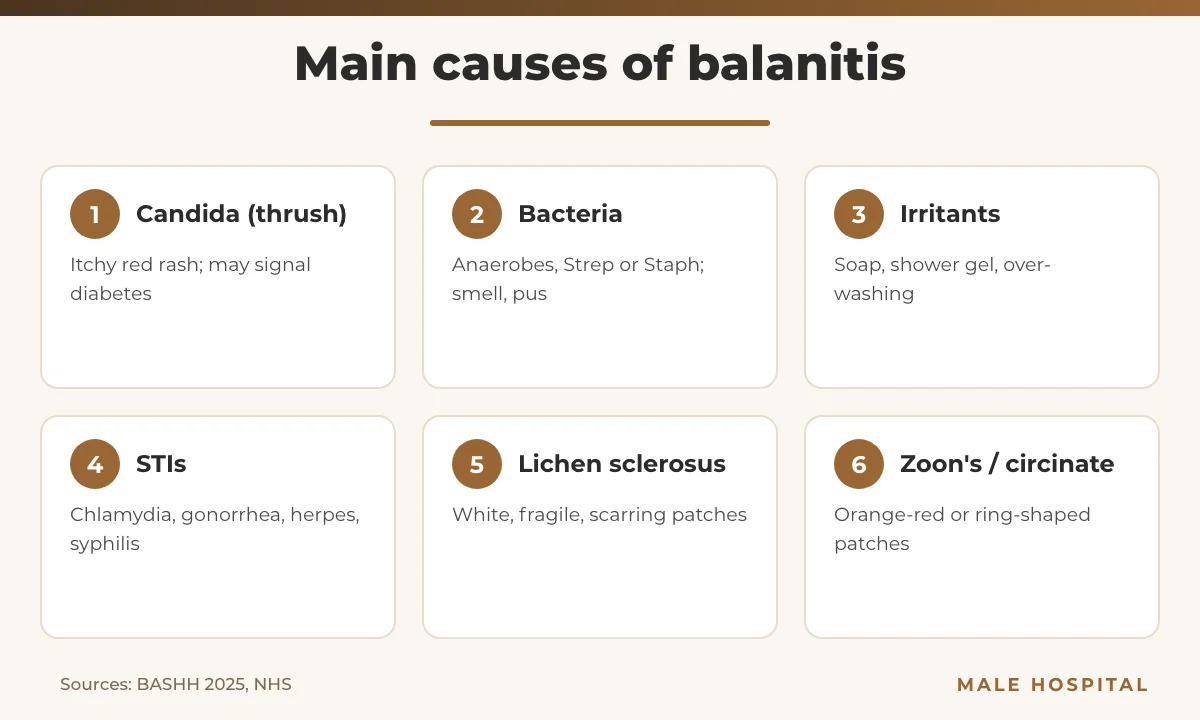
Doctors group the causes into infections, skin diseases (dermatoses) and other factors. More than one can be present at the same time: a skin condition, for example, is often complicated by a secondary yeast or bacterial infection.
Infections
- Candida (thrush): blotchy redness with small spots or dull red, glazed patches, with itch or soreness. Sexual partners often carry the same yeast.
- Anaerobic bacteria: a foul smell and discharge under the foreskin, sometimes with superficial erosions and swelling. This type is linked to phimosis.
- Aerobic bacteria: Streptococci (Group A and B) and Staphylococcus aureus can cause redness, swelling and a pus-like discharge.
- STIs: chlamydia, gonorrhea, Mycoplasma genitalium, syphilis, trichomonas, herpes and HPV can all inflame the glans. Syphilis can occasionally cause balanitis as its only sign.
Irritants and allergies
Irritant balanoposthitis is commonly associated with frequent washing with soap, and with fragrances and preservatives in toiletries. Shower gel, condoms and some medicines (a “fixed drug eruption”) can also trigger it. A history of eczema or allergies makes this more likely.
Skin conditions (dermatoses)
- Lichen sclerosus: white, fragile patches on the glans and foreskin that can scar, tighten the foreskin and narrow the urinary opening. It is not contagious.
- Zoon’s (plasma cell) balanitis: a well-defined, shiny orange-red patch with tiny darker “cayenne pepper” spots, usually in middle-aged to older uncircumcised men.
- Circinate balanitis: ring-shaped, shallow erosions with raised borders, linked to chlamydia and reactive arthritis; it is seen in about 40% of reactive arthritis cases.
- Psoriasis, lichen planus and seborrheic dermatitis can also affect the glans, often looking red and glazed rather than scaly under the foreskin.
Less common causes include trauma, systemic diseases such as Crohn’s disease or Behçet’s syndrome, and penile intraepithelial neoplasia (PeIN), a precancerous change of the skin.
Sources: BASHH — Guideline on the Management of Balanoposthitis 2025; Indian J Sex Transm Dis AIDS (PMC) — Zoon balanitis: a comprehensive review; NHS — Lichen sclerosus
Balanitis symptoms
The head of the penis is usually swollen, itchy and sore, and often looks red; on brown or black skin the redness can be harder to see, and the area may look darker, purple, gray or white instead. Other common symptoms include:
- pain or burning when peeing
- a thick discharge from under the foreskin
- an unpleasant smell
- bleeding or small cracks (fissures) around the foreskin
- difficulty pulling back the foreskin
- shiny or white patches of skin
- pain during sex if the skin is cracked or eroded
Some patterns point toward a cause. A cheesy discharge and itch suggest thrush; a strong odor suggests anaerobic bacteria; white, crinkled skin suggests lichen sclerosus. Symptoms elsewhere, such as joint pain, a rash on other parts of the body (including the mouth), general malaise or swollen glands in the groin, can indicate a whole-body condition and should be mentioned to your doctor.
Sources: NHS — Balanitis; Cleveland Clinic — Balanitis; BASHH — Guideline on the Management of Balanoposthitis 2025
How balanitis is diagnosed
Diagnosis starts with questions about your symptoms, washing habits, sexual history, medicines and general health, followed by a look at the penis. Often the appearance is typical enough, but BASHH warns that no appearance is fully reliable because secondary infection is common. Depending on the situation, the doctor may arrange:
- A swab from under the foreskin to look for Candida and bacteria.
- A urine or blood glucose test to check for diabetes, appropriate in most cases and especially if thrush is suspected.
- STI tests, including tests for herpes and syphilis if there is an ulcer.
- A skin biopsy if the diagnosis is uncertain and the problem persists, or to exclude penile intraepithelial neoplasia.
- Referral to a dermatologist for skin conditions or allergy, or to a urologist for circumcision or assessment of a suspicious lesion.
Finding a yeast or bacterium on a swab does not always prove it is the main cause; it may be growing on top of another skin condition. This is why a persistent problem needs a second look rather than repeated courses of the same cream.
Sources: BASHH — Guideline on the Management of Balanoposthitis 2025; MedlinePlus — Balanitis
Balanitis treatment by cause
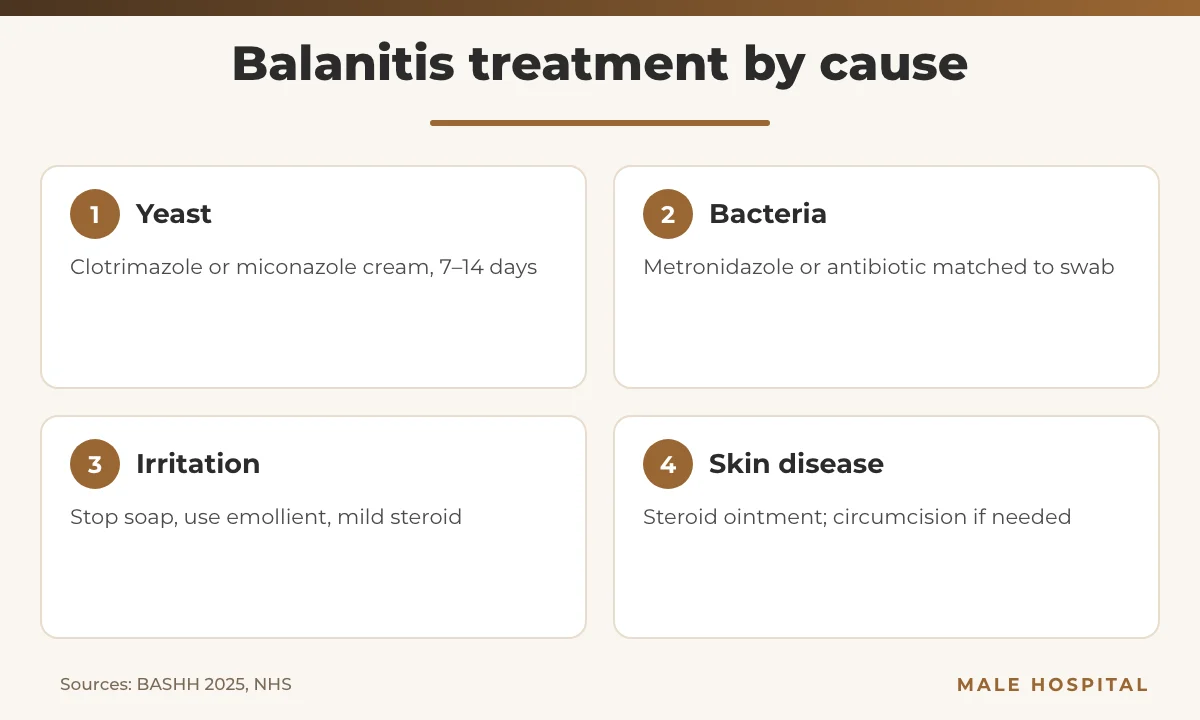
There is no single cream that fits every case. The UK NHS says a GP may prescribe a mild steroid cream, an antifungal cream or antibiotics depending on the cause, and the BASHH guideline and the 2022 European guideline give detailed regimens. The table below summarizes the usual first-line options; doses and products should always be chosen by your doctor.
| Cause | Typical clues | First-line treatment (BASHH) |
|---|---|---|
| Candida (thrush) | Itchy, blotchy red rash, small spots | Clotrimazole 1% or miconazole 2% cream twice daily for 7–14 days; single 150 mg fluconazole tablet if severe |
| Anaerobic bacteria | Foul smell, discharge, often phimosis | Metronidazole 400–500 mg twice daily for 1 week; topical metronidazole for mild cases |
| Streptococcus / Staphylococcus | Redness, swelling, pus-like discharge | Mupirocin ointment for mild cases; oral antibiotics guided by the swab if severe |
| Irritant or allergic | Itch and redness after soaps or products | Stop soaps, use emollients; hydrocortisone 1% once or twice daily |
| Lichen sclerosus | White, fragile, scarring patches | Clobetasol propionate 0.05% ointment once daily, tapered over up to 3 months |
| Zoon’s (plasma cell) | Shiny orange-red patch, pinpoint spots | Topical steroid with or without antibacterial; referral for circumcision |
| Circinate / psoriasis | Ring-shaped or well-defined red patches | Moderate-strength steroid; test and treat chlamydia if present |
Sources: BASHH — Guideline on the Management of Balanoposthitis 2025; NHS — Balanitis
Yeast (candidal) infection
An imidazole cream (clotrimazole or miconazole) is the standard treatment. If there is marked inflammation, a combined antifungal and 1% hydrocortisone cream can be used, and nystatin is an alternative if resistance or an allergy to imidazoles is suspected. Because yeast is often shared, treating a partner who has symptoms can be considered. Repeated thrush should prompt a sugar test.
Bacterial infection
Anaerobic infections respond to metronidazole, with co-amoxiclav or clindamycin cream as alternatives. Milder aerobic infections may settle with hygiene and an antibiotic ointment, while more severe ones, for example with marked swelling or Group A Streptococcus on the swab, need antibiotic tablets matched to the culture result. STIs are treated according to their own guidelines, and partners may need testing too.
Skin conditions
Steroid creams calm inflammatory skin conditions. Lichen sclerosus needs an ultra-potent steroid ointment and long-term follow-up because it can scar the foreskin and slightly raises the risk of penile cancer. The Zoon’s type often improves with creams, but a 2016 review describes circumcision as the treatment of choice, with lesions often resolving within weeks to months afterwards.
General measures for every type
Wash gently with warm water, dry carefully, and avoid soap and shower gel while the skin heals. BASHH reminds patients that creams can damage condoms, so check compatibility or avoid sex until healed.
Sources: BASHH — Guideline on the Management of Balanoposthitis 2025; J Eur Acad Dermatol Venereol (PubMed) — 2022 European guideline for the management of balanoposthitis; Indian J Sex Transm Dis AIDS (PMC) — Zoon balanitis: a comprehensive review
Recurrent balanitis and circumcision
Some men have one episode and never another; others find the problem keeps coming back. Repeated episodes usually has an underlying driver that has not been fixed. Common ones are:
- undiagnosed or poorly controlled diabetes
- a tight foreskin that traps moisture and discharge
- ongoing irritation from soaps, wipes or over-washing (recurrent irritant problems are common)
- a partner who carries yeast or an untreated STI
- a skin condition such as lichen sclerosus or psoriasis that has been treated only as an infection
The first step is to recheck the diagnosis: a swab, a sugar test, an STI screen and, if a patch keeps returning in the same place, a biopsy. Optimizing diabetes control and switching to emollients often breaks the cycle.
If the inflammation keeps returning and medicines have not helped, circumcision may be recommended. BASHH advises that the role of circumcision should be discussed in recurrent cases, and anaerobic infection with phimosis may need circumcision to prevent recurrence. Cleveland Clinic also mentions a dorsal slit, which opens the tight ring of the foreskin without removing it. Diabetes can also affect erections, so men with recurrent thrush may want to read about the physical causes of erectile dysfunction.
Sources: NHS — Balanitis; BASHH — Guideline on the Management of Balanoposthitis 2025; Cleveland Clinic — Balanitis
Complications
Most episodes heal without lasting effects. Long-standing or repeated inflammation, however, can lead to:
- Phimosis: scarring that makes the foreskin too tight to pull back, which can cause painful erections and further infections.
- Trouble returning the foreskin over the glans once it has been pulled back.
- Meatal stenosis: scarring that narrows the urinary opening and can obstruct the flow of urine.
- Reduced blood supply to the tip of the penis in severe, prolonged swelling.
- Penile cancer: the European Association of Urology (EAU) lists chronic penile inflammation and lichen sclerosus among risk factors, and states that phimosis is strongly associated with invasive penile cancer.
The cancer risk is low, but it is the reason doctors take a non-healing patch seriously. Penile intraepithelial neoplasia can look like ordinary inflammation; the velvety red form previously called erythroplasia of Queyrat progressed to invasive cancer in almost a third of untreated patients in the studies cited by BASHH.
Sources: MedlinePlus — Balanitis; EAU — Penile Cancer Guidelines: Epidemiology, aetiology and pathology; BASHH — Guideline on the Management of Balanoposthitis 2025
How to prevent balanitis
Good genital skin care prevents most cases. The aim is a clean, dry glans without stripping the skin’s natural barrier:
- Wash the penis once a day with warm water or an emollient only; gently pull back the foreskin, rinse underneath and dry carefully.
- Do not use soap, shower gel, scented wipes or harsh detergents on the area.
- Wash your hands before peeing or touching your penis.
- Choose condoms for sensitive skin if latex or lubricants irritate you, and use condoms to reduce STI risk.
- Keep diabetes well controlled and mention recurrent thrush to your doctor, especially if you take an SGLT2 medicine such as dapagliflozin.
- For boys: wash gently with warm water, change nappies often, avoid bubble bath and wipes, and never force back a foreskin that is still attached.
Sources: NHS — Balanitis
When to see a doctor
See a doctor or a sexual health clinic whenever the head of the penis becomes red, swollen, itchy or sore, rather than guessing with over-the-counter creams. Seek prompt care if:
- symptoms last more than a few days, get worse, or keep coming back
- treatment has not worked
- there is an ulcer, blister or sore, which needs STI testing
- you have a fever, feel unwell, or have swollen glands in the groin
- you cannot pull the foreskin back, or cannot return it over the glans (paraphimosis is a medical emergency: go to an emergency department)
- you have trouble passing urine
A persistent patch, lump, thickened area or non-healing sore on the glans or foreskin needs specialist review. BASHH recommends biopsy when the diagnosis is uncertain and the condition persists, and referral to a urologist for possible precancerous change or malignancy. This is usually reassuring, and when it is not, early treatment is far simpler.
Sources: NHS — Balanitis; BASHH — Guideline on the Management of Balanoposthitis 2025; NHS — Tight foreskin (phimosis and paraphimosis)
If you have recurrent inflammation, a tight foreskin or a patch that will not heal, you can book a confidential assessment with our urologist-andrologist, Assoc. Prof. Dr. Zülfü Sertkaya, in Istanbul. Send us a message on WhatsApp for a free initial consultation.
FAQs about balanitis
Is balanitis an STI?
Not usually. Most cases come from yeast, everyday skin bacteria, irritation or a skin condition, and the inflammation itself cannot be passed on. However, STIs such as chlamydia, gonorrhea, herpes, syphilis and trichomonas can cause it, so testing is sensible if you have a new partner, an ulcer or discharge from the urethra.
Source: Cleveland Clinic — Balanitis
Can a woman get thrush from a man with candidal balanitis?
Yes, yeast can be shared between partners. BASHH notes a high rate of candidal infection in the sexual partners of men with penile thrush and suggests that symptomatic partners can be treated too. It is sensible to avoid sex until the skin has healed, and remember that creams applied to the penis can affect condoms.
Source: BASHH — Guideline on the Management of Balanoposthitis 2025
How long does balanitis take to clear up?
With the right treatment, most men feel better within a few days to a week. Antifungal creams are usually applied for 7 to 14 days, and antibiotic courses typically last about a week. Skin conditions such as lichen sclerosus take longer and may need months of steroid ointment followed by maintenance treatment.
Sources: Cleveland Clinic — Balanitis; BASHH — Guideline on the Management of Balanoposthitis 2025
Can circumcised men get balanitis?
Yes, but it is much less common. Without a foreskin, moisture and discharge are less likely to be trapped. Circumcised men can still develop inflammation of the glans from irritants, psoriasis, lichen planus, fixed drug eruptions or STIs; psoriasis on a circumcised glans tends to look like red, scaly plaques similar to those elsewhere on the body.
Source: BASHH — Guideline on the Management of Balanoposthitis 2025
Can I use over-the-counter thrush cream for balanitis?
Clotrimazole cream helps only if the cause is yeast. If the problem is irritation, bacteria or a skin disease, it may not work and can even irritate further. Because the causes look alike, the NHS advises seeing a GP to find out what is behind it, particularly for a first episode or if symptoms return.
Source: NHS — Balanitis
Is balanitis a sign of diabetes?
It can be. Sugar in the urine encourages yeast growth, so penile thrush is sometimes the first sign of diabetes, and repeated episodes should prompt a glucose test. Men who already have diabetes are more prone to it, and some glucose-lowering medicines, such as dapagliflozin, list thrush as a common side effect.
Sources: NHS — Balanitis; NHS — Side effects of dapagliflozin
Can balanitis turn into cancer?
Ordinary balanitis does not turn into cancer. However, chronic inflammation, lichen sclerosus and phimosis are recognized risk factors for penile cancer, and precancerous skin changes can mimic it. That is why a lesion that does not heal with treatment should be examined by a specialist and biopsied if needed.
Source: EAU — Penile Cancer Guidelines: Epidemiology, aetiology and pathology
Does circumcision cure recurrent balanitis?
For men whose episodes keep returning despite good hygiene and treatment, circumcision removes the moist space where yeast and bacteria thrive and is the recommended option for the Zoon’s (plasma cell) type. It does not cure every cause: psoriasis, allergies and some STIs can still affect the glans afterwards, so the underlying diagnosis matters.
Source: BASHH — Guideline on the Management of Balanoposthitis 2025
Medically reviewed by Assoc. Prof. Dr. Zülfü Sertkaya, urologist and andrologist (FEBU), Istanbul. Last reviewed: October 2026.
This article is for general information and does not replace an individual consultation with a qualified doctor.
- NHS — Balanitis
- BASHH — Guideline on the Management of Balanoposthitis (and related penile skin conditions) 2025
- J Eur Acad Dermatol Venereol (PubMed) — 2022 European guideline for the management of balanoposthitis
- Cleveland Clinic — Balanitis
- MedlinePlus — Balanitis
- EAU — Penile Cancer Guidelines: Epidemiology, aetiology and pathology
- Indian J Sex Transm Dis AIDS (PMC) — Zoon balanitis: a comprehensive review
- NHS — Lichen sclerosus
- NHS — Tight foreskin (phimosis and paraphimosis)
- NHS — Side effects of dapagliflozin