Phimosis is a foreskin that is too tight to pull back over the head of the penis (the glans). In babies and young boys this is normal and usually loosens with age, but in teenagers and adults a tight, scarred or painful foreskin is usually a sign of a problem such as recurrent infection, lichen sclerosus or diabetes. Most cases can be treated with a steroid cream, gentle stretching or, when these fail, foreskin-sparing surgery or circumcision.
Source: NHS — Tight foreskin; Cleveland Clinic — Penile Diseases & Disorders
- A non-retractable foreskin is normal in young boys; by age 16 only about 1% still have one.
- In adults, a tight foreskin is usually acquired: recurrent balanitis, lichen sclerosus (also called BXO) and type 2 diabetes are the main causes.
- Paraphimosis, a retracted foreskin stuck behind the glans, is a medical emergency.
- A potent steroid cream applied for 4–8 weeks is the usual first treatment; circumcision is the definitive option when creams fail or scarring is severe.
- After adult circumcision, most men return to work in about a week and avoid sex for at least 4 weeks.
- What is phimosis?
- Physiological vs pathological phimosis
- What causes phimosis in teens and adults?
- Phimosis symptoms
- Complications: paraphimosis, painful erections, infections and cancer
- How phimosis is diagnosed
- Phimosis treatment options
- Recovery after adult circumcision
- When to see a doctor
- FAQs about phimosis
What is phimosis?
The foreskin (prepuce) is the fold of skin that covers the glans. Normally, from late childhood onward, it slides back easily for washing, urination and erections. Phimosis means the opening of the foreskin is too narrow, so it cannot be pulled back fully, or it can only be pulled back with pain or tearing.
Doctors separate two very different situations. In young children, a tight foreskin is a normal stage of development. In adolescents and adults, a foreskin that has become tight, scarred or painful is described as pathological (acquired) and usually has an underlying cause that deserves attention.
The condition is common. Its incidence peaks in the first decade of life and then rises again after the sixth decade, when skin conditions, infections and diabetes become more frequent.
Source: EAU — Paediatric Urology Guidelines: abnormalities of the penile skin; Clinics and Practice (PMC) — Phimosis in Adults: Narrative Review of the New Available Devices and the Standard Treatments
Physiological vs pathological phimosis
Normal (physiological) phimosis in children
Almost every baby boy is born with a foreskin that does not retract, because the inner foreskin is naturally stuck to the glans. These attachments separate gradually on their own. According to the Cochrane review on the topic, about 96% of newborns have a non-retractable foreskin, about 50% at age one, about 10% at age three, 6–8% at age seven and only about 1% at age 16.
The NHS notes that most foreskins do not retract before age 5, and some not until age 10 or later. Parents should never force back a young boy’s foreskin, because this can cause pain, small tears and scarring. Gentle washing with warm water is enough. This normal tightness usually needs no treatment unless it causes repeated infections or problems passing urine.
Source: Cochrane Review (PMC) — Topical corticosteroids for treating phimosis in boys; NHS — Tight foreskin
Pathological phimosis in adolescents and adults
The pathological form is caused by scarring. On examination, the tip of the foreskin shows a white, fibrous, thickened ring, and when gentle traction is applied the inner skin does not “pout” outward as it does in a normal child. It rarely appears before age five; in boys under 18 its cumulative incidence is roughly 0.6% to 1.5%.
| Feature | Physiological | Pathological |
|---|---|---|
| Typical age | Babies and young boys | Older boys, teens, adults |
| Foreskin tip | Soft, healthy skin; inner skin bulges on retraction | White, thick, scarred ring that does not bulge |
| Cause | Normal development | Infection, lichen sclerosus, diabetes, injury |
| Natural course | Usually resolves without treatment | Does not resolve on its own; may worsen |
| Usual approach | Hygiene and patience; steroid cream if symptomatic | Treat the cause; steroid cream; surgery if needed |
Source: EAU — Paediatric Urology Guidelines: abnormalities of the penile skin; Cochrane Review (PMC) — Topical corticosteroids for treating phimosis in boys
What causes phimosis in teens and adults?
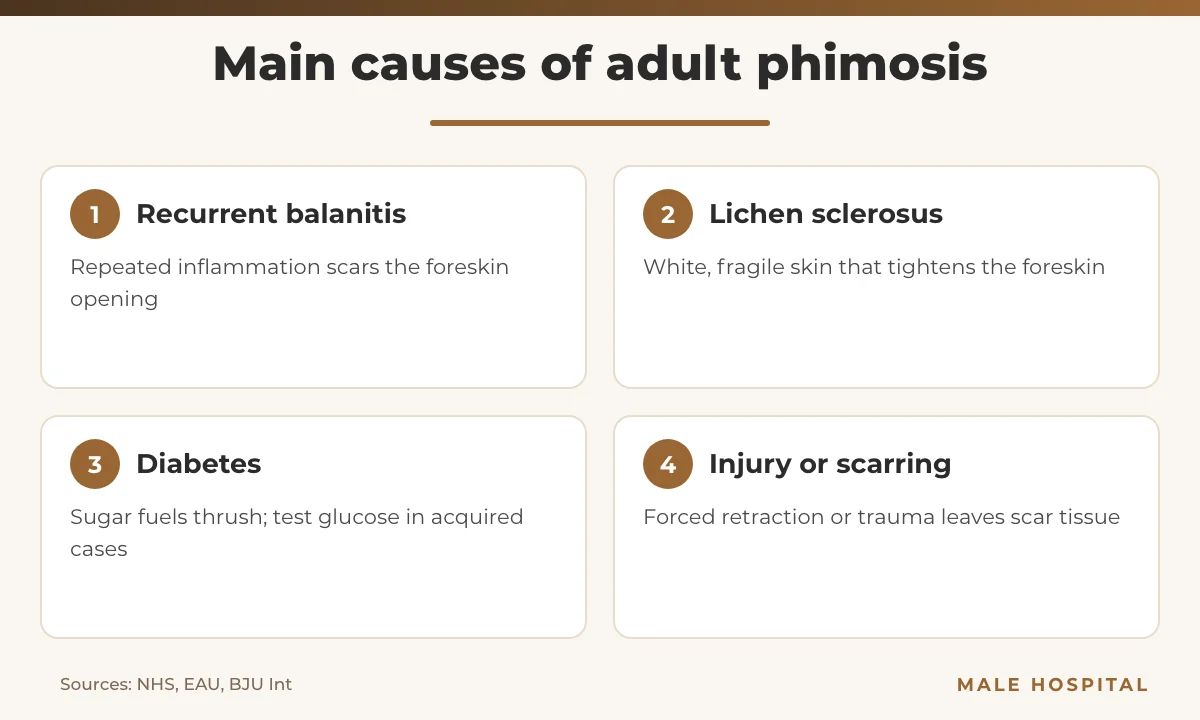
In adults, the problem may be lifelong (a foreskin that never became fully retractable) or acquired after years of normal function. An acquired tight foreskin almost always has a trigger that causes inflammation and then scarring of the foreskin opening.
Recurrent balanitis and balanoposthitis
Balanitis is inflammation of the glans; balanoposthitis also involves the foreskin. Poor hygiene, thrush, sexually transmitted infections and irritants such as soap, shower gel or condoms can all cause it. Each episode can leave a little scar tissue, and repeated episodes gradually narrow the foreskin. A tight foreskin, in turn, makes cleaning harder and infection more likely, creating a vicious circle.
Source: NHS — Balanitis; Clinics and Practice (PMC) — Phimosis in Adults: Narrative Review
Lichen sclerosus (balanitis xerotica obliterans, BXO)
Lichen sclerosus is a chronic inflammatory skin disease; on the penis it was traditionally called balanitis xerotica obliterans (BXO). It causes itchy white patches that may look smooth or crinkled, and fragile skin that bleeds or hurts easily. In men it most often affects the foreskin and glans, and the affected foreskin can tighten and make erections painful. Its cause is unknown, and it is not an infection, not contagious and not caused by poor hygiene.
BXO is common in boys and young men who need circumcision for medical reasons: it is found on tissue analysis in 35–53% of children and adolescents circumcised for medical indications. It needs long-term follow-up, sometimes together with a dermatologist.
Source: NHS — Lichen sclerosus; EAU — Paediatric Urology Guidelines: abnormalities of the penile skin
Diabetes
High blood sugar promotes thrush under the foreskin and repeated balanitis, which can lead to scarring. In a prospective study of 100 men referred with a tight foreskin in Manchester, none of the men with a lifelong problem had diabetes, but 26% of those with the acquired form already had type 2 diabetes. Among acquired cases with no known glucose problem, a further 8% were newly diagnosed with type 2 diabetes and 4% had impaired glucose regulation. The authors recommend testing blood glucose in every man whose foreskin becomes tight in adulthood. Diabetes is also a leading cause of erectile dysfunction, so the two problems often appear together.
Source: BJU International (PubMed) — Phimosis as a presenting feature of diabetes; NHS — Balanitis
Injury, forced retraction and other causes
Scar tissue after an injury, after forcing back a tight foreskin, or after some skin conditions and sexually transmitted infections can also narrow the foreskin.
Source: Cleveland Clinic — Penile Diseases & Disorders
Phimosis symptoms
A tight foreskin is not always a problem. Many men with a mildly tight foreskin have no symptoms, while others notice:
- A foreskin that will not pull back, or only partly, or splits and bleeds when retracted
- Swelling, redness, tenderness or soreness of the foreskin or glans
- Pain or a weak stream when passing urine, or the foreskin ballooning while urinating
- Blood in the urine or frequent urinary tract infections
- Thick discharge under the foreskin, bleeding or an unpleasant smell
- Painful erections or pain, tearing and bleeding during sex
- White, shiny or crinkled patches and itching, which suggest lichen sclerosus
Source: NHS — Tight foreskin; NHS — Lichen sclerosus
Complications: paraphimosis, painful erections, infections and cancer
Paraphimosis: a medical emergency
Paraphimosis happens when a tight foreskin is pulled back behind the glans and gets stuck there. The foreskin acts like a tight band, the glans swells, and the foreskin can no longer be returned. Causes include forcing the foreskin back during sex, washing or a medical procedure and forgetting to return it, or injury. Without prompt treatment, the reduced blood flow can damage the tissue of the glans, and in rare cases cause gangrene.
A doctor first squeezes the swelling down and pushes the foreskin forward. If that fails, a small cut in the tight band (dorsal incision) or circumcision is needed. If your foreskin is stuck behind the glans, go to an emergency department straight away.
Source: MedlinePlus — Paraphimosis; EAU — Paediatric Urology Guidelines: abnormalities of the penile skin
Painful erections and sexual problems
During an erection, a tight foreskin is stretched over a larger glans. This can cause pain, small splits in the skin and bleeding during intercourse, and some men start to avoid sex or lose confidence. Painful erections are a recognized reason to see a doctor. Pain with erection can also come from other conditions, such as Peyronie’s disease, which causes plaque and curvature in the shaft rather than a tight foreskin.
Source: NHS — Tight foreskin
Infections
Because the area under a tight foreskin is hard to clean, this increases the chance of balanitis, thrush and urinary tract infections. Candida (yeast) balanitis is more likely in men with a tight foreskin.
Source: NHS — Balanitis; Cleveland Clinic — Penile Diseases & Disorders
Link with penile cancer
Penile cancer is rare: about 0.94 cases per 100,000 men per year in Europe. Even so, the European Association of Urology (EAU) guideline states that phimosis is strongly associated with invasive penile cancer, which it attributes to chronic infection and inflammation. Lichen sclerosus is also relatively common in men with penile cancer, and the NHS notes that it raises the risk, although the risk remains low. Any lump, thickened skin or sore on the penis that does not heal should be checked by a doctor.
Source: EAU — Penile Cancer Guidelines: Epidemiology, aetiology and pathology; NHS — Lichen sclerosus
How phimosis is diagnosed
Phimosis is diagnosed mainly by examination. A urologist will ask when the tightness began, whether it was ever retractable, and about infections, itching, urinary symptoms, pain during erections and sex, and medical conditions such as diabetes. They then gently examine the foreskin to see how far it retracts and whether there is a scarred white ring or skin changes suggesting lichen sclerosus.
Depending on the findings, the doctor may also:
- Check blood glucose, especially when the tightness developed in adulthood
- Send the removed foreskin for histology after circumcision, because BXO is confirmed on tissue analysis
- Examine any lump, ulcer or thickened area carefully to rule out other conditions
Source: BJU International (PubMed) — Phimosis as a presenting feature of diabetes; EAU — Paediatric Urology Guidelines: abnormalities of the penile skin
Phimosis treatment options
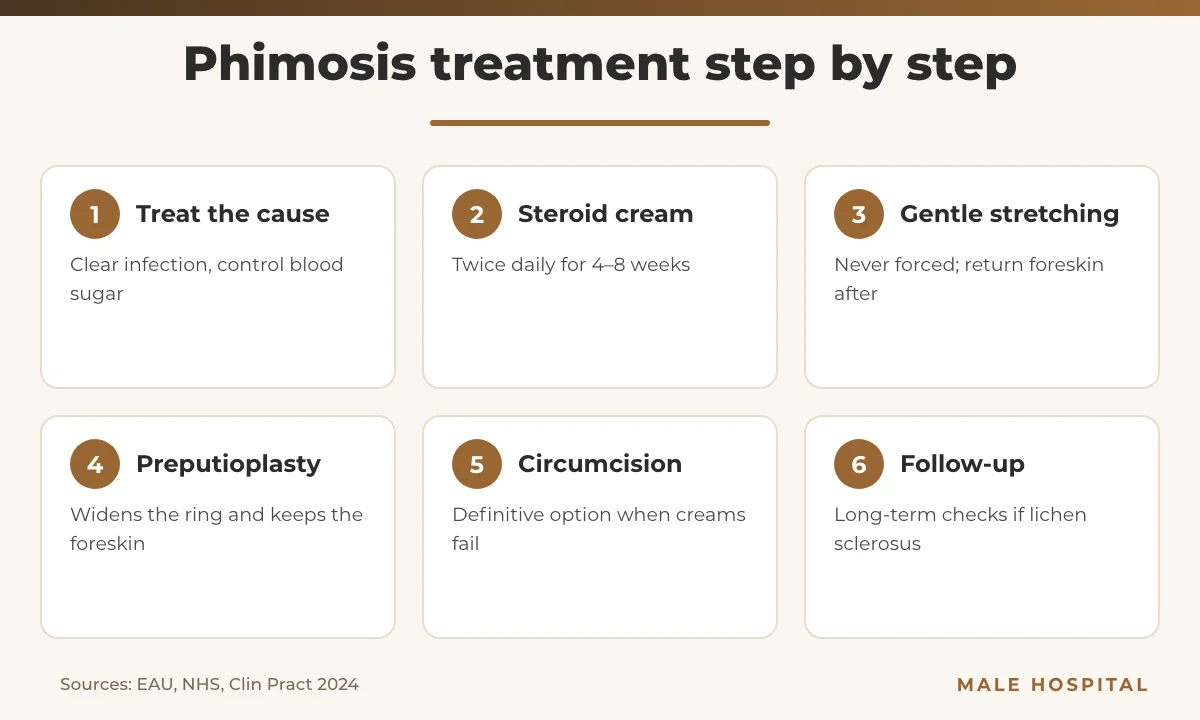
Treatment depends on age, symptoms and the cause. A tight foreskin that causes no problems may not need treatment at all. When the foreskin causes pain, infection or urinary or sexual problems, doctors usually move step by step from creams to surgery, while treating any underlying infection or diabetes.
Topical steroid cream
A steroid cream or ointment applied to the tight ring softens the skin and helps it stretch. The EAU guideline describes 0.05–0.1% corticosteroid applied twice a day for four to eight weeks, with a success rate above 80%; recurrence occurs in up to 17%, and continuing gentle daily retraction afterward lowers that risk. Adhesions between the foreskin and glans do not respond to steroids.
The strongest evidence comes from a Cochrane review of 12 randomized trials in 1,395 boys: steroid cream made complete or partial resolution about 2.45 times more likely than placebo or no treatment, and complete resolution about 3.42 times more likely. Certainty of the evidence was rated low. In adults, the data are thinner: a 2024 review reports that steroids applied for 4–8 weeks improve resolution compared with placebo or manual stretching alone, but long-term results are not known. For lichen sclerosus, a very potent steroid such as clobetasol propionate 0.05% is recommended. Steroids are used for a limited period because long-term use can thin the skin.
Source: EAU — Paediatric Urology Guidelines: abnormalities of the penile skin; Cochrane Review (PMC) — Topical corticosteroids for treating phimosis in boys; Clinics and Practice (PMC) — Phimosis in Adults: Narrative Review
Gentle stretching
Gradual, gentle stretching of the foreskin over weeks can help loosen an acquired tight foreskin, often combined with a steroid cream. Stretching should never be forceful or painful, and the foreskin must always be returned over the glans afterward to avoid paraphimosis. In a study of 85 adults with a mild to moderate acquired tight foreskin who used a silicone stretching device, 52% of those who completed follow-up no longer needed circumcision, and most of them maintained the result at about two years. This is a single-center study, so results should be viewed with caution.
Source: Cleveland Clinic — Penile Diseases & Disorders; Clinics and Practice (PMC) — Phimosis in Adults: Narrative Review
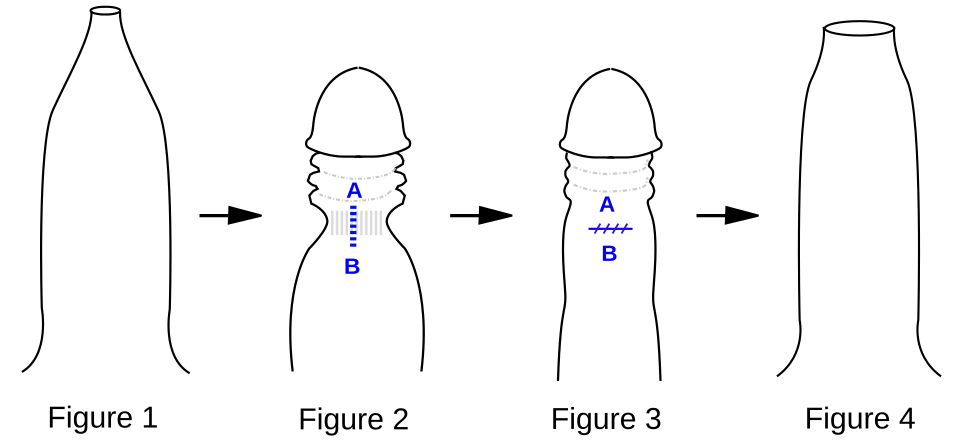
Preputioplasty (foreskin-sparing surgery)
Preputioplasty widens the tight ring with small cuts that are stitched sideways, keeping the foreskin. The NHS describes this type of procedure as usually suited to children. In adults, small series of foreskin-sparing techniques report good satisfaction and few recurrences, but the evidence is limited and some men still need circumcision later.
Source: NHS — Tight foreskin; Clinics and Practice (PMC) — Phimosis in Adults: Narrative Review
Circumcision
Circumcision removes the foreskin and is the definitive treatment for adult phimosis, especially when creams have failed, when infections keep returning, or when lichen sclerosus has scarred the foreskin. It is usually a day-case operation of about 30 minutes under general or local anesthesia, with dissolvable stitches. The overall complication rate is estimated at about 3.8%, mostly minor bleeding, wound infection or removal of too little or too much skin. Narrowing of the urethral opening (meatal stenosis) is more common when BXO is present: 20% versus 6% in one pediatric series.
Source: NHS — Circumcision in men; Clinics and Practice (PMC) — Phimosis in Adults: Narrative Review
| Treatment | Best suited for | Keeps foreskin? | Limitations |
|---|---|---|---|
| Steroid cream (4–8 weeks) | First-line for most symptomatic cases | Yes | Recurrence possible; weaker in dense scarring |
| Gentle stretching | Mild to moderate acquired tightness | Yes | Takes weeks; risk of paraphimosis if forced |
| Preputioplasty | Men who wish to keep the foreskin, without severe scarring | Yes | Limited adult data; may need circumcision later |
| Circumcision | Failed creams, recurrent infection, lichen sclerosus | No | Surgical risks; 4–6 weeks to heal fully |
Source: NHS — Circumcision in men; EAU — Paediatric Urology Guidelines: abnormalities of the penile skin
Recovery after adult circumcision
Full healing after adult circumcision usually takes 4 to 6 weeks. Swelling, bruising and some minor bleeding are normal for the first 1 to 2 weeks. The glans is often very sensitive at first because it is no longer covered, and a feeling of tightness during erections can last a few months.
- Work: most men take about a week off.
- Exercise: avoid swimming, cycling, sport and heavy lifting for at least 2 weeks.
- Sex and masturbation: avoid for at least 4 weeks, or until the wound has fully healed.
- Stitches: dissolvable stitches disappear in about 2 to 6 weeks.
- Pain relief: paracetamol or ibuprofen is usually enough.
Contact your surgeon urgently for bleeding that will not stop, a red, hot or pus-filled wound, fever, severe pain or difficulty passing urine.
Source: NHS — Circumcision in men
Many men worry about their sex life afterward. Some reduction in sensitivity of the glans is common, but the NHS notes that long-term effects on sex life are usually not major, and a 2024 review found no overall harmful effect of circumcision on sexual function. In one study of 69 men, pain during intercourse resolved after circumcision and erectile function scores improved. If erection problems persist for other reasons, our guide to erectile dysfunction explains the causes and treatments.
Source: NHS — Circumcision in men; Clinics and Practice (PMC) — Phimosis in Adults: Narrative Review
When to see a doctor
A tight foreskin in a young boy with no symptoms usually needs only patience. Teenagers and adults with a new or worsening tight foreskin should book an appointment, especially if they have:
- A tight foreskin that is swollen, sore or painful
- Bleeding, thick discharge or an unpleasant smell from under the foreskin
- Pain or difficulty when passing urine
- Painful erections, or splitting and bleeding during sex
- Itchy white patches on the foreskin or glans
- A lump, thickened skin or a sore that does not heal
Go to an emergency department immediately if the foreskin is stuck behind the glans and the tip is swollen and painful (paraphimosis), or if you cannot pass urine at all.
Source: NHS — Tight foreskin; MedlinePlus — Paraphimosis
If a tight foreskin is affecting your comfort or sex life, you can arrange a confidential assessment with our urologist-andrologist, Assoc. Prof. Dr. Zülfü Sertkaya, in Istanbul. Send us a message on WhatsApp for a free initial consultation; the right treatment and its cost depend on the examination.
FAQs about phimosis
Is phimosis normal in adults?
No. A non-retractable foreskin is normal in babies and young boys, but by age 16 only about 1% of boys still have it. A tight foreskin in an adult, especially one that used to retract, usually has a cause such as repeated balanitis, lichen sclerosus or diabetes and is worth checking with a doctor.
Source: Cochrane Review (PMC) — Topical corticosteroids for treating phimosis in boys
Can phimosis go away on its own?
In children, yes: most foreskins loosen naturally, although some do not retract until age 10 or later. In adults, the pathological form caused by scarring rarely resolves by itself and may slowly worsen, so treatment with a steroid cream, gentle stretching or surgery is usually needed if it causes symptoms.
Source: NHS — Tight foreskin
How long does steroid cream take to work for phimosis?
Steroid creams are usually applied twice daily for four to eight weeks, together with gentle retraction. Guidelines report success in more than 80% of boys, while adult data are more limited. If there is no improvement after a full course, or if the foreskin is badly scarred, your doctor will discuss surgical options.
Source: EAU — Paediatric Urology Guidelines: abnormalities of the penile skin
Can I fix phimosis without circumcision?
Often, yes. Many men improve with a steroid cream and gentle stretching, and foreskin-sparing surgery (preputioplasty) is an option for some. Circumcision is generally reserved for a tight foreskin that does not respond to these treatments, keeps causing infections, or is due to lichen sclerosus with significant scarring.
Source: Cleveland Clinic — Penile Diseases & Disorders
Is it safe to have sex with phimosis?
Many men with mild tightness have sex without problems. However, a tight foreskin can split and bleed during intercourse, and forcing it back can cause paraphimosis. Avoiding forced retraction and always returning the foreskin forward afterward help prevent this. Recurrent pain or bleeding is a reason to seek treatment.
Source: MedlinePlus — Paraphimosis
Can diabetes cause a tight foreskin?
Yes. High sugar levels encourage thrush and repeated balanitis, which can scar the foreskin. In one UK study, about a quarter of men with an acquired tight foreskin already had type 2 diabetes and more were newly diagnosed, so doctors recommend a blood sugar test for men whose foreskin becomes tight in adulthood.
Source: BJU International (PubMed) — Phimosis as a presenting feature of diabetes
Does phimosis increase the risk of penile cancer?
Penile cancer is rare, but the EAU guideline describes phimosis as strongly associated with invasive penile cancer, likely because of chronic inflammation. Lichen sclerosus also raises the risk slightly. Treating the tight foreskin, keeping the area clean and having any persistent lump or sore checked promptly are sensible steps.
Source: EAU — Penile Cancer Guidelines: Epidemiology, aetiology and pathology
How painful is adult circumcision recovery?
Pain after surgery is usually managed with paracetamol or ibuprofen. Swelling and bruising settle over one to two weeks, and the glans may feel very sensitive at first. Most men return to desk work in about a week, but sex should wait at least four weeks.
Source: NHS — Circumcision in men
Medically reviewed by Assoc. Prof. Dr. Zülfü Sertkaya, urologist and andrologist (FEBU), Istanbul. Last reviewed: October 2026.
This article is for general information and does not replace an individual consultation with a qualified doctor.
- NHS — Tight foreskin (phimosis)
- NHS — Circumcision in men
- NHS — Balanitis
- NHS — Lichen sclerosus
- EAU — Paediatric Urology Guidelines: Phimosis and other abnormalities of the penile skin
- EAU — Penile Cancer Guidelines: Epidemiology, aetiology and pathology
- Cochrane Review (PMC) — Topical corticosteroids for treating phimosis in boys
- Clinics and Practice (PMC) — Phimosis in Adults: Narrative Review of the New Available Devices and the Standard Treatments
- BJU International (PubMed) — Phimosis as a presenting feature of diabetes
- Cleveland Clinic — Penile Diseases & Disorders
- MedlinePlus — Paraphimosis