Retrograde ejaculation happens when semen flows backward into the bladder at orgasm instead of leaving through the penis, because the bladder neck does not close properly. Men usually notice a “dry” or very low-volume orgasm and cloudy urine afterwards. It is not dangerous, but it is a recognized and often treatable cause of male infertility, and sperm can usually be recovered from urine when a couple wants to conceive.
Source: NHS — Ejaculation problems; EAU — Sexual and Reproductive Health Guidelines (disorders of ejaculation)
- The typical signs are little or no semen at orgasm and cloudy urine the first time you pass urine after sex; erections and the feeling of orgasm are usually unaffected.
- The main causes are alpha-blockers and some other medicines, prostate or bladder neck surgery such as TURP, and nerve damage from diabetes, multiple sclerosis, spinal cord injury or pelvic surgery.
- The diagnosis is confirmed by finding sperm in a urine sample collected straight after orgasm (post-ejaculatory urinalysis).
- If a medicine is to blame, ejaculation usually returns once it is changed; off-label drugs such as pseudoephedrine help some men, but nerve or surgical damage may be permanent.
- For fertility, sperm can be retrieved from alkalinized urine and used for IUI or IVF/ICSI; surgical sperm retrieval is a backup.
- What is retrograde ejaculation?
- Symptoms: dry orgasm and cloudy urine
- Retrograde ejaculation causes
- Prostate (BPH) treatments and ejaculation
- Diagnosis: the post-ejaculatory urine test
- Treatment options
- Fertility options: sperm retrieval from urine
- Living with a dry orgasm
- When to see a doctor
- FAQs about retrograde ejaculation
What is retrograde ejaculation?
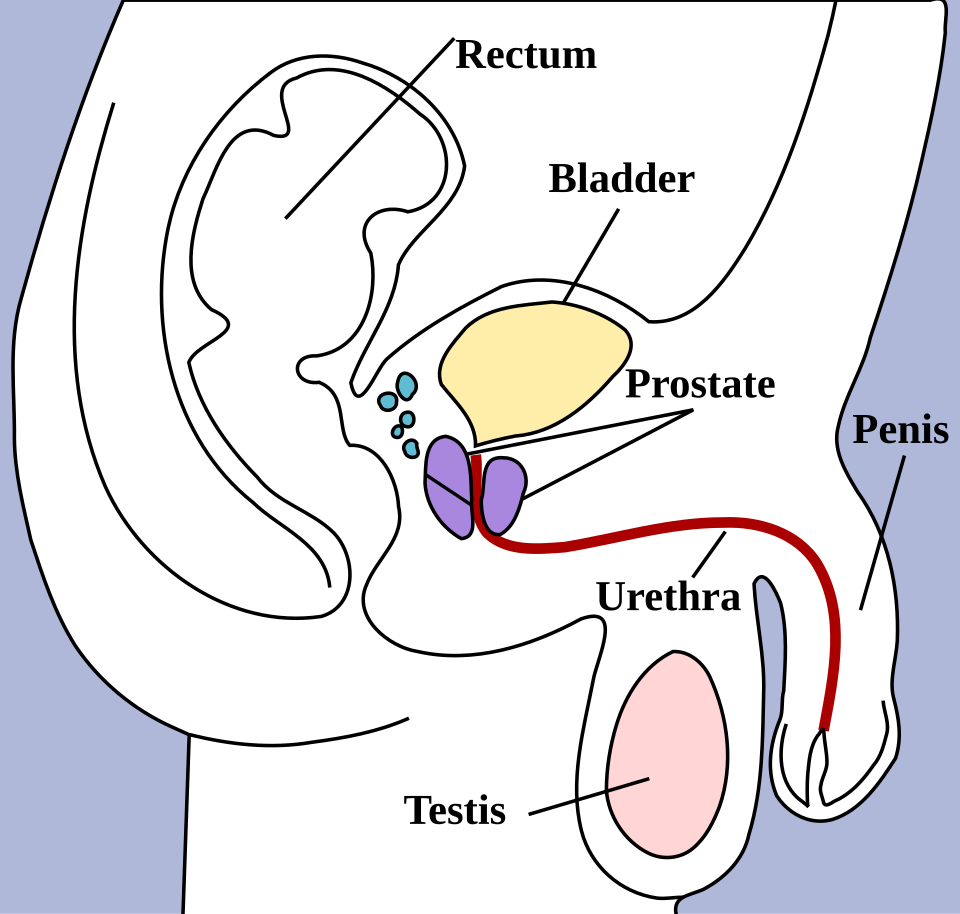
Normal ejaculation happens in two steps. First, during emission, sympathetic nerves from the lower spine (T10 to L2) squeeze sperm and fluid from the vas deferens, seminal vesicles and prostate into the urethra, and at the same moment the bladder neck (the internal urethral sphincter) tightens shut. Second, during expulsion, rhythmic contractions of the pelvic floor muscles push semen forward and out of the penis.
In this condition, the bladder neck stays open. Semen takes the path of least resistance, into the bladder, and is passed later with urine. It can be complete, with no semen at all (a “dry ejaculate”), or partial, where a reduced amount still comes out. Doctors call these states aspermia and hypospermia.
The condition is uncommon overall but well recognized in fertility clinics, where it accounts for roughly 0.3% to 2% of male infertility cases. Unlike many sexual problems, it almost always has a physical cause rather than a psychological one.
Source: World Journal of Men’s Health (PMC) — Gupta et al. 2022, guide to sperm recovery in infertile men; Translational Andrology and Urology (PMC) — Parnham & Serefoglu 2016, review of ejaculatory disorders
Symptoms: dry orgasm and cloudy urine
Many men only discover the problem when they try for a baby. When symptoms are noticed, they are usually:
- Little or no semen at orgasm (dry orgasm).
- Cloudy urine the first time you urinate after sex, because the semen is mixed with urine.
- Difficulty conceiving, because few or no sperm reach the partner’s cervix.
It does not stop you getting an erection or reaching orgasm, and it is not painful or harmful in itself. Some men do find that orgasm feels different, and the lack of semen can cause stress or anxiety.
A dry orgasm is not always retrograde ejaculation. In anejaculation there is no emission of semen at all, either forward or backward, which is why a urine test is needed to tell the two apart. If you mainly struggle to reach climax at all, that is a different problem, covered in our guide to delayed ejaculation.
Source: Cleveland Clinic — Retrograde Ejaculation: Causes, Symptoms & Treatment; MedlinePlus — Retrograde ejaculation
Retrograde ejaculation causes
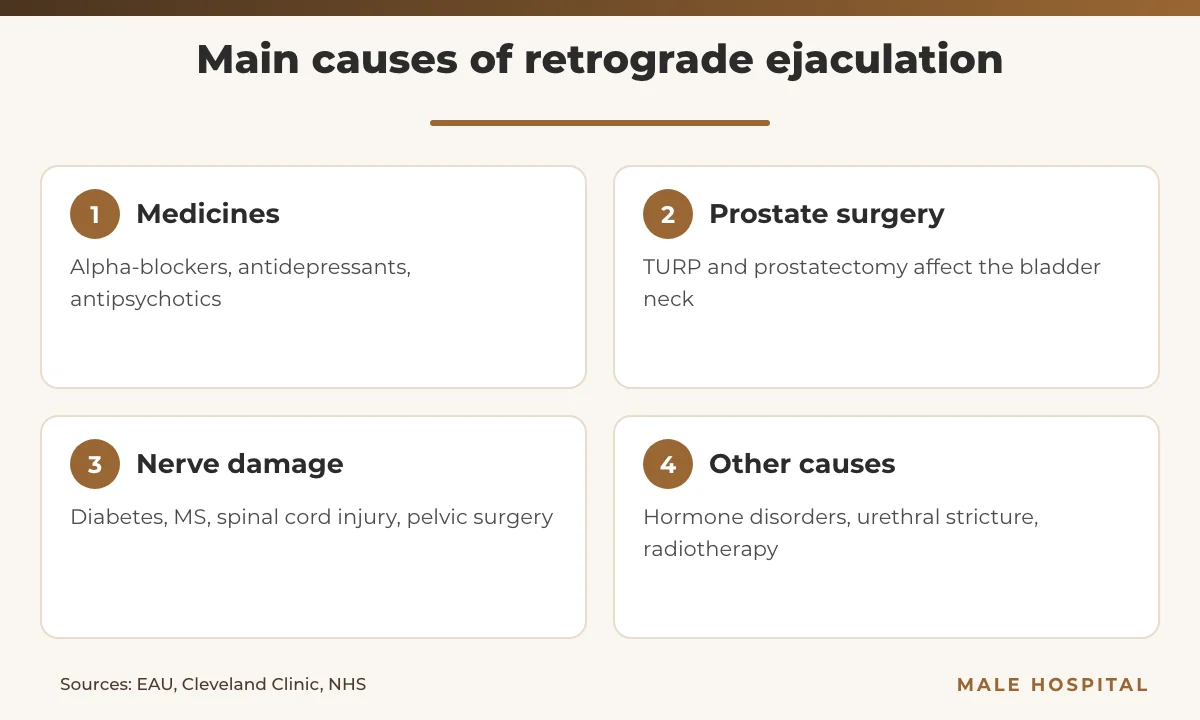
The European Association of Urology (EAU) groups the causes into four families: medicines, nerve (neurogenic) damage, anatomical changes after surgery, and hormonal (endocrine) disorders. In each case the end result is the same: the bladder neck fails to close at the moment of emission.
Medications, especially alpha-blockers
Alpha-1 blockers used for an enlarged prostate relax the smooth muscle of the prostate and bladder neck, which eases urine flow but can also disturb ejaculation. In the EAU’s pooled analysis, ejaculatory dysfunction was much more common with alpha-blockers than with placebo, and the risk was highest with the more selective drugs tamsulosin and silodosin, while doxazosin and terazosin carried a low risk. Younger age also appeared to increase the risk. Newer research suggests that part of what alpha-blockers cause is reduced emission rather than true backward flow.
Other medicines linked to the problem include some blood pressure drugs (including thiazide diuretics), antidepressants such as SSRIs, and antipsychotics. Never stop a prescribed medicine on your own; speak to the prescriber about alternatives first.
Source: EAU — Management of Non-neurogenic Male LUTS (disease management); World Journal of Men’s Health (PMC) — Gupta et al. 2022
Prostate and bladder neck surgery (TURP)
Surgery that removes or cuts tissue at the bladder neck is the classic cause. Cleveland Clinic notes that it follows most TURP (transurethral resection of the prostate) operations, and a 2020 review in the American Journal of Men’s Health points out that the vast majority of men who have classical prostate surgery for benign prostatic hyperplasia (BPH) are left with permanent backward ejaculation. Other surgical causes include urethral surgery, bladder surgery, and pelvic or rectal operations.
Nerve damage: diabetes, MS, spinal cord injury and pelvic surgery
The bladder neck is controlled by sympathetic nerves, so anything that damages them can cause the problem. Diabetes is a major example: in a small Danish controlled study, 9 of 26 men with diabetes had it, compared with none of 16 matched controls. Multiple sclerosis, spinal cord injury and non-nerve-sparing retroperitoneal lymph node dissection (an operation used for testicular cancer) can do the same. After first-time open anterior lumbar spine surgery, a pooled analysis of 2,503 men found it in 2.3%, and nearly half of those cases had resolved at follow-up.
Other causes
Less common causes include pelvic radiotherapy, a narrowed urethra (urethral stricture), congenital problems such as posterior urethral valves, and hormonal conditions such as hypothyroidism, low testosterone and high prolactin. Sometimes no cause is found.
Source: Cleveland Clinic — Retrograde Ejaculation; American Journal of Men’s Health (PMC) — Koren & Koren 2020, an unspoken aspect of prostatectomy for BPH; Andrology (PubMed) — Fedder et al. 2013, controlled study in men with diabetes; J Neurosurg Spine (PubMed) — Body et al. 2021, pooled analysis after anterior lumbar surgery
| Cause group | Examples | Can it reverse? |
|---|---|---|
| Medicines | Alpha-blockers (tamsulosin, silodosin), some blood pressure drugs, antidepressants, antipsychotics | Usually, after the drug is changed |
| Surgery (anatomical) | TURP, prostatectomy, bladder neck incision, urethral surgery | Often permanent |
| Nerve damage | Diabetes, multiple sclerosis, spinal cord injury, lymph node dissection, lumbar or pelvic surgery | Sometimes; may respond to medicines |
| Endocrine and other | Hypothyroidism, hypogonadism, high prolactin, urethral stricture, pelvic radiotherapy | Depends on the underlying cause |
Source: EAU — Sexual and Reproductive Health Guidelines (disorders of ejaculation)
Prostate (BPH) treatments and ejaculation
Because BPH treatment is the most common route into a dry orgasm, it is worth asking about ejaculation before you choose a prostate treatment. The EAU guideline on male lower urinary tract symptoms reports clear differences between options:
| BPH treatment | Effect on ejaculation (EAU data) |
|---|---|
| Alpha-blockers | Ejaculatory problems more common than placebo, highest with tamsulosin and silodosin, low with doxazosin and terazosin |
| 5-alpha-reductase inhibitors | Less frequently, backward ejaculation, ejaculation failure or lower semen volume; combined with an alpha-blocker the risk is about three times higher |
| TURP (monopolar or bipolar) | Backward ejaculation is a recognized long-term complication; anejaculation in 36% of sexually active men in the WATER trial’s TURP arm |
| Aquablation | Anejaculation 10% vs 36% with TURP; long-term antegrade ejaculation preserved in about 81% to 90% |
| Rezūm water vapor therapy | Antegrade ejaculation preserved in 98% at 12 months in a trial against TURP |
| Ejaculation-sparing HoLEP | Modified techniques maintained ejaculation in up to 77.8% of patients |
These figures come from trials with selected patients and are not personal predictions. The right choice also depends on prostate size, symptom severity and other health factors, so discuss the trade-offs with your urologist.
Source: EAU — Management of Non-neurogenic Male LUTS (disease management)
Diagnosis: the post-ejaculatory urine test
Diagnosis starts with a conversation about your symptoms, medicines, diabetes and any past surgery, followed by a physical examination. Two tests then confirm it.
Semen analysis
A semen analysis showing a low volume (under about 1.5 mL) or no ejaculate at all raises the suspicion. Cleveland Clinic notes that a low volume in at least two samples points toward the condition. However, low volume alone cannot distinguish an emission problem from true backward flow.
Post-ejaculatory urinalysis
The key test is a urine sample collected immediately after orgasm. You partly empty your bladder, then ejaculate (or reach orgasm) into one sterile pot, and straight away pass urine into a second pot, usually containing warm sperm-wash medium so that the sperm survive. The urine is spun in a centrifuge and examined. Labs may also check for fructose, a sugar found in semen.
A small number of sperm can appear in urine even in normal men, so thresholds are used: commonly 10 to 15 sperm per high-power field after centrifugation, or more than one million sperm in the sample. The EAU recommends this test for men with a total or partial absence of ejaculate and a normal or reduced orgasm, except in paraplegia.
Source: World Journal of Men’s Health (PMC) — Gupta et al. 2022; Cleveland Clinic — Retrograde Ejaculation
Treatment options
Treatment is optional. If you do not want children and the change does not bother you, many men simply choose to live with it. When treatment is wanted, the plan depends on the cause.
Changing the causative medicine
If a drug is responsible, normal ejaculation usually returns once it is stopped or switched, for example from tamsulosin or silodosin to an alpha-blocker with a lower risk, or to a different BPH strategy. This should always be done with the prescriber, especially for blood pressure or mental health medicines.
Source: NHS — Ejaculation problems; MedlinePlus — Retrograde ejaculation
Medicines that help close the bladder neck
Sympathomimetic drugs such as pseudoephedrine, ephedrine, synephrine, phenylpropanolamine and midodrine stimulate the bladder neck to contract. Antimuscarinic or antihistamine drugs such as imipramine and brompheniramine are another option, alone or combined. None of these is licensed specifically for this use, so they are prescribed off-label. The NHS notes that pseudoephedrine has helped men whose problem was caused by diabetes or surgery.
Evidence is modest. In a systematic review quoted by the EAU, sympathomimetics restored forward ejaculation in about 28% of men, antimuscarinics alone in about 22%, and the combination in about 39%, all based on small studies. The effect may fade over time. In one US series of 20 men given a short pseudoephedrine course before a semen test, 70% showed some improvement in their semen results. Side effects include dry mouth and raised blood pressure, so your doctor will check your heart and blood pressure first.
Source: EAU — Sexual and Reproductive Health Guidelines (disorders of ejaculation); Andrology (PubMed) — Shoshany et al. 2017, pseudoephedrine efficacy study
Treating the underlying condition and surgery
For men with diabetes, better blood sugar control is advised, and the NIDDK notes that doctors may treat this diabetes-related problem with medicine or by changing the diabetes care plan. Surgical reconstruction of the bladder neck has been reported in small case series, but it is rarely used. When nerves or the bladder neck have been badly damaged, normal ejaculation may not be restored, and fertility treatment becomes the practical route.
Source: NIDDK — Diabetes, Sexual, & Bladder Problems; Translational Andrology and Urology (PMC) — Parnham & Serefoglu 2016
Fertility options: sperm retrieval from urine
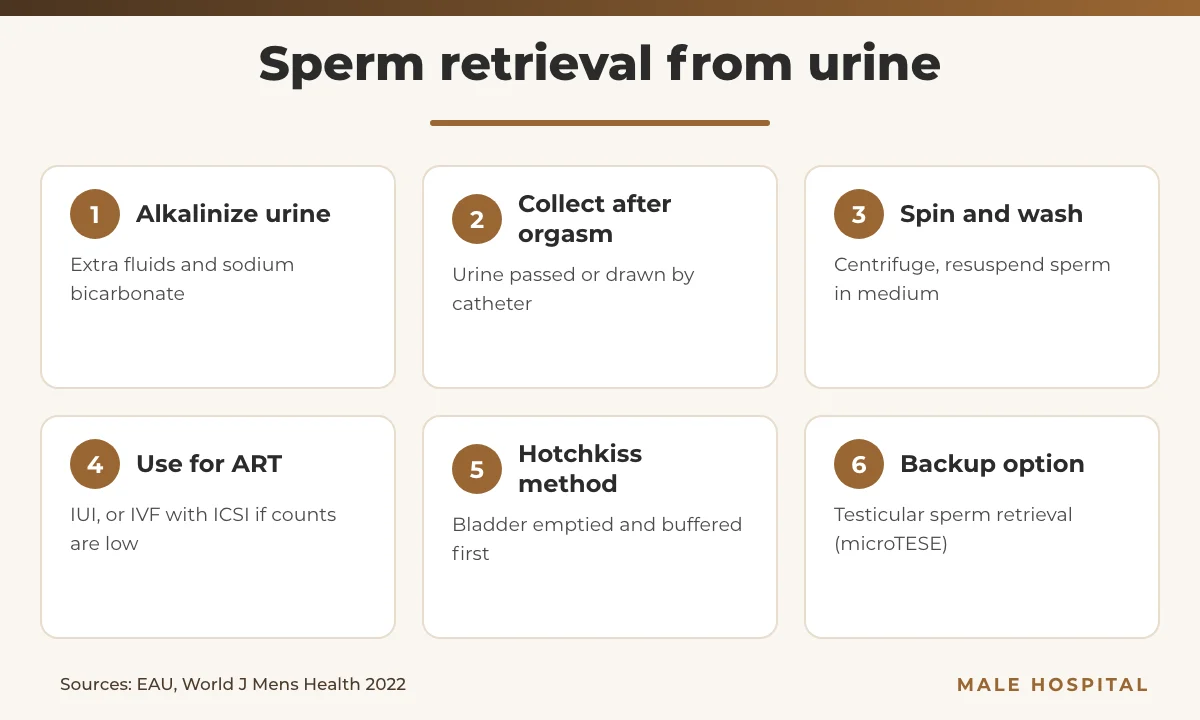
Even when medicines do not work, affected men usually still produce sperm. The EAU recommends collecting sperm from post-orgasmic urine for assisted reproduction when drug treatment fails or is not tolerated, and in men with spinal cord injury. Urine is normally acidic and concentrated, which damages sperm, so the urine is first made more sperm-friendly.
Centrifugation and resuspension
You drink more fluid and take an alkalinizing agent such as sodium bicarbonate to dilute and neutralize the urine. After orgasm, the urine is collected, centrifuged and the sperm resuspended in a culture medium. Across 15 studies, this approach gave a pregnancy rate of about 15% per cycle with IUI or IVF/ICSI.
Hotchkiss and modified Hotchkiss technique
The bladder is emptied with a catheter, rinsed and filled with a small amount of a buffered solution such as lactated Ringer’s before ejaculation, then the semen is recovered. Pregnancy rates of about 24% per cycle were reported across eight studies.
Ejaculation on a full bladder
A full bladder may help close the bladder neck. Only two small studies with five patients in total have looked at it, so the evidence is weak.
Retrieved sperm can be used for intrauterine insemination (IUI) if quality is good, or for IVF with ICSI if counts are low. If no usable sperm are recovered, surgical retrieval from the testis, such as microTESE, is an option. Men due to have surgery or treatment that carries this risk can freeze sperm beforehand. The partner’s fertility also shapes the choice of technique, and a 2012 systematic review concluded that the evidence is too limited to rank methods, so treatment should be tailored to each couple. If counts are also low, see our guide to low sperm count.
Source: EAU — Sexual and Reproductive Health Guidelines (disorders of ejaculation); World Journal of Men’s Health (PMC) — Gupta et al. 2022; Fertility and Sterility (PubMed) — Jefferys et al. 2012, management systematic review
Living with a dry orgasm
Health websites often describe retrograde ejaculation as harmless, and physically it is. But a 2020 review argued that its impact on men is often trivialized: no study has properly compared how men feel about orgasm with and without antegrade ejaculation, and men who were not warned before prostate surgery may feel misled. If ejaculation matters to you, say so before agreeing to BPH treatment, because ejaculation-sparing options exist.
Practical points: cloudy urine after sex is expected and not an infection; erections are not affected by backward flow itself; and if erection problems appear alongside it, especially with diabetes, they deserve their own assessment, as explained in our article on erectile dysfunction and diabetes. Pelvic floor (Kegel) exercises can improve ejaculatory control but will not redirect semen forward.
Source: American Journal of Men’s Health (PMC) — Koren & Koren 2020; Cleveland Clinic — Retrograde Ejaculation
When to see a doctor
See a urologist or andrologist if you notice any of the following:
- You and your partner have been trying to conceive without success.
- You have a dry or very low-volume orgasm that started after a new medicine or surgery.
- You have diabetes and your semen volume has fallen; this can be an early sign of nerve damage.
- You are planning prostate, bladder, pelvic or spine surgery and may want children later; ask about sperm freezing first.
- Orgasm without semen is causing you distress.
Seek prompt care if a dry orgasm comes with pain, blood in the urine or semen, fever, or difficulty passing urine, as these point to another problem that needs examination.
Source: MedlinePlus — Retrograde ejaculation
If you are worried about a dry orgasm or fertility, you can arrange a confidential assessment with our urologist-andrologist Assoc. Prof. Dr. Zülfü Sertkaya, whose work includes male infertility. Send us a message on WhatsApp for a free initial consultation.
FAQs about retrograde ejaculation
Is retrograde ejaculation dangerous?
No. Semen entering the bladder is not harmful and is simply passed out with urine, which may look cloudy. The condition does not damage the bladder or kidneys and does not stop erections or orgasm. Its main medical importance is fertility, because sperm do not reach the partner. Some men are also bothered by the change in sensation, which is a valid reason to seek advice.
Source: NHS — Ejaculation problems
Can retrograde ejaculation go away on its own?
It depends on the cause. When a medicine is responsible, normal ejaculation often returns soon after the drug is changed. After anterior lumbar spine surgery, nearly half of reported cases resolved within 3 to 48 months. When it follows classical prostate surgery such as TURP, or is due to established nerve damage, it is often permanent.
Source: MedlinePlus — Retrograde ejaculation; J Neurosurg Spine (PubMed) — Body et al. 2021
Does tamsulosin cause retrograde ejaculation?
Tamsulosin is one of the alpha-blockers most strongly linked to ejaculatory problems, together with silodosin, according to the EAU’s analysis. Some of the effect may be reduced emission rather than true backward flow. It usually reverses after stopping the drug. If it bothers you, ask your doctor about lower-risk alternatives such as doxazosin or other BPH treatments rather than stopping on your own.
Source: EAU — Management of Non-neurogenic Male LUTS
Can you get someone pregnant with retrograde ejaculation?
Natural conception is harder because few or no sperm are ejaculated forward, but it is not impossible when the backward flow is only partial. Many couples conceive with help: medicines can restore forward ejaculation in some men, and sperm recovered from alkalinized urine can be used for IUI or IVF/ICSI. Reported pregnancy rates are roughly 15% to 24% per treatment cycle.
Source: World Journal of Men’s Health (PMC) — Gupta et al. 2022
How do I know if I have retrograde ejaculation at home?
Signs you can notice yourself are little or no semen at orgasm and cloudy urine the first time you urinate afterwards. These clues are suggestive but not proof, because anejaculation and other problems can also cause a dry orgasm. A laboratory post-ejaculatory urine test, ideally collected at the lab into sperm-wash medium, is needed to confirm the diagnosis.
Source: Cleveland Clinic — Retrograde Ejaculation
Does pseudoephedrine work for retrograde ejaculation?
It helps some men, mainly those whose nerves are partly working, such as some men with diabetes. It is used off-label, and success rates in studies range widely; a systematic review put sympathomimetics at about 28%. It can raise blood pressure and heart rate, so it should only be taken under medical supervision, not bought and self-dosed.
Source: Translational Andrology and Urology (PMC) — Parnham & Serefoglu 2016
Does diabetes cause retrograde ejaculation?
Yes. Long-standing diabetes can damage the autonomic nerves that close the bladder neck. In one controlled study, about one in three men with diabetes who gave a sample had the condition, against none of the controls. Men with diabetes and a falling semen volume should have a post-ejaculatory urine test, and good blood sugar control is advised.
Source: Andrology (PubMed) — Fedder et al. 2013; NIDDK — Diabetes, Sexual, & Bladder Problems
Is retrograde ejaculation the same as a dry orgasm?
Not exactly. “Dry orgasm” describes the symptom: orgasm with no semen. Retrograde ejaculation is one cause, where semen goes into the bladder. Anejaculation, where no semen is emitted at all, is another, and the two are treated differently. Finding sperm in urine after orgasm is what separates the two.
Source: EAU — Sexual and Reproductive Health Guidelines (disorders of ejaculation)
Medically reviewed by Assoc. Prof. Dr. Zülfü Sertkaya, urologist and andrologist (FEBU), Istanbul. Last reviewed: November 2026.
This article is for general information and does not replace an individual consultation with a qualified doctor.
- EAU — Sexual and Reproductive Health Guidelines (disorders of ejaculation)
- EAU — Management of Non-neurogenic Male LUTS (disease management)
- NHS — Ejaculation problems
- Cleveland Clinic — Retrograde Ejaculation: Causes, Symptoms & Treatment
- MedlinePlus — Retrograde ejaculation
- NIDDK — Diabetes, Sexual, & Bladder Problems
- World Journal of Men's Health (PMC) — Gupta et al. 2022, A Comprehensive Guide to Sperm Recovery in Infertile Men with Retrograde Ejaculation
- Translational Andrology and Urology (PMC) — Parnham & Serefoglu 2016, Retrograde ejaculation, painful ejaculation and hematospermia
- American Journal of Men's Health (PMC) — Koren & Koren 2020, Retrograde Ejaculation: a Commonly Unspoken Aspect of Prostatectomy for BPH
- Andrology (PubMed) — Fedder et al. 2013, Retrograde ejaculation and sexual dysfunction in men with diabetes mellitus
- Andrology (PubMed) — Shoshany et al. 2017, Efficacy of treatment with pseudoephedrine in men with retrograde ejaculation
- Fertility and Sterility (PubMed) — Jefferys et al. 2012, The management of retrograde ejaculation: a systematic review and update
- J Neurosurg Spine (PubMed) — Body et al. 2021, Retrograde ejaculation following anterior lumbar surgery