
Paraphimosis is a urological emergency in which a retracted foreskin gets stuck behind the head of the penis (the glans) and cannot be pulled forward again. It is the reverse of phimosis, where a tight foreskin cannot be pulled back. The trapped skin acts like a tight ring, so the glans and foreskin swell, become painful and can lose their blood supply. If your foreskin will not return over the tip, go to an emergency department now: a doctor can usually reduce it quickly, and prompt treatment almost always leads to an excellent outcome.
Sources: NHS — Tight foreskin (phimosis); MedlinePlus — Paraphimosis
- The foreskin is stuck back behind the glans, not stuck forward as in phimosis, and it is an emergency.
- The most common trigger is a foreskin that was pulled back for washing, sex, an examination or a urinary catheter and not returned.
- It does not settle on its own and there is no safe home fix; the NHS advises going to A&E or calling 999.
- Doctors first reduce the swelling and pain, then push the foreskin forward; a small cut (dorsal slit) is used if this fails.
- Because it often comes back, many urologists recommend a planned circumcision once the swelling has gone.
What is paraphimosis?
The foreskin (prepuce) is the fold of skin that normally covers the glans. In most adult men it slides back for washing, urination and erections and then slides forward again. Paraphimosis happens when the retracted foreskin cannot be brought back down to cover the glans. It only affects men and boys who are uncircumcised or partially circumcised.
The problem is mechanical. The opening of the foreskin is usually its narrowest part. When it sits behind the ridge of the glans (the corona), that narrow ring squeezes the shaft just below the head. The squeeze blocks the veins and lymph vessels that drain the glans, fluid builds up, the tissue swells, and the swelling makes the ring even tighter. This is why the condition tends to get worse, not better, with time.
Sources: EAU Guidelines — Phimosis and other abnormalities of the penile skin; Merck Manual Professional — Phimosis and Paraphimosis
How common is it? The European Association of Urology (EAU) puts the incidence in children at about 0.2%, mostly after the foreskin has been manipulated. Cleveland Clinic gives a similar 0.2% figure for uncircumcised children aged 4 months to 12 years and estimates about 1% in uncircumcised males aged 16 and older. MedlinePlus notes that it is seen most often in boys and in older men, the second group often in hospitals and nursing homes.
Sources: Cleveland Clinic — Paraphimosis; MedlinePlus — Paraphimosis
Paraphimosis vs phimosis
The two names sound alike but describe opposite problems. In phimosis, the foreskin is too tight to be pulled back over the glans; it is uncomfortable but not an emergency, and it is usually treated with a steroid cream or planned surgery. In the other condition, the foreskin has been pulled back and is now stuck there. A tight foreskin does raise the risk: the EAU notes that relative phimosis makes this trapping more likely, because a narrow ring is easier to trap behind the glans.
| Feature | Phimosis | Paraphimosis |
|---|---|---|
| Position of foreskin | Covers the glans, cannot be pulled back | Pulled back, cannot return over the glans |
| Urgency | Not an emergency | Medical emergency |
| Main risk | Pain, infections, painful erections | Reduced blood flow, tissue damage of the glans |
| First treatment | Steroid cream, stretching | Emergency manual reduction |
| Surgery | Preputioplasty or circumcision if creams fail | Dorsal slit if reduction fails; circumcision later to prevent recurrence |
Sources: American Family Physician — Paraphimosis: Current Treatment Options; EAU Guidelines — Phimosis and other abnormalities of the penile skin
What causes paraphimosis?
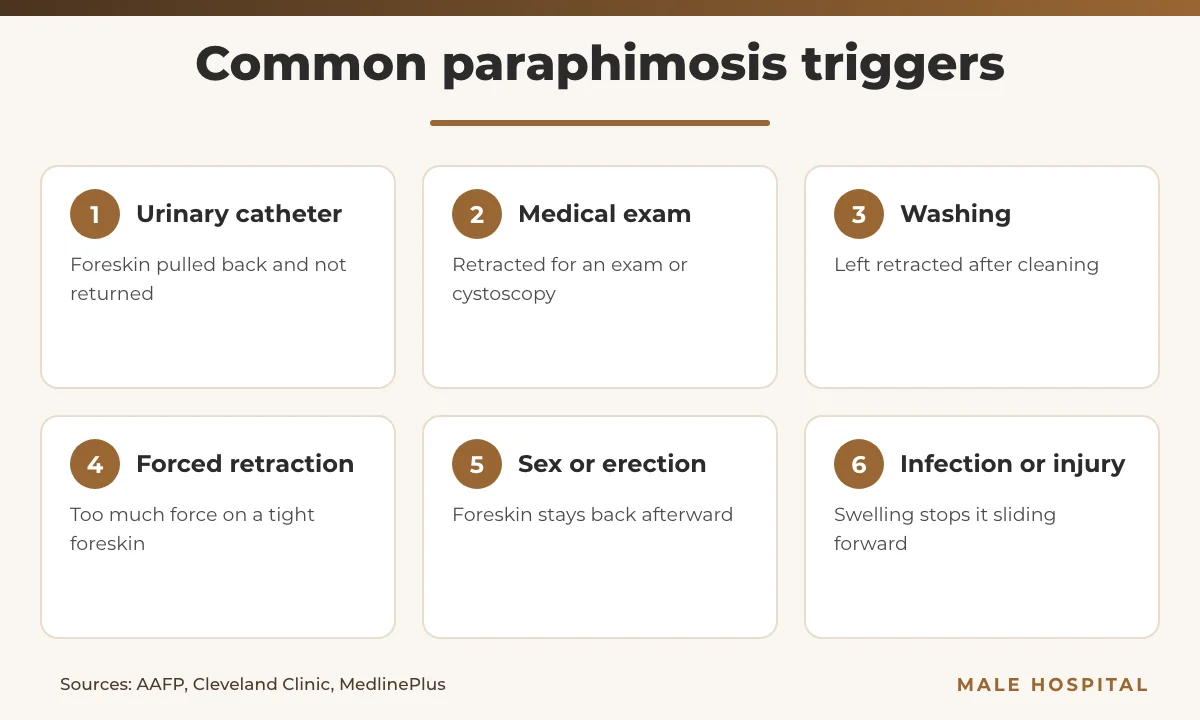
In most cases nothing is “wrong” with the penis beforehand: the foreskin was simply pulled back and left there long enough for swelling to start. A review in American Family Physician describes the condition as usually iatrogenic, meaning it follows medical care, most often after a penile examination, a urinary catheter or a cystoscopy when the foreskin is not returned afterward.
Common triggers
- Urinary catheters and examinations. The foreskin is retracted to clean the area or insert a catheter and then forgotten. Case reports in older hospital patients describe exactly this pattern.
- Washing and self-retraction. Pulling the foreskin back to clean underneath, or to stretch a tight foreskin, and not bringing it forward again.
- Forced retraction. Using too much force to pull back a foreskin that does not yet retract easily, especially in boys.
- Sex and erections. The foreskin can stay retracted after intercourse or an erection, and an erection can make a tight ring harder to return.
- Infection and inflammation. Swelling from balanitis or inflammation of the foreskin (posthitis) can make it hard to return.
- Injury, piercings and rings. Trauma to the penis and, rarely, a ring piercing the glans have been reported as causes.
Sources: American Family Physician — Paraphimosis: Current Treatment Options; Cleveland Clinic — Paraphimosis; MedlinePlus — Paraphimosis
Diabetes and SGLT2 diabetes medicines
A 2026 analysis of the WHO pharmacovigilance database found that phimosis and paraphimosis were reported more often with SGLT2 inhibitors (glucose-lowering drugs such as empagliflozin and dapagliflozin) than with other diabetes medicines, with most reports in men aged 45 to 64. This is a reporting signal, not proof that the drugs cause the problem, so never stop a diabetes medicine on your own; mention any foreskin symptoms to your doctor instead.
Source: Acta Diabetologica (PubMed) — SGLT2 inhibitors and reporting of phimosis/paraphimosis
Paraphimosis symptoms
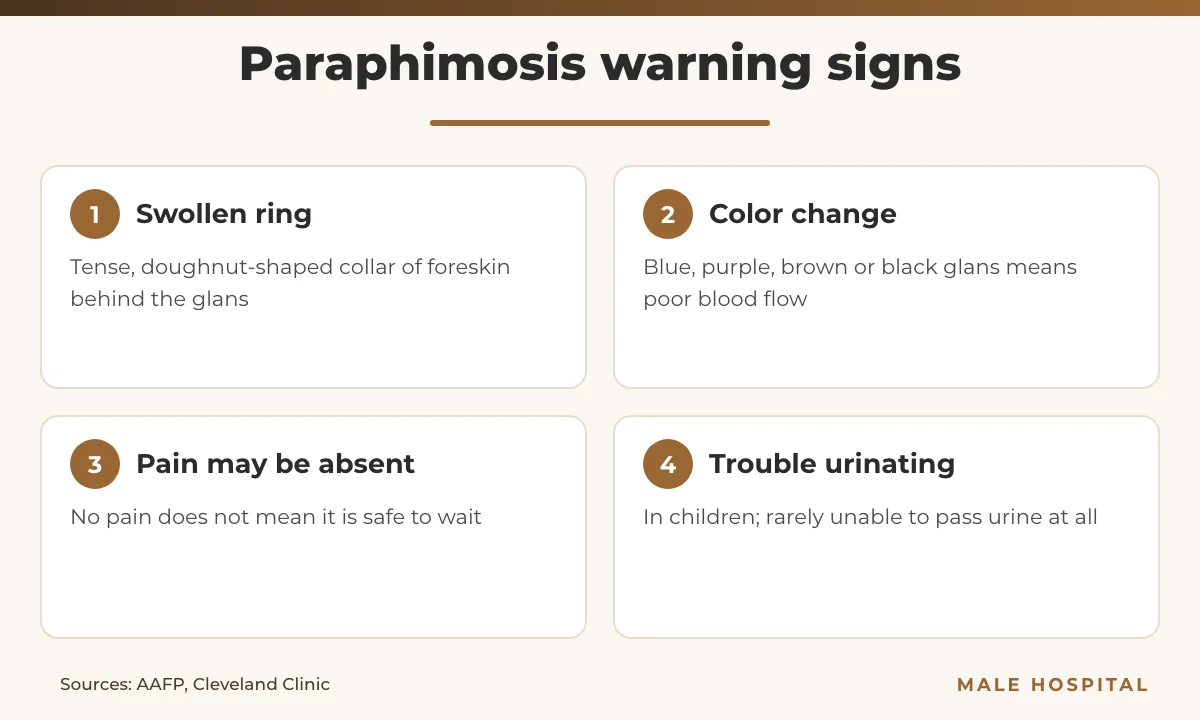
The key sign is simple: the foreskin is behind the head of the penis and will not slide back over it. Around this, typical symptoms build up over hours:
- A swollen, tense “collar” or doughnut-shaped ring of foreskin just behind the glans.
- A swollen, congested glans that may look dark red.
- Pain in the tip of the penis, sometimes severe. Pain is not always present, so the absence of pain does not mean it is safe to wait.
- Color change of the glans to blue, purple, brown or black, a warning sign of poor blood flow.
- In children, difficulty passing urine and, rarely, being unable to pass urine at all.
The shaft of the penis is usually soft. A pink or salmon-colored glans suggests the blood supply is still good, while a black, firm or hard glans suggests tissue damage has begun.
Sources: American Family Physician — Paraphimosis: Current Treatment Options; Cleveland Clinic — Paraphimosis
Diagnosis is clinical. A doctor recognizes it by looking at the penis and finding a ring-like swelling around the shaft near the glans that cannot be easily pulled forward. Blood tests or scans are not normally needed before treatment. The doctor will also ask about recent catheters, examinations, sex or injury, because this guides the plan and future prevention.
Sources: MedlinePlus — Paraphimosis; StatPearls (PubMed) — Paraphimosis
Why paraphimosis is an emergency
The NHS, the EAU and Cleveland Clinic all describe this condition as a medical emergency. The constricting band first blocks lymph and venous drainage, which causes swelling. If the swelling and pressure continue, arterial blood flow to the glans can be reduced (ischemia). Untreated, this can progress to tissue death (necrosis), gangrene and, in the most severe and neglected cases, loss of the tip of the penis. The American Family Physician review notes this can happen over days to weeks.
Sources: American Family Physician — Paraphimosis: Current Treatment Options; StatPearls (PubMed) — Paraphimosis
Serious damage is rare and is usually linked to delay or a missed diagnosis. Published case reports describe glans necrosis in an 83-year-old man whose foreskin was left retracted after a catheter was placed, and in a 25-year-old man who was not treated promptly; both kept their penis after careful treatment, but needed weeks to months of care. There is no safe number of hours to wait. Cleveland Clinic simply advises treatment as quickly as possible to prevent permanent damage.
Sources: Urology Case Reports (PMC) — Glans penis necrosis following paraphimosis; IJU Case Reports (PubMed) — Long-term follow-up of glans necrosis due to paraphimosis; Cleveland Clinic — Paraphimosis
A trapped foreskin is one of a small group of penile emergencies, together with a painful erection that will not go down (priapism) and penile fracture. All three share the same rule: go to hospital the same day rather than waiting to see if it settles.
What to do right now
If your foreskin has just been pulled back and slides forward easily with gentle pressure, there is no emergency. If it will not go back, stop and get medical help. Cleveland Clinic states that the condition cannot resolve on its own and there is no home fix.
- Go to an emergency department now. The NHS advises calling 999 or going to A&E if the foreskin is pulled back and cannot go back over the end of the penis.
- Do not drive yourself. Ask someone to take you or call an ambulance, and bring a list of any medicines you take.
- Do not force it. Repeated hard pulling on swollen skin can tear it and add to the swelling.
- Do not rely on ice. Ice can reduce swelling but Cleveland Clinic warns it is not the best option because cold can further reduce blood flow.
- Tell staff about catheters. If a family member in hospital or a care home has a catheter and a swollen penis tip, tell the nurse or doctor straight away.
Sources: NHS — Tight foreskin (phimosis); Cleveland Clinic — Paraphimosis
How doctors treat paraphimosis
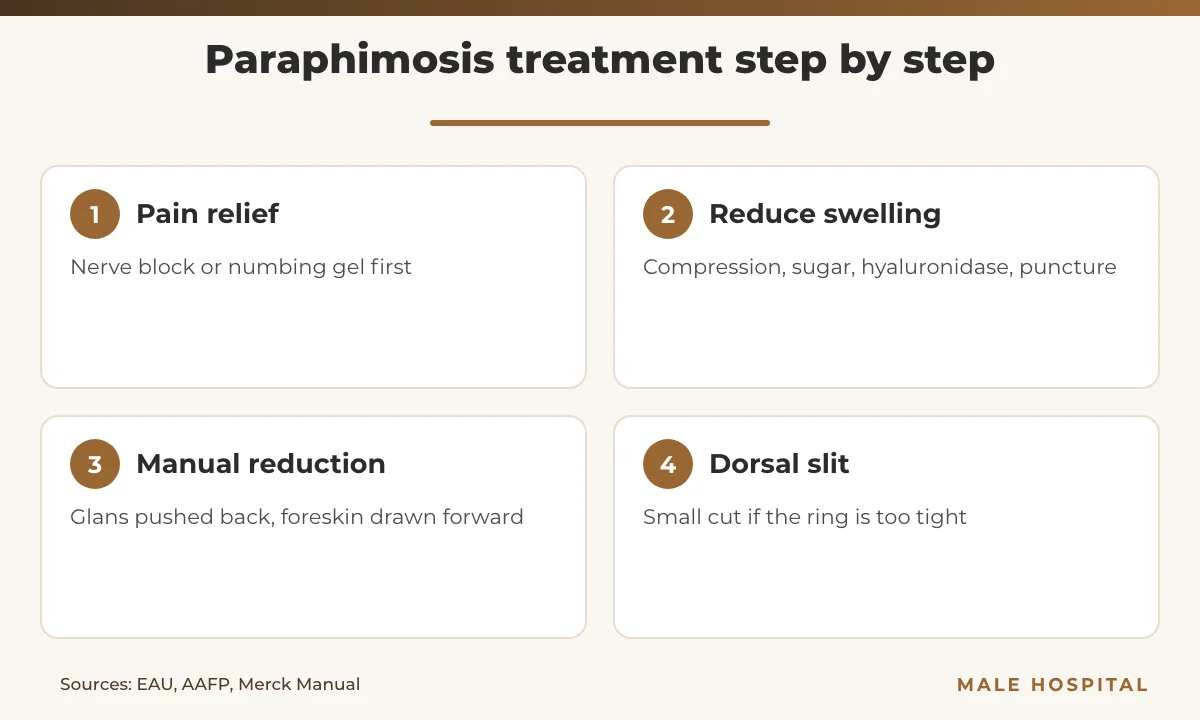
Emergency treatment has one goal: get the foreskin back over the glans before the blood supply is affected. The EAU recommends manual reduction first and surgery only if that fails. Reviews describe a stepwise sequence, from the gentlest methods to a small operation.
Sources: EAU Guidelines — Phimosis and other abnormalities of the penile skin; International Journal of Clinical Practice (PubMed) — Treatment options for paraphimosis
Step 1: Pain relief
Reduction is uncomfortable, so pain control comes first. In adults, doctors use a penile nerve block (a local anesthetic injection at the base of the penis), anesthetic gel or pain medicine. In children, a topical anesthetic cream or gel is often enough. In one study of 46 children, reduction under topical anesthetic succeeded at the first attempt in 91.4%, compared with 81.8% under intravenous sedation, and the children went home much sooner.
Sources: American Family Physician — Paraphimosis: Current Treatment Options; American Journal of Emergency Medicine (PubMed) — Topical anesthetic vs procedural sedation for pediatric paraphimosis
Step 2: Reducing the swelling
Because the swelling is what holds the ring in place, the doctor first tries to shrink it. Options include firm, steady squeezing of the glans by hand or with an elastic bandage, granulated sugar spread on the swollen skin to draw fluid out by osmosis, and injection of hyaluronidase, an enzyme that helps the fluid disperse. Another option is the puncture technique: several tiny needle holes in the swollen foreskin let the trapped fluid escape.
Step 3: Manual reduction
Once the swelling is smaller, the doctor places both thumbs on the glans and the fingers behind the swollen foreskin, then pushes the glans back while drawing the foreskin forward with steady pressure.
Step 4: Dorsal slit
If the ring is too tight, the doctor makes a small cut along the top of the constricting band under local anesthetic. This dorsal slit releases the pressure immediately and allows the foreskin to come forward. It is a temporary fix, and a planned circumcision usually follows later.
Sources: American Family Physician — Paraphimosis: Current Treatment Options; Merck Manual Professional — Phimosis and Paraphimosis; Journal of Pediatric Urology (PubMed) — Simple method of paraphimosis reduction revisited
| Method | How it works | When it is used |
|---|---|---|
| Manual compression | Steady squeezing pushes fluid out of the glans and foreskin | First step in most cases |
| Granulated sugar | Draws fluid out of swollen skin by osmosis | Mild to moderate swelling, when time allows |
| Hyaluronidase injection | Enzyme helps trapped fluid spread and drain | Swollen foreskin, often in children |
| Puncture technique | Tiny needle holes let fluid escape | Tense swelling, by an experienced doctor |
| Dorsal slit | Small cut releases the tight ring | When other methods fail |
| Circumcision | Removes the foreskin | Usually later, to prevent recurrence |
Source: American Family Physician — Paraphimosis: Current Treatment Options
It is worth being honest about the evidence. There are no randomized trials comparing these techniques, so the choice depends on how swollen the tissue is, the patient’s age and the doctor’s experience. What the sources agree on is the order: reduce the swelling, attempt manual reduction with good pain relief, and move to a dorsal slit without long delays if that fails.
Sources: American Family Physician — Paraphimosis: Current Treatment Options; International Journal of Clinical Practice (PubMed) — Treatment options for paraphimosis
Recovery, circumcision and preventing paraphimosis
After a successful reduction, the compressive dressing is removed once the swelling settles, and the doctor will check that the glans looks healthy and that you can pass urine. If a catheter was removed for the procedure, it is replaced afterward with the foreskin left in its normal forward position.
Will it happen again?
Recurrence is common, especially when the foreskin is tight. For this reason several sources recommend a planned circumcision after an episode, once the swelling has fully resolved, and Cleveland Clinic notes that circumcision is the only complete prevention. If a dorsal slit was needed, circumcision is usually advised to tidy the cut edge and stop future episodes. You can read more about the operation, healing and return to sex in our guide to adult circumcision.
Sources: Urology Case Reports (PMC) — Glans penis necrosis following paraphimosis; Merck Manual Professional — Phimosis and Paraphimosis; Cleveland Clinic — Paraphimosis
Treatment itself carries small risks. Cleveland Clinic lists bleeding, infection, pain, inflammation of the urinary opening (meatitis) and narrowing of the opening (meatal stenosis). After a circumcision, seek care for fever, pus, spreading redness, bleeding that will not stop, or trouble passing urine.
Source: Cleveland Clinic — Paraphimosis
How to prevent it from happening again
- Always return the foreskin over the glans after washing, urinating, sex or masturbation.
- Do not leave the foreskin retracted longer than necessary.
- Never force back a tight foreskin; have a tight or scarred foreskin assessed and treated.
- Treat foreskin infections early, and keep blood sugar under control if you have diabetes.
- Caregivers and hospital staff: always bring the foreskin forward after inserting a catheter or examining an uncircumcised patient.
Sources: MedlinePlus — Paraphimosis; Cleveland Clinic — Paraphimosis; Merck Manual Professional — Phimosis and Paraphimosis
When to see a doctor
A trapped foreskin always needs same-day emergency care. Go to the nearest emergency department or call an ambulance if:
- Your foreskin is pulled back and will not return over the head of the penis with gentle pressure.
- The glans or foreskin is swelling, painful, or turning blue, purple, brown or black.
- You or your child cannot pass urine or can only pass a thin, weak stream.
- A person with a urinary catheter has a swollen, discolored penis tip.
Book a routine appointment, not an emergency one, if your foreskin is tight, gets stuck briefly but returns, cracks or splits, or has been trapped before. These are the situations where planned treatment can prevent a future emergency.
Source: NHS — Tight foreskin (phimosis)
If you have had an episode of a trapped foreskin or keep struggling with a tight foreskin, you can arrange a confidential consultation with our urologist-andrologist in Istanbul via WhatsApp to discuss planned circumcision or foreskin-sparing options. For a foreskin that is stuck right now, please go to your nearest emergency department first.
FAQs about paraphimosis
Can paraphimosis go away on its own?
No. Once the foreskin is trapped and swelling has started, the swelling usually tightens the ring further. Cleveland Clinic states that it cannot resolve on its own and has no home fix. If gentle pressure does not return the foreskin, go to an emergency department so a doctor can reduce it with proper pain relief.
Source: Cleveland Clinic — Paraphimosis
How long can you wait with a stuck foreskin?
There is no safe waiting time. Damage depends on how tight the ring is and how long it lasts, and complications are linked to delay. Serious harm such as necrosis is rare and usually develops over a longer period, but nobody can predict it in an individual case, so treatment should start as soon as possible.
Sources: Urology Case Reports (PMC) — Glans penis necrosis following paraphimosis
Is paraphimosis reduction painful?
It can be, which is why doctors use pain relief first. Adults usually receive a local anesthetic block at the base of the penis or anesthetic gel; children often need only a numbing cream or gel.
Sources: American Family Physician — Paraphimosis: Current Treatment Options; American Journal of Emergency Medicine (PubMed) — Topical anesthetic vs procedural sedation
Do I need a circumcision after paraphimosis?
Not always, but it is often recommended. The problem tends to recur, particularly with a tight foreskin, and circumcision is the only complete prevention. If a dorsal slit was needed in the emergency, a later circumcision is usually advised. The operation is planned for after the swelling has fully settled, not during the emergency.
Sources: Cleveland Clinic — Paraphimosis; Merck Manual Professional — Phimosis and Paraphimosis
Can sex cause a trapped foreskin?
Yes. The foreskin can stay retracted after intercourse, masturbation or an erection, and a tight foreskin is more likely to get stuck. Reviews also mention erections and penile injuries as less common triggers. Always bring the foreskin forward afterward, and if it will not move back, seek emergency care rather than forcing it.
Source: American Family Physician — Paraphimosis: Current Treatment Options
Can you get paraphimosis if you are circumcised?
It can only happen if there is foreskin to trap. Men who are fully circumcised cannot get it, but men with a partial circumcision that left some foreskin can. If you are unsure whether your circumcision left enough skin to retract, a urologist can tell you at a routine visit.
Source: MedlinePlus — Paraphimosis
Why does this happen to older men in hospital?
In hospitals and nursing homes, the foreskin is often pulled back to clean the area or insert a urinary catheter and then not returned. Older or unwell men may not notice or report the swelling. Published cases of glans necrosis often involve catheterized patients, which is why staff are taught to always bring the foreskin forward.
Sources: MedlinePlus — Paraphimosis; Urology Case Reports (PMC) — Glans penis necrosis following paraphimosis
Can I use ice on a stuck foreskin?
Ice is sometimes used by clinicians together with compression, but it is not a home treatment. Cleveland Clinic notes that ice can reduce swelling but is not the best option because cold can further reduce blood flow to the glans. Rather than spending time on ice at home, go to an emergency department.
Source: Cleveland Clinic — Paraphimosis
Medically reviewed by Assoc. Prof. Dr. Zülfü Sertkaya, urologist and andrologist (FEBU), Istanbul. Last reviewed: November 2026.
This article is for general information and does not replace an individual consultation with a qualified doctor.
- NHS — Tight foreskin (phimosis)
- MedlinePlus — Paraphimosis
- Cleveland Clinic — Paraphimosis
- American Family Physician — Paraphimosis: Current Treatment Options (Choe, 2000)
- Merck Manual Professional — Phimosis and Paraphimosis
- EAU — Paediatric Urology Guidelines: Phimosis and other abnormalities of the penile skin
- StatPearls (PubMed) — Paraphimosis
- International Journal of Clinical Practice (PubMed) — Treatment options for paraphimosis
- American Journal of Emergency Medicine (PubMed) — Pediatric paraphimosis reduction using topical anesthetic versus intravenous procedural sedation
- Journal of Pediatric Urology (PubMed) — Simple method of paraphimosis reduction revisited
- Urology Case Reports (PMC) — Glans penis necrosis following paraphimosis
- IJU Case Reports (PubMed) — Long-term follow-up of penile glans necrosis due to paraphimosis
- Acta Diabetologica (PubMed) — SGLT2 inhibitors and reporting of phimosis/paraphimosis: WHO database analysis