
Penile fracture is a tear in the tunica albuginea, the tough sheath around the erection chambers, and it is a urological emergency. It usually happens when an erect penis is bent with force during sex, and the classic picture is a cracking sound, sudden loss of the erection, pain and fast-growing swelling. European and American urology guidelines recommend prompt surgical repair, which gives the lowest risk of lasting erection problems and curvature.
Sources: EAU Guidelines — Urological Trauma Guidelines, urogenital trauma; AUA — Urotrauma Guideline, genital trauma
- A popping or cracking sound, instant loss of erection, pain and rapid swelling or bruising after a bend of the erect penis should be treated as an emergency until proven otherwise.
- The urethra (urine channel) is also injured in about 10–22% of cases. Blood at the tip, blood in the urine or being unable to pass urine are red flags.
- EAU guidelines strongly recommend surgical closure of the tear; after surgery, nodules, curvature and erectile dysfunction (ED) were reported in 13.9%, 2.8% and 1.9% of patients.
- With non-surgical care, the EAU guideline reports scarring and angulation in 35% and ED in up to 62% of patients.
- Most men are told to avoid all sexual activity for at least four to six weeks after repair.
- What is a penile fracture?
- Causes, risky positions and prevention
- Penile fracture symptoms: the signs to know
- Signs of a urethral injury
- How doctors confirm the diagnosis
- Penile fracture treatment: surgery vs conservative care
- Recovery after surgery and return to sex
- Long-term risks: erectile dysfunction and curvature
- When to see a doctor
- FAQs about penile fracture
What is a penile fracture?
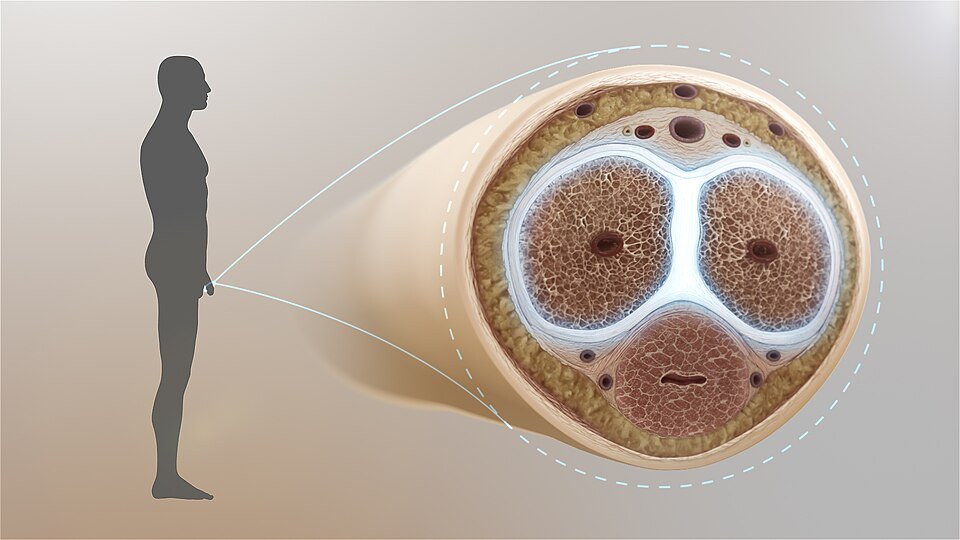
The penis has no bone, so the word “fracture” can be confusing. Inside the shaft are two spongy erection chambers, the corpora cavernosa, wrapped in a strong fibrous layer called the tunica albuginea. A third chamber underneath, the corpus spongiosum, surrounds the urethra. A penile fracture is a rupture of the tunica albuginea over one or both corpora cavernosa.
A penile fracture almost always happens during an erection. According to the EAU guideline, the tunica is about 2 mm thick when the penis is soft but thins to 0.25–0.5 mm in erection, and it is stretched tight by the blood inside. A sudden bend at that moment can split it, and blood escapes from the chamber into the surrounding tissue.
Sources: EAU Guidelines — Urological Trauma Guidelines, urogenital trauma; Cleveland Clinic — Broken penis: symptoms and treatment
Penile fracture is uncommon. Cleveland Clinic cites reported rates of roughly 1 in 10,000 to 1 in 100,000 men, while noting that the true number is unclear because many cases are probably not reported. It mostly affects sexually active men aged 40 and under.
Source: Cleveland Clinic — Broken penis: symptoms and treatment
Causes, risky positions and prevention
The EAU guideline lists sexual intercourse, forced bending of the erect penis (a practice called taqaandan), masturbation and rolling over in bed as the common causes of penile fracture. The typical mechanism is simple: during thrusting, the penis slips out and strikes the partner’s pubic bone or perineum with the full force of the movement. About 60% of cases occur during consensual intercourse, although a large meta-analysis of 58 studies and 3,213 patients found intercourse behind only 48% of cases, with masturbation and forced flexion accounting for 39%. The exact mix varies between studies.
Sources: EAU Guidelines — Urological Trauma Guidelines, urogenital trauma; PubMed (Urol Int) — Amer et al., meta-analysis of 3,213 patients (2016)
Do some sexual positions carry more risk?
Yes, in the published penile fracture series. In a 20-year Brazilian review of 288 cases, sexual activity caused 88.5%. Among those, 43.1% happened in the “doggy style” (rear-entry) position, 40.3% with the man on top and 12.1% with the woman on top. An earlier study from the same team found that rear-entry and man-on-top positions were more often linked to fractures of both chambers and to urethral injury, which are the more severe forms.
Sources: PMC (Int Braz J Urol) — Barros et al., 20-year experience (2020); PubMed (Int J Impot Res) — Barros et al., sexual position and injury severity (2017)
Practical ways to lower the risk
- Take extra care with vigorous thrusting in rear-entry and man-on-top positions, where the penis can slip out and hit the pelvis.
- Avoid high-risk maneuvers that force the erect penis into unusual angles.
- Never bend an erection on purpose to make it go down.
- Avoid rough masturbation that forces the erect shaft sideways.
Sources: ISSM — Is it possible to break your penis?; Cleveland Clinic — Broken penis: symptoms and treatment
Penile fracture symptoms: the signs to know
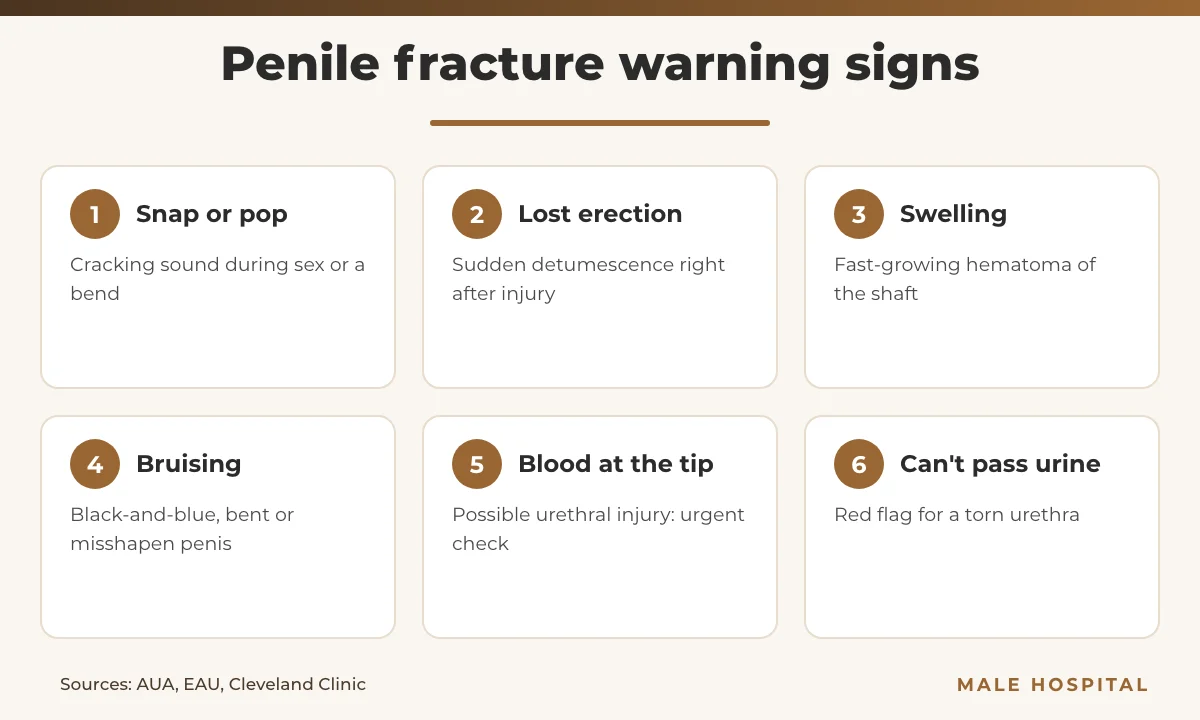
The AUA urotrauma guideline tells doctors to suspect penile fracture when a man has bruising, swelling and pain of the penis together with a cracking or snapping sound during sex or manipulation and immediate loss of the erection. History and examination alone are often enough to make the diagnosis.
Source: AUA — Urotrauma Guideline, genital trauma
In the Brazilian series of 288 cases, the frequency of each sign was:
- Hematoma (bruising and swelling): present in every case.
- Detumescence (sudden loss of erection): 82.6%.
- Snapping or popping sound: 76.3%.
- Pain: 66.3%.
- Bleeding from the urethra: 12.8%.
Source: PMC (Int Braz J Urol) — Barros et al., 20-year experience (2020)
After a penile fracture, the swelling grows quickly as blood collects under the skin. The penis can look swollen, black-and-blue and bent or misshapen, and sometimes the doctor can feel the gap in the tunica. If Buck’s fascia, the next layer out, is also torn, bleeding can spread along the shaft and down toward the lower abdominal wall.
Sources: EAU Guidelines — Urological Trauma Guidelines, urogenital trauma; ISSM — Is it possible to break your penis?
True fracture or “false fracture”?
Not every injury during sex is a penile fracture. A bruise can form under the skin without any tear in the tunica. The EAU guideline notes that the absence of a cracking sound, slow loss of the erection, penile deviation and bruising limited to the shaft are highly sensitive signs of a false fracture. Telling the two apart matters, because a hematoma without a tunica tear does not need surgery and is managed with anti-inflammatory painkillers and ice packs. Only a doctor can make that call, so the right first step is the same in both cases: get examined urgently.
Source: EAU Guidelines — Urological Trauma Guidelines, urogenital trauma
Signs of a urethral injury
The urethra runs inside the corpus spongiosum, just beneath the erection chambers, so the same force that causes a penile fracture can tear it. The EAU and AUA guidelines put the rate of urethral or corpus spongiosum injury with a fracture at 10–22%. In the Brazilian series it was 18.7%, and every complete urethral rupture occurred together with a fracture of both corpora.
Sources: AUA — Urotrauma Guideline, genital trauma; PMC (Int Braz J Urol) — Barros et al., 20-year experience (2020)
Warning signs of urethral involvement include:
- blood at the opening of the penis (the meatus);
- visible blood in the urine;
- inability to pass urine, or pain when you try.
The AUA guideline says any man with a fracture and one of these signs must be checked for urethral injury, and that a fracture of both chambers is an extra risk factor. Options are a retrograde urethrogram (an x-ray with contrast) or urethroscopy (a camera exam), and neither is clearly better. The EAU guideline strongly recommends excluding urethral injury in every case and notes that a flexible cystoscopy during surgery can rule it out.
Sources: AUA — Urotrauma Guideline, genital trauma; EAU Guidelines — Urological Trauma Guidelines, urogenital trauma
How doctors confirm the diagnosis
In most men with a penile fracture, the story and the appearance of the penis are enough. In the 20-year Brazilian series, imaging was done in only 16.1% of cases, and the authors concluded that extra tests are rarely needed. When the picture is unclear, the guidelines suggest imaging:
- Ultrasound: the AUA guideline recommends it for equivocal cases because it is widely available, quick and inexpensive. It is not needed routinely when the diagnosis is clear.
- MRI: the EAU guideline states that MRI is superior to ultrasound for diagnosing the injury; the AUA suggests it when ultrasound is unclear or unavailable.
- Retrograde urethrogram or cystoscopy: used when a urethral injury is suspected.
Sources: PMC (Int Braz J Urol) — Barros et al., 20-year experience (2020); AUA — Urotrauma Guideline, genital trauma; EAU Guidelines — Urological Trauma Guidelines, urogenital trauma
Importantly, if imaging is equivocal or doubt remains, the AUA guideline advises surgical exploration rather than waiting. A missed tear left to heal on its own carries a much higher risk of scarring and curvature.
Source: AUA — Urotrauma Guideline, genital trauma
Penile fracture treatment: surgery vs conservative care
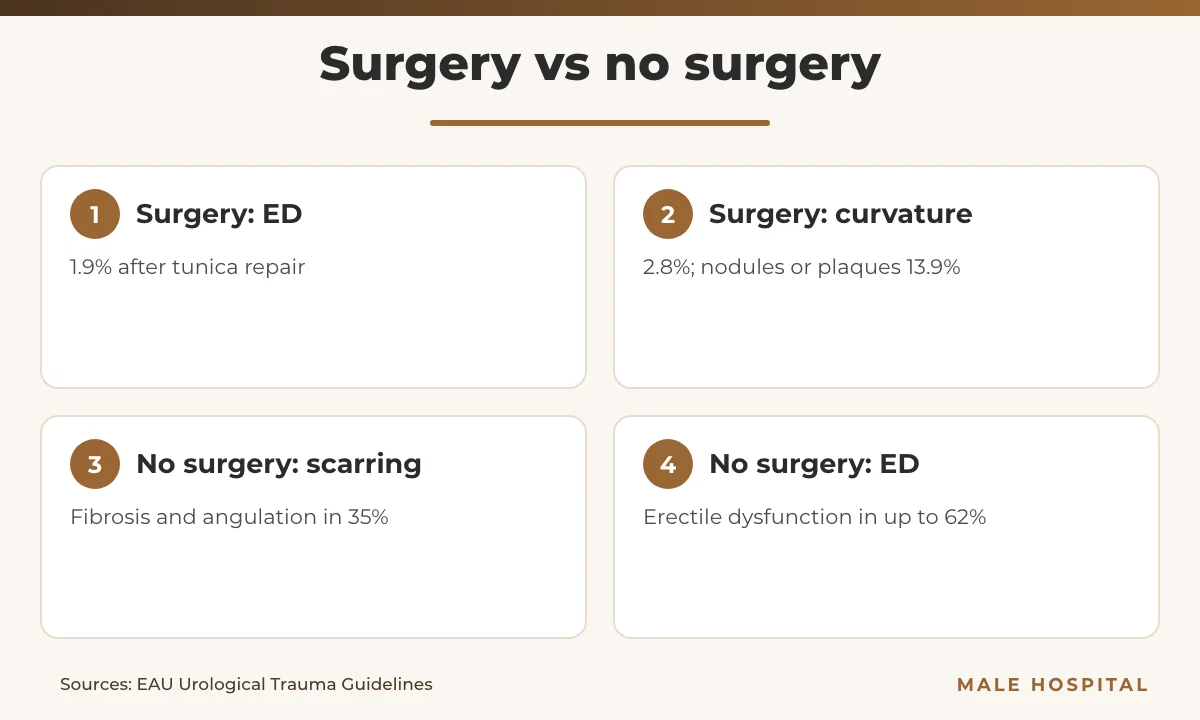
Both major guidelines favor surgery. The EAU gives a strong recommendation to treat these fractures surgically with closure of the tunica albuginea, and the AUA states that surgeons should perform prompt surgical exploration and repair in men with acute signs of penile fracture.
Sources: EAU Guidelines — Urological Trauma Guidelines, urogenital trauma; AUA — Urotrauma Guideline, genital trauma
What the operation involves
Under anesthesia, the surgeon exposes the injured chamber, finds the tear and closes the tunica with absorbable stitches. The classic approach is a circumferential incision just below the head of the penis so the skin can be slid back (degloving). Smaller longitudinal incisions directly over the tear, or along the underside, are increasingly used. If the urethra is torn, it is repaired in the same operation. Cleveland Clinic notes that most people go home the same day.
Sources: EAU Guidelines — Urological Trauma Guidelines, urogenital trauma; Cleveland Clinic — Broken penis: symptoms and treatment
How the outcomes compare
| Outcome | Surgical repair | Conservative care (no surgery) |
|---|---|---|
| Guideline position | Strongly recommended (EAU); standard of care (AUA) | Reserved for bruising without a tunica tear |
| Erectile dysfunction | 1.9% (EAU-cited data) | Up to 62% |
| Curvature or scarring | Curvature 2.8%; nodules or plaques 13.9% | Fibrosis and angulation in 35% |
| Other problems | Overall complications up to 20%; skin necrosis is rare | Abscess, missed urethral tear, persistent hematoma needing later surgery |
| Overall comparison | Significantly fewer complications | More ED, curvature and painful erections |
Sources: EAU Guidelines — Urological Trauma Guidelines, urogenital trauma; PubMed (Urol Int) — Amer et al., meta-analysis of 3,213 patients (2016)
The 2016 meta-analysis of 3,213 patients found that penile fracture surgery led to significantly fewer complications overall, and significantly less ED, curvature and painful erections than conservative care. The one outcome that did not differ was the number of men who developed plaques or nodules. Cleveland Clinic reports a surgical success rate of over 90%.
Sources: PubMed (Urol Int) — Amer et al., meta-analysis of 3,213 patients (2016); Cleveland Clinic — Broken penis: symptoms and treatment
Does the timing of surgery matter?
For penile fracture repair, faster is better, but late is still worth it. The EAU guideline cites a systematic review concluding that repair should be done within 24 hours of presentation, while stressing that a delayed presentation should not prevent surgery. That review, of 12 studies and 502 patients, found that ED and scarring did not differ significantly between immediate and delayed repair, but curvature was significantly less common after immediate repair (1.8% vs 4.5%). The authors still advised immediate repair as the standard of care because the evidence quality was low to moderate.
Sources: EAU Guidelines — Urological Trauma Guidelines, urogenital trauma; PMC (Can Urol Assoc J) — Wong et al., immediate vs delayed repair (2017)
Recovery after surgery and return to sex
Recovery from a penile fracture is usually straightforward when the tear is closed early. Typical steps include:
- Hospital stay: short; many men go home the same day, others after a brief stay.
- Follow-up visits: your surgeon checks how the wound and the repair are healing, and whether a urethral repair needs further checks.
- No sex or masturbation: Cleveland Clinic advises avoiding all sexual activity for at least one month; ISSM mentions avoiding sexual activity and strenuous exercise for at least four to six weeks. Follow the exact timeline your surgeon gives you.
Sources: Cleveland Clinic — Broken penis: symptoms and treatment; ISSM — Is it possible to break your penis?
Many men also feel anxious about sex after the injury. That is normal. A gradual, gentle return to intimacy once you are cleared, and an open conversation with your partner, usually helps. If anxiety lingers, our guide to psychological erectile dysfunction explains how performance anxiety can be treated.
Long-term risks: erectile dysfunction and curvature
Even with good penile fracture surgery, some men notice changes later. In the EAU summary, nodules or plaques at the repair site were the most common finding (13.9%), followed by curvature (2.8%) and ED (1.9%). Post-surgical ED is more common in men over 50 and in those whose two chambers were both torn, and the size of the tear may also affect long-term results.
Source: EAU Guidelines — Urological Trauma Guidelines, urogenital trauma
Rates vary between centers and with follow-up length. In the Brazilian series, among 61 men followed for at least six months, a palpable nodule was found in 72.1%, ED in 14.7% and curvature in 13.1%. This wide range between studies is a good reason to keep your follow-up appointments.
Source: PMC (Int Braz J Urol) — Barros et al., 20-year experience (2020)
What can be done if problems appear
A curve that develops after the injury is caused by scarring, a problem also seen in Peyronie’s disease. A curve that makes sex difficult can be assessed by a urologist and, where appropriate, corrected with penile curvature correction surgery. Our overview of penile curvature explains when a bend is normal and when it is not. Erection problems after the injury are evaluated and treated in the same stepwise way as other types of erectile dysfunction treatment, starting with tablets.
If you have a lasting bend, painful erections or weaker erections after a penile fracture, you can get a confidential assessment with our urologist-andrologist by WhatsApp. The right plan, and its cost, depends on the examination.
When to see a doctor
A suspected penile fracture is not a “wait and see” problem. Go to the nearest emergency department straight away if, during sex, masturbation or any accident involving an erection, you notice:
- a crack, pop or snap, followed by sudden loss of the erection;
- sharp pain and rapid swelling or dark bruising of the shaft;
- a penis that looks bent or misshapen after the injury;
- blood at the tip of the penis or in the urine;
- difficulty or inability to pass urine.
Sources: AUA — Urotrauma Guideline, genital trauma; Cleveland Clinic — Broken penis: symptoms and treatment
Do not let embarrassment delay you. This is a recognized urological emergency, and the long-term results are best when the tear is repaired early. If you arrive late, surgery is still recommended. A painful erection that will not go down, without any injury, is a different emergency, explained in our priapism guide.
Sources: EAU Guidelines — Urological Trauma Guidelines, urogenital trauma; ISSM — Is it possible to break your penis?
FAQs about penile fracture
Can a penile fracture heal on its own?
A small bruise without a tear can settle with painkillers and ice, but a true tear of the tunica albuginea should not be left alone. When fractures are managed without surgery, the EAU guideline reports scarring and angulation in 35% of men and ED in up to 62%, plus risks such as abscess and a missed urethral tear.
Source: EAU Guidelines — Urological Trauma Guidelines, urogenital trauma
How common is this injury?
Penile fracture is rare. Cleveland Clinic cites reported rates of about 1 in 10,000 to 1 in 100,000 men, mostly in sexually active men aged 40 and under. The true figure is unclear, and the injury is probably underreported, so it may be more common than these numbers suggest.
Source: Cleveland Clinic — Broken penis: symptoms and treatment
Is it a penile fracture if there was no popping sound?
It can be. In a large series, about three in four men heard a snap, so roughly one in four did not. The absence of a sound, a slow loss of erection and bruising limited to the shaft make a false fracture more likely, but only an examination, sometimes with ultrasound or MRI, can tell the difference reliably.
Sources: PMC (Int Braz J Urol) — Barros et al., 20-year experience (2020); EAU Guidelines — Urological Trauma Guidelines, urogenital trauma
How long after surgery can I have sex?
Plan on at least four to six weeks without any sexual activity, including masturbation, after surgical repair. Cleveland Clinic gives a minimum of one month and ISSM four to six weeks. Your surgeon will set the exact timing based on the size of the tear and whether the urethra was repaired.
Sources: Cleveland Clinic — Broken penis: symptoms and treatment; ISSM — Is it possible to break your penis?
Will I have erectile dysfunction after a penile fracture?
Most men do not. In the data summarized by the EAU, ED after surgical repair was 1.9%, rising in men over 50 and in those with tears of both chambers. Without surgery the risk is much higher. If erections are weaker after healing, effective treatments exist, from tablets to injections.
Source: EAU Guidelines — Urological Trauma Guidelines, urogenital trauma
Is it too late for surgery if I waited a day or more?
No. Repair within 24 hours is ideal, but the EAU guideline states that a delayed presentation should not prevent surgical exploration. A systematic review found similar ED rates after immediate and delayed repair, though curvature was more common when surgery was delayed beyond 24 hours.
Sources: EAU Guidelines — Urological Trauma Guidelines, urogenital trauma; PMC (Can Urol Assoc J) — Wong et al., immediate vs delayed repair (2017)
Which sexual position causes the most fractures?
In a Brazilian series of 255 sexual-trauma cases, rear-entry (“doggy style”) accounted for 43.1% and man-on-top for 40.3%. These two positions were also more often linked to fractures of both chambers and to urethral injury. Slowing down and keeping control of depth in these positions reduces the chance of the penis slipping out.
Sources: PMC (Int Braz J Urol) — Barros et al., 20-year experience (2020); PubMed (Int J Impot Res) — Barros et al., sexual position and injury severity (2017)
Can the penis break when it is soft?
It is very unlikely. The tunica albuginea is around 2 mm thick when flaccid and only 0.25–0.5 mm in erection, which is why almost all fractures happen in an erect penis. The EAU guideline notes that blunt trauma to the flaccid penis does not usually tear the tunica.
Source: EAU Guidelines — Urological Trauma Guidelines, urogenital trauma
Medically reviewed by Assoc. Prof. Dr. Zülfü Sertkaya, urologist and andrologist (FEBU), Istanbul. Last reviewed: November 2026.
This article is for general information and does not replace an individual consultation with a qualified doctor.
- EAU Guidelines — Urological Trauma — Urogenital trauma guidelines (penile fracture)
- AUA — Urotrauma Guideline — Genital trauma (Statements 26–29)
- Cleveland Clinic — Penile fracture (broken penis)
- ISSM — Is it possible to break your penis?
- PMC (Int Braz J Urol) — Barros et al., Lessons learned after 20 years' experience with penile fracture (2020)
- PMC (Can Urol Assoc J) — Wong et al., Can it wait? A systematic review of immediate vs. delayed surgical repair of penile fractures (2017)
- PubMed (Urol Int) — Amer et al., Penile fracture: a meta-analysis (2016)
- PubMed (Int J Impot Res) — Barros et al., Relationship between sexual position and severity of penile fracture (2017)