Penile implant satisfaction rates are among the highest of any erectile dysfunction treatment: European Association of Urology (EAU) guidelines cite 92 to 100 percent of patients and 91 to 95 percent of partners satisfied when men are properly counseled, and the largest meta-analysis so far (83 studies, more than 12,000 men) found an overall patient satisfaction rate of about 83%. Satisfaction depends mostly on realistic expectations about size and feel, device type, and avoiding complications. If you are still weighing the operation itself, start with our penile prosthesis (penile implant) surgery page; this guide focuses only on how satisfied men and partners really are, and why.
Sources: EAU Guidelines — Management of erectile dysfunction; PubMed — Corona et al., Long-term penile prosthesis couple’s satisfaction: systematic review and meta-analysis (2025)
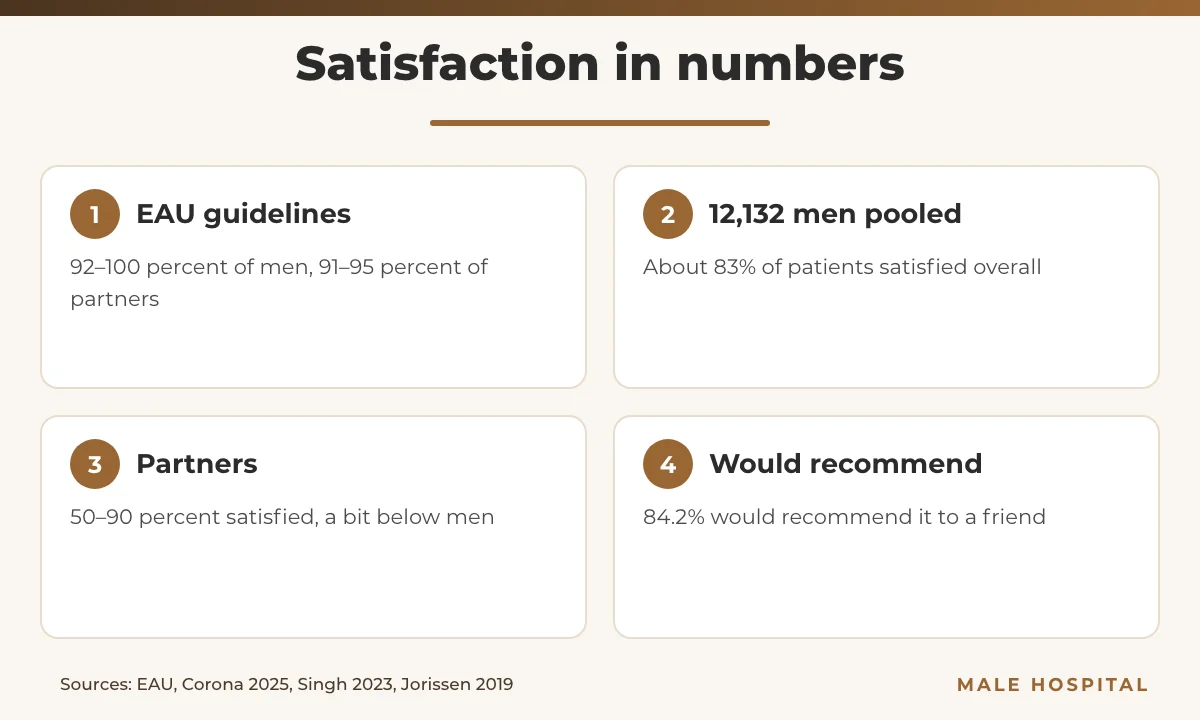
- Guideline figures put penile implant satisfaction at 92 to 100 percent for men and 91 to 95 percent for partners after proper counseling; a pooled analysis of 12,132 men found about 83%.
- Partners are usually a little less satisfied than the men themselves, with studies reporting partner penile implant satisfaction rates of roughly 50 to 90 percent.
- Three-piece inflatable implants are linked with higher penile implant satisfaction than malleable (semi-rigid) rods, although no randomized trial has compared them head to head.
- The most common reasons for disappointment are a feeling of lost length, ongoing pain and a soft glans, not a failure to get an erection.
- Detailed counseling before surgery is the single most consistent factor that experts link with good penile implant satisfaction.
- Penile implant satisfaction rates at a glance
- What the major studies show
- Partner satisfaction after a penile implant
- How implants compare with pills and injections
- Inflatable vs malleable: does the device type matter?
- What lowers penile implant satisfaction rates
- Durability, complications and long-term satisfaction
- How to improve your chances of being satisfied
- When to see a doctor
- FAQs about penile implant satisfaction rates
Penile implant satisfaction rates at a glance
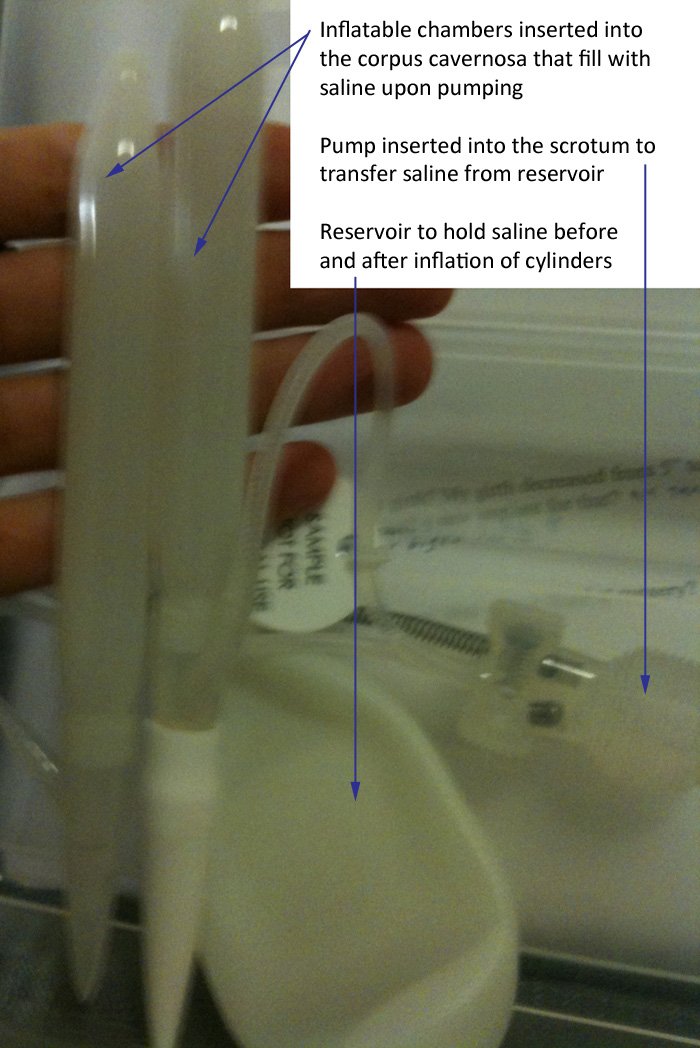
A penile implant (penile prosthesis) is a device placed inside the two erection chambers of the penis. Most men today receive a three-piece inflatable implant, with two cylinders, a pump in the scrotum and a fluid reservoir; others choose a malleable (bendable) implant. Guidelines generally reserve implants for men whose erectile dysfunction has not responded to tablets or injections, or who prefer a definitive solution.
Because the implant creates a rigid erection mechanically, it works regardless of blood flow or nerve damage. That is one reason penile implant satisfaction is high even in men with severe diabetes, heart disease or erectile dysfunction after prostate cancer surgery. The EAU states that prosthesis implantation has one of the highest satisfaction rates of all erectile dysfunction treatments, and Cleveland Clinic reports that over 90% of people with a penile implant are happy with the results.
Sources: EAU Guidelines — Management of erectile dysfunction; Cleveland Clinic — Penile implants
Why do the headline numbers differ (above 90 percent in some sources, around 83 percent in others)? Mostly because of how penile implant satisfaction is measured. Many older studies used simple yes/no questions or questionnaires that were never validated for implants, while recent meta-analyses pool very different studies and include men followed for many years. A 2025 review stressed that most data on implant success are subjective rather than objective. Either way, most estimates sit well above what men typically report with other options for severe erectile dysfunction.
What the major studies show
The table below summarizes the most useful recent evidence. Each study measured penile implant satisfaction differently, so compare the direction of the results rather than treating the percentages as directly interchangeable.
| Study | Who was studied | Key satisfaction finding |
|---|---|---|
| EAU guidelines (summary of evidence) | Men with properly counseled implant surgery | 92 to 100 percent of patients and 91 to 95 percent of partners satisfied |
| Corona et al. meta-analysis (2025) | 83 studies, 12,132 men, mean follow-up about 4 years | About 83% of patients satisfied; higher with three-piece devices; independent of age |
| Jorissen et al. (2019) | 95 men with a three-piece inflatable implant, at least 1 year after surgery | 83.2% of men and 85.4% of partners satisfied; 84.2% would recommend it to a friend |
| Beirnaert et al. (2023) | Single-center series using an implant-specific questionnaire | 53 men (89.8%) satisfied; appearance of the penis scored lowest |
| Manfredi et al. pooled analysis (2024) | 10 studies, 1,105 men assessed with the QoLSPP questionnaire | Positive scores in functional, relational, social and personal domains |
| Singh et al. systematic review (2023) | 33 studies on partners | Partner satisfaction 50 to 90 percent, consistently lower than the men’s |
Sources: EAU Guidelines — Management of erectile dysfunction; PMC — Jorissen et al., Patient and partner satisfaction after penile implant surgery (2019); PubMed — Beirnaert et al., Patient satisfaction with the French SSIPI questionnaire after inflatable penile implantation (2023); PubMed — Manfredi et al., Quality of life and sexuality with penile prosthesis: systematic review and pooled analysis (2024)
The largest meta-analysis
The 2025 meta-analysis by Corona and colleagues screened 663 articles published between 1969 and 2023 and included 83 of them. The men’s average age was 58.6 years and the average follow-up was 47.6 months. Overall penile implant satisfaction among patients was 83% (95% confidence interval 80 to 86 percent). Satisfaction was higher in men with three-piece devices and, perhaps surprisingly, in men with higher rates of cardiovascular or neurological disease. It did not depend on the patient’s age, and the authors concluded that couple satisfaction is excellent and rises over time.
A real-world single-center series
In a Belgian penile implant satisfaction series of 126 consecutive men who received a first three-piece inflatable implant, 95 were interviewed by telephone at least one year after surgery (mean follow-up about 39 months). Of these, 79 men (83.2%) were satisfied and 80 (84.2%) would recommend the operation to a friend. The authors called extensive counseling before surgery “mandatory” for good results.
Source: PMC — Jorissen et al., Patient and partner satisfaction after penile implant surgery (2019)
Partner satisfaction after a penile implant
In the Belgian series, 76 of 93 men with a regular partner (85.4%) reported that their partner was satisfied, a figure close to the men’s own rate. Across the wider literature on penile implant satisfaction, however, partners are usually somewhat less enthusiastic than the men.
A 2023 systematic review of 33 studies found partner satisfaction rates between 50 and 90 percent, with clear improvements in sexual quality of life compared with before surgery, but partner rates were consistently lower than patient rates. Many of the penile implant satisfaction studies used non-validated questionnaires, and research on same-sex couples is still very limited. The 2025 meta-analysis also found lower partner satisfaction overall, with higher partner rates when an inflatable device was used and when the man had Peyronie’s disease (penile curvature).
Sources: PubMed — Singh et al., Systematic review of partner satisfaction after penile prosthesis (2023); PubMed — Corona et al., Long-term penile prosthesis couple’s satisfaction: systematic review and meta-analysis (2025)
Partners can help shape expectations before surgery. The EAU notes that focused psychosexual counseling may improve sexuality and sexual well-being for both patients and partners after implantation.
Source: EAU Guidelines — Management of erectile dysfunction
How implants compare with pills and injections
Penile implant satisfaction is always relative to the alternatives. A US study followed 85 men treated with sildenafil, penile injections of prostaglandin E1 or an inflatable implant for a mean of about 19.5 months. Men with an implant scored significantly higher on a validated treatment satisfaction questionnaire (EDITS Index 82.03, versus 61.51 with sildenafil and 58.16 with injections) and also had better erectile function scores.
A larger prospective study of 354 couples found a different ranking: men taking sildenafil had the highest satisfaction scores, and implant users came second among the five treatment groups (testosterone, sildenafil, injections, vacuum device and implant). The difference in penile implant satisfaction likely reflects who was treated. Men who respond well to tablets are often very satisfied with them, while implants shine in men whose erectile dysfunction is too severe for tablets or penile injections to work reliably. The same study linked dissatisfaction with anxiety and depression scores, which is a reminder that the mind matters as much as the mechanics.
Sources: PubMed — Rajpurkar & Dhabuwala, Satisfaction with sildenafil, intracavernous PGE1 and penile implant surgery (2003); PubMed — Hassan et al., Couple satisfaction to different therapeutic modalities for organic erectile dysfunction (2008)
Inflatable vs malleable: does the device type matter?
There are two broad families of implant. Inflatable implants fill with fluid on demand and soften afterwards, so they look and feel more natural. Malleable implants are simpler bendable rods that are always firm. We cover the designs in detail in our guides to the inflatable penile prosthesis and the malleable penile implant.
On penile implant satisfaction, the evidence favors inflatable devices. A 2024 meta-analysis of five comparative studies found significantly higher patient satisfaction (odds ratio 3.39) and partner satisfaction (odds ratio 2.32) with inflatable implants, but also more mechanical failures (odds ratio 5.60). Ease of use and infection rates did not differ. The large 2025 meta-analysis likewise found higher satisfaction with three-piece devices.
The EAU adds an important caveat: no prospective randomized trial has compared penile implant satisfaction between inflatable and semi-rigid devices, and there are no head-to-head studies between manufacturers. The guideline lists the drawbacks of semi-rigid devices as an unnatural persistent erection and reduced concealability. A malleable implant can still be the right choice for men with limited hand strength or who prefer the simplest device.
Sources: PubMed — Satwikananda et al., Malleable vs inflatable penile prosthesis: efficacy and safety meta-analysis (2024); EAU Guidelines — Management of erectile dysfunction
What lowers penile implant satisfaction rates
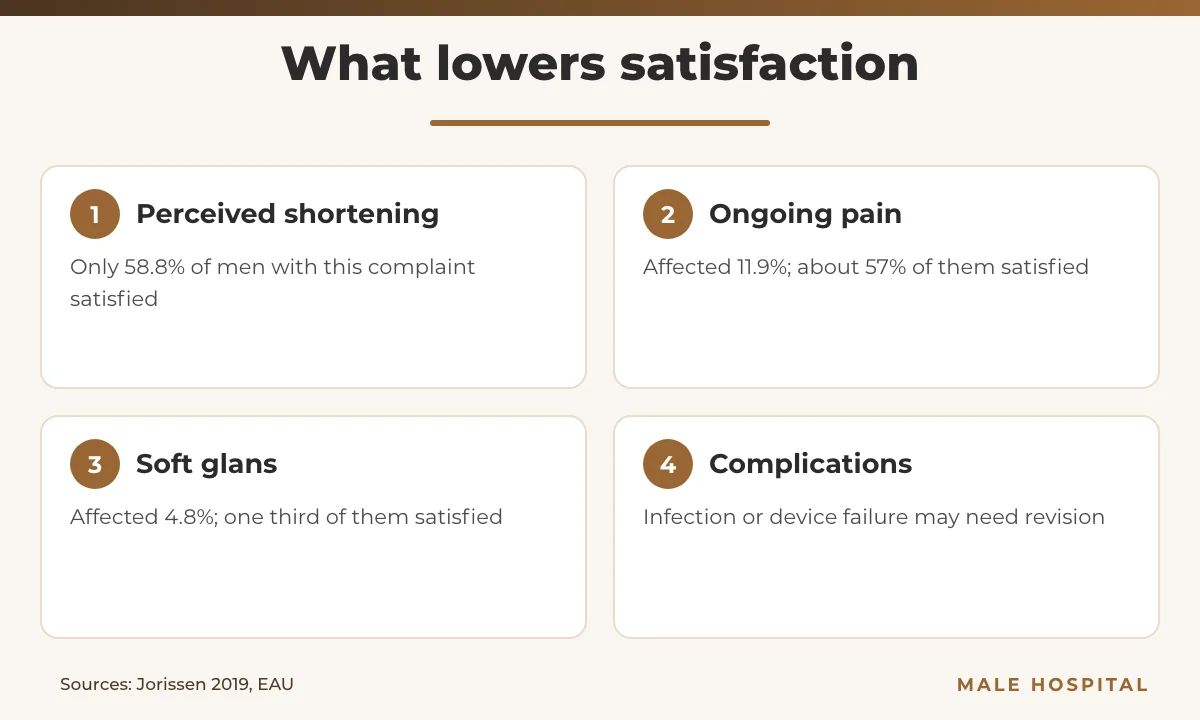
Penile implant satisfaction studies that look at the unhappy minority point to a handful of recurring issues. Most are about expectations and comfort rather than the implant failing to produce an erection.
Perceived loss of length
Lost length weighs heavily on penile implant satisfaction: in the Belgian series, 23 men (about 18%) felt their penis was shorter after surgery, and only 10 of 17 men with this complaint who were interviewed about satisfaction (58.8%) were satisfied. An implant restores rigidity, but Cleveland Clinic notes that penile implants cannot make the penis bigger than it was before surgery. The International Society for Sexual Medicine (ISSM) explains that studies disagree on how much real length is lost, that some men who feel shorter measure the same as before, and that length is usually not the biggest contributor to sexual satisfaction.
Sources: PMC — Jorissen et al., Patient and partner satisfaction after penile implant surgery (2019); Cleveland Clinic — Penile implants; ISSM — Is it common to lose length after penile implant surgery?
Pain and a soft glans
Ongoing postoperative pain affected 11.9% of men in the same series, and only about 57% of them were satisfied. Floppy glans syndrome, where the head of the penis stays soft while the shaft is rigid, occurred in 4.8% of men, and only a third of them were satisfied. A French study using a penile implant satisfaction questionnaire found that the appearance of the penis scored lowest of all items, while pain scores were very low, and men with larger implanted devices reported better functional results.
Sources: PMC — Jorissen et al., Patient and partner satisfaction after penile implant surgery (2019); PubMed — Beirnaert et al., Patient satisfaction with the French SSIPI questionnaire after inflatable penile implantation (2023)
Sensation and orgasm worries
Some men fear an implant will change how sex feels. According to the International Consultation on Sexual Medicine, implants allow penetrative sex without interfering with urination, ejaculation, sensation or orgasm, and Cleveland Clinic says an implant does not affect the ability to ejaculate and orgasm. The same consultation still advises that men be told about possible shortening and changes in sensation or shape, so these points belong in every pre-surgery discussion.
Sources: PubMed — Levine et al., Penile prosthesis surgery: recommendations from the International Consultation on Sexual Medicine (2016); Cleveland Clinic — Penile implants
Durability, complications and long-term satisfaction
A complication is one of the quickest ways to turn a good result into a disappointing one, so long-term penile implant satisfaction depends partly on how reliable the device is. The EAU cites a meta-analysis of implant survival of 93.3% at one year, 87.2% at five years, 76.8% at ten years and 52.9% at twenty years. Modern three-piece devices have mechanical failure rates below 5% after five years. Cleveland Clinic states that implants last about 20 years on average; the survival figures above show that many devices need replacing earlier, so it is wise to plan for a possible revision during your lifetime.
Infection is the most feared complication. With careful technique and antibiotics, the EAU reports infection rates of 2 to 3 percent for first implants in low-risk men, falling to 1 to 2 percent with antibiotic-impregnated or hydrophilic-coated devices; diabetes raises the risk. A 2025 systematic review of 30 studies of three-piece implants found removal rates generally below 10% and infection rates typically under 5%. Encouragingly, the 2025 satisfaction meta-analysis reported that satisfaction increases with time after surgery, with long-term complications ranging from 3% for erosion to 4.6% for mechanical failure. For the full picture of risks, see our guide to penile implant complications.
Sources: EAU Guidelines — Management of erectile dysfunction; Cleveland Clinic — Penile implants; PubMed — Lo Re et al., Removal rate and mechanical failure in penile prosthesis implantation: a systematic review; PubMed — Corona et al., Long-term penile prosthesis couple’s satisfaction (2025)
How to improve your chances of being satisfied
Most of the factors behind high penile implant satisfaction rates are within your and your surgeon’s control. Based on the studies above, the following steps make the biggest difference:
- Have a detailed counseling session. Discuss what the erection will look and feel like, what happens to length, how the pump works and what recovery involves. Both the EAU and the Belgian authors link good counseling with good outcomes.
- Measure before surgery. ISSM suggests measuring the penis before and after surgery so that any real change in length is documented rather than guessed.
- Choose the device together. An inflatable implant is linked with higher penile implant satisfaction for most men, but hand dexterity, previous surgery and personal preference may favor a malleable device.
- Follow the recovery plan. ISSM advises starting to cycle (inflate and deflate) the implant when your surgeon allows, as using the implant helps preserve length. Most people can resume sex about four to six weeks after surgery.
- Control risk factors. Good blood sugar control matters because diabetes is linked with infection and long-term complications.
Sources: ISSM — Is it common to lose length after penile implant surgery?; Cleveland Clinic — Penile implants; EAU Guidelines — Management of erectile dysfunction
Seeing realistic results also helps penile implant satisfaction. Our article on penile implant before and after explains what typically changes, and our guide to penile implant recovery covers the first weeks step by step.
When to see a doctor
If you already have an implant, contact your surgeon promptly if you notice any of the following, because early treatment of a problem protects both your health and your long-term penile implant satisfaction:
- Fever, increasing redness, warmth, swelling or discharge around the incision, penis or scrotum, which can signal infection.
- Pain that worsens over time instead of settling, or pain that persists months after surgery.
- Thinning skin, or a part of the device that you can see or feel pushing through (possible erosion).
- The implant no longer inflates or deflates properly, or it inflates on its own.
- A soft glans, new curvature or a noticeable change in shape that bothers you or your partner.
If you do not yet have an implant, see a urologist when tablets or injections no longer give you reliable erections, or if side effects stop you using them. The EAU recommends implantation if other treatments fail or depending on patient preference.
Sources: Cleveland Clinic — Penile implants; EAU Guidelines — Management of erectile dysfunction
If you want to know whether you are likely to be satisfied with an implant, you can book a confidential consultation with our urologist-andrologist, Assoc. Prof. Dr. Zülfü Sertkaya, who focuses on penile prosthesis surgery. Message us on WhatsApp to discuss your situation and our penile prosthesis treatment.
FAQs about penile implant satisfaction rates
What is the satisfaction rate for penile implants?
EAU guidelines report satisfaction of 92 to 100 percent in patients and 91 to 95 percent in partners when men are properly counseled. The largest meta-analysis, covering 83 studies and 12,132 men, found about 83% of patients satisfied. Cleveland Clinic says over 90% of people with an implant are happy with the results. Different measurement methods explain the spread in penile implant satisfaction.
Sources: EAU Guidelines — Management of erectile dysfunction; PubMed — Corona et al. (2025)
Do men regret getting a penile implant?
Most do not. In a Belgian series, 83.2% of men were satisfied and 84.2% would recommend the surgery to a friend at least one year later. Low penile implant satisfaction was concentrated among men who felt they had lost length, had ongoing pain or developed a soft glans. Careful counseling before surgery reduces the risk of disappointment.
Source: PMC — Jorissen et al. (2019)
Are partners satisfied with penile implants?
Generally yes, though slightly less than the men themselves. A systematic review of 33 studies found partner satisfaction between 50 and 90 percent, with better sexual quality of life than before surgery. Partner satisfaction tends to be higher when an inflatable device is used. Including your partner in the consultation helps set shared expectations.
Sources: PubMed — Singh et al. (2023); PubMed — Corona et al. (2025)
Is satisfaction higher with an inflatable or a malleable implant?
Comparative studies of penile implant satisfaction favor inflatable implants: a 2024 meta-analysis found patient satisfaction odds about three times higher than with malleable devices, though mechanical failure was also more common. The EAU notes that no randomized trial has compared the two directly, so the choice should reflect your anatomy, hand function and preferences.
Sources: PubMed — Satwikananda et al. (2024); EAU Guidelines — Management of erectile dysfunction
Does age affect penile implant satisfaction?
No clear effect has been found. The 2025 meta-analysis of more than 12,000 men reported that penile implant satisfaction was independent of age, and it was actually higher in men with more cardiovascular or neurological disease. What matters more is having realistic expectations, a well-chosen device and an uncomplicated recovery, whatever your age.
Source: PubMed — Corona et al. (2025)
Will a penile implant feel natural?
Inflatable implants are designed to look and feel more natural than malleable rods, and they soften when deflated. Implants do not interfere with ejaculation, sensation or orgasm according to the International Consultation on Sexual Medicine. However, men should be told about possible changes in sensation or shape, and a minority develop a soft glans, which is why counseling matters.
Sources: PubMed — Levine et al. (2016); Cleveland Clinic — Penile implants
How long does satisfaction last after implant surgery?
Penile implant satisfaction appears to hold up and even increase with time: the 2025 meta-analysis, with an average follow-up of almost four years, found satisfaction rose over time. Device survival is about 87% at five years and 77% at ten years, so some men will need a replacement, but long-term complications remain limited.
Sources: PubMed — Corona et al. (2025); EAU Guidelines — Management of erectile dysfunction
Why are some men unhappy after a penile implant?
The most common reasons are a feeling that the penis is shorter, persistent pain and a soft glans. In one series only 58.8% of men who reported lost length were satisfied, compared with much higher rates overall. Complications such as infection or device failure also lower penile implant satisfaction. Measuring before surgery and frank counseling help prevent mismatched expectations.
Sources: PMC — Jorissen et al. (2019); ISSM — Is it common to lose length after penile implant surgery?
Medically reviewed by Assoc. Prof. Dr. Zülfü Sertkaya, urologist and andrologist (FEBU), Istanbul. Last reviewed: November 2026.
This article is for general information and does not replace an individual consultation with a qualified doctor.
- EAU Guidelines — Management of erectile dysfunction
- Cleveland Clinic — Penile implants
- ISSM — Is it common to lose length after penile implant surgery?
- PubMed (Andrology) — Corona et al., Long-term penile prosthesis couple's satisfaction: systematic review and meta-analysis (2025)
- PMC (Current Urology) — Jorissen et al., Patient and partner satisfaction after penile implant surgery (2019)
- PubMed (Curr Urol Rep) — Singh et al., Systematic review of partner satisfaction after penile prosthesis (2023)
- PubMed (J Urol) — Rajpurkar & Dhabuwala, Satisfaction with sildenafil, intracavernous PGE1 and penile implant surgery (2003)
- PubMed (J Sex Med) — Hassan et al., Couple satisfaction to different therapeutic modalities for organic erectile dysfunction (2008)
- PubMed (Arch Ital Urol Androl) — Satwikananda et al., Malleable vs inflatable penile prosthesis meta-analysis (2024)
- PubMed (J Sex Med) — Beirnaert et al., Patient satisfaction with the French SSIPI questionnaire after inflatable penile implantation (2023)
- PubMed (Minerva Urol Nephrol) — Manfredi et al., Quality of life and sexuality with penile prosthesis: systematic review and pooled analysis (2024)
- PubMed (Int J Impot Res) — Lo Re et al., Removal rate and mechanical failure in penile prosthesis implantation: a systematic review
- PubMed (J Sex Med) — Levine et al., Penile prosthesis surgery: recommendations from the International Consultation on Sexual Medicine (2016)