Lichen sclerosus in men is a long-term inflammatory skin condition that usually affects the foreskin and the head of the penis (glans), causing itchy, sore, white or shiny patches that can scar and tighten the foreskin. It is not an infection and cannot be passed to a partner. Most men are controlled with a strong steroid ointment, and circumcision is highly effective when creams are not enough. Because the skin can scar, the urethra can narrow and there is a small link with penile cancer, early diagnosis and lifelong self-checks matter.
Source: NHS — Lichen sclerosus; British Association of Dermatologists — Lichen sclerosus in males
- Male genital lichen sclerosus (also called balanitis xerotica obliterans, or BXO) is almost exclusively a disease of uncircumcised men; it almost never occurs in men circumcised early in life.
- Typical signs of lichen sclerosus in men are white, shiny or scarred skin on the glans and foreskin, itching, splitting, a foreskin that becomes tight, painful erections and, sometimes, a spraying urine stream.
- First-line treatment for lichen sclerosus in men is an ultra-potent steroid ointment such as clobetasol propionate 0.05%, usually once daily for up to 3 months and then tapered.
- Circumcision cures most men whose disease does not respond to creams; narrowing of the urethra may need specialist surgery.
- There is a small but real link with penile cancer, so any lump, thickening or sore that does not heal needs a biopsy.
What is lichen sclerosus in men?
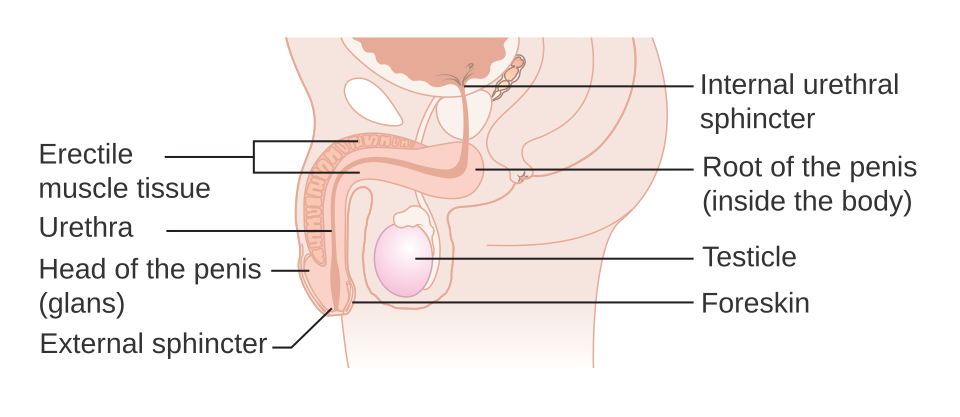
Lichen sclerosus is a chronic inflammatory skin disease. In women it mostly affects the vulva, and it is several times more common in women than in men. Lichen sclerosus in men almost always affects the genitals, especially the foreskin (prepuce) and the glans, and sometimes the opening of the urethra (the meatus) and the urethra itself. Some people also have whitish, usually painless patches on other parts of the body.
Older urology texts call lichen sclerosus in men balanitis xerotica obliterans (BXO). Dermatologists now prefer the term male genital lichen sclerosus (MGLSc). Both names describe the same condition.
Source: British Association of Dermatologists — Lichen sclerosus in males; DermNet — Lichen sclerosus
How common is it?
Lichen sclerosus in men is uncommon. In a US military hospital, 108 of 153,432 male patients (0.07%) had a recorded diagnosis over three years. It can appear at any age, including in boys. A London clinic study of 487 adult men found two adult peaks: one around the end of the third decade (late 20s) and another in the sixth decade (50s).
Source: South Med J (PubMed) — Balanitis xerotica obliterans: epidemiologic distribution; Skin Health Dis (PMC) — The age-related incidence of male genital lichen sclerosus is triphasic
How it differs from other foreskin problems
Many conditions cause redness or soreness of the glans. Lichen sclerosus in men is one of the important causes of balanitis that does not settle with antifungal creams, and it is a leading cause of a foreskin that becomes tight in adult life (acquired phimosis). Its hallmark is pallor: white or ivory skin, often with a loss of the normal groove behind the glans. Harmless bumps such as pearly penile papules do not cause itching, scarring or tightening.
Source: BASHH — Guideline on the Management of Balanoposthitis 2025
What causes lichen sclerosus in men? Causes and risk factors
The exact cause of lichen sclerosus in men is not fully understood. It is not caused by an infection, it is not contagious (including through sex), and it is not caused by poor hygiene. Several factors appear to work together.
Urine trapped under the foreskin
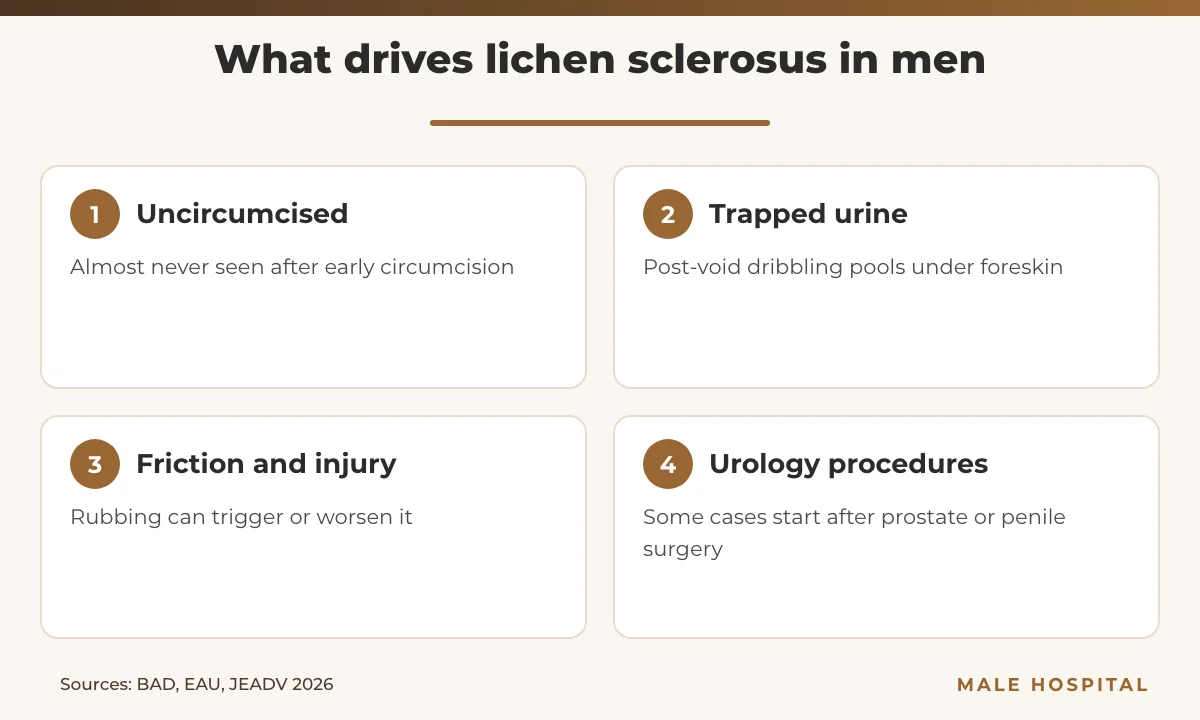
The leading theory for lichen sclerosus in men is chronic, repeated contact between urine and the skin under the foreskin. A small amount of urine can dribble after voiding (micro-incontinence) and pool between the foreskin and glans. Evidence for this includes the location of the disease on urine-exposed skin, the high cure rate after circumcision and the rarity of the disease in men circumcised as newborns. In a mapping study of foreskins removed for lichen sclerosus, all 10 men reported urinary micro-incontinence, and the disease was most extensive in the part of the foreskin with the most urine contact.
Source: J Eur Acad Dermatol Venereol (PubMed) — Male genital lichen sclerosus (2026 review); Clin Exp Dermatol (PubMed) — Male genital lichen sclerosus, microincontinence and occlusion
Other risk factors
- Being uncircumcised. The EAU urethral stricture guideline reports that uncircumcised men are far more likely to have lichen sclerosus than circumcised men.
- Urological procedures. A case series of 21 men described lichen sclerosus starting within 5 years of procedures such as radical prostatectomy, repeated cystoscopies or penile surgery, probably because these can cause post-void dribbling.
- Skin injury and friction. Rubbing or damage to the skin can trigger or worsen it (the Koebner response).
- Other health conditions. Associations have been reported with autoimmune and atopic conditions, and the EAU lists higher body mass index, diabetes, coronary artery disease and tobacco use.
An autoimmune process has long been suspected, but in a large series of 329 men autoimmunity and HPV infection seemed unimportant, while urinary contact was implicated.
Source: EAU — Urethral Strictures Guidelines: Definition, epidemiology and aetiology; Clin Exp Dermatol (PubMed) — MGLSc associated with urological interventions; J Eur Acad Dermatol Venereol (PubMed) — Clinical parameters in male genital lichen sclerosus: 329 patients
Symptoms of lichen sclerosus in men
Lichen sclerosus in men can cause anything from no symptoms at all to severe discomfort. Early disease may look red and inflamed; long-standing disease tends to look white and scarred.
- Skin changes: white, shiny, smooth or crinkled patches on the glans and inner foreskin; sometimes small bleeding spots or blood blisters.
- Itching, burning or soreness, especially during or after sex.
- Splitting and bleeding: the foreskin may crack or tear during intercourse.
- A tightening foreskin that becomes hard to pull back, which can make erections painful. A tight scar band can form around the shaft (“waisting”).
- Urinary symptoms: a spraying, thin or crooked stream, or dribbling after urinating, when the urethral opening is affected.
Sexual symptoms of lichen sclerosus in men are common. In the 329-patient series, pain during sex (dyspareunia) was a frequent reason men first sought help.
Source: British Association of Dermatologists — Lichen sclerosus in males; NHS — Lichen sclerosus; J Eur Acad Dermatol Venereol (PubMed) — Clinical parameters in male genital lichen sclerosus
Complications of untreated lichen sclerosus in men
Treating lichen sclerosus in men is not only about comfort. Ongoing inflammation leads to scarring, and scarring is what causes the lasting problems.
Phimosis and paraphimosis
A scarred foreskin can become impossible to retract. If a tight foreskin is forced back and gets stuck behind the glans, it can cause paraphimosis, which is an emergency. A foreskin too tight to clean under also needs medical attention because it raises the cancer risk if left untreated.
Meatal stenosis and urethral stricture
Lichen sclerosus in men can narrow the urethral opening (meatal stenosis) and extend inside the urethra. According to the EAU guidelines, lichen sclerosus involves the urethra in about 20% of cases and is the most common cause of strictures affecting the whole length of the urethra (panurethral stricture, 48.6%). Signs include a weak or spraying stream, straining and incomplete emptying.
Sexual problems
Pain, splitting and a tight foreskin from lichen sclerosus in men can make erections and intercourse painful, and many men avoid sex as a result.
Penile cancer risk
Lichen sclerosus in men is a recognised risk factor for penile squamous cell carcinoma. The NHS describes the risk as low. Published estimates vary; a 2022 review quotes roughly 2–8% for men, while a UK series found lichen sclerosus in 23.3% of 223 men treated for penile cancer. In the 329-patient series, effective and definitive treatment appeared to remove the cancer risk. This is why regular self-checks and a biopsy of any suspicious area are recommended.
Source: EAU — Urethral Strictures Guidelines; EAU — Penile Cancer Guidelines: Epidemiology, aetiology and pathology; Cureus (PMC) — Penile lichen sclerosis: a surgical perspective; BJU Int (PubMed) — Genital LS/BXO in men with penile carcinoma
How male genital lichen sclerosus is diagnosed
An experienced dermatologist, urologist or sexual health doctor can often recognise lichen sclerosus in men by looking at the skin. The examination checks the glans, the foreskin, the groove behind the glans (coronal sulcus) and the urethral opening.
- Skin biopsy: a small sample taken under local anaesthetic confirms the diagnosis when the picture is unclear, and is essential for any ulcer, lump or thickened area to rule out precancerous change.
- Swabs: if infection is suspected, because candida, bacteria and herpes can infect already damaged skin.
- Urine flow tests: a urine flow rate and ultrasound of bladder emptying if the stream is weak or spraying; a urethral imaging study if a stricture is suspected.
Biopsy findings can be non-specific, so results are interpreted together with the clinical picture. Conditions that can look similar to lichen sclerosus in men include vitiligo (white skin without inflammation or scarring), lichen planus, psoriasis and Zoon balanitis.
Source: British Association of Dermatologists — Lichen sclerosus in males; DermNet — Lichen sclerosus; BASHH — Guideline on the Management of Balanoposthitis 2025
Treatment of lichen sclerosus in men with steroid ointment
There is no cure for lichen sclerosus in men that works for everyone, but treatment controls symptoms well in most men and can stop scarring from progressing.
Ultra-potent steroid ointment (first line)
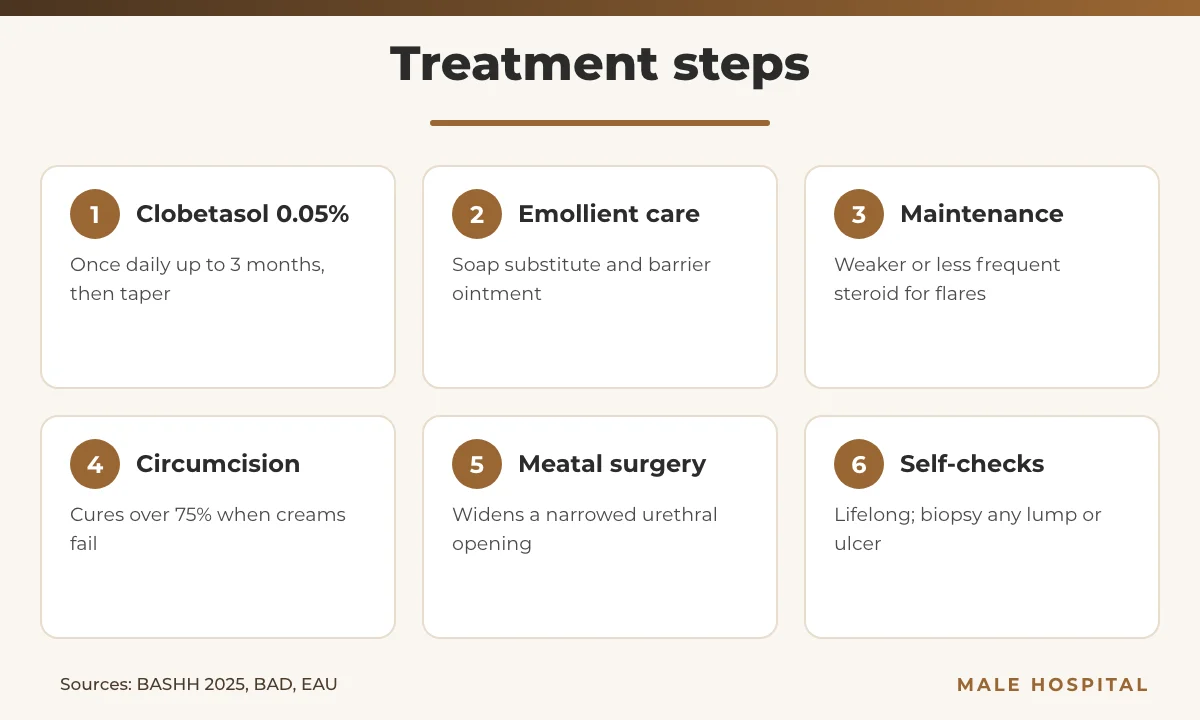
The BASHH 2025 guideline recommends an ultra-potent topical steroid, for example clobetasol propionate 0.05% ointment, applied once daily for up to 3 months as a reducing course until remission, then gradually reduced to a maintenance dose. Your doctor will tell you exactly how much to use and how often. The leaflet in the box may warn against using it on genital skin; the British Association of Dermatologists explains that this should not worry you when a specialist has prescribed it.
How well does it work? In the 329-patient series, 50–60% of men were cured by ultra-potent steroid alone. Steroids also soften the skin and can reduce the need for surgery.
Maintenance and skin care
After the initial course, many men need a moisturiser used as a soap substitute and barrier, plus an occasional weaker or less frequent steroid when symptoms flare.
Second-line medicines
Tacrolimus and pimecrolimus (calcineurin inhibitors) are not usually first choice. They do not thin the skin, but there are theoretical concerns about skin cancer risk, and their use here is off-label. Tablets such as retinoids or methotrexate are reserved for rare, severe lichen sclerosus in men. Other injected or experimental treatments are not standard care.
Source: BASHH — Guideline on the Management of Balanoposthitis 2025; British Association of Dermatologists — Lichen sclerosus in males; J Eur Acad Dermatol Venereol (PubMed) — Clinical parameters in male genital lichen sclerosus; DermNet — Lichen sclerosus
| Treatment | When it is used | What to expect |
|---|---|---|
| Ultra-potent steroid ointment (clobetasol 0.05%) | First line for almost every man | Once daily for up to 3 months, then tapered; cures about half to 60% of men |
| Emollient and barrier care | Everyone, long term | Soap substitute, petroleum jelly barrier, dry after urinating |
| Calcineurin inhibitors (tacrolimus) | Selected cases, off-label | No skin thinning; not first line |
| Circumcision | Tight foreskin or no response to steroids | Cures more than 75% of men; follow-up still needed |
| Meatotomy / meatoplasty | Narrowed urethral opening | Widens the opening; narrowing can come back |
| Oral mucosa graft urethroplasty | Urethral stricture caused by the disease | Uses cheek lining, not genital skin, to rebuild the urethra |
Source: J Eur Acad Dermatol Venereol (PubMed) — Clinical parameters in male genital lichen sclerosus; EAU — Urethral Strictures Guidelines: Disease management in males
Circumcision and surgery for lichen sclerosus in men
Circumcision
When the foreskin stays tight despite steroid ointment, or symptoms keep returning, a urologist may recommend circumcision. Removing the foreskin takes away the moist, urine-exposed space where lichen sclerosus in men thrives. In the 329-patient series, circumcision cured more than 75% of men, and a 2026 review describes it as highly effective when topical therapy fails. It is not a guarantee: in some men the disease continues or appears later on the glans or at the urethral opening, so follow-up is still needed. You can read about the procedure itself in our guide to adult circumcision.
Source: J Eur Acad Dermatol Venereol (PubMed) — Clinical parameters in male genital lichen sclerosus; J Eur Acad Dermatol Venereol (PubMed) — Male genital lichen sclerosus (2026 review); British Association of Dermatologists — Lichen sclerosus in males
Surgery for a narrowed urethra
A narrowed urethral opening may be stretched or widened with a minor operation (meatotomy or meatoplasty). After meatotomy, roughly 1 in 4 patients develop narrowing again and need further surgery. Longer strictures need reconstructive surgery (urethroplasty) by a specialist reconstructive urologist.
The EAU makes a strong recommendation not to use genital skin to rebuild the urethra in men with lichen sclerosus, because the disease returns in at least half of such grafts in reported series. Instead, a graft of the inner cheek lining (oral or buccal mucosa) is used. In men with lichen sclerosus-related strictures, single-stage oral mucosa graft urethroplasty has reported success rates ranging from 65% upward, with some series reporting no failures.
Source: F1000Research (PMC) — Recent advances in understanding urethral lichen sclerosus; EAU — Urethral Strictures Guidelines: Disease management in males
Living with lichen sclerosus: self-care and follow-up
Good daily habits reduce flare-ups of lichen sclerosus in men and protect the skin:
- Wash with an unperfumed emollient soap substitute instead of soap or shower gel; avoid scented products.
- After urinating, gently dab the glans dry, and if uncircumcised, dry under the foreskin before replacing it.
- Apply a barrier such as petroleum jelly regularly to protect the skin from urine.
- Wear loose cotton or silk underwear, avoid scratching and rubbing, and use a lubricant during sex.
- Stop smoking, which also lowers penile cancer risk.
- Keep emollients away from naked flames and lit cigarettes, as fabric soaked in them can catch fire easily.
The British Association of Dermatologists stresses that lifelong regular self-examination is very important for every man who has, or has had, genital lichen sclerosus. Look for a new lump, thickening, a change in texture or a sore that does not heal, and report it even if your skin was previously well controlled.
Source: NHS — Lichen sclerosus; British Association of Dermatologists — Lichen sclerosus in males
When to see a doctor about lichen sclerosus in men
See a doctor if you notice:
- An itchy or sore white patch on the penis or foreskin.
- A foreskin that is becoming tight, splitting or bleeding, or painful erections.
- Pain when urinating or during sex.
- Treatment that is not helping after a few weeks.
Get urgent care if you cannot pass urine, if the stream becomes very weak or you strain to empty your bladder, or if a tight foreskin is stuck behind the head of the penis and the glans is swelling. Arrange a prompt appointment for any lump, thickened area or ulcer that does not heal with steroid ointment, because it may need a biopsy to rule out cancer.
Source: NHS — Lichen sclerosus; British Association of Dermatologists — Lichen sclerosus in males
If you are worried about a white patch, a tightening foreskin or a changing urine stream, you can arrange a confidential consultation with our urologist-andrologist, Assoc. Prof. Dr. Zülfü Sertkaya, via WhatsApp. The right plan, and its cost, depends on the examination, so the first step is a free assessment.
FAQs about lichen sclerosus in men
Is lichen sclerosus contagious or an STI?
No. Lichen sclerosus in men is an inflammatory skin condition, not an infection, so it cannot be passed to a sexual partner and is not a sexually transmitted infection. It is also not caused by poor hygiene. Damaged skin can, however, pick up a secondary infection such as thrush, which may need separate treatment.
Source: NHS — Lichen sclerosus
Can lichen sclerosus in men be cured?
Often, yes. In a large series, ultra-potent steroid ointment cured about 50–60% of men and circumcision cured more than 75% of those who needed it. Because the disease can return or affect the glans or urethra later, doctors still advise lifelong self-checks, even when the skin looks normal again.
Source: J Eur Acad Dermatol Venereol (PubMed) — Clinical parameters in male genital lichen sclerosus
Can circumcised men get lichen sclerosus?
Lichen sclerosus in men is very rare in those circumcised as newborns or in early childhood. Men circumcised as adults can still have the disease on the glans or at the urethral opening, and it can occasionally appear after circumcision, especially if urine dribbling persists. Any white, itchy or scarred area should still be checked.
Source: British Association of Dermatologists — Lichen sclerosus in males; F1000Research (PMC) — Recent advances in understanding urethral lichen sclerosus
Is it safe to use clobetasol on the penis?
Yes, when prescribed and monitored by a doctor. The patient leaflet may warn against genital use, but specialists routinely prescribe ultra-potent steroid ointments for lichen sclerosus in men. The usual plan is once daily for a limited period, then reducing. Use only the amount your doctor advises and report thinning, new redness or no improvement.
Source: British Association of Dermatologists — Lichen sclerosus in males; BASHH — Guideline on the Management of Balanoposthitis 2025
Does lichen sclerosus cause erectile dysfunction?
Lichen sclerosus in men does not damage the erection mechanism itself, but it can make erections and sex painful. A tight, scarred foreskin can split, bleed or feel constricting during erection, and many men avoid intimacy as a result. Controlling inflammation, and circumcision when needed, usually relieves this pain and improves sexual comfort.
Source: British Association of Dermatologists — Lichen sclerosus in males; J Eur Acad Dermatol Venereol (PubMed) — Male genital lichen sclerosus (2026 review)
Will lichen sclerosus turn into penile cancer?
Most men with lichen sclerosus never develop penile cancer, but the risk is higher than in the general population. Good control of the disease appears to reduce this risk. Check your skin regularly and see a doctor promptly about any lump, thickening or ulcer that does not heal, as a biopsy can detect early changes.
Source: NHS — Lichen sclerosus; EAU — Penile Cancer Guidelines
What does lichen sclerosus look like on the penis?
Typically, lichen sclerosus in men appears as white, ivory or shiny patches on the glans and inner foreskin. Early on there may be redness, small cracks or tiny bleeding points. Over time the skin can look thin and scarred, the groove behind the glans may flatten, and a firm white ring may make the foreskin tight.
Source: BASHH — Guideline on the Management of Balanoposthitis 2025; British Association of Dermatologists — Lichen sclerosus in males
Can I have sex with lichen sclerosus?
Yes. Lichen sclerosus in men cannot be passed on to a partner. If sex is painful or the skin splits, use a lubricant and wait until treatment has calmed the inflammation. Tell your doctor if sex keeps causing tears, because a tight foreskin that does not soften with creams is a common reason for recommending circumcision.
Source: NHS — Lichen sclerosus; British Association of Dermatologists — Lichen sclerosus in males
Medically reviewed by Assoc. Prof. Dr. Zülfü Sertkaya, urologist and andrologist (FEBU), Istanbul. Last reviewed: November 2026.
This article is for general information and does not replace an individual consultation with a qualified doctor.
- NHS — Lichen sclerosus
- British Association of Dermatologists — Lichen sclerosus in males (patient information leaflet)
- BASHH — Guideline on the Management of Balanoposthitis 2025
- EAU — Urethral Strictures Guidelines: Definition, epidemiology, aetiology and prevention
- EAU — Urethral Strictures Guidelines: Disease management in males
- EAU — Penile Cancer Guidelines: Epidemiology, aetiology and pathology
- J Eur Acad Dermatol Venereol (PubMed) — Clinical parameters in male genital lichen sclerosus: a case series of 329 patients
- J Eur Acad Dermatol Venereol (PubMed) — Male genital lichen sclerosus (2026 review)
- Clin Exp Dermatol (PubMed) — Male genital lichen sclerosus, microincontinence and occlusion
- Clin Exp Dermatol (PubMed) — Male genital lichen sclerosus associated with urological interventions and microincontinence
- BJU Int (PubMed) — Genital lichen sclerosus/balanitis xerotica obliterans in men with penile carcinoma
- South Med J (PubMed) — Balanitis xerotica obliterans: epidemiologic distribution in an equal access health care system
- Skin Health Dis (PMC) — The age-related incidence of male genital lichen sclerosus is triphasic
- F1000Research (PMC) — Recent advances in understanding urethral lichen sclerosus
- Cureus (PMC) — Penile lichen sclerosis: a surgical perspective of its aetiology and treatment
- DermNet — Lichen sclerosus