Penile cancer is a rare cancer that usually starts on the glans (head of the penis) or the inner foreskin, and about 95% of cases are squamous cell carcinoma, a cancer of the skin cells. The first sign is most often a painless lump, sore, thickened patch or red velvety area that does not heal within four weeks. Long-standing HPV infection, a tight foreskin (phimosis), lichen sclerosus and smoking are the main risk factors, and when it is found early it is usually curable with treatment that keeps most or all of the penis.
Source: Cleveland Clinic — Penile cancer; NHS — Symptoms
- Penile cancer accounts for fewer than 1% of cancers in the US and Europe, but it is far more common in parts of South America, Africa and Asia. The average age at diagnosis is about 60.
- Any growth, sore, bleeding, smelly discharge, skin color change or new difficulty pulling back the foreskin that lasts more than four weeks needs a doctor’s examination.
- Roughly half to two-thirds of cases are linked to high-risk HPV; phimosis, lichen sclerosus, tobacco and PUVA light therapy also raise the risk.
- Guidelines favor penis-preserving treatment (creams, laser, glans surgery) for early disease; partial or total removal is reserved for tumors that invade deep tissue.
- Five-year relative survival is 79% when the cancer is still confined to the penis, so early diagnosis is the single most important factor.
What is penile cancer?
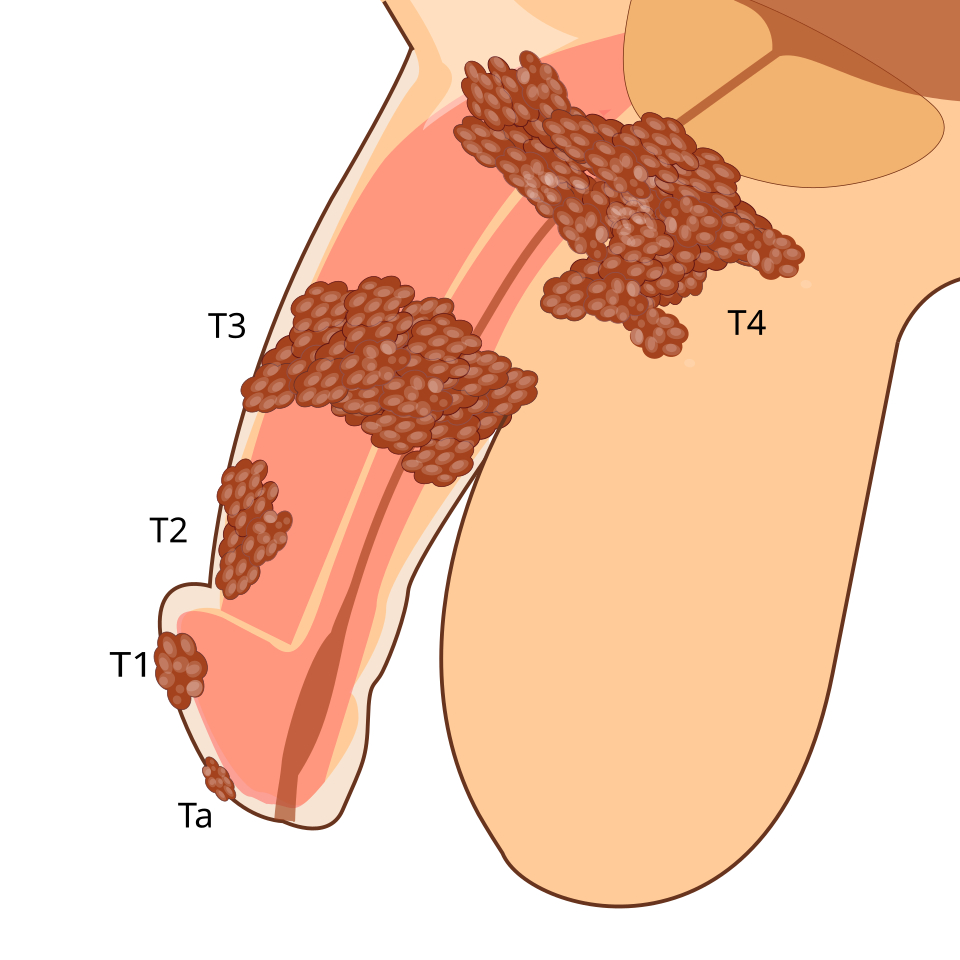
The disease develops when cells of the penis, almost always the skin cells of the glans or foreskin, begin to grow out of control. Squamous cell carcinoma makes up about 95% of cases. Rarer types include melanoma, basal cell carcinoma, adenocarcinoma, urothelial carcinoma and sarcoma. Before an invasive cancer forms, abnormal cells can sit in the surface layer of the skin for years; this precursor stage is called penile intraepithelial neoplasia (PeIN).
Not all squamous cancers behave the same way. The European Association of Urology (EAU) guideline lists several subtypes: the “usual” HPV-independent type is the most common (45–75% of cases); verrucous carcinoma (3–8%) almost never spreads; basaloid carcinoma (4–10%) and sarcomatoid carcinoma (1–7%) are the most aggressive. The subtype, the depth of invasion and whether the groin lymph nodes are involved shape every treatment decision.
Source: Cleveland Clinic — Penile cancer; EAU-ASCO Guideline — Epidemiology, aetiology and pathology
How common is it?
In Europe the incidence is about 0.94 new cases per 100,000 men per year, and in the United States about 0.5 per 100,000. The American Cancer Society estimates about 2,260 new cases and about 450 deaths in the US in 2026. In South America, Southeast Asia and parts of Africa the disease can make up 1–2% of all cancers in men; Brazil reports 8.3 per 100,000. Incidence peaks in the sixth decade, but younger men are not immune.
Source: American Cancer Society — Key statistics; EAU-ASCO Guideline — Epidemiology, aetiology and pathology
Penile cancer symptoms: what to look for
Most tumors start on the foreskin or the glans, so the early signs are skin changes you can see or feel. The NHS lists the main symptoms as a growth, lump or sore that does not heal within four weeks, a rash, bleeding from the penis or from under the foreskin, a smelly discharge, difficulty pulling back the foreskin, and a change in the color of the skin of the penis or foreskin.
The American Cancer Society adds several patterns worth knowing: an area of thickened skin, a reddish velvety rash under the foreskin, small crusty bumps, flat bluish-brown growths, foul-smelling fluid under the foreskin, and swelling at the end of the penis, especially when the foreskin is tight. Sores and lumps are usually painless, which is one reason men delay seeking help.
Signs that the cancer may have spread
The cancer spreads first to the lymph nodes in the groin, which can feel like firm lumps under the skin at the top of the thigh. Tiredness, abdominal pain, bone pain and unexplained weight loss are rarer and suggest more advanced disease. Swollen groin nodes are more often caused by infection than by cancer, but they should still be examined.
Conditions that can look similar
Many harmless or treatable problems mimic an early tumor. Inflammation of the glans (balanitis), sexually transmitted infections, genital warts and the white scarring patches of lichen sclerosus can all cause redness, sores or thickening. Rows of tiny dome-shaped bumps around the rim of the glans are usually pearly penile papules, a normal variant. The difference is that a cancerous lesion persists, slowly enlarges and does not respond to antifungal or antibiotic creams, so any change lasting more than four weeks needs a specialist’s eye.
Source: NHS — Symptoms; American Cancer Society — Signs and symptoms; Cancer Research UK — Symptoms
Causes and risk factors of penile cancer
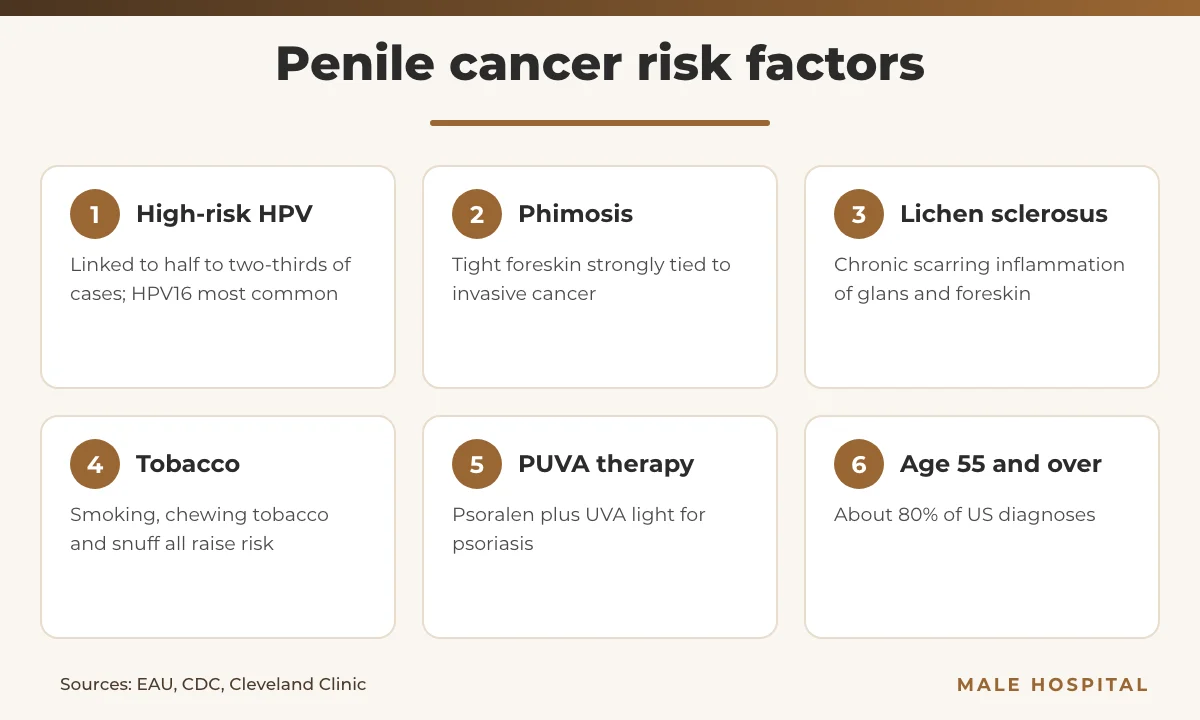
No single cause explains every case, but a handful of factors account for most of the risk. They fall into two groups: persistent infection with high-risk human papillomavirus (HPV), and chronic inflammation of the foreskin and glans.
HPV infection
HPV is the most important known cause. A pooled analysis of 52 studies cited by the EAU found HPV DNA in 50.8% of tumors, and HPV16 was by far the most common type (68.3% of HPV-positive cases). US surveillance data from the CDC attribute about 63% of cases to HPV, roughly 900 of the 1,429 diagnosed each year in 2018–2022. The association is strongest for the basaloid (84%) and warty subtypes, and weaker for the usual type. Most men who carry HPV never develop cancer; the virus is extremely common, and it is the persistence of a high-risk type over many years that matters.
Source: EAU-ASCO Guideline — Epidemiology, aetiology and pathology; CDC — Cancers linked with HPV each year
Phimosis and the foreskin
A foreskin that cannot be pulled back (phimosis) is strongly associated with invasive disease. Trapped secretions (smegma), repeated infections and chronic inflammation are thought to drive the link. Circumcision in infancy reduces the risk of invasive cancer (odds ratio 0.41 in the EAU’s cited data), but the protective effect is much weaker in men who never had phimosis, and it does not seem to lower the risk of the precursor lesion PeIN. In adults, the practical message is to treat phimosis rather than live with it.
Lichen sclerosus and chronic inflammation
Lichen sclerosus in men (balanitis xerotica obliterans) is a chronic scarring skin disease of the glans and foreskin. The EAU notes that it is common in men with this cancer, although it is not linked to more aggressive tumor types. Any long-standing inflammatory condition of the glans deserves regular review.
Other risk factors
- Tobacco: smoking, chewing tobacco and snuff all raise the risk.
- PUVA light therapy: men treated for psoriasis with psoralen plus UVA light have higher rates of the disease.
- Age: about 80% of US diagnoses are in men aged 55 or older.
- Weakened immunity: HIV infection and immunosuppressive drugs after a transplant are listed by the NHS and Cancer Research UK.
- Sexual history: in a Danish study cited by Cancer Research UK, men who never used condoms had more than double the risk, reflecting HPV exposure.
- Low socioeconomic status and poor genital hygiene are also associated with the disease.
Source: EAU-ASCO Guideline — Epidemiology, aetiology and pathology; Cancer Research UK — Risks and causes; Cleveland Clinic — Penile cancer
How penile cancer is diagnosed
Diagnosis starts with a careful examination of the whole penis, including behind the foreskin, and of both groins. The doctor records the size, position and depth of any lesion and feels for enlarged lymph nodes. A biopsy, in which a small piece or the whole abnormal area is removed under local anesthetic, is the only way to confirm cancer. The EAU recommends a biopsy whenever the diagnosis is not obvious on examination or when non-surgical treatment such as creams, laser or radiotherapy is planned.
Imaging of the penis
Physical examination is reliable for judging the size and surface stage of a tumor. MRI is recommended when it is unclear whether the cancer has reached the erectile tissue (corpus cavernosum) or when organ-sparing surgery such as glansectomy is planned; its reported sensitivity for corporal invasion is 80% and specificity 96%. Ultrasound is an acceptable alternative where MRI is not available.
Checking the lymph nodes
Because the groin nodes are the first site of spread, their status decides both treatment and prognosis. Even when no nodes can be felt, about 20–25% of men harbor hidden (occult) metastases. For tumors above the lowest risk group the EAU therefore recommends surgical staging: an ultrasound of the groin with fine-needle aspiration of any suspicious node, followed by dynamic sentinel node biopsy (DSNB), which has a sensitivity of 92–96%. When nodes are palpable, 45–80% contain cancer; they are confirmed by image-guided biopsy, and a PET/CT or CT of the chest and abdomen is used to look for pelvic nodes and distant spread. Blood tests check general health before treatment.
Source: EAU-ASCO Guideline — Diagnostic evaluation and staging; Cancer Research UK — Tests
Penile cancer stages
Staging describes how deep the tumor has grown (T), whether lymph nodes are involved (N) and whether it has spread to distant organs (M). The National Cancer Institute’s plain-language summary of the stages is shown below, alongside the groin-node survival figures from a UK supraregional center (2000–2011) reported by Cancer Research UK.
| Stage | What it means | Typical approach |
|---|---|---|
| Stage 0 (PeIN / Ta) | Abnormal cells only in the surface layer of the skin | Creams, laser, circumcision or glans resurfacing |
| Stage I (T1a) | Cancer just under the skin, no vessel or nerve invasion, low grade | Wide local excision or glansectomy |
| Stage II (T1b–T3) | Deeper growth, high grade or vessel invasion, or into the spongy erectile tissue | Glansectomy, radiotherapy or partial penectomy, plus node staging |
| Stage III (N1–N2) | Spread to one or more groin lymph nodes on one or both sides | Groin lymph node dissection, sometimes chemotherapy or radiotherapy |
| Stage IV (T4, N3 or M1) | Into the scrotum, prostate or bone; pelvic nodes or fixed node mass; distant organs | Chemotherapy first, then surgery if it responds; radiotherapy; clinical trials |
The EAU groups early tumors by their chance of hidden node spread: low risk (grade 1 Ta, Tis and T1a without vessel or nerve invasion) needs no node surgery; intermediate risk (T1a grade 2) carries a 6–8% chance; high risk (T1b or any T2–T4, or any T1 with vessel or nerve invasion) carries 22–30% or more. In the UK series, five-year survival was over 90% with no node involvement (N0), almost 75% with one involved groin node (N1), around 60% with several (N2) and almost 35% once pelvic nodes or fixed node masses were present (N3).
Source: National Cancer Institute — Stages; EAU-ASCO Guideline — Diagnostic evaluation and staging; Cancer Research UK — Survival
Penile cancer treatment options
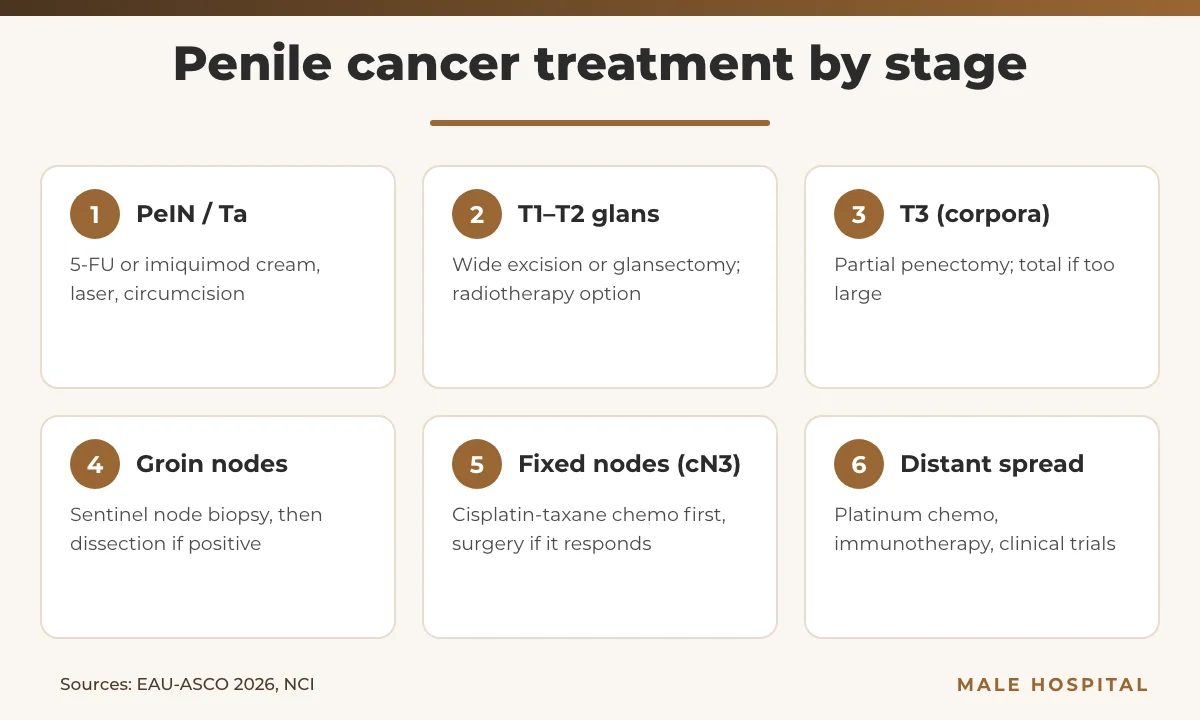
Surgery is the most common treatment at every stage, but the 2026 EAU-ASCO guideline states that penis preservation is the primary goal for localized disease. The right option depends on the stage, the subtype and the man’s own priorities, and the guideline asks surgeons to explain every suitable option and its trade-offs.
Treatments that keep the penis intact
- Circumcision is the primary surgical option when the cancer or precursor lesion is confined to the foreskin.
- Topical creams: fluorouracil (5-FU) chemotherapy cream, often applied for 12 hours every 48 hours for 4–6 weeks, or imiquimod immunotherapy cream three times a week for 12 weeks, are first-line choices for PeIN. If a cream fails, it should not be repeated.
- Laser ablation (CO2 or Nd:YAG) is offered for PeIN, Ta and selected T1 lesions; reported recurrence ranges from 7% to 48%.
- Glans resurfacing removes the surface layer of the glans and replaces it with a skin graft for extensive PeIN; recurrence is 0–20%, and up to one in five resected cases turns out to contain invasive disease on the pathology report.
- Cryotherapy (freezing) is listed by the NHS for very early cancer unlikely to have spread.
Organ-sparing surgery and radiotherapy for invasive tumors
For invasive cancer confined to the glans (T1–T2), options include wide local excision, partial or total glansectomy with reconstruction, and radiotherapy. A margin of 5–10 mm of healthy tissue gives acceptably low recurrence in lower-risk tumors, and recurrence rises sharply when the margin is under 1 mm. Radiotherapy can be given as external beam treatment (at least 60 Gy) with a brachytherapy boost, or as brachytherapy alone for lesions under 4 cm. Mohs micrographic surgery is not routinely recommended because the data are limited.
Partial and total penectomy
Partial penectomy, removing the end of the penis, is the standard treatment once the tumor invades the corpus cavernosum (T3). Total penectomy with a new urinary opening in the perineum (perineal urethrostomy) is used for large tumors that cannot be removed with a partial amputation. Reconstruction with tissue flaps may be possible. Tumors that cannot be resected may be treated with chemotherapy first and surgery if they respond, or with combined chemoradiotherapy.
| Treatment | Five-year recurrence-free rate (EAU-ASCO 2026) |
|---|---|
| Glansectomy | 78.0–95.8% |
| Partial penectomy | 75.8–95.4% |
| Brachytherapy | 78.6% |
| Laser (invasive disease) | 69.4% |
| External beam radiotherapy | 55.2% |
Source: EAU-ASCO Guideline — Disease management; National Cancer Institute — Treatment (PDQ); NHS — Treatment
Treating the lymph nodes
Involved groin nodes are removed by inguinal lymph node dissection (ILND), a more limited operation for one involved node (cN1) and a radical dissection for more extensive disease (cN2). Complications such as wound problems and leg swelling occur in 21–55% of men, which is why sentinel node biopsy is preferred for staging. If three or more groin nodes are involved on one side, or cancer breaks through the node capsule, the pelvic nodes on that side are removed too. Node surgery should be completed within three months of diagnosis unless chemotherapy is given first.
Chemotherapy, radiotherapy and immunotherapy
For a fixed groin mass or pelvic node disease (cN3), cisplatin- and taxane-based chemotherapy before surgery is preferred over operating straight away; the TIP regimen (paclitaxel, ifosfamide, cisplatin) produced a response in 50% of patients in a phase II trial, and responders who then have surgery reach about 50% five-year survival. Radiotherapy after surgery is offered for pN2–N3 disease. For spread to distant organs, platinum-based chemotherapy is first-line; bleomycin is no longer used because of lung toxicity. Immunotherapy responses are uncommon but sometimes durable (pembrolizumab plus chemotherapy: 39.4% in the HERCULES trial), and the guideline strongly encourages clinical trial enrolment.
Source: EAU-ASCO Guideline — Disease management
Survival, follow-up and life after treatment
Based on US men diagnosed between 2015 and 2021, the five-year relative survival rate is 79% when the cancer is localized, 57% when it has reached nearby nodes (regional) and 10% when it has spread to distant sites, with 65% for all stages combined. Node status is the single most important prognostic factor, which is why guidelines push for early, thorough staging of the groin.
Source: American Cancer Society — Survival rates
Follow-up schedule
Most local and groin recurrences appear within two to three years: in a series of 509 patients, 52.3% of local recurrences occurred within two years and 79.5% within three. After penis-preserving treatment the EAU recommends a check every three months in years one and two and every six months in years three to five; after amputation, every three months for two years and then yearly to five years. Local recurrence is about 10% after glansectomy, up to 27% after some penis-preserving treatments and about 4–5% after partial penectomy. Regular follow-up can stop after five years in men who self-examine and report any change immediately.
Sex and urination after surgery
Many men keep a good sex life after organ-sparing surgery. In cohort studies, 85% to nearly all men achieved erections after glansectomy, although all reported reduced sensation of the glans. Outcomes after partial penectomy are poorer: one trial reported erectile dysfunction in 61.7% of men, and urine spraying was more common (83% versus 43% after penis-preserving surgery). About 31% of patients report anxiety and 6% depression, so the guideline makes access to counselling and psychosexual therapy a strong recommendation, starting at the first pre-operative visit. For men whose erections do not recover, options from medication to a penile implant can be discussed once the cancer follow-up allows.
Source: EAU-ASCO Guideline — Follow-up and quality of life
How to lower your risk
No step removes the risk completely, but several lower it, and most are good for your health anyway.
- HPV vaccination. The CDC recommends routine vaccination at age 11–12 (it can start at 9): two doses if the series starts before the 15th birthday, three doses for those starting at 15–26. Adults aged 27–45 can discuss vaccination with a doctor, although the benefit is smaller. The vaccine prevents new infection but does not treat an infection you already have.
- Condoms. The WHO notes that condoms lower the chance of HPV transmission but do not give full protection, because the virus can live on skin the condom does not cover.
- Stop using tobacco in every form.
- Treat phimosis. A steroid cream can loosen a tight foreskin; if that fails, a dorsal slit or circumcision is recommended. Our phimosis treatment page explains the options, and adult circumcision is a routine day procedure.
- Keep the area clean. Men with a foreskin should retract it and wash the whole glans daily.
- Get lichen sclerosus or recurrent balanitis treated and keep up the follow-up your doctor recommends.
Source: CDC — HPV vaccination; WHO — Human papillomavirus and cancer; American Cancer Society — Prevention; NHS — Causes
When to see a doctor
Embarrassment is a common reason men wait, and waiting is what turns a curable lesion into a cancer that needs more radical surgery. Book an appointment promptly if you notice any of the following:
- a lump, sore, ulcer or wart-like growth on the glans, foreskin or shaft that has not healed within four weeks;
- a red velvety patch, white thickened plaque or area of skin that has changed color;
- bleeding or a foul-smelling discharge from under the foreskin;
- a foreskin that has recently become tight, swollen or impossible to retract;
- a firm, painless lump in one or both groins;
- a lesion that keeps returning after antifungal or antibiotic creams.
These symptoms are far more often caused by infection, balanitis or benign skin conditions, but only an examination and, where needed, a biopsy can tell the difference. If you would like a confidential assessment, our urologist-andrologist Assoc. Prof. Dr. Zülfü Sertkaya can examine the lesion, arrange a biopsy and coordinate referral to a uro-oncology team if needed; you can reach the clinic on WhatsApp.
Source: NHS — Symptoms; American Cancer Society — Signs and symptoms
FAQs about penile cancer
Is penile cancer curable?
Yes, in most cases when it is found early. Cancers confined to the penis have a five-year relative survival of 79% in US data, and many are treated with creams, laser or glans surgery that keeps the penis. Survival falls once the groin or pelvic nodes are involved, so prompt diagnosis matters more than any single treatment.
Source: American Cancer Society — Survival rates
What does penile cancer look like at the start?
Usually a small change on the glans or inner foreskin: a thickened or velvety red patch, a wart-like growth, a crusty bump, a flat bluish-brown area or a shallow ulcer. It is typically painless and does not heal. Bleeding or a smelly discharge from under the foreskin is another early clue.
Source: American Cancer Society — Signs and symptoms
Does HPV always lead to penile cancer?
No. HPV is very common and most infections clear on their own. Cancer develops only when a high-risk type, most often HPV16, persists for years in the skin of the glans or foreskin. Studies attribute about half to two-thirds of cases to HPV, which is why vaccination and condoms are the main preventive tools.
Source: EAU-ASCO Guideline — Epidemiology, aetiology and pathology; CDC — Cancers linked with HPV each year
Does circumcision prevent penile cancer?
Circumcision in infancy lowers the risk of invasive disease, mainly by preventing phimosis; the benefit is much smaller in men who never had a tight foreskin, and it does not reduce the precursor lesion PeIN. In adults, circumcision is recommended as a treatment for phimosis or lichen sclerosus rather than as a routine cancer-prevention step.
Source: EAU-ASCO Guideline — Epidemiology, aetiology and pathology; NHS — Causes
Is penile cancer painful?
Early lesions are usually painless, which is one reason men ignore them. Pain, bleeding and swelling tend to appear later, when the tumor is larger or infected, or when the foreskin can no longer be retracted. A painless lump is still a reason to be examined; the absence of pain says nothing about whether a lesion is cancerous.
Source: American Cancer Society — Signs and symptoms
How quickly does penile cancer spread?
It spreads in a predictable order: first to the groin lymph nodes, then to the pelvic nodes and finally to distant organs. Even with no palpable nodes, about one in four to five men with higher-risk tumors already has microscopic node involvement, and most recurrences happen within two to three years of treatment. This is why staging and follow-up focus so heavily on the groin.
Source: EAU-ASCO Guideline — Diagnostic evaluation and staging; EAU-ASCO Guideline — Follow-up and quality of life
Can you still have sex after treatment?
Often, yes. After glansectomy, 85% or more of men in cohort studies could still get erections, though glans sensation was reduced in all of them. After partial penectomy, erections, orgasm and body image are affected more, and about 62% report erectile dysfunction. Psychosexual counselling is recommended from the first consultation, and erection problems can be treated once cancer follow-up allows.
Source: EAU-ASCO Guideline — Follow-up and quality of life
Can a young man get it?
Penile cancer is uncommon under 40, and about 80% of US cases occur at 55 or older, but it does happen in younger men, particularly those with persistent high-risk HPV, phimosis, lichen sclerosus or a weakened immune system. Age is never a reason to dismiss a sore or growth that fails to heal within four weeks.
Source: Cleveland Clinic — Penile cancer; Cancer Research UK — Risks and causes
Medically reviewed by Assoc. Prof. Dr. Zülfü Sertkaya, urologist and andrologist (FEBU), Istanbul. Last reviewed: November 2026.
This article is for general information and does not replace an individual consultation with a qualified doctor.
- EAU — Penile Cancer Guidelines: Epidemiology, aetiology and pathology
- EAU — Penile Cancer Guidelines: Diagnostic evaluation and staging
- EAU — Penile Cancer Guidelines: Disease management
- EAU — Penile Cancer Guidelines: Follow-up and quality of life
- NHS — Penile cancer: symptoms
- NHS — Penile cancer: causes
- NHS — Penile cancer: treatment
- American Cancer Society — Key statistics for penile cancer
- American Cancer Society — Signs and symptoms of penile cancer
- American Cancer Society — Survival rates for penile cancer
- American Cancer Society — Can penile cancer be prevented?
- National Cancer Institute — Penile cancer stages
- National Cancer Institute — Penile cancer treatment (PDQ) – patient version
- Cleveland Clinic — Penile cancer
- Cancer Research UK — Penile cancer symptoms
- Cancer Research UK — Penile cancer risks and causes
- Cancer Research UK — Tests for penile cancer
- Cancer Research UK — Penile cancer survival
- CDC — Cancers linked with HPV each year
- CDC — HPV vaccination
- WHO — Human papillomavirus and cancer