NoFap and erectile dysfunction are linked in thousands of online posts, but the science is thinner than the forums suggest. Abstaining from pornography and masturbation does not cure erectile dysfunction (ED) by itself: large surveys find no link between how often a man masturbates or watches pornography and his erections, and the famous “testosterone peaks on day 7” study was retracted in 2021. A break can still help some men, mainly those whose use feels out of control or who have performance anxiety, but a medical check comes first. This page looks only at the abstinence question; for the wider debate, see our main guide to porn induced erectile dysfunction.
Sources: PubMed — Rowland et al., Do pornography use and masturbation play a role in erectile dysfunction? (Int J Impot Res 2023); PubMed — Jiang et al., Ejaculation and serum testosterone level in men (J Zhejiang Univ Sci 2003; retracted publication)
- NoFap is an online abstinence movement, not a medical treatment. No urology guideline lists abstinence from masturbation as a therapy for erectile dysfunction.
- In a study of 3,586 men, pornography use was unrelated to erectile function and masturbation frequency only weakly so; age, anxiety, depression, chronic illness and low desire mattered far more.
- The study behind the “day 7 testosterone spike” was retracted in 2021. Other small studies NoFap supporters cite show, at most, modest and short-lived hormone changes.
- Erection problems are linked with feeling addicted to pornography, not with the amount watched, so a NoFap break helps most when use feels compulsive.
- Rigid NoFap rules harm some men through relapse guilt, anxiety about “semen loss” and delayed care. A planned trial break plus a doctor’s assessment is safer.
- What NoFap is, and why men link it to erectile dysfunction
- NoFap and erectile dysfunction: the claims versus the evidence
- Does NoFap raise testosterone? The retracted 7-day study
- Does masturbation cause erectile dysfunction?
- What a break from pornography actually does
- When NoFap and erectile dysfunction recovery can go together
- Risks of NoFap: guilt, anxiety and delayed care
- A safer plan: test the theory without the dogma
- When to see a doctor
- FAQs about NoFap and erectile dysfunction
What NoFap is, and why men link it to erectile dysfunction
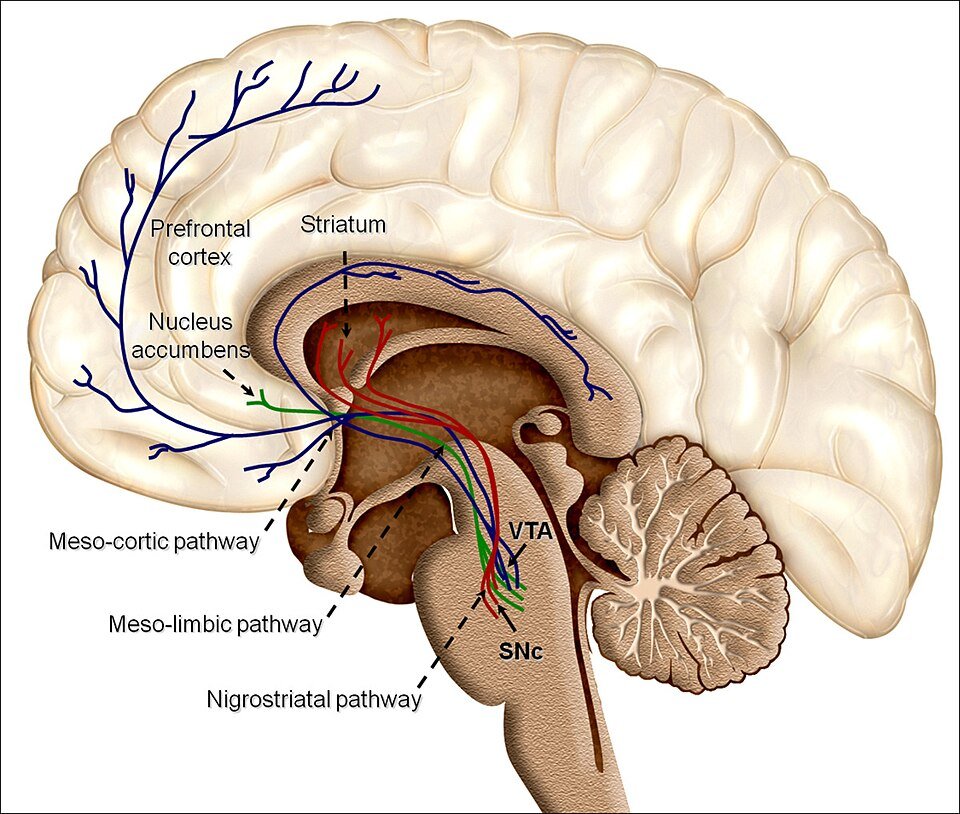
NoFap began as an internet forum and grew into a movement whose members give up pornography, masturbation, or both, often for a 90-day “reboot”, on the theory that heavy pornography use has rewired the brain’s reward system and abstinence lets it reset. By 2021 the main NoFap community counted more than 738,000 followers, which is why the question of NoFap and erectile dysfunction now reaches a urologist’s office so often.
Many men arrive at NoFap because of a real problem. When researchers read 104 abstinence journals on a “rebooting” forum, sexual difficulties were among the main reasons men started, and most saw abstinence as the solution. An analysis of 329 posts on a Reddit erectile dysfunction board found a median author age of 24; 48% believed their ED was psychological, 20% had tried abstaining from pornography or masturbation as self-treatment, and only 28% had seen a health professional.
Sources: PubMed — Fernandez et al., The pornography “rebooting” experience (Arch Sex Behav 2021); PubMed — Jiang et al., Self-reported psychogenic ED and depression among young men on social media (Urology 2020)
Erectile dysfunction means not being able to get or keep an erection firm enough for sex; occasional failures from stress, tiredness or alcohol are normal, and it becomes a medical issue when it keeps happening. Most cases are of mixed physical and psychological origin, which is one reason a single behavioral fix such as NoFap rarely explains it.
Sources: NHS — Erectile dysfunction (impotence); EAU — Sexual and Reproductive Health Guidelines, Management of erectile dysfunction
NoFap and erectile dysfunction: the claims versus the evidence
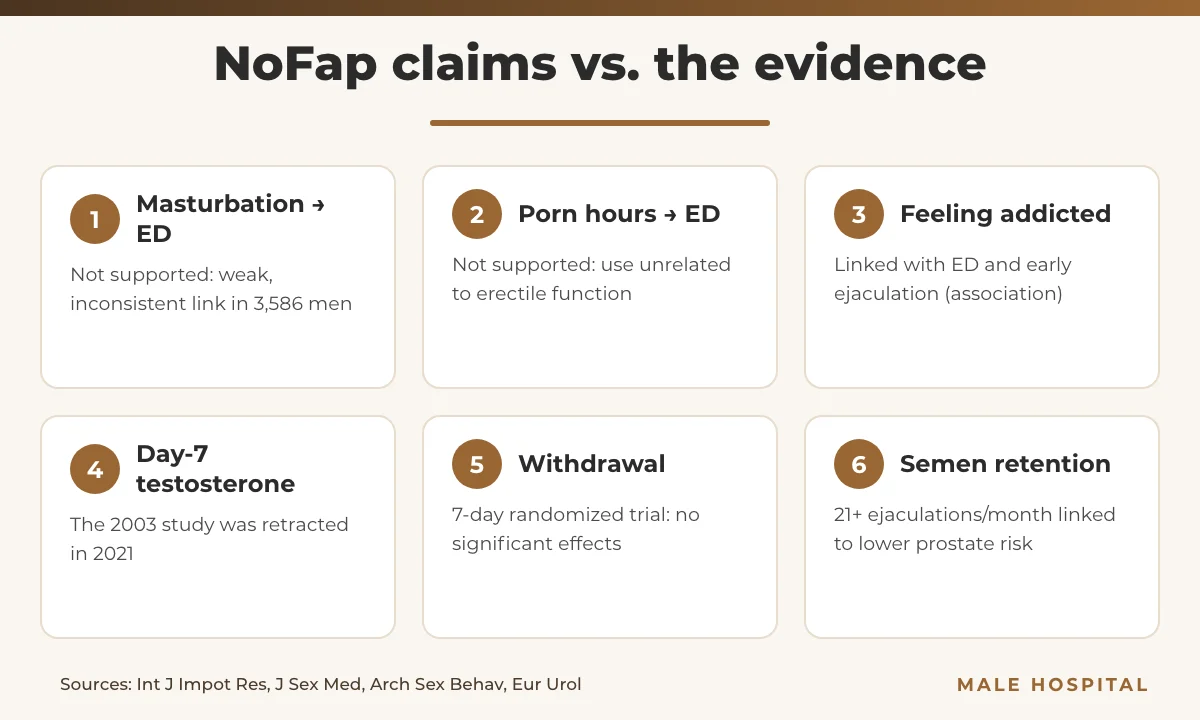
Supporters of NoFap make several distinct claims, and they do not all stand or fall together. The table separates them so you can see which parts have support.
| Claim | What the research shows | Verdict |
|---|---|---|
| Masturbation causes ED | Frequency weakly and inconsistently related to erectile function in 3,586 men; not among the strong predictors | Not supported |
| Pornography hours cause ED | Use unrelated to erectile function, including in men aged 30 and under; reviews find little or no evidence of causation | Not supported |
| Feeling “addicted” to porn is linked to ED | Self-perceived addiction showed small-to-moderate correlations with ED and early ejaculation in 942 men | Association, not proven cause |
| Testosterone peaks after 7 days | The 2003 study making this claim was retracted in 2021; other small studies show modest, short-lived changes | Unreliable |
| Quitting causes withdrawal, proving addiction | A randomized 7-day abstinence trial found no significant withdrawal, craving or mood effects overall | Not supported |
| Semen retention protects the prostate | The opposite trend: 21+ ejaculations a month was linked with about 20% lower prostate cancer risk than 4–7 | Contradicted (observational) |
Sources: PubMed — Rowland et al. (Int J Impot Res 2023); PubMed — Whelan & Brown, Pornography addiction, perceived addiction and ED (J Sex Med 2021); PubMed — Fernandez et al., 7-day pornography abstinence randomized study (Arch Sex Behav 2023); PubMed — Rider et al., Ejaculation frequency and risk of prostate cancer (Eur Urol 2016)
Notice the pattern. The NoFap claims that fail are about quantity (how often, how many hours); the claim that survives is about perception and control: men who feel their use is out of control report more sexual problems.
Does NoFap raise testosterone? The retracted 7-day study
The most quoted number in the NoFap world is “testosterone rises 45% on day 7 of abstinence”. It comes from a 2003 Chinese study of 28 volunteers who had their serum testosterone measured daily after ejaculation; the authors reported little change on days 2 to 5 and a peak of 145.7% of baseline on day 7. In December 2021 the journal retracted the paper, and PubMed now lists it as a “retracted publication”. A retracted study should not be used as evidence for anything.
What remains of the NoFap testosterone claim is small and mixed. In a study of 10 healthy men, three weeks of abstinence raised baseline testosterone, but orgasm itself did not change testosterone at all; what orgasm did raise was prolactin, adrenaline, noradrenaline, blood pressure and heart rate, before and after the abstinence period. In a 2021 randomized cross-over pilot in which 8 young men completed all three conditions, masturbation did not lower total testosterone; it slightly slowed the normal daily decline of free testosterone, and the authors said the finding needs confirmation in larger studies.
Sources: PubMed — Exton et al., Endocrine response to masturbation-induced orgasm after a 3-week abstinence (World J Urol 2001); PMC — Hormonal response after masturbation in young healthy men: a randomized cross-over pilot (Basic Clin Androl 2021)
A 2021 narrative review that gathered all of this concluded that the evidence on ejaculation frequency and hormones is sparse and inconclusive, and it noted a study of men aged 57 to 85 in which more frequent masturbation predicted higher testosterone. None of these fluctuations is large enough to treat ED. If you want to know whether your testosterone is actually low, the answer is a fasting early-morning blood test, not a counter on an app; our guide to testosterone and erectile dysfunction explains when low levels matter.
Sources: PMC — Mascherek et al. (Front Psychol 2021); EAU — Management of erectile dysfunction
Does masturbation cause erectile dysfunction?
No. Contrary to NoFap claims, Cleveland Clinic lists erectile dysfunction, lowered libido, infertility and reduced sperm count among the claims about masturbation that research has not supported, and describes masturbation as a normal, healthy behavior with no serious side effects. The physical problems it does mention are minor: chafing, tender skin or temporary reduced sensitivity from very rough or very frequent sessions, which settle within a day or two.
Source: Cleveland Clinic — Masturbation: Facts & Benefits
The largest direct test came from 3,586 men with a mean age of 41. Pornography use was unrelated to erectile function or ED severity, even in men aged 30 and under, and masturbation frequency was only weakly and inconsistently related. The strongest predictors of erectile function were age, anxiety or depression, chronic medical conditions, low sexual interest and low relationship satisfaction. The same study did find that men who masturbated more often reported lower sexual and relationship satisfaction, which may say more about an unsatisfying relationship than about masturbation.
Frequent ejaculation, the opposite of the NoFap rule, may even carry a benefit. In a cohort of 31,925 men, those reporting 21 or more ejaculations a month had a roughly 20% lower risk of prostate cancer than men reporting 4 to 7 (hazard ratios 0.81 and 0.78 for frequency in the twenties and forties). The evidence is observational, driven by low-risk disease and, in urologists’ words, far from definitive, but it points the opposite way from “semen retention”.
Sources: PubMed — Rider et al. (Eur Urol 2016); Cleveland Clinic — Can sex lower your prostate cancer risk?
What a break from pornography actually does
Forum accounts describe a dramatic “flatline” followed by recovery, so researchers tested NoFap-style abstinence under controlled conditions. In a randomized study, 176 regular pornography users were assigned either to abstain for 7 days or to continue as usual, with craving, mood and withdrawal symptoms measured nightly. There were no significant differences between the groups. Only an exploratory analysis hinted at more craving in the small subgroup who both scored high on problematic use and had been watching daily, and the authors cautioned against over-reading it.
A systematic review of 47 prospective abstinence studies across gaming, gambling, exercise, phones, social media and pornography reached a balanced conclusion: abstinence shows promise as an intervention for problematic pornography use, but counterproductive effects such as rebound and compensatory behaviors have barely been measured. In plain terms, a planned NoFap break is a reasonable experiment for a man whose use troubles him; it is not a proven cure, and nobody knows how often it backfires.
The improvement some men report after quitting also has simpler explanations than brain “rewiring”: rebooting often coincides with more sleep, exercise, less alcohol and renewed attention to a partner, all of which affect erections on their own. The journals study found sustained abstinence was described as rewarding, but its authors stressed that prospective studies are needed to rule out these other explanations.
Sources: PubMed — Fernandez et al., The pornography “rebooting” experience (Arch Sex Behav 2021); NIDDK — Symptoms & causes of erectile dysfunction
When NoFap and erectile dysfunction recovery can go together
There is a group of men for whom a NoFap break makes clinical sense. The clearest signal is the 2021 survey of 942 men aged 18 to 44: pornography use on its own was not associated with ED, early ejaculation or dissatisfaction, but self-perceived addiction was, with small-to-moderate correlations. If your use feels compulsive, if you hide it, or if you need increasingly specific material to become aroused, the relationship between NoFap and erectile dysfunction may be real for you even though it is not real for the average viewer.
Source: PubMed — Whelan & Brown (J Sex Med 2021)
The second group is men with situational ED: erections are fine alone or on waking but fail with a partner. The EAU guideline describes this performance-related, partner-related pattern as psychogenic, and nocturnal erection testing is usually normal in such men. Here the mechanism is anxiety rather than dopamine, and a break from pornography helps only insofar as it lowers pressure and shifts attention back to the partner. Our guide to sexual performance anxiety explains how to read these signs.
Source: EAU — Management of erectile dysfunction
Compulsive sexual behavior is a recognized clinical problem. Cleveland Clinic lists warning signs such as missing work, canceling plans, forgetting responsibilities and strained relationships, and recommends talk therapy. For these men, abstinence is one part of treatment, not a stand-alone NoFap challenge.
Source: Cleveland Clinic — Masturbation: Facts & Benefits
Risks of NoFap: guilt, anxiety and delayed care
The NoFap movement is not harmless for everyone. In a survey of 1,063 men, 64.2% had tried to abstain from masturbation at least once, and the strongest predictor of wanting to abstain was the belief that masturbation is unhealthy, not actual behavior: maximum or current orgasm frequency was not correlated with the wish to stop. The authors concluded that there is currently no evidence that abstinence from masturbation has health benefits, and warned against pathologizing a normal behavior.
Source: PMC — Zimmer & Imhoff, Abstinence from masturbation and hypersexuality (Arch Sex Behav 2020)
Guilt is the mechanism that does the damage. The 2021 review highlights a study of more than 4,000 male outpatients in which guilt-laden masturbation, not masturbation itself, correlated with higher anxiety and depression scores. A critical analysis of NoFap and PornFree forum posts found that the cycle of commitment, “recovery” and “relapse” helped maintain distress rather than relieve it. Researchers have also described Dhāt syndrome, a culture-bound anxiety about semen loss, emerging in US semen-retention groups.
Sources: PMC — Mascherek et al. (Front Psychol 2021); PubMed — Chasioti & Binnie, Etiological pathways of problematic pornography use in NoFap/PornFree communities (Arch Sex Behav 2021); PubMed — Prause, Dhāt syndrome emerges in the United States from semen retention/NoFap groups (Int J Impot Res 2024)
The commercial layer around NoFap adds risk. A 2024 audit of online “ejaculation training” courses found 11 programs costing $5 to $147 a week or $20 to $199 as a one-off, promising to fix ED, early ejaculation, “porn addiction”, testosterone and depression; none of the instructors claimed medical or mental-health credentials, and 70% cited only personal experience. Meanwhile 38% of the young men on the Reddit ED board reported depressive symptoms, and most were self-treating before seeing anyone qualified. Delay matters because ED can be the first sign of diabetes or vascular disease, which NIDDK lists among its leading causes.
Sources: PubMed — Prause, Online ejaculation training programs promote non-evidence-based treatment (Int J Impot Res 2024); PubMed — Jiang et al. (Urology 2020); NIDDK — Symptoms & causes of erectile dysfunction
A safer plan: test the theory without the dogma
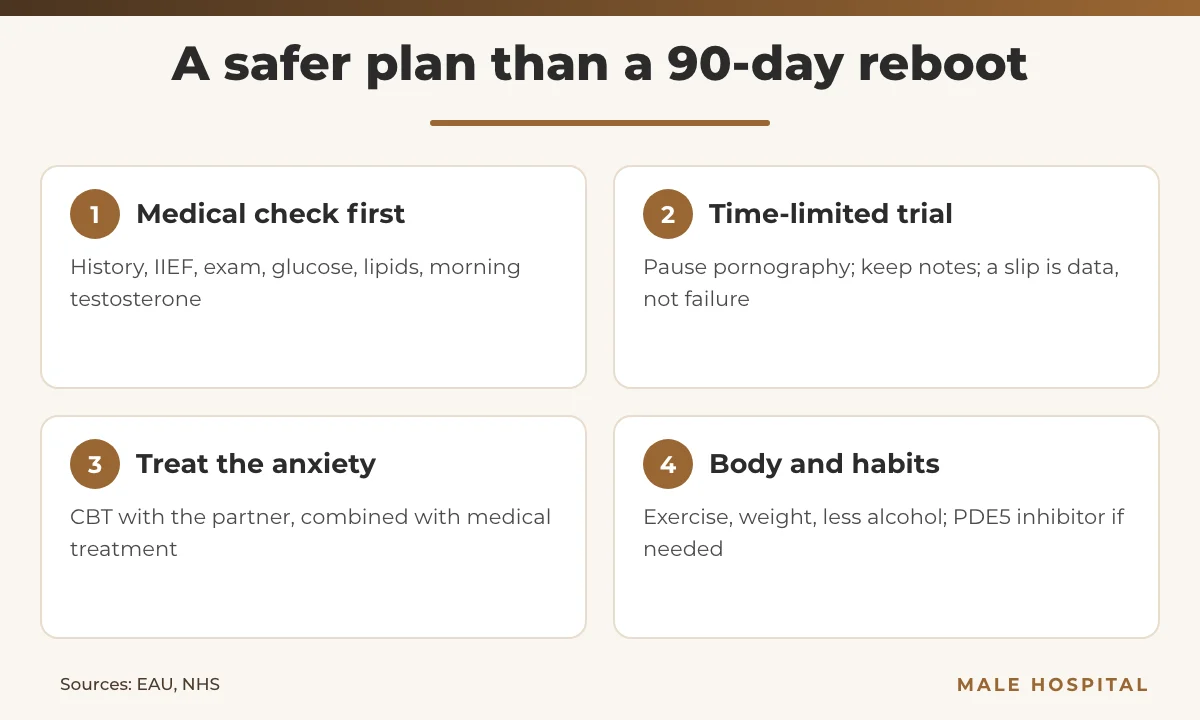
If you suspect pornography is part of your problem, you can test that idea the way a clinician would, without the shame-based rules. The first step is the same for every man with persistent ED: a medical assessment. The EAU work-up is a detailed sexual and medical history, a validated questionnaire such as the IIEF, a focused physical exam with blood pressure and waist measurement, and blood tests for fasting glucose or HbA1c, lipids and an early-morning fasting testosterone. Our guide to the erectile dysfunction test walks through each one.
Source: EAU — Management of erectile dysfunction
Run a time-limited trial, not a lifelong rule
Instead of a 90-day NoFap challenge, set a defined break from pornography, keep masturbation if you wish (the evidence does not implicate it), and note what changes with a partner. Treat a slip as data, not failure; the forum studies show relapse guilt is where the harm concentrates. If partnered erections improve while erections alone were always fine, anxiety and attention, not blood flow, were the issue.
Sources: PubMed — Rowland et al. (Int J Impot Res 2023); PubMed — Chasioti & Binnie (Arch Sex Behav 2021)
Treat the anxiety and the body at the same time
The EAU recommends cognitive behavioral therapy, ideally including the partner, combined with medical treatment rather than instead of it. Lifestyle changes come first or alongside: exercise, weight loss and control of cardiovascular risk factors can improve erections. PDE5 inhibitors such as sildenafil or tadalafil are first-line therapy, and the NHS adds that counselling or sex therapy is appropriate when erection problems are linked to emotional or mental health.
Sources: EAU — Management of erectile dysfunction; NHS — Erectile dysfunction (impotence)
Young men are the core of the NoFap audience. A 2026 national survey of 6,228 Japanese men found ED prevalence followed a U-shape with age: 25.5% of unmarried and 17.8% of married men in their twenties met the definition, more than in their thirties, with psychosocial and lifestyle factors suggested as drivers. ED in your twenties is common and treatable, not proof of a pornography-damaged brain; our page on erectile dysfunction in young men covers the full range of causes.
If you would rather not guess, Assoc. Prof. Dr. Zülfü Sertkaya, our urologist-andrologist in Istanbul, offers a confidential assessment that separates vascular, hormonal and psychological causes before any treatment is suggested; you can message the clinic on WhatsApp or read about erectile dysfunction treatment options first.
When to see a doctor
See a urologist or your family doctor promptly, rather than waiting out a 90-day NoFap reboot, if any of the following apply:
- Erection problems have continued for more than a few weeks or are getting worse, whatever you watch or do.
- Erections are weak in every situation, including on waking and when alone, which points away from a psychological cause.
- You have diabetes, high blood pressure, high cholesterol, heart disease or you smoke; ED can be the first sign that blood vessels are affected.
- You have low mood, loss of interest in sex, fatigue or reduced body hair, which can suggest low testosterone or depression.
- You notice a new curve, pain or lump in the penis, or you have pain on ejaculation.
- You feel hopeless, guilty or have thoughts of self-harm after a “relapse”; this needs help now, not more abstinence.
Sources: NHS — Erectile dysfunction (impotence); Cleveland Clinic — Erectile dysfunction; MedlinePlus — Erectile dysfunction
FAQs about NoFap and erectile dysfunction
Can NoFap cure erectile dysfunction?
Not on its own. No urology guideline recommends abstinence from masturbation as a treatment for ED, and the largest surveys find no link between masturbation frequency and erectile function. A break from pornography may help men whose use feels compulsive or who have performance anxiety, usually alongside therapy and a medical check.
Sources: EAU — Management of erectile dysfunction; PubMed — Rowland et al. (Int J Impot Res 2023)
How long does it take for erections to recover with NoFap?
There is no evidence-based timeline, because no controlled study has shown that abstinence restores erections. The 90-day NoFap figure is a forum convention, not a clinical finding. If a break is going to help, improvement with a partner usually tracks falling anxiety over weeks; if nothing changes after a few weeks, the cause is probably elsewhere and needs assessment.
Does abstaining really boost testosterone by 45% on day 7?
That figure comes from a 2003 study of 28 men that was retracted in 2021, so it should not be cited. A 10-man study found slightly higher testosterone after three weeks of abstinence, and a small cross-over trial found masturbation did not reduce total testosterone. None of these changes is large enough to affect erections.
Sources: PubMed — Jiang et al. (2003; retracted); PubMed — Exton et al. (World J Urol 2001)
Is the NoFap “flatline” a sign of withdrawal?
A randomized trial of 176 regular users found no significant withdrawal, craving or mood effects over a 7-day abstinence period compared with continued use. A temporary drop in desire during a break is reported in forums, but it has not been shown to be a withdrawal syndrome, and it is not evidence of brain damage.
Source: PubMed — Fernandez et al. (Arch Sex Behav 2023)
Should I stop masturbating as well as stop watching porn?
The evidence does not require it. Masturbation is not a supported cause of ED, lowered libido or infertility, and frequent ejaculation has been linked with lower prostate cancer risk in observational data. If you want to test whether pornography is affecting partnered sex, a break from pornography alone is the cleaner experiment.
Sources: Cleveland Clinic — Masturbation: Facts & Benefits; PubMed — Rider et al. (Eur Urol 2016)
Why do I get erections alone but not with my partner?
That pattern is typical of situational psychogenic ED, in which anxiety or relationship factors interfere while the physical machinery works. The EAU classifies it as performance- or partner-related, and nocturnal erection tests are usually normal. It responds well to therapy, sometimes with a short course of a PDE5 inhibitor to rebuild confidence.
Source: EAU — Management of erectile dysfunction
Can NoFap make erectile dysfunction worse?
Indirectly, yes, for some men. Studies of NoFap forums find that the cycle of commitment and relapse maintains distress, guilt-laden attitudes to masturbation correlate with anxiety and depression, and many young men self-treat for months before seeing a doctor. Anxiety and delay both work against erections.
Sources: PubMed — Chasioti & Binnie (Arch Sex Behav 2021); PubMed — Jiang et al. (Urology 2020)
Medically reviewed by Assoc. Prof. Dr. Zülfü Sertkaya, urologist and andrologist (FEBU), Istanbul. Last reviewed: November 2026.
This article is for general information and does not replace an individual consultation with a qualified doctor.
- EAU — Sexual and Reproductive Health Guidelines — Management of erectile dysfunction
- NHS — Erectile dysfunction (impotence)
- NIDDK — Symptoms & Causes of Erectile Dysfunction
- MedlinePlus — Erectile Dysfunction
- Cleveland Clinic — Erectile Dysfunction
- Cleveland Clinic — Masturbation: Facts & Benefits
- Cleveland Clinic — Can Sex Lower Your Prostate Cancer Risk?
- PubMed — Int J Impot Res 2023 — Rowland et al. Do pornography use and masturbation play a role in erectile dysfunction and relationship satisfaction in men?
- PubMed — J Zhejiang Univ Sci 2003 (retracted 2021) — Jiang et al. A research on the relationship between ejaculation and serum testosterone level in men
- PubMed — World J Urol 2001 — Exton et al. Endocrine response to masturbation-induced orgasm in healthy men following a 3-week sexual abstinence
- PMC — Basic Clin Androl 2021 — Hormonal response after masturbation in young healthy men: a randomized controlled cross-over pilot study
- PMC — Front Psychol 2021 — Mascherek et al. Is ejaculation frequency in men related to general and mental health?
- PubMed — Eur Urol 2016 — Rider et al. Ejaculation frequency and risk of prostate cancer: updated results with an additional decade of follow-up
- PubMed — J Sex Med 2021 — Whelan & Brown. Pornography addiction: use, perceived addiction, erectile dysfunction, premature ejaculation and sexual satisfaction
- PubMed — J Clin Med 2019 — Dwulit & Rzymski. The potential associations of pornography use with sexual dysfunctions: an integrative literature review
- PubMed — Arch Sex Behav 2023 — Fernandez et al. Effects of a 7-day pornography abstinence period on withdrawal-related symptoms: a randomized controlled study
- PubMed — Clin Psychol Rev 2020 — Fernandez et al. Short-term abstinence effects across potential behavioral addictions: a systematic review
- PubMed — Arch Sex Behav 2021 — Fernandez et al. The pornography "rebooting" experience: a qualitative analysis of abstinence journals
- PubMed — Arch Sex Behav 2021 — Chasioti & Binnie. Exploring the etiological pathways of problematic pornography use in NoFap/PornFree rebooting communities
- PMC — Arch Sex Behav 2020 — Zimmer & Imhoff. Abstinence from masturbation and hypersexuality
- PubMed — Urology 2020 — Jiang et al. Is it all in my head? Self-reported psychogenic erectile dysfunction and depression among young men seeking advice on social media
- PubMed — Int J Impot Res 2024 — Prause. Online ejaculation training programs promote non-evidence-based treatment of male sexual dysfunction
- PubMed — Int J Impot Res 2024 — Prause. Dhāt syndrome emerges in the United States from anti-masturbation semen retention/NoFap groups
- PubMed — World J Mens Health 2026 — Tsujimura et al. U-shaped age pattern of erectile dysfunction with elevated prevalence in men in their 20s