Prostate cancer treatment side effects on sexual function differ by treatment: surgery causes erection problems immediately that may partly recover over one to two years, radiation causes them slowly over several years, and hormone therapy (ADT) lowers testosterone, which removes desire as well as erections. Ejaculation also changes with every curative treatment, because the prostate and seminal vesicles make most of the semen. This page compares all three paths side by side; if you have already had surgery, our main guide to erectile dysfunction after prostatectomy covers recovery and penile rehabilitation in detail.
Source: American Cancer Society — Radiation Therapy for Prostate Cancer; National Cancer Institute — Hormone Therapy for Prostate Cancer Fact Sheet
- Surgery: the EAU reports erectile dysfunction in 25–75% of men after radical prostatectomy, with unassisted recovery in about 20–25%; orgasm becomes dry and the penis may shorten.
- Radiation: erections usually survive at first, then decline; pooled data show ED in 34% of men at 1 year and 57% at 5.5 years after external beam or seed therapy.
- Hormone therapy: ADT raises the risk of reduced libido five- to sixfold and of ED threefold; the penis and testicles can shrink, and hot flashes and breast tenderness can occur.
- In the ProtecT trial, 18% of men in the surgery group had erections sufficient for intercourse at 7 years versus 27% after radiotherapy and 30% on active monitoring; all groups converged by 12 years.
- Tablets, vacuum devices, injections and penile implants work after any of the three prostate cancer treatments, and counseling helps couples adapt when desire itself is affected.
- Why prostate cancer treatment affects sexual function
- Prostate cancer treatment side effects on sexual function after surgery
- Radiation therapy: slow-onset erection and ejaculation changes
- Hormone therapy (ADT): desire, erections and body changes
- Prostate cancer treatment side effects on sexual function compared
- How long the sexual side effects last
- Treating sexual side effects after prostate cancer
- Fertility and sperm banking before treatment
- When to see a doctor
- FAQs about prostate cancer treatment and sexual function
Why prostate cancer treatment affects sexual function
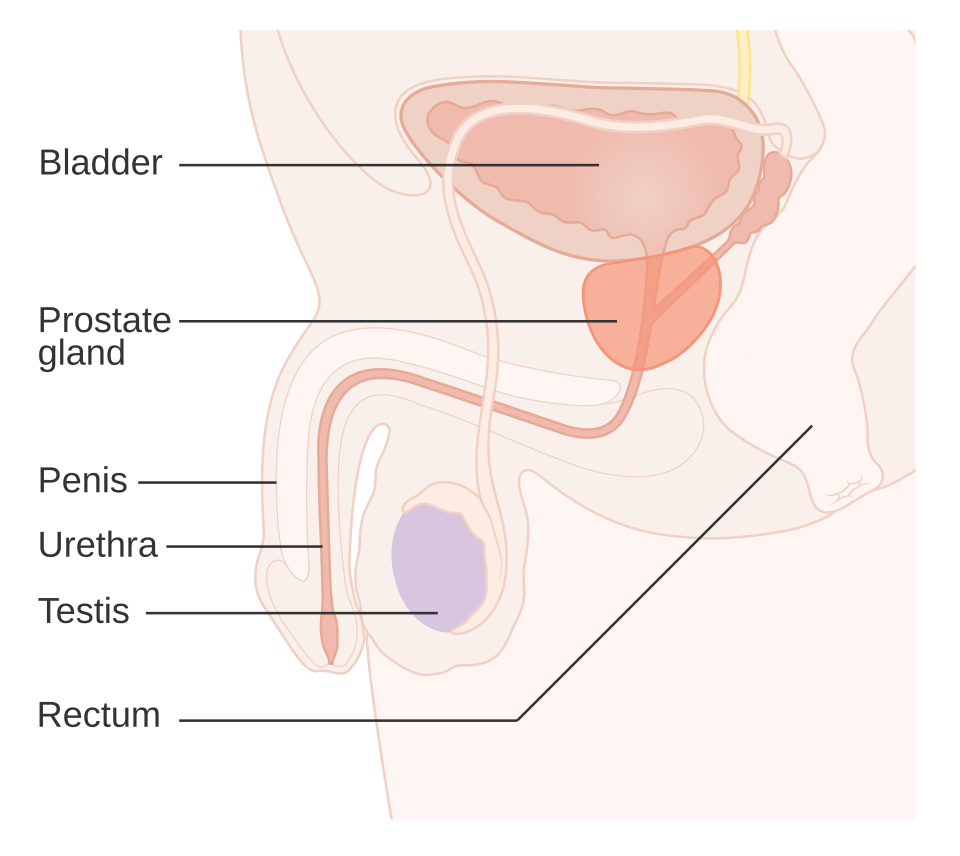
The prostate sits just below the bladder, in front of the rectum, and the urethra runs through its middle. The two cavernous nerves that trigger erections travel in thin “neurovascular bundles” along each side of the gland, and the seminal vesicles that produce most of the ejaculate are attached behind it. Any prostate cancer treatment aimed at the gland therefore reaches the nerves, blood vessels and glands that sex depends on.
Three different prostate cancer treatment mechanisms are involved. Surgery removes the prostate and seminal vesicles and can stretch, heat or cut the nerves. Radiation leaves the organs in place but damages small blood vessels and nerve fibers gradually, which is why its effects appear late. Hormone therapy acts on the whole body: it removes testosterone, the hormone that drives sexual desire and supports erectile tissue.
Source: National Cancer Institute — Sexual Health Issues in Men with Cancer; Cleveland Clinic — Maintaining Your Sex Life After Prostate Cancer
Prostate cancer treatment side effects on sexual function after surgery
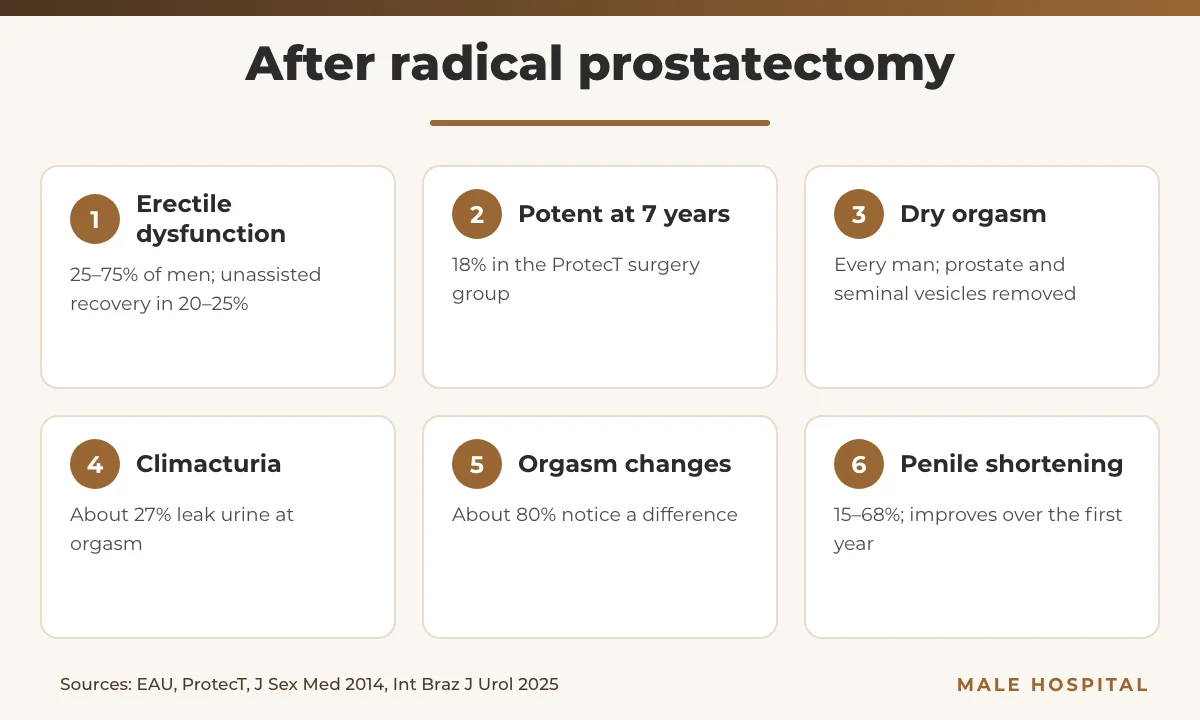
Radical prostatectomy is the prostate cancer treatment with the most immediate impact. The European Association of Urology (EAU) states that 25–75% of men experience post-operative erectile dysfunction and that unassisted recovery of erections occurs in only about 20–25% of men in most studies. Age, erectile function before surgery and the surgeon’s experience, which determines how well the nerve bundles are preserved, are the strongest predictors. Two randomized trials found only marginal improvements in erectile function with robot-assisted versus open surgery.
Recovery after this prostate cancer treatment, when it comes, is slow: the American Cancer Society explains that erections may take from a few months to two or more years to return. The month-by-month timeline and the evidence on penile rehabilitation are covered in our dedicated prostatectomy guide.
Source: EAU — Sexual and Reproductive Health Guidelines: Management of erectile dysfunction; American Cancer Society — Surgery for Prostate Cancer
Dry orgasm, climacturia and painful orgasm
Because the prostate and seminal vesicles are removed and the vas deferens is cut, every man has a “dry” orgasm after prostatectomy: the sensation remains but no semen comes out. A systematic review of 43 studies found that about 80% of men report some change in orgasm, that orgasm-associated urine leakage (climacturia) is experienced at least occasionally by 20–93% of men, and that painful orgasm affects 3–19%. A 2025 systematic review covering 5,208 patients put the overall prevalence of climacturia at about 27%.
Climacturia after prostate cancer treatment is usually manageable: emptying the bladder before sex, using a condom, pelvic floor muscle training and a variable-tension penile loop are the first steps, and a small sling can be added during penile implant surgery when leakage is persistent.
Source: Frey 2014, J Sex Med — Neglected side effects after radical prostatectomy: a systematic review; Ferrão 2025, Int Braz J Urol — The Prevalence of Climacturia in Patients after Radical Prostatectomy: A Systematic Review (PMC)
Penile shortening
Many men notice that the penis is shorter after surgical prostate cancer treatment. The same systematic review reports penile shortening in 15–68% of men; nerve sparing and early return of erections help preserve length, and the change tends to lessen over time. The EAU now gives a strong recommendation that men being treated for prostate cancer are told about sexual changes other than erectile dysfunction, including penile size changes, before treatment. A penile traction device has shown positive results in preserving length after prostatectomy compared with no treatment.
Source: Frey 2014, J Sex Med — Neglected side effects after radical prostatectomy; EAU — Management of erectile dysfunction
Radiation therapy: slow-onset erection and ejaculation changes
Radiation, the second main prostate cancer treatment, works the opposite way round. The American Cancer Society notes that erection problems after external beam radiation “usually don’t happen right away, but instead develop slowly over time,” whereas after surgery they appear immediately and may improve. Erection problems are often more common in the first few years after surgery than after radiation, but by 15 years the risk is about the same either way.
A meta-analysis of 105 publications and more than 26,000 men found that, using the SHIM questionnaire, 34% of men had erectile dysfunction one year after radiotherapy and 57% at 5.5 years. ED was common regardless of modality, and rates rose with every year of follow-up; the authors also note that men lost to follow-up after prostate cancer treatment may inflate the estimates. The EAU cites the same figures and adds that 26–55% of previously functioning men report ED five years after stereotactic radiotherapy. Limiting the dose to the penile bulb may reduce ED, particularly in younger men, and in the MIRAGE trial MRI-guided stereotactic radiotherapy produced significantly lower odds of a clinically relevant decline in sexual health than CT-guided treatment.
Source: Gaither 2017, J Sex Med — The Natural History of Erectile Dysfunction After Prostatic Radiotherapy: A Systematic Review and Meta-Analysis; EAU — Prostate Cancer Guidelines: Treatment
Brachytherapy and ejaculation
Radioactive seed implants (brachytherapy) leave the prostate in place, so most men keep ejaculating, but the semen changes. In a French study of 241 sexually active men, 81% still ejaculated after seed implantation, yet 85% of those reported reduced volume, with completely dry ejaculation in 19% of them; painful ejaculation rose from 13% before treatment to 30% afterward, and 10% could no longer reach orgasm. Some studies suggest ED rates may be lower after brachytherapy, while others find rates similar to external beam radiation or surgery; younger age and better function before treatment predict a better outcome. Blood in the semen for a few months and advice to use a condom for the first ejaculations are specific to this prostate cancer treatment.
Source: Huyghe 2009, Int J Radiat Oncol Biol Phys — Ejaculatory function after permanent 125I prostate brachytherapy; Prostate Cancer UK — Sex and relationships
Hormone therapy (ADT): desire, erections and body changes
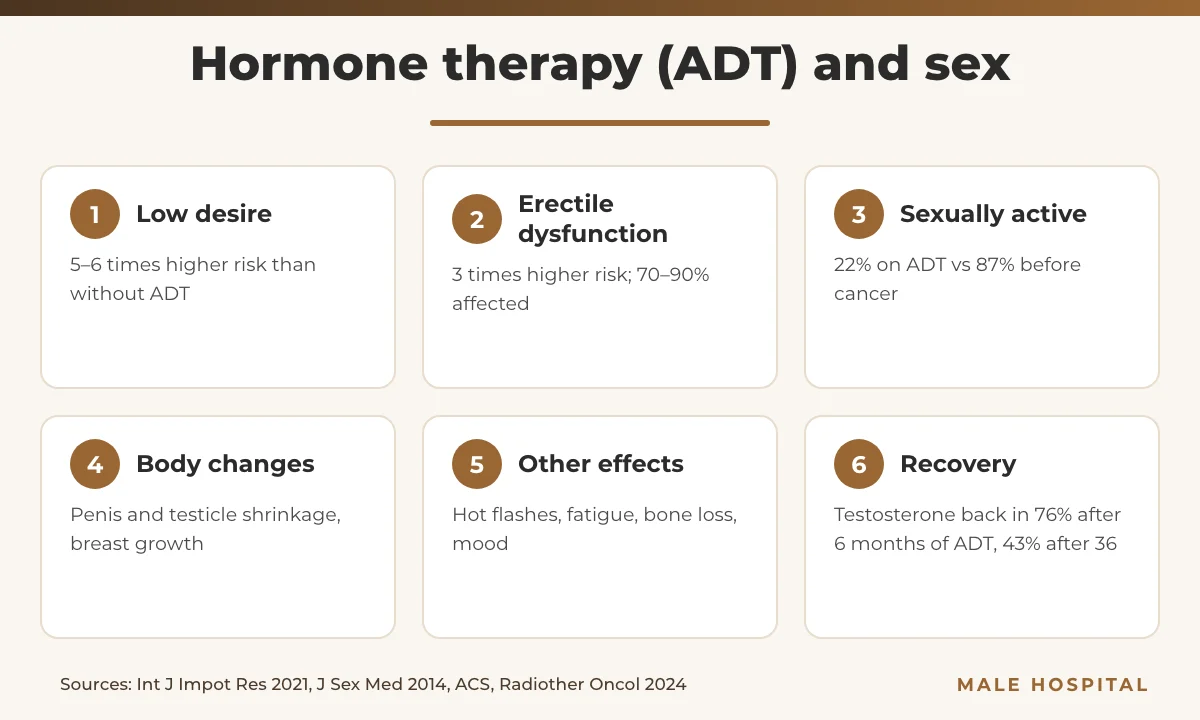
Androgen deprivation therapy removes the testosterone that prostate cancer feeds on, by surgical removal of the testicles or, far more often, by LHRH agonist or antagonist injections, sometimes with antiandrogen tablets. Men with unfavorable intermediate- or high-risk cancer often receive ADT together with radiotherapy, and the American Cancer Society notes that these men tend to have more sexual side effects than those having radiation alone. The National Cancer Institute lists loss of interest in sex, erectile dysfunction, hot flashes and loss of bone density among the effects, and says the risk increases the longer a man stays on this prostate cancer treatment.
What makes ADT different from the other prostate cancer treatments is that it removes desire, not only the erection. A 2021 critical review found that ADT increases the risk of reduced libido five- to sixfold and the risk of ED threefold, and that erectile tissue on ADT responds less well to PDE5 inhibitor tablets. In one study of 80 men with advanced cancer on ADT, 67% rated their current sexual desire as poor or absent (versus 9% before cancer) and only 22% had been sexually active in the previous month, compared with 87% before diagnosis. Rates of erectile dysfunction on ADT are estimated at 70–90%. Our guide to low libido in men explains how hormones and mood interact.
Source: Corona 2021, Int J Impot Res — Sexual function in men undergoing androgen deprivation therapy; Benedict 2014, J Sex Med — Sexual Bother in Men with Advanced Prostate Cancer Undergoing Androgen Deprivation Therapy (PMC); Donovan 2018, Psychooncology — Effect of Androgen Deprivation Therapy on Sexual Function and Bother (PMC)
Physical changes men are rarely warned about
The American Cancer Society lists shrinkage of the testicles and penis, breast tenderness and growth of breast tissue (gynecomastia), hot flashes, loss of muscle mass, weight gain, fatigue and mood changes among the possible effects of this prostate cancer treatment. Prostate Cancer UK adds that orgasms may become weaker or impossible and that the amount of semen falls. These changes affect body image and confidence, which is why counseling matters as much as medication on ADT.
Source: American Cancer Society — Hormone Therapy for Prostate Cancer; Prostate Cancer UK — Sex and relationships
Prostate cancer treatment side effects on sexual function compared
The best head-to-head data come from the UK ProtecT trial, which randomized 1,643 men with localized cancer to active monitoring, prostatectomy or radiotherapy with short-term hormones. Prostatectomy had the greatest negative effect on sexual function; radiotherapy’s effect peaked at six months and then partly recovered; function declined gradually with age in the monitoring group, and all three groups converged by year 12. Because prostate cancer deaths at 15 years were low (2.7%) whichever treatment was assigned, the choice of prostate cancer treatment is largely a trade-off between benefits and side effects.
| Effect | Surgery (prostatectomy) | Radiation (EBRT / seeds) | Hormone therapy (ADT) |
|---|---|---|---|
| Onset of erection problems | Immediate; may improve over 1–2+ years | Delayed; develops over months to years | Soon after testosterone falls |
| How common is ED | 25–75% (EAU); 18% potent at 7 years (ProtecT) | 34% at 1 year, 57% at 5.5 years (meta-analysis) | Estimated 70–90%; threefold higher risk |
| Sexual desire | Usually preserved (may fall with mood) | Usually preserved unless ADT is added | Markedly reduced in most men |
| Ejaculation / orgasm | Always dry; climacturia in ~27%; pain in 3–19% | Volume reduced or dry over time; painful ejaculation possible | Less semen; weaker or absent orgasm |
| Penis / body changes | Shortening in 15–68% | Fibrosis of surrounding tissue | Penis and testicle shrinkage, breast growth, hot flashes |
| Reversibility | Partial nerve recovery up to 2 years | Late damage tends to be progressive | Testosterone often recovers after short courses; less so after long courses |
Source: Donovan 2023, NEJM Evidence — Patient-Reported Outcomes 12 Years after Localized Prostate Cancer Treatment; Donovan 2016, N Engl J Med — Patient-Reported Outcomes after Monitoring, Surgery, or Radiotherapy for Prostate Cancer; Hamdy 2023, N Engl J Med — Fifteen-Year Outcomes after Monitoring, Surgery, or Radiotherapy for Prostate Cancer
How long the sexual side effects last
After surgical prostate cancer treatment, the Cleveland Clinic notes that erections may keep improving for up to two years but may not fully return to normal; penile length loss is most noticeable in the first weeks and may improve over the following year. After radiation, the NHS explains that side effects can appear months or even years after treatment starts, and that erection difficulty and loss of interest in sex tend to improve with time, with pain on ejaculation usually passing within a few weeks of finishing treatment. The Cleveland Clinic estimates that about half of men have some degree of ED five years after radiation and that most men return to or near their baseline, although this can take time.
After hormone therapy, recovery depends mostly on how long the prostate cancer treatment lasted. In two randomized trials of radiotherapy with 0, 6, 18 or 36 months of ADT, normal testosterone returned in 87%, 76%, 55% and 43% of men respectively, and the median time to recovery rose from about 1.6 years after 6 months of ADT to 5 years after 36 months; older age and longer treatment predicted poorer recovery. The National Cancer Institute confirms that most sexual and emotional effects eventually fade once hormone therapy stops, but that testosterone may not fully recover in older men and after long courses.
Source: Nabid 2024, Radiother Oncol — Testosterone recovery after androgen deprivation therapy in localised prostate cancer: long-term data from two randomised trials; NHS — Radiotherapy: Side effects; Cleveland Clinic — How To Manage the Possible Side Effects of Radiation for Prostate Cancer
Treating sexual side effects after prostate cancer
The same ladder of ED treatments applies whichever prostate cancer treatment you had, with two adjustments. First, PDE5 inhibitor tablets (sildenafil, tadalafil) need working nerves and adequate testosterone, so they are weaker after non-nerve-sparing surgery and during ADT. Second, the EAU advises starting pro-erectile treatment at the earliest opportunity after pelvic surgery, while being honest that no rehabilitation regimen has been shown to increase the chance of spontaneous recovery. Our page on erectile dysfunction treatment walks through each option.
- Tablets: first line for most men after prostate cancer treatment; the American Cancer Society notes they will not work if both nerve bundles that control erections were damaged or removed.
- Vacuum erection device: drug-free and nerve-independent; the EAU reports excellent results with early use after prostatectomy, especially combined with tablets. See our guide to the vacuum erection device.
- Penile injections: alprostadil or combination injections produce an erection within 10–15 minutes regardless of nerve damage and are a second-line option; details are in our article on penile injections for erectile dysfunction.
- Penile implant: the EAU gives a strong recommendation to implant a prosthesis when other treatments fail or when the patient prefers it; the Cleveland Clinic reports satisfaction rates around 90%. A sling for climacturia can be placed in the same operation.
- Counseling and couples work: on ADT, specialists advise encouraging non-penetrative intimacy when full erections are not possible and involving partners in recovery; sexual bother is not simply a function of how well the erection works.
Men on ADT also need realistic expectations: most who tried erectile aids in the advanced-cancer study stopped within a year, because the aids restore the erection but not the desire. You can discuss which option fits your situation in a confidential consultation with our urologist-andrologist via WhatsApp, including whether a penile prosthesis is appropriate after prostate cancer treatment.
Source: EAU — Management of erectile dysfunction; Cleveland Clinic — Maintaining Your Sex Life After Prostate Cancer; Benedict 2014, J Sex Med — Sexual Bother in Men on ADT (PMC)
Fertility and sperm banking before treatment
All three prostate cancer treatments affect the ability to father a child through intercourse. After prostatectomy the testicles still make sperm, but it cannot leave the body, so natural conception is no longer possible. Pelvic radiation and brachytherapy can affect both sexual function and fertility, and hormone therapy lowers sperm count. The National Cancer Institute describes sperm banking as the most common fertility preservation method for men; semen is frozen before treatment and can be stored indefinitely. If children are a possibility, raise this with your oncologist and a fertility specialist before the first treatment session rather than afterward.
Source: National Cancer Institute — Fertility Issues in Boys and Men with Cancer; NHS — Prostate cancer: Treatment
When to see a doctor
Sexual changes after prostate cancer treatment are expected, but some symptoms need prompt assessment. Contact your urologist or oncologist if you notice:
- An erection lasting more than 3 to 4 hours after using injections or tablets (priapism): the NHS says to call emergency services or go to the emergency department.
- Blood in the semen that continues beyond a few months after brachytherapy, or any blood in the urine.
- Pain on ejaculation that does not settle within a few weeks of finishing radiotherapy, or new pain, swelling or fever after any procedure.
- A new curve, lump or shortening of the penis that keeps progressing, which may need early traction or Peyronie’s assessment.
- Hot flashes, breast swelling, bone pain or low mood on hormone therapy that interfere with daily life; these deserve their own management plan.
- Loss of desire or erections that is distressing you or your partner at any stage; the NHS confirms that tablets, pumps, injections and implants can be provided after prostate cancer treatment.
Source: NHS — Priapism; NHS — Radiotherapy: Side effects; Prostate Cancer UK — Sex and relationships
FAQs about prostate cancer treatment and sexual function
Which prostate cancer treatment has the fewest sexual side effects?
For localized cancer, active monitoring avoids prostate cancer treatment effects unless management changes. Among active treatments, radiotherapy preserved erections better than surgery for the first several years in ProtecT (27% versus 18% potent at 7 years), but the groups converged by 12 years, and adding hormone therapy to radiation increases sexual side effects.
Why do erection problems start years after radiation?
Radiation injures small blood vessels and nerve fibers gradually, and the surrounding tissue slowly becomes fibrous in the years after prostate cancer treatment. That is why the American Cancer Society describes radiation-related erection problems as developing slowly over time, unlike surgery, and why pooled studies show ED rising from 34% at one year to 57% at five and a half years.
Source: Gaither 2017, J Sex Med — The Natural History of Erectile Dysfunction After Prostatic Radiotherapy
Does hormone therapy for prostate cancer cause permanent erectile dysfunction?
Not always. Most sexual effects of ADT fade once this prostate cancer treatment stops and testosterone returns, but recovery is slower and less likely after long courses and in older men: after 36 months of ADT only 43% of men regained normal testosterone, with a median wait of five years. Men on lifelong ADT for advanced cancer should expect the effects to persist.
Source: Nabid 2024, Radiother Oncol — Testosterone recovery after androgen deprivation therapy; National Cancer Institute — Hormone Therapy for Prostate Cancer Fact Sheet
Can you still have an orgasm after prostate cancer treatment?
Yes. Orgasm after prostate cancer treatment does not depend on the prostate or on an erection, so most men can still climax after surgery, radiation or seed therapy, although it is usually dry and may feel less intense. After prostatectomy, about 80% of men notice some change in orgasm, and some leak a little urine at climax, which can be treated.
Do Viagra or Cialis work after radiotherapy?
Often, yes; the Cleveland Clinic lists oral medicines as the first option after radiation. What tablets cannot do is prevent ED from developing after prostate cancer treatment: in the RTOG 0831 trial of 242 men with intact erections, daily tadalafil during and after radiotherapy made no difference to spontaneous erections at one year (72% versus 71% with placebo) or to partner satisfaction.
Source: Pisansky 2014, JAMA — Tadalafil for prevention of erectile dysfunction after radiotherapy for prostate cancer; Cleveland Clinic — Side Effects of Radiation for Prostate Cancer
Does the penis get smaller after prostate cancer treatment?
It can. Penile shortening is reported in 15–68% of men after prostatectomy and tends to improve during the first year, especially when nerves were spared and erections return early. On hormone therapy the penis and testicles can shrink because testosterone is low. Early use of a vacuum device or a traction device may help preserve length after prostate cancer treatment.
Source: Frey 2014, J Sex Med — Neglected side effects after radical prostatectomy; American Cancer Society — Hormone Therapy for Prostate Cancer
Is brachytherapy better than external beam radiation for sexual function?
The evidence is mixed. Some studies report lower ED rates after seed implants, while others find rates similar to external beam radiation or surgery, and the large meta-analysis found ED common whichever radiation modality was used. Brachytherapy does preserve ejaculation in most men, though usually with less volume and sometimes with pain.
Source: American Cancer Society — Radiation Therapy for Prostate Cancer; Huyghe 2009 — Ejaculatory function after permanent 125I prostate brachytherapy
Can I father a child after prostate cancer treatment?
Not through intercourse after prostatectomy, because sperm can no longer leave the body, and natural conception is also unlikely after radiation or hormone therapy. Banking sperm before prostate cancer treatment keeps the option of assisted reproduction open; frozen sperm can be stored indefinitely.
Source: National Cancer Institute — Fertility Issues in Boys and Men with Cancer
Medically reviewed by Assoc. Prof. Dr. Zülfü Sertkaya, urologist and andrologist (FEBU), Istanbul. Last reviewed: November 2026.
This article is for general information and does not replace an individual consultation with a qualified doctor.
- American Cancer Society — Radiation Therapy for Prostate Cancer
- American Cancer Society — Surgery for Prostate Cancer
- American Cancer Society — Hormone Therapy for Prostate Cancer
- National Cancer Institute — Hormone Therapy for Prostate Cancer Fact Sheet
- National Cancer Institute — Sexual Health Issues in Men with Cancer
- National Cancer Institute — Fertility Issues in Boys and Men with Cancer
- EAU — Sexual and Reproductive Health Guidelines: Management of erectile dysfunction
- EAU — Prostate Cancer Guidelines: Treatment
- NHS — Prostate cancer: Treatment
- NHS — Radiotherapy: Side effects
- NHS — Priapism
- Cleveland Clinic — Maintaining Your Sex Life After Prostate Cancer
- Cleveland Clinic — How To Manage the Possible Side Effects of Radiation for Prostate Cancer
- Prostate Cancer UK — Sex and relationships
- Donovan JL et al., N Engl J Med 2016 (PubMed) — Patient-Reported Outcomes after Monitoring, Surgery, or Radiotherapy for Prostate Cancer (ProtecT)
- Donovan JL et al., NEJM Evidence 2023 (PubMed) — Patient-Reported Outcomes 12 Years after Localized Prostate Cancer Treatment
- Hamdy FC et al., N Engl J Med 2023 (PubMed) — Fifteen-Year Outcomes after Monitoring, Surgery, or Radiotherapy for Prostate Cancer
- Gaither TW et al., J Sex Med 2017 (PubMed) — The Natural History of Erectile Dysfunction After Prostatic Radiotherapy: A Systematic Review and Meta-Analysis
- Pisansky TM et al., JAMA 2014 (PubMed) — Tadalafil for prevention of erectile dysfunction after radiotherapy for prostate cancer: RTOG 0831 randomized clinical trial
- Huyghe E et al., Int J Radiat Oncol Biol Phys 2009 (PubMed) — Ejaculatory function after permanent 125I prostate brachytherapy for localized prostate cancer
- Frey AU et al., J Sex Med 2014 (PubMed) — Neglected side effects after radical prostatectomy: a systematic review
- Ferrão JV et al., Int Braz J Urol 2025 (PMC) — The Prevalence of Climacturia in Patients after Radical Prostatectomy: A Systematic Review
- Clavell-Hernández J et al., Sex Med Rev 2018 (PubMed) — Orgasmic Dysfunction Following Radical Prostatectomy: Review of Current Literature
- Corona G et al., Int J Impot Res 2021 (PubMed) — Sexual function in men undergoing androgen deprivation therapy
- Benedict C et al., J Sex Med 2014 (PMC) — Sexual Bother in Men with Advanced Prostate Cancer Undergoing Androgen Deprivation Therapy
- Donovan KA et al., Psychooncology 2018 (PMC) — Effect of Androgen Deprivation Therapy on Sexual Function and Bother in Men with Prostate Cancer: A Controlled Comparison
- Nabid A et al., Radiother Oncol 2024 (PubMed) — Testosterone recovery after androgen deprivation therapy in localised prostate cancer: Long-term data from two randomised trials