Sex after 50 is normal, common and, for many couples, more satisfying than it was at 30. Large US population surveys found that 84% of men aged 57–64 and 67% of men aged 65–74 were sexually active in the past year, and most of those in good health kept a sex life they rated as good. What changes is the mechanics: erections take longer, need more direct stimulation and recover more slowly, testosterone drifts down, and illnesses and medicines start to interfere. Erectile dysfunction becomes more common with age, but it is not a normal part of aging and it is treatable at any age; our erectile dysfunction treatment page explains the full range of options.
Sources: N Engl J Med (PMC) — A Study of Sexuality and Health among Older Adults in the United States (Lindau et al., 2007); NIDDK — Definition & Facts for Erectile Dysfunction
- Most men stay sexually active well past 50, and sex after 50 is the norm rather than the exception: 84% at 57–64, 67% at 65–74 and 39% at 75–85 in a US national survey.
- Normal aging slows erections and lengthens the recovery time between orgasms; it changes sex after 50 but does not switch it off. Nine out of ten cases of persistent erectile dysfunction have a medical cause, not a psychological one.
- New erectile trouble after 50 is an early warning sign for heart disease, typically appearing two to five years before a cardiac event; it deserves a cardiovascular check, not just a pill.
- Men in very good or excellent health at 55 gain five to seven extra years of sexually active life compared with men in poor or fair health.
- Only 38% of men had discussed sex after 50 with a doctor, yet erection problems, low desire, medication side effects and pain can almost always be improved.
- What changes in sex after 50: the normal physiology
- How common is sex after 50? What the surveys show
- Erections after 50: slower, not gone
- Why erectile dysfunction after 50 is a heart warning
- Testosterone, desire and sex after 50
- Medicines and health conditions that get in the way
- How to have better sex after 50: what the evidence supports
- Safe sex after 50: infections do not retire
- When to see a doctor
- FAQs about sex after 50
What changes in sex after 50: the normal physiology
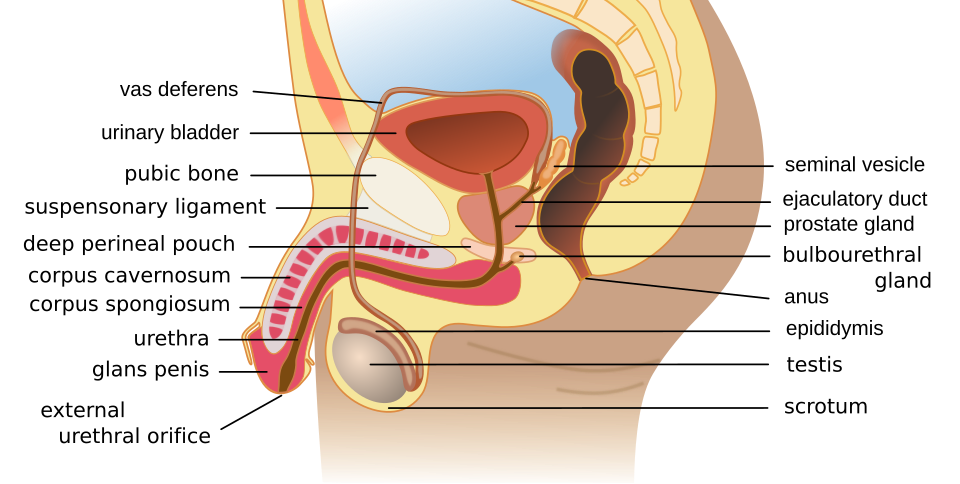
Male reproductive aging is gradual, which is why sex after 50 changes in degree rather than in kind. Unlike the fairly abrupt hormonal change of menopause in women, a man’s testosterone falls slowly over decades, testicular tissue mass decreases and sperm production slows but does not stop. Lower testosterone can mean a lower sex drive and a slower, less intense sexual response, but the pattern is a general slowing rather than a loss of function.
Three practical changes matter most for sex after 50. Erections happen less often and usually need direct touch rather than a thought or a glance. The recovery period after orgasm lengthens, so repeated ejaculations in one session become uncommon. And the prostate enlarges with age (benign prostatic hyperplasia affects about half of men), which can slow both urination and ejaculation. The volume of semen usually stays about the same, although it contains fewer living sperm.
Source: MedlinePlus — Aging changes in the male reproductive system
None of this stops a man from enjoying sex after 50; it means sex now rewards time, foreplay and communication. The US National Institute on Aging notes that many older couples find greater satisfaction in their sex lives than when they were younger, with fewer distractions, more privacy and no worry about pregnancy.
Source: National Institute on Aging — Sexuality and Intimacy in Older Adults
How common is sex after 50? What the surveys show
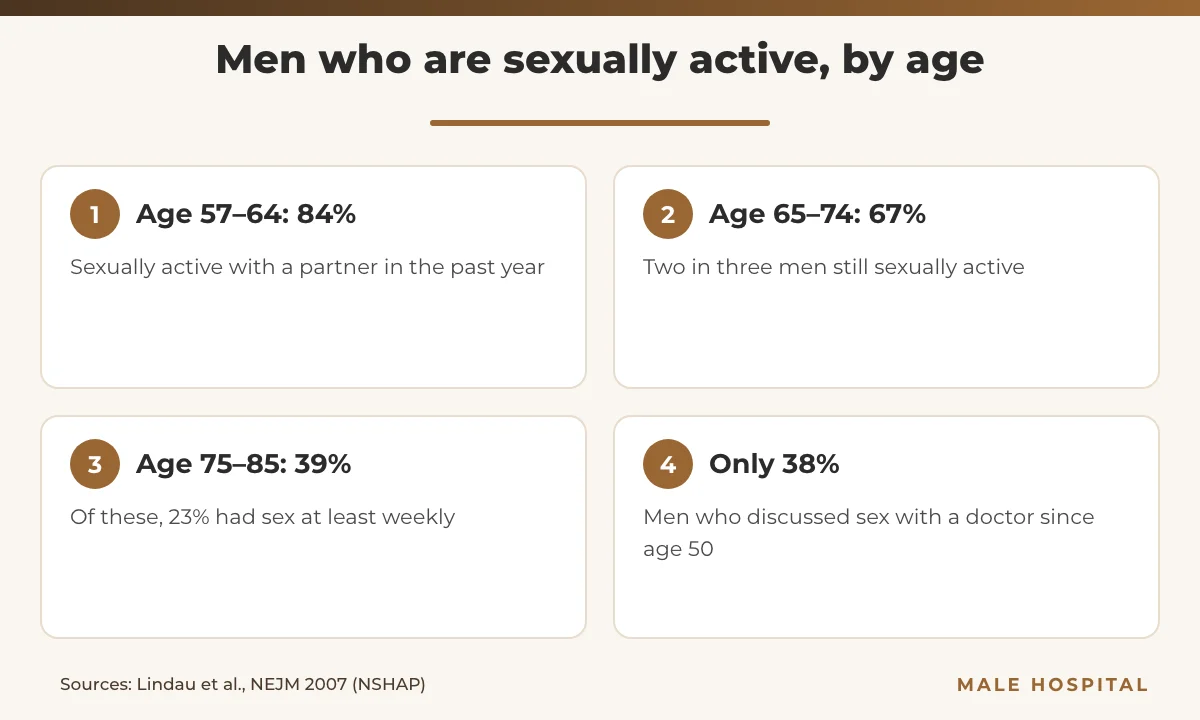
The best data on sex after 50 come from the National Social Life, Health, and Aging Project, a representative US survey of 3,005 adults aged 57 to 85 published in the New England Journal of Medicine. The share of men who reported sexual activity with a partner in the previous 12 months was 84% at 57–64, 67% at 65–74 and 39% at 75–85. Even in the oldest group, 54% of sexually active people had sex two to three times a month or more, and 23% had sex at least weekly.
Problems with sex after 50 were common but rarely discussed. About half of sexually active respondents reported at least one bothersome problem; in men the most common was erectile difficulty (37%). Only 38% of men had discussed sex with a doctor since age 50, and men in fair or poor health were far less likely to be sexually active.
A follow-up analysis in the BMJ turned these figures into “sexually active life expectancy.” At age 55 a man could expect roughly 15 more years of sexually active life (10.6 for a woman), and men in very good or excellent health gained five to seven extra years over peers in poor or fair health. Of men aged 75–85 who were still active, 71% rated their sex life as good. Health, not the calendar, is the strongest predictor of sex after 50.
Erections after 50: slower, not gone
Erectile dysfunction (ED) is the inability to get or keep an erection firm enough for sex. The Massachusetts Male Aging Study, a community sample of men aged 40 to 70, found that 52% had some degree of ED, and that complete ED rose from 5% of 40-year-olds to 15% of 70-year-olds. Age was the variable most strongly linked to ED, but heart disease, high blood pressure, diabetes, certain medicines, depression and anger scores were all independently associated with it.
Needing more stimulation, taking longer to get hard and needing a day or two between sessions are normal features of sex after 50. Regularly failing to get an erection firm enough for penetration, or losing it before you finish, is ED. The NIDDK estimates that about 40% of men are affected at 40 and 70% by age 70, yet states plainly that “ED is not a routine part of aging.” Most causes can be found and treated.
Source: NIDDK — Definition & Facts for Erectile Dysfunction
The NHS adds that most men occasionally fail to get or keep an erection because of stress, tiredness or alcohol, which is nothing to worry about; it is the repeated pattern that needs a GP visit. Depending on the cause, you may still get erections at other times, such as on waking, which is a useful clue for your doctor.
Source: NHS — Erectile dysfunction (impotence)
Why erectile dysfunction after 50 is a heart warning
The penile arteries are narrower than the coronary arteries, so they clog first. The European Association of Urology guideline describes ED as a symptom rather than a disease and says it “should be considered a precursor of cardiovascular disease,” with more severe and longer-standing ED carrying greater risk. Men presenting with ED should have a cardiovascular risk assessment, and the guideline recommends starting lifestyle changes and risk-factor treatment before or alongside any ED treatment.
Source: EAU — Guidelines on Sexual and Reproductive Health: Management of Erectile Dysfunction
The Princeton III consensus on ED and heart disease quantified the link. A meta-analysis of 12 prospective studies in 36,744 men found that ED raised the relative risk of cardiovascular events by 48% and of coronary heart disease by 46%, and the panel reported a window of two to five years between the onset of ED and a coronary event. That window is time to check blood pressure, cholesterol, blood sugar and weight, and act on them. The same consensus reassures most men about sex after 50 itself: sexual activity in a long-term relationship uses about 3 METs, equivalent to walking one mile in 20 minutes or briskly climbing two flights of stairs. Men with controlled blood pressure, stable mild heart disease or a successful stent or bypass can resume sex without further testing; men with unstable angina, uncontrolled hypertension or a heart attack within two weeks should wait until stabilised.
Our article on erectile dysfunction and heart disease covers the arteries, the drugs and the tests in more depth.
Testosterone, desire and sex after 50
Testosterone falls gradually with age, and low levels can lower desire and energy. But “low testosterone” is a diagnosis, not an assumption. The Endocrine Society guideline diagnoses hypogonadism only in men with both symptoms and consistently low testosterone on at least two early-morning fasting blood tests. It recommends against screening the general male population and against routinely treating every man aged 65 or older who simply has a low number.
When low testosterone is confirmed and symptoms fit, treatment can be considered after a frank discussion of risks. It is avoided in men with prostate or breast cancer, a PSA above 4 ng/mL without urological assessment, a raised hematocrit, untreated severe sleep apnea, uncontrolled heart failure, or a heart attack or stroke in the past six months, and it requires follow-up blood counts and PSA checks.
Source: Endocrine Society — Testosterone Therapy for Hypogonadism Guideline
The EAU adds that testosterone therapy may be considered for men with low or low-normal levels who also have problems with desire or erections, and that in hypogonadal men who do not respond to erection pills, correcting testosterone can restore the response. If fatigue, low mood and loss of interest in sex after 50 sound familiar, our guides to low testosterone symptoms and male menopause explain what is real, what is myth and which tests to ask for.
Source: EAU — Guidelines on Sexual and Reproductive Health: Management of Erectile Dysfunction
Medicines and health conditions that get in the way
The medicine cabinet and the diagnosis list both grow with age, and both can affect sex after 50. The table summarises what most often interferes and what usually helps. Never stop a prescribed medicine on your own; ask whether a switch or dose change is possible.
| Condition or medicine | How it affects sex after 50 | What usually helps |
|---|---|---|
| Diabetes | Damages small vessels and nerves; one of the commonest causes of ED | Tight glucose control, PDE5 inhibitors; injections or an implant if pills fail |
| Heart disease and high blood pressure | Narrowed arteries slow arousal and weaken erections; fear after a heart attack | Treat risk factors; most stable patients can safely have sex; ask about drug choice |
| Blood pressure pills, diuretics, antidepressants, antihistamines, sedatives | ED, delayed ejaculation, reduced desire or difficulty with orgasm | Ask the prescriber about an alternative drug or a lower dose |
| Enlarged prostate and its medicines | Slower ejaculation; some drugs cause ED or dry orgasm | Review of the drug class; standard ED treatment |
| Prostate surgery or radiotherapy | Nerve injury can cause ED and leakage of urine | Pills, vacuum device, injections, implant |
| Arthritis and chronic pain | Joint pain and fatigue make sex uncomfortable or unappealing | Change positions and timing, warm bath beforehand, treat the pain |
| Urinary incontinence | Pressure on the belly during sex can cause leakage | Empty the bladder before and after sex; bladder training; medical treatment |
| Depression | Loss of interest in sex may be a symptom; some antidepressants add ED | Treat the depression; choose an antidepressant with fewer sexual effects |
| Alcohol and smoking | Alcohol causes erection problems; smoking damages vessels | Keep alcohol under 14 units a week; quitting smoking may improve mild ED within months |
Sources: National Institute on Aging — Sexuality and Intimacy in Older Adults; NIDDK — Symptoms & Causes of Erectile Dysfunction; Cleveland Clinic — Erectile Dysfunction
Prostate cancer surgery is a common cause of sudden ED in men over 50, and erections can take many months to recover; our guide to erectile dysfunction after prostatectomy walks through that timeline.
How to have better sex after 50: what the evidence supports
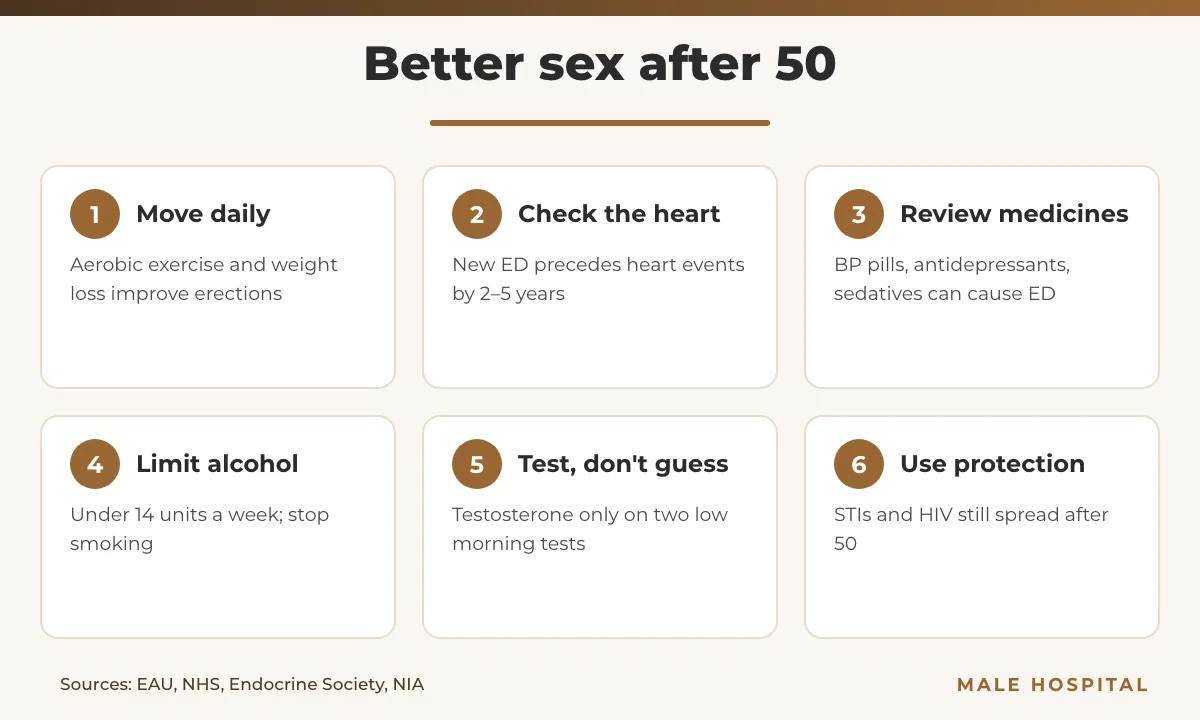
Treat your arteries like your erections depend on them
They do, and so does sex after 50. The EAU guideline notes that regular aerobic exercise, weight loss and treatment of cardiovascular risk factors can improve sexual function, and that statins have been linked to better erections in meta-analyses. The NHS list is the same: lose excess weight, stop smoking, eat well, exercise daily, keep alcohol under 14 units a week and reduce stress. Cycling more than three hours a week can contribute to ED, so try a break.
Sources: EAU — Guidelines on Sexual and Reproductive Health: Management of Erectile Dysfunction; NHS — Erectile dysfunction (impotence)
Use the treatments that work, in the order guidelines recommend
PDE5 inhibitors (sildenafil, tadalafil, vardenafil, avanafil) are first-line therapy with a strong EAU recommendation and no clear difference in efficacy between them; the guideline suggests sildenafil 50 mg when effect matters most and tadalafil 10 mg when tolerability does. They must never be combined with nitrates, but can generally be taken with blood pressure medicines and alpha-blockers. If pills are insufficient, penile injections are an effective second line, and a vacuum erection device is the drug-free option the EAU suggests for older men with infrequent intercourse and other illnesses. For men whose ED does not respond, a penile prosthesis has patient satisfaction rates above 90% in the series the guideline cites, with infection rates of 2–3%.
Source: EAU — Guidelines on Sexual and Reproductive Health: Management of Erectile Dysfunction
Redefine “sex” with your partner
Good sex after 50 rarely looks like a performance. The National Institute on Aging advises talking openly with your partner about the changes you are both experiencing, not blaming yourself or them, taking more time, and considering a therapist trained in sexual problems. If a partner seems less interested, do not assume it is about you; pain, dryness, fatigue or a medicine may be the reason, and most can be fixed. Be wary of supplements promising to cure ED: they may have dangerous side effects or interact with prescription medicines.
Source: National Institute on Aging — Sexuality and Intimacy in Older Adults
The NHS also warns against buying ED medicines online, where many sites sell fake products with variable ingredients; see a doctor first and use only a registered pharmacy.
Source: NHS — Erectile dysfunction (impotence)
Safe sex after 50: infections do not retire
Safe sex after 50 matters because age does not protect against sexually transmitted infections. Older adults who are sexually active remain at risk of syphilis, gonorrhea, chlamydia, genital herpes, hepatitis B, genital warts, trichomoniasis and HIV, and the number of older people living with HIV is growing. New relationships after divorce or widowhood often mean new partners at a time when condoms feel irrelevant because pregnancy is no longer a concern. Use a condom for vaginal or anal sex with any partner whose status you do not know, use a barrier for oral sex, and ask for STI testing at your regular check-ups. You are never too old to be at risk.
Source: National Institute on Aging — Sexuality and Intimacy in Older Adults
When to see a doctor
Book an appointment with a urologist or andrologist if sex after 50 is being affected by any of the following:
- Erections are regularly too soft or too brief for sex for more than a few months. Persistent ED is usually medical and may be the first sign of vascular disease or diabetes.
- Erectile trouble appeared alongside chest pain, breathlessness on exertion or leg pain on walking; they may share one cause.
- Desire has disappeared along with energy, mood and muscle, which may point to low testosterone, depression or a thyroid problem.
- A new medicine coincided with the start of the problem.
- The penis has developed a bend, a lump or pain during erection, which may be Peyronie’s disease and is easier to treat early.
- Sex has become painful for either partner, or urinary leakage or prostate symptoms are interfering.
Seek emergency care if an erection lasts longer than two to four hours after an ED medicine or injection; untreated priapism can permanently damage the penis. Otherwise the outlook for sex after 50 is good: ED is a very treatable condition, even when the underlying cause cannot be cured.
Sources: Cleveland Clinic — Erectile Dysfunction; National Institute on Aging — Sexuality and Intimacy in Older Adults
If you would rather talk it through privately before deciding anything, you can message our urologist-andrologist on WhatsApp for a confidential consultation, or read about the options on our erectile dysfunction treatment page.
FAQs about sex after 50
Is it normal for a man over 50 to need more stimulation to get an erection?
Yes. Sex after 50 is shaped by a general slowing rather than a loss of function: erections occur less often, need direct touch and take longer, and recovery between orgasms lengthens. Regularly failing to get an erection firm enough for sex is not expected and should be assessed.
Source: MedlinePlus — Aging changes in the male reproductive system
How often do men over 50 have sex?
In the US national survey of adults aged 57 to 85, 84% of men aged 57–64 and 67% of men aged 65–74 had been sexually active in the past year. Among sexually active people aged 75–85, 54% had sex at least two to three times a month and 23% weekly or more. No frequency of sex after 50 is “required.”
Is sex after 50 safe if I have heart disease?
For most men, yes, sex after 50 remains safe with heart disease. Sex in a long-term relationship uses about 3 METs, like walking a mile in 20 minutes. Men with controlled blood pressure, stable mild heart disease or a successful stent or bypass are low risk. Men with unstable angina, uncontrolled hypertension, severe heart failure or a heart attack within two weeks should wait and be assessed, often with an exercise test.
Source: Mayo Clin Proc (PMC) — The Princeton III Consensus Recommendations (Nehra et al., 2012)
Does every man over 50 need testosterone?
No. Testosterone is not a routine prescription for sex after 50: guidelines advise against screening all men and against routinely treating men over 65 just because a level is low. Treatment is for men with symptoms plus consistently low testosterone on two morning blood tests, after discussing the risks, and it is avoided in men with prostate cancer, a high PSA, a raised hematocrit, untreated severe sleep apnea or a recent heart attack or stroke.
Source: Endocrine Society — Testosterone Therapy for Hypogonadism Guideline
Can my blood pressure medicine be causing my erection problems?
It can. Blood pressure medicines and diuretics are among the most common drug causes of ED, alongside antidepressants, antihistamines, sedatives and some painkillers. Do not stop treatment on your own; ask whether a different class or lower dose is possible, since some newer cardiovascular drugs are neutral or even helpful for erections.
Sources: NIDDK — Symptoms & Causes of Erectile Dysfunction; EAU — Management of Erectile Dysfunction
Do men over 50 still need condoms?
With a new partner or one whose status you do not know, yes: safe sex after 50 still means condoms. Age does not protect against syphilis, gonorrhea, chlamydia, herpes, hepatitis B or HIV, and the number of older people living with HIV is rising. Use a condom for vaginal or anal sex and a barrier for oral sex, and ask for STI testing at check-ups.
Source: National Institute on Aging — Sexuality and Intimacy in Older Adults
Why does ED matter if I am not bothered by it?
Because it may be the first visible sign of narrowing arteries, diabetes or nerve damage. ED typically appears two to five years before a coronary event and raises the relative risk of cardiovascular events by about 48%. Even if you choose not to treat the erection problem, checking blood pressure, cholesterol and blood sugar after new ED can protect your heart.
Source: Mayo Clin Proc (PMC) — The Princeton III Consensus Recommendations (Nehra et al., 2012)
Medically reviewed by Assoc. Prof. Dr. Zülfü Sertkaya, urologist and andrologist (FEBU), Istanbul. Last reviewed: November 2026.
This article is for general information and does not replace an individual consultation with a qualified doctor.
- N Engl J Med (PMC) — A Study of Sexuality and Health among Older Adults in the United States (Lindau et al., 2007)
- BMJ (PMC) — Sex, health, and years of sexually active life gained due to good health (Lindau & Gavrilova, 2010)
- J Urol (PubMed) — Impotence and its medical and psychosocial correlates: results of the Massachusetts Male Aging Study (Feldman et al., 1994)
- Mayo Clin Proc (PMC) — The Princeton III Consensus Recommendations for the Management of Erectile Dysfunction and Cardiovascular Disease (Nehra et al., 2012)
- EAU — Guidelines on Sexual and Reproductive Health: Management of Erectile Dysfunction
- Endocrine Society — Testosterone Therapy for Hypogonadism Guideline
- MedlinePlus — Aging changes in the male reproductive system
- National Institute on Aging — Sexuality and Intimacy in Older Adults
- NIDDK — Definition & Facts for Erectile Dysfunction
- NIDDK — Symptoms & Causes of Erectile Dysfunction
- NHS — Erectile dysfunction (impotence)
- Cleveland Clinic — Erectile Dysfunction