Fordyce spots on penis are tiny yellowish-white bumps, usually 1–3 mm wide, caused by normal oil (sebaceous) glands that sit close to the skin surface without a hair. They are harmless, not contagious and not a sexually transmitted infection, and most adults have at least a few on the shaft, scrotum or foreskin. No treatment is needed, although removal is possible for cosmetic reasons.
Source: DermNet — Fordyce spots; Cleveland Clinic — Fordyce Spots
- Fordyce spots are visible sebaceous glands without hair follicles; they are a normal variant found in roughly 70–80% of adults on the lips, cheeks or genitals.
- Fordyce spots on penis skin appear as pale, slightly raised 1–3 mm dots on the shaft, foreskin or glans, often in crops of 50 or more, and show up best when the skin is stretched.
- Fordyce spots on penis are not an STI, not contagious and not linked to poor hygiene; they usually become visible around puberty.
- Genital warts, molluscum, early syphilis and pearly penile papules can look similar, so new bumps should be checked once by a doctor.
- No treatment of Fordyce spots on penis is required. Micro-punch surgery and CO2 laser have cleared spots in small studies, but there are no large trials, and squeezing or home remedies do not remove them.
- What are Fordyce spots on penis?
- What Fordyce spots on the penis look like
- Why Fordyce spots appear: causes and triggers
- Are Fordyce spots on penis contagious or an STI?
- Fordyce spots vs pearly penile papules, warts and other bumps
- How doctors diagnose Fordyce spots
- Fordyce spots on penis treatment: what the evidence says
- Living with Fordyce spots: sex, hygiene and what not to do
- When to see a doctor
- FAQs about Fordyce spots on penis
What are Fordyce spots on penis?
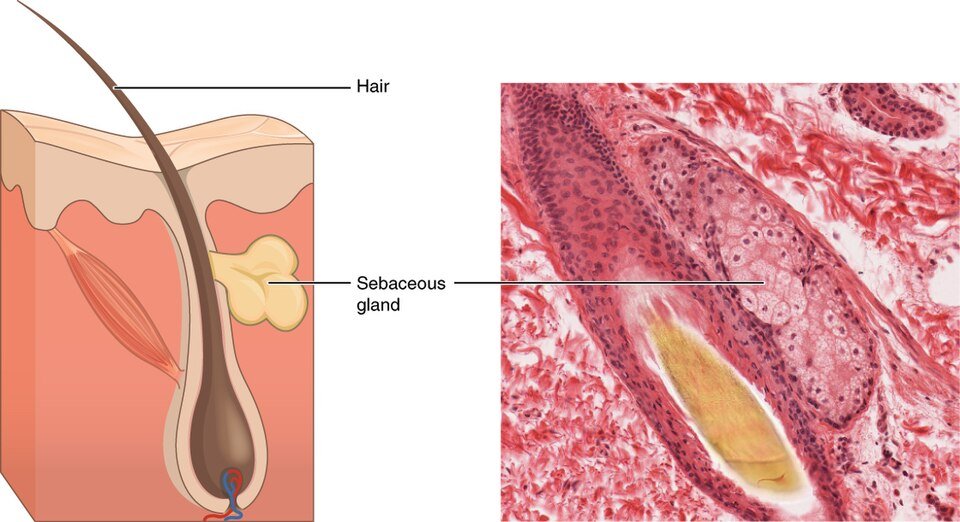
Fordyce spots (also called Fordyce granules) are sebaceous glands that open directly onto the skin surface instead of into a hair follicle. Every sebaceous gland makes sebum, the natural oil that keeps skin supple. In most body areas these glands are hidden beside a hair. On hairless skin such as the lips, the inside of the cheeks and the penile shaft, they can become visible as tiny pale dots, and that is all a Fordyce spot is.
They were first described by the American dermatologist John Addison Fordyce in 1896. Dermatologists regard them as a normal anatomical variant rather than a disease. Fordyce spots on penis are not cancerous, they do not turn into cancer, and they do not damage the organ or affect erections, fertility or urination.
Fordyce spots are extremely common. Estimates vary with how carefully people are examined, but DermNet puts the figure at about 80% of adults and the Cleveland Clinic at 70–80%. Men are affected about twice as often as women, with Fordyce spots on penis, scrotum and foreskin, often together with spots on the lips.
Source: DermNet — Fordyce spots; Cleveland Clinic — Fordyce Spots
Genital Fordyce spots are sometimes called Tyson glands, after the 17th-century anatomist who described sebaceous glands near the corona of the glans. Pathologists doubt that these exist as a separate structure: a 2014 study of 12 partial-penectomy specimens found no sebaceous glands at all in the coronal sulcus, so most “Tyson gland” bumps are simply Fordyce spots on penis shaft and foreskin.
Source: PubMed — Fernandez-Flores, Ectopic folliculosebaceous units at the coronal sulcus (J Cutan Pathol 2014); PubMed — Paolino et al., Linear ectopic sebaceous hyperplasia of the penis: the last memory of Tyson’s glands (2018)
What Fordyce spots on the penis look like
The typical picture of Fordyce spots on penis is a scatter of small, round, slightly raised dots that are white, yellowish, pale red or skin-colored. Each spot measures about 1–3 mm (some sources say up to 5 mm). They are smooth, not scaly, and the skin between them looks normal. A man may notice only a few spots or a crop of 50–100.
The most common sites for Fordyce spots on penis are the shaft, especially its underside, the outer and inner foreskin, and the scrotum. Spots on the glans itself are less common but have been reported. Because the glands sit just under the surface, the dots become far more obvious when the skin is stretched, for example during an erection or when the scrotum is warm and loose, and may almost disappear when the skin is relaxed.
Fordyce spots on penis are painless and do not itch in most men; a minority report mild friction irritation over a dense cluster during sex. They never ulcerate, bleed, weep or crust; any of those features points to a different diagnosis.
Source: Healthy Male (Australian Government-funded) — Fordyce spots; PMC — Radhakrishnan & Agarwal, Fordyce spots masquerading as penile warts (Med J Armed Forces India 2016)
Why Fordyce spots appear: causes and triggers
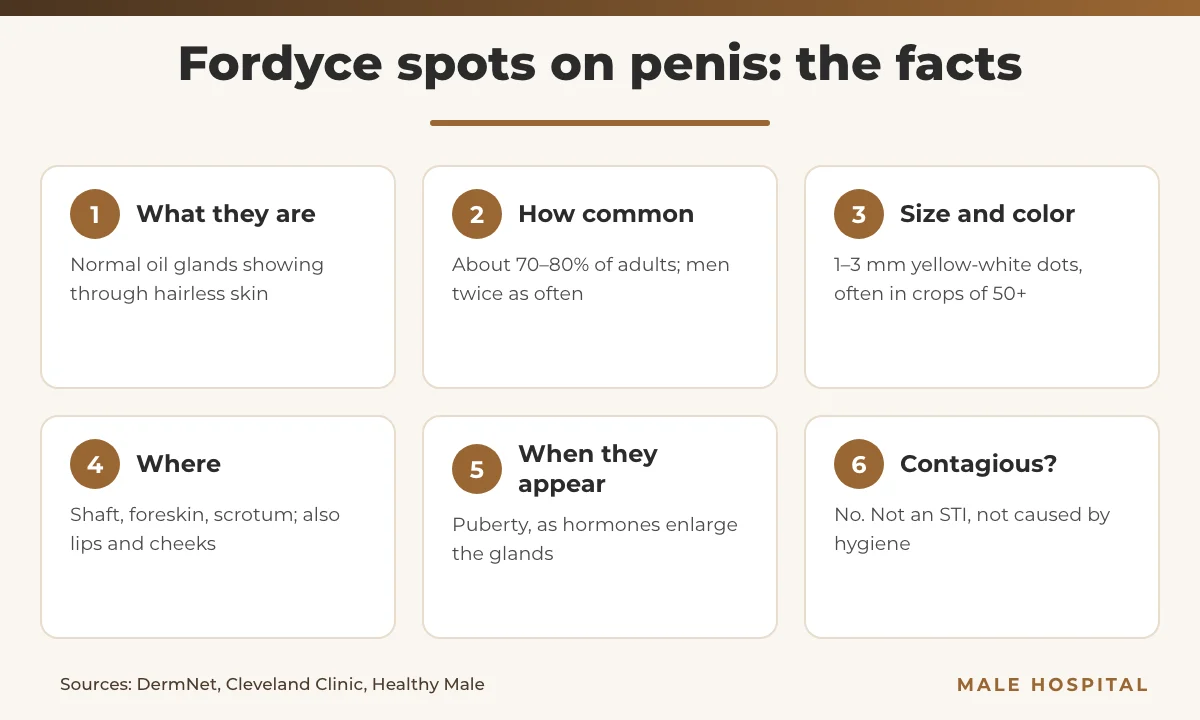
Fordyce spots on penis are not caused by anything you did. They are a feature of how your skin developed. The glands are probably present from birth, but they stay small and invisible in childhood. At puberty, rising androgen (male hormone) levels enlarge sebaceous glands everywhere on the body, which is also why acne starts in the teens. Glands on hairless genital skin grow with the rest and begin to show through as pale dots.
Several things that men often blame for Fordyce spots on penis are not causes: poor hygiene, masturbation, sexual activity, a new partner, tight underwear or diet. The spots are not an infection and nothing is “blocked” inside them. Picking or squeezing produces no pus, only irritation.
Source: Cleveland Clinic — Fordyce Spots; Healthy Male — Fordyce spots
Is there any link with other conditions?
Two weak associations appear in the literature, both for spots in the mouth rather than on the genitals. Cross-sectional studies from the United Arab Emirates (350 adults) and India (250 adults) found that people with very dense crops of oral Fordyce granules were more likely to have raised cholesterol or LDL, and a few family case series describe prominent Fordyce spots in Lynch syndrome. These are statistical associations, not causes; a man with Fordyce spots on penis or scrotum does not need blood tests on that basis alone.
Source: PubMed — Gaballah & Rahimi, Can presence of oral Fordyce’s granules serve as a marker for hyperlipidemia? (Dent Res J 2014); Cleveland Clinic Journal of Medicine — Ohta & Yoshimura, Asymptomatic granules on the buccal mucosa (2022)
Are Fordyce spots on penis contagious or an STI?
No. Fordyce spots on penis are not sexually transmitted, cannot be passed to a partner by skin contact or sex, and do not spread from one part of your body to another. A partner who develops bumps after sex with you has a different, unrelated condition that needs its own diagnosis.
The reason this question matters is that some genuine infections can look like Fordyce spots on penis skin in their early days. Genital warts caused by HPV begin as small bumps, and the virus spreads most commonly during vaginal or anal sex even when no warts are visible. Molluscum contagiosum produces shiny dome-shaped spots. The first sore of syphilis is usually firm, round and painless. Because the look-alikes are infectious and treatable, guidelines from the NHS advise that any new lump or spot on the penis should be checked by a GP or sexual health clinic rather than self-diagnosed.
Source: CDC — About Genital HPV Infection; NHS — What is this lump on my penis?
Fordyce spots vs pearly penile papules, warts and other bumps
Most “bumps on the penis” questions come down to telling apart two harmless variants, Fordyce spots and pearly penile papules, from a handful of infections. Location is the first clue: pearly penile papules form one or two neat rows around the rim of the glans, whereas Fordyce spots on penis scatter over the shaft, foreskin and scrotum. Color is the second: papules are flesh-colored and dome-shaped, Fordyce spots are yellow-white. A sexual health physician’s review of penile lumps lists these two variants together with Tyson glands, scrotal angiokeratomas and lymphocele as normal findings that are regularly mistaken for disease.
Source: PubMed — Rane & Read, Penile appearance, lumps and bumps (Aust Fam Physician 2013); DermNet — Fordyce spots
| Condition | Where | Appearance | Contagious? | Treatment |
|---|---|---|---|---|
| Fordyce spots | Shaft (often underside), foreskin, scrotum, lips | Yellow-white or pale 1–3 mm dots, smooth, in crops; clearer when skin is stretched | No | None needed; cosmetic removal optional |
| Pearly penile papules | Rim (corona) of the glans only | Flesh-colored, dome-shaped 1–2 mm bumps in one or two neat rows | No | None needed |
| Genital warts (HPV) | Shaft, glans, foreskin, around the anus | Rough, raised lumps; groups can look like cauliflower; white, red, skin-colored or darker | Yes | Prescription creams, freezing, surgery or laser; may return |
| Molluscum contagiosum | Genitals, lower abdomen, thighs | Shiny, dome-shaped 2–5 mm spots with a central dimple, in clusters | Yes | Usually clears alone within about 18 months |
| Primary syphilis sore | Penis, anus, mouth | Single firm, round, painless sore lasting 3–6 weeks | Yes | Antibiotics, urgent |
| Sebaceous hyperplasia of the foreskin | Inner foreskin | Soft rounded papules with a central dimple, mimicking molluscum | No | None needed once confirmed |
Source: NHS — Genital warts; NHS — Molluscum contagiosum; CDC — About Syphilis; PubMed — Ena et al., Sebaceous gland hyperplasia of the foreskin (Clin Exp Dermatol 2009)
Two inflammatory conditions are also worth knowing. Balanitis causes a red, sore, sometimes swollen glans and foreskin rather than discrete pale dots. Lichen sclerosus produces shiny white patches and tightening of the foreskin that can scar if untreated; it should never be confused with the innocent speckling of Fordyce spots on penis skin.
How doctors diagnose Fordyce spots
Diagnosis is clinical. An experienced urologist or dermatologist recognizes Fordyce spots on penis skin at a glance from their color, size, distribution and the way they stand out when the shaft is gently stretched. The doctor asks when the spots appeared, whether they have changed, and about sexual history, then examines the whole genital area, including under the foreskin, and often the lips, where matching granules strengthen the diagnosis.
A handheld dermatoscope (a magnifying lens with polarized light) can settle borderline cases without a biopsy. In a 2024 observational study of 206 patients with genital mucosal disorders, Fordyce spots on penis and other genital skin showed discrete white-yellow globules in every case, a pattern distinct from the hairpin vessels of pearly penile papules and the vascular patterns of warts.
A skin biopsy is rarely needed. When one is taken, it shows a mature sebaceous gland lying just beneath the epithelium and opening to the surface, with no hair follicle attached. If a doctor is unsure, tests for sexually transmitted infections (a swab, urine or blood test) may be offered to rule out the look-alikes rather than to confirm Fordyce spots themselves.
Source: PMC — Gowda et al., Dermoscopy of genital mucosal disorders (Indian Dermatol Online J 2024); DermNet — Fordyce spots
Fordyce spots on penis treatment: what the evidence says
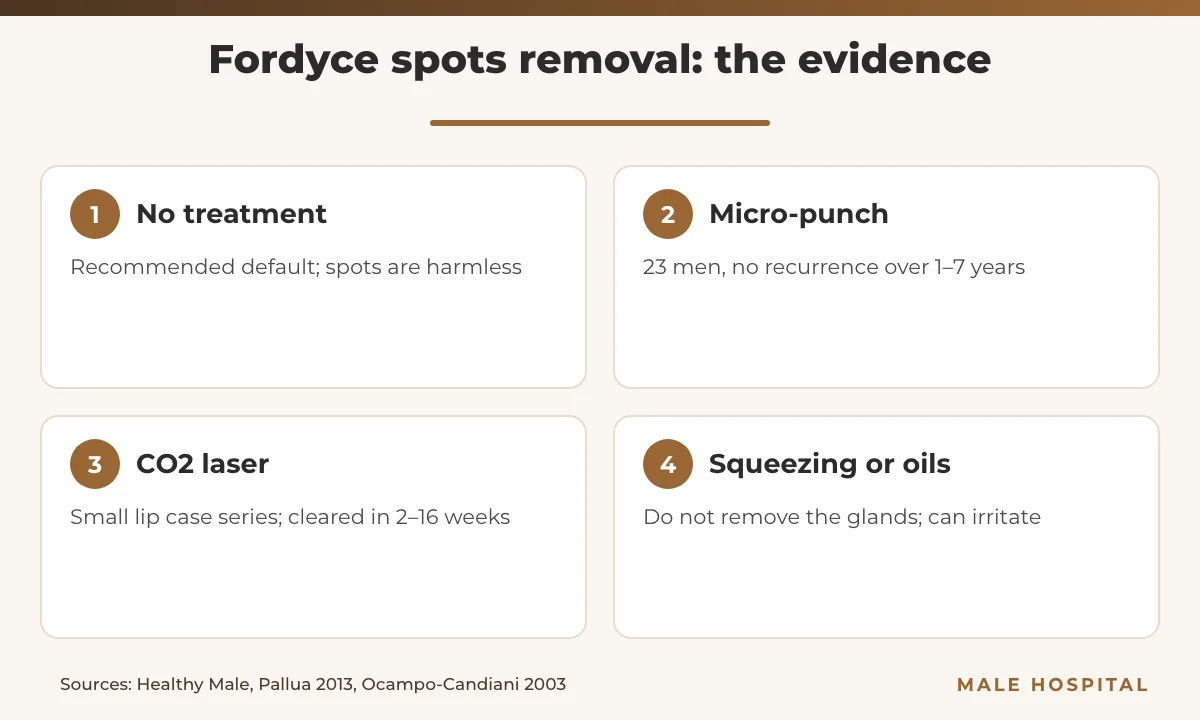
The honest summary is that Fordyce spots on penis need no treatment, and the evidence for the procedures that can remove them comes from small case series rather than randomized trials. Healthy Male, the Australian Government-funded men’s health body, states plainly that there is no good-quality evidence that any treatment removes them effectively, and that surgery, freezing, burning or laser carry a risk of injury and scarring. Treatment is therefore a personal cosmetic choice, discussed with a specialist, not a medical necessity.
Source: Healthy Male — Fordyce spots
Micro-punch surgery
Micro-punch excision removes each gland with a tiny pen-shaped punch under local anesthetic. The largest published series is a German retrospective study of 23 men with genital Fordyce spots treated between 2003 and 2011. The authors reported very satisfactory functional and cosmetic results and no recurrence during follow-up of 12 to 84 months (median about 51 months). Because every spot is punched individually, the technique suits a limited number of prominent Fordyce spots on penis skin rather than hundreds, and healing can take up to a month.
Source: PubMed — Pallua & Stromps, Micro-punch technique for treatment of Fordyce spots (J Plast Reconstr Aesthet Surg 2013); Cleveland Clinic — Fordyce Spots
CO2 laser
A carbon dioxide laser vaporizes the gland through a pinhole in the skin. The original 2003 report treated two patients’ lips with a superpulsed CO2 laser at 2–4 W; the skin had healed two weeks later with no residual spots and no side effects. A 2024 series of three young men, again on the upper lip, found no recurrence at four months. Both studies treated lips, not Fordyce spots on penis skin, and darker skin types carry a higher risk of pigment change after ablative lasers. Healing after CO2 resurfacing typically takes five to 21 days.
Source: PubMed — Ocampo-Candiani et al., Treatment of Fordyce spots with CO2 laser (Dermatol Surg 2003); PMC — Treatment of Fordyce Spots with CO2 Laser: A Case Series of Three Patients (J Cutan Aesthet Surg 2024)
Electrodesiccation, cryotherapy and other ablative methods
Electrodesiccation burns the gland with a fine electric needle and heals in about three to five days; cryotherapy freezes it and causes mild pain for a few days. Radiofrequency ablation and photodynamic therapy have also been described. All destroy tissue, so each carries some risk of a small scar, a pale or dark mark, or recurrence, and none has been compared with another in a trial.
Source: Cleveland Clinic — Fordyce Spots; PMC — Radhakrishnan & Agarwal (2016)
Creams and tablets
Topical retinoids such as tretinoin are sometimes prescribed to shrink the glands; the Cleveland Clinic notes that any effect takes two to six weeks. Oral isotretinoin, the acne drug, shrinks sebaceous glands throughout the body, and a handful of case reports describe Fordyce spots fading during acne treatment, although a 2014 report of two patients found opposite long-term outcomes. Isotretinoin has significant side effects and is not an approved or recommended treatment for Fordyce spots on penis; it is only considered when a man needs it for severe acne anyway.
Source: PubMed — Mutizwa & Berk, Dichotomous long-term response to isotretinoin in two patients with Fordyce spots (Pediatr Dermatol 2014); Cleveland Clinic — Fordyce Spots
Home remedies and products
Online shops sell creams, oils and “Fordyce removal” kits. None has been tested in a clinical study. Apple cider vinegar, coconut, argan or jojoba oil may moisturize the skin, but they cannot remove Fordyce spots on penis skin, because the gland sits under the surface, and acids can burn genital skin. If the appearance bothers you, the sensible route is a specialist consultation about the procedures above.
Source: Cleveland Clinic — Fordyce Spots; DermNet — Fordyce spots
Living with Fordyce spots: sex, hygiene and what not to do
For most men the only real problem with Fordyce spots on penis is worry. Once a doctor has confirmed the diagnosis, there is nothing to monitor, no follow-up schedule and no restriction on sexual activity. Telling a partner that the dots are oil glands, confirmed by a doctor, usually ends the conversation.
Normal hygiene is enough: wash daily with warm water and a mild, fragrance-free cleanser, dry gently, and retract the foreskin to clean beneath it if you are uncircumcised. Harsh scrubs, alcohol wipes or repeated washing do not reduce the spots and can cause the soreness of balanitis. Do not pick, squeeze, needle or apply wart liquids, which contain acids that can scar healthy skin.
Source: Healthy Male — Fordyce spots; Cleveland Clinic — Fordyce Spots
Fordyce spots on penis tend to become less prominent with age as sebaceous activity falls; the UAE study of oral granules found that density decreased with age and in smokers. The spots do not spread or multiply over time, although a man may notice more of them after an erection or in warm weather simply because the skin is stretched.
Source: PubMed — Gaballah & Rahimi (Dent Res J 2014)
If you would like a specialist to confirm that your Fordyce spots on penis are harmless, or to discuss whether removal is realistic in your case, you can arrange a confidential consultation with Assoc. Prof. Dr. Zülfü Sertkaya, urologist-andrologist in Istanbul, via WhatsApp. A clear photo and a short history are often enough for an initial opinion.
When to see a doctor
Every new lump or spot on the penis deserves one examination, because the harmless and the infectious can look alike at first. See a doctor or a sexual health clinic promptly if you notice:
- A sore, ulcer or open area on the penis, even if it is painless (a painless firm sore lasting weeks is the classic first sign of syphilis).
- Bumps that are rough, cauliflower-like, growing or multiplying, or that appeared weeks after unprotected sex.
- Spots with a central dimple, or that spread to the lower abdomen or thighs.
- Bleeding, weeping, crusting, pain or itching that does not settle.
- A red, swollen or sore glans or foreskin, a foreskin that will not retract, or white shiny patches.
- Any single spot that keeps changing in size, shape or color, or does not heal within a few weeks.
At the appointment the doctor may examine you, take a swab from the tip of the penis, or request a urine or blood test for sexually transmitted infections. These are among the most common reasons men visit a urologist, so there is no need to feel embarrassed.
Source: NHS — What is this lump on my penis?; CDC — About Syphilis
FAQs about Fordyce spots on penis
Can Fordyce spots on penis go away on their own?
They do not disappear completely, because the oil glands are a permanent part of the skin, but they often become less noticeable with age as sebaceous activity declines. They never cause harm if left alone, and many men find them far less visible once they stop examining the skin under stretch and bright light.
Source: Cleveland Clinic — Fordyce Spots
Are Fordyce spots on penis a sign of HPV or herpes?
No. Fordyce spots are glands, not an infection, and they are not caused by HPV, herpes or any other virus. Genital warts are rough, raised and often cauliflower-like; herpes causes painful blisters that break into sores. If spots appeared after a new sexual contact, get an examination and STI testing to rule those infections out.
Source: CDC — About Genital HPV Infection; NHS — Genital warts
Why are my Fordyce spots more visible when I have an erection?
The glands lie just beneath the surface, so stretching the skin thins the tissue over them and makes the pale yellow lobules show through. The same happens when the scrotum relaxes in warmth. The number of spots has not increased; relaxed skin simply hides them again.
Source: Healthy Male — Fordyce spots
What is the difference between Fordyce spots on penis and pearly penile papules?
Pearly penile papules are flesh-colored, dome-shaped bumps arranged in neat rows around the rim of the glans only. Fordyce spots are yellow-white dots scattered across the shaft, foreskin or scrotum. Both are normal variants, both are harmless and non-contagious, and neither needs treatment unless the appearance troubles you.
Source: PubMed — Rane & Read, Penile appearance, lumps and bumps (2013)
Can I pop or squeeze Fordyce spots?
No. There is no plug or pus inside a Fordyce spot, so squeezing releases nothing and only causes redness, swelling and sometimes a small wound that can become infected. DermNet and the Cleveland Clinic both advise against picking or squeezing. If the spots bother you, discuss professional removal instead.
Source: DermNet — Fordyce spots
Does laser removal of Fordyce spots work and is it permanent?
Small case series report complete clearance with CO2 laser and no recurrence at two to four months, but these studies treated lips, involved only two or three patients each and had short follow-up. The longest genital data come from micro-punch surgery, with no recurrence over a median of about four years in 23 men. No large or randomized trial exists.
Source: PMC — CO2 laser case series (2024); PubMed — Pallua & Stromps (2013)
How much does removing Fordyce spots on penis cost?
The cost depends on the number of spots, the technique (micro-punch, CO2 laser or electrodesiccation) and the number of sessions, so no single figure applies. Because the spots are harmless, removal is usually classed as cosmetic and not covered by insurance. A consultation to assess your case is the only reliable way to get a price.
Source: Healthy Male — Fordyce spots
Do Fordyce spots on penis affect fertility or sexual performance?
No. The glands sit in the skin and have no connection to the erectile tissue, urethra, testicles or hormones. They do not affect erections, sensation, ejaculation or sperm. A minority of men report slight friction irritation over dense clusters during sex, which responds to lubricant and does not indicate any underlying problem.
Source: PubMed — Pallua & Stromps (2013); Cleveland Clinic — Fordyce Spots
Medically reviewed by Assoc. Prof. Dr. Zülfü Sertkaya, urologist and andrologist (FEBU), Istanbul. Last reviewed: November 2026.
This article is for general information and does not replace an individual consultation with a qualified doctor.
- DermNet — Fordyce spots
- Cleveland Clinic — Fordyce Spots: Causes, Symptoms and Treatment
- Healthy Male (Australian Government-funded) — Fordyce spots
- NHS — What is this lump on my penis?
- NHS — Genital warts
- NHS — Molluscum contagiosum
- CDC — About Genital HPV Infection
- CDC — About Syphilis
- Cleveland Clinic Journal of Medicine — Ohta K, Yoshimura H. Asymptomatic granules on the buccal mucosa (2022)
- PubMed (J Plast Reconstr Aesthet Surg) — Pallua N, Stromps JP. Micro-punch technique for treatment of Fordyce spots: a surgical approach for an unpleasant condition of the male genital (2013)
- PubMed (Dermatologic Surgery) — Ocampo-Candiani J et al. Treatment of Fordyce spots with CO2 laser (2003)
- PMC (J Cutan Aesthet Surg) — Treatment of Fordyce Spots with CO2 Laser: A Case Series of Three Patients (2024)
- PubMed (Pediatric Dermatology) — Mutizwa MM, Berk DR. Dichotomous long-term response to isotretinoin in two patients with Fordyce spots (2014)
- PubMed (Dental Research Journal) — Gaballah KY, Rahimi I. Can presence of oral Fordyce's granules serve as a marker for hyperlipidemia? (2014)
- PubMed (Australian Family Physician) — Rane V, Read T. Penile appearance, lumps and bumps (2013)
- PMC (Med J Armed Forces India) — Radhakrishnan S, Agarwal DC. Fordyce spots masquerading as penile warts (2016)
- PMC (Indian Dermatol Online J) — Gowda SK et al. A single-center cross-sectional observational study on dermoscopy of genital mucosal disorders (2024)
- PubMed (J Cutan Pathol) — Fernandez-Flores A. Ectopic folliculosebaceous units at the coronal sulcus (2014)
- PubMed (G Ital Dermatol Venereol) — Paolino G et al. Linear ectopic sebaceous hyperplasia of the penis: the last memory of Tyson's glands (2018)
- PubMed (Clin Exp Dermatol) — Ena P et al. Sebaceous gland hyperplasia of the foreskin (2009)