Cycling and erectile dysfunction are linked through one mechanism: a traditional bicycle saddle presses on the perineum, the strip of tissue between the scrotum and the anus that carries the artery and nerve supplying the penis. Laboratory studies show penile blood flow drops sharply while a rider sits on a narrow saddle, and long-distance riders report genital numbness far more often than other athletes. Yet the largest athlete survey and the newest meta-analysis find that cyclists as a group do not have worse erections than swimmers or runners, so the risk is real but concentrated in long hours, narrow saddles and ignored numbness. Cycling is only one of many possible triggers; our guide to erectile dysfunction causes covers the full list.
Sources: Journal of Urology (PubMed) — Cycling, and male sexual and urinary function: a large multinational study (Awad 2018); Journal of Sexual Medicine (PubMed) — Bicycle riding and erectile dysfunction: a review (Sommer 2010)
- Seated cycling lowered penile oxygen pressure in more than 70% of athletic men in a German study; standing on the pedals returned it to normal.
- Genital numbness is the typical warning sign, reported by 50% to 91% of cyclists in reviews.
- In the Massachusetts Male Aging Study, riding under 3 hours a week was not linked to erectile dysfunction (ED); 3 hours or more may be. The NHS suggests a break from cycling above that threshold if you have erection problems.
- Among 3,932 athletes, cyclists scored no worse on a validated erection questionnaire than swimmers or runners. A 2021 meta-analysis found higher adjusted odds of ED in cyclists; a 2026 meta-analysis found no significant difference.
- A no-nose saddle cut perineal pressure by 66% in bicycle police officers and improved erectile function scores after 6 months.
- Does cycling cause erectile dysfunction? What the evidence says
- How cycling and erectile dysfunction are connected: the perineum
- Cycling and erectile dysfunction research: 8 key studies
- Genital numbness: the warning sign cyclists should not ignore
- Who is most at risk? Hours, saddle and riding position
- How to prevent cycling and erectile dysfunction problems: 8 fixes
- Cycling and erectile dysfunction: why riding still helps most men
- Does cycling-related ED go away? Recovery and treatment
- When to see a doctor
- FAQs about cycling and erectile dysfunction
Does cycling cause erectile dysfunction? What the evidence says
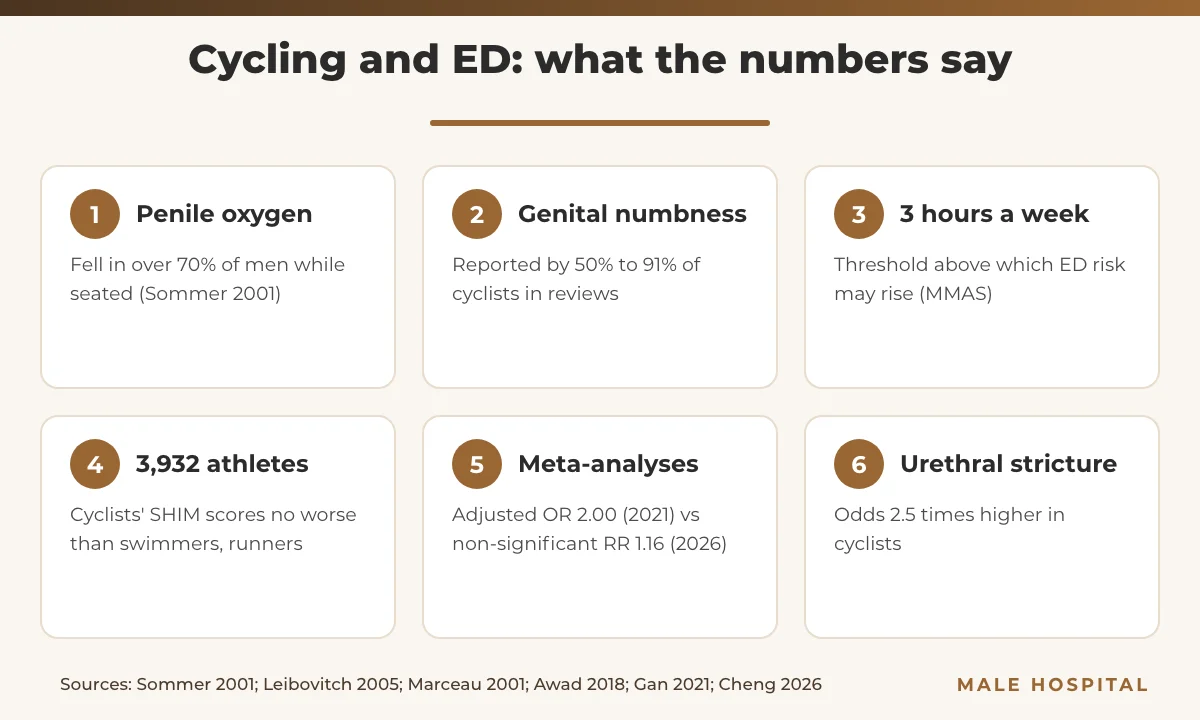
For most riders, no. The largest comparison to date, published in the Journal of Urology in 2018, surveyed 3,932 athletes using the Sexual Health Inventory for Men (SHIM), a validated five-question erection score. Swimmers and runners had a slightly lower mean score (19.5) than low-intensity cyclists (19.9) and high-intensity cyclists (20.7), and urinary and prostatitis symptom scores did not differ. The one clear downside was urethral stricture, a narrowing of the urine tube, which was 2.5 times more likely in cyclists.
The question has two layers, though: whether cyclists as a population develop more ED, and whether an individual rider can injure the artery and nerve under his saddle. On the first, the evidence is mixed. A 2021 meta-analysis of 6 studies (3,330 cyclists, 1,524 non-cyclists) found no difference in raw ED rates, but after adjusting for age and other illnesses cyclists had twice the odds of ED (odds ratio 2.00; 95% confidence interval 1.57 to 2.55). A 2026 meta-analysis of 8 studies (4,729 cyclists, 2,843 non-cyclists) found a non-significant risk ratio of 1.16 and concluded that current evidence does not support a causal link.
On the second layer the evidence is consistent: every study that measured blood flow or oxygen in the penis during seated cycling found a steep drop, and men with extreme exposure, such as bicycle police officers riding more than 5 hours a day, show measurable changes in night-time erections. Cycling does not cause ED in the average rider, but hours, saddle shape and posture can create a real, usually reversible, problem in a minority.
Sources: Journal of Urology (PubMed) — Cycling, and male sexual and urinary function (Awad 2018); Sexual Medicine Reviews (PubMed) — Systematic review and meta-analysis of cycling and erectile dysfunction (Gan 2021); International Journal of Physical Activity and Health — Cycling and erectile dysfunction: systematic review and meta-analysis (Cheng 2026)
How cycling and erectile dysfunction are connected: the perineum
The artery and nerve under the saddle
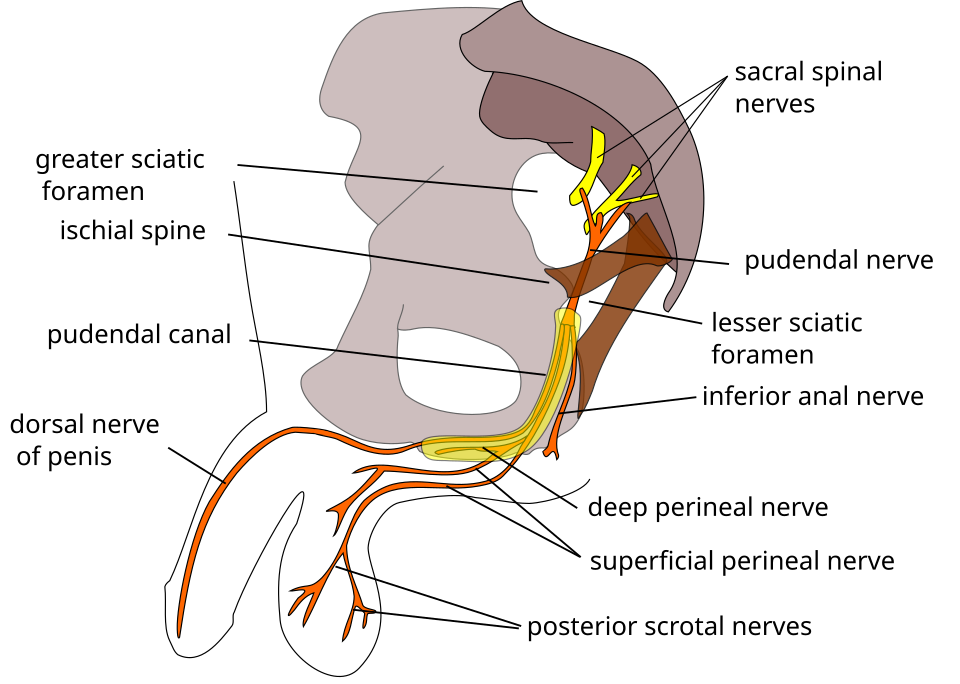
An erection depends on the internal pudendal artery delivering blood and the pudendal nerve carrying sensation and signals. Both run through the perineum in a narrow passage called the pudendal (Alcock’s) canal before branching into the dorsal artery and dorsal nerve of the penis, and a saddle nose sits exactly on this route. A 2010 systematic review concluded that cycling-induced perineal compression leads to vascular, endothelial (vessel-lining) and neurogenic dysfunction, and that a properly fitted bicycle, a suitable seat position and an appropriate saddle help prevent it. An earlier Boston University review described perineal pressures on a nosed saddle that exceed systolic blood pressure, temporarily shutting off penile perfusion and potentially injuring the endothelium.
Sources: Journal of Sexual Medicine (PubMed) — Bicycle riding and erectile dysfunction: a review (Sommer 2010); Journal of Sexual Medicine (PubMed) — Bicycle riding and erectile dysfunction: an increase in interest and concern (Huang 2005)
What happens to penile blood flow while you ride
Researchers in Cologne attached an oxygen electrode to the glans of 40 athletic men (mean age 30). Penile oxygen pressure, a proxy for blood supply, fell significantly in more than 70% of them while they pedaled seated; standing on the pedals produced no drop. In a Korean crossover study of 20 potent volunteers, sitting on a narrow unpadded saddle cut penile blood flow from 1.7 to 1.0 ml/min/100 g of tissue, whereas a wide saddle caused only a small change (1.6 to 1.5). The European Urology saddle study added the longer-term concern: repeatedly reduced oxygen tension in erectile tissue is thought to promote fibrosis, the scarring that stiffens the smooth muscle an erection depends on. This remains a mechanism rather than a proven outcome in everyday cyclists, but it explains why urologists take repeated numbness seriously.
Sources: International Journal of Sports Medicine (PubMed) — Impotence and genital numbness in cyclists (Sommer 2001); International Journal of Impotence Research (PubMed) — Bicycle saddle shape affects penile blood flow (Jeong 2002); European Urology (PubMed) — Cycling and penile oxygen pressure: the type of saddle matters (Schwarzer 2002)
The nerve side: pudendal neuralgia
When the nerve rather than the artery takes the brunt, the result can be pudendal neuralgia: chronic pelvic pain from an irritated or compressed pudendal nerve. The Cleveland Clinic lists cycling, prolonged sitting, horseback riding and squatting exercises among its causes. Typical features are stabbing or burning pain in the perineum, genitals or buttocks that is worst when sitting and eases on standing, plus numbness or tingling. Erectile dysfunction, painful sex and trouble reaching orgasm are listed symptoms, so a cyclist whose numbness turns into pain needs a specific diagnosis rather than a generic ED pill.
Source: Cleveland Clinic — Pudendal neuralgia
Cycling and erectile dysfunction research: 8 key studies
The strongest signals come from extreme exposure (a 540 km race, more than 400 km of training a week, a working day on a patrol bike), while ordinary mileage shows a weak or absent effect.
| Study | Who was studied | Main finding |
|---|---|---|
| Andersen & Bovim, 1997 | 160 men after a 540 km Norwegian race | 22% had pudendal nerve symptoms, 13% impotence; some complaints lasted up to 8 months |
| Marceau, 2001 (MMAS) | 1,709 randomly sampled men aged 40 to 70 | Under 3 h/week: no link to ED, possibly protective; 3 h/week or more: ED may be more likely |
| Sommer, 2001 | 40 healthy athletic men | Penile oxygen fell in over 70% while seated; 61% numbness; 19% of those riding over 400 km/week reported ED |
| Schrader, 2002 (NIOSH) | 17 bicycle police officers vs 5 non-riders | Officers rode 5.4 h/day; 91% had numbness; erections present in 27.1% of sleep time vs 42.8% |
| Taylor, 2004 | 688 cyclists, online survey | 17% had ED; no riding factor stayed significant after adjusting for age |
| Schrader, 2008 (NIOSH) | 90 police officers, 6 months on no-nose saddles | 66% less perineal pressure; IIEF and sensation improved; men free of numbness rose from 27% to 82% |
| Awad, 2018 | 3,932 cyclists, swimmers and runners | Cyclists’ SHIM no worse (19.9 and 20.7 vs 19.5); urethral stricture odds 2.5 times higher |
| Gan, 2021; Cheng, 2026 | Meta-analyses of 6 and 8 studies | Adjusted odds ratio 2.00 (2021) vs non-significant risk ratio 1.16 (2026) |
Sources: Acta Neurologica Scandinavica (PubMed) — Impotence and nerve entrapment in long distance amateur cyclists (Andersen 1997); International Journal of Impotence Research (PubMed) — Does bicycling contribute to the risk of ED? Massachusetts Male Aging Study (Marceau 2001); CDC Stacks — Nocturnal penile tumescence and rigidity testing in bicycling patrol officers (Schrader 2002); Journal of Urology (PubMed) — Bicycle riding and its relationship to the development of ED (Taylor 2004); Journal of Sexual Medicine (PubMed) — Cutting off the nose to save the penis (Schrader 2008)
Genital numbness: the warning sign cyclists should not ignore
A review of 62 articles in European Urology ranked the urogenital problems of cycling by frequency. Nerve entrapment presenting as genital numbness came first, reported by 50% to 91% of cyclists depending on the group studied, followed by erectile dysfunction in 13% to 24%. Priapism, penile vein thrombosis, blood in the urine, prostatitis, perineal nodules, a raised PSA and infertility were reported only sporadically.
Does numbness mean your erections are already suffering? Not necessarily. In a secondary analysis of 2,774 cyclists from the UCSF survey, numbness rose with more years of riding, more rides per week and longer rides, and was linked to lower handlebars and to not wearing padded shorts. After adjusting for age, weight and lifetime mileage, however, cyclists with and without numbness had the same mean SHIM score (20.3 vs 20.2); only men whose numbness was in the buttock scored significantly worse (18.4). Numbness tracks riding intensity but is not by itself proof of worse sexual function. The US National Institute for Occupational Safety and Health (NIOSH) still treats it as the trigger for action: its saddle research began after a police unit complained of groin numbness, and its guidance warns that contact stress from a traditional saddle may impair blood flow and may be associated with a higher risk of ED in men who ride for work.
Sources: European Urology (PubMed) — The vicious cycling: bicycling related urogenital disorders (Leibovitch 2005); BJU International (PubMed) — Bicycle-related genital numbness and SHIM score (Baradaran 2019); NIOSH (CDC) — Bicycle saddles and reproductive health
Who is most at risk? Hours, saddle and riding position
Hours in the saddle
The Massachusetts Male Aging Study is the only population-based test of a time threshold. After controlling for age, energy expenditure, smoking, depression and chronic illness, riding under 3 hours a week was not associated with ED, while 3 hours or more may be. The NHS turns this into a simple rule for men with erection problems: take a break from cycling if you ride more than 3 hours a week. At the far end, patrol officers riding 5.4 hours a day had fewer night-time erections the more hours and days they rode. Hours alone do not condemn you, though: in the UCSF survey, high-intensity cyclists had the best erection scores of all. The riders who get into trouble combine high mileage with a narrow saddle, a low handlebar and no standing breaks.
Sources: International Journal of Impotence Research (PubMed) — Massachusetts Male Aging Study (Marceau 2001); NHS — Erection problems (erectile dysfunction); Journal of Andrology (PubMed) — Nocturnal penile tumescence and rigidity testing in bicycling patrol officers (Schrader 2002)
Saddle shape: width matters more than padding
The Cologne group tested four saddles on 20 young athletes while measuring penile oxygen pressure. The heavily padded narrow saddle was the worst, and padding did not rescue it; what protected the perineal arteries was width, because a saddle wide enough to carry the sit bones keeps the nose from pressing on the canal.
| Saddle type (Schwarzer 2002) | Penile oxygen pressure while seated | Drop from standing baseline |
|---|---|---|
| Narrow, heavily padded | 11.8 mmHg | 82.4% |
| Narrow, medium padding, V-groove in the nose | 20.8 mmHg | 72.4% |
| Wide, unpadded leather | 25.3 mmHg | 63.6% |
| Wide, medium padding, no nose | 62.3 mmHg | 20.3% |
NIOSH engineers confirmed the pressure side in 33 patrol officers on a stationary bike: the traditional narrow-nosed road saddle produced more than twice the perineal pressure of three noseless designs and did not shift extra load onto the hands or pedals.
Sources: European Urology (PubMed) — Cycling and penile oxygen pressure: the type of saddle matters (Schwarzer 2002); Medicine & Science in Sports & Exercise (PubMed) — Effect of bicycle saddle designs on perineal pressure (Lowe 2004)
Handlebar height and time standing
Posture decides how much of your weight lands on the perineum. In the UCSF survey, handlebars set lower than the saddle increased numbness and saddle sores; bars level with or above the saddle lowered the odds of numbness (odds ratio 0.8) and sores (0.6), and standing on the pedals for more than 20% of riding time cut the odds of numbness by 60% (odds ratio 0.4). A 2021 meta-analysis in Sports Medicine found that sitting reduced penile oxygen pressure by roughly 73% on average compared with standing, while a recumbent bike caused only about a 2% fall.
Sources: Journal of Urology (PubMed) — Cycling, and male sexual and urinary function (Awad 2018); Sports Medicine (PMC) — Strategies for reducing the impact of cycling on the perineum: systematic review and meta-analysis (Litwinowicz 2021)
How to prevent cycling and erectile dysfunction problems: 8 fixes
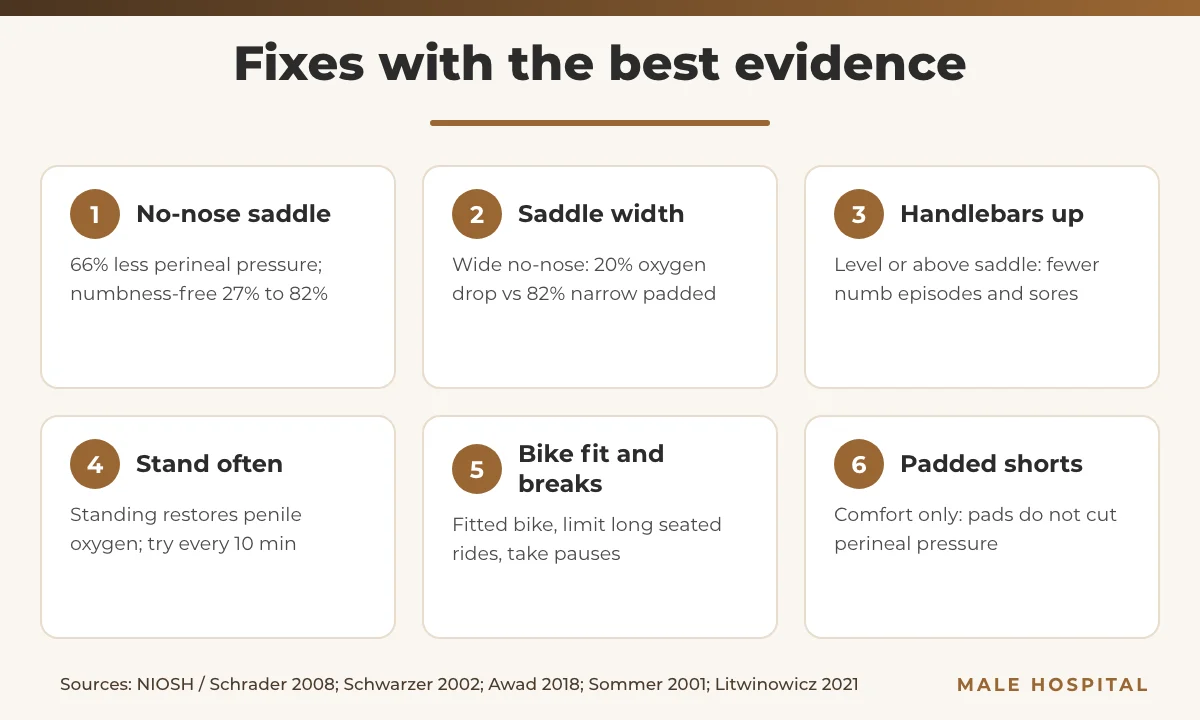
- Switch to a wide or no-nose saddle. The best-supported change. NIOSH recommends no-nose saddles for workers who ride on the job; in its 6-month trial only 3 of 90 officers went back to a traditional saddle. Expect a short adjustment period.
- Match saddle width to your sit bones. Width, not padding, keeps the perineal arteries open; a bike shop can measure sit-bone spacing.
- Raise the handlebars to saddle height or above. This shifts weight back onto the sit bones and was linked to fewer numb episodes and sores in 2,774 cyclists.
- Stand on the pedals regularly. Standing restored penile oxygen pressure to baseline in the Cologne study. The Sports Medicine review suggests a brief stand about every 10 minutes, while noting that this exact interval has not been tested.
- Get a proper bike fit. The 2010 review names a properly fitted bicycle and a suitable seat position as preventive measures.
- Cap long seated sessions and take breaks. Both the Cologne and Norwegian authors advised limiting training distance and pausing during long, vigorous rides.
- Treat padded shorts as comfort, not protection. Pressure testing found no difference in peak perineal pressure between basic, intermediate and endurance pads, although riders who skipped padded shorts reported more numbness.
- Never ride through numbness. Stop or stand until sensation returns and change the setup before the next ride. If numbness becomes pain that is worse when sitting, the Cleveland Clinic advises avoiding prolonged sitting and cycling until the pudendal nerve has been assessed.
A note on cut-out saddles: the 2021 pooled analysis found that a central hole lowered front-of-saddle pressure (31 to 26.8 kPa) but did not significantly improve penile oxygen pressure compared with a standard saddle. A wider or noseless shape has stronger evidence.
Sources: NIOSH (CDC) — No-nose saddles for preventing genital numbness and sexual dysfunction from occupational bicycling (2009-131); Journal of Sexual Medicine (PubMed) — Cutting off the nose to save the penis (Schrader 2008); Sports Medicine (PMC) — Strategies for reducing the impact of cycling on the perineum (Litwinowicz 2021); Cleveland Clinic — Pudendal neuralgia
Cycling and erectile dysfunction: why riding still helps most men
It would be a mistake to read this and sell the bike. Erectile dysfunction is mainly a vascular condition: the European Association of Urology (EAU) lists lack of regular exercise among its vasculogenic causes, grades lifestyle modification (aerobic exercise in particular) as level 1b evidence and strongly recommends starting it before or alongside any ED drug. The US National Institute of Diabetes and Digestive and Kidney Diseases (NIDDK) likewise lists too little physical activity among the lifestyle causes of ED, and the Cleveland Clinic names bicycling, alongside running and jogging, as cardiovascular exercise that helps prevent ED and treat mild cases.
How much is enough? A 2018 systematic review of intervention trials concluded that supervised aerobic exercise of moderate to vigorous intensity, 40 minutes four times a week (about 160 minutes a week) for 6 months, reduces erectile problems in men whose ED stems from inactivity, obesity, high blood pressure, metabolic syndrome or cardiovascular disease. Cycling delivers that dose with less joint impact than running, and in the UCSF survey the hardest-training cyclists had the best erection scores. For a program that pairs cardio with pelvic floor work, see our guide to exercises for erectile dysfunction.
Sources: EAU — Sexual and Reproductive Health Guidelines: Management of Erectile Dysfunction; NIDDK — Symptoms and causes of erectile dysfunction; Cleveland Clinic — Erectile dysfunction; Sexual Medicine (PMC) — Physical activity to improve erectile function: a systematic review (Gerbild 2018)
Does cycling-related ED go away? Recovery and treatment
In most reported cases the problem is temporary. Among the Norwegian race riders, numbness usually cleared within a week, and of the 21 men who reported impotence it lasted more than a month in only 3, although a few complaints persisted for up to 8 months. The NIOSH no-nose trial gives the best data on recovery after changing equipment: after 6 months, penile vibration sensitivity and IIEF erection scores had improved significantly, yet overnight RigiScan rigidity measurements had not changed, which the authors took to mean that the full erectile response may need longer than the nerves to recover.
Sources: Acta Neurologica Scandinavica (PubMed) — Impotence and nerve entrapment in long distance amateur cyclists (Andersen 1997); Journal of Sexual Medicine (PubMed) — Cutting off the nose to save the penis (Schrader 2008)
Blaming the bike can hide something else. ED in a cyclist can still come from diabetes, blood pressure, low testosterone, medication or anxiety, and the NHS advises seeing a doctor whenever erection problems keep happening. A urologist takes a sexual and riding history, examines the perineum and genitals, checks blood tests and, where needed, measures penile blood flow with Doppler ultrasound; our overview of the erectile dysfunction test explains each step. For young men with a clear history of pelvic or perineal trauma, the EAU guideline lists specialized vascular tests and, in selected cases, penile revascularization surgery with 60% to 70% long-term success, though this applies to genuine arterial injury, not routine riding. Treatment follows the standard ladder, from lifestyle change and PDE5 inhibitors to vacuum devices, injections and, for severe unresponsive cases, a penile implant. Younger riders have their own set of causes, covered in erectile dysfunction in young men.
If you ride seriously and your erections have changed, our urologist-andrologist, Assoc. Prof. Dr. Zülfü Sertkaya (FEBU, a urology specialist since 2014), offers a confidential assessment of both the cycling factors and the medical ones; message us on WhatsApp or read about erectile dysfunction treatment in Istanbul.
Sources: NHS — Erection problems (erectile dysfunction); EAU — Management of Erectile Dysfunction
When to see a doctor
Most saddle numbness fades within minutes of standing and needs an equipment change, not a clinic visit. See a urologist if you notice any of the following:
- Genital or perineal numbness that lasts more than a few days after a ride, or returns on every ride despite a wider saddle and higher bars.
- Erections that have become weaker or less reliable for 3 months or more, whether or not you have been riding.
- Burning, stabbing or shooting pain in the perineum, scrotum or buttock that is worse when sitting, which can point to pudendal neuralgia.
- A weak or spraying urine stream, straining to urinate or repeated urinary infections, since cyclists had 2.5 times the odds of urethral stricture.
- Blood in the urine or semen, a painful prolonged erection, or a hard lump in the perineum, all reported in cyclists and all needing prompt evaluation.
- Any ED alongside chest discomfort on exertion, breathlessness, high blood pressure or diabetes; ED often precedes heart disease, as our article on erectile dysfunction and heart disease explains.
Sources: NHS — Erection problems (erectile dysfunction); Cleveland Clinic — Pudendal neuralgia; European Urology (PubMed) — The vicious cycling (Leibovitch 2005)
FAQs about cycling and erectile dysfunction
Does cycling cause erectile dysfunction?
Not for most riders. In a survey of 3,932 athletes, cyclists had erection scores equal to or better than swimmers and runners, and a 2026 meta-analysis found no significant difference in ED rates. Problems cluster in men who ride many hours on narrow saddles with low handlebars and ignore numbness, a dose and equipment issue rather than a verdict on the sport.
Sources: Journal of Urology (PubMed) — Awad 2018; IJPAH — Cheng 2026
How many hours of cycling a week is too much?
The only population-based threshold comes from the Massachusetts Male Aging Study: under 3 hours a week showed no link to ED and may be protective, while 3 hours or more may raise the risk. The NHS suggests a break from cycling above 3 hours a week if you already have erection problems. Fit riders can exceed this with a wide saddle, level bars and regular standing.
Sources: International Journal of Impotence Research (PubMed) — Marceau 2001; NHS — Erection problems
Is numbness after cycling a sign of ED?
It is a sign that the pudendal nerve and artery are being compressed, which is the pathway to cycling-related ED, but it does not mean your erections are already affected. Among 2,774 cyclists, those with numbness had the same mean SHIM score as those without once age, weight and mileage were accounted for. Treat numbness as the cue to change saddle and position.
Source: BJU International (PubMed) — Baradaran 2019
Do no-nose saddles really work?
Yes, on every measure tested. In 33 patrol officers a noseless saddle more than halved perineal pressure versus a racing saddle, and in the 6-month NIOSH trial pressure fell 66%, penile sensation and IIEF scores improved, and officers free of numbness rose from 27% to 82%. The trade-off is less perceived stability and more pressure on the sit bones.
Sources: Medicine & Science in Sports & Exercise (PubMed) — Lowe 2004; Journal of Sexual Medicine (PubMed) — Schrader 2008
Are padded cycling shorts enough to protect erections?
No. Laboratory testing found basic, intermediate and endurance pads produced the same peak perineal pressure, roughly 46 to 48 kPa, so padding does not relieve compression under the saddle nose. Shorts reduce friction and sores, and riders who skip them report more numbness, but saddle width, handlebar height and standing breaks do the real work.
Source: Sports Medicine (PMC) — Litwinowicz 2021
Is a cut-out saddle better than a standard one?
Slightly for pressure, not clearly for blood flow. Pooled data show a central cut-out lowers front-of-saddle pressure from about 31 to 26.8 kPa while raising rear pressure, and penile oxygen pressure was not significantly better than on a standard saddle. A saddle wide enough for your sit bones, or with no nose, protected penile oxygen far more in head-to-head testing.
Sources: Sports Medicine (PMC) — Litwinowicz 2021; European Urology (PubMed) — Schwarzer 2002
Will my erections recover if I stop cycling or change my saddle?
Usually, and often within weeks. Race-related impotence lasted more than a month in only 3 of 21 affected riders in the Norwegian survey, and officers who switched to no-nose saddles regained penile sensation and better IIEF scores within 6 months, although overnight rigidity testing had not yet caught up. If erections stay weak 3 months after fixing the bike, get a full ED assessment.
Sources: Acta Neurologica Scandinavica (PubMed) — Andersen 1997; Journal of Sexual Medicine (PubMed) — Schrader 2008
Medically reviewed by Assoc. Prof. Dr. Zülfü Sertkaya, urologist and andrologist (FEBU), Istanbul. Last reviewed: November 2026.
This article is for general information and does not replace an individual consultation with a qualified doctor.
- EAU — Sexual and Reproductive Health Guidelines: Management of Erectile Dysfunction
- NHS — Erection problems (erectile dysfunction)
- NIDDK — Symptoms and causes of erectile dysfunction
- Cleveland Clinic — Erectile dysfunction
- Cleveland Clinic — Pudendal neuralgia
- NIOSH (CDC) — Bicycle saddles and reproductive health
- NIOSH (CDC) — No-nose saddles for preventing genital numbness and sexual dysfunction from occupational bicycling (Publication 2009-131)
- CDC Stacks — Nocturnal penile tumescence and rigidity testing in bicycling patrol officers (Schrader et al., 2002)
- Journal of Andrology (PubMed) — Nocturnal penile tumescence and rigidity testing in bicycling patrol officers (Schrader et al., 2002)
- Journal of Urology (PubMed) — Cycling, and male sexual and urinary function: results from a large, multinational, cross-sectional study (Awad et al., 2018)
- BJU International (PubMed) — The association of bicycle-related genital numbness and Sexual Health Inventory for Men (SHIM) score (Baradaran et al., 2019)
- Sexual Medicine Reviews (PubMed) — Systematic review and meta-analysis of cycling and erectile dysfunction (Gan et al., 2021)
- International Journal of Physical Activity and Health — Cycling and erectile dysfunction: a systematic review and meta-analysis of observational studies (Cheng et al., 2026)
- International Journal of Impotence Research (PubMed) — Does bicycling contribute to the risk of erectile dysfunction? Results from the Massachusetts Male Aging Study (Marceau et al., 2001)
- Journal of Sexual Medicine (PubMed) — Bicycle riding and erectile dysfunction: an increase in interest (and concern) (Huang et al., 2005)
- Journal of Sexual Medicine (PubMed) — Bicycle riding and erectile dysfunction: a review (Sommer et al., 2010)
- International Journal of Sports Medicine (PubMed) — Impotence and genital numbness in cyclists (Sommer et al., 2001)
- European Urology (PubMed) — Cycling and penile oxygen pressure: the type of saddle matters (Schwarzer et al., 2002)
- International Journal of Impotence Research (PubMed) — Bicycle saddle shape affects penile blood flow (Jeong et al., 2002)
- Medicine & Science in Sports & Exercise (PubMed) — Effect of bicycle saddle designs on the pressure to the perineum of the bicyclist (Lowe et al., 2004)
- Journal of Sexual Medicine (PubMed) — Cutting off the nose to save the penis (Schrader et al., 2008)
- Journal of Urology (PubMed) — Bicycle riding and its relationship to the development of erectile dysfunction (Taylor et al., 2004)
- Acta Neurologica Scandinavica (PubMed) — Impotence and nerve entrapment in long distance amateur cyclists (Andersen and Bovim, 1997)
- European Urology (PubMed) — The vicious cycling: bicycling related urogenital disorders (Leibovitch and Mor, 2005)
- Sports Medicine (PMC) — Strategies for reducing the impact of cycling on the perineum in healthy males: systematic review and meta-analysis (Litwinowicz et al., 2021)
- Sexual Medicine (PMC) — Physical activity to improve erectile function: a systematic review of intervention studies (Gerbild et al., 2018)