Penile discoloration means any change in the normal color of the skin of the penis: red or pink patches, white areas, brown or black spots, or purple and blue bruising. Most causes are harmless or easily treated, such as balanitis, thrush, a bruise, or benign pigment spots. A few need prompt care, including an erection that will not go down, a sudden painful swelling after sex, or a sore or dark spot that keeps changing.
Source: DermNet — Balanitis; NHS — Penile cancer: Symptoms
- The color of penile discoloration is the best first clue: red usually means inflammation or infection, white points to lichen sclerosus or vitiligo, brown or black to pigment spots, and purple or blue to blood under the skin.
- Balanitis (an inflamed, red glans) affects up to 6% of young men and is usually caused by candida, bacteria, irritants, or a tight foreskin; it responds to the right cream.
- Benign genital melanotic macules are flat tan-to-black spots that occur equally in men and women; they are harmless, but a new or changing dark spot should be examined to exclude melanoma.
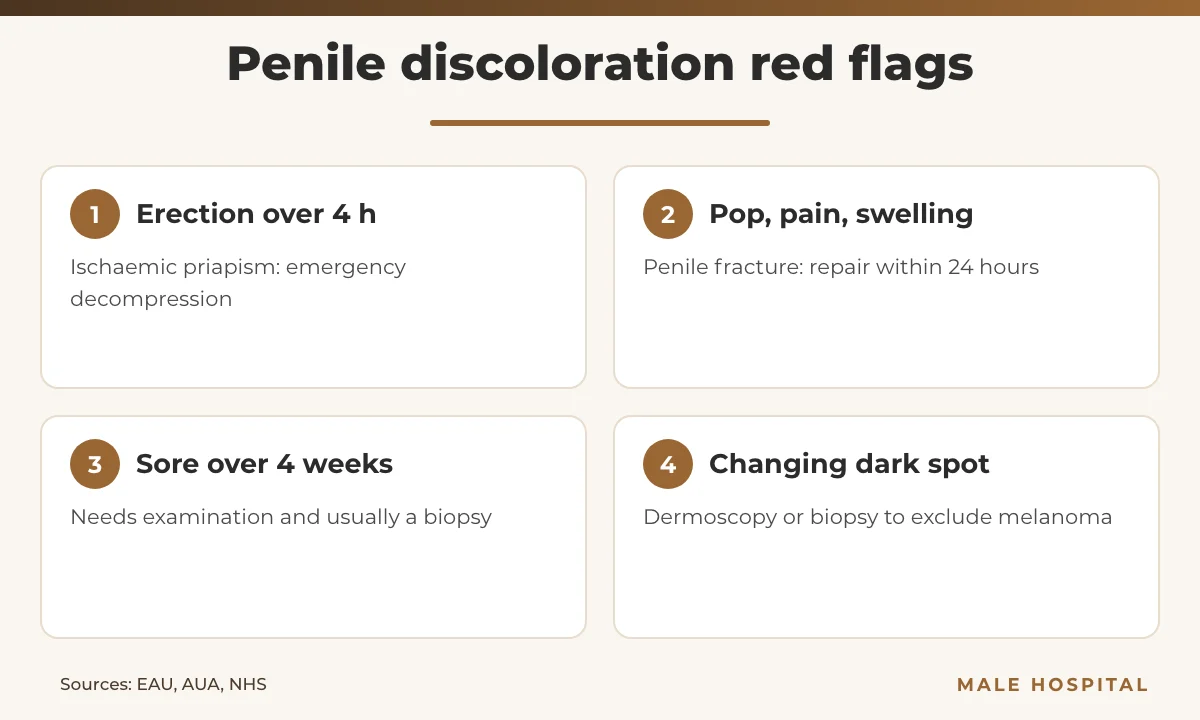
- A purple, swollen penis after a “pop” during sex, or an erection lasting more than 4 hours, is an emergency.
- Any sore, lump, red velvety patch, or penile discoloration that has not healed within 4 weeks needs a doctor and often a biopsy.
- What is penile discoloration?
- Penile discoloration by color: a quick guide
- Red or pink penile discoloration
- White or pale patches
- Brown, black, or darker areas
- Purple, blue, or bruised penis
- When penile discoloration can be precancer or cancer
- How penile discoloration is diagnosed
- Penile discoloration treatment by cause
- When to see a doctor
- FAQs about penile discoloration
What is penile discoloration?
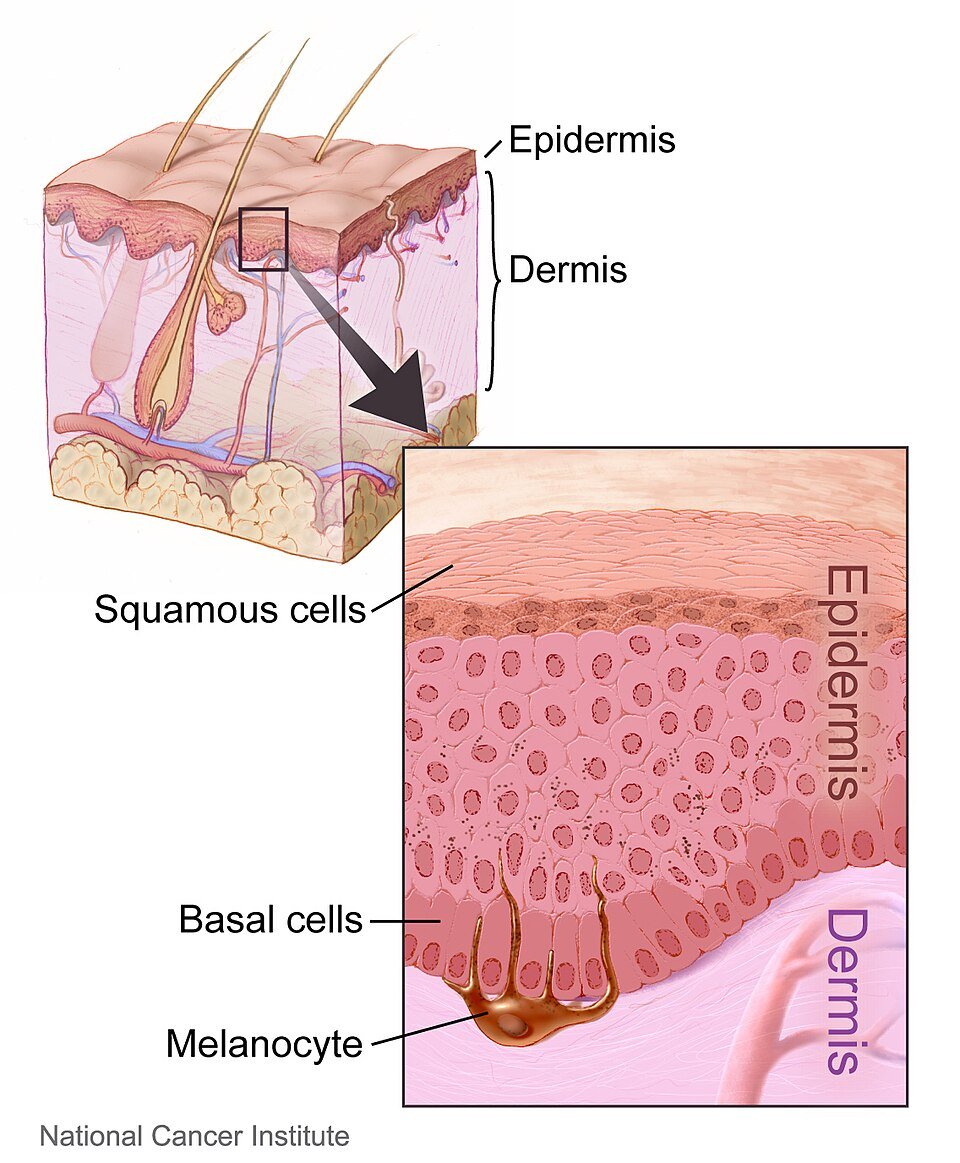
The skin of the penis, like skin elsewhere, has an outer layer (epidermis) that contains pigment-producing cells called melanocytes, and a deeper layer (dermis) that carries blood vessels. Penile discoloration happens when one of three things changes: the amount of pigment (more melanin gives brown or black, less gives white), the blood supply (more blood flow or trapped blood gives red, purple, or blue), or the surface of the skin itself (scaling, thinning, or scarring can look white, shiny, or glazed).
Because the glans and inner foreskin are thin and moist, they react quickly to irritation, infection, and friction, which is why penile discoloration is so common here. On brown or black skin, redness is often less obvious and can look violet or dark blue, so texture, swelling, and symptoms such as itching or pain matter as much as the color itself.
Source: DermNet — Postinflammatory hyperpigmentation; NHS — Balanitis
Harmless bumps that are often mistaken for a skin disease
Pearly penile papules (tiny flesh-colored bumps around the rim of the glans), Fordyce spots (small pale yellow oil glands on the shaft), and angiokeratomas (red-purple papules under 5 mm, mostly on the scrotum) are benign and need no treatment unless they bleed or bother you.
Source: DermNet — Genital skin problems; DermNet — Angiokeratoma
Penile discoloration by color: a quick guide
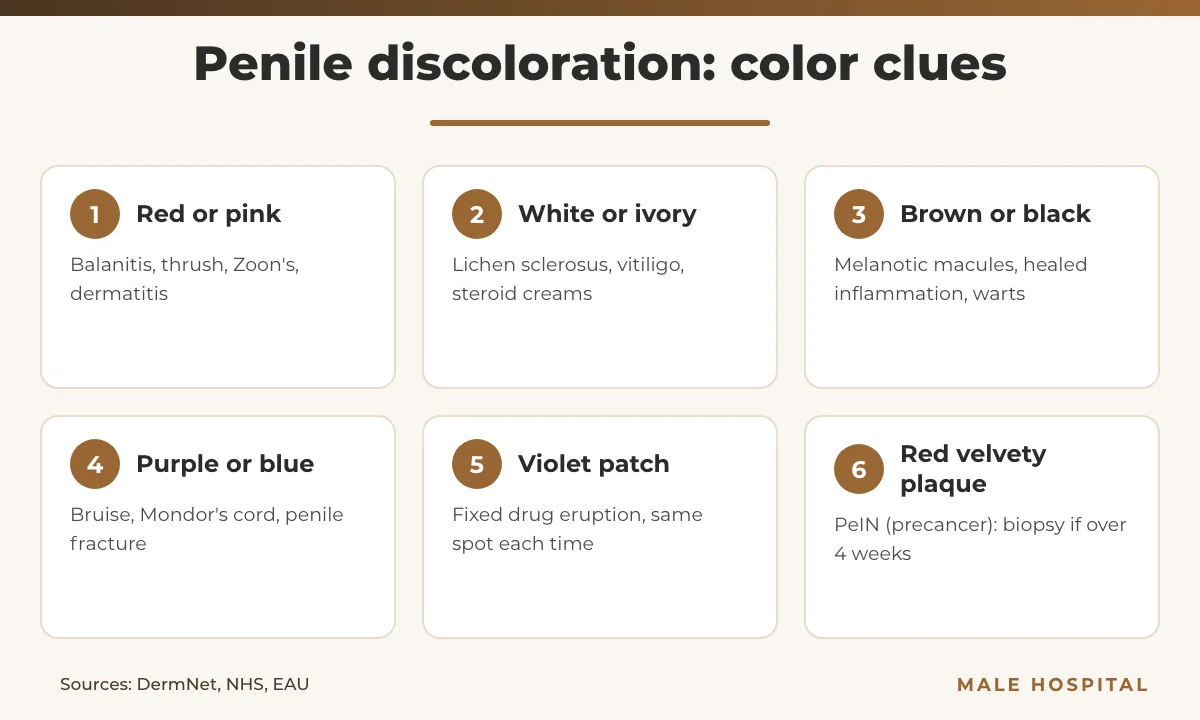
This table is a starting point, not a diagnosis: several causes of penile discoloration overlap, and a doctor may need a swab or biopsy to tell them apart.
| Color | Most likely causes | Typical clues | Urgency |
|---|---|---|---|
| Red or pink | Balanitis (candida, bacteria, irritants), Zoon’s balanitis, psoriasis, dermatitis, herpes | Itching, soreness, swelling, discharge, blisters that burst into sores | See a doctor if not better in days or it keeps returning |
| White, ivory, or pale | Lichen sclerosus, vitiligo, scarring, lightening from potent steroid creams | Shiny or thinned skin, tightening foreskin, splitting (lichen sclerosus); smooth painless patches (vitiligo) | Routine, but lichen sclerosus needs treatment and follow-up |
| Brown, tan, or black | Genital melanotic macules, post-inflammatory darkening, genital warts, bowenoid papulosis, rarely melanoma | Flat, stable spots are usually benign; raised, growing, or irregular lesions need a biopsy | Routine unless new, changing, or bleeding |
| Purple or blue | Bruise (sex, injection, vacuum device), penile fracture, Mondor’s disease, fixed drug eruption, ischaemic priapism | Recent injury or injection; cord-like tender vein; rigid painful erection | Emergency if a “pop” with swelling, or an erection over 4 hours |
| Red velvety plaque or non-healing sore | Penile intraepithelial neoplasia (precancer), penile cancer, syphilis chancre | Lasts more than 4 weeks, bleeds, crusts, or thickens; a painless firm ulcer | Prompt specialist review and biopsy or STI testing |
Source: DermNet — Balanitis; EAU — Sexual and Reproductive Health Guidelines: Priapism
Red or pink penile discoloration: balanitis, thrush, and skin conditions
Redness is the most common form of penile discoloration, and most of it is balanitis, inflammation of the glans. It is present in up to 6% of young men, and uncircumcised men are at higher risk. The head of the penis becomes swollen, itchy, and sore, and there may be a thick discharge under the foreskin, an unpleasant smell, pain when urinating, or difficulty pulling the foreskin back. Our balanitis guide covers the condition in depth; here we focus on how the different causes look.
Source: NHS — Balanitis; DermNet — Balanitis
Candida (thrush)
Candida is the most common single cause of red penile discoloration. It produces blotchy red areas with small red “satellite” papules, or dry dull red patches, often with a white cottage-cheese-like discharge and a burning feeling under the foreskin. Thrush is not classed as a sexually transmitted infection, although sex can trigger it. Poorly controlled diabetes, recent antibiotics, damaged skin, and a weakened immune system make it more likely, and it should clear within 7 to 14 days of starting an antifungal cream or tablet.
Source: NHS — Thrush in men and women; DermNet — Balanitis
Bacterial and irritant balanitis
Bacterial infection, the second most common cause of red penile discoloration, gives uniform redness and swelling, sometimes with a foul smell. Irritant dermatitis from soap, shower gel, or moisture is the most common cause of non-specific balanitis, allergy to fragrances or condom rubber is well recognized, and STIs such as gonorrhoea or chlamydia should be excluded with a swab.
Source: DermNet — Genital skin problems; NHS — Balanitis
Zoon’s balanitis and other inflammatory skin diseases
Zoon’s (plasma cell) balanitis causes a distinctive orange-glazed redness with “cayenne pepper” spots on the glans of uncircumcised men. Lichen planus produces violet-colored, ring-shaped papules and patches. Psoriasis and eczema can also affect the penis. Fixed drug eruption is a reaction to a medicine, most often an antibiotic or an anti-inflammatory painkiller (NSAID), that appears as a single well-defined round or oval red or violet patch, classically on the glans, and comes back in exactly the same spot each time the drug is taken. These conditions are diagnosed clinically, with a biopsy if the skin does not respond to treatment or cancer needs to be ruled out.
Source: DermNet — Balanitis; DermNet — Fixed drug eruption
Genital herpes
Herpes-related penile discoloration starts with tingling, burning, or itching, followed by small blisters that burst and leave open sores; on brown or black skin the sores may look less red. The virus is very easy to pass on from the first tingle until the sores have fully healed, and it can also spread when there are no symptoms. Antiviral tablets limit a first episode if started within 5 days, and later outbreaks are usually milder and less frequent.
Source: NHS — Genital herpes
White or pale penile discoloration: lichen sclerosus and vitiligo
Lichen sclerosus
Skin that has been inflamed for some time can turn white and thinned; this white penile discoloration is the hallmark of lichen sclerosus in men, once called balanitis xerotica obliterans. It causes waxy pallor, ivory-white patches, and scarring on the glans and foreskin, often with itching, burning, splitting, and a foreskin that becomes tight and painful on erection. About 60–70% of men are cured long-term with an ultra-potent steroid ointment; in the remainder, circumcision is curative. Because one-third to one-half of penile cancers are associated with lichen sclerosus, treatment and lifelong self-checks matter.
Source: British Association of Dermatologists — Lichen sclerosus in males; DermNet — Lichen sclerosus in men
Vitiligo
Vitiligo is a long-term cause of white penile discoloration in which patches of skin lose their pigment because the immune system attacks melanocytes. The genitals are among the most commonly affected areas, alongside the hands, face, and body folds. The patches are smooth, painless, and not itchy, which separates them from lichen sclerosus. Vitiligo is not an infection and cannot be caught from anyone. Steroid creams or topical calcineurin inhibitors (tacrolimus or pimecrolimus) can restore some color, but treatment cannot stop the condition from spreading, and the effect often does not last.
Source: NHS — Vitiligo; British Association of Dermatologists — Vitiligo
Lightening from steroid creams
Potent and very potent topical corticosteroids used for a long time can cause thinning and fragility of the skin, easier bruising, stretch marks, and lightening of the skin. The groin is one of the areas most prone to these effects, so steroid creams on the penis should be used only in the strength, amount, and duration your clinician advises.
Source: British Association of Dermatologists — Topical corticosteroids
Brown, black, or darker penile discoloration
Genital melanotic macules (penile melanosis)
Flat, discrete spots ranging from tan to dark brown or black, usually 0.5–2 cm across, that appear on the glans or shaft in adult life are most often genital melanotic macules. Under the microscope they show extra pigment in the basal layer with normal melanocytes and no atypical features; they are benign and occur equally in men and women. Their importance is that they can mimic early melanoma, so a new, irregular, raised, or changing dark spot should be examined by a dermatologist or urologist, who may use dermoscopy or take a biopsy before reassuring you.
Source: J Am Acad Dermatol (PubMed) — Genital melanotic macules: clinical, histologic, immunohistochemical, and ultrastructural features; DermNet — Genital skin problems
Post-inflammatory darkening
After balanitis, herpes, a fixed drug eruption, friction, or any injury has healed, the skin can stay darker for months. This post-inflammatory penile discoloration ranges from light brown to black, is more common and more persistent in darker skin types, and fades slowly on its own. With fixed drug eruption, the brown mark darkens with each recurrence, which is one reason to identify and avoid the responsible drug.
Source: DermNet — Postinflammatory hyperpigmentation; DermNet — Fixed drug eruption
Genital warts and bowenoid papulosis
Genital warts, caused by human papillomavirus (HPV), are small rough lumps that can be white, red, skin-colored, or darker than the surrounding skin, alone or in cauliflower-like groups. They sometimes disappear on their own within 6 months, and creams, freezing, or surgical removal are available. Bowenoid papulosis is a related HPV-16 lesion seen mostly in sexually active people under 30: small pink, brown, or violet papules on the glans or foreskin. It is now classified as a high-grade squamous intraepithelial lesion, so a biopsy and follow-up are needed even though it often resolves.
Source: NHS — Genital warts; DermNet — Bowenoid papulosis
Syphilis
The first sign of syphilis is a chancre: a sore that is usually firm, round, and painless, at the place where the infection entered, typically on or around the penis. It lasts 3 to 6 weeks and heals whether or not you are treated, but the infection continues, and a rough red or reddish-brown rash, often on the palms and soles, may follow. Syphilis is cured with antibiotics, so any painless genital sore deserves a blood test.
Source: CDC — About Syphilis
Purple, blue, or bruised penile discoloration
Simple bruising
A bruise, the usual cause of purple penile discoloration, is blood trapped under the skin after small vessels are crushed without the skin breaking. It starts reddish, turns bluish-purple and then greenish-yellow, and most bruises fade in about two weeks. On the penis the usual triggers are vigorous sex, a zip injury, or a device. Men using a vacuum erection device commonly report pain, petechiae (pinpoint red dots), bruising, and numbness; the constriction ring must be removed within 30 minutes, and these devices should not be used by men with bleeding disorders or on anticoagulants.
Source: MedlinePlus — Bruises; EAU — Sexual and Reproductive Health Guidelines: Management of Erectile Dysfunction
Bruising after penile injections
Bleeding or bruising at the injection site, another cause of penile discoloration, is a common side effect of intracavernosal alprostadil, the self-injection used for erectile dysfunction; guideline data also report penile pain in about 50% of users, prolonged erections in 5%, priapism in 1%, and fibrosis in 2%. An erection lasting more than 4 hours, or redness, swelling, tenderness, or unusual curving of the erect penis, needs immediate medical attention.
Source: MedlinePlus — Alprostadil urogenital; EAU — Sexual and Reproductive Health Guidelines: Management of Erectile Dysfunction
Penile fracture
A penile fracture is a tear of the tunica albuginea, the tough sheath around the erectile tissue; 60% of cases happen during consensual intercourse. It is marked by a sudden cracking or popping sound, pain, and immediate loss of the erection, followed by rapid swelling and purple penile discoloration of the shaft from the expanding hematoma, which can track to the lower abdomen. European guidelines recommend surgical closure of the tunica, ideally within 24 hours, after urethral injury has been excluded. A bruise without the “pop”, with slow softening, points to a “false fracture” or a subcutaneous hematoma, which is treated with anti-inflammatory painkillers and ice.
Source: EAU — Urological Trauma Guidelines: Urogenital trauma
Penile Mondor’s disease
Mondor’s disease is a superficial thrombophlebitis (a clot with inflammation) of the dorsal vein that runs along the top of the penis. It presents as a tender, rope-like cord, sometimes with swelling and redness of the overlying skin, after vigorous or prolonged sexual activity, trauma, or a period of abstinence. The diagnosis is usually clinical, with Doppler ultrasound if in doubt; treatment is supportive with anti-inflammatory painkillers, and most cases resolve within 4 to 6 weeks. It is benign and self-limiting, but it is often mistaken for an STI or Peyronie’s disease.
Ischaemic priapism
Ischaemic (low-flow) priapism accounts for more than 95% of cases and is a medical emergency: the corpora are fully rigid and tender while the glans stays soft, and pain is severe and progressive. Beyond 4 hours it behaves like a compartment syndrome; the risk of erectile dysfunction rises sharply after about 20 hours, and after 36 hours the likelihood of recovering erections is low. First-line treatment is aspiration of the corpora plus intracavernosal phenylephrine, with a shunt if that fails. Cold compresses, exercise, or waiting at home are unlikely to work and should not delay treatment.
Source: EAU — Sexual and Reproductive Health Guidelines: Priapism; AUA/SMSNA — Diagnosis and Management of Priapism Guideline (2022)
When penile discoloration can be precancer or cancer
Penile cancer is uncommon, with an incidence of about 0.94 per 100,000 men in Europe, and it usually arises from the skin of the inner foreskin or the glans. HPV infection is the main risk factor; phimosis is strongly associated with invasive disease, and lichen sclerosus is relatively frequent in men with the cancer. Smoking also increases risk. Our separate guide to penile cancer covers staging and treatment; the point here is which penile discoloration patterns should raise suspicion.
Source: EAU — Penile Cancer Guidelines: Epidemiology, aetiology and pathology
Penile intraepithelial neoplasia (PeIN)
PeIN is the precursor of penile squamous cell carcinoma. It appears as one or more red plaques on the glans or inner foreskin that may be smooth, velvety, moist, scaly, eroded, or warty, with itching, crusting, pain, or bleeding. Older names such as erythroplasia of Queyrat and Bowen’s disease describe the same process and are now discouraged. Diagnosis is often delayed because this penile discoloration resembles balanitis, candidiasis, dermatitis, or psoriasis; a biopsy confirms it. Left untreated, 10–30% of cases progress to invasive cancer, whereas treated lesions recur in only 3–10%.
Source: DermNet — Penile intraepithelial neoplasia; EAU — Penile Cancer Guidelines: Epidemiology, aetiology and pathology
How penile discoloration is diagnosed
Most causes of penile discoloration are diagnosed by looking. The doctor will ask about the timing of the change, injuries, new medicines, sexual history, skin disease elsewhere, and symptoms such as itch, pain, or discharge, then examine the whole penis, foreskin, and groin. Tests are chosen to match the suspected cause:
- Swabs and blood tests for candida, bacteria, and sexually transmitted infections including syphilis and HIV, plus a test for diabetes when balanitis is severe or recurrent.
- Dermoscopy and skin biopsy for red or pigmented patches that do not respond to treatment, or whenever precancer, cancer, or melanoma must be excluded.
- Doppler ultrasound for a suspected Mondor’s cord or to tell ischaemic from non-ischaemic priapism, together with a corporal blood gas in priapism.
- Ultrasound or MRI after an injury to confirm or rule out a tear of the tunica albuginea; MRI is superior to ultrasound for diagnosing penile fracture.
Source: NHS — Balanitis; DermNet — Balanitis; EAU — Urological Trauma Guidelines: Urogenital trauma
Penile discoloration treatment by cause
There is no single treatment for penile discoloration; the color goes back to normal when the cause is treated, and some benign pigment changes need no treatment at all. Genital skin is delicate, so every plan starts with gentle care: wash once or twice daily with warm water or an emollient, avoid soap and shower gel, dry carefully, and retract the foreskin to clean beneath it.
Source: DermNet — Genital skin problems; NHS — Balanitis
- Infective balanitis: antifungal cream for candida, antibiotics for bacterial infection, and treatment of any STI; a mild steroid cream calms irritant or eczema-type inflammation.
- Zoon’s balanitis, lichen planus, lichen sclerosus: an ultra-potent steroid such as clobetasol 0.05% or pimecrolimus; circumcision when the foreskin is scarred or creams fail, which is also the usual route when balanitis keeps returning. Our phimosis treatment page explains how circumcision is planned.
- Fixed drug eruption: stop and avoid the responsible drug for good; a short steroid course settles the patch.
- Vitiligo: steroid creams, topical calcineurin inhibitors, and narrowband UVB phototherapy can restore some color; camouflage products are an option.
- Precancerous lesions: topical 5-fluorouracil or imiquimod, freezing, laser, or excision, with follow-up because recurrence is possible.
- Bruise or Mondor’s disease: rest, ice, and anti-inflammatory painkillers; penile fracture needs surgical repair and priapism needs emergency decompression.
Source: DermNet — Balanitis; British Association of Dermatologists — Vitiligo; DermNet — Penile intraepithelial neoplasia
If penile discoloration is worrying you, or a treatment has not worked, you can arrange a confidential consultation with our urologist-andrologist, Assoc. Prof. Dr. Zülfü Sertkaya, via WhatsApp; the cost of any treatment depends on the assessment.
When to see a doctor about penile discoloration
Go to an emergency department immediately if you have:
- An erection that has lasted more than 4 hours, with or without pain, whether or not you used an erection medicine or injection.
- A cracking or popping sound during sex followed by pain, rapid loss of the erection, and a swelling, purple shaft.
- A penis that is cold, numb, or dusky after a constriction ring or band has been left on.
Book a routine appointment, or visit a sexual health clinic, if you have:
- Redness, soreness, swelling, or discharge of the glans that has not settled within a few days, or balanitis that keeps coming back or is not helped by treatment.
- White, shiny, or thinning skin, a foreskin that is becoming tight, or splitting and bleeding during sex.
- Any sore, lump, rash, or color change that has not healed within 4 weeks, or a dark spot that is new, growing, irregular, or bleeding.
- A painless firm sore or blisters (for STI testing), a tender cord along the top of the penis, or bruising out of proportion to any injury, especially if you take blood thinners.
Source: AUA/SMSNA — Diagnosis and Management of Priapism Guideline (2022); NHS — Penile cancer: Symptoms; MedlinePlus — Bruises
FAQs about penile discoloration
Why is the head of my penis red and itchy?
Red penile discoloration with an itchy, swollen glans is usually balanitis. The most common causes are candida (thrush), bacteria, irritation from soap or condoms, and not being able to clean under a tight foreskin. Diabetes makes thrush more likely. A swab identifies the cause, and the matching antifungal, antibiotic, or mild steroid cream usually clears it within days.
Source: NHS — Balanitis
What causes dark spots on the penis?
Flat tan, brown, or black spots that appear in adult life are usually genital melanotic macules, which are benign and contain extra pigment but normal melanocytes. Dark penile discoloration can also follow healed inflammation or injury. Raised, irregular, growing, or bleeding dark lesions are different: they need dermoscopy and often a biopsy to exclude bowenoid papulosis or melanoma.
Source: J Am Acad Dermatol (PubMed) — Genital melanotic macules; DermNet — Bowenoid papulosis
Why is my penis purple?
Purple penile discoloration after sex, masturbation, an injection, or a vacuum device is usually a bruise and fades through blue, green, and yellow over about two weeks. A purple, rapidly swelling shaft after a “pop” suggests penile fracture, and a rigid, painful, dusky erection lasting hours is ischaemic priapism; both need emergency care the same day.
Source: MedlinePlus — Bruises; EAU — Urological Trauma Guidelines: Urogenital trauma
Can an STI change the color of the penis?
Yes. Herpes causes blisters that burst into red open sores; syphilis causes a firm, round, painless chancre that heals by itself in 3 to 6 weeks while the infection continues; HPV causes warts that may be white, red, skin-colored, or darker than nearby skin; and gonorrhoea or chlamydia can inflame the glans. A sexual health clinic can test for all of these in one visit.
Source: CDC — About Syphilis; NHS — Genital warts
Can a medicine cause penile discoloration?
Yes. A fixed drug eruption is a well-defined red or violet patch, classically on the glans, that returns in the same place each time a particular medicine is taken, most often an antibiotic such as cotrimoxazole or an NSAID painkiller. It leaves a brown mark that darkens with each episode. Stopping the drug for good is the treatment.
Source: DermNet — Fixed drug eruption
Does white skin on the penis mean lichen sclerosus?
Often, but not always. Lichen sclerosus causes white, shiny, thinned, or scarred skin with itching, splitting, and a tightening foreskin, and it needs an ultra-potent steroid ointment and follow-up. Vitiligo causes smooth, symptom-free pale patches, and long-term potent steroid creams can also lighten the skin. A doctor can usually tell them apart, with a biopsy if needed.
Source: British Association of Dermatologists — Lichen sclerosus in males; NHS — Vitiligo
How long does penile discoloration take to go away?
It depends on the cause. Thrush should clear within 7 to 14 days of antifungal treatment, most bruises fade in about two weeks, and Mondor’s cords settle in 4 to 6 weeks. Post-inflammatory darkening can take months, especially in darker skin, while vitiligo patches and benign pigment spots usually stay unless treated.
Source: NHS — Thrush in men and women; Indian J Urol (PMC) — Penile Mondor’s disease
Medically reviewed by Assoc. Prof. Dr. Zülfü Sertkaya, urologist and andrologist (FEBU), Istanbul. Last reviewed: November 2026.
This article is for general information and does not replace an individual consultation with a qualified doctor.
- NHS — Balanitis
- NHS — Thrush in men and women
- NHS — Genital herpes
- NHS — Genital warts
- NHS — Vitiligo
- NHS — Penile cancer: Symptoms
- DermNet — Balanitis
- DermNet — Genital skin problems
- DermNet — Angiokeratoma
- DermNet — Postinflammatory hyperpigmentation
- DermNet — Fixed drug eruption
- DermNet — Lichen sclerosus in men
- DermNet — Bowenoid papulosis
- DermNet — Penile intraepithelial neoplasia
- British Association of Dermatologists — Lichen sclerosus in males (patient information leaflet)
- British Association of Dermatologists — Vitiligo (patient information leaflet)
- British Association of Dermatologists — Topical corticosteroids (patient information leaflet)
- EAU — Sexual and Reproductive Health Guidelines: Priapism
- EAU — Sexual and Reproductive Health Guidelines: Management of Erectile Dysfunction
- EAU — Urological Trauma Guidelines: Urogenital trauma
- EAU — Penile Cancer Guidelines: Epidemiology, aetiology and pathology
- AUA / SMSNA — Diagnosis and Management of Priapism Guideline (2022)
- MedlinePlus — Bruises
- MedlinePlus — Alprostadil urogenital
- CDC — About Syphilis
- Indian J Urol (PMC) — Thrombosis of the dorsal vein of the penis (Mondor's disease): a case report and review of the literature
- J Am Acad Dermatol (PubMed) — Genital melanotic macules: clinical, histologic, immunohistochemical, and ultrastructural features