Jelqing is a hand “milking” exercise that is supposed to make the penis longer or thicker by repeatedly pushing blood from the base toward the head of a semi-erect penis. There is no clinical trial showing that it works, no urology guideline recommends it, and the repeated pulling and squeezing can injure the same tissues that are needed for a firm erection. If size is the concern, our penis enlargement page explains which options have evidence and which do not.
Sources: EAU Guidelines — Sexual and Reproductive Health: Penile size abnormalities and dysmorphophobia; PubMed (Sex Med) — Veale et al., Sexual functioning and behavior of men with body dysmorphic disorder concerning penis size (2015)
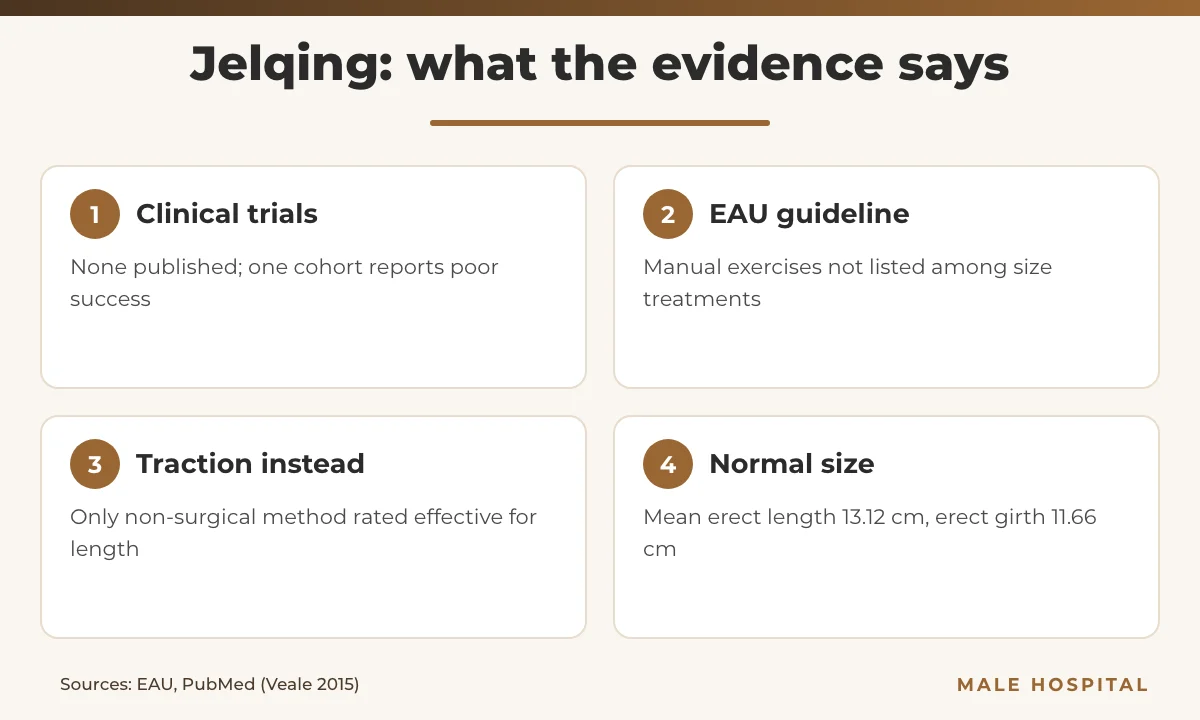
- Jelqing has never been tested in a published clinical trial. The only peer-reviewed paper that mentions it lists it among methods men tried “with poor reported success”.
- The European Association of Urology (EAU) guideline on penile size does not include manual exercises at all; the only non-surgical method it considers for length is penile traction, with a weak recommendation.
- Reported harms of forceful penile manipulation include bruising, superficial vein thrombosis (penile Mondor’s disease), scarring of the tunica albuginea (Peyronie’s disease) and, with an erect penis, penile fracture.
- Most men who ask for enlargement already have a normal-sized penis; the pooled average erect length is 13.12 cm and erect girth 11.66 cm.
- A urologist-andrologist can measure you properly, rule out curvature or scarring and explain the evidence-based alternatives.
- What is jelqing?
- How jelqing is supposed to work, and why the anatomy argues against it
- Does jelqing work? What the research actually shows
- Jelqing risks and injuries
- Jelqing and Peyronie’s disease
- Is my penis really small? The numbers
- Evidence-based alternatives to jelqing
- What urologists recommend instead of jelqing
- When to see a doctor
- FAQs about jelqing
What is jelqing?
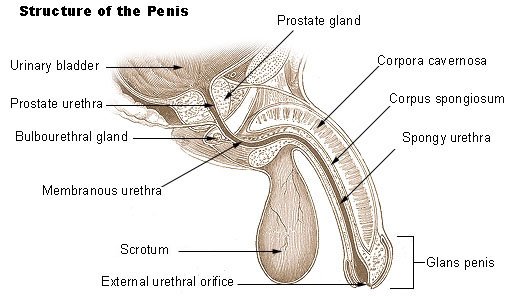
Jelqing is a manual penis “exercise” promoted on forums, videos and product sites as a way to increase length and girth. The person forms a ring with the thumb and index finger around the base of a partially erect, lubricated penis and slides it slowly toward the glans, then repeats the stroke with the other hand, often for hundreds of strokes a day over weeks or months.
The technique appears in the medical literature only as one of several self-help methods, alongside vacuum pumps and stretching devices, that men worried about penis size report trying. In the cohort that documented this, success was described as poor.
How jelqing is supposed to work, and why the anatomy argues against it
Promoters claim that forcing blood along the shaft stretches the erectile chambers and creates “micro-tears” that heal bigger, much as muscle fibres do after weight training. The penis, however, contains no skeletal muscle to train. The two corpora cavernosa are sponge-like chambers of smooth muscle and blood spaces, wrapped in a tough elastic membrane called the tunica albuginea. An erection happens when these chambers fill with blood and the tunica stretches tight enough to trap it.
That membrane is exactly what jelqing stresses. The National Institute of Diabetes and Digestive and Kidney Diseases (NIDDK) describes how bending or hitting the penis can injure the tissues inside, causing bleeding and swelling within the tunica albuginea; when the injury heals, scar tissue and a plaque can form. The injury can be a single event or repeated over time. In other words, the “micro-tears” that jelqing routines promise are the same mechanism that urologists describe for Peyronie’s disease, and they do not make the organ bigger.
Sources: NIDDK — Penile Curvature (Peyronie’s Disease); AUA — Peyronie’s Disease Guideline
Does jelqing work? What the research actually shows
No. There is no randomized trial, no prospective study and no measured case series of jelqing in the peer-reviewed literature. A search of PubMed, the US National Library of Medicine database, for the term returns a single paper, and that paper only records that men anxious about their size had tried jelqing with poor results. Claims of gains of one or two inches come from before-and-after photos and forum testimonials, which cannot be checked for lighting, angle, erection level or honesty.
The guidelines are consistent with this silence. The EAU chapter on penile size abnormalities reviews every intervention for which data exist: traction devices, vacuum devices, hormones, psychotherapy, fillers and surgery. Manual exercises are not on the list because there is nothing to review. The largest systematic review of penile enhancement, covering 57 studies and more than 4,000 men, likewise found evidence only for traction, injectable fillers and surgery, and rated even that evidence as low quality.
A fair summary is that jelqing has not been shown to work, rather than that it has been tested and failed. Without evidence of benefit, any injury is a cost with no return.
Sources: EAU Guidelines — Penile size abnormalities and dysmorphophobia; PubMed (BJU Int) — Romero-Otero et al., Non-invasive and surgical penile enhancement interventions: a systematic review (2021)
Jelqing versus the methods that have data
| Method | Published evidence | EAU position | Main risks |
|---|---|---|---|
| Jelqing (manual) | No trials; one cohort reports poor success | Not mentioned | Bruising, vein thrombosis, tunica scarring, fracture if erect |
| Penile traction device | Three prospective studies, 21–54 men; flaccid length +1.7 to +2.3 cm after 3–6 months of 4–9 h/day | Weak recommendation for length; no effect on girth | Discomfort, poor compliance |
| Vacuum erection device | 27 men, 3×/week for 6 months: no significant length gain | Ineffective for lengthening | Bruising, numbness if overused |
| Testosterone or other hormones | Works only in boys with micropenis; no effect after puberty | Strong recommendation against use after puberty | Hormonal side effects |
| Lengthening surgery | 12 studies, 931 men: gains 0.6–6.4 cm, complications 0–50% | Selected cases only, after counselling | Scarring, loss of angle, dissatisfaction |
Sources: EAU Guidelines — Penile size abnormalities and dysmorphophobia; PubMed (J Sex Med) — Abu-Ghname et al., Augmentation phalloplasty for acquired penile shortening: a systematic review (2020)
Jelqing risks and injuries
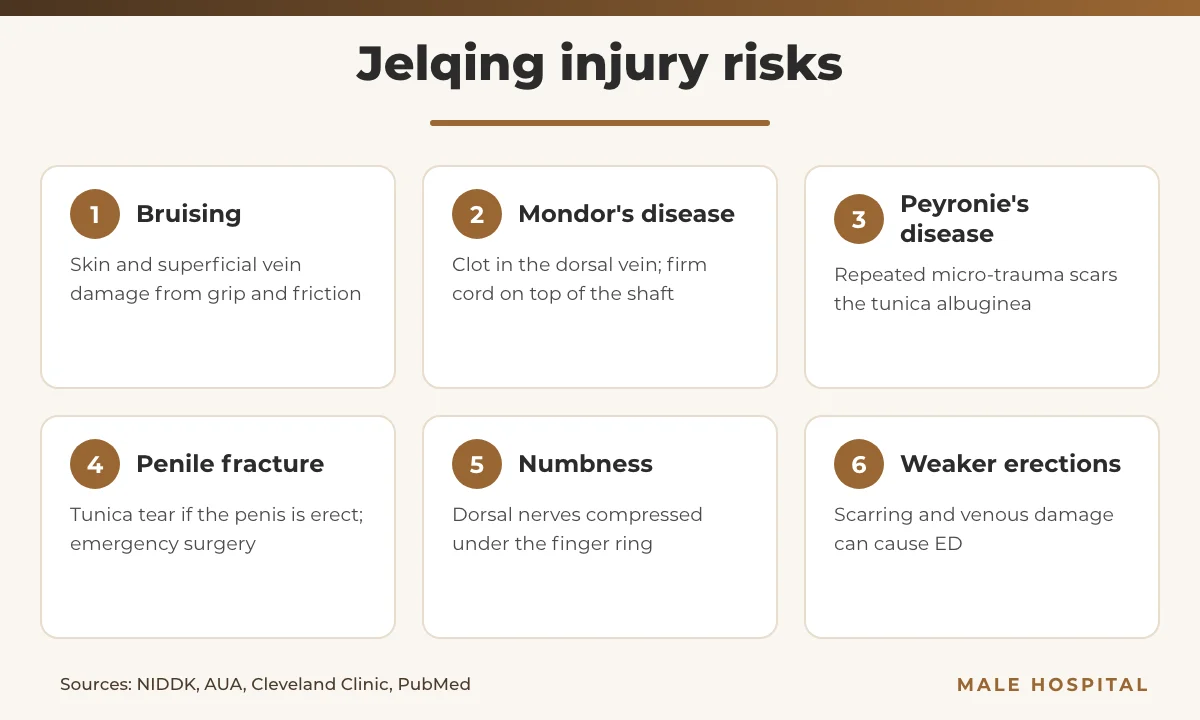
Because jelqing is unstudied, there is no complication rate to quote. What exists is a clear picture, from case reports and the penile trauma literature, of what forceful, repeated handling does to the tissues. These are the injuries a urologist thinks of first when a patient admits to months of “exercises”.
Bruising, swelling and skin damage
The superficial veins and skin of the shaft take the strain first. Over-tight grip or dry friction causes pin-point bleeding, bruising, swelling and sometimes a torn frenulum. These usually settle on their own, but they signal that the deeper layers are under the same load.
Penile Mondor’s disease
Mondor’s disease of the penis is a thrombosis of the superficial dorsal vein, felt as a firm, cord-like, sometimes painful swelling along the top of the shaft. Published reviews list trauma, excessive sexual activity and excessive exercise among its triggers, and a 2020 case report described it in a 26-year-old after intense masturbation. Treatment is usually anti-inflammatory medication and rest, but it can take weeks to settle and is frightening when it appears.
Sources: PubMed (Int Med Case Rep J) — Walsh et al., Penile Mondor’s disease: a case report and literature review (2014); PubMed (Cureus) — Sheikh et al., Penile Mondor’s disease: rare association with excessive masturbation (2020)
Penile fracture
A penile fracture is a tear in the tunica albuginea of an erect penis. Cleveland Clinic lists energetic masturbation that forcefully bends the erection among its causes, together with intercourse and “taqaandan”, a practice of deliberately bending the erect penis to change its shape. The warning signs are a popping or cracking sound, immediate loss of erection, intense pain and rapid bruising and swelling. It is a surgical emergency: repair with stitches has a success rate above 90%, while an untreated tear can leave permanent curvature, erection problems and difficulty urinating. Jelqing guides tell users to stay only partly erect for this reason, which is itself an admission of the risk.
Source: Cleveland Clinic — Penile Fracture
Erection changes and numbness
The nerves that carry sensation from the glans run along the top of the shaft, directly under the thumb-and-finger ring used in jelqing, and repeated compression can leave temporary numbness. Men who notice softer erections after weeks of exercises should stop and be assessed, because a weaker erection can be the first sign of scarring inside the tunica. Our guide to penile fracture covers the emergency picture in more detail.
Jelqing and Peyronie’s disease
Peyronie’s disease is the injury that worries andrologists most, because it is the opposite of what the jelqing user wanted: a plaque of scar tissue in the tunica albuginea that bends the erect penis, and can shorten and narrow it. The American Urological Association describes it as an acquired disorder of the tunica albuginea in which “repetitive minor trauma to the penis” sets off a cascade of protein deposition and scarring. NIDDK lists vigorous activity that causes micro-injuries among the risk factors, and Cleveland Clinic notes that up to 80% of patients cannot remember a specific triggering event, which fits a pattern of many small insults rather than one accident.
No study has counted how many Peyronie’s cases follow jelqing, so we will not invent a figure. What can be said is that the mechanism the condition is built on, repeated low-grade trauma to an elastic membrane, is the mechanism the exercise deliberately applies, hundreds of times a session. Symptoms to watch for are a hard lump under the skin of the shaft, a new bend or hourglass narrowing during erection, pain with erections and loss of length. Early treatment matters: the acute, painful phase is when the plaque is still forming, and our article on Peyronie’s disease explains the options from traction and injections to surgery.
Sources: AUA — Peyronie’s Disease Guideline; Cleveland Clinic — Peyronie’s Disease; MedlinePlus — Curvature of the penis
Is my penis really small? The numbers
Most men who look up jelqing have never been measured by a clinician, and most are normal. A systematic review that pooled measurements taken by health professionals in up to 15,521 men produced these averages: flaccid length 9.16 cm, stretched flaccid length 13.24 cm, erect length 13.12 cm, flaccid girth 9.31 cm and erect girth 11.66 cm. The authors built nomograms from these data so that a man can see where he sits on the curve; the great majority sit within a few centimetres of the mean.
The medical definition of a genuinely small penis is strict. The EAU defines micropenis as a stretched length 2.5 standard deviations or more below the population mean, a cut-off that excludes the vast majority of men seeking enlargement. Reviews of elongation surgery state plainly that the majority of men requesting treatment have a normal penile size. You can compare your own measurement with the full tables in our guide to average penis size.
Sources: PubMed (BJU Int) — Veale et al., Am I normal? Nomograms for flaccid and erect penis length and circumference in up to 15,521 men (2015); PMC (Transl Androl Urol) — Campbell & Gillis, A review of penile elongation surgery (2017)
Size anxiety and body dysmorphic disorder
When a man with a normal measurement remains convinced he is too small, guidelines ask the doctor to consider penile dysmorphic disorder, a form of body dysmorphic disorder. The EAU gives a strong recommendation to screen for it in every normal-sized man complaining of a short penis and to refer suspected cases for mental health support. This is not dismissive: men with this disorder in the Veale cohort had measurably worse erectile and orgasmic function and lower satisfaction than controls, and they were the group most likely to be jelqing, pumping and stretching with no benefit. Treating the anxiety improves sexual life in a way that no exercise can.
Sources: EAU Guidelines — Penile size abnormalities and dysmorphophobia; PubMed (Sex Med) — Veale et al., Men with body dysmorphic disorder concerning penis size (2015)
Evidence-based alternatives to jelqing
If, after measurement and counselling, a man still wants to change his size, there are options that have at least been studied. None is dramatic; the honest comparison is that these have measured results and known risks, while jelqing has neither.
Penile traction therapy
Traction is the only non-surgical method the EAU considers effective for length. In the three prospective studies it cites, men wore a device for 4 to 9 hours a day for 3 to 6 months and gained roughly 1.7 to 2.3 cm of flaccid length; a separate review reports 1 to 3 cm with 4 to 6 hours of daily wear. The gain is in length only, the recommendation is graded weak because there are no randomized trials, and compliance is the main obstacle. The key difference from jelqing is that traction applies a low, constant, measured force rather than repeated high-pressure squeezing. Our article on penis extender devices explains how they are worn and what to expect.
Vacuum devices
Vacuum erection devices are useful after prostate surgery and penile implant surgery, but for enlargement the EAU rates them ineffective: in a study of 27 men with a stretched length under 10 cm, six months of use three times a week produced no significant change in flaccid or stretched length.
Girth enhancement with fillers
Hyaluronic acid and other soft-tissue fillers are the non-surgical option with the most girth data, and the EAU gives them a weak recommendation, while strongly advising against silicone, paraffin and petroleum jelly injections. The same guideline strongly recommends not using fillers in men with penile dysmorphic disorder.
Surgery
Suspensory ligament release and related procedures produce measured gains, but the systematic review of 931 patients found complication rates from 0% to 50% and no single technique that stood out. The EAU reserves surgery for selected, well-counselled men. Both the EAU and reviewers insist on conservative treatment first. The details are in our guide to penis enlargement surgery.
Sources: EAU Guidelines — Penile size abnormalities and dysmorphophobia; PMC (Transl Androl Urol) — Campbell & Gillis, A review of penile elongation surgery (2017); PubMed (J Sex Med) — Abu-Ghname et al., Augmentation phalloplasty: a systematic review (2020)
What urologists recommend instead of jelqing
The guideline pathway is short. First, measure: stretched flaccid length at minimum, girth in every patient, and an erect measurement after an injection test before any surgery. Second, compare the result with reference values and explain them. Third, screen for dysmorphic disorder and for conditions that cause real shortening, such as Peyronie’s disease. Only then are traction, fillers or surgery discussed, with realistic numbers.
Assoc. Prof. Dr. Zülfü Sertkaya, our urologist-andrologist in Istanbul, has researched penile enlargement techniques and their complications and holds FEBU certification from the European Board of Urology. If you have been jelqing and have noticed a lump, a bend or weaker erections, a confidential assessment over WhatsApp is the quickest way to find out whether anything needs treatment.
Source: EAU Guidelines — Penile size abnormalities and dysmorphophobia
When to see a doctor
Stop jelqing and seek care the same day if any of the following happens:
- A pop or crack during an erection, followed by sudden loss of erection, pain, swelling or bruising. This is a possible penile fracture and needs emergency assessment; surgery within hours gives the best chance of a normal erection afterwards.
- Blood at the tip of the penis or in the urine, which can mean the urethra has been injured.
- Sharp pain during intercourse followed by swelling and bruising, which MedlinePlus lists as a reason to contact a provider.
Book a routine urology appointment within a few weeks if you notice a firm cord or lump along the shaft, a new curve or narrowing when erect, pain with erections, glans numbness, or softer erections since you started exercises. These are early signs of Mondor’s or Peyronie’s disease, both easier to treat before scar tissue matures.
Sources: Cleveland Clinic — Penile Fracture; MedlinePlus — Curvature of the penis
FAQs about jelqing
Does jelqing really increase penis size?
There is no published trial, measured case series or guideline that shows jelqing increases length or girth. The one peer-reviewed paper that mentions it recorded men who had tried it with poor reported success. Online before-and-after photos cannot be verified for erection level, angle or editing, so they are not evidence.
Source: PubMed (Sex Med) — Veale et al. (2015)
Is jelqing safe if I do it gently with lubricant?
Gentler technique lowers the chance of bruising and skin tears, but it does not remove the underlying problem: repeated pulling on the tunica albuginea is the type of minor, repetitive trauma that urology guidelines link to Peyronie’s scarring. Because there is no proven benefit, even a small risk is a poor trade. Any lump, bend or new pain means stop.
Source: AUA — Peyronie’s Disease Guideline
Can jelqing cause Peyronie’s disease?
No study has counted cases, so the exact risk is unknown. The mechanism, however, is the one NIDDK and the AUA describe for Peyronie’s disease: repeated bending or compression that injures the tunica albuginea, followed by scar tissue and a plaque. Most Peyronie’s patients cannot recall a single injury, which fits repeated small insults such as daily exercises.
Sources: NIDDK — Penile Curvature (Peyronie’s Disease); Cleveland Clinic — Peyronie’s Disease
Can you break your penis while jelqing?
Yes, if the penis is erect. A penile fracture is a tear of the tunica albuginea, and forceful bending of an erection during masturbation is a recognized cause. You would hear a pop, lose the erection at once and see rapid swelling and bruising. It is an emergency; surgical repair has a success rate above 90%, while leaving it untreated risks permanent curvature and erectile dysfunction.
Source: Cleveland Clinic — Penile Fracture
What is the hard, cord-like lump on top of my penis after jelqing?
A firm, rope-like swelling along the top of the shaft is the classic sign of penile Mondor’s disease, a clot in the superficial dorsal vein. Trauma, excessive sexual activity and excessive exercise are its reported triggers. It usually settles with anti-inflammatory medication and rest, but it should be examined, sometimes with a Doppler ultrasound, to confirm the diagnosis.
Source: PubMed (Int Med Case Rep J) — Walsh et al. (2014)
Is a penis extender better than jelqing?
From an evidence standpoint, yes. Traction devices are the only non-surgical method the EAU considers effective for length, with flaccid gains of about 1.7 to 2.3 cm after 3 to 6 months of daily wear in prospective studies. The recommendation is weak because there are no randomized trials, the effect is on length only, and the device must be worn for hours each day.
Source: EAU Guidelines — Penile size abnormalities and dysmorphophobia
How do I know if my penis is actually small?
Measure stretched flaccid length from the pubic bone to the tip, pressing the ruler into the fat pad. Pooled clinical measurements give a mean stretched length of 13.24 cm and erect length of 13.12 cm. Micropenis is defined as 2.5 standard deviations or more below the mean, so almost every man who worries about size is in the normal range.
Sources: PubMed (BJU Int) — Veale et al., Am I normal? (2015); EAU Guidelines
Does jelqing help erectile dysfunction?
No evidence supports jelqing for erections, and the injuries it can cause, tunica scarring and venous damage, are themselves causes of erectile dysfunction. Men who want better erections should have the actual cause assessed by a urologist, who can offer treatments that have been tested rather than an exercise that has not.
Source: Cleveland Clinic — Penile Fracture
Medically reviewed by Assoc. Prof. Dr. Zülfü Sertkaya, urologist and andrologist (FEBU), Istanbul. Last reviewed: November 2026.
This article is for general information and does not replace an individual consultation with a qualified doctor.
- EAU Guidelines — Sexual and Reproductive Health — Penile size abnormalities and dysmorphophobia
- PubMed (Sex Med) — Veale et al., Sexual functioning and behavior of men with body dysmorphic disorder concerning penis size compared with men anxious about penis size and with controls (2015)
- PubMed (BJU Int) — Veale et al., Am I normal? A systematic review and construction of nomograms for flaccid and erect penis length and circumference in up to 15,521 men (2015)
- PubMed (BJU Int) — Romero-Otero et al., Non-invasive and surgical penile enhancement interventions for aesthetic or therapeutic purposes: a systematic review (2021)
- PubMed (J Sex Med) — Abu-Ghname et al., Augmentation phalloplasty for acquired penile shortening: a systematic review of techniques, outcomes, patient satisfaction, and limitations (2020)
- PMC (Transl Androl Urol) — Campbell & Gillis, A review of penile elongation surgery (2017)
- PubMed (Int Med Case Rep J) — Walsh et al., A common presentation to an uncommon disease. Penile Mondor's disease: a case report and literature review (2014)
- PubMed (Cureus) — Sheikh et al., Penile Mondor's disease: rare association with excessive masturbation (2020)
- NIDDK — Penile Curvature (Peyronie's Disease)
- AUA — Peyronie's Disease Guideline
- Cleveland Clinic — Penile Fracture
- Cleveland Clinic — Peyronie's Disease
- MedlinePlus — Curvature of the penis