Frenulum breve is a penile frenulum that is too short, so it pulls on the head of the penis during erection and causes pain, a downward tug of the glans, or small tears that bleed during sex. It is usually present from birth, is often mistaken for phimosis, and is treated with a short outpatient operation called frenuloplasty that lengthens the band while keeping the foreskin. Below you will find how to recognize it, how it differs from a tight foreskin (see our phimosis treatment page), what stretching and creams can do, and what frenuloplasty, frenulectomy and circumcision involve.
Sources: Cleveland Clinic — Frenulum Breve (Short Frenulum); Healthy Male — Frenulum breve or tight frenulum: what you need to know
- The frenulum is the band under the head of the penis that links foreskin to glans; in frenulum breve it is too short to let the foreskin slide back fully when erect.
- Typical signs are pain during erections or sex, the glans tilting downward, difficulty retracting the foreskin, and tearing with bleeding on the underside of the head.
- Mild cases may be helped by gentle stretching and a steroid cream under medical guidance; a short frenulum does not go away on its own.
- Frenuloplasty lengthens the band in about 30 minutes, usually under local anesthesia; in a 106-man series satisfaction averaged 8.9/10 and only 8% later needed circumcision.
- Expect at least 10 days of healing and no sex for 4 weeks; a frenulum that keeps re-tearing or will not stop bleeding needs a doctor.
- What is frenulum breve?
- Frenulum breve symptoms: how it feels
- Frenulum breve vs phimosis: telling them apart
- Stretching and steroid cream: non-surgical options
- Frenuloplasty: what happens in surgery
- Frenuloplasty vs frenulectomy vs circumcision
- Recovery and risks after frenuloplasty
- Frenulum breve and premature ejaculation
- Torn frenulum first aid and when to see a doctor
- FAQs about frenulum breve
What is frenulum breve?
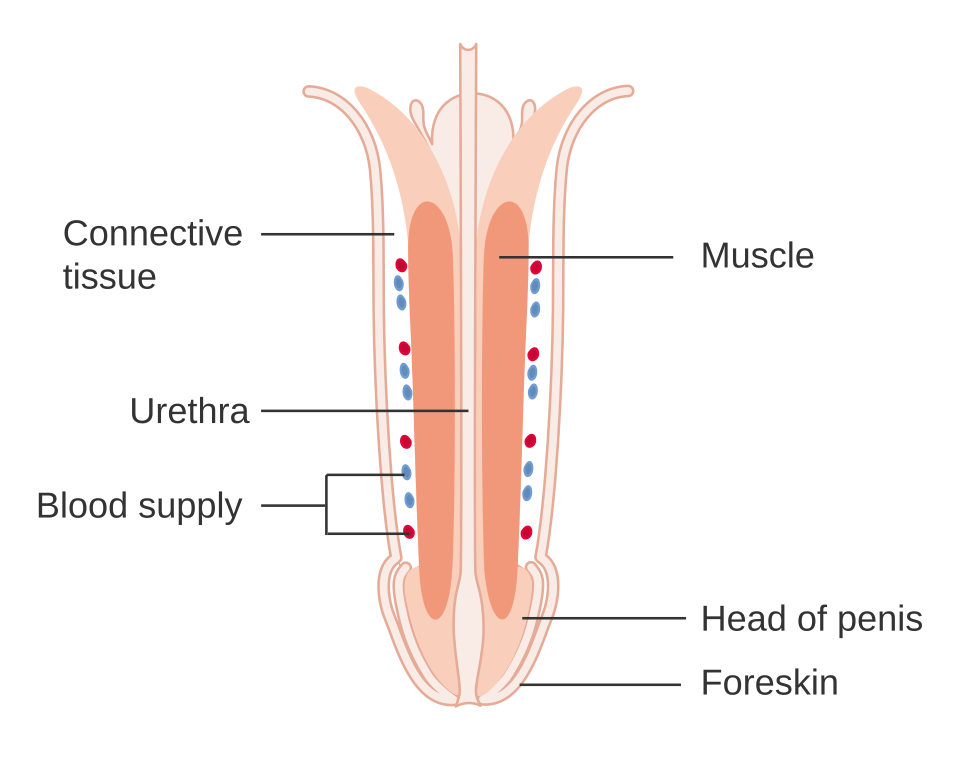
The penile frenulum is a thin ridge of tissue on the underside of the glans, where the inner foreskin meets the head of the penis. It is made of mucous membrane and tough collagen fibers, it helps the foreskin glide forward over the head and back again during an erection, and it is one of the most sensitive parts of the penis because of its dense supply of nerve endings.
“Breve” is Latin for short. In frenulum breve the band is shorter than it should be, so when the foreskin retracts on an erect penis the frenulum reaches its limit first: it pulls on the glans, resists full retraction, and can tear if the pull is strong enough. It is also called a short or tight frenulum.
Sources: Cleveland Clinic — Penis Frenulum: Anatomy, Function & Conditions; Cleveland Clinic — Frenulum Breve (Short Frenulum)
Why the frenulum is short
Most men with a short frenulum are born with it and only notice it in their teens or twenties, when erections become firmer and sex starts to stress the band. A frenulum can also shorten later in life when its tissue heals with scar: after repeated infections or inflammation of the glans and foreskin (balanitis and balanoposthitis), a skin disease such as lichen sclerosus, or a tear that healed badly. A tight foreskin can shorten the frenulum too, which is why the two problems often travel together.
Prevalence figures are scarce. Healthy Male, the Australian government-funded men’s health body, cites research in which about one in 1,200 boys in Denmark needed surgery for frenulum breve, and a 2025 surgical report describes young men in their early twenties seeking circumcision as the group in which it is most often found.
Sources: Healthy Male — Frenulum breve or tight frenulum: what you need to know; PMC — Frenulum Breve: An Addendum to Accessory Penile Frenulum (Nambi & Nanda Gopal, 2025)
Frenulum breve symptoms: how it feels
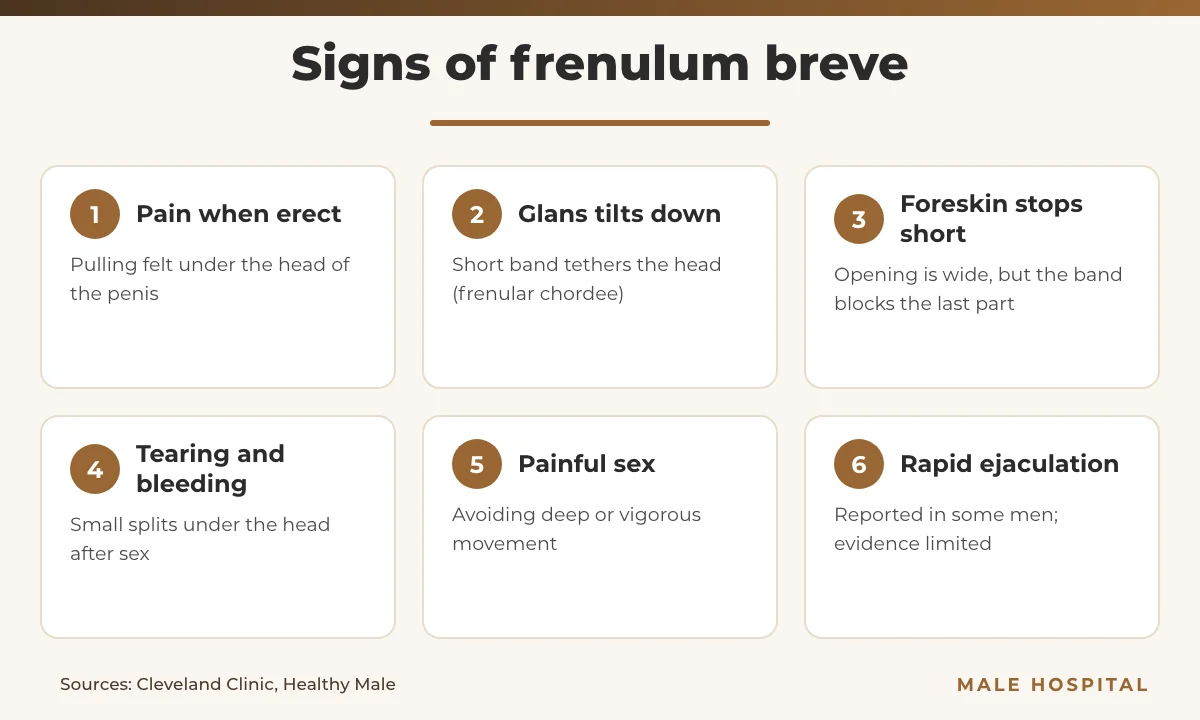
A short frenulum rarely causes trouble when the penis is soft. The symptoms appear with erections, and especially during sex or masturbation, when the foreskin is pulled back hard against the band. Men typically describe one or more of the following:
- Pain or a pulling sensation during erection, felt on the underside of the head.
- The glans tilting downward when erect, because the short band tethers it toward the shaft. When this bend is marked it is called frenular chordee.
- Difficulty pulling the foreskin fully back over the head, even though the foreskin opening itself is wide enough.
- Tearing and bleeding under the head after intercourse or vigorous masturbation; even a small split can bleed a surprising amount.
- Rapid ejaculation in some men, discussed in its own section below.
Sensation is not reduced by a short frenulum; the band stays highly sensitive. Each tear heals with a little scar, and scar is less elastic than skin, so an untreated short frenulum tends to get tighter over the years, not looser.
Sources: Cleveland Clinic — Frenulum Breve (Short Frenulum); Cleveland Clinic — Penis Frenulum: Anatomy, Function & Conditions
Frenulum breve vs phimosis: telling them apart
Frenulum breve is often misdiagnosed as phimosis, and the two can coexist. Phimosis means the foreskin opening is too narrow to retract over the head; in adults it is usually a scarred, whitish ring, and a severe form is linked to balanitis xerotica obliterans (genital lichen sclerosus). In frenulum breve the opening is wide enough, but the band underneath stops the foreskin at the last part of its journey. See our guide to phimosis in adults for the foreskin side of the story.
| Feature | Frenulum breve | Phimosis |
|---|---|---|
| What is tight | The band under the glans | The ring at the foreskin opening |
| Foreskin when soft | Usually retracts fully | Retracts partly or not at all |
| Typical sign when erect | Glans pulled downward; pain on the underside; tearing | Foreskin cannot pass over the head; may balloon when urinating |
| Common causes in adults | Congenital; scarring after tears or infection | Scarring, balanitis, BXO / lichen sclerosus |
| First-line treatment | Stretching with steroid cream in mild cases; frenuloplasty | Topical steroid 4–8 weeks (>80% success in children); circumcision if scarred |
| Foreskin-sparing surgery | Frenuloplasty | Preputioplasty or dorsal slit in selected cases |
Sources: EAU Guidelines — Paediatric Urology: Phimosis and other abnormalities of the penile skin; NHS — Phimosis (tight foreskin)
How frenulum breve is diagnosed
No scan or blood test is needed. A urologist asks when the pain or tearing happens and examines the penis with the foreskin gently retracted. A short band that tents the glans downward, a scar line or healing split on the underside, and an otherwise wide foreskin opening confirm the diagnosis. The examination also looks for whitish scarring that would point to lichen sclerosus, because that changes the choice of operation.
Sources: Cleveland Clinic — Frenulum Breve (Short Frenulum); EAU Guidelines — Paediatric Urology: Phimosis and other abnormalities of the penile skin
Stretching and steroid cream: non-surgical options
For a mildly short frenulum that has never torn, doctors may first suggest gentle daily stretching with a low-potency steroid cream. The cream makes the skin more supple; the stretch is done for a few minutes a day, after a warm shower or with a lubricant. Cleveland Clinic and Healthy Male both stress that stretching should only be done under a clinician’s instructions, because pulling too hard can split the band and create the very scar you are trying to avoid.
Be realistic about what this achieves. The strong evidence for topical steroids comes from phimosis, where EAU guidelines report success above 80% with a 0.05–0.1% corticosteroid applied twice daily for four to eight weeks, and recurrence of up to 17%. There are no comparable trials for the frenulum. Healthy Male notes plainly that a short frenulum does not go away on its own, and a band already scarred by repeated tears is unlikely to lengthen with cream. If symptoms persist after a supervised trial, surgery is the next step.
Never cut or “release” the frenulum yourself. Home cutting rarely fixes the problem, risks heavy bleeding and infection, and usually heals with more scar tissue that makes the band even shorter.
Sources: Cleveland Clinic — Frenulum Breve (Short Frenulum); Healthy Male — Frenulum breve or tight frenulum: what you need to know; EAU Guidelines — Paediatric Urology: Phimosis and other abnormalities of the penile skin
Frenuloplasty: what happens in surgery
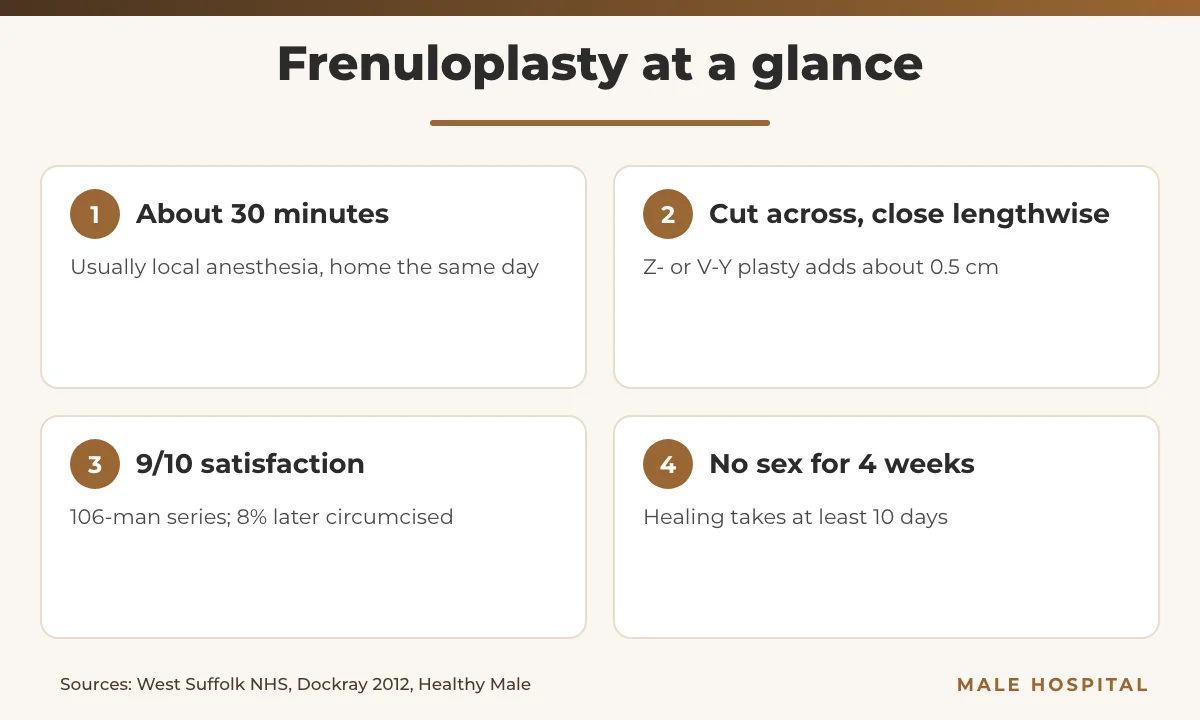
Frenuloplasty is the standard foreskin-sparing operation for a short frenulum. The principle is simple: the surgeon cuts across the short band and then closes the wound lengthwise, which converts a short horizontal gap into a longer vertical seam. UK urology patient information describes the result as lengthening the frenulum by roughly 0.5 cm, enough to let the foreskin retract without tension.
Anesthesia and timing
The operation takes about 30 minutes. In an andrology clinic it is usually done under local anesthesia, so you are awake but feel no pain and go home the same day. Some hospitals offer a general or spinal anesthetic instead, particularly when frenuloplasty is combined with another procedure. Absorbable stitches are used, so nothing needs removing.
Surgical techniques
Urologists borrow scar-lengthening techniques from plastic surgery. In a Z-plasty two triangular flaps on either side of the band are swapped, which redirects and lengthens the scar line; in a V-Y plasty a V-shaped incision is advanced and closed as a Y. In the largest published series, from King’s College Hospital in London, surgeons used V-Y plasty, Z-plasty or a combination in 106 men, grading the severity of the frenular problem before choosing the method.
Sources: West Suffolk NHS Foundation Trust — Lengthening of the penile frenulum (frenuloplasty): procedure-specific information; Healthy Male — Frenulum breve or tight frenulum: what you need to know; PubMed — Penile frenuloplasty: a simple and effective treatment for frenular pain or scarring (Dockray et al., BJU Int 2012)
What the results look like
The King’s College series followed every one of the 106 men at three months and 91% for a year or longer, up to ten years. Satisfaction and cosmetic scores both averaged 8.9 out of 10, 97% of respondents would recommend the operation to a friend, minor complications (bruising, infection, partial wound separation) occurred in 8%, and 8% later needed a circumcision. An earlier 213-patient series from Newcastle reported a median satisfaction of 8 out of 10 and an 11% circumcision rate, estimated at 15–20% once non-responders are allowed for. Both are observational series, not randomized trials, but together they support frenuloplasty as a reliable first operation.
Sources: PubMed — Penile frenuloplasty: a simple and effective treatment for frenular pain or scarring (Dockray et al., BJU Int 2012); PubMed — Is frenuloplasty worthwhile? A 12-year experience (Rajan et al., 2006)
Frenuloplasty vs frenulectomy vs circumcision
Three operations are offered for a short frenulum, and the choice depends on how much scar there is, whether the foreskin is also tight, and whether you want to keep it. Frenuloplasty lengthens the band; frenulectomy (frenectomy) removes it, which is sometimes preferred when it is heavily scarred; circumcision removes the foreskin and the frenulum with it. EAU guidance notes that when a tight foreskin is operated on, an associated short frenulum is released at the same time, so a man with both problems is offered a single operation.
| Option | What is done | Best suited to | Points to weigh |
|---|---|---|---|
| Frenuloplasty | Band cut across and closed lengthwise (Z- or V-Y plasty); about 30 min, usually local anesthesia | Isolated short frenulum, normal foreskin, wish to keep the foreskin | Satisfaction about 8.9/10; around 8–11% later need circumcision |
| Frenulectomy | The whole band is removed and the skin edges closed | Thick scar or repeated tears where there is little healthy band left | Sensitivity of the area usually remains; does not change penis size |
| Circumcision | Foreskin removed; frenulum trimmed or repaired at the same time | Short frenulum plus scarred phimosis, BXO / lichen sclerosus, recurrent balanitis | Longer recovery; removes the foreskin for good; complication rates reported from 0% to 30% depending on setting |
If circumcision turns out to be the better choice for you, our guide to adult circumcision walks through the techniques, anesthesia and recovery in detail.
Sources: EAU Guidelines — Paediatric Urology: Phimosis and other abnormalities of the penile skin; Cleveland Clinic — Penis Frenulum: Anatomy, Function & Conditions; PMC — Frenulum Breve: An Addendum to Accessory Penile Frenulum (Nambi & Nanda Gopal, 2025)
Recovery and risks after frenuloplasty
Frenuloplasty is a day-case procedure, and you normally go home the same day. Discomfort at the incision is usual for two to three days and responds to ordinary painkillers. Swelling of the penis for three to four days is expected. Passing urine is not affected.
Aftercare that protects the result
- Apply petroleum jelly to the tip of the penis and the stitch line so it does not stick to underwear; wear loose clothing for two to three days.
- Once the wound has sealed, gently retract the foreskin every day. UK urology guidance recommends this specifically to stop the new seam from scarring and shortening again.
- Keep the area clean with plain water, pat dry, and do not pick at the dissolving stitches; they normally fall out within three to four weeks.
- Return to work when comfortable; wait at least 10 days for the wound to heal and avoid sex and masturbation for a minimum of four weeks (Cleveland Clinic quotes four to six weeks for full healing in adults).
Sources: West Suffolk NHS Foundation Trust — Lengthening of the penile frenulum (frenuloplasty): procedure-specific information; Cleveland Clinic — Frenulum Breve (Short Frenulum)
Possible complications
UK urology patient information groups the risks by frequency. Common (more than 1 in 10): swelling of the penis for several days and an area that stays sensitive for some time. Occasional (1 in 10 to 1 in 50): wound infection needing treatment, bleeding that occasionally needs a further procedure, and stitches that persist beyond three to four weeks and must be removed. Rare (less than 1 in 50): altered sensation, a tender scar, dissatisfaction with the cosmetic result, and a later circumcision if symptoms are not relieved.
Sources: West Suffolk NHS Foundation Trust — Lengthening of the penile frenulum (frenuloplasty): procedure-specific information; PubMed — Penile frenuloplasty: a simple and effective treatment for frenular pain or scarring (Dockray et al., BJU Int 2012)
Frenulum breve and premature ejaculation
Because the frenulum is so richly supplied with nerves, researchers have asked whether a short, tense band drives some men to climax too quickly. The most cited study, from an andrology practice in Naples, examined 137 men with lifelong premature ejaculation and found a short frenulum in 59 (43%). After frenulectomy, average time to ejaculation rose from 1.65 to 4.11 minutes and the symptom score fell from 15.8 to 9.85 over a mean follow-up of 7.3 months, with no surgical complications.
These numbers deserve a careful reading. The study had no control group and came from a single center, so the result has not been confirmed as a general rule; Healthy Male puts it fairly: treating frenulum breve may help, but more evidence is needed. The EAU chapter on ejaculation disorders does not mention the frenulum at all; its first-line options are dapoxetine and a lidocaine/prilocaine spray, and it recommends no surgery for PE. In practice, if you have both rapid ejaculation and a frenulum that hurts or tears, treat the band on its own merits; any gain in control is a bonus, not a promise. For timing problems without pain, see our premature ejaculation treatment page.
Sources: PubMed — The role of short frenulum and the effects of frenulectomy on premature ejaculation (Gallo et al., J Sex Med 2010); Healthy Male — Frenulum breve or tight frenulum: what you need to know; EAU Guidelines — Sexual and Reproductive Health: Disorders of Ejaculation
Torn frenulum first aid and when to see a doctor
A torn frenulum is the most common emergency linked to a short frenulum, and it usually happens during sex, masturbation, contact sports or cycling. For light bleeding: wash your hands, rinse the area with mild soap and water, pat dry with a clean towel, apply a thin layer of petroleum jelly or plain skin ointment, and cover with clean gauze. Take an over-the-counter painkiller if needed and avoid sexual activity until the split has fully healed.
See a urologist, rather than waiting for the next tear, if any of the following apply:
- Bleeding is heavy or will not stop: go to the nearest emergency department.
- The tear is not healing after a week, or the area becomes red, swollen, hot or starts to discharge, which suggests infection.
- The frenulum has torn more than once, or you can see a pale scar line on the underside of the head.
- Erections are painful, the glans bends downward, or the foreskin will not retract fully, because these are the core signs of a short frenulum.
- You notice white, shiny or thickened patches on the foreskin or glans, which may point to lichen sclerosus and need a specialist opinion.
- The foreskin is stuck behind the head and will not come forward: this is paraphimosis, a medical emergency.
Sources: Cleveland Clinic — Penis Frenulum: Anatomy, Function & Conditions; NHS — Phimosis (tight foreskin); Healthy Male — Frenulum breve or tight frenulum: what you need to know
If you recognize these symptoms, a confidential assessment with our urologist-andrologist, Assoc. Prof. Dr. Zülfü Sertkaya, FEBU, in Istanbul can confirm whether the problem is the frenulum, the foreskin or both; the cost depends on that assessment, so send a message on WhatsApp for a free consultation.
FAQs about frenulum breve
Can frenulum breve go away on its own?
No. A short frenulum is a fixed length of tissue, and tears tend to heal with scar that makes it tighter. Mild cases may become comfortable with supervised stretching and a steroid cream, but the band itself does not lengthen spontaneously, and symptoms that keep returning usually need frenuloplasty.
Source: Healthy Male — Frenulum breve or tight frenulum: what you need to know
Is frenuloplasty painful?
The operation itself is done under local or general anesthesia, so you feel pressure at most. Afterwards expect soreness for two to three days that ordinary painkillers control, plus swelling for three to four days. Most men describe the recovery as mild, and absorbable stitches mean no return visit for removal.
How long after frenuloplasty can I have sex?
Wait a minimum of four weeks, and longer if the seam still feels tender. Healing takes at least 10 days on the surface and four to six weeks for the deeper tissue. Resuming sex early is the commonest way to reopen the wound and turn a good repair into a scarred one.
Sources: West Suffolk NHS Foundation Trust — Lengthening of the penile frenulum (frenuloplasty): procedure-specific information; Cleveland Clinic — Frenulum Breve (Short Frenulum)
Will frenuloplasty reduce sensitivity?
Altered sensation is a rare risk, affecting fewer than 1 in 50 men, and the area usually stays sensitive even when the band is removed altogether. Cleveland Clinic notes that removing a problematic frenulum can improve comfort and sexual function, because the pulling and the fear of tearing are gone.
Sources: West Suffolk NHS Foundation Trust — Lengthening of the penile frenulum (frenuloplasty): procedure-specific information; Cleveland Clinic — Penis Frenulum: Anatomy, Function & Conditions
Do I need a circumcision for frenulum breve?
Usually not. Frenuloplasty keeps the foreskin and solves the problem for the large majority; in published series only 8–11% of men later chose circumcision, with an upper estimate of 15–20%. Circumcision is advised when the foreskin is also scarred and tight, when lichen sclerosus is present, or when balanitis keeps recurring.
Sources: PubMed — Is frenuloplasty worthwhile? A 12-year experience (Rajan et al., 2006); EAU Guidelines — Paediatric Urology: Phimosis and other abnormalities of the penile skin
Does fixing frenulum breve cure premature ejaculation?
Not reliably. One uncontrolled study found a short frenulum in 43% of men with lifelong premature ejaculation and a gain of about 2.5 minutes after frenulectomy, but the finding has not been confirmed in controlled trials, and guidelines do not list the operation as a PE treatment. Treat the frenulum for its own symptoms; address PE with proven therapies.
Sources: PubMed — The role of short frenulum and the effects of frenulectomy on premature ejaculation (Gallo et al., J Sex Med 2010); EAU Guidelines — Sexual and Reproductive Health: Disorders of Ejaculation
Medically reviewed by Assoc. Prof. Dr. Zülfü Sertkaya, urologist and andrologist (FEBU), Istanbul. Last reviewed: November 2026.
This article is for general information and does not replace an individual consultation with a qualified doctor.
- Cleveland Clinic — Frenulum Breve (Short Frenulum)
- Cleveland Clinic — Penis Frenulum: Anatomy, Function & Conditions
- Healthy Male (Australian Government-funded) — Frenulum breve or tight frenulum: what you need to know
- EAU Guidelines — Paediatric Urology: Phimosis and other abnormalities of the penile skin
- EAU Guidelines — Sexual and Reproductive Health: Disorders of Ejaculation
- NHS — Phimosis (tight foreskin)
- West Suffolk NHS Foundation Trust (BAUS-based leaflet) — Lengthening of the penile frenulum (frenuloplasty): procedure-specific information
- PubMed — Penile frenuloplasty: a simple and effective treatment for frenular pain or scarring (Dockray J, Finlayson A, Muir GH. BJU Int 2012;109:1546-50)
- PubMed — Is frenuloplasty worthwhile? A 12-year experience (Rajan P, McNeill SA, Turner KJ. Ann R Coll Surg Engl 2006;88:583-4)
- PubMed — The role of short frenulum and the effects of frenulectomy on premature ejaculation (Gallo L, Perdonà S, Gallo A. J Sex Med 2010;7:1269-76)
- PMC — Frenulum Breve: An Addendum to Accessory Penile Frenulum (Nambi GI, Nanda Gopal C. Indian J Plast Surg 2025;58:79)