Anejaculation is the complete absence of ejaculation at sexual climax: no semen comes out of the penis and none goes backward into the bladder. Most men still have normal erections and often a normal orgasm. It is almost always caused by nerve damage (spinal cord injury, lymph node or pelvic surgery, diabetes, multiple sclerosis), by medicines such as antidepressants and alpha-blockers, or, less often, by psychological blocks. It differs from retrograde ejaculation, where semen flows into the bladder, and from delayed ejaculation, where it eventually happens. It is harmless to health but a major cause of male infertility, and sperm can almost always be obtained for a pregnancy.
Source: EAU Guidelines — Disorders of ejaculation; AUA/SMSNA — Disorders of Ejaculation Guideline
- Anejaculation means no semen is released either forward or backward; orgasm is usually still felt. It is always linked to a nervous system problem, a drug or a psychological block.
- Spinal cord injury and lymph node surgery for testicular cancer account for almost 90% of organic cases; SSRIs, tamsulosin, diabetes and multiple sclerosis are the other common causes.
- A urine sample collected right after orgasm separates anejaculation (no sperm in urine) from retrograde ejaculation (sperm in urine).
- Drugs alone rarely work for nerve-related cases. Penile vibratory stimulation (PVS) is the first-line way to obtain semen; electroejaculation succeeds in almost all men when PVS fails.
- With PVS, electroejaculation or surgical sperm retrieval plus IUI or IVF/ICSI, men with anejaculation can father children with good success rates.
- What is anejaculation?
- Types of anejaculation
- Anejaculation causes
- Anejaculation vs retrograde and delayed ejaculation
- How anejaculation is diagnosed
- Anejaculation treatment by cause
- Fertility options: PVS, electroejaculation and sperm retrieval
- Outlook and living with the condition
- When to see a doctor
- FAQs about anejaculation
What is anejaculation?
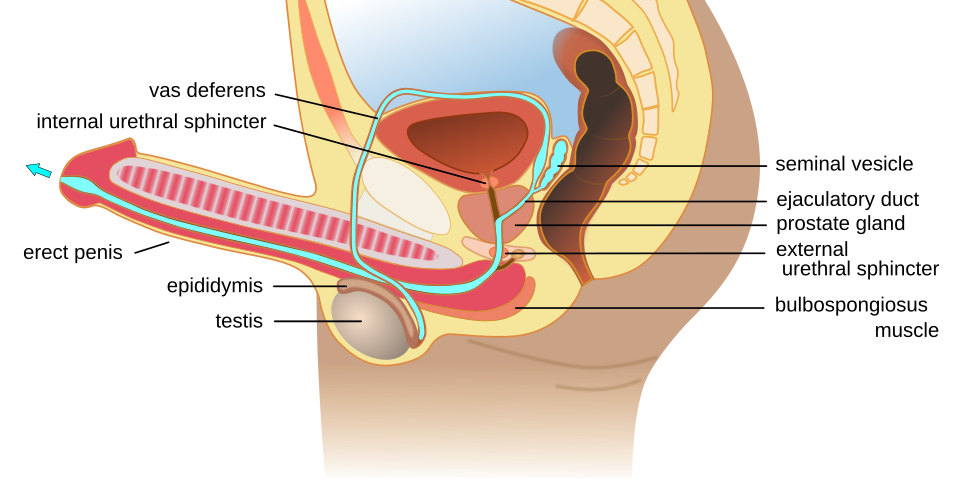
Ejaculation is a reflex with two phases. In the emission phase, sympathetic nerves from spinal cord segments T10 to L2 make the vas deferens, seminal vesicles and prostate contract, pushing sperm and seminal fluid into the back of the urethra while the bladder neck closes. In the expulsion phase, controlled from segments S2 to S4, the bulbospongiosus and pelvic floor muscles contract rhythmically and propel semen out of the penis.
Anejaculation is the complete failure of this reflex: there is no emission, so nothing is expelled and nothing enters the bladder. The European Association of Urology (EAU) defines it as “the complete absence of antegrade or retrograde ejaculation” and notes that the true form usually comes with a normal orgasmic sensation and is always associated with nervous system dysfunction or with drugs. The American Urological Association (AUA) describes it as the absence of seminal ejaculation at climax, with or without orgasm.
The condition is uncommon overall but frequent after neurological injury. Cleveland Clinic estimates that more than 12,000 people a year see a provider for it in the United States, and that the true number is higher because many men never seek care.
Source: Research and Reports in Urology (PMC) — Ibrahim et al. 2022, penile vibratory stimulation in men with spinal cord injury; EAU Guidelines — Disorders of ejaculation; Cleveland Clinic — Anejaculation
Types of anejaculation
Doctors describe the condition along three axes, because each points to a different cause and treatment path.
- Primary vs secondary. Primary (lifelong) means a man has never been able to ejaculate; secondary (acquired) means the ability was lost after an injury, an operation or a new medicine.
- Situational vs total. Situational anejaculation happens only in some settings, typically during intercourse but not masturbation, and strongly suggests a psychological or stimulation-related cause. Total means no ejaculation in any setting.
- Orgasmic vs anorgasmic. In the orgasmic form the man feels a climax but no semen appears, which is typical of nerve damage. In the anorgasmic form neither orgasm nor ejaculation occurs; this overlaps with delayed ejaculation and is more often psychological or drug-related.
A 2018 review adds that the problem should cause personal distress before it is labeled a disorder; some men who do not wish to father children choose no treatment.
Source: Cleveland Clinic — Anejaculation; Translational Andrology and Urology (PMC) — Gray et al. 2018, Contemporary management of ejaculatory dysfunction
Anejaculation causes
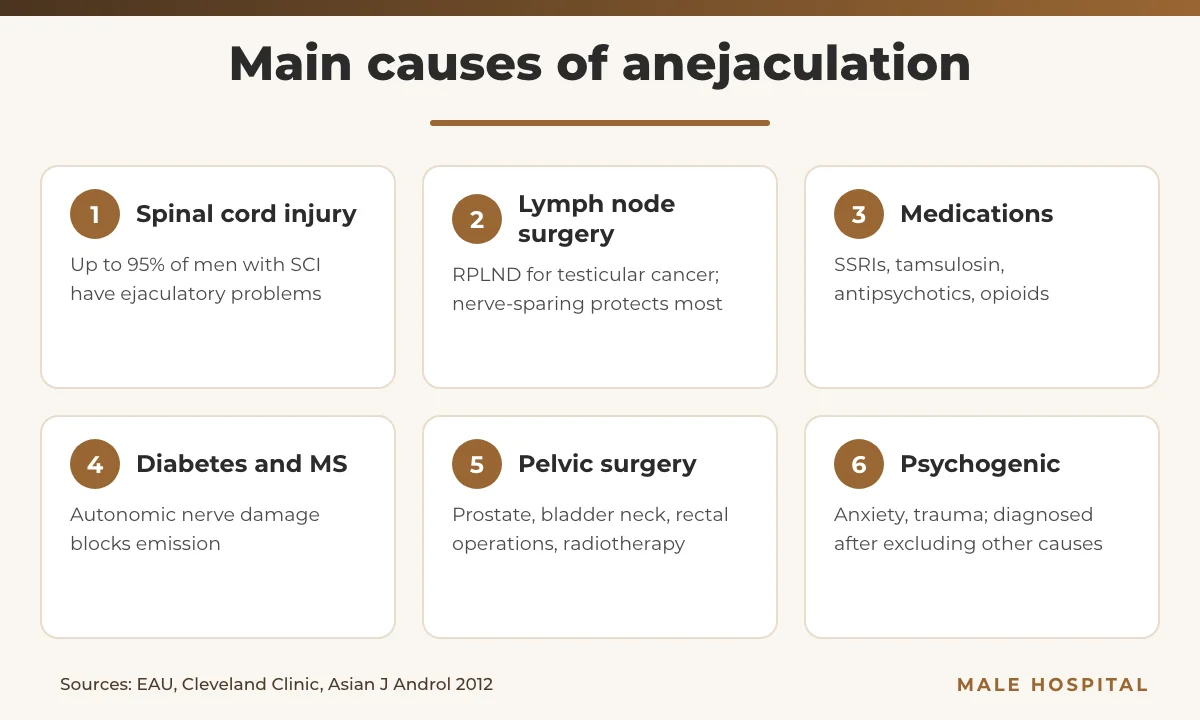
Whatever the trigger, the sympathetic signal that should start emission never reaches the seminal vesicles, vas deferens and prostate. The causes fall into five groups.
Spinal cord injury
Spinal cord injury (SCI) is the leading cause of organic anejaculation. Up to 95% of men with SCI have ejaculatory problems, and only about 10% can ejaculate by masturbation or during sex. Level and completeness matter: fewer than 5% of men with complete upper motor neuron lesions keep the ability to ejaculate, compared with about 22% of those with incomplete lesions, while almost all men with incomplete lower motor neuron lesions still can. An injury above these segments blocks voluntary ejaculation even when the reflex arc itself is intact, which is what vibratory stimulation exploits.
Source: Translational Andrology and Urology (PMC) — Gray et al. 2018; Research and Reports in Urology (PMC) — Ibrahim et al. 2022
Retroperitoneal lymph node dissection and pelvic surgery
Retroperitoneal lymph node dissection (RPLND), the operation that removes abdominal lymph nodes in testicular cancer, runs through the sympathetic nerves that control emission; with SCI it accounts for almost 90% of organic cases in fertility clinics. Nerve-sparing surgery has changed the picture: 99% of 176 men kept antegrade ejaculation 3 to 9 years after primary nerve-sparing RPLND. After chemotherapy, scar tissue makes nerve sparing harder: 79% of men in one large series kept antegrade ejaculation, falling to 44% when the residual mass was 5 cm or larger. The EAU notes that unilateral dissection or autonomic nerve preservation can prevent it. Prostatectomy, bladder neck incision, TURP, colorectal surgery and pelvic radiotherapy can cause the same nerve injury.
Source: Asian Journal of Andrology (PMC) — Barazani et al. 2012, Management of ejaculatory disorders in infertile men; Urology (PMC) — Pettus et al. 2008, Preservation of ejaculation after nerve-sparing post-chemotherapy RPLND; EAU Guidelines — Disorders of ejaculation
Medications
Drugs are the most common reversible cause. SSRI and SNRI antidepressants were linked to sexual difficulties in 73% of treated patients in one series, with two-thirds reporting orgasmic or ejaculatory problems. Alpha-1 blockers prescribed for an enlarged prostate interfere with emission, and the risk depends on how selective the drug is: in healthy volunteers, tamsulosin reduced ejaculate volume in 90% of men and caused anejaculation in 35%, versus 21% and 0% with alfuzosin. Tricyclics, MAO inhibitors, antipsychotics, opioids, benzodiazepines, alcohol and recreational drugs are other culprits. Never stop a prescribed medicine on your own.
Source: Asian Journal of Andrology (PMC) — Barazani et al. 2012; Translational Andrology and Urology (PMC) — Gray et al. 2018; NHS — Ejaculation problems
Diabetes, multiple sclerosis and other nerve diseases
Diabetes damages the autonomic nerves that run the bladder neck and the emission reflex. It most commonly causes retrograde ejaculation, but the NIDDK notes that some men with diabetic nerve damage may not ejaculate at all, and severe neuropathy can produce true anejaculation. Multiple sclerosis, transverse myelitis, Parkinson’s disease, stroke, alcoholic neuropathy and a tethered spinal cord can do the same. Hypothyroidism and low testosterone are rarer contributors worth checking because they are treatable.
Source: NIDDK — Diabetes, Sexual, & Bladder Problems; Translational Andrology and Urology (PMC) — Gray et al. 2018
Psychogenic anejaculation
In the psychogenic (idiopathic) form the man is otherwise healthy, has erections and nocturnal emissions, but cannot ejaculate during intercourse or masturbation. It has been linked to anhedonia, anxiety about ejaculation itself, fear of pregnancy, relationship conflict and traumatic experiences, and it is a diagnosis of exclusion. A useful clue: roughly three-quarters of men with difficulty ejaculating can still do so by solitary masturbation, which points away from nerve damage.
Source: Translational Andrology and Urology (PMC) — Meng et al. 2018, Electroejaculation in psychogenic anejaculation refractory to PVS; Asian Journal of Andrology (PMC) — Barazani et al. 2012; MedlinePlus — Delayed ejaculation
Anejaculation vs retrograde and delayed ejaculation
Three conditions produce a “dry” or disappointing climax. The distinction matters because sperm can be collected from urine in retrograde ejaculation, whereas anejaculation needs a method that triggers emission or retrieves sperm directly.
| Feature | Anejaculation | Retrograde ejaculation | Delayed ejaculation |
|---|---|---|---|
| Semen at orgasm | None | None or very little | Normal, but only after a long delay (or not at all on some occasions) |
| Orgasm | Usually present (may be absent) | Present | Delayed or absent |
| Sperm in post-orgasm urine | No | Yes (urine often cloudy) | No |
| Typical causes | Spinal cord injury, RPLND, SSRIs, tamsulosin, diabetes, psychogenic | Alpha-blockers, TURP, bladder neck surgery, diabetes | SSRIs, age, psychological factors, partial nerve damage |
| Fertility route | PVS, electroejaculation, surgical sperm retrieval | Sympathomimetic drugs, sperm recovery from alkalinized urine | Sex therapy, medication change, PVS if needed |
Source: EAU Guidelines — Disorders of ejaculation; NHS — Ejaculation problems; Cleveland Clinic — Anejaculation
How anejaculation is diagnosed
The AUA guideline says evaluation of a man with delayed ejaculation or anejaculation should include a full medical and sexual history, a focused physical examination, a serum testosterone level, and any further tests suggested by those findings. In practice the work-up has four steps.
- History. Total or situational? Does ejaculation happen with masturbation or never? Which medicines are taken? Is there diabetes, neurological disease, spinal injury or past abdominal, pelvic or prostate surgery? Does orgasm still occur?
- Examination. A genital and rectal exam, plus basic neurological testing such as anal sphincter tone and the bulbocavernosus reflex, which reflect the sacral nerves involved in expulsion.
- Post-orgasm urine test. If the man can reach climax, urine collected immediately afterward is examined under the microscope. Sperm or seminal fluid in the urine confirms retrograde ejaculation; no sperm confirms anejaculation. Because a few sperm appear in the urine of many fertile men, laboratories usually require about 10 to 15 sperm per high-power field before calling it retrograde.
- Targeted tests. Testosterone and, where indicated, thyroid hormones, prolactin and glucose; a spinal MRI if a lesion such as a tethered cord is suspected; a semen analysis whenever any sample can be produced; and ultrasound to rule out blocked ejaculatory ducts, which cause low-volume rather than absent ejaculate.
A clinic trial of penile vibratory stimulation is itself diagnostic: if it triggers ejaculation, the reflex arc is intact, which is good news for fertility.
Source: AUA/SMSNA — Disorders of Ejaculation Guideline; Translational Andrology and Urology (PMC) — Gray et al. 2018; MedlinePlus — Delayed ejaculation
Anejaculation treatment by cause
No drug is approved by the FDA or the EMA for anejaculation or delayed ejaculation, and the AUA states that there is insufficient evidence to judge the risk-benefit ratio of oral pharmacotherapy. Treatment therefore targets the cause and the goal: ejaculation during sex, or sperm for a pregnancy.
Medication-induced
Guidelines recommend replacing, reducing or gradually stopping any contributing medicine, in agreement with the prescriber. Ejaculation usually returns once an SSRI or tamsulosin is changed.
Nerve-related
The EAU is direct: drug treatment for anejaculation caused by lymph node dissection or neuropathy is not effective. Sympathomimetics such as pseudoephedrine, midodrine and imipramine are used off-label and help a minority: alpha-agonists produced antegrade ejaculation in about 50% of men with retrograde ejaculation but only about 12% of men with anejaculation, although they sometimes convert the latter into retrograde ejaculation, which allows sperm to be collected from urine. Midodrine is most useful as an add-on to vibratory stimulation: in 158 men with spinal cord injury, midodrine plus PVS led to ejaculation in almost 65%.
Psychogenic
Sex therapy with both partners, psychotherapy for anxiety or trauma, and structured “homework” that shifts the focus from performance to pleasure are the mainstays; MedlinePlus reports that treatment commonly takes 12 to 18 sessions with an average success rate of 70% to 80%. The AUA also suggests referral to a mental health professional with sexual health expertise. When a couple wants a child and therapy has not worked, PVS and electroejaculation work in psychogenic cases too.
Hormonal and medical
Confirmed testosterone deficiency and hypothyroidism should be corrected. Good diabetes control limits further nerve damage, although established neuropathy is rarely reversible. Coexisting erectile dysfunction is treated in its own right.
Source: EAU Guidelines — Disorders of ejaculation; AUA/SMSNA — Disorders of Ejaculation Guideline; Asian Journal of Andrology (PMC) — Barazani et al. 2012; MedlinePlus — Delayed ejaculation; NHS — Ejaculation problems
Fertility options: PVS, electroejaculation and sperm retrieval
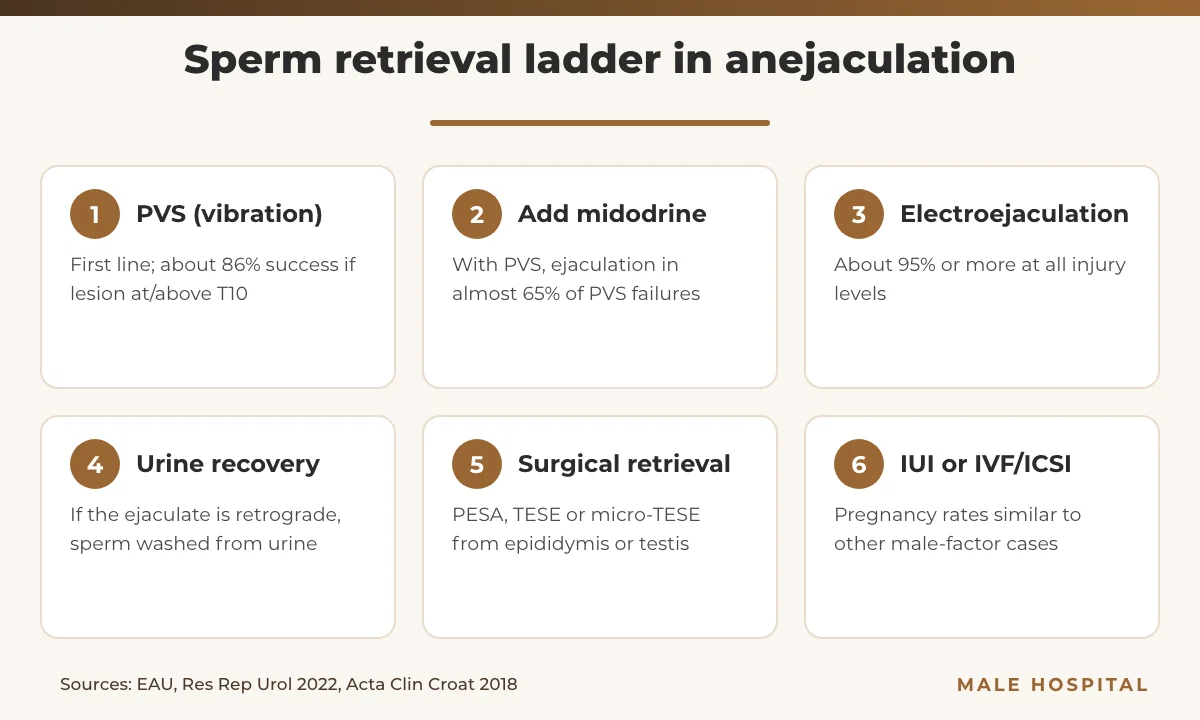
For a couple trying to conceive, anejaculation is one of the most solvable forms of male infertility, because the testes usually keep producing sperm. The EAU and the AUA/ASRM agree on a ladder: penile vibratory stimulation first, electroejaculation if that fails, surgical sperm retrieval as the backup, then insemination or IVF, as explained on our male infertility treatment page.
Penile vibratory stimulation (PVS)
A medical vibrator is held against the glans for a few minutes; most responders ejaculate within two minutes. Purpose-built devices use a high amplitude of about 2.5 mm, which proved far more effective than ordinary vibrators (ejaculation in 96% versus 32% of men at 1 mm). PVS needs an intact lumbosacral reflex arc: success is about 86% for injuries at or above T10 but only 17% to 21% below, and roughly 54% overall. It is non-invasive and inexpensive, and couples who inseminate at home with PVS-obtained semen report pregnancy rates of 25% to 70% per couple.
The main safety issue is autonomic dysreflexia, a sudden dangerous rise in blood pressure in men with injuries at or above T6; centers pre-treat these patients with sublingual nifedipine and monitor blood pressure during stimulation.
Electroejaculation (EEJ)
If PVS fails, a rectal probe delivers brief electrical pulses to the nerves next to the prostate and seminal vesicles. EEJ is safe and succeeds in roughly 95% of men or more at all injury levels, including diabetic, post-surgical and psychogenic cases. It usually needs anesthesia in men with normal sensation and often produces a retrograde fraction, so the bladder is catheterized to recover sperm from urine as well. In a series of 20 men with the psychogenic form who had failed PVS, EEJ retrieved sperm in every case; 14 couples went on to IUI with a pregnancy rate of 38.5% per cycle, and six healthy children were born in total.
Surgical sperm retrieval
When EEJ fails or is not possible, sperm can be taken directly from the epididymis or testis (PESA, MESA, TESA, TESE or micro-TESE); testicular sperm can only be used with IVF/ICSI. Our sperm retrieval surgery page explains these procedures.
What to expect from the sperm
Semen from men with spinal cord injury typically has a normal count but reduced motility, which falls with each step of the ladder: about 37% with masturbation, 26% with PVS and 15% with EEJ. Around 5 million total motile sperm are recommended for IUI, whereas IVF needs only a few hundred thousand and ICSI, in theory, a single motile sperm. Pregnancy rates with IUI or IVF/ICSI are similar to other male-factor infertility; the ASRM notes that pregnancy is more likely after IVF than IUI, at the price of a more invasive and costly treatment.
| Method | How it works | Success in obtaining semen/sperm | Setting and comfort |
|---|---|---|---|
| Penile vibratory stimulation | High-amplitude vibrator on the glans triggers the reflex | About 86% if lesion at/above T10; 17–21% below; about 54% overall | Office or home, no anesthesia; watch for autonomic dysreflexia |
| Electroejaculation | Rectal probe stimulates pelvic nerves | About 95% or more at all levels | Clinic; anesthesia unless sensation is absent; retrograde fraction common |
| Surgical sperm retrieval | Needle or open retrieval from epididymis or testis | High when sperm production is normal | Day surgery; sperm usable only with IVF/ICSI |
Source: Research and Reports in Urology (PMC) — Ibrahim et al. 2022; Acta Clinica Croatica (PMC) — Kasum et al. 2018, Sexual and reproductive function in men with spinal cord lesion; Asian Journal of Andrology (PMC) — Barazani et al. 2012; Translational Andrology and Urology (PMC) — Meng et al. 2018; ASRM ReproductiveFacts — Fertility options for men with spinal cord injury; Cleveland Clinic — Anejaculation
Outlook and living with the condition
Anejaculation does not harm physical health: unreleased seminal fluid is reabsorbed. The outlook for ejaculation itself depends on the cause: drug-induced and psychogenic cases often resolve, while cases after complete spinal cord injury or extensive nerve damage are usually permanent. The outlook for fatherhood is far more hopeful, because the retrieval ladder obtains usable sperm in the large majority of men.
The emotional side deserves attention. Men describe embarrassment, a feeling that sex is “incomplete” and grief about fertility, while partners may wrongly assume they are not attractive enough. Talking openly, involving the partner in consultations and seeing a sex therapist early protect the relationship. If you are planning a family, start early: sperm obtained by PVS or EEJ can be frozen for later cycles.
You can arrange a confidential consultation with our urologist-andrologist, Assoc. Prof. Dr. Zülfü Sertkaya, by WhatsApp to discuss diagnosis and sperm retrieval in Istanbul.
Source: Cleveland Clinic — Anejaculation; ASRM ReproductiveFacts — Fertility options for men with spinal cord injury
When to see a doctor
Make an appointment with a urologist or andrologist if:
- You never, or almost never, release semen at orgasm, whether or not orgasm feels normal.
- Ejaculation stopped after a new medicine, after an operation on the abdomen, pelvis, prostate or spine, or after a neurological diagnosis.
- You and your partner are trying to conceive and no ejaculate can be produced for testing.
- Dry orgasm comes with cloudy urine afterward (possible retrograde ejaculation), pain, blood in the urine or new urinary symptoms.
- The problem is causing distress, avoidance of sex or strain in your relationship.
Seek urgent care if a dry orgasm comes with new weakness, numbness in the legs or genitals, or loss of bladder or bowel control, which can signal a spinal cord problem, or if a man with a spinal injury at or above T6 develops a pounding headache, flushing or a sudden blood pressure rise during stimulation (autonomic dysreflexia).
Source: Cleveland Clinic — Anejaculation; Research and Reports in Urology (PMC) — Ibrahim et al. 2022
FAQs about anejaculation
Can you still have an orgasm with anejaculation?
Yes, in most cases. The EAU notes that true anejaculation is usually accompanied by a normal orgasmic sensation, because the nerves that carry pleasure and the nerves that drive emission are different. Some men, particularly with drug-related or psychological causes, lose both orgasm and ejaculation; this anorgasmic form overlaps with delayed ejaculation.
Source: EAU Guidelines — Disorders of ejaculation
Is anejaculation the same as retrograde ejaculation?
No. In retrograde ejaculation semen is produced but flows backward into the bladder, so sperm show up in urine passed after orgasm and the urine often looks cloudy. In anejaculation there is no emission at all, so post-orgasm urine contains no sperm. That single urine test tells them apart, and their fertility treatments differ.
Source: Cleveland Clinic — Anejaculation; NIDDK — Diabetes, Sexual, & Bladder Problems
Can anejaculation be cured?
It depends on the cause. When a medicine is responsible, ejaculation usually returns after the drug is changed, and psychogenic cases often improve with sex therapy. Cases caused by complete spinal cord injury, extensive lymph node surgery or advanced neuropathy are usually permanent, but they do not prevent fatherhood, because sperm can be obtained with vibratory stimulation, electroejaculation or surgical retrieval.
Source: NHS — Ejaculation problems; Cleveland Clinic — Anejaculation
Which medications cause anejaculation?
The commonest are SSRI and SNRI antidepressants and the selective alpha-blocker tamsulosin, which produced this effect in 35% of healthy volunteers in one study. Tricyclic antidepressants, MAO inhibitors, antipsychotics, opioids, benzodiazepines and heavy alcohol use can also block ejaculation. Ask your prescriber about alternatives such as alfuzosin for the prostate or an antidepressant with fewer sexual side effects.
Source: Asian Journal of Andrology (PMC) — Barazani et al. 2012; Translational Andrology and Urology (PMC) — Gray et al. 2018
Does penile vibratory stimulation hurt, and can it be done at home?
PVS is non-invasive and needs no anesthesia; the main risk is autonomic dysreflexia in men with spinal injuries at or above T6, which is why the first sessions are done in a clinic with blood pressure monitoring. Once a man is known to respond safely, couples can be taught to use the device at home and inseminate with the sample, with reported pregnancy rates of 25% to 70% per couple.
Source: Research and Reports in Urology (PMC) — Ibrahim et al. 2022
How successful is electroejaculation?
Very: electroejaculation obtains semen in roughly 95% of men or more regardless of the level of spinal injury, and it also works in diabetic, post-surgical and psychogenic cases. The trade-offs are that it usually needs anesthesia in men with normal sensation, requires specialized equipment, and sperm motility in the sample is lower than with vibratory stimulation.
Source: Acta Clinica Croatica (PMC) — Kasum et al. 2018; Translational Andrology and Urology (PMC) — Meng et al. 2018
Can a man with anejaculation have children naturally?
Natural conception is unlikely because no semen reaches the vagina during intercourse. However, if PVS triggers ejaculation, the sample can be placed in the vagina at home around ovulation, and many couples conceive this way. Otherwise, sperm from PVS, electroejaculation or surgical retrieval is used for IUI or IVF/ICSI, with pregnancy rates similar to other male-factor infertility.
Source: Research and Reports in Urology (PMC) — Ibrahim et al. 2022; ASRM ReproductiveFacts — Fertility options for men with spinal cord injury
What is the difference between anejaculation and azoospermia?
Anejaculation means no semen is released; the testes may be producing sperm normally. Azoospermia means semen is released but contains no sperm. Confusingly, a post-orgasm urine sample with no sperm is also described as “azoospermic,” which is how doctors confirm absent rather than retrograde ejaculation. The work-up and treatments for the two conditions are different.
Source: Cleveland Clinic — Anejaculation; EAU Guidelines — Disorders of ejaculation
Medically reviewed by Assoc. Prof. Dr. Zülfü Sertkaya, urologist and andrologist (FEBU), Istanbul. Last reviewed: November 2026.
This article is for general information and does not replace an individual consultation with a qualified doctor.
- EAU — Sexual and Reproductive Health Guidelines — Disorders of ejaculation
- AUA/SMSNA — Disorders of Ejaculation: An AUA/SMSNA Guideline
- NHS — Ejaculation problems
- Cleveland Clinic — Anejaculation: Causes, Symptoms, Diagnosis & Treatment
- MedlinePlus — Delayed ejaculation (Anejaculation)
- NIDDK — Diabetes, Sexual, & Bladder Problems
- ASRM ReproductiveFacts — Fertility options for men with spinal cord injury (fact sheet, revised 2023)
- Research and Reports in Urology (PMC) — Ibrahim, Brackett & Lynne 2022, Penile Vibratory Stimulation for Semen Retrieval in Men with Spinal Cord Injury
- Acta Clinica Croatica (PMC) — Kasum et al. 2018, Improvement of Sexual and Reproductive Function in Men with Spinal Cord Lesion
- Asian Journal of Andrology (PMC) — Barazani et al. 2012, Management of ejaculatory disorders in infertile men
- Translational Andrology and Urology (PMC) — Gray et al. 2018, Contemporary management of ejaculatory dysfunction
- Translational Andrology and Urology (PMC) — Meng et al. 2018, Electroejaculation combined with ART in psychogenic anejaculation refractory to PVS
- Urology (PMC) — Pettus et al. 2008, Preservation of Ejaculation in Nerve-Sparing Post-Chemotherapy RPLND