
Male Infertility Treatment: 6 Proven Steps to the Best Plan
Male infertility treatment starts with finding the cause, because the right option depends on whether the problem is sperm production, hormones, a blockage, a varicocele or a genetic condition. European Association of Urology (EAU) guidelines recommend assessing both partners at the same time, then choosing between lifestyle and medical treatment, varicocele repair, surgery for blockages, surgical sperm retrieval and assisted reproduction (IUI, IVF or ICSI). Many men with very poor semen results, and even some with no sperm in the ejaculate, can still father a biological child.
Source: EAU — Sexual and Reproductive Health Guidelines: Male Infertility
- A male factor is found in about half of infertile couples, so the man should be assessed alongside his partner, not after months of female testing.
- The core workup is a semen analysis (repeated if abnormal), hormone tests, a scrotal ultrasound and, for very low counts or no sperm, genetic tests.
- Specific causes need specific male infertility treatment: hCG and FSH for pituitary-related hormone deficiency, repair of a palpable varicocele, and reconstruction or sperm retrieval for blockages.
- Testosterone therapy is not a male infertility treatment; it suppresses sperm production.
- When sperm are very few or absent, sperm retrieval combined with ICSI is the main route to a biological child.
Share your semen analysis or history with our urologist-andrologist and get a confidential, personalised male infertility treatment plan.
- What is male infertility treatment?
- Who is a good candidate for treatment?
- The full workup before treatment
- Male infertility treatment options compared
- Surgical options in brief
- Assisted reproduction: IUI, IVF and ICSI
- The treatment pathway step by step
- Recovery and response timeline
- Risks and side effects
- Results and realistic expectations
- Treatment with Dr. Zülfü Sertkaya in Istanbul
- How to start
- When to see a doctor
- FAQs about male infertility treatment
What is male infertility treatment?
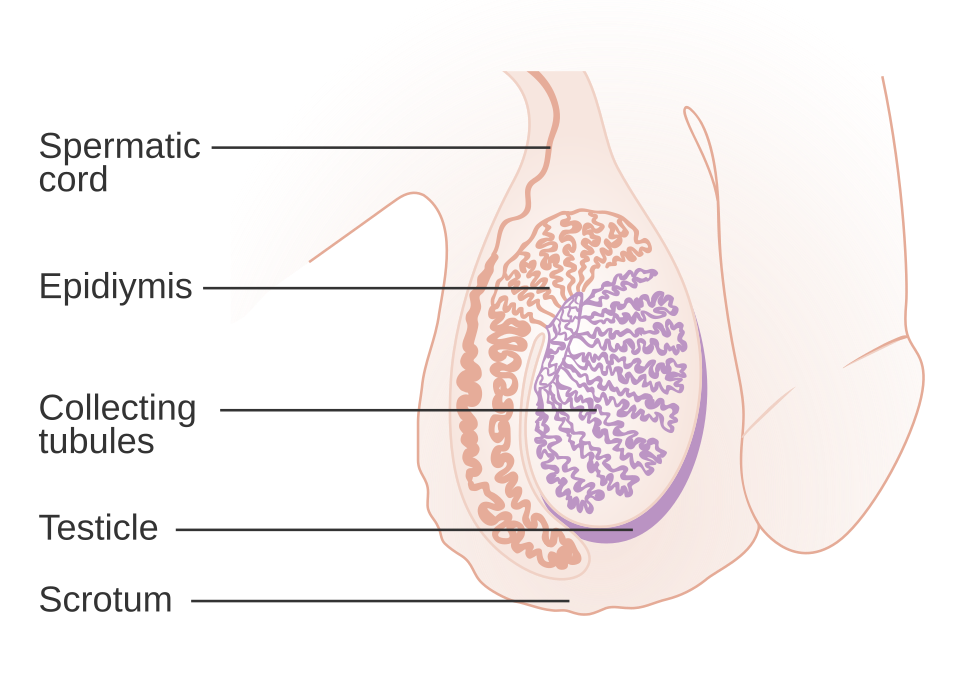
The World Health Organization (WHO) defines infertility as no pregnancy after 12 months or more of regular unprotected sex, and estimates that about 1 in 6 people of reproductive age are affected at some point. According to the EAU, a male-associated factor is found in about 50% of infertile couples and is the only factor in about 20%. In 30–40% of men, no clear cause is found even after full testing.
Sources: WHO — Infertility fact sheet; EAU — Sexual and Reproductive Health Guidelines: Male Infertility
Male infertility treatment covers everything a urologist-andrologist does to help a man father a child: correcting reversible causes, improving sperm production where possible, opening or bypassing blockages, and retrieving sperm for assisted reproduction when natural conception is unlikely. It is planned together with the female partner’s fertility specialist, because her age and ovarian reserve strongly influence which route makes sense. For a broader explanation of causes and symptoms, see our guide to male infertility.
Sources: EAU — Sexual and Reproductive Health Guidelines: Male Infertility; Cleveland Clinic — Male Infertility: Causes, Diagnosis and Treatment
Who is a good candidate for treatment?
You should be assessed if you and your partner have not conceived after a year of regular unprotected sex. Earlier assessment makes sense when the female partner is 36 or older, or when either partner already knows of a possible fertility problem. Men with any of the following should not wait a full year to ask about male infertility treatment:
- Undescended testicles, testicular injury or previous testicular or groin surgery.
- Past chemotherapy or radiotherapy (ideally sperm should have been frozen beforehand).
- Current or past use of testosterone or anabolic steroids.
- Low sex drive, erection or ejaculation problems.
- A previous vasectomy, mumps orchitis or a sexually transmitted infection.
- Visible enlarged scrotal veins or a known abnormal semen analysis.
Sources: NHS — Infertility; Cleveland Clinic — Male Infertility: Causes, Diagnosis and Treatment
A man whose semen is normal on repeated testing usually needs no male infertility treatment; the focus then moves to the female partner or to the couple’s assisted reproduction plan. The EAU also notes that infertile men have a higher risk of testicular cancer than fertile men, which is one more reason the male evaluation is worthwhile even when IVF is already planned.
Source: EAU — Sexual and Reproductive Health Guidelines: Male Infertility
The full workup before treatment
The EAU strongly recommends investigating both partners simultaneously. For the man, assessment begins with a detailed medical, sexual and medication history and an examination of the testicles, epididymis, vas deferens and scrotal veins. Tests are then added step by step before any male infertility treatment is chosen.
Source: EAU — Sexual and Reproductive Health Guidelines: Male Infertility
Semen analysis
The semen analysis is the cornerstone test before male infertility treatment. Laboratories should follow the latest WHO manual, and an abnormal result should be repeated because counts vary between samples. The 6th edition WHO reference values (2021) include a lower 5th-centile concentration of 16 million sperm per mL and total motility of 42%; these are reference points, not strict fertile/infertile cut-offs. Our guide to semen analysis explains how to prepare and read the report.
Sources: EAU — Sexual and Reproductive Health Guidelines: Male Infertility; Andrology (PubMed) — Campbell et al. 2021, Distribution of semen examination results 2020
Hormone tests
For men with a low sperm count or no sperm, the EAU strongly recommends measuring total testosterone, FSH and LH. Low FSH and LH with low testosterone point to hypogonadotropic hypogonadism, which is treatable with medical male infertility treatment. A high FSH usually signals reduced sperm production in the testicle itself, although it does not reliably predict whether sperm will be found at surgery.
Source: EAU — Sexual and Reproductive Health Guidelines: Male Infertility
Genetic tests
Before male infertility treatment, the EAU recommends a karyotype (chromosome test) with genetic counselling for all men with no sperm or a concentration below 5 million/mL. Y-chromosome microdeletion testing is mandatory at 1 million/mL or less and should be considered below 5 million/mL. Men with an absent vas deferens, and their partners, should be tested for CFTR (cystic fibrosis gene) mutations. A man with a Y microdeletion will pass it to any son conceived through assisted reproduction.
Sources: EAU — Sexual and Reproductive Health Guidelines: Male Infertility; MedlinePlus Genetics — Y chromosome infertility
Scrotal ultrasound and other imaging
The EAU recommends scrotal ultrasound in infertile men because of their higher testicular cancer risk; it also clarifies a varicocele when examination is uncertain. A transrectal ultrasound is added when a blockage near the prostate is suspected, for example when semen volume is very low. Sperm DNA fragmentation testing is recommended for couples with recurrent pregnancy loss, not routinely for everyone starting male infertility treatment.
Source: EAU — Sexual and Reproductive Health Guidelines: Male Infertility
Male infertility treatment options compared
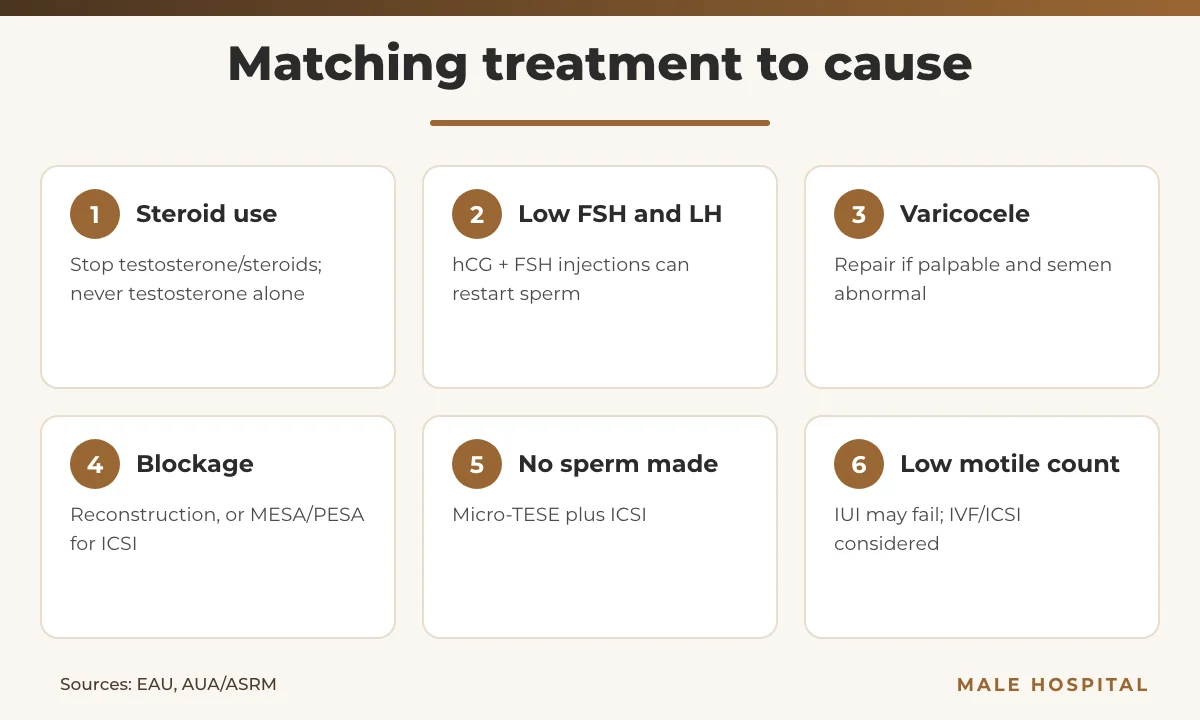
The table summarises the main male infertility treatment options, who they suit and what guidelines say. In practice several are combined, for example stopping steroids and repairing a varicocele, with ICSI kept as a back-up.
| Option | Best suited for | What the evidence says |
|---|---|---|
| Lifestyle and stopping gonadotoxic drugs | All men, especially smokers and steroid users | Reasonable first step; supplements of questionable value (AUA/ASRM) |
| hCG + FSH | Hypogonadotropic hypogonadism | Strong EAU recommendation; no proven benefit in primary testicular failure |
| Varicocele repair | Palpable varicocele + abnormal semen | Recommended by EAU and AUA/ASRM; not for imaging-only varicoceles |
| Reconstruction | Vasectomy or epididymal blockage | Vasectomy reversal patency 90–97% in EAU data |
| Sperm retrieval (MESA, PESA, TESE, micro-TESE) | No sperm in the ejaculate | Micro-TESE is the treatment of choice in non-obstructive azoospermia |
| IUI | Mild male factor with enough motile sperm | Success may be reduced with low total motile counts |
| IVF / ICSI | Very low count, poor motility or shape, retrieved sperm | ICSI is the most common treatment for male infertility |
Sources: EAU — Sexual and Reproductive Health Guidelines: Male Infertility; AUA/ASRM — Diagnosis and Treatment of Infertility in Men: AUA/ASRM Guideline Part II; HFEA — Intracytoplasmic sperm injection (ICSI)
Lifestyle changes and medicines to stop
Stopping smoking and recreational drugs, limiting alcohol, reaching a healthy weight and avoiding frequent heat exposure are sensible first steps in any male infertility treatment. The most important reversible cause today is testosterone or anabolic steroid use: hormones taken from outside switch off the brain’s FSH and LH signals, so the testicles reduce sperm production. The AUA/ASRM guideline states that testosterone alone should not be prescribed to men who want children now or later.
Sources: Cleveland Clinic — Male Infertility: Causes, Diagnosis and Treatment; AUA/ASRM — Diagnosis and Treatment of Infertility in Men: AUA/ASRM Guideline Part II
Antioxidants and fertility supplements are widely sold as male infertility treatment, but the AUA/ASRM guideline calls their benefit of questionable clinical utility and finds the data inadequate to recommend any specific product. The EAU notes that lifestyle changes and antioxidants may improve sperm quality, but randomised trials have not confirmed this.
Sources: AUA/ASRM — Diagnosis and Treatment of Infertility in Men: AUA/ASRM Guideline Part II; EAU — Sexual and Reproductive Health Guidelines: Male Infertility
Medical (hormonal) treatment
Medical male infertility treatment works best when a hormone problem is proven. In hypogonadotropic hypogonadism, the EAU strongly recommends hCG and FSH injections, which can restart sperm production. In men with primary testicular failure (high FSH), gonadotropin therapy has no substantial proven benefit, and routine hormonal stimulation before sperm retrieval is not recommended. For men with low testosterone, the AUA/ASRM guideline allows aromatase inhibitors, hCG or SERMs such as clomiphene, but notes that SERMs offer limited benefit compared with assisted reproduction in unexplained infertility. If low testosterone symptoms are your main concern, see our low testosterone treatment page.
Sources: EAU — Sexual and Reproductive Health Guidelines: Male Infertility; AUA/ASRM — Diagnosis and Treatment of Infertility in Men: AUA/ASRM Guideline Part II
Surgical options in brief
Varicocele repair
A varicocele is the most common identifiable cause in EAU data, found in about 15% of unselected infertile men. Guidelines support repair as male infertility treatment only for a palpable varicocele with abnormal semen parameters, and advise against treating varicoceles seen only on ultrasound or in men with normal semen. Microsurgical repair has fewer complications and lower recurrence than other techniques, while embolisation is a non-surgical alternative. Details are on our varicocele treatment page.
Sources: EAU — Sexual and Reproductive Health Guidelines: Male Infertility; AUA/ASRM — Diagnosis and Treatment of Infertility in Men: AUA/ASRM Guideline Part II
Surgery for blockages
When sperm production is normal but the tubes are blocked, surgical male infertility treatment (reconstruction) can restore sperm to the ejaculate. In EAU data, vasectomy reversal achieves patency in 90–97% with pregnancy rates of 52–73%, and epididymovasostomy achieves patency in 63–85%. Where reconstruction is not possible, for example in congenital absence of the vas deferens, sperm are collected directly from the epididymis or testicle.
Source: EAU — Sexual and Reproductive Health Guidelines: Male Infertility
Sperm retrieval
For obstructive azoospermia, epididymal (MESA or PESA) or testicular (TESA or TESE) retrieval usually finds sperm, and one MESA can give enough material for several ICSI cycles. For non-obstructive azoospermia, both the EAU and the AUA/ASRM recommend microdissection TESE (micro-TESE), in which the surgeon uses an operating microscope to find the small areas that still make sperm. The full procedure, a key step in male infertility treatment for azoospermia, is explained on our sperm retrieval surgery page.
Sources: EAU — Sexual and Reproductive Health Guidelines: Male Infertility; AUA/ASRM — Diagnosis and Treatment of Infertility in Men: AUA/ASRM Guideline Part II
Assisted reproduction: IUI, IVF and ICSI
In intrauterine insemination (IUI), the semen is washed, the fastest-moving sperm are selected and placed in the womb through a thin tube. In IVF, the partner’s ovaries are stimulated, eggs are collected and fertilised in the laboratory, and an embryo is returned to the womb. The AUA/ASRM guideline notes that IUI success may be reduced when the total motile sperm count is low on repeated tests, and that IVF/ICSI may then be considered as the next male infertility treatment.
Sources: NHS — Infertility: treatment; AUA/ASRM — Diagnosis and Treatment of Infertility in Men: AUA/ASRM Guideline Part II
In ICSI, the most common male infertility treatment, an embryologist injects a single sperm directly into each egg. The UK Human Fertilisation and Embryology Authority (HFEA) describes ICSI as suitable for very low counts, poor motility or shape, and surgically retrieved sperm, with success rates very similar to IVF. For couples whose problem is not sperm-related, ICSI offers no proven advantage over standard IVF. Retrieved sperm can be used fresh or frozen; outcomes in obstructive azoospermia are comparable, while in non-obstructive cases some centres coordinate retrieval with the egg collection.
Sources: HFEA — Intracytoplasmic sperm injection (ICSI); AUA/ASRM — Diagnosis and Treatment of Infertility in Men: AUA/ASRM Guideline Part II
The treatment pathway step by step
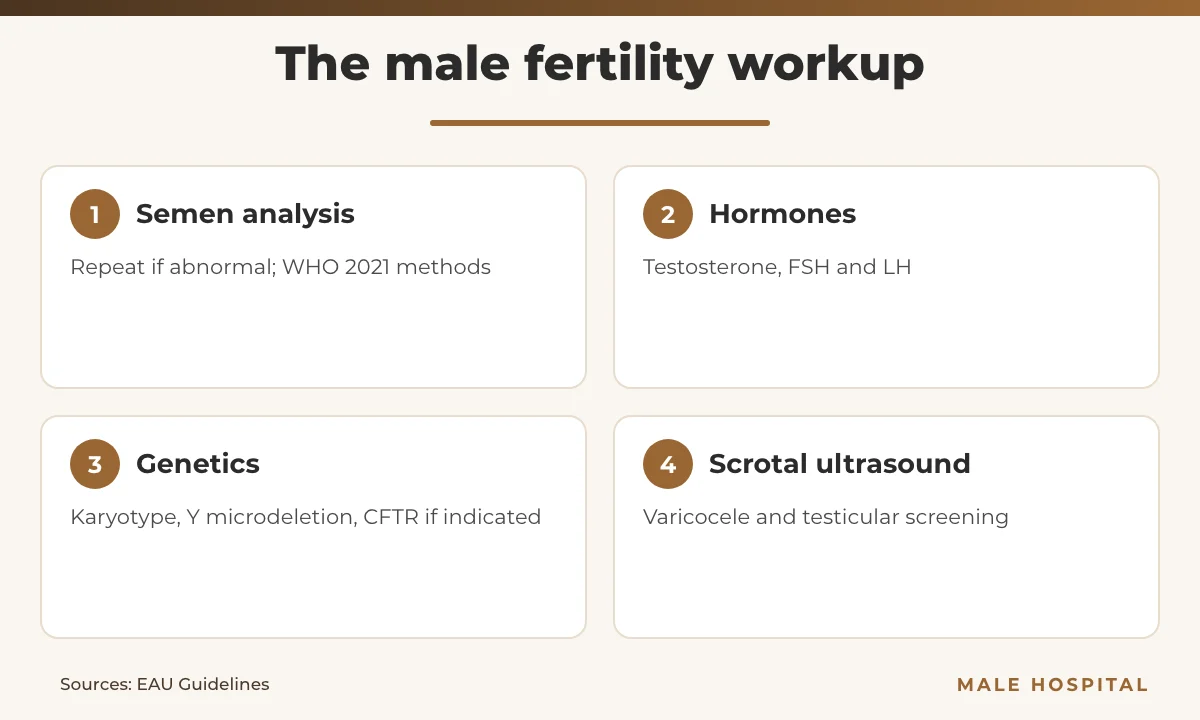
A typical male infertility treatment pathway looks like this, although the order changes with each man’s results:
- History and examination: fertility history, medicines, steroid use, previous surgery, and examination of the testicles and veins.
- Semen analysis: at least two samples if the first is abnormal.
- Targeted tests: testosterone, FSH and LH; scrotal ultrasound; karyotype, Y microdeletion or CFTR testing when indicated.
- Diagnosis and plan: the result is discussed together with the partner’s fertility assessment.
- Treatment: correcting reversible causes, hormonal therapy, varicocele repair, reconstruction or sperm retrieval.
- Follow-up: repeat semen analysis and, where needed, coordination with the IVF/ICSI team.
Source: EAU — Sexual and Reproductive Health Guidelines: Male Infertility
Recovery and response timeline
Sperm take time to mature, so most results are judged in months, not weeks. The table gives guideline-based time frames for each male infertility treatment.
| Situation | What to expect |
|---|---|
| After varicocele repair | Semen improvement within up to two spermatogenic cycles; pregnancies typically at 6–12 months |
| Choosing repair before ART | Defers IVF/ICSI by at least six months |
| Surgical sperm retrieval | Usually same-day, often under local anaesthetic; sperm quality reported the same day |
| After conventional TESE | Testosterone may dip and usually recovers in 18–26 months |
| After chemotherapy | Sperm production usually recovers in one to four years |
Sources: EAU — Sexual and Reproductive Health Guidelines: Male Infertility; AUA/ASRM — Diagnosis and Treatment of Infertility in Men: AUA/ASRM Guideline Part II; NHS — Infertility: treatment
Risks and side effects
Every step of male infertility treatment has trade-offs that should be discussed openly:
- Hormonal medicines: possible side effects include nausea, headaches and hot flushes; benefit is limited outside proven hormone deficiency.
- Varicocele repair: recurrence and fluid collection (hydrocele); hydrocele is more frequent after surgical ligation than embolisation.
- Testicular sperm extraction: bruising inside the testicle, scarring and a temporary fall in testosterone, more often after conventional TESE than micro-TESE; long-term hormone follow-up is reasonable.
- ICSI: a slightly higher risk than some other treatments, possible egg damage, and the usual IVF risks for the partner.
Sources: NHS — Infertility: treatment; EAU — Sexual and Reproductive Health Guidelines: Male Infertility; HFEA — Intracytoplasmic sperm injection (ICSI)
Genetics matter too. The HFEA notes that a son conceived through ICSI may inherit his father’s infertility, which is highly likely when the cause is on the Y chromosome. This is why genetic testing and counselling come before male infertility treatment, not after.
Sources: HFEA — Intracytoplasmic sperm injection (ICSI); MedlinePlus Genetics — Y chromosome infertility
Results and realistic expectations
Results of male infertility treatment depend on the cause, the partner’s age and the route chosen, so no clinic can honestly promise a pregnancy. In pooled EAU data, sperm were found in about 52% of men with micro-TESE versus 35% with conventional TESE, although the latest meta-analysis showed similar rates for both. In Klinefelter syndrome, sperm recovery can reach up to 50%. In obstructive azoospermia, retrieved sperm gave live-birth rates of up to 28% per ICSI cycle.
Source: EAU — Sexual and Reproductive Health Guidelines: Male Infertility
Male infertility treatment is therefore best seen as a way to give the couple the best realistic chance with the least invasive effective option. When no sperm can be found, donor sperm remains a possibility, and couples deserve clear information to make that decision in their own time.
Source: NHS — Infertility: treatment
Treatment with Dr. Zülfü Sertkaya in Istanbul
Male infertility treatment at Male Hospital is led by Assoc. Prof. Dr. Zülfü Sertkaya, a urologist and andrologist in Istanbul. He is a Fellow of the European Board of Urology (FEBU, 2017), became Associate Professor of Urology in 2020 and has been a urology specialist since 2014. His clinical focus includes male infertility, and his research covers micro-TESE, hormones and semen parameters in infertile men. He is a member of the EAU, ESSM, ISSM, the Turkish Urological Association and the Turkish Society of Andrology.
For patients travelling to Istanbul for male infertility treatment, our team provides reception and transport, translation, trip planning, hotel accommodation, medical consultation and aftercare. Pricing is given after a free assessment, because it depends on which tests and which technique you actually need.
How to start
Begin with a free, confidential WhatsApp consultation. Send your history, any semen analyses, hormone results or ultrasound reports, and your partner’s fertility situation if known. Our urologist-andrologist reviews them and suggests a personalised plan, including which tests are still missing and whether male infertility treatment can start before or during your visit.
When to see a doctor
Beyond the timing described above, get checked promptly if you notice:
- A lump, swelling or change in a testicle.
- Visible or painful enlarged veins in the scrotum.
- Low sex drive, erection problems or problems ejaculating.
- Fertility concerns after chemotherapy, radiotherapy or steroid use.
Sources: NHS — Infertility; Cleveland Clinic — Male Infertility: Causes, Diagnosis and Treatment
Related men’s health guides
- Male Infertility: Causes, Tests and 6 Proven Treatments
- Semen Analysis: WHO 2021 Values and 7 Key Results Explained
- Low Sperm Count: WHO 2021 Limits, 6 Causes and Treatments
- Sperm Motility: Normal Values, 7 Causes and How to Improve
- How to Increase Sperm Count: 9 Evidence-Based Steps
- Varicocele: Causes, Grades, Fertility and 3 Treatments
FAQs about male infertility treatment
Can male infertility be cured?
Some causes can be corrected with male infertility treatment, such as hormone deficiency from the pituitary, steroid-induced suppression, some varicoceles and many blockages. Other causes, such as genetic conditions or primary testicular failure, cannot be cured, but sperm retrieval with ICSI can still allow a biological child in many cases. Around 30–40% of men have no identifiable cause.
Source: EAU — Sexual and Reproductive Health Guidelines: Male Infertility
How long does male infertility treatment take?
The length of male infertility treatment depends on the route. Semen changes after varicocele repair take up to two sperm production cycles, and pregnancies usually follow at 6–12 months. Sperm retrieval is a same-day procedure, but the full IVF/ICSI cycle depends on the partner’s treatment schedule.
Sources: EAU — Sexual and Reproductive Health Guidelines: Male Infertility; NHS — Infertility: treatment
Is fertility surgery painful?
Tests are mostly blood draws, a semen sample and an ultrasound. Surgical sperm retrieval is usually done under local anaesthetic, sometimes general, as an outpatient procedure. Mild soreness and bruising afterwards are common; your surgeon will advise on pain relief and when to resume activity.
Source: NHS — Infertility: treatment
Does testosterone help male fertility?
No. Testosterone given from outside the body lowers the brain hormones that drive sperm production and can reduce or stop sperm output. The AUA/ASRM guideline says testosterone alone should not be prescribed to men who want children. Other medicines may be used instead.
Sources: AUA/ASRM — Diagnosis and Treatment of Infertility in Men: AUA/ASRM Guideline Part II; Cleveland Clinic — Male Infertility: Causes, Diagnosis and Treatment
Do fertility supplements work for men?
The evidence is weak. The AUA/ASRM guideline describes supplements as of questionable clinical utility and finds the data inadequate to recommend specific products. The EAU notes possible benefits on sperm quality that randomised trials have not confirmed.
Sources: AUA/ASRM — Diagnosis and Treatment of Infertility in Men: AUA/ASRM Guideline Part II; EAU — Sexual and Reproductive Health Guidelines: Male Infertility
Can a man with zero sperm count have a baby?
Often, yes. With a blockage, sperm production is usually normal and sperm can be retrieved from the epididymis or testicle. In non-obstructive azoospermia, micro-TESE finds sperm in about half of men in pooled studies. Retrieved sperm is used with ICSI.
Sources: EAU — Sexual and Reproductive Health Guidelines: Male Infertility; HFEA — Intracytoplasmic sperm injection (ICSI)
Should I repair my varicocele or go straight to IVF?
Repair is recommended for a palpable varicocele with abnormal semen, but it delays IVF/ICSI by at least six months. When the female partner is older or IVF is already needed for other reasons, going straight to ICSI may be more sensible.
Sources: AUA/ASRM — Diagnosis and Treatment of Infertility in Men: AUA/ASRM Guideline Part II; EAU — Sexual and Reproductive Health Guidelines: Male Infertility
Is ICSI safe for the baby?
ICSI is widely used, but the HFEA notes that certain genetic and developmental problems have been seen in a very small number of children, possibly linked to the underlying infertility rather than the procedure. Sons may inherit their father’s infertility, so genetic counselling is advised first.
Source: HFEA — Intracytoplasmic sperm injection (ICSI)
How much does male infertility treatment cost in Istanbul?
There is no single price, because costs depend on the tests you still need and whether treatment involves medicine, varicocele repair or sperm retrieval. We give pricing after a free assessment of your results on WhatsApp.
Ready to plan the next step? Send your results for a free, confidential review by our urologist-andrologist.
Medically reviewed by Assoc. Prof. Dr. Zülfü Sertkaya, urologist and andrologist (FEBU), Istanbul. Last reviewed: October 2026.
This article is for general information and does not replace an individual consultation with a qualified doctor.
- EAU — Sexual and Reproductive Health Guidelines: Male Infertility
- AUA/ASRM — Diagnosis and Treatment of Infertility in Men: AUA/ASRM Guideline Part II
- HFEA — Intracytoplasmic sperm injection (ICSI)
- NHS — Infertility: treatment
- NHS — Infertility
- Cleveland Clinic — Male Infertility: Causes, Diagnosis and Treatment
- WHO — Infertility fact sheet
- MedlinePlus Genetics — Y chromosome infertility
- Andrology (PubMed) — Campbell et al. 2021, Distribution of semen examination results 2020