
Enclomiphene is an oral selective estrogen receptor modulator (SERM) that raises a man’s own testosterone by prompting the pituitary to release more LH and FSH, instead of adding testosterone from outside. Because it keeps the testicles working, it preserves sperm production, which is why it is discussed as an alternative to testosterone replacement for men with secondary (pituitary-driven) low testosterone who still want children. It is not approved by the FDA or the European Medicines Agency for any use, so every prescription is off-label or compounded. This guide is a supporting page to our main overview of low testosterone treatment, which covers diagnosis and all treatment options.
Source: BJU International (PubMed) — Kim et al. 2016, phase III trials; FDA — Pharmacy Compounding Advisory Committee transcript, June 8, 2022
- Enclomiphene is the active trans-isomer of clomiphene (Clomid). It blocks estrogen feedback in the brain so the pituitary sends more LH and FSH to the testicles.
- In two 16-week phase III trials it raised testosterone into the normal range and kept sperm concentration normal, while testosterone gel markedly reduced sperm production.
- No product is approved anywhere: the FDA issued a complete response letter in 2015 and the EMA refused EnCyzix in 2018, because symptom benefit was not shown and blood clots were a concern.
- Reported side effects include headache, hot flushes, nausea, muscle spasm, blurred vision and mood changes; it cannot work in primary (testicular) hypogonadism.
- The EAU calls anti-estrogens an off-label option with poor evidence; the Endocrine Society says neither efficacy nor safety of clomiphene has been shown in randomized trials.
- What is enclomiphene?
- How enclomiphene works: restoring the hormone axis
- Enclomiphene vs clomiphene: what is the difference?
- Enclomiphene vs testosterone replacement therapy
- What the enclomiphene studies actually show
- Is enclomiphene FDA-approved? Off-label and regulatory status
- Enclomiphene side effects and risks
- Who might be a candidate: dosing and monitoring
- When to see a doctor
- FAQs about enclomiphene
What is enclomiphene?
Enclomiphene citrate is one of the two molecules that make up clomiphene citrate, the fertility tablet prescribed to women since the 1960s. Clomiphene is a roughly 62:38 mixture of enclomiphene (the trans-isomer) and zuclomiphene (the cis-isomer). Research over the past two decades suggests that most of the testosterone-raising benefit in men comes from the trans-isomer, while zuclomiphene contributes little and behaves more like an estrogen.
The single-isomer product was developed by Repros Therapeutics under the brand name Androxal for secondary hypogonadism, meaning low testosterone caused by weak signalling from the hypothalamus or pituitary rather than by damaged testicles. Men with this pattern have low testosterone together with low or inappropriately normal LH and FSH, and it is the most common form seen in overweight men and men with type 2 diabetes. Our guide to low testosterone explains how primary and secondary hypogonadism are told apart.
Source: Expert Review of Endocrinology & Metabolism (PubMed) — Earl & Kim 2019, drug profile; Cleveland Clinic — Low testosterone (male hypogonadism)
How enclomiphene works: restoring the hormone axis
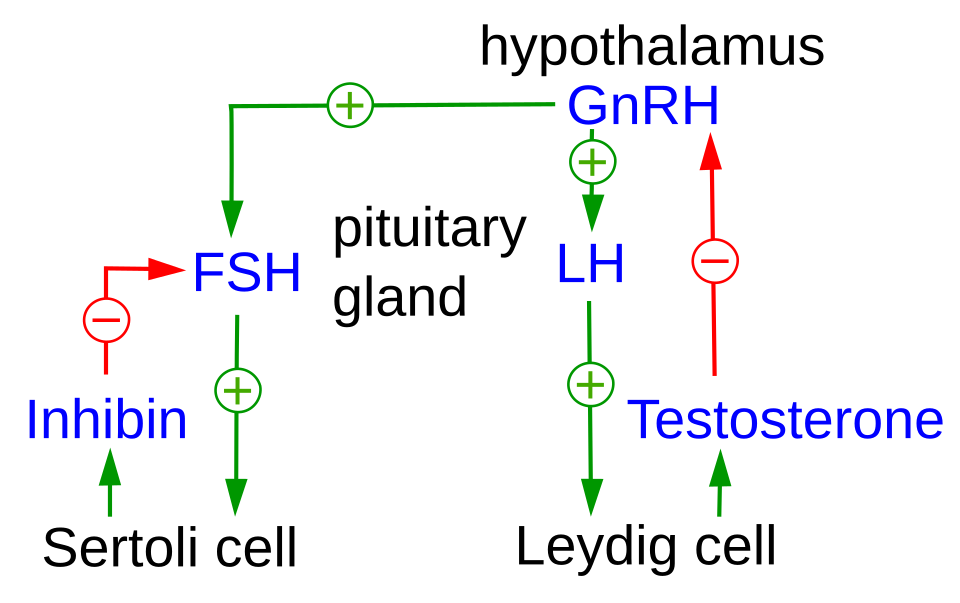
Testosterone production is run by a feedback loop called the hypothalamic-pituitary-gonadal (HPG) axis. The hypothalamus releases GnRH in pulses, the pituitary answers with LH and FSH, LH tells the Leydig cells in the testicles to make testosterone, and FSH supports sperm production. A fraction of that testosterone is converted to estradiol, which the pituitary reads as the main “enough hormone, slow down” signal.
Enclomiphene occupies the estrogen receptors in the hypothalamus and pituitary and blocks that slow-down signal. The brain reads this as low estrogen, releases more GnRH, LH and FSH, and the testicles respond by making more testosterone of their own. In the first pharmacology study, LH and testosterone increased within two weeks, and the effect persisted for at least a week after the tablets were stopped.
This mechanism explains two practical points. The drug needs a working axis: if the testicles themselves have failed (primary hypogonadism, with high LH and FSH), more stimulation cannot help. And because LH and FSH go up rather than down, sperm production is maintained rather than switched off, which is the central difference from testosterone replacement therapy.
Source: BJU International (PMC) — Wiehle et al. 2013, pharmacodynamics and pharmacokinetics; EAU Guidelines — Male hypogonadism
Enclomiphene vs clomiphene: what is the difference?
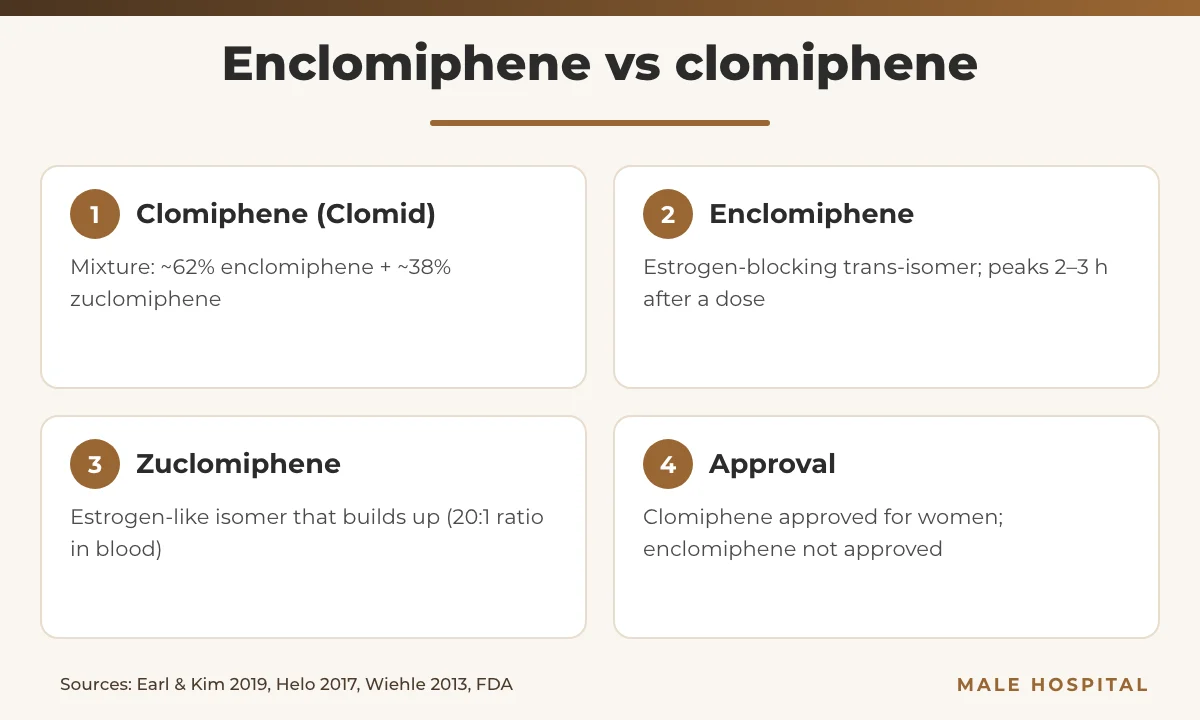
Clomiphene citrate (Clomid) is approved to induce ovulation in women and, as MedlinePlus notes, is “sometimes used to treat male infertility”. When a urologist prescribes it to a man for low testosterone, that is off-label use of an approved drug, and it is by far the better-studied option. A 2022 systematic review of 19 studies and 1,642 men found that clomiphene raised total and free testosterone, LH and FSH, improved symptom scores, caused side effects in under 10% of participants and produced no serious adverse events.
The argument for the single isomer is pharmacological. Zuclomiphene is cleared slowly and accumulates: in men who had taken clomiphene 25 mg daily for at least six weeks, the median zuclomiphene-to-enclomiphene ratio in blood was 20:1. Zuclomiphene has estrogen-like activity, and the single-isomer approach aims to keep the androgenic benefit of clomiphene without the undesirable effects attributed to zuclomiphene. Enclomiphene, by contrast, peaks about 2 to 3 hours after a dose and then falls steadily. In theory, the pure tablet gives the testosterone benefit with less estrogenic “baggage”.
Whether that theory translates into better results has only been tested in small, non-randomized studies. In a 2023 chart review of 78 men, both drugs raised testosterone (medians 390 to 581 ng/dL on enclomiphene and 244 to 470 ng/dL on clomiphene) and 87 to 89% of men in each group reached a level above 300 ng/dL. Only the enclomiphene group showed a significant rise in LH, FSH and total motile sperm count, but the between-group differences were not significant, the groups were not matched, and estradiol more than doubled. The honest summary: cleaner on paper, but clomiphene has far more human data.
Source: MedlinePlus — Clomiphene; Andrology (PubMed) — Huijben et al. 2022, clomiphene meta-analysis; BJU International (PubMed) — Helo et al. 2017, isomer levels on long-term clomiphene; Cureus (PMC) — Thomas et al. 2023, clomiphene vs enclomiphene
Enclomiphene vs testosterone replacement therapy
Testosterone replacement (gels, injections, pellets) is the guideline-endorsed treatment for symptomatic testosterone deficiency, and it works whether the problem is in the testicles or the pituitary. Its drawback for younger men is that exogenous testosterone switches off LH and FSH, which suppresses the testicles’ own testosterone and sperm production. The EAU lists an active desire to have children as an absolute contraindication to testosterone therapy, and the Endocrine Society recommends against it in men planning fertility in the near term.
SERMs fill that gap: they raise testosterone while LH, FSH and sperm counts are maintained, and clomiphene has been linked to a lower chance of polycythemia, the hematocrit rise that is the most common laboratory problem on testosterone. On the other hand, their evidence base is thinner, estradiol tends to climb, and an estimated third of men with a good biochemical response do not feel better, so the symptom benefit is less predictable. The table compares the main options for a man with secondary hypogonadism.
| Option | How it works | Sperm production | Approval status | Main drawbacks |
|---|---|---|---|---|
| Enclomiphene | Blocks estrogen feedback; raises LH, FSH and own testosterone | Maintained | Not approved by FDA or EMA; compounded or off-label | Limited long-term data; headache, hot flushes, visual and mood effects; clot risk flagged by EMA |
| Clomiphene (Clomid) | Same mechanism, mixed with estrogenic zuclomiphene | Maintained or improved | Approved for women; off-label in men | Zuclomiphene accumulates; estradiol rises; visual and mood effects |
| Testosterone replacement | Adds testosterone from outside | Suppressed, often severely | Approved for testosterone deficiency | Infertility while treated; hematocrit rise; lifelong therapy |
| hCG injections | Mimics LH directly at the testicle | Maintained; standard for men wanting paternity | Approved; the only FDA-approved non-testosterone option | Injections three times a week; expensive |
Source: EAU Guidelines — Male hypogonadism; Endocrine Society (JCEM) — Testosterone Therapy in Men With Hypogonadism, 2018; Cleveland Clinic Consult QD — The emerging role of clomiphene; Translational Andrology and Urology (PMC) — Krzastek & Smith 2020, non-testosterone management
What the enclomiphene studies actually show
Almost all human data come from developer-run trials between 2010 and 2015, one reason regulators have been cautious.
Phase II: dose-finding over six weeks
In a randomized, single-blind study of 48 men with secondary hypogonadism, three daily doses (6.25, 12.5 and 25 mg) were compared with testosterone gel. After six weeks, morning testosterone averaged 604 ± 160 ng/dL on 25 mg versus 500 ± 278 ng/dL on the gel, a difference that was not statistically significant. LH climbed to roughly 13 IU/L on 25 mg but fell to about 1.5 IU/L on the gel. Thyroid hormones, cortisol, lipids and bone markers did not change.
Phase III: 16 weeks in overweight men
Two parallel randomized, double-blind, placebo-controlled trials (ZA-304 and ZA-305) enrolled overweight men aged 18 to 60 with morning testosterone of 300 ng/dL or less and low or normal LH. After 16 weeks, enclomiphene had consistently raised testosterone, LH and FSH into the normal range and sperm concentration stayed normal, while men on testosterone gel showed a marked reduction in spermatogenesis. These are the trials the FDA judged inadequate in design to prove a clinical benefit, because they measured hormone levels rather than symptoms.
What is missing
There is still no randomized trial against clomiphene, no trial showing improvement in energy, libido, erections, bone or body composition, and no long-term safety cohort like the 400-patient, up-to-7-year clomiphene series published in 2019. The Endocrine Society’s 2018 guideline states that for clomiphene “neither its efficacy nor its safety has been demonstrated in randomized trials”, and that applies with even more force to the single isomer.
Source: BJU International (PMC) — Wiehle et al. 2013; BJU International (PubMed) — Kim et al. 2016; Journal of Urology (PubMed) — Krzastek et al. 2019, long-term clomiphene; Endocrine Society (JCEM) — 2018 guideline
Is enclomiphene FDA-approved? Off-label and regulatory status
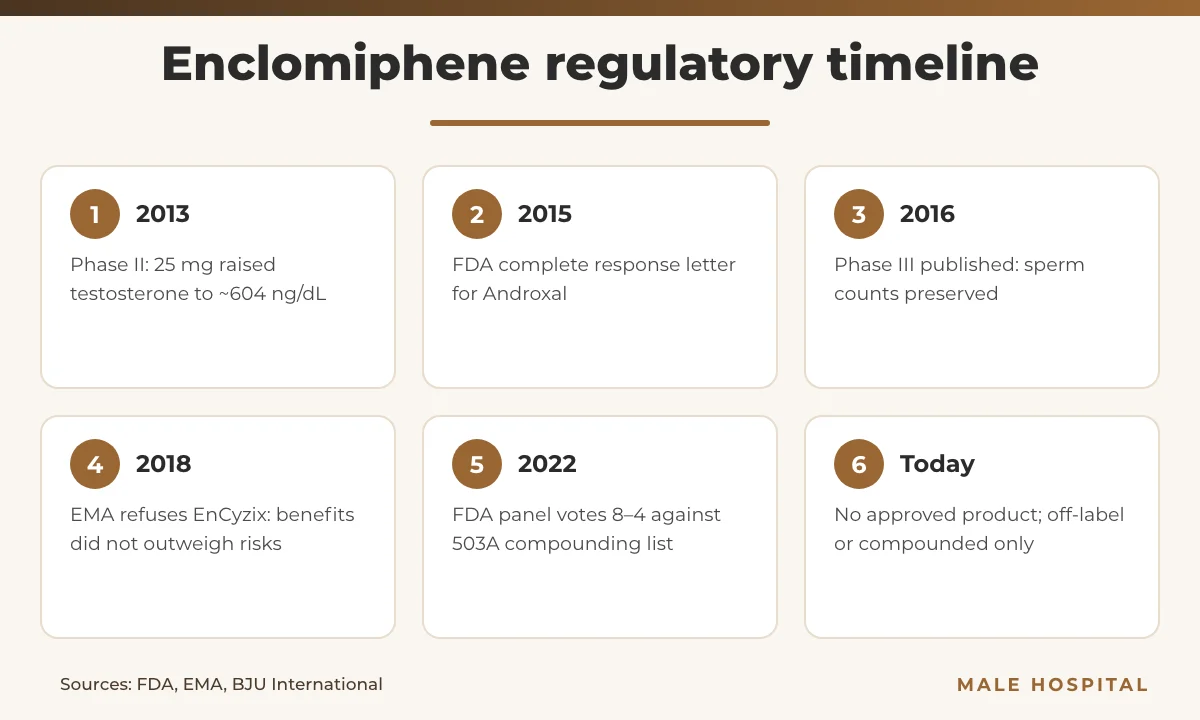
No. As the FDA reviewer told the Pharmacy Compounding Advisory Committee in June 2022, “No FDA-approved drugs contain enclomiphene as active ingredient.” Repros submitted a New Drug Application for Androxal in secondary hypogonadism, and in 2015 announced a complete response letter: the FDA found the phase III design inadequate to demonstrate clinical benefit and raised concerns about entry criteria, dose titration and the assay used to measure the drug.
In Europe, Renable Pharma applied in 2016 for marketing authorization of enclomifene under the name EnCyzix for overweight men with hypogonadotropic hypogonadism. The CHMP adopted a negative opinion on 25 January 2018 and the license was formally refused on 6 April 2018. The reasoning is worth reading: the studies showed higher testosterone but “did not look at whether EnCyzix would improve symptoms”, there was a risk of venous thromboembolism, and the benefits therefore did not outweigh the risks.
The 2022 FDA meeting considered whether enclomiphene citrate should be added to the 503A Bulks List, which would let licensed pharmacies compound it from raw powder. The FDA proposed it should not be added, and the committee voted 8 to 4 against placing it on the list, several members citing a lack of clinical efficacy evidence. Prescriptions advertised online today are therefore compounded under interim FDA policy or, outside the United States, supplied on an unlicensed basis. In short: an unapproved, experimental drug with a plausible mechanism and regulatory refusals on two continents.
Source: FDA — PCAC transcript, June 8, 2022; FDA — PCAC final summary minutes, June 8, 2022; FDA — June 8, 2022 PCAC meeting announcement; European Medicines Agency — EnCyzix (enclomifene): refusal of marketing authorisation
Enclomiphene side effects and risks
In the development trials, the most frequent adverse events were headache, hot flushes, nausea and muscle spasm. The events that led men to stop treatment were blurred vision, muscle spasm, headache and aggression. In a longer safety study, serious events included chest pain, transient ischemic attack, atrial flutter, pulmonary embolism and deep vein thrombosis, and the EMA noted that cardiac and thromboembolic events were slightly more frequent than on testosterone. The FDA reviewer summarised the concerns as cardiac and thromboembolic events, elevated estradiol, increased PSA and increased hematocrit, with long-term safety data lacking.
Two class effects deserve special attention. SERMs can cause visual disturbances (blurred vision, spots, flashes, double vision); MedlinePlus advises calling a doctor right away if these occur with clomiphene, and clinicians generally stop the drug. Mood changes, including irritability and worsening depression, are the other well-recognised problem. In the 2019 clomiphene series of men treated for more than three years, 8% reported side effects, most often mood changes (5 men), blurred vision (3) and breast tenderness (2).
The EAU guideline adds that SERMs may predispose to venous thromboembolism because of their agonist effect on veins, and that patients should be warned of this; it also cautions that long-term use of anti-estrogen agents can reduce bone density. Men with a history of blood clots, liver disease or significant eye disease need particular care. Compare these with the side effects of TRT before deciding which trade-off suits you.
Source: FDA — PCAC transcript, June 8, 2022; MedlinePlus — Clomiphene; Journal of Urology (PubMed) — Krzastek et al. 2019; EAU Guidelines — Male hypogonadism
Who might be a candidate: dosing and monitoring
Based on the trials and the EAU’s description of anti-estrogen therapy, the profile that makes sense is a man with confirmed secondary hypogonadism, typically overweight or with metabolic disease, who wants to keep or improve his fertility and understands that the drug is off-label. Confirmation means total testosterone measured fasting between 07:00 and 10:00 on at least two separate mornings, below 12 nmol/L (350 ng/dL) by EAU criteria or below the 300 ng/dL cut-off used in the United States, together with low or normal LH and FSH. Check your results against normal testosterone levels by age before assuming you are low.
Doses used in studies
The development trials used 6.25, 12.5 and 25 mg once daily, and 25 mg most reliably moved testosterone into the mid-normal range; in the 2023 Miami series men took 12.5 or 25 mg daily. Clomiphene is usually started at 25 to 50 mg every other day and titrated to a target testosterone level. Any “cycle” or “post-cycle therapy” protocol copied from bodybuilding forums has no supporting evidence.
Monitoring
Because estradiol rises along with testosterone, follow-up blood tests should include total testosterone, estradiol, LH, FSH and hematocrit, with PSA in older men, plus a semen analysis before and a few months into treatment when fertility is the goal. Symptom response is variable: a Cleveland Clinic endocrinologist estimates that about two-thirds of men feel better on clomiphene even though nearly all show a biochemical response, so treatment that only improves the lab number should be reconsidered.
Who should not take it
Men with primary hypogonadism (high LH and FSH, for example after chemotherapy, with Klinefelter syndrome or testicular injury) cannot respond, because the drug works by stimulating testicles that must be able to answer. Men with previous venous thromboembolism, active liver disease or unexplained visual symptoms need specialist review first. If your goal is conception rather than symptoms, our overview of male infertility treatment explains how hormone therapy fits alongside varicocele repair, lifestyle change and assisted reproduction.
Assoc. Prof. Dr. Zülfü Sertkaya, our urologist-andrologist in Istanbul, has a special interest in male infertility and hormonal evaluation and is a member of the EAU, ESSM and ISSM. If you are weighing enclomiphene, clomiphene, hCG or testosterone, you can request a confidential consultation on WhatsApp; the right choice, and the cost of care, depend on your hormone results and fertility plans.
Source: EAU Guidelines — Male hypogonadism; Cureus (PMC) — Thomas et al. 2023; Pharmaceuticals (PMC) — Wu & Sung 2024, clomiphene as an alternative for male hypogonadism; Cleveland Clinic Consult QD — The emerging role of clomiphene
When to see a doctor
Do not start enclomiphene or clomiphene bought online without a diagnosis. Low energy, low libido and weak erections have many causes, and a tablet that raises testosterone will not fix sleep apnea, depression, thyroid disease or a pituitary tumour. See a urologist or endocrinologist first, and never combine a SERM with testosterone or anabolic steroids on a forum protocol: exogenous testosterone shuts down the very LH signal the drug is trying to raise.
If you are already taking it, stop and seek medical attention the same day for any of these red flags:
- Blurred vision, spots, flashes of light or double vision.
- Swelling, warmth or pain in one calf, or sudden chest pain and breathlessness (possible blood clot).
- Severe headache, fainting, palpitations or a brief episode of weakness, numbness or slurred speech.
- New aggression, severe irritability or depressive thoughts.
- Rapidly growing or painful breast tissue, or a hard testicular lump.
Source: FDA — PCAC transcript, June 8, 2022; MedlinePlus — Clomiphene
FAQs about enclomiphene
Is enclomiphene legal?
Possession with a prescription is legal in most countries, but no regulator has approved a product. In the United States it is available only as a compounded preparation; in the EU the EnCyzix application was refused in 2018. Buying from unregulated websites carries the usual risks of unknown purity and dose.
Source: EMA — EnCyzix refusal; FDA — PCAC minutes 2022
How much does enclomiphene raise testosterone?
In the phase II trial, 25 mg daily raised morning testosterone to an average of 604 ng/dL after six weeks, comparable to testosterone gel. In routine practice, median levels rose from 390 to 581 ng/dL and about 87% of men reached a level above 300 ng/dL. Individual responses vary widely.
Source: BJU International (PMC) — Wiehle et al. 2013; Cureus (PMC) — Thomas et al. 2023
How long does enclomiphene take to work?
Hormone levels change quickly: LH and testosterone increased within two weeks of daily dosing, with the full effect by six weeks. Symptoms such as energy and libido, if they improve at all, lag behind the blood tests by several weeks, and studies typically re-check semen only after at least three months of treatment.
Source: BJU International (PMC) — Wiehle et al. 2013; Cureus (PMC) — Thomas et al. 2023
Does enclomiphene affect fertility or sperm count?
It preserves it. In the 16-week phase III trials sperm concentration stayed in the normal range, whereas testosterone gel caused a marked fall. In the Miami chart review, total motile sperm count rose significantly. That said, a pregnancy benefit has not been proven in a randomized trial for either isomer.
Source: BJU International (PubMed) — Kim et al. 2016; Cureus (PMC) — Thomas et al. 2023
Does enclomiphene cause weight loss or gynecomastia?
Neither has been shown. The trials did not test body weight as an outcome. Because the drug raises estradiol, breast tenderness or enlargement is possible, as reported with clomiphene. Men who develop breast changes should have estradiol checked and the dose reviewed.
Source: Pharmaceuticals (PMC) — Wu & Sung 2024; Journal of Urology (PubMed) — Krzastek et al. 2019
What happens when you stop enclomiphene?
Unlike testosterone therapy, which leaves the axis suppressed, the effect on LH and testosterone persisted for at least a week after the last dose in the phase II study. What happens over the following months has not been studied, so expect levels to drift back toward baseline unless the underlying cause, often excess weight, has changed.
Source: BJU International (PMC) — Wiehle et al. 2013
Is enclomiphene better than clomiphene?
Not proven. It avoids zuclomiphene, the estrogenic isomer that accumulates during clomiphene therapy, and in one small retrospective study it raised gonadotropins and motile sperm more clearly. But no randomized head-to-head trial exists, clomiphene has years of long-term safety data, and clomiphene is an approved, inexpensive tablet. Guidelines still regard both as off-label options with limited evidence.
Source: BJU International (PubMed) — Helo et al. 2017; Cureus (PMC) — Thomas et al. 2023; EAU Guidelines — Male hypogonadism
Medically reviewed by Assoc. Prof. Dr. Zülfü Sertkaya, urologist and andrologist (FEBU), Istanbul. Last reviewed: November 2026.
This article is for general information and does not replace an individual consultation with a qualified doctor.
- EAU Guidelines — Sexual and Reproductive Health: Male hypogonadism
- Endocrine Society (JCEM) — Bhasin et al. 2018, Testosterone Therapy in Men With Hypogonadism: Clinical Practice Guideline
- FDA — Pharmacy Compounding Advisory Committee, June 8, 2022: meeting transcript (enclomiphene citrate)
- FDA — Pharmacy Compounding Advisory Committee, June 8, 2022: final summary minutes
- FDA — June 8, 2022 Meeting of the Pharmacy Compounding Advisory Committee: announcement
- European Medicines Agency — EnCyzix (enclomifene): refusal of the marketing authorisation
- BJU International (PMC) — Wiehle et al. 2013, Testosterone restoration using enclomiphene citrate in men with secondary hypogonadism: pharmacodynamics and pharmacokinetics
- BJU International (PubMed) — Kim et al. 2016, Oral enclomiphene citrate raises testosterone and preserves sperm counts in obese hypogonadal men, unlike topical testosterone
- BJU International (PubMed) — Helo et al. 2017, Serum levels of enclomiphene and zuclomiphene in men with hypogonadism on long-term clomiphene citrate treatment
- Expert Review of Endocrinology & Metabolism (PubMed) — Earl & Kim 2019, Enclomiphene citrate: a treatment that maintains fertility in men with secondary hypogonadism
- Cureus (PMC) — Thomas et al. 2023, Efficacy of Clomiphene Citrate Versus Enclomiphene Citrate for Male Infertility Treatment: A Retrospective Study
- Andrology (PubMed) — Huijben et al. 2022, Clomiphene citrate for men with hypogonadism: a systematic review and meta-analysis
- Journal of Urology (PubMed) — Krzastek et al. 2019, Long-Term Safety and Efficacy of Clomiphene Citrate for the Treatment of Hypogonadism
- Translational Andrology and Urology (PMC) — Krzastek & Smith 2020, Non-testosterone management of male hypogonadism
- Pharmaceuticals (PMC) — Wu & Sung 2024, Clomiphene Citrate Treatment as an Alternative Therapeutic Approach for Male Hypogonadism
- Cleveland Clinic Consult QD — Male Hypogonadotropic Hypogonadism: The Emerging Role of Clomiphene
- Cleveland Clinic — Low Testosterone (Low T): Hypogonadism, Symptoms & Treatment
- MedlinePlus — Clomiphene: Drug Information