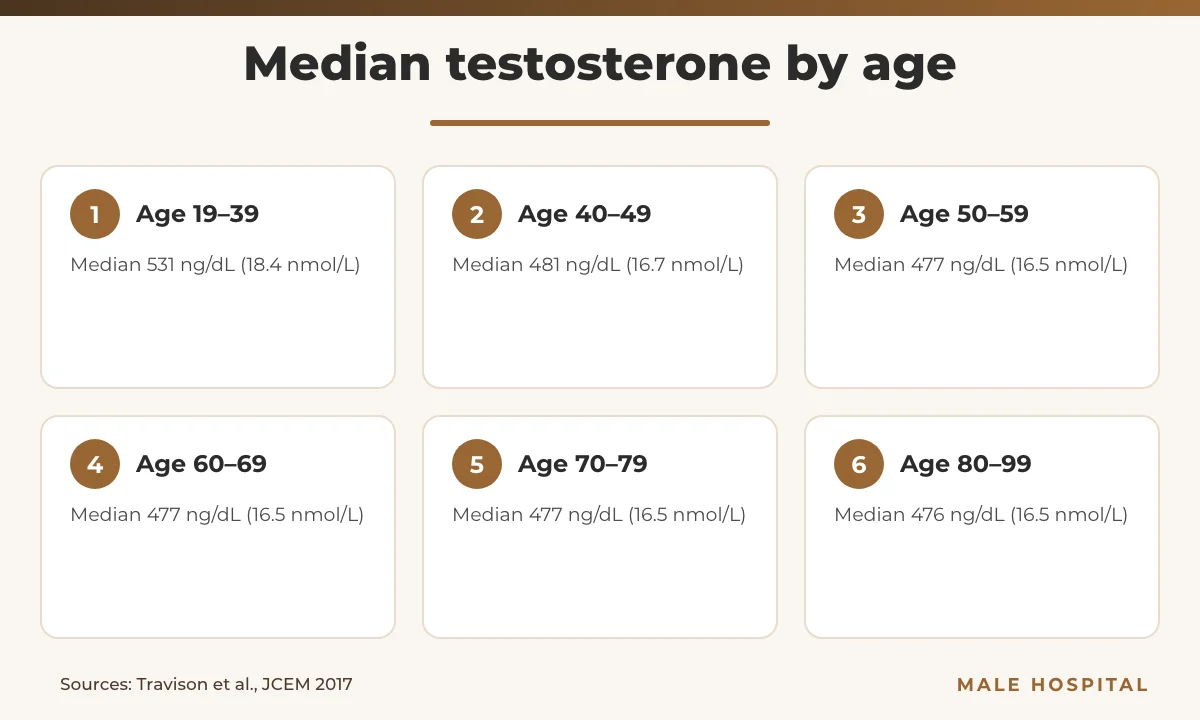
Normal testosterone levels by age are best taken from large studies that measured healthy men with a calibrated method. In the largest harmonized analysis of 9,054 men, the normal total testosterone range for healthy, non-obese men aged 19 to 39 was 264–916 ng/dL (about 9.2–31.8 nmol/L), with a median of 531 ng/dL. After 40, the median falls only modestly, to about 477 ng/dL, while the lowest values drop more clearly with each decade. A level is only part of the picture: diagnosing low testosterone (male hypogonadism) also needs symptoms and a repeat morning test.
Source: J Clin Endocrinol Metab (PMC) — Harmonized Reference Ranges for Circulating Testosterone Levels in Men of Four Cohort Studies (Travison et al., 2017); J Clin Endocrinol Metab (PubMed) — Testosterone Therapy in Men With Hypogonadism: Endocrine Society Guideline (2018)
- The harmonized normal range for total testosterone levels in healthy young men is 264–916 ng/dL; to convert ng/dL to nmol/L, divide by 28.84.
- Median testosterone levels in non-obese men stay close to 477 ng/dL from the 40s to the 80s; the lower end of the range is what falls with age.
- Long-term studies show total testosterone falling by roughly 0.4–1.6% a year after 40, and free testosterone falling faster because SHBG rises.
- Free testosterone matters when total testosterone is borderline or SHBG is abnormal; it should be calculated or measured by equilibrium dialysis.
- Test in the morning (07:00–10:00), fasting, and repeat any low result before drawing conclusions.
- What counts as normal testosterone levels by age?
- Testosterone units and how to convert them
- Normal testosterone levels by age: the reference table
- How much does testosterone fall with age?
- Free vs total testosterone
- SHBG: the protein that changes your result
- How to get an accurate testosterone test
- When is a level considered low?
- When to see a doctor
- FAQs about normal testosterone levels by age
What counts as normal testosterone levels by age?
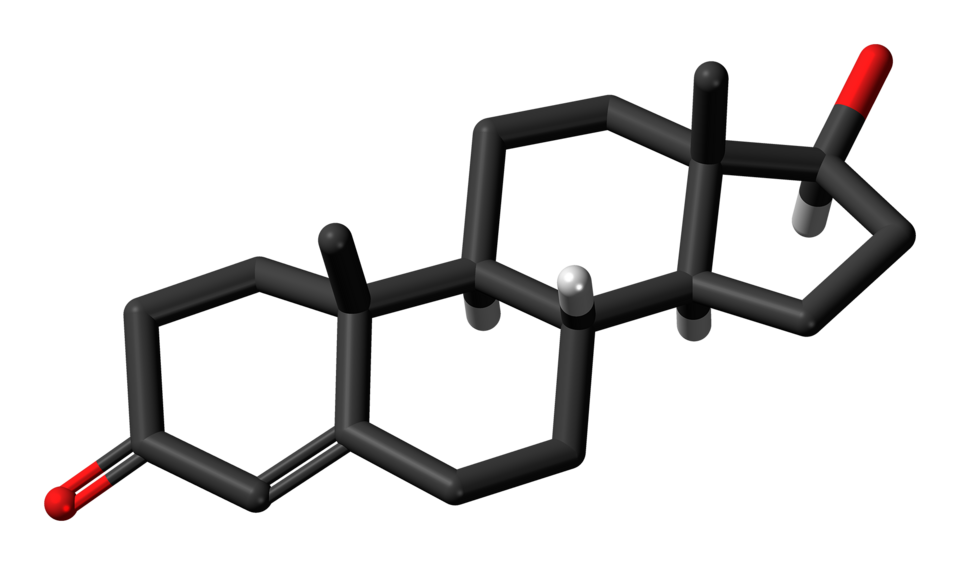
A “normal” range for testosterone levels on a lab report is a statistical range, not a health guarantee. Laboratories usually define it as the middle 95% of results from a reference group of healthy men, so the lowest 2.5% and the highest 2.5% of healthy men fall outside it by design. The range a lab prints also depends on the assay it uses, which is why two labs can give different “normal” limits for the same blood sample.
To fix this, researchers cross-calibrated the testosterone results of four large cohorts in the United States and Europe (the Framingham Heart Study, the European Male Aging Study, the Osteoporotic Fractures in Men Study and the Male Sibling Study of Osteoporosis) against the reference method of the US Centers for Disease Control and Prevention (CDC). The study found that a substantial part of the difference between cohorts came from assay differences rather than from the men themselves. The resulting harmonized ranges are now the most widely quoted source for normal testosterone levels by age.
Age matters before adulthood too. Testosterone levels are very low in children (under about 25 ng/dL), rise sharply during puberty and peak in the late teens. Ranges for boys depend on pubertal stage, so the adult tables below should not be applied to teenagers. Cleveland Clinic also stresses that normal ranges vary with the type of test and the laboratory.
Source: Cleveland Clinic — Testosterone: What It Is, Function and Levels
Testosterone units and how to convert them
Total testosterone levels are reported in two main units. Labs in the United States usually use nanograms per deciliter (ng/dL), while most labs in Europe, the UK and many other countries use nanomoles per liter (nmol/L). Some reports use ng/mL, which is simply ng/dL divided by 100. Free testosterone is much smaller and is reported in picomoles per liter (pmol/L), picograms per milliliter (pg/mL) or ng/dL.
Because testosterone has a fixed molecular weight, conversion is straightforward. One nmol/L equals about 28.84 ng/dL. For example, the 300 ng/dL threshold used in US practice equals about 10.4 nmol/L, and the European 12 nmol/L threshold equals 3.5 ng/mL (about 346 ng/dL). For free testosterone, the EAU threshold of 220 pmol/L equals 6.4 ng/dL (about 63 pg/mL).
Source: J Clin Endocrinol Metab (PMC) — Diurnal Variation in Serum Testosterone During Clinic Hours (Brambilla et al., 2009); EAU — Sexual and Reproductive Health Guidelines: Male Hypogonadism
| To convert | Calculation | Example |
|---|---|---|
| Total T: nmol/L → ng/dL | multiply by 28.84 | 12 nmol/L ≈ 346 ng/dL |
| Total T: ng/dL → nmol/L | divide by 28.84 | 300 ng/dL ≈ 10.4 nmol/L |
| Total T: ng/mL → ng/dL | multiply by 100 | 3.5 ng/mL = 350 ng/dL |
| Free T: pmol/L → pg/mL | multiply by 0.2884 | 220 pmol/L ≈ 63 pg/mL (6.4 ng/dL) |
Normal testosterone levels by age: the reference table
The table below shows model-based percentiles for total testosterone levels in 6,933 healthy, non-obese men from the four harmonized cohorts. The median (50th percentile) is the typical value; the 2.5th and 5th percentiles show where the lowest healthy values sit; the 95th percentile shows the upper end. Values in brackets are nmol/L, converted with the factor above.
| Age (years) | 2.5th percentile | 5th percentile | Median | 95th percentile |
|---|---|---|---|---|
| 19–39 | 267 ng/dL (9.3) | 304 (10.5) | 531 (18.4) | 850 (29.5) |
| 40–49 | 235 (8.1) | 273 (9.5) | 481 (16.7) | 839 (29.1) |
| 50–59 | 219 (7.6) | 256 (8.9) | 477 (16.5) | 839 (29.1) |
| 60–69 | 218 (7.6) | 254 (8.8) | 477 (16.5) | 839 (29.1) |
| 70–79 | 218 (7.6) | 252 (8.7) | 477 (16.5) | 839 (29.1) |
| 80–99 | 157 (5.4) | 218 (7.6) | 476 (16.5) | 839 (29.1) |
Source: J Clin Endocrinol Metab (PMC) — Harmonized Reference Ranges for Circulating Testosterone Levels in Men of Four Cohort Studies (Travison et al., 2017), Table 4
How to read this table
Two patterns in testosterone levels stand out. First, the upper end of the range barely moves with age: the 95th percentile stays between 839 and 850 ng/dL from the 20s to the 90s. Second, the lower end falls, from 304 ng/dL at the 5th percentile in men aged 19–39 to 252 ng/dL at 70–79 and 218 ng/dL after 80. In other words, ageing pulls more men into the low zone rather than lowering everyone equally.
Weight makes a clear difference to testosterone levels. When the researchers included all men, obese and non-obese, the median fell from 531 to 507 ng/dL in men aged 19–39 and from 477 to 446 ng/dL in men in their 50s and older. The authors noted that values in non-obese men were higher than in all men at every percentile.
Why other “by age” charts show different numbers
Many online charts give narrow age bands from single studies or from one laboratory’s method, so their numbers do not match the harmonized table. An older Framingham reference sample measured with mass spectrometry, for example, set the lower limit (2.5th percentile) at 348 ng/dL for total testosterone and 70 pg/mL for calculated free testosterone in healthy non-obese men aged 19–40. Men below those limits were more likely to have slow walking speed, frailty, diabetes and sexual symptoms. Always compare your result with the reference range printed by the lab that ran it.
How much does testosterone fall with age?
Cross-sectional tables compare different men at different ages. Longitudinal studies, which follow the same men over years, give a more direct view of the decline in testosterone levels, and they generally show a steeper fall within individuals.
- Massachusetts Male Aging Study (1,156 men followed for 7–10 years): total testosterone fell by about 1.6% a year within individuals, and bioavailable testosterone by 2–3% a year. SHBG rose by about 1.6% a year cross-sectionally. Men in apparent good health had androgen levels 10–15% higher than men with chronic illness, obesity, regular medication or heavy drinking.
- Baltimore Longitudinal Study of Aging (890 men): total testosterone fell by an average of 0.124 nmol/L (about 3.6 ng/dL) a year, independent of illness. Using total testosterone criteria, hypogonadal levels were found in about 20% of men over 60, 30% over 70 and 50% over 80, and in more men when free testosterone was used.
- European Male Ageing Study: total testosterone fell by about 0.4% a year and free testosterone by about 1.3% a year. The EAU notes that in healthy ageing men the decline up to age 80 is small and gradual.
Sources: J Clin Endocrinol Metab (PubMed) — Age Trends in the Level of Serum Testosterone: Massachusetts Male Aging Study (Feldman et al., 2002); J Clin Endocrinol Metab (PubMed) — Longitudinal Effects of Aging on Serum Total and Free Testosterone: Baltimore Longitudinal Study of Aging (Harman et al., 2001); EAU — Sexual and Reproductive Health Guidelines: Male Hypogonadism
The practical message is that age alone causes only a slow decline in testosterone levels. A large drop, or a low level in a younger man, usually points to something else, such as weight gain, diabetes, medication or a problem in the testicles or pituitary. The MMAS authors suggested that new illness may speed up the age-related fall. That is also why lifestyle changes can matter; see our guide on how to increase testosterone naturally.
Free vs total testosterone
Most testosterone in the blood is attached to proteins: tightly to sex hormone-binding globulin (SHBG) and loosely to albumin. Only the small unbound fraction, called free testosterone, can act directly on tissues. A total testosterone test measures bound and free testosterone together. A free testosterone test measures only the unbound part, and a bioavailable testosterone test measures free testosterone plus the part loosely bound to albumin.
Source: MedlinePlus — Testosterone Levels Test
Total testosterone is the first test in almost every case. The Endocrine Society recommends adding free testosterone when total testosterone is near the lower limit of normal, or when a condition alters SHBG. Free testosterone should be measured by equilibrium dialysis or estimated with an accurate formula from total testosterone, SHBG and albumin.
The method used to measure testosterone levels matters. A classic comparison study found that calculated free testosterone gave almost the same values as equilibrium dialysis, while direct “analog” free testosterone immunoassays gave only a fraction of the true value and the free androgen index (FAI) was unreliable in men. The EAU likewise advises against direct free testosterone immunoassays and states that liquid chromatography–tandem mass spectrometry (LC-MS/MS) is the most accurate method for sex steroids.
Sources: J Clin Endocrinol Metab (PubMed) — A Critical Evaluation of Simple Methods for the Estimation of Free Testosterone in Serum (Vermeulen et al., 1999); EAU — Sexual and Reproductive Health Guidelines: Male Hypogonadism
SHBG: the protein that changes your result
SHBG is a protein made mostly in the liver that binds testosterone and estrogen. When SHBG is high, less testosterone is free, so a man can have a normal total level but low free testosterone. When SHBG is low, more testosterone is free, so a low-looking total level may be less meaningful than it seems. This is why SHBG and total testosterone levels are often ordered together.
According to MedlinePlus, SHBG is raised by liver disease, an overactive thyroid (hyperthyroidism) and some eating disorders. It is lowered by obesity, an underactive thyroid (hypothyroidism), type 2 diabetes or insulin resistance, anabolic steroid use and Cushing’s syndrome. In men, SHBG also rises with age, which is one reason free testosterone falls faster than total testosterone in later life.
Sources: MedlinePlus — SHBG Blood Test; J Clin Endocrinol Metab (PubMed) — Age Trends in the Level of Serum Testosterone: Massachusetts Male Aging Study (Feldman et al., 2002)
The EAU recommends measuring SHBG and calculating free testosterone in all conditions in which SHBG is altered. In practice this often applies to older men, men with obesity or diabetes, and men with thyroid or liver disease.
Source: EAU — Sexual and Reproductive Health Guidelines: Male Hypogonadism
How to get an accurate testosterone test
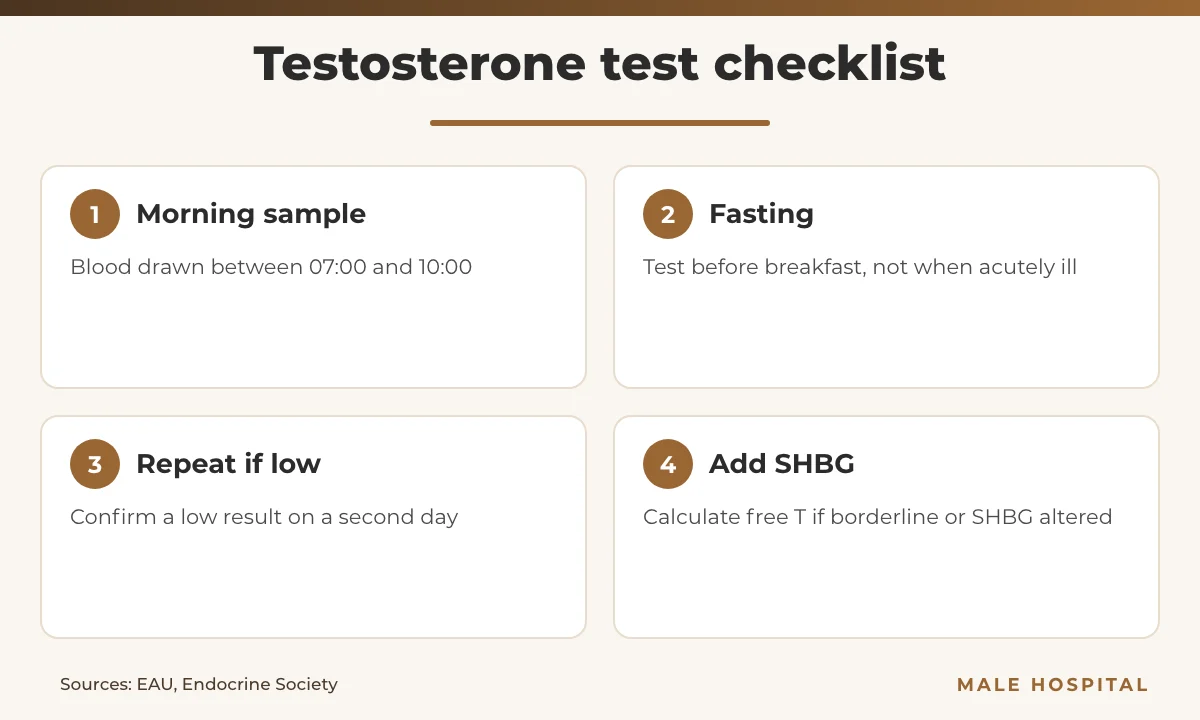
Testosterone levels follow a daily rhythm and are highest in the morning. In a Boston study of men aged 30–80 who gave six blood samples, levels in men aged 30–40 were 20–25% lower at 4 pm than at 8 am, and the gap shrank to about 10% at age 70. Seventeen men who had at least one result below 300 ng/dL after noon had normal results at all three of their morning visits.
Guidelines therefore set clear testing conditions:
- Time: draw blood between 07:00 and 10:00. Night-shift workers should be tested after an adequate sleep period.
- Fasting: the EAU and the Endocrine Society both recommend a fasting morning sample.
- Repeat: repeat a low total testosterone on at least one more occasion before any diagnosis or treatment.
- Not when unwell: testosterone levels should generally not be measured during an acute illness.
- Same lab when possible: because assays differ, compare results from the same method and use the lab’s own reference range.
- Medicines: tell your doctor about everything you take, including hormones and supplements, but do not stop any medicine unless your doctor advises it.
Sources: EAU — Sexual and Reproductive Health Guidelines: Male Hypogonadism; J Clin Endocrinol Metab (PubMed) — Testosterone Therapy in Men With Hypogonadism: Endocrine Society Guideline (2018); MedlinePlus — Testosterone Levels Test
A testosterone result on its own cannot diagnose any condition. The Endocrine Society also recommends against screening the general population for low testosterone, so testing makes most sense when there are symptoms or a medical reason.
Sources: MedlinePlus — Testosterone Levels Test; Endocrine Society — Testosterone Therapy for Hypogonadism Guideline
When is a level considered low?
Although normal testosterone levels by age differ, the diagnostic cut-offs used by guidelines are single numbers, not age-specific ones. The American Urological Association (AUA) uses total testosterone below 300 ng/dL as a reasonable cut-off, confirmed on two early-morning samples together with symptoms or signs. The EAU uses 12 nmol/L (3.5 ng/mL) for total testosterone and 220 pmol/L (6.4 ng/dL) for free testosterone.
Sources: Urology Times — Testosterone deficiency FAQs from the AUA guideline; EAU — Sexual and Reproductive Health Guidelines: Male Hypogonadism
| Reference point | Total testosterone | What it means |
|---|---|---|
| Harmonized normal range, men 19–39 | 264–916 ng/dL (9.2–31.8 nmol/L) | Middle 95% of healthy non-obese young men |
| EAU threshold | 12 nmol/L (about 346 ng/dL) | Reliable threshold for late-onset hypogonadism with symptoms |
| AUA cut-off | 300 ng/dL (about 10.4 nmol/L) | Low, if confirmed twice with symptoms or signs |
| EAU free testosterone threshold | Free T 220 pmol/L (6.4 ng/dL) | Useful when SHBG is abnormal or total T is borderline |
Sources: J Clin Endocrinol Metab (PMC) — Harmonized Reference Ranges (Travison et al., 2017); EAU — Sexual and Reproductive Health Guidelines: Male Hypogonadism; Urology Times — Testosterone deficiency FAQs from the AUA guideline
Both guidelines agree that a number alone is not a diagnosis. Testosterone deficiency is diagnosed only when a man has symptoms or signs and consistently low results. Typical symptoms include low sex drive, fewer morning erections, erectile problems, fatigue and low mood; our article on low testosterone symptoms covers them in detail. If deficiency is confirmed, treatment options, including testosterone replacement therapy, depend on the cause and on whether you plan to have children. During therapy, the Endocrine Society suggests aiming for testosterone levels in the mid-normal range.
When to see a doctor
A single result outside the lab range, with no symptoms, is not a reason for alarm; it usually needs a correctly timed repeat test. See a doctor, ideally a urologist-andrologist or endocrinologist, if you have:
- Low sex drive, erectile problems or fewer morning erections that persist for months.
- Two morning results below your lab’s lower limit, or below 300 ng/dL (about 10.4 nmol/L).
- Fatigue, low mood or reduced energy and strength together with sexual symptoms.
- Headaches or visual disturbance together with low testosterone levels, which may point to a pituitary disorder.
- Very low levels in a young man, or difficulty conceiving with a partner.
- Very high testosterone levels without a medical reason, which can follow anabolic steroid use.
Sources: EAU — Sexual and Reproductive Health Guidelines: Male Hypogonadism; MedlinePlus — Testosterone Levels Test
If your results or symptoms worry you, you can arrange a confidential review of your blood tests with our urologist-andrologist, Assoc. Prof. Dr. Zülfü Sertkaya, through WhatsApp. Further tests and any treatment depend on your full assessment.
FAQs about normal testosterone levels by age
What is a normal testosterone level for a man in his 20s or 30s?
In the harmonized analysis of four large cohorts, healthy non-obese men aged 19 to 39 had a normal total testosterone range of 264–916 ng/dL, roughly 9.2–31.8 nmol/L, with a median of 531 ng/dL. Your own lab may print slightly different limits for testosterone levels because assays differ, so always read your result against the range on your report.
Source: J Clin Endocrinol Metab (PMC) — Harmonized Reference Ranges (Travison et al., 2017)
What is a normal testosterone level at 50 or 60?
For healthy non-obese men in their 50s and 60s, the harmonized data show a median of about 477 ng/dL (16.5 nmol/L), a 5th percentile of about 255 ng/dL and a 95th percentile of 839 ng/dL. Including men with obesity, the median drops to about 446 ng/dL. Testosterone levels in the low part of this range are only meaningful together with symptoms.
Source: J Clin Endocrinol Metab (PMC) — Harmonized Reference Ranges (Travison et al., 2017)
At what age does testosterone start to decline?
Studies of men aged 40 and over show a gradual decline in testosterone levels: about 0.4% a year for total testosterone in the European Male Ageing Study and about 1.6% a year within individuals in the Massachusetts Male Aging Study. Free testosterone falls faster, roughly 1.3–3% a year, because SHBG rises with age. Poor health and obesity speed the fall.
Sources: EAU — Sexual and Reproductive Health Guidelines: Male Hypogonadism; J Clin Endocrinol Metab (PubMed) — Massachusetts Male Aging Study (Feldman et al., 2002)
Is free testosterone more important than total testosterone?
Not always. Total testosterone is the recommended first test. Free testosterone becomes important when total testosterone is close to the lower limit or when SHBG is abnormal, for example with obesity, diabetes, thyroid or liver disease, or older age. It should be calculated from total testosterone and SHBG or measured by equilibrium dialysis, not by a direct analog immunoassay.
Sources: J Clin Endocrinol Metab (PubMed) — Endocrine Society Guideline (2018); J Clin Endocrinol Metab (PubMed) — Vermeulen et al., 1999
Does the time of day really change my testosterone result?
Yes, especially in younger men. In one study, men aged 30–40 had testosterone levels 20–25% lower at 4 pm than at 8 am, and some men with low afternoon results were normal on every morning test. That is why guidelines ask for a fasting sample taken between 07:00 and 10:00, and a repeat test before any diagnosis.
Source: J Clin Endocrinol Metab (PMC) — Brambilla et al., 2009
How do I convert nmol/L to ng/dL?
Multiply nmol/L by 28.84 to get ng/dL, or divide ng/dL by 28.84 to get nmol/L. For example, 15 nmol/L is about 433 ng/dL, and 300 ng/dL is about 10.4 nmol/L. If your report uses ng/mL, multiply by 100 to get ng/dL. Free testosterone in pmol/L can be multiplied by 0.2884 to get pg/mL.
Source: J Clin Endocrinol Metab (PMC) — Brambilla et al., 2009
What does high SHBG with normal testosterone mean?
High SHBG binds more testosterone, so free testosterone can be low even when the total looks normal. This can explain symptoms despite normal total testosterone levels. Causes of high SHBG include liver disease, hyperthyroidism, some eating disorders and older age. Your doctor may calculate free testosterone and look for the underlying cause.
Source: MedlinePlus — SHBG Blood Test
Should every man over 40 have his testosterone checked?
No. The Endocrine Society recommends against screening the general population for low testosterone. Testing testosterone levels is advised when a man has symptoms or signs that suggest deficiency, such as low sex drive, erectile dysfunction or fewer morning erections. A test without symptoms often leads to confusing borderline results, and a single result cannot diagnose a condition on its own.
Sources: Endocrine Society — Testosterone Therapy for Hypogonadism Guideline; EAU — Sexual and Reproductive Health Guidelines: Male Hypogonadism
Medically reviewed by Assoc. Prof. Dr. Zülfü Sertkaya, urologist and andrologist (FEBU), Istanbul. Last reviewed: November 2026.
This article is for general information and does not replace an individual consultation with a qualified doctor.
- J Clin Endocrinol Metab (PMC) — Harmonized Reference Ranges for Circulating Testosterone Levels in Men of Four Cohort Studies (Travison et al., 2017)
- J Clin Endocrinol Metab (PMC) — Reference Ranges for Testosterone in Men Generated Using LC-MS/MS (Bhasin et al., 2011)
- J Clin Endocrinol Metab (PMC) — Diurnal Variation in Serum Testosterone During Clinic Hours (Brambilla et al., 2009)
- J Clin Endocrinol Metab (PubMed) — Age Trends in the Level of Serum Testosterone: Massachusetts Male Aging Study (Feldman et al., 2002)
- J Clin Endocrinol Metab (PubMed) — Longitudinal Effects of Aging on Serum Total and Free Testosterone: Baltimore Longitudinal Study of Aging (Harman et al., 2001)
- J Clin Endocrinol Metab (PubMed) — A Critical Evaluation of Simple Methods for the Estimation of Free Testosterone in Serum (Vermeulen et al., 1999)
- J Clin Endocrinol Metab (PubMed) — Testosterone Therapy in Men With Hypogonadism: Endocrine Society Clinical Practice Guideline (2018)
- Endocrine Society — Testosterone Therapy for Hypogonadism Guideline
- EAU — Sexual and Reproductive Health Guidelines: Male Hypogonadism
- Urology Times — Testosterone deficiency FAQs from the AUA guideline
- MedlinePlus — Testosterone Levels Test
- MedlinePlus — SHBG Blood Test
- Cleveland Clinic — Testosterone: What It Is, Function and Levels