
Hydrocele Surgery in Istanbul: 7 Expert Facts for Best Care
Hydrocele surgery (hydrocelectomy) removes or repairs the fluid-filled sac around a testicle so that the swelling does not come back. In adult men it is a short operation through a small cut in the scrotum, usually done as a day case under general or spinal anesthesia. It is offered when the hydrocele is large, uncomfortable or bothersome, after a scrotal ultrasound has ruled out other causes of the swelling.
Source: BAUS — Repair of a scrotal hydrocele (patient leaflet); Cleveland Clinic — Hydrocelectomy: Purpose, Procedure, Risks & Recovery
- A small hydrocele that causes no symptoms does not need treatment. Hydrocele surgery is for swelling that hurts, gets in the way or bothers you.
- No tablet shrinks a hydrocele. Open surgery (Lord’s plication, Jaboulay’s eversion or excision of the sac) is the standard, definitive treatment.
- Needle drainage alone refills quickly. Aspiration with sclerotherapy avoids an operation but has a clearly higher recurrence rate in trials.
- After hydrocele surgery, expect swelling and bruising for days to a few weeks, about a week off desk work and no heavy lifting for around four weeks.
- Any new scrotal swelling should be examined, and usually scanned, before treatment, because testicular cancer is an important differential diagnosis.
Send us your scan or symptoms and our urologist will tell you whether your hydrocele needs treatment at all.
- What is hydrocele surgery?
- Who needs hydrocele surgery?
- Ruling out a testicular tumor first
- Hydrocele surgery options compared
- The procedure step by step
- Recovery timeline after hydrocele surgery
- Risks and side effects
- Fertility and hydrocele treatment
- Results and realistic expectations
- Treatment with Dr. Zülfü Sertkaya in Istanbul
- When to see a doctor
- FAQs about hydrocele surgery
What is hydrocele surgery?
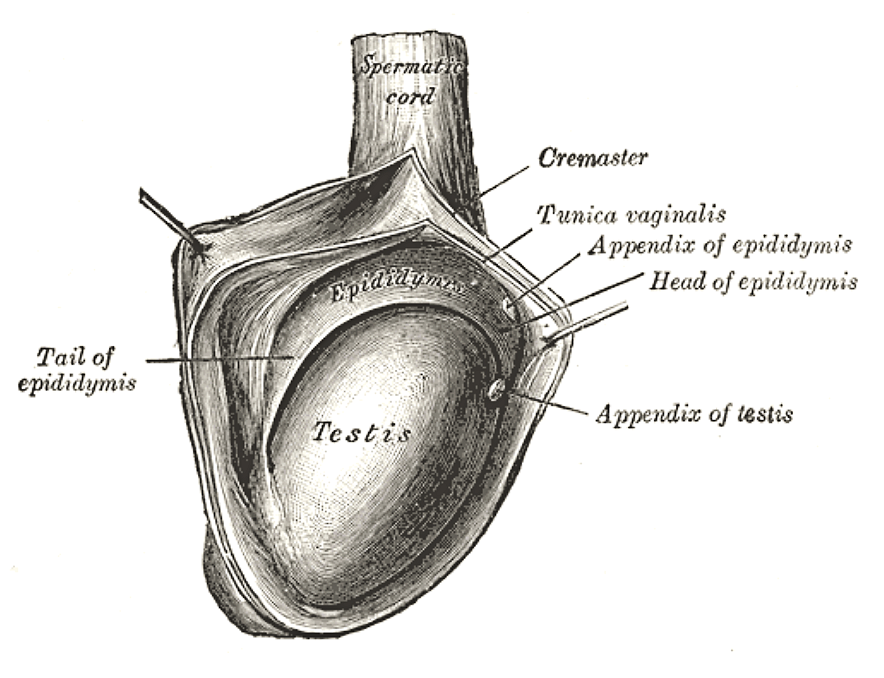
Each testicle sits inside a thin, two-layered pouch called the tunica vaginalis. Normally only a few milliliters of fluid lie between the layers. A hydrocele forms when fluid builds up in this space, either because too much is produced or because it does not drain well. The result is a smooth, usually painless swelling of one side of the scrotum.
Hydroceles affect about 1% of men, mostly over the age of 40. In adults most are idiopathic, meaning no clear cause is found, but they can also follow infection, injury, inguinal hernia repair or varicocele surgery. Unlike many hydroceles in babies, adult hydroceles usually do not go away on their own.
Source: Canadian Urological Association Journal — The use of TPA in combination with alcohol in the treatment of the recurrent complex hydrocele; MedlinePlus — Hydrocele
The operation drains the fluid and then deals with the sac so it cannot refill: the lining is either gathered up with stitches, turned inside out, or partly cut away. There is no medication that shrinks a hydrocele, so hydrocele surgery is the only reliable way to correct one that persists and causes problems.
Source: BAUS — Repair of a scrotal hydrocele (patient leaflet); Cleveland Clinic — Hydrocele: Causes, Symptoms, Diagnosis & Treatment
Who needs hydrocele surgery?
Many adult hydroceles are simply watched. A hydrocele is generally treated only when it causes symptoms, and the decision is yours, guided by your urologist. Typical reasons to choose hydrocele surgery are:
- a swelling large enough to make walking, sitting, sport or clothing uncomfortable;
- a dragging ache or pain in the scrotum;
- embarrassment or distress about the size or appearance;
- a hydrocele that keeps growing, or one with a hernia alongside it.
If both sides are affected, hydrocele surgery can usually repair both through a single incision. If the swelling changes size when pressed or when you lie down, an inguinal hernia is more likely, and the hernia is repaired at the same time if one is found.
Source: Cleveland Clinic — Hydrocelectomy: Purpose, Procedure, Risks & Recovery; MedlinePlus — Hydrocele; BAUS — Repair of a scrotal hydrocele (patient leaflet)
When watching and waiting is reasonable
A small, painless hydrocele that does not bother you needs no treatment. Observation is a legitimate choice. Men who are not fit for hydrocele surgery, or who prefer to avoid it, can also discuss aspiration with sclerotherapy, described below.
Source: BAUS — Repair of a scrotal hydrocele (patient leaflet); PubMed (Surg Endosc, 2023) — Aspiration and sclerotherapy versus hydrocelectomy for treating hydroceles: a systematic review and meta-analyses
Ruling out a testicular tumor first
A hydrocele is diagnosed by examination: the scrotum is swollen but not tender, and a light shone through it glows if the fluid is clear (transillumination). The problem is that the fluid can hide the testicle, so the doctor cannot feel whether the testicle itself is normal.
That is why a scrotal ultrasound is a standard part of the work-up before hydrocele surgery or sclerotherapy. Testicular cancer is an important differential diagnosis, and a hydrocele can occasionally be a sign of a more serious condition such as a tumor or inflammation of the testicle or epididymis. In a series of 156 men aged 20 to 60 who had a hydrocelectomy, pre-operative ultrasound found no malignancy, which is reassuring, but the scan is still how that reassurance is earned.
Source: MedlinePlus — Hydrocele; PubMed (Anticancer Res, 2020) — Incidental Testicular Pathologies in Patients With Idiopathic Hydrocele Testis: Is Preoperative Scrotal Ultrasound Justified?; Cleveland Clinic — Hydrocelectomy: Purpose, Procedure, Risks & Recovery
The same series found that 27% of men had symptoms other than painless enlargement, most often recurring pain. Pain, a hard area in the testicle or rapid growth all deserve a prompt scan before any hydrocele surgery or needle treatment is planned.
Hydrocele surgery options compared
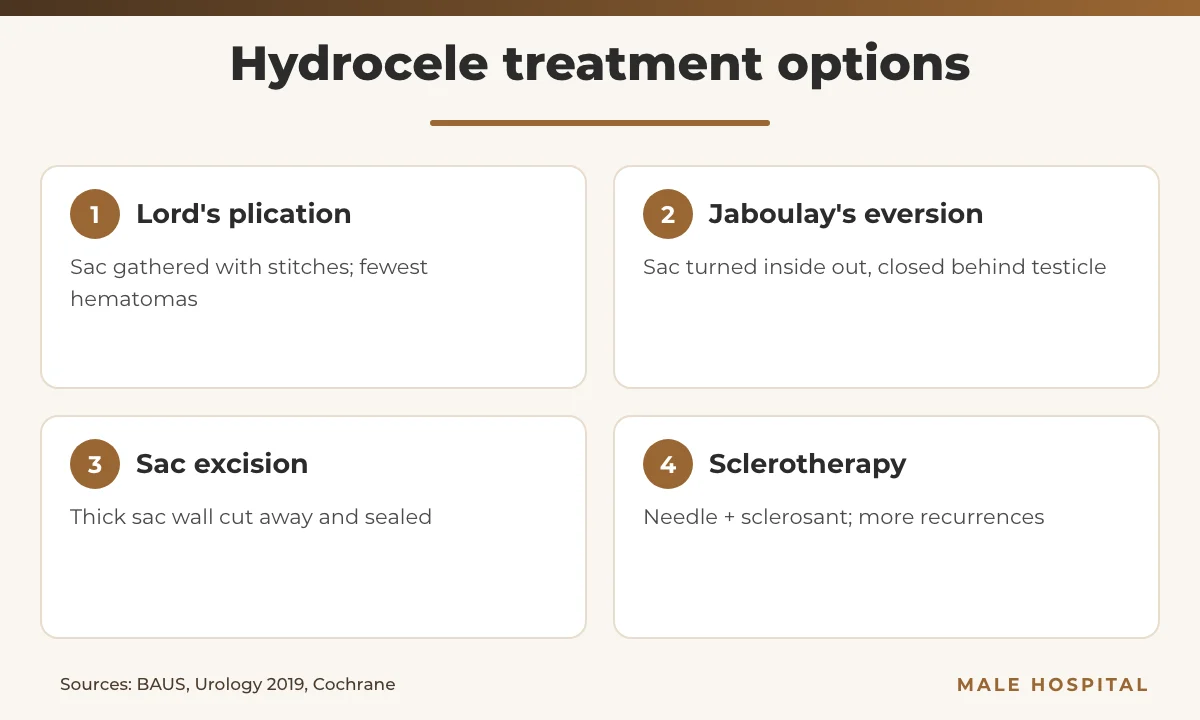
All open hydrocele surgery techniques start the same way: a small cut in the scrotum, delivery of the sac and drainage of the fluid. They differ in what is done with the sac afterward. The choice depends mainly on the size of the hydrocele and the thickness of its wall.
| Option | What is done | Main strengths | Main drawbacks |
|---|---|---|---|
| Lord’s plication | Sac opened, drained and “bunched up” with absorbable stitches; little dissection | Lowest overall complication and hematoma rates in a 276-operation comparison | Testicle feels bulkier afterward; less suited to very thick-walled sacs |
| Jaboulay’s eversion | Sac turned inside out and stitched closed behind the testicle | Widely used; similar recurrence to other techniques | More dissection than plication |
| Excision of the sac | Most of the sac wall is cut away and the edges sealed | Useful when the wall is very thick | More raw tissue, so more potential for bleeding |
| Aspiration + sclerotherapy | Fluid drawn off with a needle, then a sclerosing drug injected to seal the space | No incision; cheaper and faster return to work in trials | Much higher recurrence; repeat sessions may be needed |
| Aspiration alone | Fluid drawn off with a needle only | Quick temporary relief | Refills quickly; not curative; may introduce infection |
Source: PubMed (Urology, 2019) — Comparison of Recurrence and Postoperative Complications Between 3 Different Techniques for Surgical Repair of Idiopathic Hydrocele; BAUS — Repair of a scrotal hydrocele (patient leaflet); Cochrane — Aspiration and sclerotherapy versus hydrocoelectomy for treating hydrocoeles
Lord’s vs Jaboulay’s: what the evidence shows
In a review of 276 operations for idiopathic hydrocele (70 Jaboulay, 127 excision-type hydrocelectomies and 79 Lord’s repairs), 6% needed repeat surgery for recurrence, with no difference between techniques. Complications such as hematoma, testicular pain and infection occurred in 11.6% overall, and Lord’s repair had significantly fewer complications and hematomas. The largest hydrocele in the series, 2.4 liters, was treated with Lord’s repair.
These are retrospective data, not a randomized trial, so surgeons still tailor hydrocele surgery to the individual sac. A very thick or calcified wall, for example, may be better removed than folded.
Source: PubMed (Urology, 2019) — Comparison of Recurrence and Postoperative Complications Between 3 Different Techniques for Surgical Repair of Idiopathic Hydrocele; BAUS — Repair of a scrotal hydrocele (patient leaflet)
Aspiration and sclerotherapy: an honest look
In sclerotherapy, the fluid is removed through a needle and an irritant drug is injected so the two layers stick together. Agents used in trials include sodium tetradecyl sulfate, tetracycline, phenol and polidocanol. A Cochrane review of four small trials (275 men) found recurrence was significantly more common after sclerotherapy than after hydrocele surgery, although infections, cost and time off work tended to be lower. The authors rated the evidence as very uncertain.
A 2023 meta-analysis of five small randomized trials (335 men) reached the same conclusion: similar short-term cure, but a roughly nine-fold higher relative risk of recurrence, with no difference in fever, infection or hematoma. It recommends sclerotherapy mainly for men at high risk from hydrocele surgery or who want to avoid it. Needle drainage without a sclerosant is not a cure, because the fluid comes back quickly.
Source: Cochrane — Aspiration and sclerotherapy versus hydrocoelectomy for treating hydrocoeles; PubMed (Surg Endosc, 2023) — Aspiration and sclerotherapy versus hydrocelectomy for treating hydroceles: a systematic review and meta-analyses; BAUS — Repair of a scrotal hydrocele (patient leaflet)
The procedure step by step
Before the operation
Before hydrocele surgery you will be asked about your medical history and medicines. Tell the team if you take blood thinners such as aspirin, warfarin, clopidogrel or newer anticoagulants, or supplements such as vitamin E, because some may need to be paused. Stopping smoking before any operation lowers the risk of complications and helps healing.
Source: BAUS — Repair of a scrotal hydrocele (patient leaflet); MedlinePlus — Hydrocele repair
Anesthesia
Hydrocele surgery is normally done under general anesthesia (you are asleep) or spinal anesthesia (you are awake but numb from the waist down). Local anesthesia alone is possible but unusual. The anesthetist will also plan pain relief for after the operation.
During the operation
- An antibiotic injection may be given after checking for allergies.
- A small incision is made in the scrotum and the fluid is drained.
- The sac is plicated (Lord), everted and closed behind the testicle (Jaboulay), or partly removed if its wall is very thick.
- Some surgeons leave a small drain for a day or two.
- The skin is closed with dissolvable stitches and a scrotal support is applied.
Hydrocele surgery usually takes less than an hour, and most men go home the same day.
Source: BAUS — Repair of a scrotal hydrocele (patient leaflet); Cleveland Clinic — Hydrocelectomy: Purpose, Procedure, Risks & Recovery
Recovery timeline after hydrocele surgery
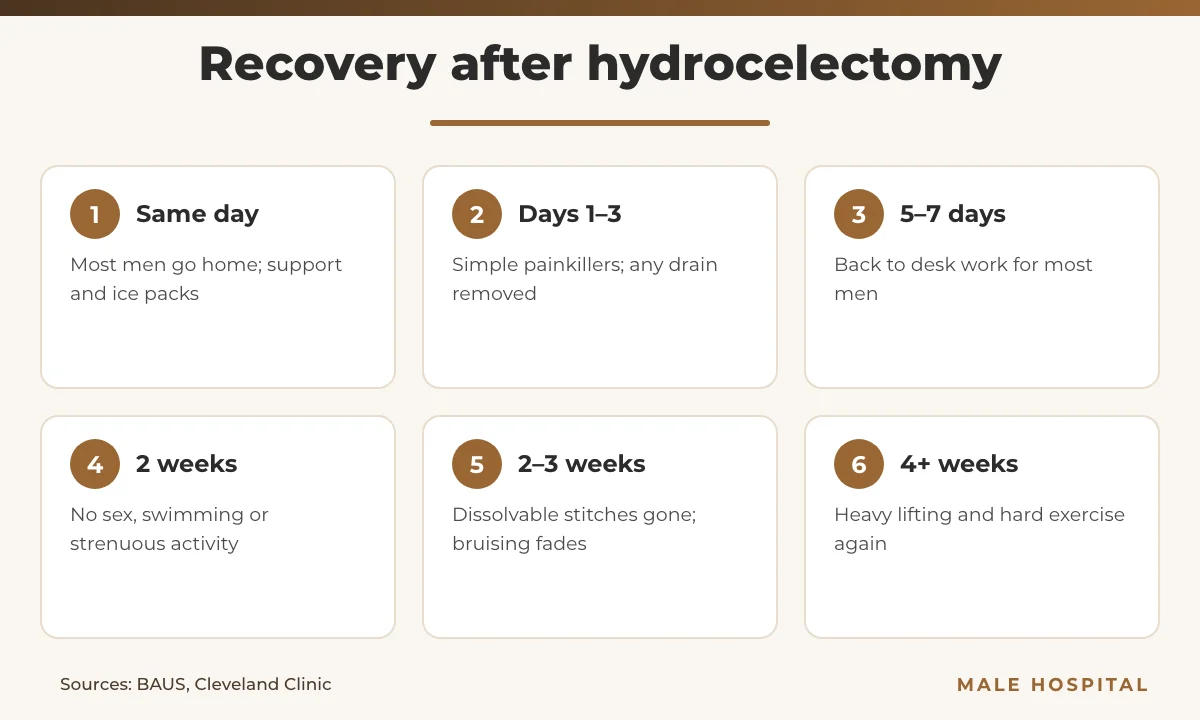
Recovery from hydrocele surgery is usually straightforward, but the scrotum swells easily, so the first days are about support, cold packs and rest. The timeline below combines advice from British and American urology sources; your own surgeon’s instructions take priority.
| When | What to expect |
|---|---|
| Day of surgery | Home the same day in most cases; scrotal support on; ice packs (wrapped, not on bare skin) for at least 24 hours |
| Days 1–3 | Simple painkillers such as paracetamol or ibuprofen; drain, if used, removed after a day or two |
| First week | Discomfort settles; supportive briefs worn day and night; showers allowed, but no baths until the wound heals; most men return to desk work after 5–7 days |
| Weeks 1–2 | No sex, masturbation, swimming or strenuous activity for at least two weeks; up to two weeks off for physical jobs |
| Weeks 2–3 | Dissolvable stitches disappear; swelling and bruising, which can last from several days to a few weeks, fade |
| Week 4 and after | Heavy lifting and strenuous exercise usually resumed after at least four weeks; stretched scrotal skin may take up to a month to shrink back |
Source: BAUS — Repair of a scrotal hydrocele (patient leaflet); Cleveland Clinic — Hydrocelectomy: Purpose, Procedure, Risks & Recovery; MedlinePlus — Hydrocele repair
If you cannot tolerate a jockstrap, tight supportive underwear or cycling shorts work too. Swelling, bruising or pain that gets worse day by day, rather than better, is a reason to contact your surgical team.
Source: BAUS — Repair of a scrotal hydrocele (patient leaflet)
Risks and side effects
Hydrocele surgery is considered a safe, low-risk operation, but the scrotum bleeds and swells easily, so minor complications are not rare. The British Association of Urological Surgeons gives these estimates:
- Almost all men: swelling, discomfort and bruising for several days to a few weeks, and a permanently bulkier feel around the testicle where the sac was gathered.
- Between 1 in 10 and 1 in 50: a blood collection (hematoma) that resolves slowly or needs drainage; wound or testicular infection needing antibiotics or drainage.
- Between 1 in 50 and 1 in 250: recurrence of the hydrocele; accidental injury to the epididymis, vas deferens or the testicle’s blood supply; chronic testicular or scrotal pain.
Source: BAUS — Repair of a scrotal hydrocele (patient leaflet)
What published series report
Real-world numbers vary between centers. A population-based review of 161 men after outpatient hydrocele and spermatocele surgery found infection or abscess in 9.3%, persistent swelling in 9.3% and chronic pain in 0.6%; using a drain did not change the complication rate. A Veterans Affairs series of 110 scrotal procedures reported recurrence in 6%, hematoma in 5% and wound infection in 3.6%, with most complications occurring after hydrocelectomy. Other series report lower rates, such as 3.2%.
Source: PubMed (J Urol, 2004) — A population based assessment of complications following outpatient hydrocelectomy and spermatocelectomy; PubMed (Urology, 2007) — Complications of scrotal surgery for benign conditions; PubMed (Anticancer Res, 2020) — Incidental Testicular Pathologies in Patients With Idiopathic Hydrocele Testis
As with any operation, hydrocele surgery carries small general risks from anesthesia and blood clots. Most of these problems are minor and settle with time, antibiotics or a small procedure.
Source: MedlinePlus — Hydrocele repair; Cleveland Clinic — Hydrocelectomy: Purpose, Procedure, Risks & Recovery
Fertility and hydrocele treatment
A hydrocele by itself usually does not cause infertility. The fertility question is really about the treatment. During hydrocele surgery the epididymis and vas deferens, the tubes that carry sperm, lie right next to the sac. BAUS estimates accidental injury to these structures or to the testicle’s blood supply at between 1 in 50 and 1 in 250 operations, and Cleveland Clinic notes that such an injury could affect fertility or testosterone production.
Source: Cleveland Clinic — Hydrocele: Causes, Symptoms, Diagnosis & Treatment; BAUS — Repair of a scrotal hydrocele (patient leaflet); Cleveland Clinic — Hydrocelectomy: Purpose, Procedure, Risks & Recovery
For sclerotherapy, fertility data are thin. None of the randomized trials in the Cochrane review reported semen results, and one excluded men with fertility concerns. In a series of 69 men treated with alcohol sclerotherapy, sperm concentration, motility and morphology dropped for up to six months and returned to normal by 12 months. If you hope to father children, say so before choosing between hydrocele surgery and sclerotherapy; a baseline semen analysis can help, and men with known sperm problems may be better served by a combined plan through our male infertility treatment service.
Source: Cochrane — Aspiration and sclerotherapy versus hydrocoelectomy for treating hydrocoeles; PubMed (Int Braz J Urol, 2011) — Sclerotherapy of hydroceles and spermatoceles with alcohol: results and effects on the semen analysis
A hydrocele can also appear after varicocele repair, so men who have had or are planning varicocele treatment should mention any new swelling at follow-up.
Results and realistic expectations
Hydrocelectomy has a high success rate and a very good long-term outlook. Most men are pleased to lose the weight and bulk of the swelling, and recurrence after open hydrocele surgery is uncommon: about 6% needed a repeat operation in the 276-operation series, and BAUS estimates between 1 in 50 and 1 in 250.
Three things are worth knowing before hydrocele surgery. First, the scrotum looks worse before it looks better, because post-operative swelling can last a few weeks. Second, the operated testicle will always feel a little bulkier than the other one, which is normal and not a recurrence. Third, after a very large hydrocele the stretched skin takes weeks to tighten.
Source: Cleveland Clinic — Hydrocelectomy: Purpose, Procedure, Risks & Recovery; PubMed (Urology, 2019) — Comparison of Recurrence and Postoperative Complications Between 3 Different Techniques for Surgical Repair of Idiopathic Hydrocele; BAUS — Repair of a scrotal hydrocele (patient leaflet)
Treatment with Dr. Zülfü Sertkaya in Istanbul
Your assessment and any hydrocele surgery are planned by Assoc. Prof. Dr. Zülfü Sertkaya, a urologist and andrologist in Istanbul. He has been a urology specialist since 2014, is a Fellow of the European Board of Urology (FEBU, 2017) and became Associate Professor of Urology in 2020. His andrology work includes male infertility, and he is a member of the European Association of Urology (EAU), the European Society for Sexual Medicine (ESSM) and the International Society for Sexual Medicine (ISSM). He founded and works at Andro Expertise Men’s Health and Aesthetic Clinic in Zeytinburnu, Istanbul.
For patients travelling to Istanbul we arrange reception and transport, translation, trip planning, hotel accommodation, the medical consultation and aftercare follow-up. Hydrocele surgery pricing is given after a free assessment, because it depends on your scan, the size of the hydrocele and the technique chosen.
How to start
Send us a confidential WhatsApp message with your age, which side is swollen, how long it has been there, any pain, any previous groin or scrotal surgery, whether you plan to have children, and a scrotal ultrasound report if you have one. The doctor reviews this and suggests a personalised plan, including whether you need treatment now, observation, or further tests first.
When to see a doctor
See a doctor about any new swelling or lump in the scrotum, so that other causes of a testicular lump can be ruled out. Seek help urgently if:
- you have sudden or severe pain in the scrotum or testicle, especially with swelling; this is an emergency, because some causes can cost you the testicle;
- the testicle feels hard or has a lump, or the swelling grows quickly;
- after surgery you have heavy bleeding, a fever of 38°C (100°F) or higher, red, purple or dark discoloration, or pain and swelling that get much worse.
Source: MedlinePlus — Hydrocele; Cleveland Clinic — Hydrocelectomy: Purpose, Procedure, Risks & Recovery
Get an honest, confidential opinion on whether your hydrocele needs surgery, sclerotherapy or simply watching.
Related men’s health guides
- Hydrocele in Adults: Causes, Ultrasound and 3 Treatments
- Testicular Pain: 9 Causes and When It’s an Emergency
- Epididymitis: 7 Causes, Torsion Red Flags and Treatment
- Varicocele: Causes, Grades, Fertility and 3 Treatments
- Blood in Semen: 7 Causes, Red Flags and Treatment
- Prostatitis: 4 Types, Symptoms, Treatment and Sex Life
FAQs about hydrocele surgery
Is hydrocele surgery painful?
You feel nothing during hydrocele surgery because it is done under general or spinal anesthesia. Afterward, discomfort is usually mild and settles within about a week. Simple painkillers such as paracetamol or ibuprofen, a scrotal support and wrapped ice packs in the first days are normally enough; stronger medicine is occasionally prescribed after more extensive surgery.
Source: Cleveland Clinic — Hydrocelectomy: Purpose, Procedure, Risks & Recovery; BAUS — Repair of a scrotal hydrocele (patient leaflet)
How long does hydrocele surgery take?
The operation itself usually takes less than an hour. Including admission, anesthesia and recovery from it, most men spend part of a day at the clinic and go home the same day. Both sides can usually be repaired through one incision, which adds only a little time.
Source: Cleveland Clinic — Hydrocelectomy: Purpose, Procedure, Risks & Recovery
Can a hydrocele go away without surgery?
In babies it often does, but in adult men a hydrocele usually does not disappear on its own. There is no medicine that shrinks one. If it is small and painless you can safely leave it alone; if it bothers you, hydrocele surgery is the reliable fix, and sclerotherapy is an alternative with a higher chance of the fluid returning.
Source: MedlinePlus — Hydrocele; Cleveland Clinic — Hydrocele: Causes, Symptoms, Diagnosis & Treatment
Why not just drain the fluid with a needle?
Simple needle aspiration removes the fluid, but it re-accumulates quickly, so it is not a curative or standard treatment and it carries a small risk of introducing infection. Adding a sclerosing drug improves the result but still recurs more often than hydrocele surgery.
Source: BAUS — Repair of a scrotal hydrocele (patient leaflet); PubMed (Surg Endosc, 2023) — Aspiration and sclerotherapy versus hydrocelectomy for treating hydroceles
When can I have sex after hydrocele surgery?
Cleveland Clinic advises avoiding sexual activity, including masturbation, for at least two weeks, along with strenuous exercise and swimming. Wait until the wound has healed and the swelling has settled enough to be comfortable, and ask your surgeon if you had a large repair or a complication such as a hematoma.
Source: Cleveland Clinic — Hydrocelectomy: Purpose, Procedure, Risks & Recovery
When can I go back to work and the gym?
Most men return to office work after about five to seven days, or up to two weeks for physically demanding jobs. Heavy lifting and strenuous exercise should wait at least four weeks according to BAUS.
Source: Cleveland Clinic — Hydrocelectomy: Purpose, Procedure, Risks & Recovery; BAUS — Repair of a scrotal hydrocele (patient leaflet)
Can a hydrocele come back after surgery?
Yes, but it is uncommon. BAUS puts recurrence at between 1 in 50 and 1 in 250 operations, and about 6% of men needed repeat surgery in a large retrospective series, with no difference between Lord’s, Jaboulay’s and excision techniques. Remember that a slightly bulky testicle after hydrocele surgery is expected and is not a recurrence.
Source: BAUS — Repair of a scrotal hydrocele (patient leaflet); PubMed (Urology, 2019) — Comparison of Recurrence and Postoperative Complications Between 3 Different Techniques for Surgical Repair of Idiopathic Hydrocele
Will hydrocele surgery affect my fertility or erections?
Usually not. Hydrocele surgery is on the sac around the testicle, not on the penis, so erections are not affected. The main fertility risk is accidental injury to the epididymis or vas deferens, estimated at between 1 in 50 and 1 in 250 operations. If you are planning a family, tell your surgeon beforehand so the approach can be chosen with that in mind.
Source: BAUS — Repair of a scrotal hydrocele (patient leaflet); Cleveland Clinic — Hydrocelectomy: Purpose, Procedure, Risks & Recovery
Do I need an ultrasound before hydrocele surgery?
In most cases, yes. Because the fluid can hide the testicle, ultrasound is the standard way to confirm the diagnosis and make sure there is no tumor or other problem underneath. Testicular cancer is uncommon in this setting, but it is an important differential diagnosis and should be checked for whenever there is pain or a hard area.
Source: PubMed (Anticancer Res, 2020) — Incidental Testicular Pathologies in Patients With Idiopathic Hydrocele Testis: Is Preoperative Scrotal Ultrasound Justified?; MedlinePlus — Hydrocele
Medically reviewed by Assoc. Prof. Dr. Zülfü Sertkaya, urologist and andrologist (FEBU), Istanbul. Last reviewed: October 2026.
This article is for general information and does not replace an individual consultation with a qualified doctor.
- BAUS — Repair of a scrotal hydrocele (patient leaflet)
- Cleveland Clinic — Hydrocelectomy: Purpose, Procedure, Risks & Recovery
- Cleveland Clinic — Hydrocele: Causes, Symptoms, Diagnosis & Treatment
- MedlinePlus — Hydrocele
- MedlinePlus — Hydrocele repair
- Cochrane — Aspiration and sclerotherapy versus hydrocoelectomy for treating hydrocoeles
- PubMed (Surg Endosc, 2023) — Aspiration and sclerotherapy versus hydrocelectomy for treating hydroceles: a systematic review and meta-analyses
- PubMed (Urology, 2019) — Comparison of Recurrence and Postoperative Complications Between 3 Different Techniques for Surgical Repair of Idiopathic Hydrocele
- PubMed (Anticancer Res, 2020) — Incidental Testicular Pathologies in Patients With Idiopathic Hydrocele Testis: Is Preoperative Scrotal Ultrasound Justified?
- PubMed (J Urol, 2004) — A population based assessment of complications following outpatient hydrocelectomy and spermatocelectomy
- PubMed (Urology, 2007) — Complications of scrotal surgery for benign conditions
- PubMed (Int Braz J Urol, 2011) — Sclerotherapy of hydroceles and spermatoceles with alcohol: results and effects on the semen analysis
- Canadian Urological Association Journal (2014) — The use of TPA in combination with alcohol in the treatment of the recurrent complex hydrocele